

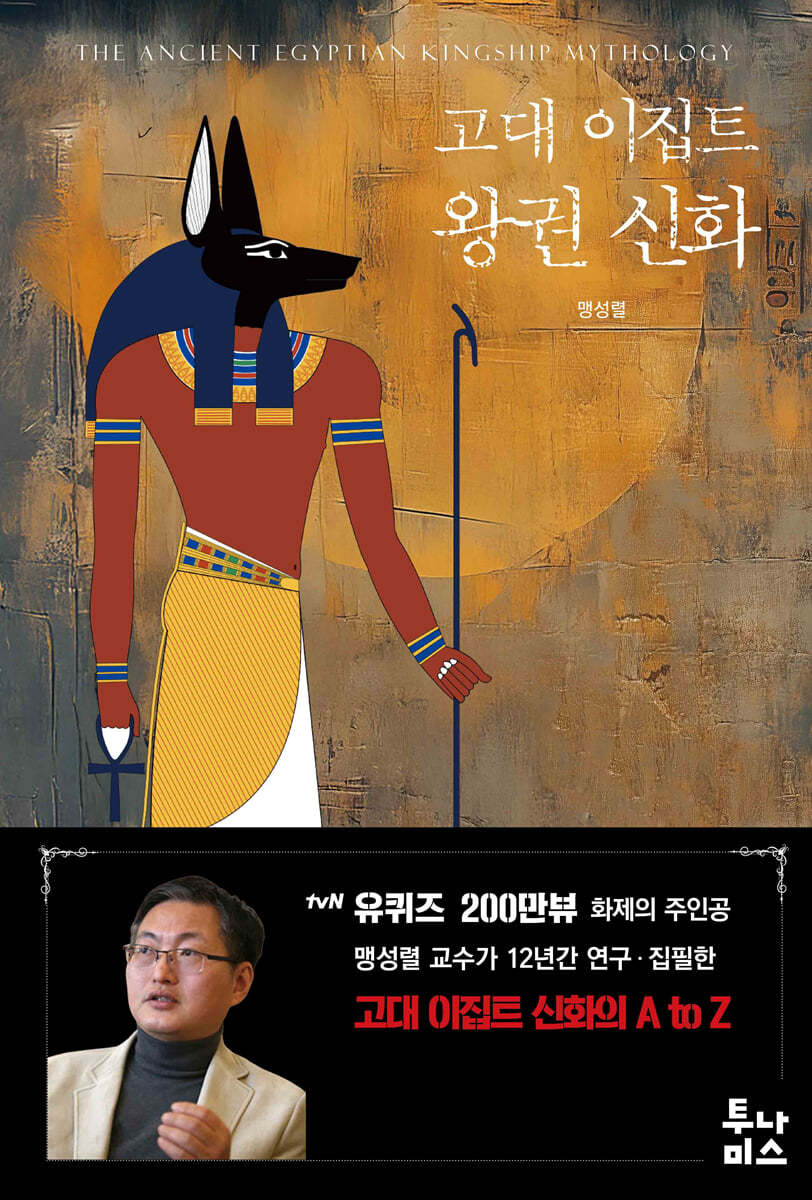
Ancient Egyptian Kingship Myths
 |
Description
Book Introduction
Ranked 0th in broadcasting casting, 2 million views on You Quiz, and the talk of the town Professor Maeng Seong-ryeol's 12-year research and writing of Ancient Egyptian Mythology: A to Z Exploring the mysteries of ancient Egyptian civilization and its profound religious meaning, 『The Myths of Kingship in Ancient Egypt』 is a masterpiece that deals with the essence of religious rituals and mythological symbols of the Pharaonic era. Author Maeng Seong-ryeol, through thorough research, provides an interesting account of the myths of Osiris and Horus, the Hieros Gamos ritual, and the essence of the justification of royal authority. Beyond a simple list of historical facts, this book broadly analyzes the philosophical depth of ancient Egyptian religion and its influence on modern civilization. This book, consisting of five parts, covers the analysis of ancient texts and murals, including the Pyramid Texts and the Book of the Dead, an in-depth interpretation of the Osiris myth, and cultural connections with Greece. In particular, it closely examines the process by which the pharaoh's power gained divine legitimacy, focusing on the Osiris and Horus myths, and vividly shows the symbolic representation of ancient kingship and the essence of ritual. For readers seeking to understand the essence of ancient civilization, scholars interested in Egyptology, or those exploring the relationship between mythology and religion, this book will provide new insights and inspiration. |
- You can preview some of the book's contents.
Preview
index
Introduction 10
Part 1 Hieros Gamos
Chapter 1: The Da Vinci Code and the Origins of the Religion of Jesus
Chapter 2: Dionysian Festivals and Mysteries 30
Chapter 3 Dionysus Festival vs.
Festival of Osiris 41
Chapter 4: The Story of Osiris as Told by Ancient Greek Scholars 49
Chapter 5: Ancient Egyptian Civilization as Presented to the Modern West 57
Chapter 6: The Book of the Dead vs.
Pyramid Texts 70
Chapter 7: Appearances of the Major Gods in the Osiris Myth 87
Chapter 8: The Death of Osiris as Described in Ancient Egyptian Texts 102
Chapter 9: The Osiris Mysteries Depicted in Temple Murals 114
Chapter 10: The Death and Resurrection of Osiris in the Osiris Festival 122
Chapter 11: The Ritual of the Dedication of Clothing 143
Chapter 12: The Ultimate Goal of Ancient Egyptian Kingship Mythology: Hieros Gamos 153
Part 2: The Two Horus Problem
Chapter 13: Osiris's Siblings and Children, as Collected by Ancient Greek Authors 165
Chapter 14: The Osiris Family Tree in Ancient Egyptian Creation Myths 172
Chapter 15: Horus Leads the Resurrection of Osiris 183
Chapter 16: The Importance of Ancient Egyptian Kingship Myths 193
Chapter 17: Horus's Role Revealed in the Festival of Osiris 197
Chapter 18: The Coronation of King Horus 203
Chapter 19: The Ka of Osiris and Horus 215
Chapter 20: The True Meaning of Ka-Hug 2256 Ancient Egyptian Kingship Myths
Chapter 21: The Opening of the Mouth and the Birth of God 232
Chapter 22: Sleep Rituals 239
Chapter 23: Leather Ritual 246
Chapter 24: Solving the Two Horus Paradoxes 261
Chapter 25: Horus's Self-Conception and Legitimacy 268
Part 3: The Jubilee Festival and the Mixing of the Gods
Chapter 26: Ramses II and His Temples 279
Chapter 27: The Great Temple of Abu Simbel and the Sunrise Alignment 287
Chapter 28: The Jubilee of Ramses II 294
Chapter 29: The Jubilee Festival and Osiris 309
Chapter 30: Scholars' Views on the Jubilee Festival 320
Chapter 31: The Essence of the Jubilee Festival 327
Chapter 32: The Identity of the People 330
Chapter 33: Hieros Gamos and Min 338
Chapter 34: Hathor, the Goddess of the People's Partner 347
Chapter 35: The Jubilee Festival, the Festival of Osiris, and the God Seth 353
Chapter 36: Sed, Webwawet, and Anubis 360
Chapter 37: The Identity of the God Thoth 368
Chapter 38: The Confrontation Between Horus and Set 374
Chapter 39: The Backbone of Ancient Egyptian Festivals: The Conception of Horus 381
Chapter 40: The Jubilee Festival and the Sperm War 3948 Ancient Egyptian Kingship Myths
Part 4 Menes of Memphis
Chapter 41: The Memphis Mystery 407
Chapter 42: Archaeological Evidence for King Menes 419
Chapter 43: The Mythical Significance of the Unification of the Two Kingdoms 426
Chapter 44: The Mystery of Menes Killed by the Hippopotamus 432
Chapter 45: The Identity of Menes 439
Chapter 46: The Supreme God Amun 444
Chapter 47: The Coronation and the Ancient Hills 455
Chapter 48: The Many Ancient Hills of Egypt 463
Chapter 49: In Search of the Ancient Hills of Mythology 476
Chapter 50: Aquette and Aker 485
Part 5: Horus's Summer Journey
Chapter 51: Where the Dead King Goes 503
Chapter 52: Orion, Sirius, and the Morning Star 516
Chapter 53: The Birth of Horus 527
Chapter 54: The Essence of Ancient Egyptian Beliefs 531
Chapter 55 Horus of the Underworld 544
Chapter 56: The Sun God's Summer Journey Described in the Books of the Underworld 549
Chapter 57 Horus on the Sunship 555
Chapter 58: Reinterpreting the Books of the Fallen Kingdom 566
Outgoing Post 572
Reference 575
Part 1 Hieros Gamos
Chapter 1: The Da Vinci Code and the Origins of the Religion of Jesus
Chapter 2: Dionysian Festivals and Mysteries 30
Chapter 3 Dionysus Festival vs.
Festival of Osiris 41
Chapter 4: The Story of Osiris as Told by Ancient Greek Scholars 49
Chapter 5: Ancient Egyptian Civilization as Presented to the Modern West 57
Chapter 6: The Book of the Dead vs.
Pyramid Texts 70
Chapter 7: Appearances of the Major Gods in the Osiris Myth 87
Chapter 8: The Death of Osiris as Described in Ancient Egyptian Texts 102
Chapter 9: The Osiris Mysteries Depicted in Temple Murals 114
Chapter 10: The Death and Resurrection of Osiris in the Osiris Festival 122
Chapter 11: The Ritual of the Dedication of Clothing 143
Chapter 12: The Ultimate Goal of Ancient Egyptian Kingship Mythology: Hieros Gamos 153
Part 2: The Two Horus Problem
Chapter 13: Osiris's Siblings and Children, as Collected by Ancient Greek Authors 165
Chapter 14: The Osiris Family Tree in Ancient Egyptian Creation Myths 172
Chapter 15: Horus Leads the Resurrection of Osiris 183
Chapter 16: The Importance of Ancient Egyptian Kingship Myths 193
Chapter 17: Horus's Role Revealed in the Festival of Osiris 197
Chapter 18: The Coronation of King Horus 203
Chapter 19: The Ka of Osiris and Horus 215
Chapter 20: The True Meaning of Ka-Hug 2256 Ancient Egyptian Kingship Myths
Chapter 21: The Opening of the Mouth and the Birth of God 232
Chapter 22: Sleep Rituals 239
Chapter 23: Leather Ritual 246
Chapter 24: Solving the Two Horus Paradoxes 261
Chapter 25: Horus's Self-Conception and Legitimacy 268
Part 3: The Jubilee Festival and the Mixing of the Gods
Chapter 26: Ramses II and His Temples 279
Chapter 27: The Great Temple of Abu Simbel and the Sunrise Alignment 287
Chapter 28: The Jubilee of Ramses II 294
Chapter 29: The Jubilee Festival and Osiris 309
Chapter 30: Scholars' Views on the Jubilee Festival 320
Chapter 31: The Essence of the Jubilee Festival 327
Chapter 32: The Identity of the People 330
Chapter 33: Hieros Gamos and Min 338
Chapter 34: Hathor, the Goddess of the People's Partner 347
Chapter 35: The Jubilee Festival, the Festival of Osiris, and the God Seth 353
Chapter 36: Sed, Webwawet, and Anubis 360
Chapter 37: The Identity of the God Thoth 368
Chapter 38: The Confrontation Between Horus and Set 374
Chapter 39: The Backbone of Ancient Egyptian Festivals: The Conception of Horus 381
Chapter 40: The Jubilee Festival and the Sperm War 3948 Ancient Egyptian Kingship Myths
Part 4 Menes of Memphis
Chapter 41: The Memphis Mystery 407
Chapter 42: Archaeological Evidence for King Menes 419
Chapter 43: The Mythical Significance of the Unification of the Two Kingdoms 426
Chapter 44: The Mystery of Menes Killed by the Hippopotamus 432
Chapter 45: The Identity of Menes 439
Chapter 46: The Supreme God Amun 444
Chapter 47: The Coronation and the Ancient Hills 455
Chapter 48: The Many Ancient Hills of Egypt 463
Chapter 49: In Search of the Ancient Hills of Mythology 476
Chapter 50: Aquette and Aker 485
Part 5: Horus's Summer Journey
Chapter 51: Where the Dead King Goes 503
Chapter 52: Orion, Sirius, and the Morning Star 516
Chapter 53: The Birth of Horus 527
Chapter 54: The Essence of Ancient Egyptian Beliefs 531
Chapter 55 Horus of the Underworld 544
Chapter 56: The Sun God's Summer Journey Described in the Books of the Underworld 549
Chapter 57 Horus on the Sunship 555
Chapter 58: Reinterpreting the Books of the Fallen Kingdom 566
Outgoing Post 572
Reference 575
Detailed image

Into the book
When we think of ancient Egyptian religion, the first thing that comes to mind is the Book of the Dead.
This document reflects the belief that life after death exists in a form similar to the present world, and aims for the dead to go to the afterlife to be judged and begin a second life.
However, this was different from the core content of the religion of the ancient Egyptian Pharaohs.
The original ancient Egyptian religion was centered around the Pharaoh, and much of the Book of the Dead is based on texts from the royal religion of the Pharaoh.
The Pyramid Texts, carved on the inner walls of the pyramids of the 5th and 6th Dynasties, are just such phrases.
Yet, no matter how hard I search, I can't find any mention of the king being judged after his death! The ancient Egyptian religion we know today is a later, popular recreation.
So what did the original ancient Egyptian royal religion look like?
Some argue that the post-mortem judgment was applied to priests, although this is not explicitly stated in the Pyramid Texts.
Therefore, it is argued that the idea of being judged after death existed originally in ancient Egyptian religion.
But in ancient Egypt, the punishments applied to priests or commoners had nothing to do with the essential nature of the religion.
So what was the core of the true ancient Egyptian religion?
Many scholars believe that the ancient Egyptian religion, centered around the Pharaoh, also had 'funeral' at its center.
This is because the 『Pyramid Texts』 are considered to be funeral documents for a dead king.
However, the funeral rites of the dead king were only a part of the ancient Egyptian religious rituals and could not be considered the core.
The funeral was held in conjunction with the coronation of the new successor, and a closer look at its details reveals that the funeral was subordinate to the coronation.
In other words, the original Egyptian religion was not focused on the funeral of the dead king, but on the coronation of the new king.
In the funeral/coronation ceremony, the most important religious ritual of the ancient Egyptian royal family, the deceased king was identified with the god Osiris.
And the new king who ascended the throne assumed the role of Horus.
The most central part of the funeral/coronation ceremony, in which the dead king's mummy dressed as Osiris and the heir to the throne dressed as Horus played the leading roles, was a secret ritual called the 'Opening the Mouth Ceremony'.
So what was the content of this ritual? The essential nature of ancient Egyptian religious ritual, which I seek to reveal in this book, is as follows.
Adult Horus travels back in time to Osiris' funeral.
After becoming Horus within Osiris, he sacrifices his eye to resurrect Osiris.
He becomes part of Osiris' reproductive organs and revives Osiris' sexual powers.
Under his dominion the sacred union of Isis and Osiris takes place.
Through this, he is released as sperm from the genitals of Osiris and travels to the womb of Isis.
And eventually, he is born as a baby Horus, the grandson of the sun god, on the 'Primeval Hill'.
This birth of baby Horus was the culmination of the coronation of King Horus!
In this book, the author will thoroughly examine the process by which Horus united with Osiris, then ejaculated as semen toward Isis's womb, fought his way through Set's sperm swarm, successfully conceiving her, and ultimately attaining the position of supreme god, through thorough research into ancient Egyptian texts.
This document reflects the belief that life after death exists in a form similar to the present world, and aims for the dead to go to the afterlife to be judged and begin a second life.
However, this was different from the core content of the religion of the ancient Egyptian Pharaohs.
The original ancient Egyptian religion was centered around the Pharaoh, and much of the Book of the Dead is based on texts from the royal religion of the Pharaoh.
The Pyramid Texts, carved on the inner walls of the pyramids of the 5th and 6th Dynasties, are just such phrases.
Yet, no matter how hard I search, I can't find any mention of the king being judged after his death! The ancient Egyptian religion we know today is a later, popular recreation.
So what did the original ancient Egyptian royal religion look like?
Some argue that the post-mortem judgment was applied to priests, although this is not explicitly stated in the Pyramid Texts.
Therefore, it is argued that the idea of being judged after death existed originally in ancient Egyptian religion.
But in ancient Egypt, the punishments applied to priests or commoners had nothing to do with the essential nature of the religion.
So what was the core of the true ancient Egyptian religion?
Many scholars believe that the ancient Egyptian religion, centered around the Pharaoh, also had 'funeral' at its center.
This is because the 『Pyramid Texts』 are considered to be funeral documents for a dead king.
However, the funeral rites of the dead king were only a part of the ancient Egyptian religious rituals and could not be considered the core.
The funeral was held in conjunction with the coronation of the new successor, and a closer look at its details reveals that the funeral was subordinate to the coronation.
In other words, the original Egyptian religion was not focused on the funeral of the dead king, but on the coronation of the new king.
In the funeral/coronation ceremony, the most important religious ritual of the ancient Egyptian royal family, the deceased king was identified with the god Osiris.
And the new king who ascended the throne assumed the role of Horus.
The most central part of the funeral/coronation ceremony, in which the dead king's mummy dressed as Osiris and the heir to the throne dressed as Horus played the leading roles, was a secret ritual called the 'Opening the Mouth Ceremony'.
So what was the content of this ritual? The essential nature of ancient Egyptian religious ritual, which I seek to reveal in this book, is as follows.
Adult Horus travels back in time to Osiris' funeral.
After becoming Horus within Osiris, he sacrifices his eye to resurrect Osiris.
He becomes part of Osiris' reproductive organs and revives Osiris' sexual powers.
Under his dominion the sacred union of Isis and Osiris takes place.
Through this, he is released as sperm from the genitals of Osiris and travels to the womb of Isis.
And eventually, he is born as a baby Horus, the grandson of the sun god, on the 'Primeval Hill'.
This birth of baby Horus was the culmination of the coronation of King Horus!
In this book, the author will thoroughly examine the process by which Horus united with Osiris, then ejaculated as semen toward Isis's womb, fought his way through Set's sperm swarm, successfully conceiving her, and ultimately attaining the position of supreme god, through thorough research into ancient Egyptian texts.
--- From the text
Publisher's Review
Unique features of this book
A rare and valuable book on ancient Egyptian mythology
An in-depth, specialized book covering the entirety of ancient Egyptian kingship mythology, a subject that is impossible to access through internet searches alone.
12 years of writing and research, a collection of highly valuable works
This book stands out as the culmination of extensive research by a scientist armed with a deep love and passion for ancient Egyptian civilization.
A fully verified commentary with over 130 pages of references
Filled with thoroughly vetted literature and highly reliable reference materials, this book offers a high-quality, logically complete explanation.
“Horus was the bull of his mother, that is, his own father.
Hathor, the cosmic mother goddess whose name means 'house of Horus', is the consort and mother of this god of conception.
In his aspect as the father, that is, the mighty bull, this god is Osiris, and is identified with the dead father of the Pharaoh.”
A new milestone in the in-depth exploration of ancient Egypt
『The Myth of Ancient Egyptian Kingship』 is a masterpiece born from a deep passion for ancient civilization and scholarly research.
Professor Maeng Seong-ryeol, the author, reconstructs the process of legitimizing Egyptian royal authority based on the Osiris myth, reviving forgotten ancient wisdom for modern readers.
His analysis of the mythological and philosophical significance of the Hieros Gamos ritual, linking it to the coronation and funeral rites of the pharaohs, is particularly compelling.
The author's compelling narrative, based on ancient texts and archaeological findings, transforms the reader into not just an explorer of the past, but a companion in exploring the intellectual depths of Egypt.
Another great advantage is that it simultaneously secures academic depth and popular appeal by interpreting literature such as the Pyramid Texts and the Book of the Dead from a popular perspective.
『Ancient Egyptian Kingship Myths』 is a highly recommended book for anyone seeking a new understanding of ancient civilization.
A rare and valuable book on ancient Egyptian mythology
An in-depth, specialized book covering the entirety of ancient Egyptian kingship mythology, a subject that is impossible to access through internet searches alone.
12 years of writing and research, a collection of highly valuable works
This book stands out as the culmination of extensive research by a scientist armed with a deep love and passion for ancient Egyptian civilization.
A fully verified commentary with over 130 pages of references
Filled with thoroughly vetted literature and highly reliable reference materials, this book offers a high-quality, logically complete explanation.
“Horus was the bull of his mother, that is, his own father.
Hathor, the cosmic mother goddess whose name means 'house of Horus', is the consort and mother of this god of conception.
In his aspect as the father, that is, the mighty bull, this god is Osiris, and is identified with the dead father of the Pharaoh.”
A new milestone in the in-depth exploration of ancient Egypt
『The Myth of Ancient Egyptian Kingship』 is a masterpiece born from a deep passion for ancient civilization and scholarly research.
Professor Maeng Seong-ryeol, the author, reconstructs the process of legitimizing Egyptian royal authority based on the Osiris myth, reviving forgotten ancient wisdom for modern readers.
His analysis of the mythological and philosophical significance of the Hieros Gamos ritual, linking it to the coronation and funeral rites of the pharaohs, is particularly compelling.
The author's compelling narrative, based on ancient texts and archaeological findings, transforms the reader into not just an explorer of the past, but a companion in exploring the intellectual depths of Egypt.
Another great advantage is that it simultaneously secures academic depth and popular appeal by interpreting literature such as the Pyramid Texts and the Book of the Dead from a popular perspective.
『Ancient Egyptian Kingship Myths』 is a highly recommended book for anyone seeking a new understanding of ancient civilization.
GOODS SPECIFICS
- Date of issue: January 31, 2025
- Page count, weight, size: 640 pages | 152*225*30mm
- ISBN13: 9791194005209
- ISBN10: 1194005209
You may also like
카테고리
korean


korean

![ELLE 엘르 스페셜 에디션 A형 : 12월 [2025]](http://librairie.coreenne.fr/cdn/shop/files/b8e27a3de6c9538896439686c6b0e8fb.jpg?v=1766436872&width=3840)


