

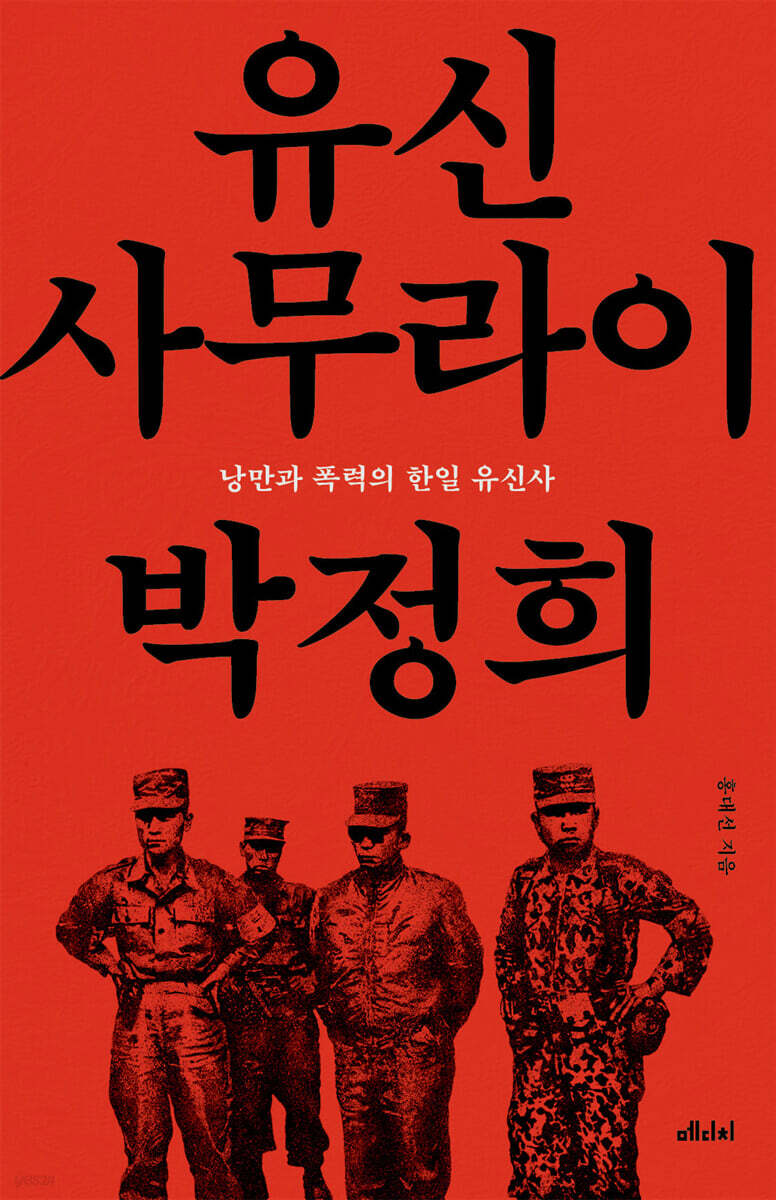
Yushin samurai Park Chung-hee
 |
Description
Book Introduction
Why did Park Chung-hee and the young officers stage the May 16 coup?
Why did Kim Jae-gyu have to shoot Park Chung-hee, whom he had followed so closely?
Was ‘For the eternal glory of the fatherland and people…’ just an empty phrase to hide one’s lust for power?
Park Chung-hee and Kim Jae-gyu were samurai addicted to ‘Yushin’!
From the Meiji Restoration to October 26, we delve into the inner workings of modern and contemporary Korean and Japanese history, bound together by the "Meiji Restoration."
Although he came to power through a military coup, Park Chung-hee became president as the winner of three presidential elections.
Park Chung-hee's dictatorship began in earnest with the 'October Yushin'.
The October Yushin was Park Chung-hee's own 'national reform project'.
Why did Park Chung-hee insist on embracing the idea of a "restoration" originating in Japan? The Meiji Restoration, the Showa Restoration, and the Restoration leaders...
To Park Chung-hee, Yushin was not just a political event of a bygone era.
The spirit of the Restoration, which made it possible to willingly die for the 'country,' the 'emperor,' and 'Japan,' was the dark core and decisive factor in Japan's modernization.
Japan became strong through the 'Meiji Restoration' and fell through the 'Meiji Restoration'.
Park Chung-hee was fascinated by the 'Yushin'.
Park Chung-hee and Kim Jae-gyu were born during the Japanese colonial period and grew up in the world of Yushin.
The May 16 coup was different from the coups that were common in the Third World at the time.
It was a Korean version of the Meiji Restoration, following the footsteps of Kita Ikki and the young officers of the Imperial Way faction who instigated a revolution led by the samurai and military before and after the Meiji Restoration.
The Showa Restoration, which failed in Japan, succeeded in Korea.
Just as Japan's Yushin regime ran wild and killed tens of millions of people, Park Chung-hee's Yushin regime also ran wild and reached the brink of massacre of its citizens.
The last 'Yushin leader', Kim Jae-gyu, was the one who narrowly stopped Park Chung-hee, who was willing to kill millions of people during the Buma Uprising.
Why did Kim Jae-gyu have to shoot Park Chung-hee, whom he had followed so closely?
Was ‘For the eternal glory of the fatherland and people…’ just an empty phrase to hide one’s lust for power?
Park Chung-hee and Kim Jae-gyu were samurai addicted to ‘Yushin’!
From the Meiji Restoration to October 26, we delve into the inner workings of modern and contemporary Korean and Japanese history, bound together by the "Meiji Restoration."
Although he came to power through a military coup, Park Chung-hee became president as the winner of three presidential elections.
Park Chung-hee's dictatorship began in earnest with the 'October Yushin'.
The October Yushin was Park Chung-hee's own 'national reform project'.
Why did Park Chung-hee insist on embracing the idea of a "restoration" originating in Japan? The Meiji Restoration, the Showa Restoration, and the Restoration leaders...
To Park Chung-hee, Yushin was not just a political event of a bygone era.
The spirit of the Restoration, which made it possible to willingly die for the 'country,' the 'emperor,' and 'Japan,' was the dark core and decisive factor in Japan's modernization.
Japan became strong through the 'Meiji Restoration' and fell through the 'Meiji Restoration'.
Park Chung-hee was fascinated by the 'Yushin'.
Park Chung-hee and Kim Jae-gyu were born during the Japanese colonial period and grew up in the world of Yushin.
The May 16 coup was different from the coups that were common in the Third World at the time.
It was a Korean version of the Meiji Restoration, following the footsteps of Kita Ikki and the young officers of the Imperial Way faction who instigated a revolution led by the samurai and military before and after the Meiji Restoration.
The Showa Restoration, which failed in Japan, succeeded in Korea.
Just as Japan's Yushin regime ran wild and killed tens of millions of people, Park Chung-hee's Yushin regime also ran wild and reached the brink of massacre of its citizens.
The last 'Yushin leader', Kim Jae-gyu, was the one who narrowly stopped Park Chung-hee, who was willing to kill millions of people during the Buma Uprising.
- You can preview some of the book's contents.
Preview
index
Places of the Yushin
Yushin incidents
Introductory remarks: A postposition attached to a certain death
Chapter 1: Seed: Wind, Become Fierce
The Beginning of Everything / How War Becomes a Sacrifice / Mukurigokuri, the Name of the Monster / An Idea Born from an Idea, Invasion of the Korean Peninsula
Chapter 2: Conception: The Uninvited Guest
Samurai in the Edo Period, a Time of Peace / Factories Overwhelm Artisans' Skills / The Return of Mukuri Kokuri and the United States / The Rise of Choshu and Satsuma / Heroes Made
Chapter 3 Birth: The Divine Fall
To defeat the enemy, learn from the enemy / Satsuma: War is total war / Choshu: Going all the way / Between victory and destruction / The whereabouts of the ruling power / Warriors and the patriots / The patriots and the aesthetic gentry / The lightning-fast modern state / The Restoration as a self-destructive force
Chapter 4 Expansion: Addiction to War
Kim Ok-gyun, Joseon's Yushin leader / Yushin, victory over the Self-Strengthening Movement / The Great Game and Japan / Mass deaths in Lushun / Bloody Sunday and the triumph of human sacrifice / The light that determined the outcome of the war / An unwelcome victory
Chapter 5: Rampage: Savagery Protecting a Pure World
The Gwangmu Reform and the Death of the Korean Empire / Japan's Covetousness of the Korean Peninsula's Rice / Double Exploitation: Exploitation of Koreans for the Exploitation of the Japanese / Owners of the State / Taisho Democracy / Democracy and Minponshugi / Japan's Revival of the Knights / The Original Sin and Barbarism of Central World Japan / The Yushin Swallowed the People
Chapter 6 Madness: The Age of Innocence
The explosion that shook Manchuria / The violence that yearned for a "governor" / The people who stood in the perpetrator's place / Kita Ikki and the February 26 Incident / The madness that pushed out madness
Chapter 7: The End: Emperor Heika Banzai
The Nanjing Massacre and the War Sport of 'Beheading a Hundred Men' / China, Japan's Swamp / War for the Sake of War / Japan Will Inevitably Lose / From Liberator to Invader / His Majesty the Emperor, Now Going to Die / With Words of Purity's Struggle / Kamikaze and 100 Million Suicides, Adding Death to Death / Remnants of War and the 'Last Samurai'
Chapter 8: Resurrection: The Ethical World and the Aesthetic World
An Unblessed Birth / A Brother's Shadow / A Blood-Written, Self-Destructive Service / The Red Heart of the Yushin / A Failed Communist / What Was to Come Has Come
Chapter 9: Climax: Supreme Love, Perfect Breeding
National consciousness without national consciousness / A standing ovation echoing throughout the banquet hall / A sense of the times between those who serve and those who are served / A Yushin patriot born on the Korean Peninsula / Use and breeding
Chapter 10 Complete: Shooting the Heart of Yushin with the Heart of a Beast
Joseon's Nogi General / Strange Democrats / That Man's Military Unity / Hymn of Death / The Last Patriot, Completing Yushin / With the Heart of a Beast, He Shot Yushin's Heart
Review: Altar of the Spirit
References
Yushin incidents
Introductory remarks: A postposition attached to a certain death
Chapter 1: Seed: Wind, Become Fierce
The Beginning of Everything / How War Becomes a Sacrifice / Mukurigokuri, the Name of the Monster / An Idea Born from an Idea, Invasion of the Korean Peninsula
Chapter 2: Conception: The Uninvited Guest
Samurai in the Edo Period, a Time of Peace / Factories Overwhelm Artisans' Skills / The Return of Mukuri Kokuri and the United States / The Rise of Choshu and Satsuma / Heroes Made
Chapter 3 Birth: The Divine Fall
To defeat the enemy, learn from the enemy / Satsuma: War is total war / Choshu: Going all the way / Between victory and destruction / The whereabouts of the ruling power / Warriors and the patriots / The patriots and the aesthetic gentry / The lightning-fast modern state / The Restoration as a self-destructive force
Chapter 4 Expansion: Addiction to War
Kim Ok-gyun, Joseon's Yushin leader / Yushin, victory over the Self-Strengthening Movement / The Great Game and Japan / Mass deaths in Lushun / Bloody Sunday and the triumph of human sacrifice / The light that determined the outcome of the war / An unwelcome victory
Chapter 5: Rampage: Savagery Protecting a Pure World
The Gwangmu Reform and the Death of the Korean Empire / Japan's Covetousness of the Korean Peninsula's Rice / Double Exploitation: Exploitation of Koreans for the Exploitation of the Japanese / Owners of the State / Taisho Democracy / Democracy and Minponshugi / Japan's Revival of the Knights / The Original Sin and Barbarism of Central World Japan / The Yushin Swallowed the People
Chapter 6 Madness: The Age of Innocence
The explosion that shook Manchuria / The violence that yearned for a "governor" / The people who stood in the perpetrator's place / Kita Ikki and the February 26 Incident / The madness that pushed out madness
Chapter 7: The End: Emperor Heika Banzai
The Nanjing Massacre and the War Sport of 'Beheading a Hundred Men' / China, Japan's Swamp / War for the Sake of War / Japan Will Inevitably Lose / From Liberator to Invader / His Majesty the Emperor, Now Going to Die / With Words of Purity's Struggle / Kamikaze and 100 Million Suicides, Adding Death to Death / Remnants of War and the 'Last Samurai'
Chapter 8: Resurrection: The Ethical World and the Aesthetic World
An Unblessed Birth / A Brother's Shadow / A Blood-Written, Self-Destructive Service / The Red Heart of the Yushin / A Failed Communist / What Was to Come Has Come
Chapter 9: Climax: Supreme Love, Perfect Breeding
National consciousness without national consciousness / A standing ovation echoing throughout the banquet hall / A sense of the times between those who serve and those who are served / A Yushin patriot born on the Korean Peninsula / Use and breeding
Chapter 10 Complete: Shooting the Heart of Yushin with the Heart of a Beast
Joseon's Nogi General / Strange Democrats / That Man's Military Unity / Hymn of Death / The Last Patriot, Completing Yushin / With the Heart of a Beast, He Shot Yushin's Heart
Review: Altar of the Spirit
References
Into the book
The main character of this book, “Yushin Samurai Park Chung-hee: A History of the Romantic and Violent Yushin Period in Korea and Japan,” is “Yushin.”
It is the very same restoration that is attached to Japan's 'Meiji Restoration' and Korea's 'October Restoration'.
This epic story, which begins with the invasion of Japan by the Mongolian-Goryeo allied forces back in time, ends with the October 26 Incident, when Kim Jae-gyu assassinated Park Chung-hee.
I began working to understand the strange story of the one who shot the bullet and the one who was shot, two people who had a passionate relationship with their monarch and subject, and who ended up in their respective deaths.
---From "Introductory Remarks: A Condolence for a Death"
We can all support or criticize Park Chung-hee according to our own thoughts.
But whatever choice we make, we must first understand him holistically.
We must look at a complex human being caught between hero and devil.
To understand the October 26 incident, I first wanted to understand Kim Jae-gyu.
And to understand why he fired the pistol, I had to understand Park Chung-hee again.
In doing so, I confirmed that we cannot talk about our modern history without overcoming the mountain called Park Chung-hee.
What happens if you follow Park Chung-hee?
There is a monster named 'Yushin' lurking there.
(…) The various wars and invasions waged by Japan, along with the overnight prosperity of Japan, were all the result of the ‘Meiji Restoration.’
Yushin seemed to have died with two nuclear bombs, but he was resurrected across the sea on the Korean Peninsula with Park Chung-hee and young officers.
And finally, he is killed by the last Yushin governor, Kim Jae-gyu.
For Yushin, born with a self-destructive destiny, death was the end.
To compose all these stories into a single narrative, I had to chronicle the life of the blind monster known as Yushin, traveling back and forth between modern and contemporary Korean and Japanese history.
It was a history of romance and violence that explored death.
---From "Introductory Remarks: A Condolence for a Death"
The scale and strength of the Yeomong-Mongol allied invasion force were unimaginable from Japan's perspective.
The Japanese warriors who fought against the Goryeo-Mongol allied forces were brave, but they were fighting to the death.
Bravery became tragedy, and tragedy was romanticized by the kamikaze.
After fighting hard and dying hard, heaven helped me.
This is not a war, but a structure of sacrifice.
It is the most aesthetic human sacrifice in the world.
Two typhoons made the war against invaders from another world for the Japanese a matter of heaven, not of man.
Our ancestors fought with all their heart and died repeatedly, performing human sacrifices to pray for rain, and the heavens responded to the romantic deaths of humans with kamikaze.
At the end of the Pacific War, the Japanese drove themselves endlessly to suicidal deaths.
The so-called "100 Million Deaths," in which the entire nation resisted the US military and died while completely losing the ability to wage war, was not a tactic, but a massive sacrificial plan.
By human common sense, it was an act that led to destruction, but the result was already a work of heaven, not of humans.
---From "Chapter 1: Seed: Wind, Become Fierce"
Yoshida Shoin is not a very important person.
His thoughts are too short, illogical, and unfounded.
People with that level of knowledge are quite common in any era.
I am not ignoring Yoshida Shoin.
Rather, it is a question of why he is treated so importantly now.
The way we remember a person's life and death is determined by the tastes of future generations.
And people originally like to create 'holy places' and visit them.
The Restoration that established Japan → The Choshu Domain, which became the center of the Restoration → The ideology and spirit of the Choshu Domain samurai → Their teacher, Yoshida Shoin
If they want to turn the order around and make Songha Village a holy place, that is their freedom.
By the same principle, small springs that become the source of large rivers receive special treatment.
However, the truth is that numerous streams, groundwater, and rainwater come together to form a large river.
---From "Chapter 2: Conception: The Uninvited Guest"
When the survivors 'ultimately' came to rule Japan, the result justified the process.
Instead of savoring the fate of the Mito clansmen, they savored their own success story.
All that recklessness and aggression was ultimately justified.
Japan is the right country, so it must now take on the outside world, that is, the Qing Dynasty, Russia, and the United States.
It does not mean that we fight because it is a 'right' war 'despite the fact that the opponent is strong.'
There is a scary notion here that 'it is a reckless war because the opponent is so strong / so it is right.'
In that respect, the fate of Choshu and Satsuma, which survived and were recorded in history in place of the Mito clan that failed to survive and was erased, remained as an ominous sign foreshadowing the path of tyranny that Japan would later experience and its consequences.
---From "Chapter 3 Birth: The Divine Fall"
Wasn't the miraculous victory of the Sino-Japanese War the result of heaven responding to a prayer?
Japan, as always, prepared another sacrifice.
Japan evolves into a full-fledged war nation.
The warring states that emerged in history took the form of war enterprises.
For example, the Mongol Empire founded by Genghis Khan maintained its growth momentum by continuing war.
For a nation at war, war is nothing more than a tool.
But Japan was different.
Japan's transformation into a war nation was a way for the nation to exist for war.
The idea of pouring everything into the sacrifice and leaving the results to heaven began.
Japan's war expenses incurred in the Russo-Japanese War are estimated at 1.73 billion yen.
It was more than eight times the cost of the Sino-Japanese War and more than six times Japan's annual gross national product at the time.
---From "Chapter 4 Expansion: Addiction to War"
For the Japanese military, Koreans in Japan were like fuel for Hitler, just like Jews living in Germany.
The Japanese military used the most effective method to win over the general public to the Yushin ideology that they were intoxicated with.
It is 'making them accomplices to violence'.
Persuasion takes a long time, and requires repeated rebuttals.
There is no need for accomplices to discuss.
Within the Shinto ideology of protecting Shinto from external filth, the massacre became a holy war.
Japanese militarism was completed on the corpses of Koreans.
And as per the established procedure, the next sacrificial table is filled with the corpses of the Japanese.
In 1925, two years after the Great Kanto Earthquake, the Restoration completed the framework of militaristic Japan.
Through the Public Security Preservation Act.
The National Security Preservation Act is the father of Korea's infamous National Security Act.
The two core points of the Public Security Preservation Act, which was implemented under the pretext of dealing with the social chaos caused by the great earthquake, are as follows.
Do not dare to doubt the sanctity of the imperial system and do not deny the system of private property.
---From "Chapter 5: Runaway: Savagery Protecting a Pure World"
Emperor Showa had no choice but to ask the military ministers.
Why did a war break out without my knowledge?
Hajime Sugiyama declared in front of the Emperor that he could not stop the war that had already begun.
He then comforted the emperor by saying that he would conquer all of China in one month, so he should not worry.
The Japanese military rebuked Hajime Sugiyama in front of the emperor, saying that he was too optimistic and that it would take three months if he analyzed it coolly.
Four years later, Hajime Sugiyama was reprimanded by Emperor Showa for not conquering China yet.
In this way, Yushin was drawn into the path of the Sino-Japanese War, or rather, death.
It was the fate of a suicidal Yushin from birth.
Conquering China required money and resources.
To secure resources, it was necessary to occupy Southeast Asia, South Asia, and the Pacific.
Finally, to achieve this goal, they had to fight the United States for dominance in the Pacific.
Japan wages war for the sake of war, and starts another war not to stop the war, but to 'maintain' or 'expand' it.
Since the final destination was inevitable death, Japan, which had now become the Meiji Restoration itself, began to have a crush on death.
Slaying, banzai charge, kamikaze are all other names for love.
---From "Chapter 6 Madness: The Age of Innocence"
Why did the Yushin regime entrust its fate to low-quality people like Tojo Hideki, Mutaguchi Renya, Sugiyama Hajime, and Tominaga Kyoji?
If we go back a few decades, the Yushin leaders were at least not cowardly.
They slept, wandered, fought and assassinated, and gave their lives in the belief that it was for others, not for themselves.
I find this passion for death philosophically problematic.
However, no matter how much we criticize the Yushin leaders, we cannot deny the fact that they decided to die 'for others'.
However, the Japanese Empire in the 1940s was driven by people who sacrificed others for themselves.
This is in fact the predetermined fate of Yushin.
The struggle of pure people and the struggle for purity are different.
But the struggle of the pure brings about a struggle for purity.
In times of struggle for purity, the pure do not win.
Those who 'claim and act pure' win the internal struggle.
It is unlikely that they are truly pure.
Because pure fighters are too busy taking action to waste time on words.
---From "Chapter 7: The End of Life: Emperor Heika Banzai"
If he had not been the son of a poor farmer, Park Chung-hee would not have chosen Kita Itki as his ideological mentor.
In the February 26 Incident, those whom the unit sought to save were the miserable peasants of the countryside who made up the majority of the Japanese population.
Of course, the method of salvation is arbitrary, violent, and coercive.
And it was self-destructive.
So, was Park Chung-hee a socialist, a militarist, or an embodiment of desire? None of them.
One word that describes Park Chung-hee's complexity is 'Yushin.'
---From "Chapter 8 Resurrection: The Ethical World and the Aesthetic World"
The people chose Park Chung-hee in the 1960s because they thought he was useful, even though he was a 'commie' and a 'Manchurian soldier'.
The people decided that they had had enough of Park Chung-hee and turned their attention to democracy.
Now, in the eyes of the people, the new product called Kim Dae-jung, with its new features of democracy and an American-style market economy, appeared to be more effective.
Just as the Choshu clansmen tried to kidnap the emperor out of love for him, Park Chung-hee tried to kidnap the people for the sake of the people.
He knows that his rule must continue, but the people do not.
If so, we must raise the people.
That kind of breeding is nothing but oppression.
But to Park Chung-hee, ‘complete breeding’ was ‘love.’
---From "Chapter 9: Climax: The Greatest Love, Perfect Breeding"
The people of South Korea did not recognize Chun Doo-hwan as much as they did Park Chung-hee.
Throughout his seven years in power, Chun Doo-hwan and his wife Lee Soon-ja were the targets of ridicule and insults.
If Kim Jae-gyu played a decisive role in democratization, that statement is far off the mark.
Korea's democratization was achieved entirely through the power of the people.
However, it cannot be said that Kim Jae-gyu's bullet was not a factor in the people's victory over Chun Doo-hwan in the June Struggle of 1987.
Therefore, as time passes and Koreans are able to calmly reflect on the past, it is only natural that Kim Jae-gyu has become the subject of a reevaluation.
As I write this book, Kim Jae-gyu is called both a traitor and a righteous man.
But I assure you.
He is not a doctor, he is a governor, and he is the last governor of Yushin.
---From "Chapter 10: Shooting the Heart of the Goddess with the Heart of a Beast"
Park Chung-hee's death was a kind of legacy.
Koreans lost Park Chung-hee without being mentally prepared to say goodbye to him.
History moves according to the 'spirit of the times', but it returns the residue left behind by the 'sentiment of the times' with interest.
Lee Myung-bak, the 17th President of the Republic of Korea, was a 'salaryman legend' who rose from a rank-and-file employee to the position of president of Hyundai Engineering & Construction.
His presence brought back memories of the industrial age.
Lee Myung-bak blatantly used Park Chung-hee's image as a marketing ploy during the presidential election.
The people were not satisfied even with a 'pseudo-Park Chung-hee'.
So, in the 18th presidential election, Park Chung-hee's genes were chosen.
As a result, all that was confirmed was the ghost of Yushin.
The old garden, which was the tomb of the god, was nothing but ruins.
A grave is just a grave.
Nothing can be resurrected there.
It is the very same restoration that is attached to Japan's 'Meiji Restoration' and Korea's 'October Restoration'.
This epic story, which begins with the invasion of Japan by the Mongolian-Goryeo allied forces back in time, ends with the October 26 Incident, when Kim Jae-gyu assassinated Park Chung-hee.
I began working to understand the strange story of the one who shot the bullet and the one who was shot, two people who had a passionate relationship with their monarch and subject, and who ended up in their respective deaths.
---From "Introductory Remarks: A Condolence for a Death"
We can all support or criticize Park Chung-hee according to our own thoughts.
But whatever choice we make, we must first understand him holistically.
We must look at a complex human being caught between hero and devil.
To understand the October 26 incident, I first wanted to understand Kim Jae-gyu.
And to understand why he fired the pistol, I had to understand Park Chung-hee again.
In doing so, I confirmed that we cannot talk about our modern history without overcoming the mountain called Park Chung-hee.
What happens if you follow Park Chung-hee?
There is a monster named 'Yushin' lurking there.
(…) The various wars and invasions waged by Japan, along with the overnight prosperity of Japan, were all the result of the ‘Meiji Restoration.’
Yushin seemed to have died with two nuclear bombs, but he was resurrected across the sea on the Korean Peninsula with Park Chung-hee and young officers.
And finally, he is killed by the last Yushin governor, Kim Jae-gyu.
For Yushin, born with a self-destructive destiny, death was the end.
To compose all these stories into a single narrative, I had to chronicle the life of the blind monster known as Yushin, traveling back and forth between modern and contemporary Korean and Japanese history.
It was a history of romance and violence that explored death.
---From "Introductory Remarks: A Condolence for a Death"
The scale and strength of the Yeomong-Mongol allied invasion force were unimaginable from Japan's perspective.
The Japanese warriors who fought against the Goryeo-Mongol allied forces were brave, but they were fighting to the death.
Bravery became tragedy, and tragedy was romanticized by the kamikaze.
After fighting hard and dying hard, heaven helped me.
This is not a war, but a structure of sacrifice.
It is the most aesthetic human sacrifice in the world.
Two typhoons made the war against invaders from another world for the Japanese a matter of heaven, not of man.
Our ancestors fought with all their heart and died repeatedly, performing human sacrifices to pray for rain, and the heavens responded to the romantic deaths of humans with kamikaze.
At the end of the Pacific War, the Japanese drove themselves endlessly to suicidal deaths.
The so-called "100 Million Deaths," in which the entire nation resisted the US military and died while completely losing the ability to wage war, was not a tactic, but a massive sacrificial plan.
By human common sense, it was an act that led to destruction, but the result was already a work of heaven, not of humans.
---From "Chapter 1: Seed: Wind, Become Fierce"
Yoshida Shoin is not a very important person.
His thoughts are too short, illogical, and unfounded.
People with that level of knowledge are quite common in any era.
I am not ignoring Yoshida Shoin.
Rather, it is a question of why he is treated so importantly now.
The way we remember a person's life and death is determined by the tastes of future generations.
And people originally like to create 'holy places' and visit them.
The Restoration that established Japan → The Choshu Domain, which became the center of the Restoration → The ideology and spirit of the Choshu Domain samurai → Their teacher, Yoshida Shoin
If they want to turn the order around and make Songha Village a holy place, that is their freedom.
By the same principle, small springs that become the source of large rivers receive special treatment.
However, the truth is that numerous streams, groundwater, and rainwater come together to form a large river.
---From "Chapter 2: Conception: The Uninvited Guest"
When the survivors 'ultimately' came to rule Japan, the result justified the process.
Instead of savoring the fate of the Mito clansmen, they savored their own success story.
All that recklessness and aggression was ultimately justified.
Japan is the right country, so it must now take on the outside world, that is, the Qing Dynasty, Russia, and the United States.
It does not mean that we fight because it is a 'right' war 'despite the fact that the opponent is strong.'
There is a scary notion here that 'it is a reckless war because the opponent is so strong / so it is right.'
In that respect, the fate of Choshu and Satsuma, which survived and were recorded in history in place of the Mito clan that failed to survive and was erased, remained as an ominous sign foreshadowing the path of tyranny that Japan would later experience and its consequences.
---From "Chapter 3 Birth: The Divine Fall"
Wasn't the miraculous victory of the Sino-Japanese War the result of heaven responding to a prayer?
Japan, as always, prepared another sacrifice.
Japan evolves into a full-fledged war nation.
The warring states that emerged in history took the form of war enterprises.
For example, the Mongol Empire founded by Genghis Khan maintained its growth momentum by continuing war.
For a nation at war, war is nothing more than a tool.
But Japan was different.
Japan's transformation into a war nation was a way for the nation to exist for war.
The idea of pouring everything into the sacrifice and leaving the results to heaven began.
Japan's war expenses incurred in the Russo-Japanese War are estimated at 1.73 billion yen.
It was more than eight times the cost of the Sino-Japanese War and more than six times Japan's annual gross national product at the time.
---From "Chapter 4 Expansion: Addiction to War"
For the Japanese military, Koreans in Japan were like fuel for Hitler, just like Jews living in Germany.
The Japanese military used the most effective method to win over the general public to the Yushin ideology that they were intoxicated with.
It is 'making them accomplices to violence'.
Persuasion takes a long time, and requires repeated rebuttals.
There is no need for accomplices to discuss.
Within the Shinto ideology of protecting Shinto from external filth, the massacre became a holy war.
Japanese militarism was completed on the corpses of Koreans.
And as per the established procedure, the next sacrificial table is filled with the corpses of the Japanese.
In 1925, two years after the Great Kanto Earthquake, the Restoration completed the framework of militaristic Japan.
Through the Public Security Preservation Act.
The National Security Preservation Act is the father of Korea's infamous National Security Act.
The two core points of the Public Security Preservation Act, which was implemented under the pretext of dealing with the social chaos caused by the great earthquake, are as follows.
Do not dare to doubt the sanctity of the imperial system and do not deny the system of private property.
---From "Chapter 5: Runaway: Savagery Protecting a Pure World"
Emperor Showa had no choice but to ask the military ministers.
Why did a war break out without my knowledge?
Hajime Sugiyama declared in front of the Emperor that he could not stop the war that had already begun.
He then comforted the emperor by saying that he would conquer all of China in one month, so he should not worry.
The Japanese military rebuked Hajime Sugiyama in front of the emperor, saying that he was too optimistic and that it would take three months if he analyzed it coolly.
Four years later, Hajime Sugiyama was reprimanded by Emperor Showa for not conquering China yet.
In this way, Yushin was drawn into the path of the Sino-Japanese War, or rather, death.
It was the fate of a suicidal Yushin from birth.
Conquering China required money and resources.
To secure resources, it was necessary to occupy Southeast Asia, South Asia, and the Pacific.
Finally, to achieve this goal, they had to fight the United States for dominance in the Pacific.
Japan wages war for the sake of war, and starts another war not to stop the war, but to 'maintain' or 'expand' it.
Since the final destination was inevitable death, Japan, which had now become the Meiji Restoration itself, began to have a crush on death.
Slaying, banzai charge, kamikaze are all other names for love.
---From "Chapter 6 Madness: The Age of Innocence"
Why did the Yushin regime entrust its fate to low-quality people like Tojo Hideki, Mutaguchi Renya, Sugiyama Hajime, and Tominaga Kyoji?
If we go back a few decades, the Yushin leaders were at least not cowardly.
They slept, wandered, fought and assassinated, and gave their lives in the belief that it was for others, not for themselves.
I find this passion for death philosophically problematic.
However, no matter how much we criticize the Yushin leaders, we cannot deny the fact that they decided to die 'for others'.
However, the Japanese Empire in the 1940s was driven by people who sacrificed others for themselves.
This is in fact the predetermined fate of Yushin.
The struggle of pure people and the struggle for purity are different.
But the struggle of the pure brings about a struggle for purity.
In times of struggle for purity, the pure do not win.
Those who 'claim and act pure' win the internal struggle.
It is unlikely that they are truly pure.
Because pure fighters are too busy taking action to waste time on words.
---From "Chapter 7: The End of Life: Emperor Heika Banzai"
If he had not been the son of a poor farmer, Park Chung-hee would not have chosen Kita Itki as his ideological mentor.
In the February 26 Incident, those whom the unit sought to save were the miserable peasants of the countryside who made up the majority of the Japanese population.
Of course, the method of salvation is arbitrary, violent, and coercive.
And it was self-destructive.
So, was Park Chung-hee a socialist, a militarist, or an embodiment of desire? None of them.
One word that describes Park Chung-hee's complexity is 'Yushin.'
---From "Chapter 8 Resurrection: The Ethical World and the Aesthetic World"
The people chose Park Chung-hee in the 1960s because they thought he was useful, even though he was a 'commie' and a 'Manchurian soldier'.
The people decided that they had had enough of Park Chung-hee and turned their attention to democracy.
Now, in the eyes of the people, the new product called Kim Dae-jung, with its new features of democracy and an American-style market economy, appeared to be more effective.
Just as the Choshu clansmen tried to kidnap the emperor out of love for him, Park Chung-hee tried to kidnap the people for the sake of the people.
He knows that his rule must continue, but the people do not.
If so, we must raise the people.
That kind of breeding is nothing but oppression.
But to Park Chung-hee, ‘complete breeding’ was ‘love.’
---From "Chapter 9: Climax: The Greatest Love, Perfect Breeding"
The people of South Korea did not recognize Chun Doo-hwan as much as they did Park Chung-hee.
Throughout his seven years in power, Chun Doo-hwan and his wife Lee Soon-ja were the targets of ridicule and insults.
If Kim Jae-gyu played a decisive role in democratization, that statement is far off the mark.
Korea's democratization was achieved entirely through the power of the people.
However, it cannot be said that Kim Jae-gyu's bullet was not a factor in the people's victory over Chun Doo-hwan in the June Struggle of 1987.
Therefore, as time passes and Koreans are able to calmly reflect on the past, it is only natural that Kim Jae-gyu has become the subject of a reevaluation.
As I write this book, Kim Jae-gyu is called both a traitor and a righteous man.
But I assure you.
He is not a doctor, he is a governor, and he is the last governor of Yushin.
---From "Chapter 10: Shooting the Heart of the Goddess with the Heart of a Beast"
Park Chung-hee's death was a kind of legacy.
Koreans lost Park Chung-hee without being mentally prepared to say goodbye to him.
History moves according to the 'spirit of the times', but it returns the residue left behind by the 'sentiment of the times' with interest.
Lee Myung-bak, the 17th President of the Republic of Korea, was a 'salaryman legend' who rose from a rank-and-file employee to the position of president of Hyundai Engineering & Construction.
His presence brought back memories of the industrial age.
Lee Myung-bak blatantly used Park Chung-hee's image as a marketing ploy during the presidential election.
The people were not satisfied even with a 'pseudo-Park Chung-hee'.
So, in the 18th presidential election, Park Chung-hee's genes were chosen.
As a result, all that was confirmed was the ghost of Yushin.
The old garden, which was the tomb of the god, was nothing but ruins.
A grave is just a grave.
Nothing can be resurrected there.
---From "Review: The Altar of the Spirit"
Publisher's Review
Was ‘For the eternal glory of the fatherland and people…’ just an empty phrase to hide one’s lust for power?
The Japanese Yushin leaders, Park Chung-hee and Kim Jae-gyu were also samurai addicted to Yushin!
The idea of the Japanese Restoration that it is okay to die for the values you believe in
Japan was torn between prosperity and war, leading to world war and destruction.
President Park Chung-hee of the Yushin regime also took over the country, brought it to prosperity, and eventually brought it to the brink of ruin.
The driving force behind the problematic figures in Korean-Japanese history is the Yushin Constitution!
#1.
The October Restoration is the successor to the Showa Restoration: “You continue the ‘Restoration’!”
On February 29, 1936, the February 26 coup by young officers, which had begun a few days earlier, was just about to end.
Captain Teruzo Ando, commander of the 6th Company of the 3rd Infantry Regiment of the 1st Division of the Japanese Army, was one of the young officers of the Imperial Way faction and was so trusted that he was even recognized by the Control faction, his rivals within the military.
Ando tried to stop the coup, but when it finally happened, he was more diligent than anyone else in directing the situation and working hard to ensure its success.
However, they were isolated due to the cowardice and betrayal of their superiors, and on top of that, the difference in military power was enormous.
It was a fight that was lacking from the start.
As the punitive force continued to broadcast urging surrender, Ando ordered his men to surrender and then pulled the trigger of his pistol against his own neck (the gun failed to kill him instantly due to a malfunction and he was later executed).
What were the young officers of that time rising up for? The February 26th Coup was the "Showa Restoration," a plan to thoroughly transform Japan, which had only superficially changed under the Meiji Restoration.
Meeting the children of poor farmers and awakening to the hellish reality of Japan, the young officers dreamed of a new Japan.
Ando Teruzo said this to his subordinate who tried to stop him from committing suicide.
“You’ve scolded this company commander before.
Captain, when are you going to rise up?
If we leave things like this, we won't be able to save the countryside.
“In the end, the farmers were not saved,” Ando Teruzo said to his subordinates.
“You guys, continue with the ‘Yushin’.”
The young officers who rose up under the banner of the "Showa Restoration" and their ideological leader, Kita Itki, were later sentenced to death and imprisonment in a trial, and were removed from the stage of history.
Ando hoped that his surviving subordinates would continue the 'reform', but his dream was not realized.
In Ando Teruzo's words, which are like his last words, we can see that the 'Meiji Restoration' was not a historical event we are familiar with, but rather a powerful movement and idea that it was okay to sacrifice oneself (and others) for the sake of the country and the people.
#2.
Japan is a country protected by God: The pseudo-revolutionaries who put their own lives first, imitating the Yushin patriots.
Yushin is not a declaration.
There was no grand ceremony like, “Now that Japan is reunified, we declare the ‘Meijin.’”
Although it is now called the first year of the Meiji Restoration, 1868 was a time of turmoil, with a new government established on one side and fierce fighting raging on the other.
The word "Yusin" is an expression recorded in the Book of Documents, one of the Four Books and Three Classics.
The event in which the Zhou Dynasty of ancient China completely reorganized its system and overcame the crisis of destruction and was revived is called the Reformation.
The new government that overthrew the shogunate was wondering how to express their success and came up with the expression "reform" in the Book of Documents.
The success of the Meiji Restoration was a gift given to many of the Restoration leaders who fought in their own ways.
Just as the February 26 coup by young officers decades later proclaimed the "Showa Restoration," so too has the restoration become a just cause for those who risk their lives to act according to their beliefs in Japan since the Meiji Restoration.
But the success story soon gave way to a series of failures and horror stories.
Japan was led by those who, while proclaiming the prosperity and success of the Japanese Empire in the name of a just cause, were in fact only concerned with protecting themselves, or who blindly put their subordinates, colleagues, and citizens at risk by distorting reality to fit their own ideas.
A strange and bizarre coincidence led to Japan's success, but it was a dangerous run that could collapse at any moment.
The problematic figures who left their mark on modern and contemporary Japanese history often accelerated or derailed the course of history through bold, illogical actions.
Invasion of Manchuria, the Second Sino-Japanese War, invasion of Southeast Asia, and the Pacific War... Japan's relentless advance ultimately ended with kamikaze, the "100 million suicides," and the atomic bombs dropped on Hiroshima and Nagasaki.
The end of 'Yushin' was equally destructive.
Renya Mutaguchi, who is called a secret independence fighter who contributed to the independence of the Republic of Korea, said this to his subordinates during the Battle of Imphal, which took place on the border between Burma and India.
“The imperial army must fight even if there is nothing to eat.
No weapons, no ammunition, no food, etc. cannot be reasons for retreat.
If you don't have ammunition, fight with your sword, if you don't have a sword, fight with your bare hands, if that doesn't work with your bare hands, fight with your legs, and if your legs get hit, fight with your teeth.
Have you forgotten that the Japanese still harbor the Yamato spirit? Japan is a nation protected by God.” Armed with a self-destructive Confucian view of the Restoration, Japan launched wars against the United States, China, and the Soviet Union, fueled by this destructive ideology, but ended up losing on all three fronts.
It was a shabby ending that Yushin finally arrived at.
#3.
The Success of the "Showa Restoration": May 16 and Korea's Yushin Leaders: Park Chung-hee and Kim Jae-gyu
The Yushin regime, which had been destroyed in Japan, was quietly revived across the sea on the Korean Peninsula.
On August 15, 1945, the Korean Peninsula was finally liberated from the colonial history of Japanese colonial rule.
Although evaluations of his achievements may vary, the person who contributed most to shaping the Republic of Korea as it is today after liberation is undoubtedly Park Chung-hee.
Unlike those who experienced the late Joseon Dynasty and the Korean Empire, Park Chung-hee and Kim Jae-gyu, who stopped Park Chung-hee's final tyranny, were born and raised in a land where 'Japan' acted as the master. They were baptized in 'Yushin' and grew up in the atmosphere of 'Yushin'.
To them, 'Yushin' was a symbol of strength that was shiny and attractive, something that every man should emulate.
Korea had already encountered the Yushin regime before the October Yushin in 1972.
The 'May 16th' coup by Park Chung-hee and the young officers who followed him was different from the other military coups that were common in the Third World at the time.
The Korean Restoration, which followed the example of the samurai before and after the Meiji Restoration, the young officers of the Imperial Way faction during the period of militarism, Ishiwara Kanji who dreamed of world war, and Kita Ikki who advocated a revolution led by the military, was, to put it more bluntly, the Korean version of the Showa Restoration that failed in Japan.
Like Teruzo Ando and the young officers of the Imperial Way faction, who heard the true reality of Japan from the soldiers who were the children of poor farmers and questioned the future of a new Japan, Park Chung-hee wanted to save the poor rural areas of South Korea, which he had experienced and discovered for himself, and build an industrialized South Korea.
The industrial development that was carried out militarily after May 16 was a Korean version of the Japanese Restoration, which developed through war and a system of national mobilization, and more recently, the experience of Manchukuo.
However, just as Japan's Yushin regime ran wild and took all of the Japanese people hostage, reaching a crisis point (they were sincerely trying to carry out the "100 Million Deaths" where all 100 million people would die to protect the emperor and the Japanese territory, and those 100 million included the people of colonial Korea), Park Chung-hee's Yushin regime also ran wild and reached the critical point of murdering its people.
During the Buma Uprising, it was Kim Jae-gyu, whom Park Chung-hee once loved and trusted, who blocked his will to protect the country and regime even at the cost of killing millions of people.
Kim Jae-gyu, who was fascinated by the Japanese Restoration leaders and heroic soldiers, made a final decision to protect the people and bring democracy to this land.
He showed his loyalty as a Yushin patriot by abandoning his lord Park Chung-hee and giving him a few bullets.
Kim Jae-gyu was the last Yushin leader, and with Park Chung-hee's death, Yushin was finally able to end its long history of tyranny.
The Japanese Yushin leaders, Park Chung-hee and Kim Jae-gyu were also samurai addicted to Yushin!
The idea of the Japanese Restoration that it is okay to die for the values you believe in
Japan was torn between prosperity and war, leading to world war and destruction.
President Park Chung-hee of the Yushin regime also took over the country, brought it to prosperity, and eventually brought it to the brink of ruin.
The driving force behind the problematic figures in Korean-Japanese history is the Yushin Constitution!
#1.
The October Restoration is the successor to the Showa Restoration: “You continue the ‘Restoration’!”
On February 29, 1936, the February 26 coup by young officers, which had begun a few days earlier, was just about to end.
Captain Teruzo Ando, commander of the 6th Company of the 3rd Infantry Regiment of the 1st Division of the Japanese Army, was one of the young officers of the Imperial Way faction and was so trusted that he was even recognized by the Control faction, his rivals within the military.
Ando tried to stop the coup, but when it finally happened, he was more diligent than anyone else in directing the situation and working hard to ensure its success.
However, they were isolated due to the cowardice and betrayal of their superiors, and on top of that, the difference in military power was enormous.
It was a fight that was lacking from the start.
As the punitive force continued to broadcast urging surrender, Ando ordered his men to surrender and then pulled the trigger of his pistol against his own neck (the gun failed to kill him instantly due to a malfunction and he was later executed).
What were the young officers of that time rising up for? The February 26th Coup was the "Showa Restoration," a plan to thoroughly transform Japan, which had only superficially changed under the Meiji Restoration.
Meeting the children of poor farmers and awakening to the hellish reality of Japan, the young officers dreamed of a new Japan.
Ando Teruzo said this to his subordinate who tried to stop him from committing suicide.
“You’ve scolded this company commander before.
Captain, when are you going to rise up?
If we leave things like this, we won't be able to save the countryside.
“In the end, the farmers were not saved,” Ando Teruzo said to his subordinates.
“You guys, continue with the ‘Yushin’.”
The young officers who rose up under the banner of the "Showa Restoration" and their ideological leader, Kita Itki, were later sentenced to death and imprisonment in a trial, and were removed from the stage of history.
Ando hoped that his surviving subordinates would continue the 'reform', but his dream was not realized.
In Ando Teruzo's words, which are like his last words, we can see that the 'Meiji Restoration' was not a historical event we are familiar with, but rather a powerful movement and idea that it was okay to sacrifice oneself (and others) for the sake of the country and the people.
#2.
Japan is a country protected by God: The pseudo-revolutionaries who put their own lives first, imitating the Yushin patriots.
Yushin is not a declaration.
There was no grand ceremony like, “Now that Japan is reunified, we declare the ‘Meijin.’”
Although it is now called the first year of the Meiji Restoration, 1868 was a time of turmoil, with a new government established on one side and fierce fighting raging on the other.
The word "Yusin" is an expression recorded in the Book of Documents, one of the Four Books and Three Classics.
The event in which the Zhou Dynasty of ancient China completely reorganized its system and overcame the crisis of destruction and was revived is called the Reformation.
The new government that overthrew the shogunate was wondering how to express their success and came up with the expression "reform" in the Book of Documents.
The success of the Meiji Restoration was a gift given to many of the Restoration leaders who fought in their own ways.
Just as the February 26 coup by young officers decades later proclaimed the "Showa Restoration," so too has the restoration become a just cause for those who risk their lives to act according to their beliefs in Japan since the Meiji Restoration.
But the success story soon gave way to a series of failures and horror stories.
Japan was led by those who, while proclaiming the prosperity and success of the Japanese Empire in the name of a just cause, were in fact only concerned with protecting themselves, or who blindly put their subordinates, colleagues, and citizens at risk by distorting reality to fit their own ideas.
A strange and bizarre coincidence led to Japan's success, but it was a dangerous run that could collapse at any moment.
The problematic figures who left their mark on modern and contemporary Japanese history often accelerated or derailed the course of history through bold, illogical actions.
Invasion of Manchuria, the Second Sino-Japanese War, invasion of Southeast Asia, and the Pacific War... Japan's relentless advance ultimately ended with kamikaze, the "100 million suicides," and the atomic bombs dropped on Hiroshima and Nagasaki.
The end of 'Yushin' was equally destructive.
Renya Mutaguchi, who is called a secret independence fighter who contributed to the independence of the Republic of Korea, said this to his subordinates during the Battle of Imphal, which took place on the border between Burma and India.
“The imperial army must fight even if there is nothing to eat.
No weapons, no ammunition, no food, etc. cannot be reasons for retreat.
If you don't have ammunition, fight with your sword, if you don't have a sword, fight with your bare hands, if that doesn't work with your bare hands, fight with your legs, and if your legs get hit, fight with your teeth.
Have you forgotten that the Japanese still harbor the Yamato spirit? Japan is a nation protected by God.” Armed with a self-destructive Confucian view of the Restoration, Japan launched wars against the United States, China, and the Soviet Union, fueled by this destructive ideology, but ended up losing on all three fronts.
It was a shabby ending that Yushin finally arrived at.
#3.
The Success of the "Showa Restoration": May 16 and Korea's Yushin Leaders: Park Chung-hee and Kim Jae-gyu
The Yushin regime, which had been destroyed in Japan, was quietly revived across the sea on the Korean Peninsula.
On August 15, 1945, the Korean Peninsula was finally liberated from the colonial history of Japanese colonial rule.
Although evaluations of his achievements may vary, the person who contributed most to shaping the Republic of Korea as it is today after liberation is undoubtedly Park Chung-hee.
Unlike those who experienced the late Joseon Dynasty and the Korean Empire, Park Chung-hee and Kim Jae-gyu, who stopped Park Chung-hee's final tyranny, were born and raised in a land where 'Japan' acted as the master. They were baptized in 'Yushin' and grew up in the atmosphere of 'Yushin'.
To them, 'Yushin' was a symbol of strength that was shiny and attractive, something that every man should emulate.
Korea had already encountered the Yushin regime before the October Yushin in 1972.
The 'May 16th' coup by Park Chung-hee and the young officers who followed him was different from the other military coups that were common in the Third World at the time.
The Korean Restoration, which followed the example of the samurai before and after the Meiji Restoration, the young officers of the Imperial Way faction during the period of militarism, Ishiwara Kanji who dreamed of world war, and Kita Ikki who advocated a revolution led by the military, was, to put it more bluntly, the Korean version of the Showa Restoration that failed in Japan.
Like Teruzo Ando and the young officers of the Imperial Way faction, who heard the true reality of Japan from the soldiers who were the children of poor farmers and questioned the future of a new Japan, Park Chung-hee wanted to save the poor rural areas of South Korea, which he had experienced and discovered for himself, and build an industrialized South Korea.
The industrial development that was carried out militarily after May 16 was a Korean version of the Japanese Restoration, which developed through war and a system of national mobilization, and more recently, the experience of Manchukuo.
However, just as Japan's Yushin regime ran wild and took all of the Japanese people hostage, reaching a crisis point (they were sincerely trying to carry out the "100 Million Deaths" where all 100 million people would die to protect the emperor and the Japanese territory, and those 100 million included the people of colonial Korea), Park Chung-hee's Yushin regime also ran wild and reached the critical point of murdering its people.
During the Buma Uprising, it was Kim Jae-gyu, whom Park Chung-hee once loved and trusted, who blocked his will to protect the country and regime even at the cost of killing millions of people.
Kim Jae-gyu, who was fascinated by the Japanese Restoration leaders and heroic soldiers, made a final decision to protect the people and bring democracy to this land.
He showed his loyalty as a Yushin patriot by abandoning his lord Park Chung-hee and giving him a few bullets.
Kim Jae-gyu was the last Yushin leader, and with Park Chung-hee's death, Yushin was finally able to end its long history of tyranny.
GOODS SPECIFICS
- Date of issue: October 26, 2024
- Page count, weight, size: 360 pages | 502g | 143*221*21mm
- ISBN13: 9791157063758
You may also like
카테고리
korean


korean

![ELLE 엘르 스페셜 에디션 A형 : 12월 [2025]](http://librairie.coreenne.fr/cdn/shop/files/b8e27a3de6c9538896439686c6b0e8fb.jpg?v=1766436872&width=3840)


