

Imjin War (Part 1)
 |
Description
Book Introduction
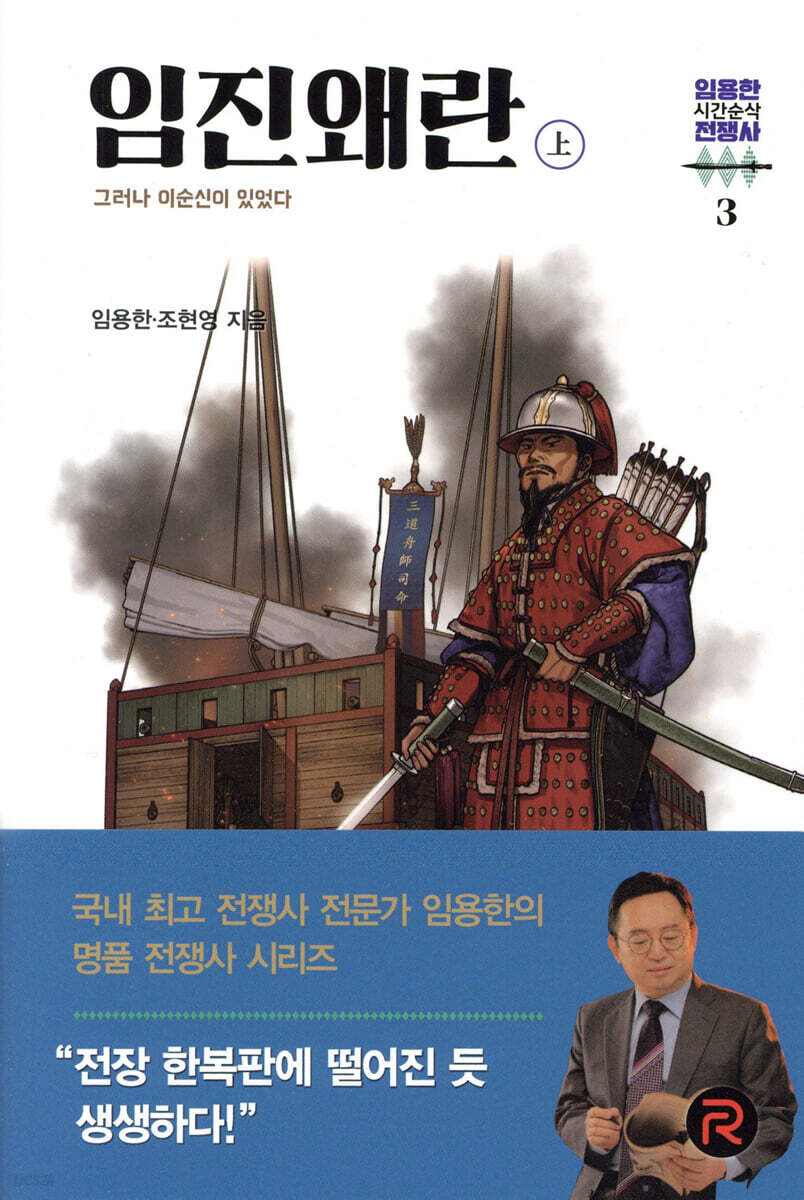
For you who live fiercely Dr. Im Yong-han's "Time-Swept War History Series" Explained Easily The first part of the Imjin War (Part 1 and Part 2) 'Im Yong-han's Time-Swept War History' is a war history series written by Dr. Im Yong-han, who received much love for [Talkumentary War History], and writer Jo Hyeon-yeong, who wrote the script. We've written it in an easy-to-understand way and introduced infographics so that you can understand the entire history of war by reading just one volume. Anyone who is a war historian, military nerd, or history reader, as well as someone who lives each day as if it were a war, can read it as if it were their own story. The third book in the series, “Imjin War Part 1: But There Was Yi Sun-sin,” delves into Yi Sun-sin, a figure who could arguably have ended the Imjin War. Although Yi Sun-sin is recognized as a great leader, the fact that he was also a war leader is somewhat overlooked. To uncover why Yi Sun-sin was such an outstanding 'war' leader, Dr. Im Yong-han examines in detail not only the military power, tactics, and battles of the Joseon navy, but also the Japanese army. Additionally, it portrays Yi Sun-sin in a more three-dimensional way through his relationships with various figures such as Seonjo and Won Gyun. By reading this book, you will gain various insights, such as the true leadership of Yi Sun-sin that you did not know before and how battles were fought during the Imjin War. |
- You can preview some of the book's contents.
Preview
index
Author's Note
Part 1: The Hero Standing on the Sea
01 April of that year - the day the Seven Years' War began
02 Departure in Chaos - Yi Sun-sin's Wait
03 Naval Battle Tactics of Joseon, Goryeo, and Japan - Bows vs. Guns vs. Cannons
04 The start of a myth of 23 wins in 23 matches - The Turtle Ship charges forward
05 Battle of Joseon and Japan - Turtle Ship vs. Japanese Ship
06 The Imjin War of a Brother and Sister - Black Land, Red Sea
07 Battle of Dangpo, Battle of Danghangpo - Victory Report from the South Sea
08 The Departing Ancestor - I just look west and cry.
09 Battle of Hansan - Unfold the Crane Wing Formation
10 Battle of Angolpo - The Secret of Yi Sun-sin's Report
11 Partisanship and Shock Tactics - Myths and Truths About Partisanship
12 Soldiers Fighting in the Dark - The Explorer Heo Su-gwang
13 Battle of Busanpo - Towards Final Victory
14 Disruption of the Coordination and the Plague - Enemies Without and Enemies Within
Part 2: The Hero Standing on the Edge of the Sword
01 Fear of the Ancestors - Ah, the Controller
02 King Seonjo, mired in conspiracy - Yi Sun-sin must be dismissed.
03 The Strange Love Triangle - A Long-Simmering Conflict
04 Won-gyun, a miraculous comeback - a defeat that deserved death
05 The Person Who Saved Won-gyun - Fighting with a Bomb by His Side
06 Ancestor's Resolution - Change the Controller
07 Operation to Dismiss Yi Sun-sin - Guan Yu is the King Who Feared
08 Expeditions You Shouldn't Take - The Black Sea
09 Battle of Chilcheollyang - Annihilation
10 The Return of Yi Sun-sin - Battle Panic
11. Battle of Myeongnyang - The Sea Roars
12. The Retreating Japanese Army - Let's End the War in This Sea
13 Battle of Noryang - The Longest Day
14. What good is it to receive a reward after death?
INFOGRAPHY
References, illustrations, and photo sources
Part 1: The Hero Standing on the Sea
01 April of that year - the day the Seven Years' War began
02 Departure in Chaos - Yi Sun-sin's Wait
03 Naval Battle Tactics of Joseon, Goryeo, and Japan - Bows vs. Guns vs. Cannons
04 The start of a myth of 23 wins in 23 matches - The Turtle Ship charges forward
05 Battle of Joseon and Japan - Turtle Ship vs. Japanese Ship
06 The Imjin War of a Brother and Sister - Black Land, Red Sea
07 Battle of Dangpo, Battle of Danghangpo - Victory Report from the South Sea
08 The Departing Ancestor - I just look west and cry.
09 Battle of Hansan - Unfold the Crane Wing Formation
10 Battle of Angolpo - The Secret of Yi Sun-sin's Report
11 Partisanship and Shock Tactics - Myths and Truths About Partisanship
12 Soldiers Fighting in the Dark - The Explorer Heo Su-gwang
13 Battle of Busanpo - Towards Final Victory
14 Disruption of the Coordination and the Plague - Enemies Without and Enemies Within
Part 2: The Hero Standing on the Edge of the Sword
01 Fear of the Ancestors - Ah, the Controller
02 King Seonjo, mired in conspiracy - Yi Sun-sin must be dismissed.
03 The Strange Love Triangle - A Long-Simmering Conflict
04 Won-gyun, a miraculous comeback - a defeat that deserved death
05 The Person Who Saved Won-gyun - Fighting with a Bomb by His Side
06 Ancestor's Resolution - Change the Controller
07 Operation to Dismiss Yi Sun-sin - Guan Yu is the King Who Feared
08 Expeditions You Shouldn't Take - The Black Sea
09 Battle of Chilcheollyang - Annihilation
10 The Return of Yi Sun-sin - Battle Panic
11. Battle of Myeongnyang - The Sea Roars
12. The Retreating Japanese Army - Let's End the War in This Sea
13 Battle of Noryang - The Longest Day
14. What good is it to receive a reward after death?
INFOGRAPHY
References, illustrations, and photo sources
Detailed image

Into the book
History must be true.
To be truthful, one must not only have sound analysis and judgment, but also the courage to face the real truth.
No scholar's work can be completely correct.
It is influenced by the limitations of feed, errors in feed, the problems of the times, thoughts and values.
But at least when writing, we must overcome all those limitations and do our work with honesty and courage.
---From the author's note
On the turtle ship, the soldiers lowered the sails, the gunners steadied the ship, and the gunners moved frantically, checking for any possible cracks and weighing gunpowder, but the onlookers were completely unaware of this scene.
On board the ship, the officers were urging the gunners to work harder.
In a naval battle, the first one to shoot wins.
Once you open the main door on the side of the ship, you must fire before enemy bullets enter through the door.
The general used to urge them like this.
Open your eyes wide and look at the good deed.
The first one to shoot, even if it's as fast as the blink of an eye, wins.
---From "Part 1 | 01 April of that year - The day the Seven Years' War began"
As the sun set, the sky and sea were dyed red by the burning ships and the blood of the fallen soldiers.
But no heat could be hotter than the thrill of victory.
The soldiers shouted as they looked at the empty sea where the enemy had retreated.
This sea and this land are ours.
Wait a minute.
Now we will invade your land.
---From "Part 1 | 03 Naval Battle Tactics of Joseon, Goryeo, and Japan - Bows vs. Guns vs. Cannons"
The enemy ship is empty.
Should he rush in like a leopard, hunting down the empty ships? Or should he approach with a commanding, imposing formation like Mount Tai, overpowering the enemy? Yi Sun-sin chose Mount Tai.
Shouldn't a brave and courageous general have chosen the "leopard"? Why did Yi Sun-sin choose "Taesan"?
---From "Part 1 | 04 The Beginning of the Myth of 23 Wins in 23 Matches - The Turtle Ship Charges"
I'm not even twenty yet, but this is the first time in my life that I've felt this crazy.
Should I die here for my country? Should I fight for my life? Images flashed before my eyes: my father, thrown into the sea by Joseon naval soldiers, dead; the old landowner and village elder who coveted my younger sister; my missing mother and younger sister; the village elders, hacked to death.
'Should I die for this damn country? Or should I side with those beasts?'
---From "Part 1 | 06 The Imjin War of One Sibling - Black Land, Red Sea"
The moment I heard those words, my heart suddenly sank and tears welled up in my eyes.
When I turned my body and looked at the shore, the old monk had already disappeared and was nowhere to be seen.
Heo Su-gwang asked alone.
Will I survive? No, when will this war end?
---From "Part 1 | 12 Soldiers Fighting in the Darkness - The Explorer Heo Su-gwang"
So now let's move on to the most important question.
When did King Seonjo begin to restrain and fear Yi Sun-sin? When did he begin to consider Won Gyun as Yi Sun-sin's rival, his replacement? There is no definitive evidence.
This is a question that no one can say for sure based on the evidence we currently have.
In my opinion, it was from the beginning.
It all started from the day when Yi Sun-sin appeared like a comet and was promoted from a 6th-rank official to the position of Jeolla Left Naval Commander.
To be truthful, one must not only have sound analysis and judgment, but also the courage to face the real truth.
No scholar's work can be completely correct.
It is influenced by the limitations of feed, errors in feed, the problems of the times, thoughts and values.
But at least when writing, we must overcome all those limitations and do our work with honesty and courage.
---From the author's note
On the turtle ship, the soldiers lowered the sails, the gunners steadied the ship, and the gunners moved frantically, checking for any possible cracks and weighing gunpowder, but the onlookers were completely unaware of this scene.
On board the ship, the officers were urging the gunners to work harder.
In a naval battle, the first one to shoot wins.
Once you open the main door on the side of the ship, you must fire before enemy bullets enter through the door.
The general used to urge them like this.
Open your eyes wide and look at the good deed.
The first one to shoot, even if it's as fast as the blink of an eye, wins.
---From "Part 1 | 01 April of that year - The day the Seven Years' War began"
As the sun set, the sky and sea were dyed red by the burning ships and the blood of the fallen soldiers.
But no heat could be hotter than the thrill of victory.
The soldiers shouted as they looked at the empty sea where the enemy had retreated.
This sea and this land are ours.
Wait a minute.
Now we will invade your land.
---From "Part 1 | 03 Naval Battle Tactics of Joseon, Goryeo, and Japan - Bows vs. Guns vs. Cannons"
The enemy ship is empty.
Should he rush in like a leopard, hunting down the empty ships? Or should he approach with a commanding, imposing formation like Mount Tai, overpowering the enemy? Yi Sun-sin chose Mount Tai.
Shouldn't a brave and courageous general have chosen the "leopard"? Why did Yi Sun-sin choose "Taesan"?
---From "Part 1 | 04 The Beginning of the Myth of 23 Wins in 23 Matches - The Turtle Ship Charges"
I'm not even twenty yet, but this is the first time in my life that I've felt this crazy.
Should I die here for my country? Should I fight for my life? Images flashed before my eyes: my father, thrown into the sea by Joseon naval soldiers, dead; the old landowner and village elder who coveted my younger sister; my missing mother and younger sister; the village elders, hacked to death.
'Should I die for this damn country? Or should I side with those beasts?'
---From "Part 1 | 06 The Imjin War of One Sibling - Black Land, Red Sea"
The moment I heard those words, my heart suddenly sank and tears welled up in my eyes.
When I turned my body and looked at the shore, the old monk had already disappeared and was nowhere to be seen.
Heo Su-gwang asked alone.
Will I survive? No, when will this war end?
---From "Part 1 | 12 Soldiers Fighting in the Darkness - The Explorer Heo Su-gwang"
So now let's move on to the most important question.
When did King Seonjo begin to restrain and fear Yi Sun-sin? When did he begin to consider Won Gyun as Yi Sun-sin's rival, his replacement? There is no definitive evidence.
This is a question that no one can say for sure based on the evidence we currently have.
In my opinion, it was from the beginning.
It all started from the day when Yi Sun-sin appeared like a comet and was promoted from a 6th-rank official to the position of Jeolla Left Naval Commander.
---From "Part 2 | 02: King Seonjo, Trapped in Conspiracy? Yi Sun-sin Must Be Dismissed"
Publisher's Review
“Overwhelming suction power!”
The "Im Yong-han's Time-Saving War History" series, which simultaneously captures knowledge, fun, and insight in one volume.
Continuing the fun of [Talkumentary War History] that 80 million people were crazy about!
“If you hire him, you can trust him!”
“Listening to the story gives you a new understanding of history!”
A commander recognized worldwide,
Why is Yi Sun-sin called an outstanding war leader?
Yi Sun-sin is famous not only in Korea but also around the world.
Yi Sun-sin has consistently appeared in Japanese textbooks, and has already been evaluated as “Yi Sun-sin is undoubtedly the greatest naval commander” (Admiral Tetsutaro Sato, “Military History of the Empire”) and “Admiral Yi Sun-sin is a strategist, tactician, and leader of outstanding qualities” (General Bernard Law Montgomery, “History of War”).
Most people overseas who highly regard Yi Sun-sin's achievements and abilities are those related to war.
This is why we need to reexamine the ‘war leader’ Yi Sun-sin.
For example, to understand how surprising and difficult the order given by Yi Sun-sin not to take the heads of enemy soldiers was, we must understand how military achievements were evaluated and rewarded at the time.
Also, to understand why Yi Sun-sin's tactic of utilizing the crane-wing formation in the Battle of Myeongnyang was so great, we must understand the differences between the Joseon and Japanese battle lines and battle methods at the time.
In this book, the author carefully examines the details of Yi Sun-sin's evaluation, reflecting on these points.
We reanalyzed existing historical materials, including the Joseon naval tactics that began and developed during the Goryeo Dynasty, the debate over the floor height of the turtle ship, and its tactical operation, from a military history perspective. We also collected data by personally visiting Namhae, Tongyeong, and other places to understand the topographical characteristics of the battle sites.
War and the lives of very ordinary people
Immersive scenario-based narrative! And full-color infographics.
“As the red light spread across the horizon, the outlines of islands appeared in black here and there.
Deokryong stared at the black mass with anxious eyes.
He had lived by the sea ever since he was born, but the scenery here was very different from the seaside where he had lived.
The island shadows were too numerous and complex.
And it was scary.
It seemed as if at any moment a wire would spring out from behind that shadow and fire a cannon.
" - In the text
Existing war history books often focused on providing information in order to cover various aspects, making them difficult for inexperienced readers to access.
The author uses two devices to increase reader immersion in this book and throughout the series.
The first is the literary narrative form.
Commoners who were captured by the Japanese army and became Japanese soldiers to fight against the Joseon army, ordinary soldiers on the eve of a decisive battle, and scouts who specialized in gathering information, these people were described in a single sentence in general war history, and they were brought back to life with imagination based on historical materials.
This not only allows readers to easily immerse themselves in the story, but also allows them to feel the emotions of ordinary individuals caught up in a massive war and reconsider the meaning of the act of 'war' itself.
The second is a full-color infographic that was well-received in the previous books in the series.
Infographics are much easier to understand than simple text because they weave fragmented information into a single context and present it on one page.
Additionally, while most pre-modern war photos are in black and white, which makes them somewhat less realistic, infographics are produced in full color, making them visually exciting.
“The fierce survive!”
Make history your ally in this war-like everyday life.
Why should we study the history of war? Until now, war has felt like a distant story.
But the Russo-Ukrainian War and the Israeli-Palestinian War broke out, and the United States and China are still struggling for hegemony.
The world situation has become chaotic again.
Ultimately, it has had an impact on our daily lives, including stock investment, politics, and prices.
Also, our daily life is already a war.
Rapid economic austerity has frozen society, leading to numerous internal wars, such as generational conflict, conflict between the rich and the poor, and conflict between men and women.
This is an obvious phenomenon and requires fierce effort to survive here.
In these harsh times, to survive, you must make history work for you.
The "Im Yong-han's Time-Saving War History" series, which simultaneously captures knowledge, fun, and insight in one volume.
Continuing the fun of [Talkumentary War History] that 80 million people were crazy about!
“If you hire him, you can trust him!”
“Listening to the story gives you a new understanding of history!”
A commander recognized worldwide,
Why is Yi Sun-sin called an outstanding war leader?
Yi Sun-sin is famous not only in Korea but also around the world.
Yi Sun-sin has consistently appeared in Japanese textbooks, and has already been evaluated as “Yi Sun-sin is undoubtedly the greatest naval commander” (Admiral Tetsutaro Sato, “Military History of the Empire”) and “Admiral Yi Sun-sin is a strategist, tactician, and leader of outstanding qualities” (General Bernard Law Montgomery, “History of War”).
Most people overseas who highly regard Yi Sun-sin's achievements and abilities are those related to war.
This is why we need to reexamine the ‘war leader’ Yi Sun-sin.
For example, to understand how surprising and difficult the order given by Yi Sun-sin not to take the heads of enemy soldiers was, we must understand how military achievements were evaluated and rewarded at the time.
Also, to understand why Yi Sun-sin's tactic of utilizing the crane-wing formation in the Battle of Myeongnyang was so great, we must understand the differences between the Joseon and Japanese battle lines and battle methods at the time.
In this book, the author carefully examines the details of Yi Sun-sin's evaluation, reflecting on these points.
We reanalyzed existing historical materials, including the Joseon naval tactics that began and developed during the Goryeo Dynasty, the debate over the floor height of the turtle ship, and its tactical operation, from a military history perspective. We also collected data by personally visiting Namhae, Tongyeong, and other places to understand the topographical characteristics of the battle sites.
War and the lives of very ordinary people
Immersive scenario-based narrative! And full-color infographics.
“As the red light spread across the horizon, the outlines of islands appeared in black here and there.
Deokryong stared at the black mass with anxious eyes.
He had lived by the sea ever since he was born, but the scenery here was very different from the seaside where he had lived.
The island shadows were too numerous and complex.
And it was scary.
It seemed as if at any moment a wire would spring out from behind that shadow and fire a cannon.
" - In the text
Existing war history books often focused on providing information in order to cover various aspects, making them difficult for inexperienced readers to access.
The author uses two devices to increase reader immersion in this book and throughout the series.
The first is the literary narrative form.
Commoners who were captured by the Japanese army and became Japanese soldiers to fight against the Joseon army, ordinary soldiers on the eve of a decisive battle, and scouts who specialized in gathering information, these people were described in a single sentence in general war history, and they were brought back to life with imagination based on historical materials.
This not only allows readers to easily immerse themselves in the story, but also allows them to feel the emotions of ordinary individuals caught up in a massive war and reconsider the meaning of the act of 'war' itself.
The second is a full-color infographic that was well-received in the previous books in the series.
Infographics are much easier to understand than simple text because they weave fragmented information into a single context and present it on one page.
Additionally, while most pre-modern war photos are in black and white, which makes them somewhat less realistic, infographics are produced in full color, making them visually exciting.
“The fierce survive!”
Make history your ally in this war-like everyday life.
Why should we study the history of war? Until now, war has felt like a distant story.
But the Russo-Ukrainian War and the Israeli-Palestinian War broke out, and the United States and China are still struggling for hegemony.
The world situation has become chaotic again.
Ultimately, it has had an impact on our daily lives, including stock investment, politics, and prices.
Also, our daily life is already a war.
Rapid economic austerity has frozen society, leading to numerous internal wars, such as generational conflict, conflict between the rich and the poor, and conflict between men and women.
This is an obvious phenomenon and requires fierce effort to survive here.
In these harsh times, to survive, you must make history work for you.
GOODS SPECIFICS
- Date of issue: July 5, 2024
- Page count, weight, size: 500 pages | 498g | 125*188*24mm
- ISBN13: 9791171176403
- ISBN10: 1171176406
You may also like
카테고리
korean


korean

![ELLE 엘르 스페셜 에디션 A형 : 12월 [2025]](http://librairie.coreenne.fr/cdn/shop/files/b8e27a3de6c9538896439686c6b0e8fb.jpg?v=1766436872&width=3840)


