

Joseon cuisine
 |
Description
Book Introduction
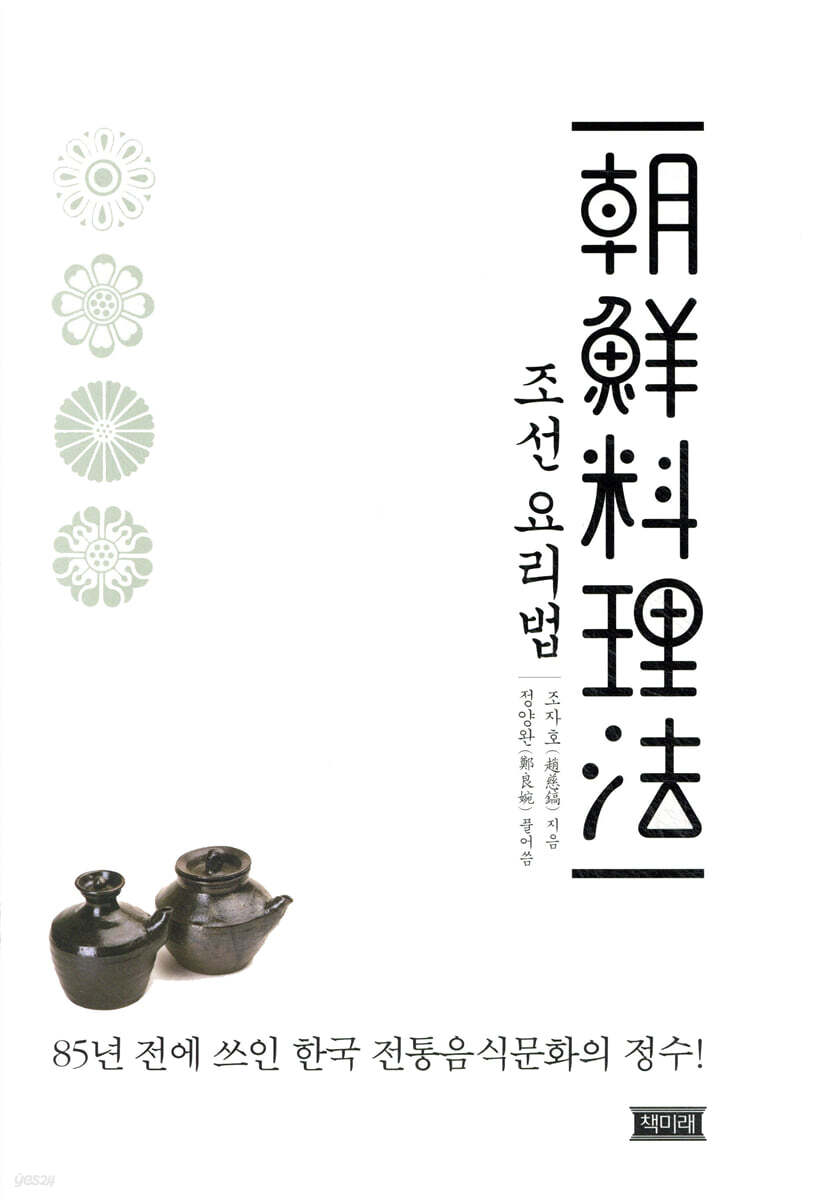
This book was published by Gwanghan Publishing in 1939.
At that time, there were Korean cookbooks such as "Joseon Cooking Recipe" and "Joseon Musang Shinsik Cooking Recipe" (1924) by Professor Bang Shin-yeong of the Department of Home Economics at Ewha Womans University, which were the first modern cookbooks published in 1917, and "Easy Joseon Cooking Recipe" (1934) by Lee Seok-man. However, "Joseon Cooking Recipe" by Jo Ja-ho was well-received by the public as a book that focused on traditional cooking methods of our food.
The contents are 33 sections including gomyeong (10 kinds), meju (2), various soy sauces (9), various powders (6), kimchi (6), fresh kimchi and kimchi for drinking (13), cold soup (4), vegetables (16), pickled vegetables (10), braised dishes (14), raw vegetables (8), ganap (21), japchae (6), jangguk (14), hwachae (16), jaban and po (19), hoe (25), grilled food (24), jochi (9), porridge (8), tojangguk (9), tteok (27), jeongol (12), yaksik and assorted pyeon (11), clear soy sauce soup (19), guja (sinseongro) and jjim (10), mieum and yangjeop (5), jeonggwa (10), ssam (3), raw fish and uggi (4), jeotgal (8), etc., for a total of 425 items including 67 items added in Appendix 1. It introduces Korean cooking methods in detail, and at the end of the book, it describes how to serve food with side dishes, how to divide food according to the season, how to complement food, and food etiquette.
At that time, there were Korean cookbooks such as "Joseon Cooking Recipe" and "Joseon Musang Shinsik Cooking Recipe" (1924) by Professor Bang Shin-yeong of the Department of Home Economics at Ewha Womans University, which were the first modern cookbooks published in 1917, and "Easy Joseon Cooking Recipe" (1934) by Lee Seok-man. However, "Joseon Cooking Recipe" by Jo Ja-ho was well-received by the public as a book that focused on traditional cooking methods of our food.
The contents are 33 sections including gomyeong (10 kinds), meju (2), various soy sauces (9), various powders (6), kimchi (6), fresh kimchi and kimchi for drinking (13), cold soup (4), vegetables (16), pickled vegetables (10), braised dishes (14), raw vegetables (8), ganap (21), japchae (6), jangguk (14), hwachae (16), jaban and po (19), hoe (25), grilled food (24), jochi (9), porridge (8), tojangguk (9), tteok (27), jeongol (12), yaksik and assorted pyeon (11), clear soy sauce soup (19), guja (sinseongro) and jjim (10), mieum and yangjeop (5), jeonggwa (10), ssam (3), raw fish and uggi (4), jeotgal (8), etc., for a total of 425 items including 67 items added in Appendix 1. It introduces Korean cooking methods in detail, and at the end of the book, it describes how to serve food with side dishes, how to divide food according to the season, how to complement food, and food etiquette.
index
Congratulatory message from Yoon Seo-seok
Congratulatory message from Lee Jong-mi
Release of Joseon cuisine
Seo Jo Dong-sik
Seo Hwang Shin-deok
Autobiography by Jo Ja-ho
1.
How to make a famous
2.
How to make soybean paste
3.
How to make soy sauce and gochujang
4.
How to make various powders
5.
How to make kimchi
6.
Fresh kimchi and kimchi to go with alcohol
7.
How to make cold soup
8.
How to make vegetables
9.
Pickled vegetables
10.
Braised dishes
11.
raw vegetables
12.
Liver type
13.
Japchae
14.
Soup
15.
Vegetables
16.
Seafood and seafood
17.
Circulation
18.
Grilled food
19.
Actions
20.
Bamboo
21.
Tojang Guk
22.
Types of rice cakes
23.
stews
24.
A variety of snacks and rice cakes
25.
Clear soups
26.
Gujawa steamed dishes
27.
Milk and juice
28.
Jeonggwaryu (Fruit)
29.
Ssamryu
30.
Life and Laughter
31.
How to make salted seafood
32.
How to serve food
33.
Divide food according to season
34.
How to see the prize
35.
A few etiquette rules
Appendix 1.
Joseon cuisine preservation
Appendix 2.
Handwritten manuscript by Jo Ja-ho (written after Joseon cuisine)
Appendix 3.
Joseon cuisine research presentation
Appendix 4.
Cooking practice manuscript
Appendix 5.
Newspaper, magazine, and broadcast articles by Professor Jo Ja-ho
Appendix 6.
Letters and Memoirs
Translator's Note
Search
Congratulatory message from Lee Jong-mi
Release of Joseon cuisine
Seo Jo Dong-sik
Seo Hwang Shin-deok
Autobiography by Jo Ja-ho
1.
How to make a famous
2.
How to make soybean paste
3.
How to make soy sauce and gochujang
4.
How to make various powders
5.
How to make kimchi
6.
Fresh kimchi and kimchi to go with alcohol
7.
How to make cold soup
8.
How to make vegetables
9.
Pickled vegetables
10.
Braised dishes
11.
raw vegetables
12.
Liver type
13.
Japchae
14.
Soup
15.
Vegetables
16.
Seafood and seafood
17.
Circulation
18.
Grilled food
19.
Actions
20.
Bamboo
21.
Tojang Guk
22.
Types of rice cakes
23.
stews
24.
A variety of snacks and rice cakes
25.
Clear soups
26.
Gujawa steamed dishes
27.
Milk and juice
28.
Jeonggwaryu (Fruit)
29.
Ssamryu
30.
Life and Laughter
31.
How to make salted seafood
32.
How to serve food
33.
Divide food according to season
34.
How to see the prize
35.
A few etiquette rules
Appendix 1.
Joseon cuisine preservation
Appendix 2.
Handwritten manuscript by Jo Ja-ho (written after Joseon cuisine)
Appendix 3.
Joseon cuisine research presentation
Appendix 4.
Cooking practice manuscript
Appendix 5.
Newspaper, magazine, and broadcast articles by Professor Jo Ja-ho
Appendix 6.
Letters and Memoirs
Translator's Note
Search
Into the book
For Jeongwoljang, if you put one mal of meju into one stone bowl of water, the color of soy sauce will be good.
One teaspoon of salt per bucket of water (about 9 liters) is enough.
Dissolve the salt water a day in advance and sieve it through a fine sieve. Sweep the meju cleanly with a brush and place it in a crock, then pour in the salt water.
Pour in all the water, add a few whole red peppers, break up the charcoal into small pieces, heat it red hot, add three or four pieces, and add a few jujubes.
It will float after about 50 days of pickling.
Even before it gets hot, after three days, open it every day before meals and cover it in the evening.
Wrap the jar with something like Munpo (a hemp cloth imported from the Chaemun region of China) or Mokasa and tie it up.
And sometimes the chapter opens and sometimes it doesn't.
Pour the broth into a pot and bring to a boil, then skim off the foam.
--- p.51
Spectator (Pheasant Kimchi)
· ingredient
A bowl of minced pheasant, a small cucumber, a small bamboo shoot, two large shiitake mushrooms, a medium abalone, two medium sea cucumbers, a little beef, a small pear, a little vinegar, a little sugar, a few shredded red peppers, a little soy sauce, a spoonful of shiitake mushrooms, a stone, and pickled vegetables (in the winter, whole cabbage kimchi is also good).
How to make
After removing the feathers and guts of a good pheasant, wash it thoroughly in water, blanch it briefly, and thinly slice it. Chop the beef finely and season it with various seasonings, add a little water and stir-fry it. Then, put the sliced pheasant in a pot, pour in the broth from the stir-fried meat, and press it down with a spoon to cook it. (67)
raw fish
· ingredient
Mackerel, green onion leaves, sesame oil, salt, and red pepper flakes.
How to make
Handle a good, whole mackerel carefully, cut off the head and belly, split it in half, oil the knife, slice it thinly, cut it into thin strips, add a few finely chopped green onion leaves, mix in a little bit of red pepper, season with salt and set aside.
Take a picture of the Yunjip and eat it.
--- p.148
Accommodation and
Suksilgwa is made by removing the seeds from various fruits, adding sugar and water, boiling them thoroughly, and when the moisture has evaporated and they become thick, cooling them, forming them into various fruit shapes, coating them with syrup, and dusting them with pine nut powder.
Here's how to serve it with suksilgwa:
In other words, the method of storage varies depending on the region and circumstances, and many different ingredients are added to the storage.
However, these days, not all of those types are available and are only for decoration, so it is sufficient to just know the traditional ones.
--- p.336
Five-colored celebration rice cakes
· ingredient
750 grams of non-glutinous rice flour, 320 grams of sugar, about 1 cup of water, 12 walnuts, 1/2 cup of pine nuts, 1 gardenia, a few green leaves, a very small amount of red food coloring, a spoonful of thick black sesame powder, 3 large jujubes, and jipcheong (汁淸: boiled ginger and cinnamon in water and seasoned with jokcheong).
(also called jipcheong) about 1/3 cup
How to make
① Prepare rice flour and divide it into 5 parts.
② Pour water into the sugar, bring to a boil, and cool.
③ Crack the walnuts with a hammer to remove the outer shell, thinly slice the flesh, roughly chop, and cut into quarters.
One teaspoon of salt per bucket of water (about 9 liters) is enough.
Dissolve the salt water a day in advance and sieve it through a fine sieve. Sweep the meju cleanly with a brush and place it in a crock, then pour in the salt water.
Pour in all the water, add a few whole red peppers, break up the charcoal into small pieces, heat it red hot, add three or four pieces, and add a few jujubes.
It will float after about 50 days of pickling.
Even before it gets hot, after three days, open it every day before meals and cover it in the evening.
Wrap the jar with something like Munpo (a hemp cloth imported from the Chaemun region of China) or Mokasa and tie it up.
And sometimes the chapter opens and sometimes it doesn't.
Pour the broth into a pot and bring to a boil, then skim off the foam.
--- p.51
Spectator (Pheasant Kimchi)
· ingredient
A bowl of minced pheasant, a small cucumber, a small bamboo shoot, two large shiitake mushrooms, a medium abalone, two medium sea cucumbers, a little beef, a small pear, a little vinegar, a little sugar, a few shredded red peppers, a little soy sauce, a spoonful of shiitake mushrooms, a stone, and pickled vegetables (in the winter, whole cabbage kimchi is also good).
How to make
After removing the feathers and guts of a good pheasant, wash it thoroughly in water, blanch it briefly, and thinly slice it. Chop the beef finely and season it with various seasonings, add a little water and stir-fry it. Then, put the sliced pheasant in a pot, pour in the broth from the stir-fried meat, and press it down with a spoon to cook it. (67)
raw fish
· ingredient
Mackerel, green onion leaves, sesame oil, salt, and red pepper flakes.
How to make
Handle a good, whole mackerel carefully, cut off the head and belly, split it in half, oil the knife, slice it thinly, cut it into thin strips, add a few finely chopped green onion leaves, mix in a little bit of red pepper, season with salt and set aside.
Take a picture of the Yunjip and eat it.
--- p.148
Accommodation and
Suksilgwa is made by removing the seeds from various fruits, adding sugar and water, boiling them thoroughly, and when the moisture has evaporated and they become thick, cooling them, forming them into various fruit shapes, coating them with syrup, and dusting them with pine nut powder.
Here's how to serve it with suksilgwa:
In other words, the method of storage varies depending on the region and circumstances, and many different ingredients are added to the storage.
However, these days, not all of those types are available and are only for decoration, so it is sufficient to just know the traditional ones.
--- p.336
Five-colored celebration rice cakes
· ingredient
750 grams of non-glutinous rice flour, 320 grams of sugar, about 1 cup of water, 12 walnuts, 1/2 cup of pine nuts, 1 gardenia, a few green leaves, a very small amount of red food coloring, a spoonful of thick black sesame powder, 3 large jujubes, and jipcheong (汁淸: boiled ginger and cinnamon in water and seasoned with jokcheong).
(also called jipcheong) about 1/3 cup
How to make
① Prepare rice flour and divide it into 5 parts.
② Pour water into the sugar, bring to a boil, and cool.
③ Crack the walnuts with a hammer to remove the outer shell, thinly slice the flesh, roughly chop, and cut into quarters.
--- p.356
Publisher's Review
This book was published by Gwanghan Publishing in 1939.
At that time, there were Korean cookbooks such as "Joseon Cooking Recipe" and "Joseon Musang Shinsik Cooking Recipe" (1924) by Professor Bang Shin-yeong of the Department of Home Economics at Ewha Womans University, which were the first modern cookbooks published in 1917, and "Easy Joseon Cooking Recipe" (1934) by Lee Seok-man. However, "Joseon Cooking Recipe" by Jo Ja-ho was well-received by the public as a book that focused on traditional cooking methods of our food.
The contents are 33 sections including gomyeong (10 kinds), meju (2), various soy sauces (9), various powders (6), kimchi (6), fresh kimchi and kimchi for drinking (13), cold soup (4), vegetables (16), pickled vegetables (10), braised dishes (14), raw vegetables (8), ganap (21), japchae (6), jangguk (14), hwachae (16), jaban and po (19), hoe (25), grilled food (24), jochi (9), porridge (8), tojangguk (9), tteok (27), jeongol (12), yaksik and assorted pyeon (11), clear soy sauce soup (19), guja (sinseongro) and jjim (10), mieum and yangjeop (5), jeonggwa (10), ssam (3), raw fish and uggi (4), jeotgal (8), etc., for a total of 425 items including 67 items added in Appendix 1. It introduces Korean cooking methods in detail, and at the end of the book, it describes how to serve food with side dishes, how to divide food according to the season, how to complement food, and food etiquette.
The most distinctive feature of this book is that it was written in the oral Korean style of the 1930s, allowing the public to easily learn the recipes for the yangban cuisine and royal court cuisine, the essence of our traditional cuisine that was on the verge of being lost from the late Joseon Dynasty to the Japanese colonial period.
This provided an important opportunity for the food culture of the Joseon Dynasty's nobility and royal court, centered around Seoul, to be inherited and preserved in popular culture to this day.
The fact that he compiled this cookbook at the age of 28 also demonstrates the genius of the author, Jo Ja-ho.
This book is not only valuable as a historical source on the history of Korean cooking, but it is also a literary resource that vividly shows the state of Korean expression in the late Japanese colonial period.
Another unique feature of this book is that it uses as many Korean expressions as possible, which are as colorful and beautiful as the food itself, and it is written in an easy-to-understand way, as if you were talking to someone in the kitchen and teaching them how to cook, using your own body and mind.
Our country's traditional cookbooks include Jeon Sun-ui's "Sangayorok (山家要錄)" from the mid-1400s during the reign of King Sejo of the Joseon Dynasty, Kim Yu's "Suunjapbang (需雲雜方)" from around 1540 during the reign of King Jungjong, Heo Gyun's "Domundaejak (屠門大嚼)", Jang Gye-hyang's "Eumsikdimibang (靨閤叢書)", Bingheogak Lee's "Gyuhapchongseo (閨閤叢書)", Seo Yu-gu's "Imwongyeongjeji (林園經濟志)" among others, and "Siuijeonseo (是議全書)" by Banga (班家) women from Sangju, Gyeongbuk, etc., but Jo Ja-ho's "Joseon Cooking Method" contains the spirit and culture of cooking of our ancestors contained in the hundreds of years of tradition of these old cookbooks. It will be said that it has been inherited and revealed again.
At that time, there were Korean cookbooks such as "Joseon Cooking Recipe" and "Joseon Musang Shinsik Cooking Recipe" (1924) by Professor Bang Shin-yeong of the Department of Home Economics at Ewha Womans University, which were the first modern cookbooks published in 1917, and "Easy Joseon Cooking Recipe" (1934) by Lee Seok-man. However, "Joseon Cooking Recipe" by Jo Ja-ho was well-received by the public as a book that focused on traditional cooking methods of our food.
The contents are 33 sections including gomyeong (10 kinds), meju (2), various soy sauces (9), various powders (6), kimchi (6), fresh kimchi and kimchi for drinking (13), cold soup (4), vegetables (16), pickled vegetables (10), braised dishes (14), raw vegetables (8), ganap (21), japchae (6), jangguk (14), hwachae (16), jaban and po (19), hoe (25), grilled food (24), jochi (9), porridge (8), tojangguk (9), tteok (27), jeongol (12), yaksik and assorted pyeon (11), clear soy sauce soup (19), guja (sinseongro) and jjim (10), mieum and yangjeop (5), jeonggwa (10), ssam (3), raw fish and uggi (4), jeotgal (8), etc., for a total of 425 items including 67 items added in Appendix 1. It introduces Korean cooking methods in detail, and at the end of the book, it describes how to serve food with side dishes, how to divide food according to the season, how to complement food, and food etiquette.
The most distinctive feature of this book is that it was written in the oral Korean style of the 1930s, allowing the public to easily learn the recipes for the yangban cuisine and royal court cuisine, the essence of our traditional cuisine that was on the verge of being lost from the late Joseon Dynasty to the Japanese colonial period.
This provided an important opportunity for the food culture of the Joseon Dynasty's nobility and royal court, centered around Seoul, to be inherited and preserved in popular culture to this day.
The fact that he compiled this cookbook at the age of 28 also demonstrates the genius of the author, Jo Ja-ho.
This book is not only valuable as a historical source on the history of Korean cooking, but it is also a literary resource that vividly shows the state of Korean expression in the late Japanese colonial period.
Another unique feature of this book is that it uses as many Korean expressions as possible, which are as colorful and beautiful as the food itself, and it is written in an easy-to-understand way, as if you were talking to someone in the kitchen and teaching them how to cook, using your own body and mind.
Our country's traditional cookbooks include Jeon Sun-ui's "Sangayorok (山家要錄)" from the mid-1400s during the reign of King Sejo of the Joseon Dynasty, Kim Yu's "Suunjapbang (需雲雜方)" from around 1540 during the reign of King Jungjong, Heo Gyun's "Domundaejak (屠門大嚼)", Jang Gye-hyang's "Eumsikdimibang (靨閤叢書)", Bingheogak Lee's "Gyuhapchongseo (閨閤叢書)", Seo Yu-gu's "Imwongyeongjeji (林園經濟志)" among others, and "Siuijeonseo (是議全書)" by Banga (班家) women from Sangju, Gyeongbuk, etc., but Jo Ja-ho's "Joseon Cooking Method" contains the spirit and culture of cooking of our ancestors contained in the hundreds of years of tradition of these old cookbooks. It will be said that it has been inherited and revealed again.
GOODS SPECIFICS
- Date of issue: May 17, 2024
- Page count, weight, size: 576 pages | 152*225*35mm
- ISBN13: 9791185134758
- ISBN10: 1185134751
You may also like
카테고리
korean


korean

![ELLE 엘르 스페셜 에디션 A형 : 12월 [2025]](http://librairie.coreenne.fr/cdn/shop/files/b8e27a3de6c9538896439686c6b0e8fb.jpg?v=1766436872&width=3840)


