

Korean history in one go
 |
Description
Book Introduction
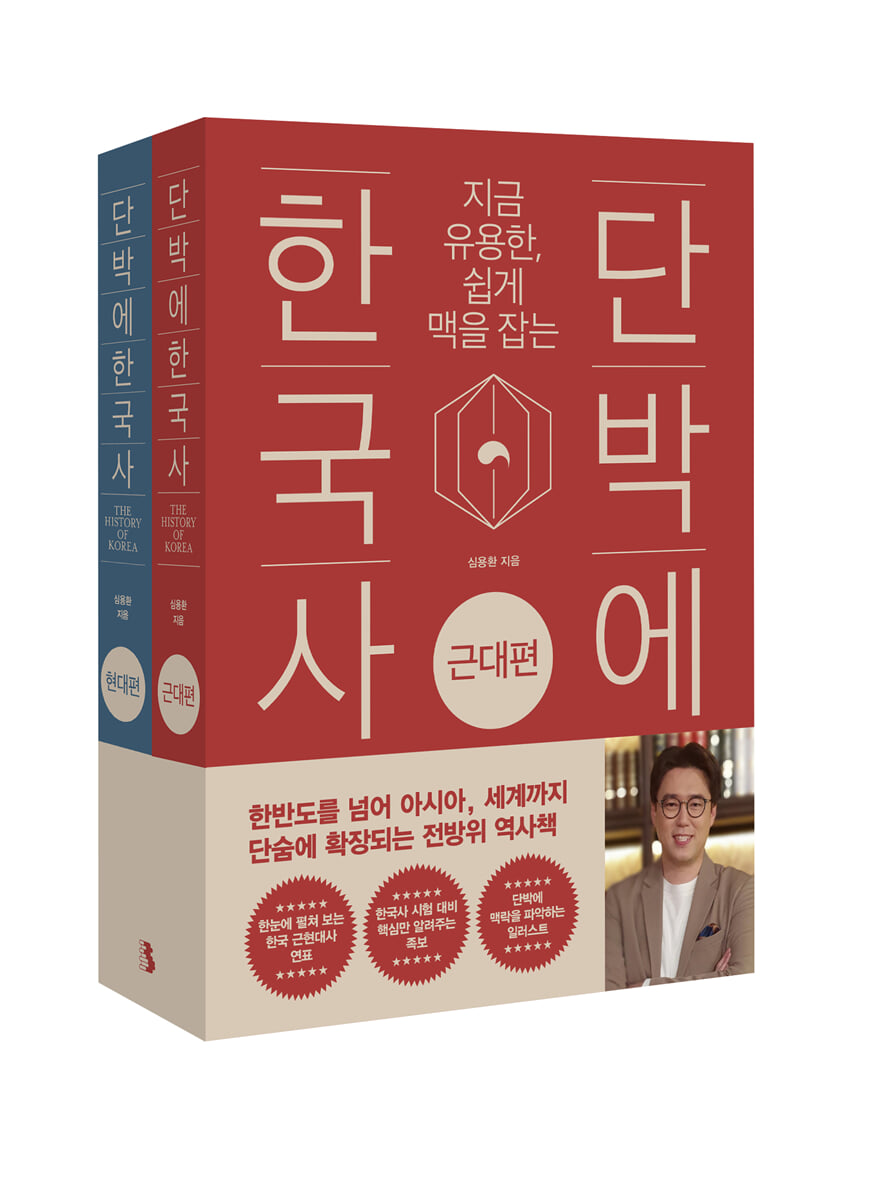
Korean History by Sim Yong-hwan, Korea's Leading History Communicator
A lot has happened on the Korean Peninsula over the past 150 years.
It has been a period of much more intense social change than the social changes that took place in traditional societies over the thousands of years from Gojoseon to Joseon.
The book begins with the situation and response of Joseon in the rapidly changing international situation of the late 19th century, including the struggles of Western powers armed with imperialism, Japan becoming a modern nation after the Meiji Restoration, and China with the collapse of its imperial system.
《Korean History in a Single Shot》 thoroughly rejects the nationalistic perspective that examines the history of only one nation without considering the surrounding political situation or international relations.
Author Sim Yong-hwan, a leading historical communicator and historian in South Korea, writes based on objective sources and thorough research, but also uses his imagination to create gaps in historical time, seeking wisdom for living in the present within the past.
Moreover, modern and contemporary Korean history is vividly brought to life through the stories of the dedication of leaders and independence activists who saved the country from crisis, as well as the aspirations of ordinary people and the marginalized.
A lot has happened on the Korean Peninsula over the past 150 years.
It has been a period of much more intense social change than the social changes that took place in traditional societies over the thousands of years from Gojoseon to Joseon.
The book begins with the situation and response of Joseon in the rapidly changing international situation of the late 19th century, including the struggles of Western powers armed with imperialism, Japan becoming a modern nation after the Meiji Restoration, and China with the collapse of its imperial system.
《Korean History in a Single Shot》 thoroughly rejects the nationalistic perspective that examines the history of only one nation without considering the surrounding political situation or international relations.
Author Sim Yong-hwan, a leading historical communicator and historian in South Korea, writes based on objective sources and thorough research, but also uses his imagination to create gaps in historical time, seeking wisdom for living in the present within the past.
Moreover, modern and contemporary Korean history is vividly brought to life through the stories of the dedication of leaders and independence activists who saved the country from crisis, as well as the aspirations of ordinary people and the marginalized.
- You can preview some of the book's contents.
Preview
index
*Korean History in One Shot - Modern Era*
The power of the preface, the power of history
Lecture 1: Heungseon Daewongun's Reforms: Aspiration and Despair
Heungseon Daewongun abolishes the Office of Military Affairs and the Seowon (Confucian academies)
strive for the stability of people's livelihood
The reforms were powerful, but their limitations were clear.
Joseon, engulfed in turmoil: The Joseon Strategy Debate
Trapped in an unequal treaty
Western powers surrounding East Asia
The Collapse of the Three-Power East Asian International Order: The Crisis of the Imperial Rule
The Taiping Rebellion, China's last civil war
Invasion by Western powers
The Yangwu Movement: Preserve Traditions While Seeking Revival
Defeat in the Sino-French War and the First Sino-Japanese War
How Japan Became a Modern Nation: The Meiji Restoration of 1868
The success of the reform and the study of Mito
Leaders of the Meiji Restoration
Iwakura Mission
5. Joseon was able to gain independence. 1: The Im-o Incident
The revival of nepotism
The Old Soldiers' Mutiny and Its Repercussions
Chapter 6 Joseon was able to gain independence 2: Gapsin Coup
Kim Ok-gyun and the Young Ones' Three-Day World
The East Asian Crisis and the Neutralization of the Korean Peninsula
Chapter 7: Reform from Below: The Donghak Peasant Revolution
The Donghak Peasant Revolution that shook Joseon
Peasant Liberation War? Revolution?
The 8 Unstable Reforms: The Gabo Reform and the Gwangmu Reform
Reform agency Military Affairs Office
The rapidly changing situation after the Sino-Japanese War
The clear achievements and limitations of the Gabo Reforms
Emperor-led modernization and the Gwangmu Reform
Women's liberation begins
Lecture 9: The Beginning of Parliamentary Politics: The Independence Association
Early Independence Association: Creating a Newspaper and Erecting the Independence Gate
Economic invasion by the great powers
The Later Independence Association: Holds the first popular assembly and demands a parliament.
Gojong's true intentions
10. The Russo-Japanese War: A Changing Landscape in East Asia
Negotiation? War?
The unexpected outcome of the war
Asia ecstatic over Japan's victory
Taiwan, a training ground for Korean colonization
Lesson 11: A Strong Nation Prospers: Patriotic Enlightenment Movement vs. Righteous Army Uprising
Patriotic Enlightenment Movement: Education and Industry
Righteous Army Uprising: Armed resistance
New People's Association and Republicanism
Independence movements of oppressed peoples in Southeast Asia
Lecture 12: An Jung-geun Didn't Kill Ito for That Reason: Theory of Eastern Peace
Special Envoys Advocate for Civil Rights, Not Imperial Power
An Jung-geun shoots Ito Hirobumi
Joseon disappears in 1910
Lesson 13: To Conform or to Resist?: The Struggle for Values in East Asia
Black Dragon Society and Iljin Society
Those who resisted reality and opposed imperialism
Sun Yat-sen and the Provisional Government Join Forces
Anarchism begins
Conscientious Activists
Lesson 14: What Was China Like After the Xinhai Revolution?
Sun Yat-sen's Three Principles of the People
Xinhai Revolution: Establishment of East Asia's First Democratic Republic
The New Culture Movement and the May Fourth Movement: A Path Opens in the Face of Suffering
Lecture 15: How Japan Ruled: The Japanese Colonial Period
1910s: The era of military rule
1920s to mid-1930s: The era of cultural rule
From the late 1930s to 1945: a reign of genocide
French imperialism and colonies
Lecture 16: Colonial Modernization Theory 1: Agricultural Policy
Colonization, not modernization
Japanese agricultural policy
Administrative district reorganization
Tenancy agreements and peasant movements
Lecture 17: Colonial Modernization Theory 2: Industrial Policy
Industrialization of the Korean Peninsula, filling the pockets of Japanese capitalists
From the domestic product promotion movement to the labor movement
Japanese labor policy
A new history begins: the March 1st Movement
Going on the path of the Republic of Korea
A joint work of President Wilson and Emperor Gojong?
Japan's merciless suppression
Lecture 19: The Beginning of the Republic of Korea: The Provisional Government of the Republic of Korea
Three governments merge
Why the Provisional Government is a 'Government'
Shanghai independence activists
Fall into the hands of the National Assembly
Lesson 20: This is How They Fought 1: History of the Armed Independence Movement
Armed struggle in Gando
Armed struggle in Primorsky Krai
Conflict and destruction
Korean National Association in the Americas
Lesson 21: This is How They Fought 2: Armed Independence Activists
Raising military funds for armed struggle and Japanese retaliatory massacres
Female revolutionary Nam Ja-hyeon
There were not only forces resisting
Lecture 22: The Emergence of the Socialist State, the Soviet Union: The Russian Revolution
Until the emergence of socialism
All power to the Soviets
The Beginning of Total War, World War I
Lecture 23: China Reunites the Continent: Cooperation between the Kuomintang and the Communists, the Northern Expedition, and the Nationalist Government
The first Kuomintang-Communist cooperation collapsed
Ten Years of the Nanjing Nationalist Government and the Rise of Mao Zedong
Anti-Japanese sentiment and the second Kuomintang-Communist cooperation
The 24 Massacres: The Nanjing Massacre and the Kwantung Massacre
The Nanjing Massacre: The Reality of Its Violence
The Light and Darkness of Taisho Democracy
The Kanto Massacre, which began with a rumor
25. Racing Towards Destruction: Japan, a Militaristic Nation
eve of the Sino-Japanese War
The Pacific War led to destruction
Episode 26: Stained by Madness: Forced Conscription
Three Realities of Conscription
Those taken to the Nanyang Islands and their prisoner guards
Sakhalin: The Tragedy of Double Conscription
Japanese conglomerates that benefited from the war
Lecture 27: War Did Not Spare Women: Japanese Military Comfort Women
Organized forced mobilization
Each one is dragged there for different reasons
Complete Liberation in Chapter 28!: The Uiyoldan and the Chongqing Provisional Government
Uiyoldan: Kim Won-bong and the Anarchists
Korean Patriotic Corps Members Lee Bong-chang and Yun Bong-gil: Establishing the Provisional Government
1940, preparing for the founding of the nation in Chongqing
Lecture 29: Back to the Age of Turmoil: A History of Socialism
domestic socialist organizations
Conflict between nationalists and socialists
Socialism in Vietnam
References
*Korean History in One Shot - Modern Times*
The power of the preface, the power of history
Lecture 1: The Outbreak of World War II: The Fall of Britain and France
Age of War
Wins in the US, Europe, and Asia
The history of bombing that changed the face of war
The World Made by America: The Emergence of a Global Empire
US-centered international order
The Cold War Begins: Not Everything Went America's Way
The Bretton Woods system, a global economic system led by the United States
The World of Three Powers: The Soviet Union, China, and Capitalism
Soviet Union: Beyond Lenin to Stalin
China: Mao Zedong establishes the People's Republic of China
1945: A New World Opens: Liberation and Division
The US military government enters Korea and competition among political powers begins.
Moscow Tripartite Conference: Drifting into Extreme Left-Right Conflict
Memories of August 15th in Korea, China, and Japan
Japan's Unreflective Visit to Yasukuni Shrine
Who is the winner and who is the loser?: Three years after liberation.
How did Syngman Rhee win?
The defeat of Kim Gu and the centrists
The Sixth Republic, the Republic of Korea: An Imperfect Start
The centrists' commitment to preventing division
The success of land reform: land belongs to the farmers
The Special Committee on Anti-Japanese Collaborators: Failed to Punish Pro-Japanese Collaborators
Kim Gu's assassination and the people behind it
Lesson 7: A Horrific Tragedy, Massacre of Civilians: The Jeju April 3 Incident
Daegu October 1st Incident: Give us rice
Jeju April 3 Incident
Peace negotiations with Kim Ik-ryeol
From the conflict between the left and right to unprecedented human rights violations
Enactment of the National Security Act
How North Korea Changed After Liberation: The Kim Il-sung Regime
Park Hon-yong and the South Korean Labor Party
Kim Il-sung, the leader chosen by the Soviet Union
North Korea's perception of the situation
Establishing a land reform and mobilization system
Kim Il-sung prepares for unification by force
If we start a war, South Korea will collapse on its own?
Episode 9: The Korean War, the Climax of Tragedy: From Civil War to International War
Situation on the eve of war
From the fight between South and North Korea to the fight between the United States and China
America's Position After MacArthur's Dismissal
The United States continues its relentless bombing campaign
The era of anti-communism begins with the massacre.
Lecture 10: The April Revolution: The Fall of Dictator Syngman Rhee
Cho Bong-am and the Progressive Party's social democracy
The March 15, 1960 election fraud and the April Revolution
Syngman Rhee's mobilization system to control the masses
Lecture 11: The Crisis of the Democratic Republic: The May 16 Military Coup
The May 16 Military Coup: Crossing the Han River Bridge
Transfer of power to a civilian government and the establishment of the Third Republic
Why Police Reform Failed
The Correlation Between Economic Development and Illicit Accumulation
Lecture 12: For Whom Is the War?: The Vietnam War, the United States, and East Asia
Vietnam War I: North Vietnam Didn't Fall
Geneva Accords and Division
Vietnam War II: The US-led anti-communist war
Lesson 13: Fighting the Enemy or Fighting Poverty: The Vietnam War and the Korea-Japan Treaty
Deploy troops to Vietnam and wage a proxy war
Brown Memorandum and Vietnam Special
The issue of civilian massacres during the Vietnam War
Establishment of formal diplomatic relations with Japan in 1965
Lecture 14: Democracy Frustrated Again: The Yushin Regime
Constitutional Amendment 257 for a Third Term for Permanent Power
The End of the Judiciary 262
Human Rights Violations by Intelligence Agencies 26
Lesson 15: Starting in Seoul and Ending in Seoul: The Era of Korea's Modernization
The Light and Dark Side of Economic Development Plans
Urban development, road development, and the Wau Apartment incident
Hannam Bridge, Gyeongbu Expressway, and Gangnam Development
Tongil Rice, Myca, and the Saemaul Movement
The Age of Torture and Manipulation: A History of Human Rights Violations
Manipulating the student movement into a communist incident
East Berlin spy ring case
The case of a Korean student studying abroad in Japan as a spy
Irresponsible public officials
Lecture 17: Will Spring Come to Seoul?: The Busan-Masan Uprising, the Gwangju Democratization Movement, and the Chun Doo-hwan Regime
The Busan-Masan Democratic Struggle: Calling for the Abolition of the Yushin Constitution and the Overthrow of Dictatorship
December 12 Military Coup: Chun Doo-hwan's New Military Government Seizes Power
May 18th Democratization Movement: The citizens of Gwangju did not back down.
The 1980s were not the era of Chun Doo-hwan.
College students take to the streets
A New Era Begins: After the June Struggle of 1987
Park Jong-cheol torture death case
June 1987: The moment South Korea became a democratic republic
The era of a single five-year term president
labor issues
North Korea issue
China, Japan, and the United States
References
The power of the preface, the power of history
Lecture 1: Heungseon Daewongun's Reforms: Aspiration and Despair
Heungseon Daewongun abolishes the Office of Military Affairs and the Seowon (Confucian academies)
strive for the stability of people's livelihood
The reforms were powerful, but their limitations were clear.
Joseon, engulfed in turmoil: The Joseon Strategy Debate
Trapped in an unequal treaty
Western powers surrounding East Asia
The Collapse of the Three-Power East Asian International Order: The Crisis of the Imperial Rule
The Taiping Rebellion, China's last civil war
Invasion by Western powers
The Yangwu Movement: Preserve Traditions While Seeking Revival
Defeat in the Sino-French War and the First Sino-Japanese War
How Japan Became a Modern Nation: The Meiji Restoration of 1868
The success of the reform and the study of Mito
Leaders of the Meiji Restoration
Iwakura Mission
5. Joseon was able to gain independence. 1: The Im-o Incident
The revival of nepotism
The Old Soldiers' Mutiny and Its Repercussions
Chapter 6 Joseon was able to gain independence 2: Gapsin Coup
Kim Ok-gyun and the Young Ones' Three-Day World
The East Asian Crisis and the Neutralization of the Korean Peninsula
Chapter 7: Reform from Below: The Donghak Peasant Revolution
The Donghak Peasant Revolution that shook Joseon
Peasant Liberation War? Revolution?
The 8 Unstable Reforms: The Gabo Reform and the Gwangmu Reform
Reform agency Military Affairs Office
The rapidly changing situation after the Sino-Japanese War
The clear achievements and limitations of the Gabo Reforms
Emperor-led modernization and the Gwangmu Reform
Women's liberation begins
Lecture 9: The Beginning of Parliamentary Politics: The Independence Association
Early Independence Association: Creating a Newspaper and Erecting the Independence Gate
Economic invasion by the great powers
The Later Independence Association: Holds the first popular assembly and demands a parliament.
Gojong's true intentions
10. The Russo-Japanese War: A Changing Landscape in East Asia
Negotiation? War?
The unexpected outcome of the war
Asia ecstatic over Japan's victory
Taiwan, a training ground for Korean colonization
Lesson 11: A Strong Nation Prospers: Patriotic Enlightenment Movement vs. Righteous Army Uprising
Patriotic Enlightenment Movement: Education and Industry
Righteous Army Uprising: Armed resistance
New People's Association and Republicanism
Independence movements of oppressed peoples in Southeast Asia
Lecture 12: An Jung-geun Didn't Kill Ito for That Reason: Theory of Eastern Peace
Special Envoys Advocate for Civil Rights, Not Imperial Power
An Jung-geun shoots Ito Hirobumi
Joseon disappears in 1910
Lesson 13: To Conform or to Resist?: The Struggle for Values in East Asia
Black Dragon Society and Iljin Society
Those who resisted reality and opposed imperialism
Sun Yat-sen and the Provisional Government Join Forces
Anarchism begins
Conscientious Activists
Lesson 14: What Was China Like After the Xinhai Revolution?
Sun Yat-sen's Three Principles of the People
Xinhai Revolution: Establishment of East Asia's First Democratic Republic
The New Culture Movement and the May Fourth Movement: A Path Opens in the Face of Suffering
Lecture 15: How Japan Ruled: The Japanese Colonial Period
1910s: The era of military rule
1920s to mid-1930s: The era of cultural rule
From the late 1930s to 1945: a reign of genocide
French imperialism and colonies
Lecture 16: Colonial Modernization Theory 1: Agricultural Policy
Colonization, not modernization
Japanese agricultural policy
Administrative district reorganization
Tenancy agreements and peasant movements
Lecture 17: Colonial Modernization Theory 2: Industrial Policy
Industrialization of the Korean Peninsula, filling the pockets of Japanese capitalists
From the domestic product promotion movement to the labor movement
Japanese labor policy
A new history begins: the March 1st Movement
Going on the path of the Republic of Korea
A joint work of President Wilson and Emperor Gojong?
Japan's merciless suppression
Lecture 19: The Beginning of the Republic of Korea: The Provisional Government of the Republic of Korea
Three governments merge
Why the Provisional Government is a 'Government'
Shanghai independence activists
Fall into the hands of the National Assembly
Lesson 20: This is How They Fought 1: History of the Armed Independence Movement
Armed struggle in Gando
Armed struggle in Primorsky Krai
Conflict and destruction
Korean National Association in the Americas
Lesson 21: This is How They Fought 2: Armed Independence Activists
Raising military funds for armed struggle and Japanese retaliatory massacres
Female revolutionary Nam Ja-hyeon
There were not only forces resisting
Lecture 22: The Emergence of the Socialist State, the Soviet Union: The Russian Revolution
Until the emergence of socialism
All power to the Soviets
The Beginning of Total War, World War I
Lecture 23: China Reunites the Continent: Cooperation between the Kuomintang and the Communists, the Northern Expedition, and the Nationalist Government
The first Kuomintang-Communist cooperation collapsed
Ten Years of the Nanjing Nationalist Government and the Rise of Mao Zedong
Anti-Japanese sentiment and the second Kuomintang-Communist cooperation
The 24 Massacres: The Nanjing Massacre and the Kwantung Massacre
The Nanjing Massacre: The Reality of Its Violence
The Light and Darkness of Taisho Democracy
The Kanto Massacre, which began with a rumor
25. Racing Towards Destruction: Japan, a Militaristic Nation
eve of the Sino-Japanese War
The Pacific War led to destruction
Episode 26: Stained by Madness: Forced Conscription
Three Realities of Conscription
Those taken to the Nanyang Islands and their prisoner guards
Sakhalin: The Tragedy of Double Conscription
Japanese conglomerates that benefited from the war
Lecture 27: War Did Not Spare Women: Japanese Military Comfort Women
Organized forced mobilization
Each one is dragged there for different reasons
Complete Liberation in Chapter 28!: The Uiyoldan and the Chongqing Provisional Government
Uiyoldan: Kim Won-bong and the Anarchists
Korean Patriotic Corps Members Lee Bong-chang and Yun Bong-gil: Establishing the Provisional Government
1940, preparing for the founding of the nation in Chongqing
Lecture 29: Back to the Age of Turmoil: A History of Socialism
domestic socialist organizations
Conflict between nationalists and socialists
Socialism in Vietnam
References
*Korean History in One Shot - Modern Times*
The power of the preface, the power of history
Lecture 1: The Outbreak of World War II: The Fall of Britain and France
Age of War
Wins in the US, Europe, and Asia
The history of bombing that changed the face of war
The World Made by America: The Emergence of a Global Empire
US-centered international order
The Cold War Begins: Not Everything Went America's Way
The Bretton Woods system, a global economic system led by the United States
The World of Three Powers: The Soviet Union, China, and Capitalism
Soviet Union: Beyond Lenin to Stalin
China: Mao Zedong establishes the People's Republic of China
1945: A New World Opens: Liberation and Division
The US military government enters Korea and competition among political powers begins.
Moscow Tripartite Conference: Drifting into Extreme Left-Right Conflict
Memories of August 15th in Korea, China, and Japan
Japan's Unreflective Visit to Yasukuni Shrine
Who is the winner and who is the loser?: Three years after liberation.
How did Syngman Rhee win?
The defeat of Kim Gu and the centrists
The Sixth Republic, the Republic of Korea: An Imperfect Start
The centrists' commitment to preventing division
The success of land reform: land belongs to the farmers
The Special Committee on Anti-Japanese Collaborators: Failed to Punish Pro-Japanese Collaborators
Kim Gu's assassination and the people behind it
Lesson 7: A Horrific Tragedy, Massacre of Civilians: The Jeju April 3 Incident
Daegu October 1st Incident: Give us rice
Jeju April 3 Incident
Peace negotiations with Kim Ik-ryeol
From the conflict between the left and right to unprecedented human rights violations
Enactment of the National Security Act
How North Korea Changed After Liberation: The Kim Il-sung Regime
Park Hon-yong and the South Korean Labor Party
Kim Il-sung, the leader chosen by the Soviet Union
North Korea's perception of the situation
Establishing a land reform and mobilization system
Kim Il-sung prepares for unification by force
If we start a war, South Korea will collapse on its own?
Episode 9: The Korean War, the Climax of Tragedy: From Civil War to International War
Situation on the eve of war
From the fight between South and North Korea to the fight between the United States and China
America's Position After MacArthur's Dismissal
The United States continues its relentless bombing campaign
The era of anti-communism begins with the massacre.
Lecture 10: The April Revolution: The Fall of Dictator Syngman Rhee
Cho Bong-am and the Progressive Party's social democracy
The March 15, 1960 election fraud and the April Revolution
Syngman Rhee's mobilization system to control the masses
Lecture 11: The Crisis of the Democratic Republic: The May 16 Military Coup
The May 16 Military Coup: Crossing the Han River Bridge
Transfer of power to a civilian government and the establishment of the Third Republic
Why Police Reform Failed
The Correlation Between Economic Development and Illicit Accumulation
Lecture 12: For Whom Is the War?: The Vietnam War, the United States, and East Asia
Vietnam War I: North Vietnam Didn't Fall
Geneva Accords and Division
Vietnam War II: The US-led anti-communist war
Lesson 13: Fighting the Enemy or Fighting Poverty: The Vietnam War and the Korea-Japan Treaty
Deploy troops to Vietnam and wage a proxy war
Brown Memorandum and Vietnam Special
The issue of civilian massacres during the Vietnam War
Establishment of formal diplomatic relations with Japan in 1965
Lecture 14: Democracy Frustrated Again: The Yushin Regime
Constitutional Amendment 257 for a Third Term for Permanent Power
The End of the Judiciary 262
Human Rights Violations by Intelligence Agencies 26
Lesson 15: Starting in Seoul and Ending in Seoul: The Era of Korea's Modernization
The Light and Dark Side of Economic Development Plans
Urban development, road development, and the Wau Apartment incident
Hannam Bridge, Gyeongbu Expressway, and Gangnam Development
Tongil Rice, Myca, and the Saemaul Movement
The Age of Torture and Manipulation: A History of Human Rights Violations
Manipulating the student movement into a communist incident
East Berlin spy ring case
The case of a Korean student studying abroad in Japan as a spy
Irresponsible public officials
Lecture 17: Will Spring Come to Seoul?: The Busan-Masan Uprising, the Gwangju Democratization Movement, and the Chun Doo-hwan Regime
The Busan-Masan Democratic Struggle: Calling for the Abolition of the Yushin Constitution and the Overthrow of Dictatorship
December 12 Military Coup: Chun Doo-hwan's New Military Government Seizes Power
May 18th Democratization Movement: The citizens of Gwangju did not back down.
The 1980s were not the era of Chun Doo-hwan.
College students take to the streets
A New Era Begins: After the June Struggle of 1987
Park Jong-cheol torture death case
June 1987: The moment South Korea became a democratic republic
The era of a single five-year term president
labor issues
North Korea issue
China, Japan, and the United States
References
Detailed image
Publisher's Review
Beyond the Korean Peninsula, to Asia and the world
A comprehensive history book that is confirmed in one breath
『Korean History in a Single Shot』 is a history of Korea written from a world historical perspective that goes beyond the East Asian perspective.
In that sense, it is not limited to the history of the Korean Peninsula, but is also East Asian history and world history based on Korean history.
The book runs at a rapid pace, from the reforms of Heungseon Daewongun to the June Struggle of 1987, amidst the turbulent international situation of the late 19th century.
"Korean History in a Single Shot" (Modern Era) unfolds like a novel, from the reign of Heungseon Daewongun to the Japanese colonial period, the fierce struggle for independence, and finally liberation. The breathtaking story and captivating illustrations imprint key historical scenes in your mind.
『Korean History in a Single Shot』(Modern Edition) focuses on the period from liberation in 1945 to the June Struggle in 1987.
This paper closely examines the political turmoil immediately following liberation, the conflict between the left and right, the establishment of separate governments in North and South Korea, the outbreak of the Korean War and the solidification of division, the period of dictatorship and the democratization movement, and the processes that North Korea, the United States, the Soviet Union, China, and Japan went through during that period to arrive at the world we live in today.
Even now, when history is constantly being interpreted and distorted to suit one's own perspective, guided by partisan logic, the author's efforts to objectively and coolly describe the reality, responses, and limitations of the Korean Peninsula shine through.
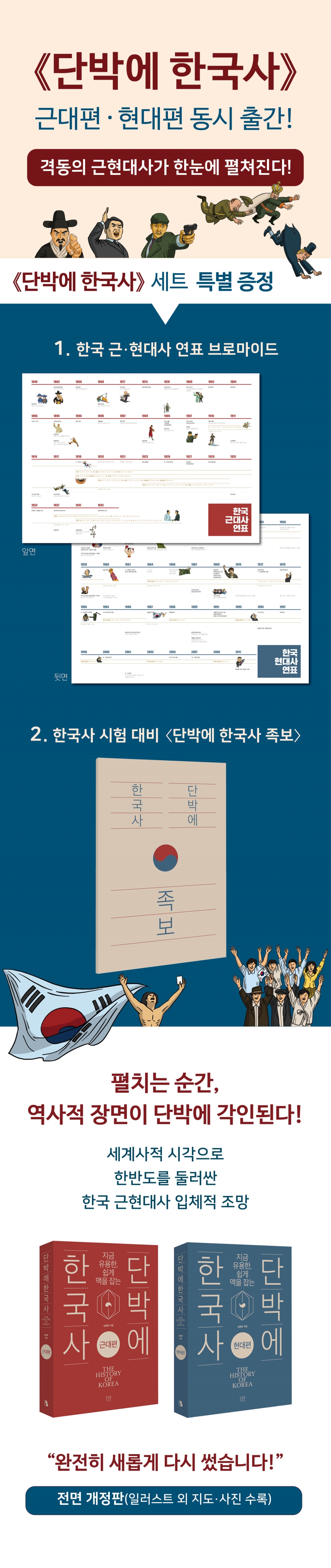
A bromide of a timeline of modern and contemporary Korean history at a glance
Special gift of "Korean History Genealogy in One Shot," which provides only the essential information for the Korean history exam.
All books in the 'Danbak-e' series contain illustrations by artist Bang Sang-ho.
By placing illustrations by artist Bang Sang-ho at the beginning of each chapter, readers can see the themes and major events of each period at a glance before reading the main text.
In addition, the newly published 『Korean History in One Shot』 in 2024 added maps and reference photos that help readers understand the world structure from a geopolitical perspective, to further enhance their understanding.
The "Korean History in a Single Shot" series aims to be a stepping stone to raising the intellectual level of historical knowledge, rather than a history book focused on stimulating interest or a reference book focused on memorization.
History is not a theory from a laboratory, but a story of each and every individual's life.
In that sense, 『Korean History in a Single Shot』 is not simply a fact-checking book, but a history book that brings joy and sorrow, surprise and relief, indignation and catharsis, with stories that are still vivid and alive today.
For those seeking to learn about history for the first time, author Yong-Hwan Shim's "In a Single Shot" history series will be an excellent introductory book that goes beyond fun and provides depth, thanks to the author's unique storytelling and the questions that remain relevant today.
In particular, the sets of 『Korean History in One Shot』(Modern Era) and 『Korean History in One Shot』(Contemporary Era) include a bromide of modern and contemporary Korean history that covers East Asian history and world history at a glance, as well as a 〈Korean History Genealogy in One Shot〉 for preparing for Korean history tests such as the Korean History Proficiency Test.
A comprehensive history book that is confirmed in one breath
『Korean History in a Single Shot』 is a history of Korea written from a world historical perspective that goes beyond the East Asian perspective.
In that sense, it is not limited to the history of the Korean Peninsula, but is also East Asian history and world history based on Korean history.
The book runs at a rapid pace, from the reforms of Heungseon Daewongun to the June Struggle of 1987, amidst the turbulent international situation of the late 19th century.
"Korean History in a Single Shot" (Modern Era) unfolds like a novel, from the reign of Heungseon Daewongun to the Japanese colonial period, the fierce struggle for independence, and finally liberation. The breathtaking story and captivating illustrations imprint key historical scenes in your mind.
『Korean History in a Single Shot』(Modern Edition) focuses on the period from liberation in 1945 to the June Struggle in 1987.
This paper closely examines the political turmoil immediately following liberation, the conflict between the left and right, the establishment of separate governments in North and South Korea, the outbreak of the Korean War and the solidification of division, the period of dictatorship and the democratization movement, and the processes that North Korea, the United States, the Soviet Union, China, and Japan went through during that period to arrive at the world we live in today.
Even now, when history is constantly being interpreted and distorted to suit one's own perspective, guided by partisan logic, the author's efforts to objectively and coolly describe the reality, responses, and limitations of the Korean Peninsula shine through.
A bromide of a timeline of modern and contemporary Korean history at a glance
Special gift of "Korean History Genealogy in One Shot," which provides only the essential information for the Korean history exam.
All books in the 'Danbak-e' series contain illustrations by artist Bang Sang-ho.
By placing illustrations by artist Bang Sang-ho at the beginning of each chapter, readers can see the themes and major events of each period at a glance before reading the main text.
In addition, the newly published 『Korean History in One Shot』 in 2024 added maps and reference photos that help readers understand the world structure from a geopolitical perspective, to further enhance their understanding.
The "Korean History in a Single Shot" series aims to be a stepping stone to raising the intellectual level of historical knowledge, rather than a history book focused on stimulating interest or a reference book focused on memorization.
History is not a theory from a laboratory, but a story of each and every individual's life.
In that sense, 『Korean History in a Single Shot』 is not simply a fact-checking book, but a history book that brings joy and sorrow, surprise and relief, indignation and catharsis, with stories that are still vivid and alive today.
For those seeking to learn about history for the first time, author Yong-Hwan Shim's "In a Single Shot" history series will be an excellent introductory book that goes beyond fun and provides depth, thanks to the author's unique storytelling and the questions that remain relevant today.
In particular, the sets of 『Korean History in One Shot』(Modern Era) and 『Korean History in One Shot』(Contemporary Era) include a bromide of modern and contemporary Korean history that covers East Asian history and world history at a glance, as well as a 〈Korean History Genealogy in One Shot〉 for preparing for Korean history tests such as the Korean History Proficiency Test.
GOODS SPECIFICS
- Date of issue: April 17, 2024
- Page count, weight, size: Page count being confirmed | 1,530g | 165*230*15mm
- ISBN13: 9791198493491
- ISBN10: 1198493496
You may also like
카테고리
korean


korean

![ELLE 엘르 스페셜 에디션 A형 : 12월 [2025]](http://librairie.coreenne.fr/cdn/shop/files/b8e27a3de6c9538896439686c6b0e8fb.jpg?v=1766436872&width=3840)


