

Conquest of the Shang Dynasty
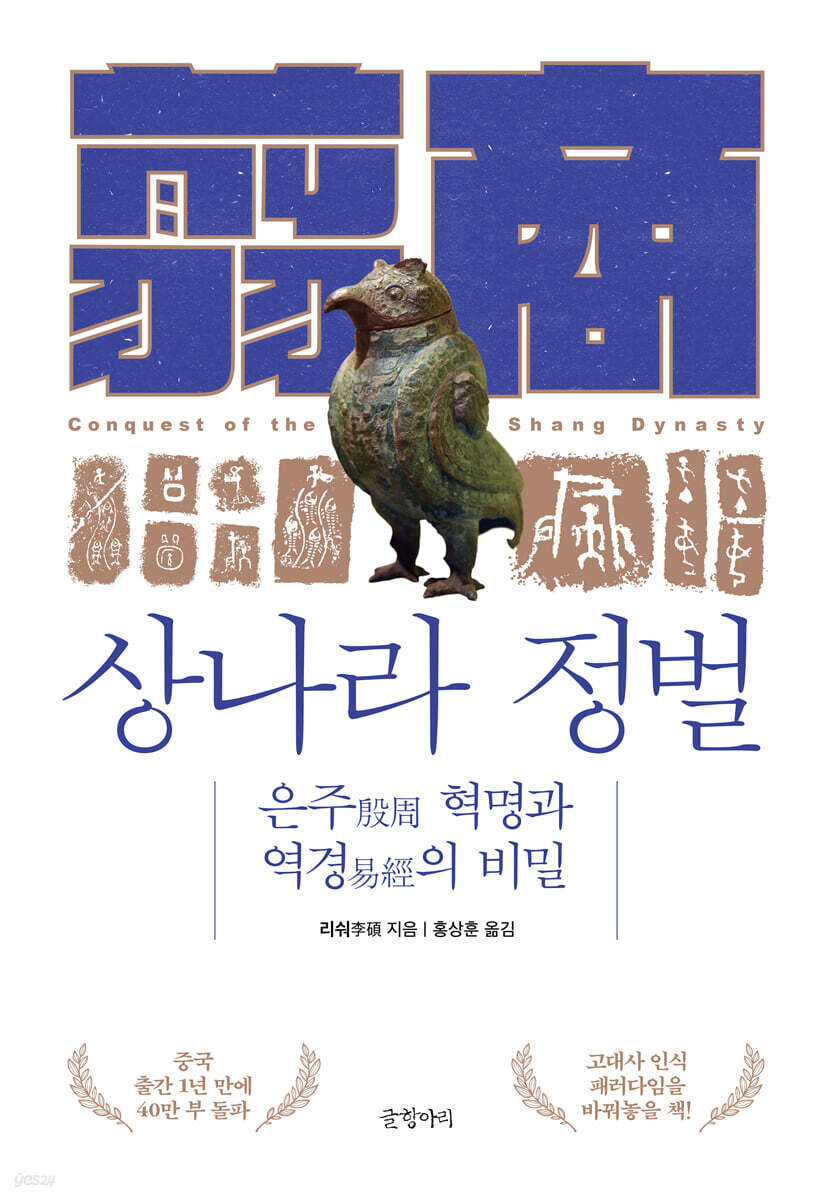 |
Description
Book Introduction
These shocking and terrifying secrets hidden behind the history of the Zhou Dynasty, which conquered and destroyed the Shang Dynasty, have been revealed through a rereading of ancient texts that reflect the results of recent archaeological excavations and research on oracle bone inscriptions.
Of course, the author Li Shu's sharp and sophisticated research and novel writing based on rational reasoning played a decisive role in re-arranging and explaining these secrets in their proper place in history. This topic is groundbreaking, yet heavy and groundbreaking, and Lee presents scholarly evidence while simultaneously unraveling the mystery like a detective novel, as a skilled storyteller. So, as Xu Hong mentioned in his preface, once you open this book, you won't be able to put it down easily. The cold-eyed description of the detailed rituals of human sacrifice, steeped in the bloody scent of cruelty, simultaneously creates a sense of suffocating tension and a certain sense of distance, engulfing one in a strange emotion. As a result, the hidden secrets of history, which are revealed one by one through new interpretations of the 『Book of Changes』, 『Book of Documents』, and 『Book of Songs』, and the discovery of new values in the 『Book of the Rituals』, captivate readers with 'fun' rather than shocking. |
- You can preview some of the book's contents.
Preview
index
In lieu of a preface: Our strange form
prolog
The Last Human Sacrifice of the Silver Medal | Rescuing a Lost Civilization | Beyond Human Sacrifice
Appendix: Classification of Human Sacrifice in Ancient Times
Chapter 1 Social Development in the Neolithic Age
From Villages and Tribes to Early States | Did Rice Farming Bring Peace?
Chapter 2: The Truth About Daewoo Flood Control: Rice and Dragons
Old Luoyang, Reliant on Rice Farming: Erlitou | Those Who Migrated Over the Songshan Mountains | The Truth About the Great Flood Control | The Dynasty of the Playful Dragon
Chapter 3: Casting the Scepter in Bronze
The oldest 'castle-building plan' | A royal garden | Human sacrifice outside the palace | Human bones at a bronze foundry | Bronze: The birth of civilization | Finite human sacrifice and a dualistic society
Appendix: The Secret History of Bronze
Chapter 4: Other Races Occupy Erlitou
The 500-Li Dynasty | The Fall of the Xia Capital | The Faraway Colony of Chaohu
Appendix: Memories of the Xia Dynasty
Chapter 5: The Mystery of the Origin of the Shang Tribe
The Shangdi and the Bird's Egg | Nomadic life, riding a water buffalo | Worship of the Bird God
Chapter 6: The Early Shang Dynasty: The Warehouse
Two Capitals of the East and the West | The Expansion of the Bronze Age | The Colonial Fortresses of the Jinnan Dynasty | The Mystery of the Great Warehouse
Chapter 7: The Prosperity of Human Sacrifice and the Reformation Movement
Yanshi: From Pig Sacrifice to Human Sacrifice | Folk Rituals in Zhengzhou's Second Period | The Royal Court: Hybrid Human-Canine Rituals and Skull Processing | Human Sacrifice as a State Religion | A Hidden Reform Movement | The Mid-Shang Dynasty: The Cruel Xiao Shuangchao
Chapter 8: Wu De, Losing Southern Territories: Pan Longcheng
The Bronze Industrial Base of the Yangtze River Basin | The Shang People, Not Bloodthirsty | Peaceful Sacrificial Rites in the South | The Spread of Bronze Technology to the South
Chapter 9: The Military Camp of 3,300 Years Ago: Taishi
Human Heads Under the Eaves | Bronze Age Warriors | Living Quarters and Kitchens | Subtropical Periods in the North China Region | Appendix: Cannibal Tribes in the North
Chapter 10: Human Sacrifice in the Yin Dynasty
The Radius of Discipline | The Abandonment of Huanbei's Capital in the Middle | Wu Ding's New Capital | Royal Tombs and the Burial Ground | Sacrificial Pit as Dense as the Stars | The Seriousness of Beheading
Appendix 1: Divination Using the Human Hipbone | Appendix 2: The First Steamed Iron
Appendix 3: The number of human sacrifices recorded in oracle bone inscriptions
Chapter 11: Reasons for and State of the Sangjok
A ruthless and violent worldview | Foreign technology and the revival of silver | The basic unit of Shang society: the "tribe" | Royal authority and the family feudal system | Assimilation with other tribes: the risk of losing traditions
Chapter 12 The Queen's Social Circle
The Queen's Tomb, Preserved by Fortune | Comparison with Royal Tombs | The Marital Life of a Shang King | The Son of a Wealthy Man as Recorded in the "Wangs' Chronicles" | The Life of a Wealthy Family
Chapter 13: The University and the Prince
The Royal Student's Training Subject | Duel Partner | The Noble Life of 'Za' | The Fallen Chieftain 'Ajang'
Chapter 14: The Western War of Advance and Retreat: Lao Niu Po
Early Shang invaders | The Second Western Jin Movement | Chonghou, born 200 years earlier | Chongguo's cannibals | Chonghou's bronze industry
Chapter 15: The Origins of the Zhou Epic and Archaeology
The Zhou people descended from the Qiang people | Agriculture, livestock farming, and migration | Into the 'barbarians' | Caves and millet | Did Shang refugees bring bronze? | A peaceful tribe | Appendix: The origins of the Huaxia story
Chapter 16: The Henchman of the Shang Dynasty: Approaching Zhu Yuan
An Uninvited Guest Visits the Cave House | The Old Chief's New Estate | The Departed Brothers and the Wife from afar
Chapter 17: The Secrets of King Wen's Cave
Was King Wen the uncle of King Zhou? | The Zhou Clan's Siheyuan | The Underground Workshop | Records of the Copy Carved by King Wen
Chapter 18: Captive Hunting and Offering in the Book of Changes
Captive 'Bu' | The Runaway Ram, the Rebellious Qiang Chieftain | The Experience of Being a Captive | The Chance to Meet the King of Zhou | Witnessing the Sacrificial Ceremony of Yin Xu
Chapter 19: Memories of the Brain Jade in Yuri?
From Governor to Prisoner | A Feast of Cannibalism in a Dungeon | Punishment and Slaughter | Another Side of Sodalgi
Chapter 20: The Conquest of the Shang Dynasty and the Worldview of the I Ching
Divination by the reverse hexagrams handed down from the Shang tribe | King Wen's hexagrams and hexagrams | What is contained in the hexagrams and hexagrams | Why do the 64 hexagrams pair up? | Even the conquest of the Shang Dynasty can be divined.
Chapter 21: Human Sacrifice by the People of Yin
A human sacrifice shrine along the capital's main street | The cruelty of the Dasung settlement | Corpses abandoned in the moat | A Shang tribe settlement that refused human sacrifice
Chapter 22: King Zhou's Southeastern War
King Wen's Southern Conquest | The Sajok Clan that Pioneered the Southeast | A Sacrificial Offering of Mixed Humans and Dogs
Chapter 23: Jiang Taigong and Zhou Fangbo
The various titles of Jiang Taigong | A commoner at the Yin Ruins | King Zhou appoints him "Zhu Fang Bo" | The devoured Zhuangzi | Recollections of Baiyi Gao | King Wen curses Yin Shang
Chapter 24: The People of the West
The conspiracy of the Qiang allies and Taigong | Devoting oneself to the faith of Shangdi | The plot to conquer the Shang Dynasty in the Book of Changes | The "flying bird" refers to the enemy | The article in the "Mingyi Gua" | King Wen's expansion | Lao Niu Bu - The fall of the Song Dynasty | The great universities of the Zhou Dynasty
Chapter 25: Showing Bravery in the Fields
The Duke of Zhou's Dream Interpretation | The First Advance | The Day of the Jia Zi of Muye | The Conqueror's Welcome | King Wu's Human Sacrifice | The Duke of Zhou Offers Himself
Chapter 26: The New Era of the Zhou Dynasty
Rebellion in the East | The Disintegration of the Shang Clan | Another Side of the Duke of Zhou | The End of the Cruel Tribes | Moral Speeches from the New City of Luoyi | Revising the Memory of History | King Cheng's Wrath | Fiefdoms Targeting the Remnants of the Yin Dynasty: Wei and Song | The Duke of Zhou's Great Fiefdom and the New Peace | Intermarriage and Ethnic Fusion | The Western Zhou Dynasty Enters the "Normal Era"
Chapter 27: After the Gods Depart
Traces of Human Sacrifice | The Undercurrents of Human Sacrifice Memory
Epilogue: From the Duke to the Prince
The Origins of Confucianism and the Human Sacrificing Civilization | The Secular Moral System Established by the Duke of Zhou | How the Original Meaning of the Book of Changes Was Concealed | Confucius Solves the Duke of Zhou's Riddle
Appendix: Editing the Six Classics of Confucius's Later Years
Postscript / Notes / Translator's Note / Index
prolog
The Last Human Sacrifice of the Silver Medal | Rescuing a Lost Civilization | Beyond Human Sacrifice
Appendix: Classification of Human Sacrifice in Ancient Times
Chapter 1 Social Development in the Neolithic Age
From Villages and Tribes to Early States | Did Rice Farming Bring Peace?
Chapter 2: The Truth About Daewoo Flood Control: Rice and Dragons
Old Luoyang, Reliant on Rice Farming: Erlitou | Those Who Migrated Over the Songshan Mountains | The Truth About the Great Flood Control | The Dynasty of the Playful Dragon
Chapter 3: Casting the Scepter in Bronze
The oldest 'castle-building plan' | A royal garden | Human sacrifice outside the palace | Human bones at a bronze foundry | Bronze: The birth of civilization | Finite human sacrifice and a dualistic society
Appendix: The Secret History of Bronze
Chapter 4: Other Races Occupy Erlitou
The 500-Li Dynasty | The Fall of the Xia Capital | The Faraway Colony of Chaohu
Appendix: Memories of the Xia Dynasty
Chapter 5: The Mystery of the Origin of the Shang Tribe
The Shangdi and the Bird's Egg | Nomadic life, riding a water buffalo | Worship of the Bird God
Chapter 6: The Early Shang Dynasty: The Warehouse
Two Capitals of the East and the West | The Expansion of the Bronze Age | The Colonial Fortresses of the Jinnan Dynasty | The Mystery of the Great Warehouse
Chapter 7: The Prosperity of Human Sacrifice and the Reformation Movement
Yanshi: From Pig Sacrifice to Human Sacrifice | Folk Rituals in Zhengzhou's Second Period | The Royal Court: Hybrid Human-Canine Rituals and Skull Processing | Human Sacrifice as a State Religion | A Hidden Reform Movement | The Mid-Shang Dynasty: The Cruel Xiao Shuangchao
Chapter 8: Wu De, Losing Southern Territories: Pan Longcheng
The Bronze Industrial Base of the Yangtze River Basin | The Shang People, Not Bloodthirsty | Peaceful Sacrificial Rites in the South | The Spread of Bronze Technology to the South
Chapter 9: The Military Camp of 3,300 Years Ago: Taishi
Human Heads Under the Eaves | Bronze Age Warriors | Living Quarters and Kitchens | Subtropical Periods in the North China Region | Appendix: Cannibal Tribes in the North
Chapter 10: Human Sacrifice in the Yin Dynasty
The Radius of Discipline | The Abandonment of Huanbei's Capital in the Middle | Wu Ding's New Capital | Royal Tombs and the Burial Ground | Sacrificial Pit as Dense as the Stars | The Seriousness of Beheading
Appendix 1: Divination Using the Human Hipbone | Appendix 2: The First Steamed Iron
Appendix 3: The number of human sacrifices recorded in oracle bone inscriptions
Chapter 11: Reasons for and State of the Sangjok
A ruthless and violent worldview | Foreign technology and the revival of silver | The basic unit of Shang society: the "tribe" | Royal authority and the family feudal system | Assimilation with other tribes: the risk of losing traditions
Chapter 12 The Queen's Social Circle
The Queen's Tomb, Preserved by Fortune | Comparison with Royal Tombs | The Marital Life of a Shang King | The Son of a Wealthy Man as Recorded in the "Wangs' Chronicles" | The Life of a Wealthy Family
Chapter 13: The University and the Prince
The Royal Student's Training Subject | Duel Partner | The Noble Life of 'Za' | The Fallen Chieftain 'Ajang'
Chapter 14: The Western War of Advance and Retreat: Lao Niu Po
Early Shang invaders | The Second Western Jin Movement | Chonghou, born 200 years earlier | Chongguo's cannibals | Chonghou's bronze industry
Chapter 15: The Origins of the Zhou Epic and Archaeology
The Zhou people descended from the Qiang people | Agriculture, livestock farming, and migration | Into the 'barbarians' | Caves and millet | Did Shang refugees bring bronze? | A peaceful tribe | Appendix: The origins of the Huaxia story
Chapter 16: The Henchman of the Shang Dynasty: Approaching Zhu Yuan
An Uninvited Guest Visits the Cave House | The Old Chief's New Estate | The Departed Brothers and the Wife from afar
Chapter 17: The Secrets of King Wen's Cave
Was King Wen the uncle of King Zhou? | The Zhou Clan's Siheyuan | The Underground Workshop | Records of the Copy Carved by King Wen
Chapter 18: Captive Hunting and Offering in the Book of Changes
Captive 'Bu' | The Runaway Ram, the Rebellious Qiang Chieftain | The Experience of Being a Captive | The Chance to Meet the King of Zhou | Witnessing the Sacrificial Ceremony of Yin Xu
Chapter 19: Memories of the Brain Jade in Yuri?
From Governor to Prisoner | A Feast of Cannibalism in a Dungeon | Punishment and Slaughter | Another Side of Sodalgi
Chapter 20: The Conquest of the Shang Dynasty and the Worldview of the I Ching
Divination by the reverse hexagrams handed down from the Shang tribe | King Wen's hexagrams and hexagrams | What is contained in the hexagrams and hexagrams | Why do the 64 hexagrams pair up? | Even the conquest of the Shang Dynasty can be divined.
Chapter 21: Human Sacrifice by the People of Yin
A human sacrifice shrine along the capital's main street | The cruelty of the Dasung settlement | Corpses abandoned in the moat | A Shang tribe settlement that refused human sacrifice
Chapter 22: King Zhou's Southeastern War
King Wen's Southern Conquest | The Sajok Clan that Pioneered the Southeast | A Sacrificial Offering of Mixed Humans and Dogs
Chapter 23: Jiang Taigong and Zhou Fangbo
The various titles of Jiang Taigong | A commoner at the Yin Ruins | King Zhou appoints him "Zhu Fang Bo" | The devoured Zhuangzi | Recollections of Baiyi Gao | King Wen curses Yin Shang
Chapter 24: The People of the West
The conspiracy of the Qiang allies and Taigong | Devoting oneself to the faith of Shangdi | The plot to conquer the Shang Dynasty in the Book of Changes | The "flying bird" refers to the enemy | The article in the "Mingyi Gua" | King Wen's expansion | Lao Niu Bu - The fall of the Song Dynasty | The great universities of the Zhou Dynasty
Chapter 25: Showing Bravery in the Fields
The Duke of Zhou's Dream Interpretation | The First Advance | The Day of the Jia Zi of Muye | The Conqueror's Welcome | King Wu's Human Sacrifice | The Duke of Zhou Offers Himself
Chapter 26: The New Era of the Zhou Dynasty
Rebellion in the East | The Disintegration of the Shang Clan | Another Side of the Duke of Zhou | The End of the Cruel Tribes | Moral Speeches from the New City of Luoyi | Revising the Memory of History | King Cheng's Wrath | Fiefdoms Targeting the Remnants of the Yin Dynasty: Wei and Song | The Duke of Zhou's Great Fiefdom and the New Peace | Intermarriage and Ethnic Fusion | The Western Zhou Dynasty Enters the "Normal Era"
Chapter 27: After the Gods Depart
Traces of Human Sacrifice | The Undercurrents of Human Sacrifice Memory
Epilogue: From the Duke to the Prince
The Origins of Confucianism and the Human Sacrificing Civilization | The Secular Moral System Established by the Duke of Zhou | How the Original Meaning of the Book of Changes Was Concealed | Confucius Solves the Duke of Zhou's Riddle
Appendix: Editing the Six Classics of Confucius's Later Years
Postscript / Notes / Translator's Note / Index
Publisher's Review
The Bloody Revelation of the Summer, Shang, and Zhou Dynasties
Supporting slaughter, human sacrifice, and cannibalism
A cooperative system between the great empire and human hunters
A book that will change the paradigm of understanding ancient history.
Sales exceeded 400,000 copies in just one year since its publication in China.
The meticulous erasure of past history since the founding of the Zhou Dynasty created the fictitious images of King Wen, Jiang Taigong, the Duke of Zhou, and Confucius, transformed the book of revenge, the Book of Changes, into the book of wisdom, the Book of Changes, and covered up a whopping 3,000 years of history with a blank space.
“Looking at the history of war, I found that history was indeed filled with war and death, but the vocabulary hindered my intuitive perception of emotions, making it difficult to feel a sense of ‘immersion.’
And while looking at the photos of the horribly killed remains, I tried to recreate the slaughter scene of the human sacrifice and enter the psychological world of the murderer and the murdered, but I always felt that I did not have the strength to handle the pressure.
(…) This journey of inescapable terror was like walking alone through a wilderness filled with corpses.” _Author's Note
◆ Classification of human sacrifices in ancient times ◆
◆ The Mystery of the Giant Warehouse ◆
◆ The most brutal Xiaoshuangchao, Dashkung settlement ◆
◆ Northern cannibal tribe ◆
◆ The first steamed human head ◆
◆ Captive hunting lessons for the children of Shang nobles ◆
King Wen's Underground Workshop Excavated, Revealing His Plan for Revenge
◆ Why are the 64 hexagrams paired? ◆
King Mun had to prove the ingredients by eating his son Baek Eop-go's meat.
◆ The plot to conquer the Shang Dynasty in the Book of Changes ◆
◆ Yin Xu welcoming the conqueror ◆
◆ Confucius Solves the Riddle of the Duke of Zhou ◆
In the history of Korean publishing, there has never been a book that contains such shocking truths about ancient Chinese history.
The King Zhou of Shang, King Wen and King Wu of Zhou, Jiang Taigong, Duke Dan of Zhou, and Confucius that we knew of were nothing more than fabricated illusions!
As soon as the book titled "Traditional Business" was published by Guangxi Normal University Press in China in October 2022, the academic and reading worlds were in an uproar.
This book, which can be translated as “Beating the Shang Dynasty” or “Conquering the Shang Dynasty,” has the provocative and mysterious subtitle, “The Yin Zhou Revolution and the Secret of the I Ching.”
However, the title and subtitle were rather polite compared to the content of the text.
The reading world in Taiwan, where it was translated and published in traditional Chinese characters, was thrilled by the historical content it contained.
Everyone has a different perspective on history, but the most important thing is the 'practical motivation' that moves the actors.
In other words, the motive of survival has been the driving force that has driven history.
This book completely rewrites the nature of early Chinese civilization, spanning approximately 1,000 years, from the Neolithic Age through the tribal and early state stages, and on to the Xia, Shang, and Zhou periods.
The key word leads to the conclusion that there was a country called the Shang Dynasty, a country of fanatic cannibalism where human sacrifice, which involves killing people and offering them up for ceremonies, reached a religious level.
This country, called the Shang Dynasty or the Yin Dynasty after its capital Yin, had a very large territory and reached the level of civilization of an ancient empire with numerous states.
As civilization deepened, religious fanaticism also became more severe and continued for hundreds of years.
The Zhou Dynasty, which emerged after the Shang Dynasty, was, so to speak, its lackey and confidant.
In other words, they were able to maintain their territorial integrity by professionally hunting and offering human sacrifices for the Shang dynasty's human sacrifice rituals, and after growing their power to the peak and overthrowing the Shang dynasty, they began a systematic cover-up of the past.
The existence of this semi-civilized civilization was buried deep underground until 3,000 years later, when buried human bones and oracle bones were discovered.
The author's anatomical gaze turns to the origins of the Zhou Dynasty, which laid the foundations for the patriarchal and tributary states.
Starting with Gao Gong Danfu, the leader of the early Zhou people, and continuing through Ji Li and King Wen, the Zhou people lived a humiliating life as subordinates to the Shang dynasty, hunting down their fellow Qiang people and offering them as human sacrifices for the Shang dynasty's ceremonies.
Meanwhile, King Wen's eldest son, Baek Eup-go, was offered as a human sacrifice, and King Wen and his other children were even forced to eat meat sauce made from Baek Eup-go's flesh.
King Wen, known as a moral and benevolent king, was actually a ruthless human hunter, and when he himself was imprisoned in a cave in Yuli?ri and became a candidate for human sacrifice, he was a hypocrite who ate human flesh, consulted with gods, and prepared for rebellion.
The Book of Changes, which he compiled secretly in a secret cave in his mansion after overcoming a near-death experience, was not simply a book of divination, but a record of his personal experiences and a book containing a secret plan to conquer the Shang Dynasty.
And Jiang Taigong, the leader of a small tribe in the west, lived a lowly life as a butcher in Yin Xu, and conspired with King Wen, who may have been his enemy, to overthrow the Shang Dynasty.
The main character, who is considered to be virtuous and decent, was once a member of a human hunter, and suffered from the psychological shock of eating meat stew made from his brother's flesh, which caused him to often suffer from nausea when eating for the rest of his life.
And after destroying the Shang Dynasty, they eradicated the bloody practice of human sacrifice and manipulated memories through historical distortion to hide their dark history of serving in the Shang Dynasty.
Accordingly, the cruel customs of the Shang tribe, in which the entire clan indulged in bloodthirsty madness through drunken, shocking slaughter and cannibalism, were absolved, and all sins were placed on the 'immoral' King Zhou personally.
The sins of King Zhou, represented by the practice of drinking wine in a pond and burning meat in a forest, were actually religious customs of the entire Shang clan, but due to the Duke of Zhou's manipulation of memory, they became the sins of King Zhou personally.
Because of this, Emperor Xin, who had deified himself and devoted himself to the unique religion of the Shang tribe, even offering up the nobles of the royal family as sacrifices, was branded as a 'Zhou', a 'monopolist', who 'harmed righteousness and goodness'.
China, up to the Shang dynasty, which subdued and brutally ruled the scattered tribes in a state of barbarism, which the author defines as the 'old Chinese civilization', was not in fact a collection that could be specifically encompassed.
There may have been some alliances between some tribes that practiced exogamy, like the Zhou tribe, but there were also quite a few tribes that practiced endogamy, so the tribes of the continent were like a group of stars scattered across the night sky.
Their chemical combination to form one massive entity—what the author calls the "new Chinese civilization"—was a groundbreaking achievement of the Zhou Dynasty.
And the protagonist, who played a key role in that process, eliminated the shadow of the 'divine power' that enjoyed the savage bloodshed there, and filled that void with human 'virtue'.
Therefore, his distortion of history was truly a 'well-intentioned' and almost 'the best' decision at the time.
Even after Confucius, the Confucian "sage" who studied and taught empirical studies based on the contents recorded in literature, discovered the secrets in the "Book of Changes," he agreed with the Duke of Zhou's distortion of history, and even more precisely reflected the Duke of Zhou's spirit through the compilation of the "Six Classics." Therefore, it was not a simple expression of gratitude as a descendant of the Shang clan for covering up the shame of his ancestors.
It was the result of a consensus on the necessity of rejecting the blood-soaked 'barbaric civilization' and creating a new culture that retains the warmth of 'humanities.'
When teaching his disciples, he did not talk about the supernatural and tyrannical gods, and even cursed the act of burying dolls in graves. The ultimate goal of his beliefs and words was 'benevolence', which was the most important virtue that a 'human being' should possess.
The shocking and terrifying secret history hidden behind the history of the Zhou Dynasty, which conquered and destroyed the Shang Dynasty, has been revealed through a rereading of ancient texts that reflects the results of recent archaeological excavations and research on oracle bone inscriptions.
Of course, the author's sharp and sophisticated research and novel writing based on sound reasoning played a crucial role in re-arranging and explaining these secrets in their proper place in history.
He explains a groundbreaking, yet heavy and groundbreaking subject matter, unfolding the clues like a detective novel, as a skilled storyteller.
So, as Xu Hong, who wrote the preface, said, once you open the book, you won't be able to put it down easily.
The cold-eyed description of the detailed rituals of human sacrifice, steeped in the bloody scent of cruelty, simultaneously creates a sense of suffocating tension and a certain sense of distance, engulfing one in a strange emotion.
As a result, the hidden secrets of history, which are revealed one by one through new interpretations of the 『Book of Changes』, 『Book of Documents』, and 『Book of Songs』, and the discovery of new values in the 『Book of the Rituals』, captivate readers with 'fun' rather than shocking.
Korean readers who have read some about Chinese thought and history and are familiar with Confucius and Confucianism will probably have some questions.
For example, there is the question of why the Zhou Dynasty has such a large presence in Chinese history.
Why did Confucius miss Zhougong so much?
Confucius said to his disciples, “Wear the hat of the Zhou Dynasty.”
What kind of entity was the Zhou Dynasty that it could create such a perfect example that all later dynasties would wear the Zhou Dynasty's crown?
Another one is the Book of Changes.
What wise man in the distant past could have written such a book of wisdom?
What kind of experiential enlightenment was the idea of the 64 hexagrams, which extend to Uiri Station and Sangsu Station and simultaneously dominate the world of rational reason and the world of magic, based on?
『Conquering the Shang Dynasty?』 is a book that completely answers these two questions head-on.
History, recorded in writing over time, is truly a game of probability.
The book concludes with a spine-chilling presentation of seemingly impossible probabilities, grounded in a wealth of evidence.
This book should not be read from the conclusion.
You can only truly experience that catharsis if you read it carefully from the beginning to the conclusion.
『Conquering the Shang Dynasty?』 is definitely different from books that focus on the cruel religious culture of ancient empires.
It concretizes not only the site of the sacrifice, but also the origins of the veiled Shang clan, and its growth to a scale almost comparable to that of an empire, at least in various aspects, such as the civilization's technological superiority, religion, education system, and the art of governing by utilizing the border.
It also shows, without reservation, the secret of the birth of the 'noble' Zhou Dynasty that they wanted to keep hidden, the agonizing persecution and torture inflicted on the early founders of the country, and the finale where they appear at the forefront of Chinese history like a son who kills his father and rises up.
Supporting slaughter, human sacrifice, and cannibalism
A cooperative system between the great empire and human hunters
A book that will change the paradigm of understanding ancient history.
Sales exceeded 400,000 copies in just one year since its publication in China.
The meticulous erasure of past history since the founding of the Zhou Dynasty created the fictitious images of King Wen, Jiang Taigong, the Duke of Zhou, and Confucius, transformed the book of revenge, the Book of Changes, into the book of wisdom, the Book of Changes, and covered up a whopping 3,000 years of history with a blank space.
“Looking at the history of war, I found that history was indeed filled with war and death, but the vocabulary hindered my intuitive perception of emotions, making it difficult to feel a sense of ‘immersion.’
And while looking at the photos of the horribly killed remains, I tried to recreate the slaughter scene of the human sacrifice and enter the psychological world of the murderer and the murdered, but I always felt that I did not have the strength to handle the pressure.
(…) This journey of inescapable terror was like walking alone through a wilderness filled with corpses.” _Author's Note
◆ Classification of human sacrifices in ancient times ◆
◆ The Mystery of the Giant Warehouse ◆
◆ The most brutal Xiaoshuangchao, Dashkung settlement ◆
◆ Northern cannibal tribe ◆
◆ The first steamed human head ◆
◆ Captive hunting lessons for the children of Shang nobles ◆
King Wen's Underground Workshop Excavated, Revealing His Plan for Revenge
◆ Why are the 64 hexagrams paired? ◆
King Mun had to prove the ingredients by eating his son Baek Eop-go's meat.
◆ The plot to conquer the Shang Dynasty in the Book of Changes ◆
◆ Yin Xu welcoming the conqueror ◆
◆ Confucius Solves the Riddle of the Duke of Zhou ◆
In the history of Korean publishing, there has never been a book that contains such shocking truths about ancient Chinese history.
The King Zhou of Shang, King Wen and King Wu of Zhou, Jiang Taigong, Duke Dan of Zhou, and Confucius that we knew of were nothing more than fabricated illusions!
As soon as the book titled "Traditional Business" was published by Guangxi Normal University Press in China in October 2022, the academic and reading worlds were in an uproar.
This book, which can be translated as “Beating the Shang Dynasty” or “Conquering the Shang Dynasty,” has the provocative and mysterious subtitle, “The Yin Zhou Revolution and the Secret of the I Ching.”
However, the title and subtitle were rather polite compared to the content of the text.
The reading world in Taiwan, where it was translated and published in traditional Chinese characters, was thrilled by the historical content it contained.
Everyone has a different perspective on history, but the most important thing is the 'practical motivation' that moves the actors.
In other words, the motive of survival has been the driving force that has driven history.
This book completely rewrites the nature of early Chinese civilization, spanning approximately 1,000 years, from the Neolithic Age through the tribal and early state stages, and on to the Xia, Shang, and Zhou periods.
The key word leads to the conclusion that there was a country called the Shang Dynasty, a country of fanatic cannibalism where human sacrifice, which involves killing people and offering them up for ceremonies, reached a religious level.
This country, called the Shang Dynasty or the Yin Dynasty after its capital Yin, had a very large territory and reached the level of civilization of an ancient empire with numerous states.
As civilization deepened, religious fanaticism also became more severe and continued for hundreds of years.
The Zhou Dynasty, which emerged after the Shang Dynasty, was, so to speak, its lackey and confidant.
In other words, they were able to maintain their territorial integrity by professionally hunting and offering human sacrifices for the Shang dynasty's human sacrifice rituals, and after growing their power to the peak and overthrowing the Shang dynasty, they began a systematic cover-up of the past.
The existence of this semi-civilized civilization was buried deep underground until 3,000 years later, when buried human bones and oracle bones were discovered.
The author's anatomical gaze turns to the origins of the Zhou Dynasty, which laid the foundations for the patriarchal and tributary states.
Starting with Gao Gong Danfu, the leader of the early Zhou people, and continuing through Ji Li and King Wen, the Zhou people lived a humiliating life as subordinates to the Shang dynasty, hunting down their fellow Qiang people and offering them as human sacrifices for the Shang dynasty's ceremonies.
Meanwhile, King Wen's eldest son, Baek Eup-go, was offered as a human sacrifice, and King Wen and his other children were even forced to eat meat sauce made from Baek Eup-go's flesh.
King Wen, known as a moral and benevolent king, was actually a ruthless human hunter, and when he himself was imprisoned in a cave in Yuli?ri and became a candidate for human sacrifice, he was a hypocrite who ate human flesh, consulted with gods, and prepared for rebellion.
The Book of Changes, which he compiled secretly in a secret cave in his mansion after overcoming a near-death experience, was not simply a book of divination, but a record of his personal experiences and a book containing a secret plan to conquer the Shang Dynasty.
And Jiang Taigong, the leader of a small tribe in the west, lived a lowly life as a butcher in Yin Xu, and conspired with King Wen, who may have been his enemy, to overthrow the Shang Dynasty.
The main character, who is considered to be virtuous and decent, was once a member of a human hunter, and suffered from the psychological shock of eating meat stew made from his brother's flesh, which caused him to often suffer from nausea when eating for the rest of his life.
And after destroying the Shang Dynasty, they eradicated the bloody practice of human sacrifice and manipulated memories through historical distortion to hide their dark history of serving in the Shang Dynasty.
Accordingly, the cruel customs of the Shang tribe, in which the entire clan indulged in bloodthirsty madness through drunken, shocking slaughter and cannibalism, were absolved, and all sins were placed on the 'immoral' King Zhou personally.
The sins of King Zhou, represented by the practice of drinking wine in a pond and burning meat in a forest, were actually religious customs of the entire Shang clan, but due to the Duke of Zhou's manipulation of memory, they became the sins of King Zhou personally.
Because of this, Emperor Xin, who had deified himself and devoted himself to the unique religion of the Shang tribe, even offering up the nobles of the royal family as sacrifices, was branded as a 'Zhou', a 'monopolist', who 'harmed righteousness and goodness'.
China, up to the Shang dynasty, which subdued and brutally ruled the scattered tribes in a state of barbarism, which the author defines as the 'old Chinese civilization', was not in fact a collection that could be specifically encompassed.
There may have been some alliances between some tribes that practiced exogamy, like the Zhou tribe, but there were also quite a few tribes that practiced endogamy, so the tribes of the continent were like a group of stars scattered across the night sky.
Their chemical combination to form one massive entity—what the author calls the "new Chinese civilization"—was a groundbreaking achievement of the Zhou Dynasty.
And the protagonist, who played a key role in that process, eliminated the shadow of the 'divine power' that enjoyed the savage bloodshed there, and filled that void with human 'virtue'.
Therefore, his distortion of history was truly a 'well-intentioned' and almost 'the best' decision at the time.
Even after Confucius, the Confucian "sage" who studied and taught empirical studies based on the contents recorded in literature, discovered the secrets in the "Book of Changes," he agreed with the Duke of Zhou's distortion of history, and even more precisely reflected the Duke of Zhou's spirit through the compilation of the "Six Classics." Therefore, it was not a simple expression of gratitude as a descendant of the Shang clan for covering up the shame of his ancestors.
It was the result of a consensus on the necessity of rejecting the blood-soaked 'barbaric civilization' and creating a new culture that retains the warmth of 'humanities.'
When teaching his disciples, he did not talk about the supernatural and tyrannical gods, and even cursed the act of burying dolls in graves. The ultimate goal of his beliefs and words was 'benevolence', which was the most important virtue that a 'human being' should possess.
The shocking and terrifying secret history hidden behind the history of the Zhou Dynasty, which conquered and destroyed the Shang Dynasty, has been revealed through a rereading of ancient texts that reflects the results of recent archaeological excavations and research on oracle bone inscriptions.
Of course, the author's sharp and sophisticated research and novel writing based on sound reasoning played a crucial role in re-arranging and explaining these secrets in their proper place in history.
He explains a groundbreaking, yet heavy and groundbreaking subject matter, unfolding the clues like a detective novel, as a skilled storyteller.
So, as Xu Hong, who wrote the preface, said, once you open the book, you won't be able to put it down easily.
The cold-eyed description of the detailed rituals of human sacrifice, steeped in the bloody scent of cruelty, simultaneously creates a sense of suffocating tension and a certain sense of distance, engulfing one in a strange emotion.
As a result, the hidden secrets of history, which are revealed one by one through new interpretations of the 『Book of Changes』, 『Book of Documents』, and 『Book of Songs』, and the discovery of new values in the 『Book of the Rituals』, captivate readers with 'fun' rather than shocking.
Korean readers who have read some about Chinese thought and history and are familiar with Confucius and Confucianism will probably have some questions.
For example, there is the question of why the Zhou Dynasty has such a large presence in Chinese history.
Why did Confucius miss Zhougong so much?
Confucius said to his disciples, “Wear the hat of the Zhou Dynasty.”
What kind of entity was the Zhou Dynasty that it could create such a perfect example that all later dynasties would wear the Zhou Dynasty's crown?
Another one is the Book of Changes.
What wise man in the distant past could have written such a book of wisdom?
What kind of experiential enlightenment was the idea of the 64 hexagrams, which extend to Uiri Station and Sangsu Station and simultaneously dominate the world of rational reason and the world of magic, based on?
『Conquering the Shang Dynasty?』 is a book that completely answers these two questions head-on.
History, recorded in writing over time, is truly a game of probability.
The book concludes with a spine-chilling presentation of seemingly impossible probabilities, grounded in a wealth of evidence.
This book should not be read from the conclusion.
You can only truly experience that catharsis if you read it carefully from the beginning to the conclusion.
『Conquering the Shang Dynasty?』 is definitely different from books that focus on the cruel religious culture of ancient empires.
It concretizes not only the site of the sacrifice, but also the origins of the veiled Shang clan, and its growth to a scale almost comparable to that of an empire, at least in various aspects, such as the civilization's technological superiority, religion, education system, and the art of governing by utilizing the border.
It also shows, without reservation, the secret of the birth of the 'noble' Zhou Dynasty that they wanted to keep hidden, the agonizing persecution and torture inflicted on the early founders of the country, and the finale where they appear at the forefront of Chinese history like a son who kills his father and rises up.
GOODS SPECIFICS
- Date of issue: February 12, 2024
- Format: Hardcover book binding method guide
- Page count, weight, size: 936 pages | 1,310g | 150*217*40mm
- ISBN13: 9791169092067
- ISBN10: 1169092063
You may also like
카테고리
korean


korean

![ELLE 엘르 스페셜 에디션 A형 : 12월 [2025]](http://librairie.coreenne.fr/cdn/shop/files/b8e27a3de6c9538896439686c6b0e8fb.jpg?v=1766436872&width=3840)


