

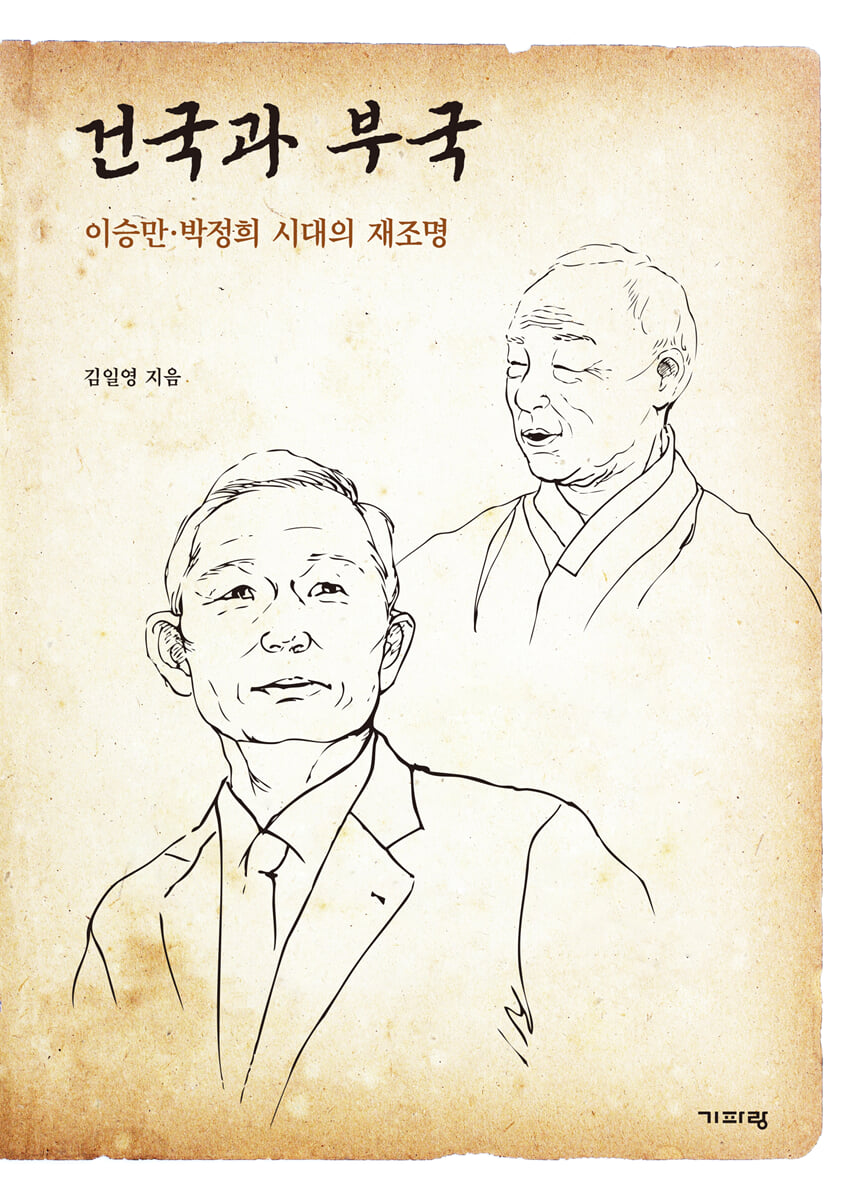
Founding and enrichment of the nation
 |
Description
Book Introduction
What do the Syngman Rhee and Park Chung-hee regimes mean to us?
In the 60 years of modern Korean history, the period primarily examined in this book is the 30 years from liberation in 1945 to the establishment of the Yushin regime in 1972. This period can be said to be a period of national construction and industrialization, that is, the founding of the nation and the enrichment of the nation.
The author, who presents a different interpretation of history from revisionists and the "386 Generation," views modern Korean history from a more macroscopic and comparative perspective, rather than being caught up in a microscopic, nationalistic, or moralistic perspective.
The author approaches the division process from the perspective of the global historical development of the Cold War, and then analyzes land reform and the Korean War from the perspective of state formation and national formation. The author positions the 1950s as a budding period preparing for the development and dynamism of the 1960s and beyond, and reexamines the short life of the Chang Myon regime and the rapid economic development under the Park Chung-hee regime from the perspective of the formation and development of a developmental state.
It covers modern Korean history from liberation to the Park Chung-hee Yushin era.
The author, a political scientist, collected and meticulously reviewed primary sources with more effort than a historian, analyzing the political history of South Korea up to the late 1970s from a comparative historical perspective.
The objectivity of his interpretation, based on such analysis, is accepted by scholars of both the left and the right, regardless of ideological leanings.
This book serves as a compass to correct the errors that many academic studies have revealed due to the generalities and specificities inherent in modern Korean history.
For a long time, scholars in our society, regardless of their political affiliation, have tended to selectively and arbitrarily piece together the special experiences and general phenomena of modern Korea after liberation, and cleverly utilize them to rationalize their arguments.
This book goes beyond such limitations and objectively interprets modern history by establishing a sophisticated analytical framework that uses world historical generalities as the warp and national historical specificities as the weft.
In the 60 years of modern Korean history, the period primarily examined in this book is the 30 years from liberation in 1945 to the establishment of the Yushin regime in 1972. This period can be said to be a period of national construction and industrialization, that is, the founding of the nation and the enrichment of the nation.
The author, who presents a different interpretation of history from revisionists and the "386 Generation," views modern Korean history from a more macroscopic and comparative perspective, rather than being caught up in a microscopic, nationalistic, or moralistic perspective.
The author approaches the division process from the perspective of the global historical development of the Cold War, and then analyzes land reform and the Korean War from the perspective of state formation and national formation. The author positions the 1950s as a budding period preparing for the development and dynamism of the 1960s and beyond, and reexamines the short life of the Chang Myon regime and the rapid economic development under the Park Chung-hee regime from the perspective of the formation and development of a developmental state.
It covers modern Korean history from liberation to the Park Chung-hee Yushin era.
The author, a political scientist, collected and meticulously reviewed primary sources with more effort than a historian, analyzing the political history of South Korea up to the late 1970s from a comparative historical perspective.
The objectivity of his interpretation, based on such analysis, is accepted by scholars of both the left and the right, regardless of ideological leanings.
This book serves as a compass to correct the errors that many academic studies have revealed due to the generalities and specificities inherent in modern Korean history.
For a long time, scholars in our society, regardless of their political affiliation, have tended to selectively and arbitrarily piece together the special experiences and general phenomena of modern Korea after liberation, and cleverly utilize them to rationalize their arguments.
This book goes beyond such limitations and objectively interprets modern history by establishing a sophisticated analytical framework that uses world historical generalities as the warp and national historical specificities as the weft.
- You can preview some of the book's contents.
Preview
index
Preface: How should we view modern Korean history?
Prologue: Modern Korean Political History Divided by Political Concepts
Chapter 1: The Birth of the Republic of Korea
Chapter 2: From Division to War
Chapter 3: The Korean War and Its Impact
Chapter 4: Stability, Unrest, and Collapse of the Syngman Rhee Regime
Chapter 5: The Sprout Period of the 1950s
Chapter 6: The April 19 Revolution, the Jang Myeon Regime, and the Legacy of Democracy
Chapter 7: The Rise of the Rich Nation, the Park Chung-hee Regime, and the Developmental State
Chapter 8: The Yushin Regime and Its Aftermath
Epilogue: How should we view the Park Chung-hee regime?
Chronology
Eulogy
Bokgansa
Prologue: Modern Korean Political History Divided by Political Concepts
Chapter 1: The Birth of the Republic of Korea
Chapter 2: From Division to War
Chapter 3: The Korean War and Its Impact
Chapter 4: Stability, Unrest, and Collapse of the Syngman Rhee Regime
Chapter 5: The Sprout Period of the 1950s
Chapter 6: The April 19 Revolution, the Jang Myeon Regime, and the Legacy of Democracy
Chapter 7: The Rise of the Rich Nation, the Park Chung-hee Regime, and the Developmental State
Chapter 8: The Yushin Regime and Its Aftermath
Epilogue: How should we view the Park Chung-hee regime?
Chronology
Eulogy
Bokgansa
Publisher's Review
This book, first published in 2004, was revised and supplemented after the author's death and republished in 2010. It went out of print over time, but was republished due to continued requests from readers.
From college students stamping their feet because they couldn't find the book, which was selected as a reference for a university lecture, to middle-aged readers who wanted to confirm the theoretical validity of their thoughts on Syngman Rhee and Park Chung-hee, the readers' requests for "Founding and Enriching a Nation" were as earnest as those for a best-selling novel.
There was even a rumor that it was being sold for 160,000 won in used bookstores.
From college students stamping their feet because they couldn't find the book, which was selected as a reference for a university lecture, to middle-aged readers who wanted to confirm the theoretical validity of their thoughts on Syngman Rhee and Park Chung-hee, the readers' requests for "Founding and Enriching a Nation" were as earnest as those for a best-selling novel.
There was even a rumor that it was being sold for 160,000 won in used bookstores.
GOODS SPECIFICS
- Date of issue: August 15, 2023
- Page count, weight, size: 492 pages | 810g | 150*210*30mm
- ISBN13: 9788965235125
- ISBN10: 896523512X
You may also like
카테고리
korean


korean

![GQ KOREA Mark (Monthly): December [2025]](http://librairie.coreenne.fr/cdn/shop/files/8ef265dbbfbf186523ed75ba7319009d.jpg?v=1765340328&width=3840)


