

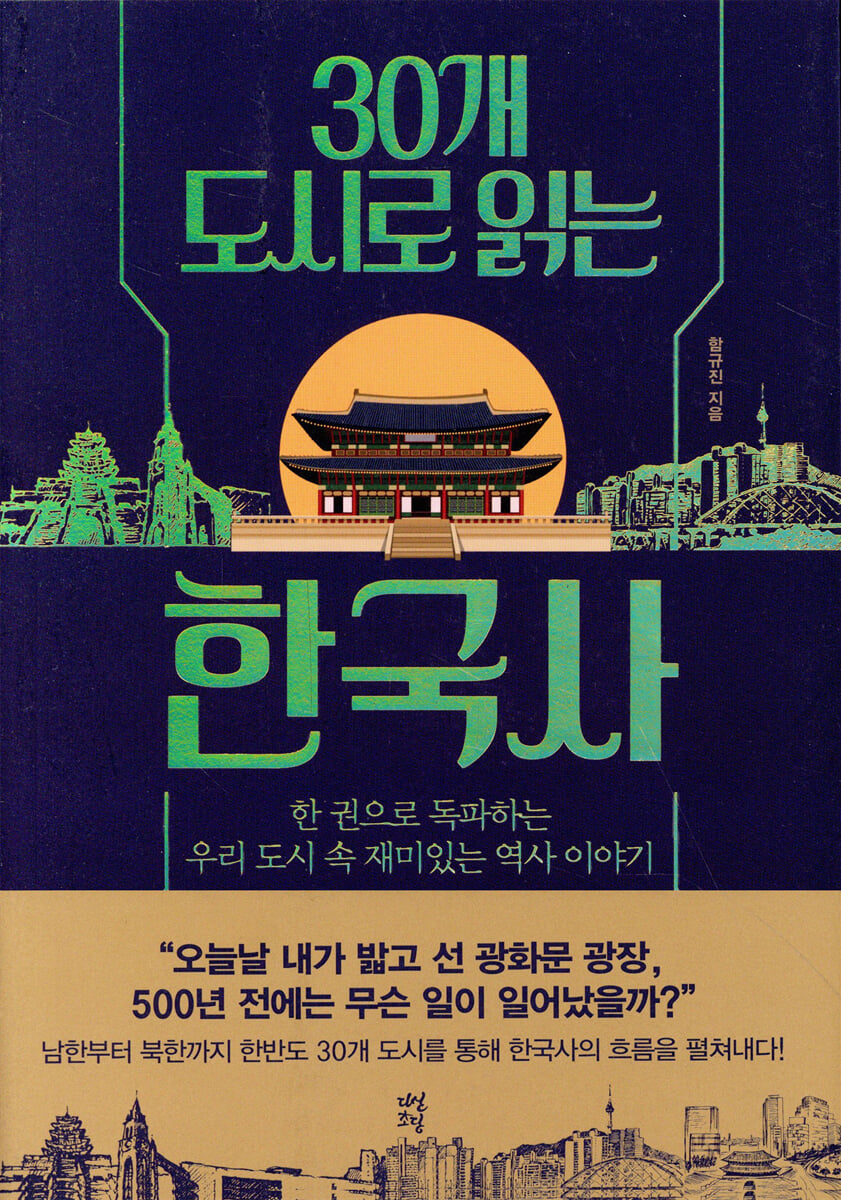
Korean History in 30 Cities
 |
Description
Book Introduction
“Gwanghwamun Square, where I stand today, “What happened 500 years ago?” Unfold the flow of Korean history through 30 cities across the Korean Peninsula, from South to North Korea! Seoul, Jeju, Busan, Kaesong, Pyongyang, Sinuiju… A walk through Korean history, visiting 30 cities that fostered civilization on the Korean Peninsula for thousands of years. Even when dynasties changed overnight and ruthless foreign invasions occurred, the city remained in its place and accumulated its own unique history. Therefore, when you look at the 'city', you can see through the history of the entire Korean peninsula, which has been preserved for thousands of years. From ancient times to the present, the 30 cities that shaped the Korean Peninsula are imbued with themes ranging from significant events that changed the course of history to the lives of the people who lived there. By opening a book like a light trip to one city a day, we will be able to gain detailed insight into the past and present of a city we were unaware of. |
- You can preview some of the book's contents.
Preview
index
A Korean History Travel Map to 30 Cities
01 Seoul, the center of all memories of the Republic of Korea
02 Suwon, the city of water filled with King Jeongjo's dreams
03 Princess Embracing the Splendid Baekje Culture
04 Road leading to anywhere in Cheonan
05 Jeonju, a city of cultural tourism with a strong sense of style
06 Gwangju, that day that never ended
07 Namwon, the land of art that hopes for the return of spring
08 Yeosu Three Colors of the Sea
09 Jeju Island that never sleeps
Waiting for the day to boil again like a 10-part cauldron
11. The Millennium Boundary of Tsushima Island
12 Kim Hae's Golden Sea Warriors
13 Ulsan, Korea's leading industrial city
14 Gyeongju, the golden land where the yellow dragon played
Shouting out the resistance movement in the 15th district
16 Andong upholds two high ideals
17 Gangneung Kingdom of Immortals
18 Incheon Sea Road and Sky Road Starting Point
19 Paju, a peaceful capital that wishes for unification
20 Years of the Oldest Korean Traces
21 Shangdo, the city that brought about the blossoming of Goryeo culture
A city that did not yield to the king of the 22nd year
23 Pyongyang Red Washington
A city that moves forward despite the pain of the 24-hour bombing of Wonsan Mountain
25 Hamheung, the sacred site of the Joseon Dynasty
26 Sinuiju, the gateway connecting China and Korea
27. Beyond the Yalu River, a secret hideout for spies from various countries.
28 The Unforgotten Royal Road
29 Long Jing, the city of counting stars
30 Ning An, a city that holds the dream of Balhae
Source of the illustration
01 Seoul, the center of all memories of the Republic of Korea
02 Suwon, the city of water filled with King Jeongjo's dreams
03 Princess Embracing the Splendid Baekje Culture
04 Road leading to anywhere in Cheonan
05 Jeonju, a city of cultural tourism with a strong sense of style
06 Gwangju, that day that never ended
07 Namwon, the land of art that hopes for the return of spring
08 Yeosu Three Colors of the Sea
09 Jeju Island that never sleeps
Waiting for the day to boil again like a 10-part cauldron
11. The Millennium Boundary of Tsushima Island
12 Kim Hae's Golden Sea Warriors
13 Ulsan, Korea's leading industrial city
14 Gyeongju, the golden land where the yellow dragon played
Shouting out the resistance movement in the 15th district
16 Andong upholds two high ideals
17 Gangneung Kingdom of Immortals
18 Incheon Sea Road and Sky Road Starting Point
19 Paju, a peaceful capital that wishes for unification
20 Years of the Oldest Korean Traces
21 Shangdo, the city that brought about the blossoming of Goryeo culture
A city that did not yield to the king of the 22nd year
23 Pyongyang Red Washington
A city that moves forward despite the pain of the 24-hour bombing of Wonsan Mountain
25 Hamheung, the sacred site of the Joseon Dynasty
26 Sinuiju, the gateway connecting China and Korea
27. Beyond the Yalu River, a secret hideout for spies from various countries.
28 The Unforgotten Royal Road
29 Long Jing, the city of counting stars
30 Ning An, a city that holds the dream of Balhae
Source of the illustration
Detailed image

Into the book
In 1970, Jeon Tae-il, who was working as a garment worker at the Pyeonghwa Market, directly rejected this reality.
He first filed a complaint with the Dongdaemun District Office, then with the Ministry of Labor, and even sent a petition to the president, but when it was of no use, he finally burned a copy of the Labor Standards Act on November 13, poured kerosene on himself, and set himself on fire in front of Pyeonghwa Market.
“Follow the Labor Standards Act!” This demand, neither radical nor extreme, was ignored, and the reality began to improve little by little only after he sacrificed his young life.
Today, a statue of him stands at 274 Cheonggyecheon-ro, where he committed suicide, and a memorial hall has also been built.
And Dongdaemun Market is being reborn as a mecca for fashion design with the opening of complex shopping malls focusing on fashion, clothing, and jewelry, such as Milliore and Doosan Tower, and the Dongdaemun Design Plaza.
---From "Seoul, Dongdaemun Area, pp. 66-67"
This "Daepungga" is a song that Liu Bang, the founder of the Han dynasty, sang at a banquet he held in his hometown of Pungbae after suppressing a rebellion by warlords in 196 BC.
In short, it was a song of an emperor who had conquered the world, and to Yi Seong-gye, Goryeo was already his own country.
It is said that Jeong Mong-ju, a friend of Yi Seong-gye and a loyal subject of Goryeo, was so shocked after hearing this song that he climbed Namgosanseong Fortress alone, cried, and wrote a patriotic poem.
But whether Jeong Mong-ju's heart broke or not, the spirit of the people of Jeonju was sky-high.
It must have felt like all the sadness I had endured was washed away.
It is said that the site of the victory feast is Omokdae, which still remains today.
Emperor Gojong of the Korean Empire visited this place in 1900 and erected a monument to Emperor Gojong's writings in his own handwriting to commemorate the feast of that day.
---From "Jeonju, page 153"
In May 1980, South Korea became a gigantic Golgotha.
Gwangju was crucified on it.
It doesn't seem like this situation was developed according to a single scenario, as some have claimed.
There was an escalation of the use of force, which often occurs in conflict situations.
At the beginning of the deployment, martial law forces attempted to disperse the protesters with only tear gas and batons.
However, the number and momentum of the protesters exceeded expectations, and there were even situations where the tear gas ran out.
The martial law army had no choice but to stop the protesters who were charging at them with bayonets.
As casualties arose, the excited protesters used vehicles to attack the martial law forces.
The martial law soldiers who saw their comrades being run over by cars and killed right before their eyes must have been so gripped by fear and anger that they fired live rounds.
There may have also been unnecessary harsh treatment of the suppressed protesters.
But blood calls forth blood.
There were female students who threw their textbooks and ran into the streets at the news that 'soldiers are killing their older sisters and brothers', fathers who ran into the streets with clubs or kitchen knives, their eyes wide open at the soldiers who stripped the female students naked and ordered them to bomb Wonsan, and young men who ran to the police station, turned over the fathers, and seized their weapons after seeing them being driven through the city with their bodies loaded onto a truck.
---From "Gwangju, page 180"
The most brutal and brutal uprising in Jeju Island's history began on April 3, 1948.
In early 1947, the conflict between police and civilians on Jeju Island, which had been brewing since the US military government, finally erupted into a large-scale armed conflict.
In the south, the leftists, unable to bear the prospect of a right-wing government being established, attacked government offices and right-wing groups first, and a general election was held in August under martial law, and a government was established.
The Syngman Rhee government took the situation unfolding in Jeju Island very seriously and ordered, 'Find out and punish all communists and their sympathizers.
He gave an order saying, ‘If necessary, you can kill all the people of Jeju Island.’
The Northwest Youth League, comprised of North Koreans who had lost their property and hometowns and whose eyes were bloodshot when they heard the word communist, was given military and police-like authority under Syngman Rhee's direction.
They and the military and police declared that "anyone living at the foot of Mt. Halla will be regarded as a communist spy and shot to death, regardless of the reason," and before the declaration was fully known, they raided mountain villages and killed and killed again.
There were countless instances of entire villages burning down and piles of corpses being left behind.
---From "Jeju, pp. 259-260"
There is an international market on the inland side, and a Jagalchi market on the seaside side.
The International Market, which became famous through movies, was created when Busan's poor and refugees sat on the floor and sold items left behind by the Japanese and discarded by American soldiers.
Since these were items picked up from various places, they were truly a variety of street goods, and it is said that the term "flea market" originated from here.
Jagalchi Market is said to have been named Jagalchi because of the many pebbles on the beach. During the Japanese colonial period, it was once used as a beach, but then a fish market was built there.
It has long been one of the must-visit attractions for anyone visiting Busan, and is still said to be the world's largest fish market.
Jagalchi is literally the most vibrant beach in the world.
---From "Busan, page 285"
During the reign of King Myeongjong, when the politics of favoritism was at its peak, Im Kkeok-jeong shook Hwanghae-do.
Although he was not from Haeju, he was active in Haeju and its surrounding areas.
Jang Gil-san, who is considered one of the three greatest bandits of Joseon along with Im Kkeok-jeong, lived during the reign of King Sukjong and was active in Pyeongan Province and Hwanghae Province.
Although it is not certain, there is a rumor that his hometown is Haeju.
They were evaluated as not being simple criminals, but rather representing the people who strongly criticized corrupt officials and wrong politics.
The common people also had a strong spirit of resistance.
Immediately after the Byeongjahoran, when the government, which was intimidated by the Later Jin army, took a very humble stance, there was an incident where the people of Haeju privately attacked and killed Later Jin soldiers.
After tensions between the two countries rose again, while the court was away on a walk, the Later Jin army retaliated by brutally ravaging the Haeju and Hwanghae regions.
In 1770, during the reign of King Yeongjo, the people of Haeju blocked the king's procession and staged a sit-in protest, shouting, "The pastor is a very bad person. Please replace him!"
The court lamented that it was something they had never heard of or seen before.
Even fighting on the road where the royal family passes is a matter of death, so how much more so for a group of people, not even individuals, to stage a demonstration as if they were trying to capture the king!
---From "Haeju, pp. 531-532"
Yi Seong-gye once made his name known through his performances in Uiju.
In 1370, he launched the first expedition to conquer Liaodong under the direction of King Gongmin.
The area around Dongningfu was returned to Goryeo, but Dongningfu itself was moved to Liaodong.
Dongningbu was also the stronghold of the Gi clan, which had been shaking the Goryeo government with Empress Gi as its background, so an attempt was made to subdue it.
Yi Seong-gye set out from Uiju in December with 1,200 troops, crossed the Yalu River, and moved to Dandong.
At that time, there were no bridges, and for some reason, the Yalu River did not freeze in the middle of winter, so they say they built a pontoon bridge to cross it.
From Dongningbu, Lee Won-gyeong, Cheomyeong, and others confronted me.
Yi Seong-gye first defeated Yi Won-gyeong and received his surrender, then used him as a guide and advanced.
He also tried to defeat Cheomyeong and receive his surrender, but when he refused, Yi Seong-gye displayed his legendary archery skills and shot him in the leg first, then said, “If you still don’t surrender, I will shoot you in the head,” and ultimately received Cheomyeong’s surrender.
Afterwards, Cheomyeong became Lee Seong-gye's confidant, and followed him to the end, achieving great achievements.
---From "Shinuiju, p. 601"
Anyway, out of sight, out of mind, they say, and although it may have been like that at first, living in different cities naturally created a rift between father and son.
In the 8th year, the king of Hwangryong Kingdom sent Kanggung, but Haemyeong broke Kanggung with both hands.
However, King Yuri was displeased with this and ordered Hae-myeong to go to Hwangryong Kingdom. He then secretly sent a message to Hwangryong Kingdom saying, “Hae-myeong has been unfilial to me, so kill him instead.”
What constitutes unfilial piety? If you really think about it, you might say, "Who am I to destroy a gift from a neighboring country?" But even so, it's not considered unfilial piety so severe that it warrants death.
Hae-myeong returned safely, as if he had thought so too in Hwangryong Kingdom.
But the King of Glass's hatred did not cease, and a year later he said, "You have disrespected another country and have tarnished my face.
I command you.
He gave a chilling order: “Die.”
Hae-myeong replied, "I broke it because you sent me a taunt asking if I could handle such a strong bow, so I told you not to look down on Goguryeo." However, in the end, he said, "I cannot disobey my father's orders," planted a spear, rode his horse to that place, and committed suicide by being impaled by the spear.
---From "Gian, pp. 642-643"
Today, the Balhae capital site is located in Bohaijin.
When you go there, you will find the Sanggyeong Yuji Museum, which shows in detail the reality of the Balhae ruins that have been excavated and investigated since the 1930s.
However, the phrase describing Balhae from the beginning of the exhibition room is “one of the vassal states of the Tang Dynasty.
It is written as “a local ethnic government centered on the Sokmalmalgal.”
This is a phrase that completely denies the truth that Balhae was a successor state to Goguryeo with a royal family of Goguryeo descent, that it was an independent state called Haedongseongguk that could never be called a vassal state even though it formally paid tribute to Tang, and furthermore, that it completely denies the identity of Balhae as a part of Korean history.
This has been China's consistent position even before the term "Northeast Project" itself was introduced.
Accordingly, there are constant protests from Korean researchers and tourists visiting this place, and every time an international academic conference on Balhae is held, a fierce battle erupts between scholars from the two countries over the question, "Is Balhae history Korean history or Chinese history?"
Recently, Russia has even suggested, oddly enough, that Balhae history should be viewed as part of Central Asian history, mediating between the two countries' excessive nationalistic views.
The grasslands of Central Asia and the forests of Manchuria have completely different living and cultural environments, but the reason for this claim is the perception that Russia is the leader of Central Asia.
It is like the Japanese view of Manchuria, which considered the entire Manchurian land, including the Korean Peninsula, to be Japanese territory.
He first filed a complaint with the Dongdaemun District Office, then with the Ministry of Labor, and even sent a petition to the president, but when it was of no use, he finally burned a copy of the Labor Standards Act on November 13, poured kerosene on himself, and set himself on fire in front of Pyeonghwa Market.
“Follow the Labor Standards Act!” This demand, neither radical nor extreme, was ignored, and the reality began to improve little by little only after he sacrificed his young life.
Today, a statue of him stands at 274 Cheonggyecheon-ro, where he committed suicide, and a memorial hall has also been built.
And Dongdaemun Market is being reborn as a mecca for fashion design with the opening of complex shopping malls focusing on fashion, clothing, and jewelry, such as Milliore and Doosan Tower, and the Dongdaemun Design Plaza.
---From "Seoul, Dongdaemun Area, pp. 66-67"
This "Daepungga" is a song that Liu Bang, the founder of the Han dynasty, sang at a banquet he held in his hometown of Pungbae after suppressing a rebellion by warlords in 196 BC.
In short, it was a song of an emperor who had conquered the world, and to Yi Seong-gye, Goryeo was already his own country.
It is said that Jeong Mong-ju, a friend of Yi Seong-gye and a loyal subject of Goryeo, was so shocked after hearing this song that he climbed Namgosanseong Fortress alone, cried, and wrote a patriotic poem.
But whether Jeong Mong-ju's heart broke or not, the spirit of the people of Jeonju was sky-high.
It must have felt like all the sadness I had endured was washed away.
It is said that the site of the victory feast is Omokdae, which still remains today.
Emperor Gojong of the Korean Empire visited this place in 1900 and erected a monument to Emperor Gojong's writings in his own handwriting to commemorate the feast of that day.
---From "Jeonju, page 153"
In May 1980, South Korea became a gigantic Golgotha.
Gwangju was crucified on it.
It doesn't seem like this situation was developed according to a single scenario, as some have claimed.
There was an escalation of the use of force, which often occurs in conflict situations.
At the beginning of the deployment, martial law forces attempted to disperse the protesters with only tear gas and batons.
However, the number and momentum of the protesters exceeded expectations, and there were even situations where the tear gas ran out.
The martial law army had no choice but to stop the protesters who were charging at them with bayonets.
As casualties arose, the excited protesters used vehicles to attack the martial law forces.
The martial law soldiers who saw their comrades being run over by cars and killed right before their eyes must have been so gripped by fear and anger that they fired live rounds.
There may have also been unnecessary harsh treatment of the suppressed protesters.
But blood calls forth blood.
There were female students who threw their textbooks and ran into the streets at the news that 'soldiers are killing their older sisters and brothers', fathers who ran into the streets with clubs or kitchen knives, their eyes wide open at the soldiers who stripped the female students naked and ordered them to bomb Wonsan, and young men who ran to the police station, turned over the fathers, and seized their weapons after seeing them being driven through the city with their bodies loaded onto a truck.
---From "Gwangju, page 180"
The most brutal and brutal uprising in Jeju Island's history began on April 3, 1948.
In early 1947, the conflict between police and civilians on Jeju Island, which had been brewing since the US military government, finally erupted into a large-scale armed conflict.
In the south, the leftists, unable to bear the prospect of a right-wing government being established, attacked government offices and right-wing groups first, and a general election was held in August under martial law, and a government was established.
The Syngman Rhee government took the situation unfolding in Jeju Island very seriously and ordered, 'Find out and punish all communists and their sympathizers.
He gave an order saying, ‘If necessary, you can kill all the people of Jeju Island.’
The Northwest Youth League, comprised of North Koreans who had lost their property and hometowns and whose eyes were bloodshot when they heard the word communist, was given military and police-like authority under Syngman Rhee's direction.
They and the military and police declared that "anyone living at the foot of Mt. Halla will be regarded as a communist spy and shot to death, regardless of the reason," and before the declaration was fully known, they raided mountain villages and killed and killed again.
There were countless instances of entire villages burning down and piles of corpses being left behind.
---From "Jeju, pp. 259-260"
There is an international market on the inland side, and a Jagalchi market on the seaside side.
The International Market, which became famous through movies, was created when Busan's poor and refugees sat on the floor and sold items left behind by the Japanese and discarded by American soldiers.
Since these were items picked up from various places, they were truly a variety of street goods, and it is said that the term "flea market" originated from here.
Jagalchi Market is said to have been named Jagalchi because of the many pebbles on the beach. During the Japanese colonial period, it was once used as a beach, but then a fish market was built there.
It has long been one of the must-visit attractions for anyone visiting Busan, and is still said to be the world's largest fish market.
Jagalchi is literally the most vibrant beach in the world.
---From "Busan, page 285"
During the reign of King Myeongjong, when the politics of favoritism was at its peak, Im Kkeok-jeong shook Hwanghae-do.
Although he was not from Haeju, he was active in Haeju and its surrounding areas.
Jang Gil-san, who is considered one of the three greatest bandits of Joseon along with Im Kkeok-jeong, lived during the reign of King Sukjong and was active in Pyeongan Province and Hwanghae Province.
Although it is not certain, there is a rumor that his hometown is Haeju.
They were evaluated as not being simple criminals, but rather representing the people who strongly criticized corrupt officials and wrong politics.
The common people also had a strong spirit of resistance.
Immediately after the Byeongjahoran, when the government, which was intimidated by the Later Jin army, took a very humble stance, there was an incident where the people of Haeju privately attacked and killed Later Jin soldiers.
After tensions between the two countries rose again, while the court was away on a walk, the Later Jin army retaliated by brutally ravaging the Haeju and Hwanghae regions.
In 1770, during the reign of King Yeongjo, the people of Haeju blocked the king's procession and staged a sit-in protest, shouting, "The pastor is a very bad person. Please replace him!"
The court lamented that it was something they had never heard of or seen before.
Even fighting on the road where the royal family passes is a matter of death, so how much more so for a group of people, not even individuals, to stage a demonstration as if they were trying to capture the king!
---From "Haeju, pp. 531-532"
Yi Seong-gye once made his name known through his performances in Uiju.
In 1370, he launched the first expedition to conquer Liaodong under the direction of King Gongmin.
The area around Dongningfu was returned to Goryeo, but Dongningfu itself was moved to Liaodong.
Dongningbu was also the stronghold of the Gi clan, which had been shaking the Goryeo government with Empress Gi as its background, so an attempt was made to subdue it.
Yi Seong-gye set out from Uiju in December with 1,200 troops, crossed the Yalu River, and moved to Dandong.
At that time, there were no bridges, and for some reason, the Yalu River did not freeze in the middle of winter, so they say they built a pontoon bridge to cross it.
From Dongningbu, Lee Won-gyeong, Cheomyeong, and others confronted me.
Yi Seong-gye first defeated Yi Won-gyeong and received his surrender, then used him as a guide and advanced.
He also tried to defeat Cheomyeong and receive his surrender, but when he refused, Yi Seong-gye displayed his legendary archery skills and shot him in the leg first, then said, “If you still don’t surrender, I will shoot you in the head,” and ultimately received Cheomyeong’s surrender.
Afterwards, Cheomyeong became Lee Seong-gye's confidant, and followed him to the end, achieving great achievements.
---From "Shinuiju, p. 601"
Anyway, out of sight, out of mind, they say, and although it may have been like that at first, living in different cities naturally created a rift between father and son.
In the 8th year, the king of Hwangryong Kingdom sent Kanggung, but Haemyeong broke Kanggung with both hands.
However, King Yuri was displeased with this and ordered Hae-myeong to go to Hwangryong Kingdom. He then secretly sent a message to Hwangryong Kingdom saying, “Hae-myeong has been unfilial to me, so kill him instead.”
What constitutes unfilial piety? If you really think about it, you might say, "Who am I to destroy a gift from a neighboring country?" But even so, it's not considered unfilial piety so severe that it warrants death.
Hae-myeong returned safely, as if he had thought so too in Hwangryong Kingdom.
But the King of Glass's hatred did not cease, and a year later he said, "You have disrespected another country and have tarnished my face.
I command you.
He gave a chilling order: “Die.”
Hae-myeong replied, "I broke it because you sent me a taunt asking if I could handle such a strong bow, so I told you not to look down on Goguryeo." However, in the end, he said, "I cannot disobey my father's orders," planted a spear, rode his horse to that place, and committed suicide by being impaled by the spear.
---From "Gian, pp. 642-643"
Today, the Balhae capital site is located in Bohaijin.
When you go there, you will find the Sanggyeong Yuji Museum, which shows in detail the reality of the Balhae ruins that have been excavated and investigated since the 1930s.
However, the phrase describing Balhae from the beginning of the exhibition room is “one of the vassal states of the Tang Dynasty.
It is written as “a local ethnic government centered on the Sokmalmalgal.”
This is a phrase that completely denies the truth that Balhae was a successor state to Goguryeo with a royal family of Goguryeo descent, that it was an independent state called Haedongseongguk that could never be called a vassal state even though it formally paid tribute to Tang, and furthermore, that it completely denies the identity of Balhae as a part of Korean history.
This has been China's consistent position even before the term "Northeast Project" itself was introduced.
Accordingly, there are constant protests from Korean researchers and tourists visiting this place, and every time an international academic conference on Balhae is held, a fierce battle erupts between scholars from the two countries over the question, "Is Balhae history Korean history or Chinese history?"
Recently, Russia has even suggested, oddly enough, that Balhae history should be viewed as part of Central Asian history, mediating between the two countries' excessive nationalistic views.
The grasslands of Central Asia and the forests of Manchuria have completely different living and cultural environments, but the reason for this claim is the perception that Russia is the leader of Central Asia.
It is like the Japanese view of Manchuria, which considered the entire Manchurian land, including the Korean Peninsula, to be Japanese territory.
---From "Ning'an, pp. 685-686"
Publisher's Review
A new historical story hidden in a city that even Koreans didn't know about.
“If you know the history of a city, you will definitely fall in love with it!”
When we talk about 'Korean history', historical events are usually explained in chronological order, such as the Three Kingdoms period, the Goryeo period, and the Joseon period.
History books like this are full of textbook-like stories, so they are not fun to read, and unless you memorize them, you cannot understand the overall historical flow that connects different eras.
"Reading Korean History through 30 Cities" breaks away from conventional historical narratives and uncovers the hidden stories of cities that have remained in place and accumulated over the years.
The city, the crystallization of culture created by people, has remained in its place, preserving its history, even as its appearance has changed over time.
Unraveling the history of the Korean Peninsula centered around familiar cities shatters the common belief that "history is difficult," and allows us to learn about familiar yet unknown stories of our cities all at once.
The city we live in today, with its high-rise buildings, apartments, and subway lines, was the very setting of a history we only saw in textbooks.
By following the unique urban travel storytelling and traveling to representative cities of the eight provinces across the country, as well as North Korean cities such as Kaesong and Pyongyang, you can experience the vivid breath of history that even Koreans were unaware of.
Let's stroll through 30 cities, experiencing major historical events from ancient times to modern times, as well as the legends and tales hidden in every alley.
You will naturally fall in love with the charm of our cities that permeate Korean history.
The city most similar to Pyongyang today is Washington?!
A story about a North Korean city not covered in any other book!
Do you know which city most closely resembles Pyongyang today? Surprisingly, it's Washington, the capital of the United States, the heart of the world! You might wonder how the capitals of two quintessential capitalist and socialist nations could be the same, but Washington is undeniably the city on Earth most similar to Pyongyang.
Washington, D.C. is a diamond-shaped city with wide, long streets centered around the Washington Monument, which is modeled after an Egyptian pharaoh's obelisk.
And at each corner of the rhombus are the Capitol, the White House, the Lincoln Memorial, and the Jefferson Memorial.
The White House and the Capitol are the two pinnacles of American political power, and the Lincoln and Jefferson Memorials are shrines to the Founding Fathers, the fathers of modern America, and the freedmen of slavery.
The magnificent white building is surrounded by a wide, green lawn and the Potomac River.
I don't know if Washington was a reference when rebuilding Pyongyang after the war, but no other city is as similar as Washington in terms of dividing the urban space around the Taedong River into regular sections and arranging large monuments.
There are also cities in North Korea that have been touched by foreign influence.
It is 'Hamheung'.
Modern Hamheung is a German-style city.
This is because there was active support from East Germany during the post-war reconstruction of the city that was reduced to ashes.
Thanks to this, Hamheung was reborn as a neatly organized city like a modern Western city, and as a token of gratitude, the newly paved street was named 'Wilhelm Peak Boulevard'.
But now, they are quietly changing the name and promoting the post-war reconstruction as a product of their own efforts, such as the Chollima Movement.
To fight against foreign powers that are coveting our land and history.
A must-read travel history book that covers half a million years of history in one volume!
Even before the term "Northeast Project" appeared, China had claimed that Balhae was "one of the vassal states of the Tang Dynasty, a local ethnic regime centered on the Malgal people."
Even if there was formal tribute, the Haedongseong Kingdom was an independent nation and existed as a successor state to Goguryeo, so China's claim completely denies the identity of Balhae history, which is part of Korean history.
Recently, Russia has been interfering with China and South Korea.
He argues that Balhae history should be viewed as part of Central Asian history, mediating the excessive nationalistic views of the two countries.
Although the lifestyle, culture, and environment are all different, it is because of the perception that Russia is the leader of Central Asia.
Currently, China is attempting to have the Shangjing site registered as a UNESCO World Heritage Site.
While the registration of Balhae history on UNESCO is welcome, there are growing concerns that the historical perception of Balhae as a vassal state of China will become entrenched in the global perception, as the main entity attempting the registration is China.
Today, we live in reality without properly knowing history.
China covets Balhae history, and Japan claims Dokdo as Japanese territory.
To protect Korea in the world, we must first look into the history of our city, which we thought we knew well.
A nation that forgets its history has no future.
Let us reflect on our present indifference to history and pay attention to the history our ancestors have preserved.
The history that remains in the city will protect us, enlighten us, and show us the path we must take.
“If you know the history of a city, you will definitely fall in love with it!”
When we talk about 'Korean history', historical events are usually explained in chronological order, such as the Three Kingdoms period, the Goryeo period, and the Joseon period.
History books like this are full of textbook-like stories, so they are not fun to read, and unless you memorize them, you cannot understand the overall historical flow that connects different eras.
"Reading Korean History through 30 Cities" breaks away from conventional historical narratives and uncovers the hidden stories of cities that have remained in place and accumulated over the years.
The city, the crystallization of culture created by people, has remained in its place, preserving its history, even as its appearance has changed over time.
Unraveling the history of the Korean Peninsula centered around familiar cities shatters the common belief that "history is difficult," and allows us to learn about familiar yet unknown stories of our cities all at once.
The city we live in today, with its high-rise buildings, apartments, and subway lines, was the very setting of a history we only saw in textbooks.
By following the unique urban travel storytelling and traveling to representative cities of the eight provinces across the country, as well as North Korean cities such as Kaesong and Pyongyang, you can experience the vivid breath of history that even Koreans were unaware of.
Let's stroll through 30 cities, experiencing major historical events from ancient times to modern times, as well as the legends and tales hidden in every alley.
You will naturally fall in love with the charm of our cities that permeate Korean history.
The city most similar to Pyongyang today is Washington?!
A story about a North Korean city not covered in any other book!
Do you know which city most closely resembles Pyongyang today? Surprisingly, it's Washington, the capital of the United States, the heart of the world! You might wonder how the capitals of two quintessential capitalist and socialist nations could be the same, but Washington is undeniably the city on Earth most similar to Pyongyang.
Washington, D.C. is a diamond-shaped city with wide, long streets centered around the Washington Monument, which is modeled after an Egyptian pharaoh's obelisk.
And at each corner of the rhombus are the Capitol, the White House, the Lincoln Memorial, and the Jefferson Memorial.
The White House and the Capitol are the two pinnacles of American political power, and the Lincoln and Jefferson Memorials are shrines to the Founding Fathers, the fathers of modern America, and the freedmen of slavery.
The magnificent white building is surrounded by a wide, green lawn and the Potomac River.
I don't know if Washington was a reference when rebuilding Pyongyang after the war, but no other city is as similar as Washington in terms of dividing the urban space around the Taedong River into regular sections and arranging large monuments.
There are also cities in North Korea that have been touched by foreign influence.
It is 'Hamheung'.
Modern Hamheung is a German-style city.
This is because there was active support from East Germany during the post-war reconstruction of the city that was reduced to ashes.
Thanks to this, Hamheung was reborn as a neatly organized city like a modern Western city, and as a token of gratitude, the newly paved street was named 'Wilhelm Peak Boulevard'.
But now, they are quietly changing the name and promoting the post-war reconstruction as a product of their own efforts, such as the Chollima Movement.
To fight against foreign powers that are coveting our land and history.
A must-read travel history book that covers half a million years of history in one volume!
Even before the term "Northeast Project" appeared, China had claimed that Balhae was "one of the vassal states of the Tang Dynasty, a local ethnic regime centered on the Malgal people."
Even if there was formal tribute, the Haedongseong Kingdom was an independent nation and existed as a successor state to Goguryeo, so China's claim completely denies the identity of Balhae history, which is part of Korean history.
Recently, Russia has been interfering with China and South Korea.
He argues that Balhae history should be viewed as part of Central Asian history, mediating the excessive nationalistic views of the two countries.
Although the lifestyle, culture, and environment are all different, it is because of the perception that Russia is the leader of Central Asia.
Currently, China is attempting to have the Shangjing site registered as a UNESCO World Heritage Site.
While the registration of Balhae history on UNESCO is welcome, there are growing concerns that the historical perception of Balhae as a vassal state of China will become entrenched in the global perception, as the main entity attempting the registration is China.
Today, we live in reality without properly knowing history.
China covets Balhae history, and Japan claims Dokdo as Japanese territory.
To protect Korea in the world, we must first look into the history of our city, which we thought we knew well.
A nation that forgets its history has no future.
Let us reflect on our present indifference to history and pay attention to the history our ancestors have preserved.
The history that remains in the city will protect us, enlighten us, and show us the path we must take.
GOODS SPECIFICS
- Date of issue: July 25, 2023
- Page count, weight, size: 696 pages | 1,082g | 148*210*42mm
- ISBN13: 9791130699363
- ISBN10: 1130699366
You may also like
카테고리
korean


korean

![GQ KOREA Mark (Monthly): December [2025]](http://librairie.coreenne.fr/cdn/shop/files/8ef265dbbfbf186523ed75ba7319009d.jpg?v=1765340328&width=3840)


