

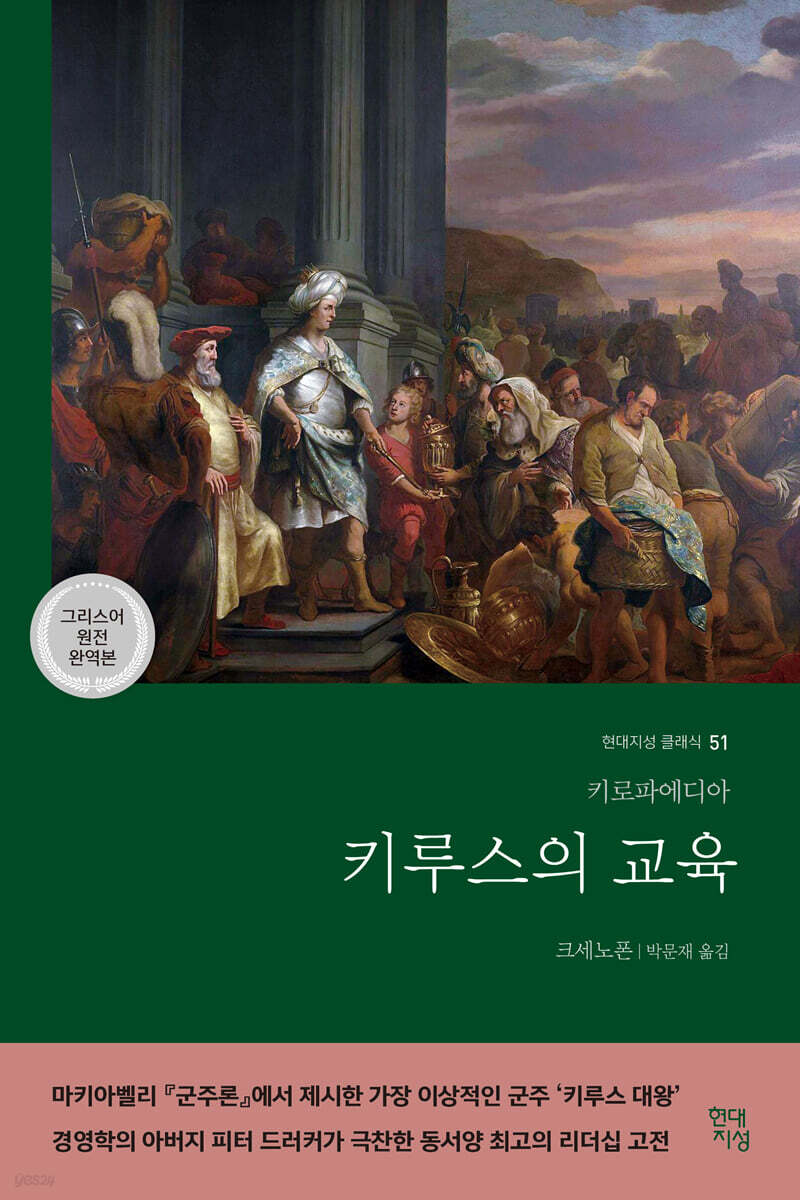
Cyrus's education
 |
Description
Book Introduction
Cyrus the Great, the most ideal monarch presented by Machiavelli in The Prince
The greatest leadership classic of the East and the West, highly praised by Peter Drucker, the father of management.
A leader's character and attitude, self-management, interpersonal relationships, organizational management, etc.
It embodies all the virtues of a true leader, transcending time and space.
As Greece descended into chaos and division after the Peloponnesian War, the practical historian Xenophon began to search for an example of a leader who could save the dark times.
The leader he finally found was Cyrus the Great, the Persian monarch (BC
600?-530).
Although Cyrus the Great was an enemy monarch, Xenophon discovered in him the virtues of a true leader who transcended time and country.
How did Cyrus the Great, who brought the Persian Empire to its zenith, grow into the great leader who built a vast empire? In "The Education of Cyrus," Xenophon retraces Cyrus' life from his extraordinary childhood to his triumphant rise to power as a ruler who effectively governed a vast empire. He reflects on the qualities and capabilities a true leader possesses.
This book unfilteredly presents the essence of Cyrus's leadership: how to fairly implement justice, how to take responsibility for oneself without relying on others, how to elicit voluntary obedience, how to promote talent, how to exercise thorough self-control without being swayed by desire, and how to run a sustainable empire.
As the monarch of a vast empire, Cyrus sought peaceful coexistence among all nations and peoples.
He severely punished the rulers of the conquered countries, but showed the appearance of a virtuous king who showed boundless mercy to the common people.
Moreover, the Jews who were liberated from Babylon thanks to Cyrus even praised the pagan king as “the shepherd of Jehovah.”
The 'King Cyrus' of the Old Testament is Cyrus the Great.
Xenophon's "The Education of Cyrus," comparable to Plato's "The Republic," is an immortal leadership textbook that has been loved for the past 2,400 years.
Alexander the Great enjoyed reading Cyrus on the battlefield, and Machiavelli presented Cyrus as the most ideal model of a monarch in The Prince.
Peter Drucker, the father of modern management, also praised this book as the greatest leadership classic of the East and the West.
The Modern Intellect Classics' 『The Education of Cyrus』 is a direct translation of the original Greek text, enhancing the completeness of the translation and providing the pleasure of reading classics by including 81 footnotes and translator's notes.
It will also serve as a source of great wisdom and inspiration for readers today who are contemplating what constitutes a true leader.
The greatest leadership classic of the East and the West, highly praised by Peter Drucker, the father of management.
A leader's character and attitude, self-management, interpersonal relationships, organizational management, etc.
It embodies all the virtues of a true leader, transcending time and space.
As Greece descended into chaos and division after the Peloponnesian War, the practical historian Xenophon began to search for an example of a leader who could save the dark times.
The leader he finally found was Cyrus the Great, the Persian monarch (BC
600?-530).
Although Cyrus the Great was an enemy monarch, Xenophon discovered in him the virtues of a true leader who transcended time and country.
How did Cyrus the Great, who brought the Persian Empire to its zenith, grow into the great leader who built a vast empire? In "The Education of Cyrus," Xenophon retraces Cyrus' life from his extraordinary childhood to his triumphant rise to power as a ruler who effectively governed a vast empire. He reflects on the qualities and capabilities a true leader possesses.
This book unfilteredly presents the essence of Cyrus's leadership: how to fairly implement justice, how to take responsibility for oneself without relying on others, how to elicit voluntary obedience, how to promote talent, how to exercise thorough self-control without being swayed by desire, and how to run a sustainable empire.
As the monarch of a vast empire, Cyrus sought peaceful coexistence among all nations and peoples.
He severely punished the rulers of the conquered countries, but showed the appearance of a virtuous king who showed boundless mercy to the common people.
Moreover, the Jews who were liberated from Babylon thanks to Cyrus even praised the pagan king as “the shepherd of Jehovah.”
The 'King Cyrus' of the Old Testament is Cyrus the Great.
Xenophon's "The Education of Cyrus," comparable to Plato's "The Republic," is an immortal leadership textbook that has been loved for the past 2,400 years.
Alexander the Great enjoyed reading Cyrus on the battlefield, and Machiavelli presented Cyrus as the most ideal model of a monarch in The Prince.
Peter Drucker, the father of modern management, also praised this book as the greatest leadership classic of the East and the West.
The Modern Intellect Classics' 『The Education of Cyrus』 is a direct translation of the original Greek text, enhancing the completeness of the translation and providing the pleasure of reading classics by including 81 footnotes and translator's notes.
It will also serve as a source of great wisdom and inspiration for readers today who are contemplating what constitutes a true leader.
- You can preview some of the book's contents.
Preview
index
Volume 1: Boy Cyrus
Book 2: Preparations for the Departure of Commander-in-Chief Cyrus and the Training of the Army
Book 3: Armenian Expedition
Book 4: The First War with the Assyrian Coalition
Book 5: Gobryas and Gadatas
Book 6: Before the Second War with the Assyrian Allies
Book 7: The Fall of Sardis and Babylon
Book 8: The Building of the Empire and the Death of Cyrus
Release | Park Moon-jae
Xenophon's Chronology
Book 2: Preparations for the Departure of Commander-in-Chief Cyrus and the Training of the Army
Book 3: Armenian Expedition
Book 4: The First War with the Assyrian Coalition
Book 5: Gobryas and Gadatas
Book 6: Before the Second War with the Assyrian Allies
Book 7: The Fall of Sardis and Babylon
Book 8: The Building of the Empire and the Death of Cyrus
Release | Park Moon-jae
Xenophon's Chronology
Detailed image

Into the book
But if we recall that Cyrus the Persian conquered countless peoples, nations, and peoples, and that they submitted to him, our thoughts change.
If you just do something skillfully, you can't help but think that ruling people isn't at all impossible or difficult.
We know that these people were many days' journey away from Cyrus, many months' journey away, had never seen Cyrus, and knew very well that they would never see him, yet they willingly submitted to him.
--- pp.10~11
My mother said.
“My son, the justice that your grandfather speaks of is not the same as the justice that is spoken of in Persia.
My grandfather is the ruler and master of everything in Media, but in Persia, justice is considered to be for everyone to share equally.
Your father prioritizes carrying out the commands of the state and accepting those commands, and he says that the standard is the law, not his own thoughts.
So if you come home having learned from your grandfather not monarchy, but tyranny, which is the idea that one man should have more than all the others, won't your father beat you to death?
--- pp.30~31
Cyrus said.
“But if my grandfather stays here and waits for reinforcements to join us, our troops will be too scared to move.
On the other hand, if any of us make any move to attack them, those raiders will immediately abandon their spoils and flee.” Cyrus’ words struck Astyages right in the heart.
So Astyages was amazed at how Cyrus had acquired such wisdom and keen observation.
He ordered his son to lead the cavalry and drive out those who were plundering the treasure, and then said:
“If these men, who are encamped in dense formation, move against you, I will attack them and make them turn against us.
--- p.39
Cambyses said.
“Son, it is difficult to always give benefits to those whom you want to give benefits to.
However, it is clear that we must be in solidarity with each other in these things: rejoicing together when good things happen to them, feeling pain together when bad things happen, working together to help each other when they face difficulties, worrying about whether bad things will happen to them, and trying to prevent bad things from happening in advance.
And as for conduct, the ruler must endure the heat of the sun in summer, the cold in winter, and the hardships of difficult times better than his subjects.
“In all these things, only by doing so can a ruler be loved by his subjects.”
--- p.61
You usually follow your prey wherever it leads you, without a guide, and wander up and down the mountains, but this time, don't go to places that are difficult to get to, and tell your guide to lead you by the easiest path, as long as it doesn't take too many circuitous routes.
Because for the military, the easiest way is the fastest way.
Don't make your soldiers run to you because you're used to running up the mountain, but make them hurry up and keep up with you at an appropriate pace.
It would also be a good idea to have a few of your strongest and most enthusiastic soldiers march behind and encourage the stragglers.
If you have such soldiers run in single file next to the marching soldiers, every soldier will see it and be inspired to hurry.”
--- p.107
Just as when people have to fight, it is right to consider the one who defeats the most enemies as the bravest, so when people have to be persuaded, it is right to consider the one who can persuade the most people to agree with our views as the most eloquent and capable.
When persuading someone, don't think about how to win them over by showing off your speaking skills. Instead, prepare to persuade people with the mindset of making them realize what will happen if they do what you suggest.
--- p.250
You have trained far more than the enemy in preparation for war, have trained together in the same place for far longer than the enemy, and have fought together to achieve victory after victory.
But the majority of the enemy are those who fought against us and were defeated.
It is the same for both enemies and allies, there are those who are fighting for the first time.
But while the enemy knows that there are traitors among those fighting beside them, we know that our comrades beside us are willing to fight alongside us.
(Omitted) Each of you must remind the soldiers under your command of what I have just reminded you of, and also demonstrate your resolute will to the soldiers through your posture, facial expressions, and words, so that the soldiers will trust and follow you.
--- pp.288~289
Even if you are brave now, you cannot remain brave unless you make a constant effort to maintain your bravery.
Just as other skills, if neglected and not practiced, will deteriorate, and even a physically fit person will become even more physically unwell if they live a comfortable and lazy life, so too will discernment, self-control, and physical strength deteriorate again if they are not continuously trained.
Therefore, we must not let our guard down, nor be immersed in the pleasures before our eyes.
I think that while acquiring an empire is a big deal, maintaining it once you've acquired it is an even bigger deal.
For while acquiring an empire often requires nothing more than boldness and courage, maintaining it once acquired requires discernment, self-control, and painstaking effort.
--- p.334
As Cyrus pondered how he could manage these administrative matters effectively while still having time to spare, his thoughts turned to the organization of the army.
Typically, a squad leader manages 10 squad members, a platoon leader manages squad leaders, a company commander manages platoon leaders, a regimental commander manages company commanders, and a division commander manages regimental commanders. Therefore, no matter how many people there are, there is not a single person who is not managed.
Whenever the commander-in-chief wants to use his troops for any purpose, he simply issues an order to his division commanders.
Cyrus centralized the administrative organization, modeling it after the military organization.
As a result, Cyrus was able to manage and supervise the administrative affairs of the empire without exception by directing them to a small number of people.
At last he had more free time than the man who managed a household or a ship.
After he reorganized the administrative organization, he instructed his associates to utilize the organization in the same way.
--- p.342
First of all, Cyrus always treated people with sincerity and warmth.
Just as it is not easy to love someone who hates us or to treat someone with good intentions, I thought it would be impossible to hate someone who showed love and good intentions to us.
In the beginning, Cyrus was not in a position to win people's hearts by using his wealth, so he tried to win their hearts by being considerate of them, trying to make things better for them, sharing their joys when good things happened, and sharing their pain when bad things happened.
But when he was later able to win people's hearts by giving them money, Cyrus seems to have known from the beginning that nothing would win people's hearts more than sharing food and drink with them, given the same cost.
--- p.349
I feel like it's time for me to leave, as my soul is leaving every part of my body.
Anyone present here who wishes to hold my right hand or look me in the eye while I am still alive, let him come near.
But my sons, after I die and my body is covered with a cloth, I ask that no one see my body, not even you.
Invite all Persians and allies to my funeral and share in my joy.
For now I will be free from all harm, whether with or without the gods.
Treat them with all courtesy and courtesy, as if you were treating guests at a banquet held in the home of a person who has become a great man.
Finally, remember that doing good to your friends is punishing your enemies.
Farewell, my beloved sons.
Say goodbye to your mother too.
I say goodbye to my friends who are here and to my friends who are not here.
If you just do something skillfully, you can't help but think that ruling people isn't at all impossible or difficult.
We know that these people were many days' journey away from Cyrus, many months' journey away, had never seen Cyrus, and knew very well that they would never see him, yet they willingly submitted to him.
--- pp.10~11
My mother said.
“My son, the justice that your grandfather speaks of is not the same as the justice that is spoken of in Persia.
My grandfather is the ruler and master of everything in Media, but in Persia, justice is considered to be for everyone to share equally.
Your father prioritizes carrying out the commands of the state and accepting those commands, and he says that the standard is the law, not his own thoughts.
So if you come home having learned from your grandfather not monarchy, but tyranny, which is the idea that one man should have more than all the others, won't your father beat you to death?
--- pp.30~31
Cyrus said.
“But if my grandfather stays here and waits for reinforcements to join us, our troops will be too scared to move.
On the other hand, if any of us make any move to attack them, those raiders will immediately abandon their spoils and flee.” Cyrus’ words struck Astyages right in the heart.
So Astyages was amazed at how Cyrus had acquired such wisdom and keen observation.
He ordered his son to lead the cavalry and drive out those who were plundering the treasure, and then said:
“If these men, who are encamped in dense formation, move against you, I will attack them and make them turn against us.
--- p.39
Cambyses said.
“Son, it is difficult to always give benefits to those whom you want to give benefits to.
However, it is clear that we must be in solidarity with each other in these things: rejoicing together when good things happen to them, feeling pain together when bad things happen, working together to help each other when they face difficulties, worrying about whether bad things will happen to them, and trying to prevent bad things from happening in advance.
And as for conduct, the ruler must endure the heat of the sun in summer, the cold in winter, and the hardships of difficult times better than his subjects.
“In all these things, only by doing so can a ruler be loved by his subjects.”
--- p.61
You usually follow your prey wherever it leads you, without a guide, and wander up and down the mountains, but this time, don't go to places that are difficult to get to, and tell your guide to lead you by the easiest path, as long as it doesn't take too many circuitous routes.
Because for the military, the easiest way is the fastest way.
Don't make your soldiers run to you because you're used to running up the mountain, but make them hurry up and keep up with you at an appropriate pace.
It would also be a good idea to have a few of your strongest and most enthusiastic soldiers march behind and encourage the stragglers.
If you have such soldiers run in single file next to the marching soldiers, every soldier will see it and be inspired to hurry.”
--- p.107
Just as when people have to fight, it is right to consider the one who defeats the most enemies as the bravest, so when people have to be persuaded, it is right to consider the one who can persuade the most people to agree with our views as the most eloquent and capable.
When persuading someone, don't think about how to win them over by showing off your speaking skills. Instead, prepare to persuade people with the mindset of making them realize what will happen if they do what you suggest.
--- p.250
You have trained far more than the enemy in preparation for war, have trained together in the same place for far longer than the enemy, and have fought together to achieve victory after victory.
But the majority of the enemy are those who fought against us and were defeated.
It is the same for both enemies and allies, there are those who are fighting for the first time.
But while the enemy knows that there are traitors among those fighting beside them, we know that our comrades beside us are willing to fight alongside us.
(Omitted) Each of you must remind the soldiers under your command of what I have just reminded you of, and also demonstrate your resolute will to the soldiers through your posture, facial expressions, and words, so that the soldiers will trust and follow you.
--- pp.288~289
Even if you are brave now, you cannot remain brave unless you make a constant effort to maintain your bravery.
Just as other skills, if neglected and not practiced, will deteriorate, and even a physically fit person will become even more physically unwell if they live a comfortable and lazy life, so too will discernment, self-control, and physical strength deteriorate again if they are not continuously trained.
Therefore, we must not let our guard down, nor be immersed in the pleasures before our eyes.
I think that while acquiring an empire is a big deal, maintaining it once you've acquired it is an even bigger deal.
For while acquiring an empire often requires nothing more than boldness and courage, maintaining it once acquired requires discernment, self-control, and painstaking effort.
--- p.334
As Cyrus pondered how he could manage these administrative matters effectively while still having time to spare, his thoughts turned to the organization of the army.
Typically, a squad leader manages 10 squad members, a platoon leader manages squad leaders, a company commander manages platoon leaders, a regimental commander manages company commanders, and a division commander manages regimental commanders. Therefore, no matter how many people there are, there is not a single person who is not managed.
Whenever the commander-in-chief wants to use his troops for any purpose, he simply issues an order to his division commanders.
Cyrus centralized the administrative organization, modeling it after the military organization.
As a result, Cyrus was able to manage and supervise the administrative affairs of the empire without exception by directing them to a small number of people.
At last he had more free time than the man who managed a household or a ship.
After he reorganized the administrative organization, he instructed his associates to utilize the organization in the same way.
--- p.342
First of all, Cyrus always treated people with sincerity and warmth.
Just as it is not easy to love someone who hates us or to treat someone with good intentions, I thought it would be impossible to hate someone who showed love and good intentions to us.
In the beginning, Cyrus was not in a position to win people's hearts by using his wealth, so he tried to win their hearts by being considerate of them, trying to make things better for them, sharing their joys when good things happened, and sharing their pain when bad things happened.
But when he was later able to win people's hearts by giving them money, Cyrus seems to have known from the beginning that nothing would win people's hearts more than sharing food and drink with them, given the same cost.
--- p.349
I feel like it's time for me to leave, as my soul is leaving every part of my body.
Anyone present here who wishes to hold my right hand or look me in the eye while I am still alive, let him come near.
But my sons, after I die and my body is covered with a cloth, I ask that no one see my body, not even you.
Invite all Persians and allies to my funeral and share in my joy.
For now I will be free from all harm, whether with or without the gods.
Treat them with all courtesy and courtesy, as if you were treating guests at a banquet held in the home of a person who has become a great man.
Finally, remember that doing good to your friends is punishing your enemies.
Farewell, my beloved sons.
Say goodbye to your mother too.
I say goodbye to my friends who are here and to my friends who are not here.
--- pp.398~399
Publisher's Review
Loved for 2,400 years
The Immortal Leadership Manual
The Education of Cyrus (Cyropaedia in Greek), written by Xenophon, an ancient Greek historian and philosopher, in the 4th century BC, is the greatest leadership textbook loved by mankind for the past 2,400 years.
As Peter Drucker, the father of modern management, said, it is not only the 'oldest' book in history that systematically deals with the leadership of a monarch, but also the 'highest' book.
History clearly demonstrates the value of this book.
Alexander the Great, who built a great empire that combined East and West, took Cyrus the Great, who had previously founded the great Persian Empire, as his role model.
He always took 『The Education of Cyrus』 with him to the battlefield and enjoyed reading it as a favorite book.
The Jews also praised Cyrus the Great as the Messiah.
Cyrus, who freed them from Babylonian captivity, was praised as “the shepherd of Jehovah.”
It is very unusual for Jews, who have a strong sense of chosen people, to exalt a pagan king.
Niccolò Machiavelli, a Renaissance political thinker, also considered Cyrus the Great to be the greatest monarch in history in his book The Prince.
The Prince, which was directly influenced by The Education of Cyrus, presented Cyrus the Great as the most ideal model of a monarch, along with Moses, Romulus, and Theseus.
What about today? Even today, "The Education of Cyrus" remains a rich source of wisdom and inspiration for great leaders, even to the point that Peter Drucker considered it the greatest leadership classic of the East and the West.
Xenophon, the practical historian,
In search of a true leader
How did Xenophon come to write "The Education of Cyrus"? With Greece in turmoil due to the Peloponnesian War between Athens and Sparta, Xenophon began searching for a model of a true leader who could save the dark times.
Although he was a Greek, he found leadership qualities to emulate in Cyrus, the leader of a rival nation at the time.
The reason why we were able to evaluate a person's character solely without falling into the ideological bias of a so-called 'country', 'nation', or 'era' is closely related to Xenophon's life and philosophy.
Xenophon was born in Athens, Greece, but served as a mercenary during the Persian Civil War.
When he returned to his homeland, he was expelled from Athens for serving as a mercenary in Persia, an ally of the enemy nation Sparta.
Xenophon had to spend the rest of his life on the outskirts of Sparta, where he wrote several works, including The Education of Cyrus.
Between the two empires of Greece and Persia, and between the two cities of Athens and Sparta, he lived as a 'borderline person' and a 'marginal person' who did not belong to either side.
Only when you stand on the edge can you see reality objectively and coolly.
Xenophon was able to pinpoint the true type of leader that Greece should pursue.
Xenophon, a disciple of Socrates, is compared to another disciple, Plato.
While Plato, in his Republic, presented a plausible but idealistic alternative, such as the "philosopher's rule," for how Greece could escape its crisis, Xenophon, in his Education of Cyrus, sought a realistic solution that could be implemented here and now.
Xenophon, a practical historian, incorporated his own philosophy into The Education of Cyrus, based on his own personal experiences and knowledge.
Transcending East and West, past and present
The Essence of Cyrus Leadership
Thanks to Xenophon's search for the essence of leadership that resonates with everyone, without leaning toward any one political or ideological faction, "The Education of Cyrus" has been loved by many for many years.
Although "The Education of Cyrus" is a biography covering Cyrus' life from his childhood until his death, it is not a simple biography.
Xenophon was inspired by Cyrus's virtues, but he also projected his own philosophy of leadership onto Cyrus.
This point had a great influence on the overall concept and composition of 『The Education of Cyrus』.
For example, early in the book, there is a story about the mother taking Cyrus to visit Media, the country of his maternal grandfather.
Like mother, like son, they say.
The mother teaches her son by comparing the differences in the justice pursued by Media and Persia.
In Media, the monarch's command was law, but in Persia, the law existed above the monarch.
Persia pursued justice as 'equality before all', which was also the value that Xenophon pursued.
Cyrus made this definition the guiding principle of his life as a leader.
"The Education of Cyrus" unfolds the story of Cyrus leading the war, conquering neighboring countries one by one, and ultimately establishing the vast Persian Empire.
In this process, we see Cyrus gradually grow in leadership from a mere general to the monarch of an empire.
It contains almost all the virtues a leader should possess, from 'self-management', which involves self-restraint as a leader, to 'human relations', which involves bestowing virtues on colleagues, to 'organizational management', which involves peacefully ruling the vast Persian Empire, comprised of diverse ethnic groups, without conflict.
Even today, we are acutely aware of the profound impact that one person's leadership can have on entire communities—home, school, company, society, nation, and the world.
Even if we live in a democratic society where everyone is the master, a leader who represents the community is inevitably needed.
Leadership is an eternal challenge for humanity as long as we live in a community.
We can glean the wisdom and insight we need to tackle this challenge from the best leadership classics.
The Education of Cyrus will serve as a wonderful example for us today, as it did for Xenophon and later generations.
The Immortal Leadership Manual
The Education of Cyrus (Cyropaedia in Greek), written by Xenophon, an ancient Greek historian and philosopher, in the 4th century BC, is the greatest leadership textbook loved by mankind for the past 2,400 years.
As Peter Drucker, the father of modern management, said, it is not only the 'oldest' book in history that systematically deals with the leadership of a monarch, but also the 'highest' book.
History clearly demonstrates the value of this book.
Alexander the Great, who built a great empire that combined East and West, took Cyrus the Great, who had previously founded the great Persian Empire, as his role model.
He always took 『The Education of Cyrus』 with him to the battlefield and enjoyed reading it as a favorite book.
The Jews also praised Cyrus the Great as the Messiah.
Cyrus, who freed them from Babylonian captivity, was praised as “the shepherd of Jehovah.”
It is very unusual for Jews, who have a strong sense of chosen people, to exalt a pagan king.
Niccolò Machiavelli, a Renaissance political thinker, also considered Cyrus the Great to be the greatest monarch in history in his book The Prince.
The Prince, which was directly influenced by The Education of Cyrus, presented Cyrus the Great as the most ideal model of a monarch, along with Moses, Romulus, and Theseus.
What about today? Even today, "The Education of Cyrus" remains a rich source of wisdom and inspiration for great leaders, even to the point that Peter Drucker considered it the greatest leadership classic of the East and the West.
Xenophon, the practical historian,
In search of a true leader
How did Xenophon come to write "The Education of Cyrus"? With Greece in turmoil due to the Peloponnesian War between Athens and Sparta, Xenophon began searching for a model of a true leader who could save the dark times.
Although he was a Greek, he found leadership qualities to emulate in Cyrus, the leader of a rival nation at the time.
The reason why we were able to evaluate a person's character solely without falling into the ideological bias of a so-called 'country', 'nation', or 'era' is closely related to Xenophon's life and philosophy.
Xenophon was born in Athens, Greece, but served as a mercenary during the Persian Civil War.
When he returned to his homeland, he was expelled from Athens for serving as a mercenary in Persia, an ally of the enemy nation Sparta.
Xenophon had to spend the rest of his life on the outskirts of Sparta, where he wrote several works, including The Education of Cyrus.
Between the two empires of Greece and Persia, and between the two cities of Athens and Sparta, he lived as a 'borderline person' and a 'marginal person' who did not belong to either side.
Only when you stand on the edge can you see reality objectively and coolly.
Xenophon was able to pinpoint the true type of leader that Greece should pursue.
Xenophon, a disciple of Socrates, is compared to another disciple, Plato.
While Plato, in his Republic, presented a plausible but idealistic alternative, such as the "philosopher's rule," for how Greece could escape its crisis, Xenophon, in his Education of Cyrus, sought a realistic solution that could be implemented here and now.
Xenophon, a practical historian, incorporated his own philosophy into The Education of Cyrus, based on his own personal experiences and knowledge.
Transcending East and West, past and present
The Essence of Cyrus Leadership
Thanks to Xenophon's search for the essence of leadership that resonates with everyone, without leaning toward any one political or ideological faction, "The Education of Cyrus" has been loved by many for many years.
Although "The Education of Cyrus" is a biography covering Cyrus' life from his childhood until his death, it is not a simple biography.
Xenophon was inspired by Cyrus's virtues, but he also projected his own philosophy of leadership onto Cyrus.
This point had a great influence on the overall concept and composition of 『The Education of Cyrus』.
For example, early in the book, there is a story about the mother taking Cyrus to visit Media, the country of his maternal grandfather.
Like mother, like son, they say.
The mother teaches her son by comparing the differences in the justice pursued by Media and Persia.
In Media, the monarch's command was law, but in Persia, the law existed above the monarch.
Persia pursued justice as 'equality before all', which was also the value that Xenophon pursued.
Cyrus made this definition the guiding principle of his life as a leader.
"The Education of Cyrus" unfolds the story of Cyrus leading the war, conquering neighboring countries one by one, and ultimately establishing the vast Persian Empire.
In this process, we see Cyrus gradually grow in leadership from a mere general to the monarch of an empire.
It contains almost all the virtues a leader should possess, from 'self-management', which involves self-restraint as a leader, to 'human relations', which involves bestowing virtues on colleagues, to 'organizational management', which involves peacefully ruling the vast Persian Empire, comprised of diverse ethnic groups, without conflict.
Even today, we are acutely aware of the profound impact that one person's leadership can have on entire communities—home, school, company, society, nation, and the world.
Even if we live in a democratic society where everyone is the master, a leader who represents the community is inevitably needed.
Leadership is an eternal challenge for humanity as long as we live in a community.
We can glean the wisdom and insight we need to tackle this challenge from the best leadership classics.
The Education of Cyrus will serve as a wonderful example for us today, as it did for Xenophon and later generations.
GOODS SPECIFICS
- Date of issue: June 1, 2023
- Page count, weight, size: 432 pages | 150*225*30mm
- ISBN13: 9791139710816
- ISBN10: 1139710818
You may also like
카테고리
korean


korean

![ELLE 엘르 스페셜 에디션 A형 : 12월 [2025]](http://librairie.coreenne.fr/cdn/shop/files/b8e27a3de6c9538896439686c6b0e8fb.jpg?v=1766436872&width=3840)


