

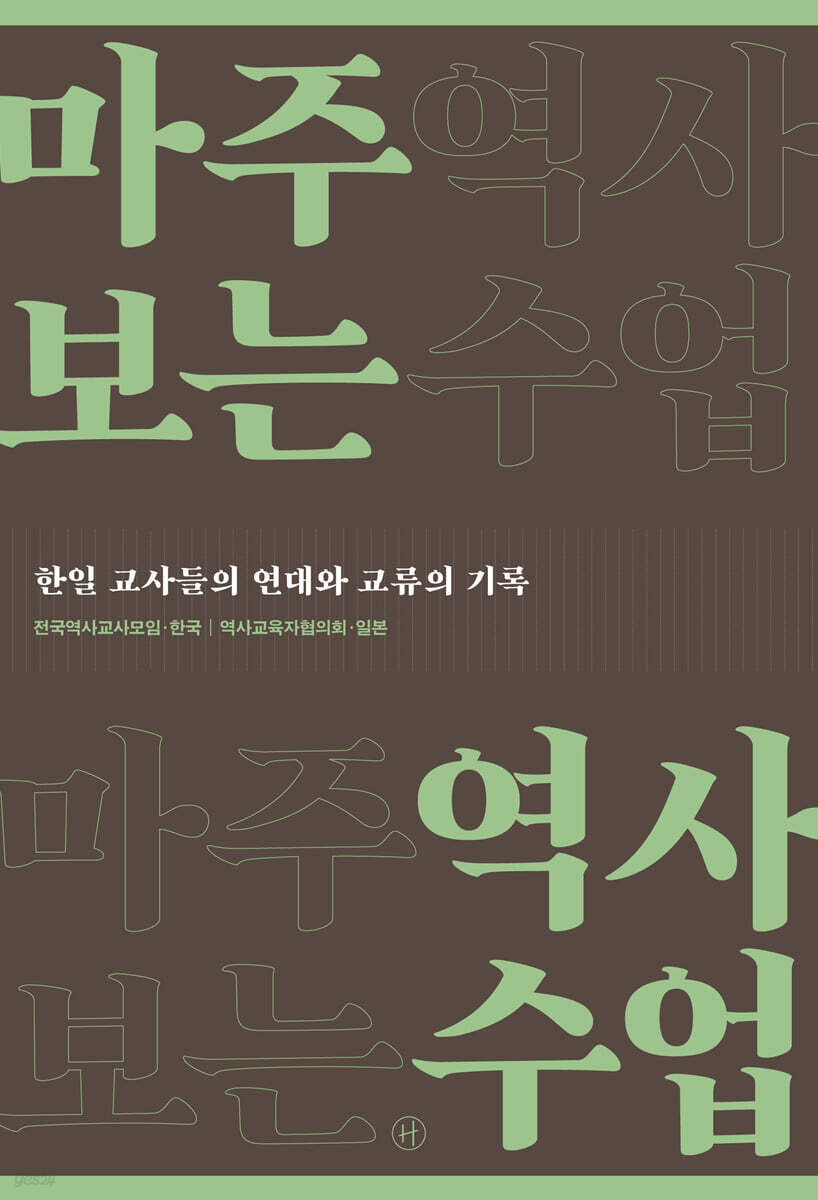
Facing history class
 |
Description
Book Introduction
Dreaming of peace, solidarity, and coexistence through history classes
Korean and Japanese history teachers
A record of history classes that we have been thinking about and practicing together for over 20 years.
Amid the ongoing turmoil of East Asia's historical wars, Korean and Japanese history teachers dreaming of peace, solidarity, and coexistence met.
This book contains 26 case studies of classroom practices created and shared through exchanges between the National History Teachers Association of Korea and the History Educators Association of Japan over the past 20 years.
Through a variety of class topics and methods, teachers' solidarity and practice can be seen in concrete ways, and students' concerns about Korea-Japan relations and hopes for the future can also be glimpsed.
This book will serve as a starting point for future generations to consider how to view and discuss "history" in order to create an East Asia of understanding, coexistence, and peace.
Korean and Japanese history teachers
A record of history classes that we have been thinking about and practicing together for over 20 years.
Amid the ongoing turmoil of East Asia's historical wars, Korean and Japanese history teachers dreaming of peace, solidarity, and coexistence met.
This book contains 26 case studies of classroom practices created and shared through exchanges between the National History Teachers Association of Korea and the History Educators Association of Japan over the past 20 years.
Through a variety of class topics and methods, teachers' solidarity and practice can be seen in concrete ways, and students' concerns about Korea-Japan relations and hopes for the future can also be glimpsed.
This book will serve as a starting point for future generations to consider how to view and discuss "history" in order to create an East Asia of understanding, coexistence, and peace.
- You can preview some of the book's contents.
Preview
index
In publishing the book
Part 1: Learning about life and culture
Chapter 1: Learning about the lives of common people in the Edo period through ukiyo-e
Understanding Humanity and History through Chapter 2, "The Lives of People in Gyeongseong During the Japanese Colonial Period."
Chapter 3: Comprehensive Learning for 6th Graders: Thinking About the Okinawan Language
Part 2: Thinking about War and Peace
The Asia-Pacific War, starting with Chapter 1, "Comparing the Monuments to the Fallen."
Chapter 2: The People of Korea and Japan Driven to the Battlefield
Chapter 3: Modern Japan and the World: Reflecting on the World and Okinawa from US Military Bases
Chapter 4: The Value of Peace - Focusing on the Okinawa and Jeju Gangjeong Bases
Chapter 5: Exploring History through the Statue of Peace
Part 3: Surrounding colonial rule
Chapter 1: How Do Japanese High School Students View Colonial Rule? - Reviewing the Textbook "Japanese History A"
Chapter 2: Thinking about Colonial Korea from the Perspective of "Building a Democratic Republic" - Overcoming Dichotomous Historical Perceptions
Chapter 3: The March 1st Movement and Female Students
Chapter 4: Korean and Japanese Students' Perceptions of the March 1st Movement
Part 4: Creating Classes from an East Asian Perspective
Chapter 1: The Imjin War as Seen by Middle School Students
Chapter 2: How to Teach the History of the Ainu, an Indigenous People, from an East Asian Perspective
Chapter 3 Sorry, Vietnam
Chapter 4: Territorial Education and Elementary School Students' Perceptions of Japan through Dokdo: Dokdo Education as a Future-Oriented Task for Korea and Japan
Part 5: In Search of New Korea-Japan Relations
Chapter 1: History Studies: Developing a Perspective on History and a Warm View of Neighboring Countries - Joseon Tongsinsa and Amenomori Hoshu Classes
Chapter 2: Getting Closer to a Society of Living Together Through Classes for Zainichi Koreans
Chapter 3: Not Repeating History: Words Turn to Swords
Chapter 4: The Path the Mind Makes, The Heart That Opens the Path
Chapter 5: The Roots of Conflict in East Asia and Finding a Path to Reconciliation
Learn the 6th lesson method
Chapter 1: Getting to Know Koreans in Japan Through "Our School"
Chapter 2: Learning about the Second Donghak Peasant Revolution - Was the Sino-Japanese War a War Between Japan and the Qing Dynasty?
Chapter 3: Library-based historical exploration of the Korean War
Chapter 4: 'Toyotomi Hideyoshi's Invasion of Joseon' Class with Korean Middle School Students - Through the Actions of Sayaka, the Anti-Japanese General
Chapter 5: Learning about the March 1st Movement through Research and Presentation
Epilogue
The significance and direction of exchanges between Korean and Japanese history educators
Exchanges between Japan and Korea
From personal experience to the future of Korea and Japan
About the publication of "Facing Korean-Japanese History"
supplement
Chronology of the Korea-Japan History Education Practice Symposium
Status of participation and presentations at the Japan History Educators Association National Conference
About the writers
Part 1: Learning about life and culture
Chapter 1: Learning about the lives of common people in the Edo period through ukiyo-e
Understanding Humanity and History through Chapter 2, "The Lives of People in Gyeongseong During the Japanese Colonial Period."
Chapter 3: Comprehensive Learning for 6th Graders: Thinking About the Okinawan Language
Part 2: Thinking about War and Peace
The Asia-Pacific War, starting with Chapter 1, "Comparing the Monuments to the Fallen."
Chapter 2: The People of Korea and Japan Driven to the Battlefield
Chapter 3: Modern Japan and the World: Reflecting on the World and Okinawa from US Military Bases
Chapter 4: The Value of Peace - Focusing on the Okinawa and Jeju Gangjeong Bases
Chapter 5: Exploring History through the Statue of Peace
Part 3: Surrounding colonial rule
Chapter 1: How Do Japanese High School Students View Colonial Rule? - Reviewing the Textbook "Japanese History A"
Chapter 2: Thinking about Colonial Korea from the Perspective of "Building a Democratic Republic" - Overcoming Dichotomous Historical Perceptions
Chapter 3: The March 1st Movement and Female Students
Chapter 4: Korean and Japanese Students' Perceptions of the March 1st Movement
Part 4: Creating Classes from an East Asian Perspective
Chapter 1: The Imjin War as Seen by Middle School Students
Chapter 2: How to Teach the History of the Ainu, an Indigenous People, from an East Asian Perspective
Chapter 3 Sorry, Vietnam
Chapter 4: Territorial Education and Elementary School Students' Perceptions of Japan through Dokdo: Dokdo Education as a Future-Oriented Task for Korea and Japan
Part 5: In Search of New Korea-Japan Relations
Chapter 1: History Studies: Developing a Perspective on History and a Warm View of Neighboring Countries - Joseon Tongsinsa and Amenomori Hoshu Classes
Chapter 2: Getting Closer to a Society of Living Together Through Classes for Zainichi Koreans
Chapter 3: Not Repeating History: Words Turn to Swords
Chapter 4: The Path the Mind Makes, The Heart That Opens the Path
Chapter 5: The Roots of Conflict in East Asia and Finding a Path to Reconciliation
Learn the 6th lesson method
Chapter 1: Getting to Know Koreans in Japan Through "Our School"
Chapter 2: Learning about the Second Donghak Peasant Revolution - Was the Sino-Japanese War a War Between Japan and the Qing Dynasty?
Chapter 3: Library-based historical exploration of the Korean War
Chapter 4: 'Toyotomi Hideyoshi's Invasion of Joseon' Class with Korean Middle School Students - Through the Actions of Sayaka, the Anti-Japanese General
Chapter 5: Learning about the March 1st Movement through Research and Presentation
Epilogue
The significance and direction of exchanges between Korean and Japanese history educators
Exchanges between Japan and Korea
From personal experience to the future of Korea and Japan
About the publication of "Facing Korean-Japanese History"
supplement
Chronology of the Korea-Japan History Education Practice Symposium
Status of participation and presentations at the Japan History Educators Association National Conference
About the writers
Publisher's Review
1.
Over 20 years of historical education exchange between Korea and Japan,
Contains records of that era and practice
The National History Teachers Association of Korea and the History Educators Association of Japan, deeply aware of the importance of history education in creating a true "East Asian community," took their first steps toward official exchange in 2001 and have continued to foster solidarity and exchange in the field of history education for over 20 years to overcome differences in historical perception.
In particular, in order to foster mutual understanding and future-oriented historical awareness, the joint Korean-Japanese history textbook 『Facing Korean-Japanese History』 pre-modern history section (I·II, 2007) and modern and contemporary history section (III, 2014) were published, and since 2002, the Korea-Japan History Education Exchange Symposium has been held annually to conduct class research and development and class practice exchanges so that the awareness and content contained in the joint textbook can be utilized as practical tools.
This book is a record of the exchange and solidarity between Korean and Japanese teachers over the past 20 years, as well as a record of the classroom practices they have explored and developed together.
It contains specific examples of individual classes, exchange classes between Korea and Japan, and joint classes between Korea and Japan that have been conducted in elementary, middle, and high schools in Korea and Japan from 2002 to the present.
The students' reflections from the class offer a glimpse into the concerns and hopes of students from both countries regarding Korea-Japan relations, war and peace, hatred and discrimination, and more. This raises expectations for the role of future generations who will continue to fill the gaps in the exchanges between Korean and Japanese teachers.
Classroom practice is a process of sharing historical awareness or communication with the next generation.
This is the starting point and the end point for our history educators.
If our historical education practices can secure a channel of communication across generations and national borders, it means our hopes and dreams will take root.
The passage will be a journey that continues forward without a destination, passing through generations.
We stand at the first stop on this endless journey toward the future.
- From the epilogue, "The Significance and Direction of Exchanges between Korean and Japanese History Educators" (p. 346)
2.
Korea and Japan: Letting Go of Misunderstandings and Prejudices About Each Other
- Contents of this 1
This book opens with a practical lesson that examines and imagines the daily lives of people in Gyeongseong during the Japanese colonial period and the popular culture of ancient Koreans and Japanese people, such as the Japanese folk painting 'Ukiyo-e'.
Because understanding the daily life and culture of a country or a certain era is the first step to knowing it.
By using the popular culture and people who lived in the great flow of history as teaching materials, we help students understand the reality of history and deepen their historical awareness.
It also contains classroom practices that address the issue of Japanese imperialism's colonial rule.
These classes study the March 1st Movement, which arose to understand the reality of colonial rule and overcome it, and specifically introduce the different perspectives and perceptions of Korean and Japanese students through their presentations and reflections.
Going one step further, I wanted to examine Korea-Japan relations from a broader perspective of East Asia, beyond the perspective of one's own country and people.
The students' reactions in actual classes demonstrate that viewing history outside the framework of one's own country or ethnicity is not an easy task. However, they also remind us that, above all, it is important to understand each other's differences of opinion through dialogue and to deepen our understanding and reflection on each other.
At a time when Korea-Japan relations are said to be at their worst since the war, it was difficult to convey to Korean high school students the opinions of Japanese middle school students who thought that the March 1st Movement should be suppressed or that it was difficult to say which side it was on.
However… … (Korean students) first accepted the thoughts of Japanese middle school students.
He went on to say that we must look at the incident from a “Korean perspective” and a “critical viewpoint” and “objectively understand the March 1st Movement.”
… … Korean students asked the Japanese students questions again from various perspectives.
Korean students seemed to be appealing to their Japanese counterparts that they should not perceive historical facts in a nationalistic manner, but rather learn the facts accurately and, based on this, overcome mutual distrust.
- From Part 3, Chapter 4, “Korean and Japanese Students’ Perceptions of the March 1st Movement” (page 154)
The teacher met with two students who had expressed the opinion that Dokdo should be shared between Korea and Japan and listened to their thoughts in depth.
… … Those students understood Dokdo as our territory.
However, in terms of how to resolve the (Dokdo) issue, the existing 'dialogue and compromise' was given importance.
Also, compromise is thought of as 'considering the other party's opinion and giving up some of my opinion', so the idea of 'dividing Dokdo' as a compromise came to be.
… … When Dokdo is proposed as a subject of compromise, the possibility that other students will react in the same way as these students will increase.
- From Part 4, Chapter 4, "Elementary School Students' Perceptions of Japan through Territorial Education and Dokdo" (pp. 193, 196)
3.
A history class that looks back on today and thinks about the future.
- Contents of this book 2
Rather than being buried in a past marred by invasion and exploitation, the class also explored how efforts could be made to forge a future for Korea-Japan relations within the remnants of that past.
This class explores the various names for "Zainichi Koreans," examining the problem of how state-centered history education limits understanding, empathy, and imagination for people in various situations throughout history. It also explores the possibility of combating hate with students through examples of historical instances where hate led to hate crimes (such as the massacre of Koreans during the Great Kanto Earthquake). Through these lessons, students reflect on the problems we face today and consider solutions.
There are also classroom practices that consider how the war will be remembered, who the victims of the war were, and examine Okinawa and Jeju, which still bear the scars of war.
These practices are an effort to reflect on war and peace with future generations and to explore how to pass on those memories and build a peaceful world without war.
Also, classes that utilize the controversy surrounding the removal of the Statue of Peace, which has been widely covered in various media, the case of a member of a famous Korean idol group who became controversial after wearing a T-shirt with a picture of an atomic bomb cloud, and the case of a Taiwanese idol who became controversial after waving the Taiwanese flag on a broadcast are also interesting.
This class is meaningful in that it fosters understanding and solidarity by bringing social issues that students are familiar with and interested in to the history class in a realistic way, allowing them to confirm each other's perceptions through dialogue and narrow the gaps.
We looked back at the history of current hate speech and hate crimes and used the massacre of Koreans during the Great Kanto Earthquake as a subject for class.
And to show that this is not just happening in Korea and Japan, but also in other regions, he also introduced the case of hate crimes against blacks during the Hurricane Katrina disaster in the United States in 2005.
On the other hand, I set the activities of the ‘Association to Excavate and Commemorate the Remains of Koreans Massacred during the Great Kanto Earthquake’ as an important topic of class, believing that it could provide a clue to solving the current problems of hate speech and hate crimes.
- From Part 5, Chapter 3, "Not Repeating the History of Words Turning into Swords" (pp. 226, 227)
Since the 2000s, the Korean Wave has been expanding, captivating young people across a wide range of fields.
… … However, it also appears that they are only ‘consuming’ the superficial aspects as entertainment and are avoiding and not attempting to confront the political aspects of Korea-Japan relations.
It is not uncommon for Japanese fans to lament that their favorite Korean celebrities are anti-Japanese when they post on social media celebrating March 1st or August 15th.
However, despite recognizing it as 'anti-Japanese', we do not delve deeply into its essence.
In order to understand the underlying differences in historical perception and to think about how to confront them, this class will cover the case of the "Atomic Bomb T-shirt."
- From Part 5, Chapter 4, “The Path Made by the Heart, the Heart That Opens the Path” (page 239)
4.
Creating classes that encourage self-questioning, thinking, and understanding
- Contents of this book 3
The strength of this book is that it introduces various teaching methods from elementary to high school, without any restrictions on department.
In particular, classes that encourage students to ask questions, explore, and understand on their own are attracting attention.
In Japanese elementary school classes, students learn the Okinawan language to answer the question they pose: "Is the Okinawan language a dialect or an independent language?" They write letters to experts like linguists and local broadcasters to ask for their opinions, and they compare and research maps and timelines to find things that seem strange on the list of fallen soldiers on the village's "War Memorial Monument" to learn about the Asia-Pacific War on their own.
Korean middle school students directly created questions about the Korean War and sought answers using materials from the school library, while Japanese high school students formed historical awareness through classes in which they critically reviewed, researched, presented, and discussed the contents related to colonial rule in Japanese history textbooks, evaluated textbook techniques, and wrote revisions. At the same time, they experienced historical research methods in which they read materials and discovered new topics within them.
Every class needs good questions to have meaningful learning.
In lecture-style classes, where teachers ask questions with predetermined answers and students answer them, it is difficult to come up with good questions.
When teaching about a time period that students find difficult to imagine or fully understand, their genuine questions are incredibly important.
In classroom practice where students ask questions and find answers on their own, you can encounter more diverse stories than in a teacher's lecture.
Learning that begins with finding 'strange things' is a process in which students discover and learn more about things in history that they find strange and unexpected, thereby expanding their historical awareness.
By investigating strange facts and engaging in conversations with one another, you gain a broader understanding by connecting various events and facts, and you can give your own meaning to the newly discovered historical facts.
In other words, it is a learning that can be expected to deepen historical awareness, including recognition of facts, recognition of relationships, and recognition of meaning.
In war studies like this one, it is important for students to develop historical awareness by thinking for themselves about how to create a peaceful society without another war.
- From Part 2, Chapter 1, "The Asia-Pacific War Begins with 'Comparing the Monuments to the Fallen'" (p. 63)
Basically, we let students choose topics that they were interested in… … Some students read history textbooks in detail, understood the issue of repatriation of prisoners of war in connection with the novel “The Square,” excavated the remains of fallen soldiers, understood the Korean War in the context of the conflict between capitalism and communism, compared life in South and North Korea, terminology that emerged after the war, food eaten by people during the Korean War, and even leaflets.
… … Topics were also selected starting from questions such as “Why did my grandmother become afraid of the term ‘red’?”, “Why did she start eating milmyeon in Busan?”, “Why did she start eating a lot of sujebi during the war?”, and “Why did the talk about armistice negotiations start in 1951, but the actual armistice agreement was signed in 1953?”
- From Part 6, Chapter 3, “Library-Based Historical Exploration Learning on the Korean War” (pp. 204, 305)
Over 20 years of historical education exchange between Korea and Japan,
Contains records of that era and practice
The National History Teachers Association of Korea and the History Educators Association of Japan, deeply aware of the importance of history education in creating a true "East Asian community," took their first steps toward official exchange in 2001 and have continued to foster solidarity and exchange in the field of history education for over 20 years to overcome differences in historical perception.
In particular, in order to foster mutual understanding and future-oriented historical awareness, the joint Korean-Japanese history textbook 『Facing Korean-Japanese History』 pre-modern history section (I·II, 2007) and modern and contemporary history section (III, 2014) were published, and since 2002, the Korea-Japan History Education Exchange Symposium has been held annually to conduct class research and development and class practice exchanges so that the awareness and content contained in the joint textbook can be utilized as practical tools.
This book is a record of the exchange and solidarity between Korean and Japanese teachers over the past 20 years, as well as a record of the classroom practices they have explored and developed together.
It contains specific examples of individual classes, exchange classes between Korea and Japan, and joint classes between Korea and Japan that have been conducted in elementary, middle, and high schools in Korea and Japan from 2002 to the present.
The students' reflections from the class offer a glimpse into the concerns and hopes of students from both countries regarding Korea-Japan relations, war and peace, hatred and discrimination, and more. This raises expectations for the role of future generations who will continue to fill the gaps in the exchanges between Korean and Japanese teachers.
Classroom practice is a process of sharing historical awareness or communication with the next generation.
This is the starting point and the end point for our history educators.
If our historical education practices can secure a channel of communication across generations and national borders, it means our hopes and dreams will take root.
The passage will be a journey that continues forward without a destination, passing through generations.
We stand at the first stop on this endless journey toward the future.
- From the epilogue, "The Significance and Direction of Exchanges between Korean and Japanese History Educators" (p. 346)
2.
Korea and Japan: Letting Go of Misunderstandings and Prejudices About Each Other
- Contents of this 1
This book opens with a practical lesson that examines and imagines the daily lives of people in Gyeongseong during the Japanese colonial period and the popular culture of ancient Koreans and Japanese people, such as the Japanese folk painting 'Ukiyo-e'.
Because understanding the daily life and culture of a country or a certain era is the first step to knowing it.
By using the popular culture and people who lived in the great flow of history as teaching materials, we help students understand the reality of history and deepen their historical awareness.
It also contains classroom practices that address the issue of Japanese imperialism's colonial rule.
These classes study the March 1st Movement, which arose to understand the reality of colonial rule and overcome it, and specifically introduce the different perspectives and perceptions of Korean and Japanese students through their presentations and reflections.
Going one step further, I wanted to examine Korea-Japan relations from a broader perspective of East Asia, beyond the perspective of one's own country and people.
The students' reactions in actual classes demonstrate that viewing history outside the framework of one's own country or ethnicity is not an easy task. However, they also remind us that, above all, it is important to understand each other's differences of opinion through dialogue and to deepen our understanding and reflection on each other.
At a time when Korea-Japan relations are said to be at their worst since the war, it was difficult to convey to Korean high school students the opinions of Japanese middle school students who thought that the March 1st Movement should be suppressed or that it was difficult to say which side it was on.
However… … (Korean students) first accepted the thoughts of Japanese middle school students.
He went on to say that we must look at the incident from a “Korean perspective” and a “critical viewpoint” and “objectively understand the March 1st Movement.”
… … Korean students asked the Japanese students questions again from various perspectives.
Korean students seemed to be appealing to their Japanese counterparts that they should not perceive historical facts in a nationalistic manner, but rather learn the facts accurately and, based on this, overcome mutual distrust.
- From Part 3, Chapter 4, “Korean and Japanese Students’ Perceptions of the March 1st Movement” (page 154)
The teacher met with two students who had expressed the opinion that Dokdo should be shared between Korea and Japan and listened to their thoughts in depth.
… … Those students understood Dokdo as our territory.
However, in terms of how to resolve the (Dokdo) issue, the existing 'dialogue and compromise' was given importance.
Also, compromise is thought of as 'considering the other party's opinion and giving up some of my opinion', so the idea of 'dividing Dokdo' as a compromise came to be.
… … When Dokdo is proposed as a subject of compromise, the possibility that other students will react in the same way as these students will increase.
- From Part 4, Chapter 4, "Elementary School Students' Perceptions of Japan through Territorial Education and Dokdo" (pp. 193, 196)
3.
A history class that looks back on today and thinks about the future.
- Contents of this book 2
Rather than being buried in a past marred by invasion and exploitation, the class also explored how efforts could be made to forge a future for Korea-Japan relations within the remnants of that past.
This class explores the various names for "Zainichi Koreans," examining the problem of how state-centered history education limits understanding, empathy, and imagination for people in various situations throughout history. It also explores the possibility of combating hate with students through examples of historical instances where hate led to hate crimes (such as the massacre of Koreans during the Great Kanto Earthquake). Through these lessons, students reflect on the problems we face today and consider solutions.
There are also classroom practices that consider how the war will be remembered, who the victims of the war were, and examine Okinawa and Jeju, which still bear the scars of war.
These practices are an effort to reflect on war and peace with future generations and to explore how to pass on those memories and build a peaceful world without war.
Also, classes that utilize the controversy surrounding the removal of the Statue of Peace, which has been widely covered in various media, the case of a member of a famous Korean idol group who became controversial after wearing a T-shirt with a picture of an atomic bomb cloud, and the case of a Taiwanese idol who became controversial after waving the Taiwanese flag on a broadcast are also interesting.
This class is meaningful in that it fosters understanding and solidarity by bringing social issues that students are familiar with and interested in to the history class in a realistic way, allowing them to confirm each other's perceptions through dialogue and narrow the gaps.
We looked back at the history of current hate speech and hate crimes and used the massacre of Koreans during the Great Kanto Earthquake as a subject for class.
And to show that this is not just happening in Korea and Japan, but also in other regions, he also introduced the case of hate crimes against blacks during the Hurricane Katrina disaster in the United States in 2005.
On the other hand, I set the activities of the ‘Association to Excavate and Commemorate the Remains of Koreans Massacred during the Great Kanto Earthquake’ as an important topic of class, believing that it could provide a clue to solving the current problems of hate speech and hate crimes.
- From Part 5, Chapter 3, "Not Repeating the History of Words Turning into Swords" (pp. 226, 227)
Since the 2000s, the Korean Wave has been expanding, captivating young people across a wide range of fields.
… … However, it also appears that they are only ‘consuming’ the superficial aspects as entertainment and are avoiding and not attempting to confront the political aspects of Korea-Japan relations.
It is not uncommon for Japanese fans to lament that their favorite Korean celebrities are anti-Japanese when they post on social media celebrating March 1st or August 15th.
However, despite recognizing it as 'anti-Japanese', we do not delve deeply into its essence.
In order to understand the underlying differences in historical perception and to think about how to confront them, this class will cover the case of the "Atomic Bomb T-shirt."
- From Part 5, Chapter 4, “The Path Made by the Heart, the Heart That Opens the Path” (page 239)
4.
Creating classes that encourage self-questioning, thinking, and understanding
- Contents of this book 3
The strength of this book is that it introduces various teaching methods from elementary to high school, without any restrictions on department.
In particular, classes that encourage students to ask questions, explore, and understand on their own are attracting attention.
In Japanese elementary school classes, students learn the Okinawan language to answer the question they pose: "Is the Okinawan language a dialect or an independent language?" They write letters to experts like linguists and local broadcasters to ask for their opinions, and they compare and research maps and timelines to find things that seem strange on the list of fallen soldiers on the village's "War Memorial Monument" to learn about the Asia-Pacific War on their own.
Korean middle school students directly created questions about the Korean War and sought answers using materials from the school library, while Japanese high school students formed historical awareness through classes in which they critically reviewed, researched, presented, and discussed the contents related to colonial rule in Japanese history textbooks, evaluated textbook techniques, and wrote revisions. At the same time, they experienced historical research methods in which they read materials and discovered new topics within them.
Every class needs good questions to have meaningful learning.
In lecture-style classes, where teachers ask questions with predetermined answers and students answer them, it is difficult to come up with good questions.
When teaching about a time period that students find difficult to imagine or fully understand, their genuine questions are incredibly important.
In classroom practice where students ask questions and find answers on their own, you can encounter more diverse stories than in a teacher's lecture.
Learning that begins with finding 'strange things' is a process in which students discover and learn more about things in history that they find strange and unexpected, thereby expanding their historical awareness.
By investigating strange facts and engaging in conversations with one another, you gain a broader understanding by connecting various events and facts, and you can give your own meaning to the newly discovered historical facts.
In other words, it is a learning that can be expected to deepen historical awareness, including recognition of facts, recognition of relationships, and recognition of meaning.
In war studies like this one, it is important for students to develop historical awareness by thinking for themselves about how to create a peaceful society without another war.
- From Part 2, Chapter 1, "The Asia-Pacific War Begins with 'Comparing the Monuments to the Fallen'" (p. 63)
Basically, we let students choose topics that they were interested in… … Some students read history textbooks in detail, understood the issue of repatriation of prisoners of war in connection with the novel “The Square,” excavated the remains of fallen soldiers, understood the Korean War in the context of the conflict between capitalism and communism, compared life in South and North Korea, terminology that emerged after the war, food eaten by people during the Korean War, and even leaflets.
… … Topics were also selected starting from questions such as “Why did my grandmother become afraid of the term ‘red’?”, “Why did she start eating milmyeon in Busan?”, “Why did she start eating a lot of sujebi during the war?”, and “Why did the talk about armistice negotiations start in 1951, but the actual armistice agreement was signed in 1953?”
- From Part 6, Chapter 3, “Library-Based Historical Exploration Learning on the Korean War” (pp. 204, 305)
GOODS SPECIFICS
- Date of issue: January 16, 2023
- Page count, weight, size: 367 pages | 532g | 150*220*18mm
- ISBN13: 9791160809572
- ISBN10: 1160809577
You may also like
카테고리
korean


korean

![ELLE 엘르 스페셜 에디션 A형 : 12월 [2025]](http://librairie.coreenne.fr/cdn/shop/files/b8e27a3de6c9538896439686c6b0e8fb.jpg?v=1766436872&width=3840)


