

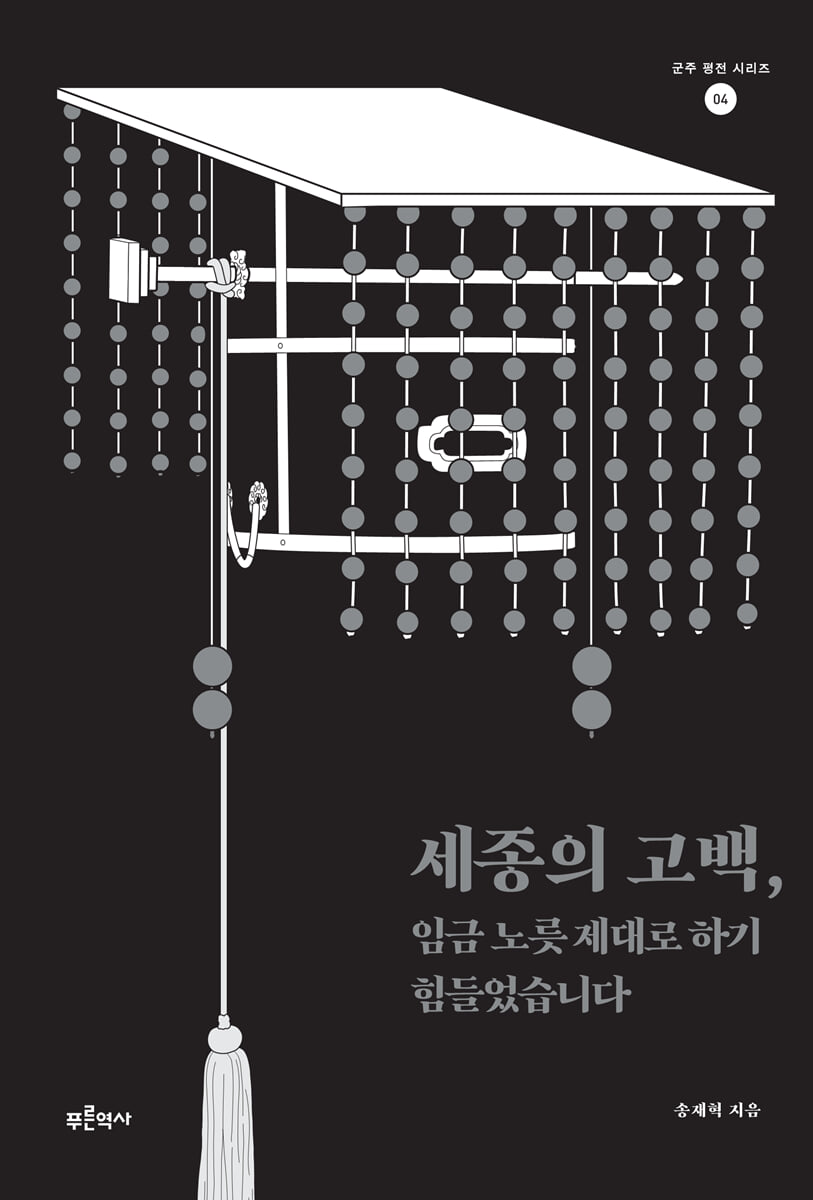
Sejong's confession: It was difficult to properly fulfill the role of king.
 |
Description
Book Introduction
32 years of 'peace of mind', 'for the people', and 'convenience of the people'
A young political scientist challenges the myth of King Sejong.
Beyond the dichotomy of success and failure
We who live on this land cannot leave Sejong.
Even this writing right now is thanks to the Hangul created by King Sejong.
Not only that, we also meet Sejong through the 10,000 won bills that we frequently use.
So, he is remembered as a very successful ruler, the greatest saintly king and wise king in Korean history.
However, Sejong himself, looking back on his reign in his later years, evaluated it as a failure.
As he said, it would be closer to the truth to say that Sejong was a person who grew through countless failures.
The author rejects the dichotomy of success and failure and seeks the true nature of King Sejong as a great ruler.
A young political scientist challenges the myth of King Sejong.
Beyond the dichotomy of success and failure
We who live on this land cannot leave Sejong.
Even this writing right now is thanks to the Hangul created by King Sejong.
Not only that, we also meet Sejong through the 10,000 won bills that we frequently use.
So, he is remembered as a very successful ruler, the greatest saintly king and wise king in Korean history.
However, Sejong himself, looking back on his reign in his later years, evaluated it as a failure.
As he said, it would be closer to the truth to say that Sejong was a person who grew through countless failures.
The author rejects the dichotomy of success and failure and seeks the true nature of King Sejong as a great ruler.
- You can preview some of the book's contents.
Preview
index
In publishing a book
prolog
Sejong Chronology
1.
The third prince who became king [from birth to father's death: 1397–1421]
Chapter 1: A Prince, Not a Crown Prince
1.
The third son of Prince Jeongan, Yi Bang-won
Born in Hanyang | Suspicious Records | Annals Revised by Lee Do | Political Man
2.
Life as the third prince
Brothers and Sisters | Teachers from the Grand Prince's Day | "Not an Ordinary Person" | A Prince, Not a Crown Prince
3.
An opportunity that came by chance
A Firm Successor | Taejong Drives Out the Crown Prince | Another Taejong, Yangnyeong
Chapter 2 The King Chosen by Taejong
1.
Become a crown prince
The Contenders | Being Selected as the Crown Prince | Life as a Crown Prince Less Than Two Months
2.
ascend to the throne
King Taejong's sudden abdication | Ascension to the throne at Gyeongbokgung Palace | Announcement of the coronation edict | Life as a king
3.
Take the first step
The Unprepared King | "I Will Report to the King" | The Great Learning Textbook
Chapter 3: Establishing a Position
1.
Apprenticeship period
King Taejong, the King of Kings | Taejong's Conspiracy | Unable to Prevent the Downfall of His Wife's Family | A Puppet King
2.
Develop your skills through patience
Jiphyeonjeon and Gyeongyeon | Understanding the Importance of Military Affairs | Learning the Power of the King
3.
Death of mother and father
Visiting Taejong's palace|Mother Min dies|Gaining the former king's trust|Father Taejong dies
2.
Standing Alone [First Half of Reign: 1422-1427]
Chapter 4: Starting a Family
1.
Carefully inherit the throne
Dangerous Person Yangnyeong | Eliminating Another Threat | Father's Servants
2.
Heaven's Test
Famine from the Beginning | Nine Years of Floods and Seven Years of Drought | Efforts to Provide Relief | Downsizing the Government
3.
Diplomacy is put to the test
The Tyranny of Emperor Yongle | Inheriting the Intellectual and Four-facedness of King Taejong | The Japanese in the South and the Barbarians in the North
Chapter 5: Trial and Error
1.
Begin to rule in earnest
The death of the sister and eldest daughter | The funeral of King Taejong is completed | The resumption of the military service | The faithful administration of state affairs | The era of the phenomenon of a virtuous king
2.
Taste failure
Attempting to popularize coins | Politics different from theory | Avoiding responsibility
3.
fall into crisis
Illness | The capital city of Hanyang burns | Reforms that ended in a flash
Chapter 6: Taking the Initiative
1.
Establish discipline
Punishing Taejong's favorites | Beginning a crackdown on corruption | Concluding with light punishments | The king's prerogatives | Aiming for 'politics of household affairs'
2.
Advocating military-monarchical politics
Pride in Academic Achievement | The Political Theory of Neo-Confucianism | Institutionalizing the Competition
3.
Summon Prince Yangnyeong
Preliminary Battle | Enforcing the Will | A New Era
3.
The Era of Peace [Mid-Reign Period 1: 1427–1432]
Chapter 7: The Four Great Powers and Friendship
1.
Serve with intelligence
Attempting to woo the Crown Prince | Diplomacy of a weak nation | Humiliation and patience
2.
The reality and achievements of the Four Great Powers
Exemption from Gold and Silver Works | Eunuchs from Joseon | Gaining the Emperor's Trust
3.
Gyorin and Kimi
Another Diplomatic Mission: Kyorin | Sending an Envoy to Japan | Maintaining the Northern Border
Chapter 8: Seeking Social Stability
1.
The teachings of the people
From the rich to the expatriates | Tough on crime | Seeking solutions for the expatriates | Advocating for the politics of a virtuous king
2.
Strengthen the caste system
Promoting Legislation | Prohibiting Status Change | Reflecting on the Principles of Politics
3.
Between Confucianism and Legalism
The Other Side of the Confucian Monarch | Another Means of Governance: Punishment | Focusing on the Development of a Legal Code
Chapter 9: Establishing the Foundation for Governance
1.
Seek financial stability
Declaring tax reform | Emphasizing the people as the justification for reform | Listening to the opinions of over 170,000 people | Withdrawing the reform
2.
Establish a receipt system
Implementing a rationing system | Encouraging farming | Producing geography books and maps
3.
diligent ruler
A place to meet with your subjects | Renovating Gyeongbokgung Palace | "The people are peaceful and at peace."
4.
Ambition and Deadlock [Mid-Reign 2: 1433–1437]
Chapter 10: Conquering the Barbarians
1.
Trouble in the North
The Invasion of the Wild Ones|The Intent to Conquer Announced|The Prickly Emperor of the Ming Dynasty
2.
Carry out the will to conquer
Lee Man-ju of Geonju | The Prerequisite for Public Opinion Politics: Strong Leadership | Carrying Out the Conquest
3.
A strong aftershock
A Poor Achievement | The Beginning of the Politics of Inaction | The Emperor Rebukes the Conquest
Chapter 11: Beginning Territory Development
1.
harvest season
The Death of a Wild Chieftain | "The Time is Ripe to Expand Territory" | Using Investigation to Persuade
2.
Dispatching Kim Jong-seo to Hamgyong Province
Nurturing and Testing Talent | Favor and Jealousy | Unconventional Selection
3.
The difficult and tedious northern exploration
The Beginning of Civilization and Fortress Construction | Building a Military Base | Trust and Delegation
Chapter 12 Deadlock
1.
The noisy north
Continued unrest | Conflict with the barbarians intensifies | Seeking conquest again
2.
Face a financial crisis
Severe drought | Austerity policy | What is politics for?
3.
Express your anguish
The Troublesome Daughter-in-Law | "There's No Satisfaction in Ruling" | Exchanging Encouragement with Her Subjects
5.
Seeking Transition [Second Half of Reign 1: 1436–1442]
Chapter 13: Transforming the Governing System
1.
Implement the Uijeongbu Seosajye system
From the Sixth-Clan System to the State Council System | The First Transfer of Power | Distributing Political Responsibility
2.
Political partner, Hwang Hee
Sharing the Glory | Guardians of the Charter | Politics of Action and Politics of Inaction
3.
Substantial award, new
"I'm late in getting my new dog" | Leading the Second Conquest of the Wild Men | Bestowing Favor
Chapter 14: Accumulating Fatigue
1.
Attempt to transfer power
The Crown Prince Prepared | The Crown Prince's Regency Takes Off | Withdrawing from the Debate
2.
Reconstructing the Coup of the Year of the Monkey
Strange Records | Shin Gae's Suggestion | Records of a Sensitive Coup | Summoning Lee Suk-beon | The Conclusion of the Coup
3.
Sagrada's motivation
Stop the competition | "I'm old and sick now" | Multiple trips to hot springs
Chapter 15: Reforming the Tax System
1.
Seeking reform again
Jeong In-ji, who took the lead | Establishing the Public Law Court | Declaring the abandonment of public law
2.
Push through reforms
Finally testing the law | Fixing the tax rate and eliminating the test | Reforms for more taxes
3.
A wealthy country and peaceful people
The Monarch of Conquest | The Final Pains of Reform | Completing the Reform
6.
The King Who Wasn't a King [Second Half of Reign 2: 1443-1450]
Chapter 16: Retirement from the Front Line
1.
Devolution of power
Cultivating a Successor | Using Expedient Methods | The Shadow of Taejong
2.
A throne in name only
Entrusting the king's affairs to the crown prince | Remaining in seclusion in the deep palace | Moving from one prince's home to another
Chapter 17: Dreaming of an Eternal Kingdom
1.
Create a new character
The Results of 25 Years of Rule | From China to Immigration | Acceptance of Standards and the Birth of the Eastern Kingdom | Hunmin and Pyeonmin
2.
Justification of the founding of the nation and the coup
Revising the Annals of the Joseon Dynasty | Justifying the Founding of a Nation with Virtue and the Mandate of Heaven | Completing the History of a Fallen Nation
3.
Leaving a standard for governance
A Digest for Rulers | A Guide for Successors | Singing the Eternity of the Dynasty
Chapter 18: Dark Clouds Gather
1.
Anguish and Faith
The death of two sons | The queen dies first | The immortal
2.
Suyang is injured
International Chaos | The Crown Prince Falls | Suyang Receives the Envoy | Preparing for Death
Epilogue
References
Search
prolog
Sejong Chronology
1.
The third prince who became king [from birth to father's death: 1397–1421]
Chapter 1: A Prince, Not a Crown Prince
1.
The third son of Prince Jeongan, Yi Bang-won
Born in Hanyang | Suspicious Records | Annals Revised by Lee Do | Political Man
2.
Life as the third prince
Brothers and Sisters | Teachers from the Grand Prince's Day | "Not an Ordinary Person" | A Prince, Not a Crown Prince
3.
An opportunity that came by chance
A Firm Successor | Taejong Drives Out the Crown Prince | Another Taejong, Yangnyeong
Chapter 2 The King Chosen by Taejong
1.
Become a crown prince
The Contenders | Being Selected as the Crown Prince | Life as a Crown Prince Less Than Two Months
2.
ascend to the throne
King Taejong's sudden abdication | Ascension to the throne at Gyeongbokgung Palace | Announcement of the coronation edict | Life as a king
3.
Take the first step
The Unprepared King | "I Will Report to the King" | The Great Learning Textbook
Chapter 3: Establishing a Position
1.
Apprenticeship period
King Taejong, the King of Kings | Taejong's Conspiracy | Unable to Prevent the Downfall of His Wife's Family | A Puppet King
2.
Develop your skills through patience
Jiphyeonjeon and Gyeongyeon | Understanding the Importance of Military Affairs | Learning the Power of the King
3.
Death of mother and father
Visiting Taejong's palace|Mother Min dies|Gaining the former king's trust|Father Taejong dies
2.
Standing Alone [First Half of Reign: 1422-1427]
Chapter 4: Starting a Family
1.
Carefully inherit the throne
Dangerous Person Yangnyeong | Eliminating Another Threat | Father's Servants
2.
Heaven's Test
Famine from the Beginning | Nine Years of Floods and Seven Years of Drought | Efforts to Provide Relief | Downsizing the Government
3.
Diplomacy is put to the test
The Tyranny of Emperor Yongle | Inheriting the Intellectual and Four-facedness of King Taejong | The Japanese in the South and the Barbarians in the North
Chapter 5: Trial and Error
1.
Begin to rule in earnest
The death of the sister and eldest daughter | The funeral of King Taejong is completed | The resumption of the military service | The faithful administration of state affairs | The era of the phenomenon of a virtuous king
2.
Taste failure
Attempting to popularize coins | Politics different from theory | Avoiding responsibility
3.
fall into crisis
Illness | The capital city of Hanyang burns | Reforms that ended in a flash
Chapter 6: Taking the Initiative
1.
Establish discipline
Punishing Taejong's favorites | Beginning a crackdown on corruption | Concluding with light punishments | The king's prerogatives | Aiming for 'politics of household affairs'
2.
Advocating military-monarchical politics
Pride in Academic Achievement | The Political Theory of Neo-Confucianism | Institutionalizing the Competition
3.
Summon Prince Yangnyeong
Preliminary Battle | Enforcing the Will | A New Era
3.
The Era of Peace [Mid-Reign Period 1: 1427–1432]
Chapter 7: The Four Great Powers and Friendship
1.
Serve with intelligence
Attempting to woo the Crown Prince | Diplomacy of a weak nation | Humiliation and patience
2.
The reality and achievements of the Four Great Powers
Exemption from Gold and Silver Works | Eunuchs from Joseon | Gaining the Emperor's Trust
3.
Gyorin and Kimi
Another Diplomatic Mission: Kyorin | Sending an Envoy to Japan | Maintaining the Northern Border
Chapter 8: Seeking Social Stability
1.
The teachings of the people
From the rich to the expatriates | Tough on crime | Seeking solutions for the expatriates | Advocating for the politics of a virtuous king
2.
Strengthen the caste system
Promoting Legislation | Prohibiting Status Change | Reflecting on the Principles of Politics
3.
Between Confucianism and Legalism
The Other Side of the Confucian Monarch | Another Means of Governance: Punishment | Focusing on the Development of a Legal Code
Chapter 9: Establishing the Foundation for Governance
1.
Seek financial stability
Declaring tax reform | Emphasizing the people as the justification for reform | Listening to the opinions of over 170,000 people | Withdrawing the reform
2.
Establish a receipt system
Implementing a rationing system | Encouraging farming | Producing geography books and maps
3.
diligent ruler
A place to meet with your subjects | Renovating Gyeongbokgung Palace | "The people are peaceful and at peace."
4.
Ambition and Deadlock [Mid-Reign 2: 1433–1437]
Chapter 10: Conquering the Barbarians
1.
Trouble in the North
The Invasion of the Wild Ones|The Intent to Conquer Announced|The Prickly Emperor of the Ming Dynasty
2.
Carry out the will to conquer
Lee Man-ju of Geonju | The Prerequisite for Public Opinion Politics: Strong Leadership | Carrying Out the Conquest
3.
A strong aftershock
A Poor Achievement | The Beginning of the Politics of Inaction | The Emperor Rebukes the Conquest
Chapter 11: Beginning Territory Development
1.
harvest season
The Death of a Wild Chieftain | "The Time is Ripe to Expand Territory" | Using Investigation to Persuade
2.
Dispatching Kim Jong-seo to Hamgyong Province
Nurturing and Testing Talent | Favor and Jealousy | Unconventional Selection
3.
The difficult and tedious northern exploration
The Beginning of Civilization and Fortress Construction | Building a Military Base | Trust and Delegation
Chapter 12 Deadlock
1.
The noisy north
Continued unrest | Conflict with the barbarians intensifies | Seeking conquest again
2.
Face a financial crisis
Severe drought | Austerity policy | What is politics for?
3.
Express your anguish
The Troublesome Daughter-in-Law | "There's No Satisfaction in Ruling" | Exchanging Encouragement with Her Subjects
5.
Seeking Transition [Second Half of Reign 1: 1436–1442]
Chapter 13: Transforming the Governing System
1.
Implement the Uijeongbu Seosajye system
From the Sixth-Clan System to the State Council System | The First Transfer of Power | Distributing Political Responsibility
2.
Political partner, Hwang Hee
Sharing the Glory | Guardians of the Charter | Politics of Action and Politics of Inaction
3.
Substantial award, new
"I'm late in getting my new dog" | Leading the Second Conquest of the Wild Men | Bestowing Favor
Chapter 14: Accumulating Fatigue
1.
Attempt to transfer power
The Crown Prince Prepared | The Crown Prince's Regency Takes Off | Withdrawing from the Debate
2.
Reconstructing the Coup of the Year of the Monkey
Strange Records | Shin Gae's Suggestion | Records of a Sensitive Coup | Summoning Lee Suk-beon | The Conclusion of the Coup
3.
Sagrada's motivation
Stop the competition | "I'm old and sick now" | Multiple trips to hot springs
Chapter 15: Reforming the Tax System
1.
Seeking reform again
Jeong In-ji, who took the lead | Establishing the Public Law Court | Declaring the abandonment of public law
2.
Push through reforms
Finally testing the law | Fixing the tax rate and eliminating the test | Reforms for more taxes
3.
A wealthy country and peaceful people
The Monarch of Conquest | The Final Pains of Reform | Completing the Reform
6.
The King Who Wasn't a King [Second Half of Reign 2: 1443-1450]
Chapter 16: Retirement from the Front Line
1.
Devolution of power
Cultivating a Successor | Using Expedient Methods | The Shadow of Taejong
2.
A throne in name only
Entrusting the king's affairs to the crown prince | Remaining in seclusion in the deep palace | Moving from one prince's home to another
Chapter 17: Dreaming of an Eternal Kingdom
1.
Create a new character
The Results of 25 Years of Rule | From China to Immigration | Acceptance of Standards and the Birth of the Eastern Kingdom | Hunmin and Pyeonmin
2.
Justification of the founding of the nation and the coup
Revising the Annals of the Joseon Dynasty | Justifying the Founding of a Nation with Virtue and the Mandate of Heaven | Completing the History of a Fallen Nation
3.
Leaving a standard for governance
A Digest for Rulers | A Guide for Successors | Singing the Eternity of the Dynasty
Chapter 18: Dark Clouds Gather
1.
Anguish and Faith
The death of two sons | The queen dies first | The immortal
2.
Suyang is injured
International Chaos | The Crown Prince Falls | Suyang Receives the Envoy | Preparing for Death
Epilogue
References
Search
Into the book
In the case of Lee Do, it was not until 1418 (the 18th year of King Taejong's reign) that he suddenly became the crown prince instead of his eldest brother, Lee Je, and two months later, he ascended to the throne.
The Annals of King Taejong, which records such a process, began compiling in 1423 (the 5th year of King Sejong's reign) during the reign of King Ido, and was completed in 1431 (the 13th year of King Sejong's reign).
… … It is important to note that the records from 1418, when he ascended to the throne, and before that, as well as those after that, are ‘the records of the victor’.
--- p.33
Taejong clearly distinguished the positions of the eldest and third sons.
Taejong provided Yi Do with many fine works of art, including calligraphy, paintings, and geumseul (a type of zither).
“You have nothing to do, so just enjoy yourself.” Because of this, Ido becomes proficient in various arts and even acquires the skills to teach the Crown Prince the art of gold.
It was a skill he could learn because he was not a crown prince.
But ironically, after ascending to the throne, it helped him achieve success in various fields.
--- p.42
Taejong defined the period after him as “Su-mun,” that is, the era of “Su-seong” (defending the nation that his father and himself had built up to that point).
He wanted a successor who could normalize the abnormal politics he had built through power politics through the politics of scholarship and ideology.
--- p.48
On August 8, 1418, Taejong handed over the national seal, a symbol of the king, to Crown Prince Lee Do.
Ido was twenty-two years old.
… … He personally put the king’s hat, the Ikseongwan, on his son Ido, prepared the royal ceremonial attire, and took him to Gyeongbokgung Palace to have him ascend to the throne.
--- p.59
Ido promised to provide good politics to the people through the phrase “施仁發政”.
“Poet’s passion” is a phrase that appears in the Confucian classic, Mencius.
Mencius used the term “發政施仁” (promoting government and providing benevolence) to describe the royal politics of King Wen of the Zhou Dynasty as an ideal example.
King Taejo Yi Seong-gye and King Taejong Yi Bang-won had to focus on founding the nation and establishing the system.
Accordingly, up until now, only the institutionalization of the state called Joseon has been accomplished.
Going forward, it was necessary to fill it with content, that is, to infuse it with an ideological identity.
--- p.62
The king speaks to the magistrate Ha Yeon.
“I do not know the person well, so I will discuss it with the Left State Councillor, the Right State Councillor, and the high-ranking officials of the Ministry of Personnel and the Ministry of War before appointing them to official posts.” … … There is also an opinion that interprets the words “I will discuss it and appoint them to official posts” as the beginning of the so-called Sejong-style ruling style, “public opinion politics.”
But he became the new king without any preparation.
Of course, I have no choice but to follow the opinions of my subjects.
--- p.65
Ido was a trainee king.
He was a nominal king, and the real power was held by the late King Taejong.
The ministers who were by his side were also veterans like Taejong.
Ido had no choice but to either reserve his position and say, “We will have to discuss it again,” or respond, “I will report it to the king.”
I had to be patient and develop my own abilities.
--- p.67
The governance of a nation must follow precedents and principles.
A king cannot rule arbitrarily.
In particular, Joseon advocated being a Confucian state.
However, Taejong relied on his own academic knowledge as a scholar and did not establish a separate advisory body.
In this respect, the establishment of Jiphyeonjeon, an academic advisory body, early in Lee Do's reign signifies a return to normalcy.
--- p.78
In the year that Taejong passed away, Lee Do seems to have issued an order: “When punishing those who spread false rumors, those whose words reach the king and are detrimental to the right way and cause harm should be executed by beheading, and those who do not should be punished by 100 lashes and three years of exile.”
This is an instruction that does not fit the image of a saintly king.
This means that the establishment of royal authority in the early days of the reign was important.
--- p.96
The drought continued endlessly.
Later, it was said that “since ascending to the throne, there has not been a year without disaster in the 22 years.”
During his 32-year reign, there were only six years in which he did not perform rain-making rites due to drought.
Due to repeated famines, relief work was carried out with no end in sight.
… … The relief work was carried out by providing immediate food to the famine victims and lending seeds for farming to the patients.
The warehouse established for this purpose is Uichang.
--- p.105
We had to find a separate way to overcome the financial shortfall.
… … Lee Do chose to reduce the size of the government and thus reduce the cost of running the government.
First, we sent out the people who were not absolutely necessary from each office.
In December of this year, useless officials were dismissed from the capital city of Hanyang and the local governments.
--- p.106
Lee Do inherited Taejong's diplomatic strategy.
The diplomatic strategy of the Ji Seong Sa Dae is to secure maximum stability within the sphere of influence of the great power Ming, if it cannot be ignored, and to concentrate its power on what is possible as a small country.
… … By faithfully fulfilling its duties as a vassal state, Joseon sought a solid position within the international order centered around the Ming Dynasty.
Furthermore, as a faithful vassal state, it operated domestic politics stably under the protection of the Ming Dynasty and independently established relationships with other vassal states.
--- p.110
This island... ... carried out the military service every year.
It cannot be seen through military preparation alone.
Like his father, we can see that Lee Do also used force as a means of maintaining power.
… … From 1424 until 1446 (the 22nd year of King Sejong’s reign), he went on a military expedition every year.
The minimum duration was 4 days and the maximum was 14 days, and most of the time, it was around 10 days, and it was implemented in places such as Cheorwon and Pyeonggang in Gangwon Province.
--- p.118
Around 1446 (the 28th year of King Sejong's reign), Lee Do mentions his failures.
Since I ascended to the throne, many new laws have been enacted.
But for some unwise reason, I failed to anticipate the problems that would arise.
There are countless examples of this, such as Jeonpae (money), Ho-pae (banner), Sucha (waterwheel), and A-ak (musical instrument).
If the consequences had been anticipated and addressed in advance when legislating, things wouldn't have gotten this bad.
--- p.124
I believed that and abolished the currency and issued coins.
But now, after only a few years, the people stopped using it and it became useless like a low-quality coin.
The failure of the coin distribution policy is being blamed on the ministers.
The situation has come to this point because several of his subjects made false claims.
It was King Lee Do himself who made the decisions and implemented the policies.
--- p.128
In the later years of the previous dynasty, bribes were openly given and received, and the old custom still remains.
Officials in Hanyang and the provinces openly give government property as bribes and do not think it is strange at all.
Rather, those who do not receive what is given are laughed at.
I find it very disconcerting that officials continue to steal national property.
--- p.138
Lee Do took responsibility for the corruption problem on his own.
… … It has not been long since Ido began to rule.
If you think about it, it was Taejong who sowed the seeds of corruption.
In that case, the issue of corruption could have been linked to Taejong's politics, the two coups he initiated, and even the legitimacy of the founding of Joseon.
Even Taejong's positive achievements could be denied, and even the foundation of his rule could be denied.
--- p.143
This idea goes beyond the appropriateness of crime and punishment under current law.
In short, it means, “I will not kill.”
Ido's strong will not to kill people is also confirmed in the following words.
“Because the greed of the old man is so great, his sin deserves to be beheaded.
However, he cannot be killed because he has contributed to the country.
Moreover, isn't there already a law of manipulation that says you can't kill a substitute?" Ido doesn't want a political death.
It seems to be a denial of the political death that occurred through Taejong's power politics.
Lee Do aims for 'politics of humanity' and 'politics of livelihood.'
--- p.144
Ido is now starting to take the initiative.
However, it is not enough to simply gain the upper hand by pointing out political skills or the weaknesses of your subordinates.
So, what did Ido use to secure his authority as king? His academic achievements.
--- p.145
Let's take a closer look at the contest that Ido opened.
His scholarly achievements led to a prosperous reign.
During his reign, Ido held a total of 1,898 competitions.
He held the competition until February 16, 1439 (the 21st year of King Sejong's reign).
--- p.149
Books related to policy issues were also discussed in the contest.
During the process of compiling the code of laws, he read the Six Canons twice in lectures.
After reading the music book “Yulryeo Shinseo,” he established the musical scale and completed the Aakbo.
In order to learn Chinese, he lectured on “Zhihai Xiaoxue” at the competition, and even covered Feng Shui books in order to understand the Feng Shui geography of the capital city.
A difference can be seen from the inertial competitions of later generations.
--- p.152
Ido attempted to implement a policy of spreading Confucian morals and ethics to the people.
The goal was to stabilize the political community by internalizing the ideology of loyalty and filial piety among the people.
During this period, Confucian rituals became widespread.
The practice of building shrines to hold ancestral rites and, for poor people who could not afford such rites, performing rites in their own rooms began to spread during this period.
--- p.184
Ido is known as a person who drastically improved the treatment of slaves.
Slaves were also given leave before and after childbirth, and when holding senior citizen's banquets, even older slaves were encouraged to attend.
Furthermore, Ido was a man ahead of his time, to the point of questioning the very existence of slaves.
--- p.188
Ido eventually included in the law code a bill that would allow the people to appeal their grievances.
In 1433 (the 15th year of King Sejong's reign), a new law code called "Sinchan Gyeongjesok Yukjeon" was published.
There was a section on complaints filed by citizens within this.
This is a provision that states, "If a person appeals for injustice, the complaint will be accepted and a new judgment will be made."
--- p.193
Ido was an idealist.
He has faith in humanity.
The judgment was that people commit crimes because they do not know the law.
So, they tried to compile a code of laws and disseminate it.
However, the law code written in Idu and Chinese characters had limitations as it had to be interpreted by officials and made known to the people.
The work of disseminating the law code later led to the invention of writing, a means by which the people could read it directly.
--- p.197
If the people do not like it, this law cannot be enforced.
However, when evaluating the success or failure of crops, there were many instances where fairness was lost as each party insisted on their own opinion.
I am also very concerned that the cunning officials are using tricks to favor the rich and harass the poor.
When all reports arrive from each province, have all officials deliberate and report on the convenience of the construction method and the measures to be taken to remedy any damage.
--- p.204
《Sejong Sillok Jiriji》 contains not only information recorded in other geographic books, such as the history of each region, surnames, castles, and temples, but also various information that is difficult to find in other geographic books, such as farmland by region, number of soldiers, tribute, and local products.
This shows that Ido attempted to implement comprehensive and systematic governance.
--- p.212
“Received the royal condolence, reported on state affairs, performed royal ceremonies, and went to the royal lecture.” This is a record that clearly shows Lee Do’s daily routine during this period.
The Sangcham and Jocham, where subjects meet the king to report on state affairs, the Sisa, where they discuss state affairs, the Yundae, where officials from each government office take turns meeting the king, and the Gyungyeon, where they discuss classics and cultivate their learning, all continue to be held with great passion.
As various channels for direct contact with officials became more active, objectivity, rationality, and fairness in the policy decision-making process were secured.
--- p.214
In the case of the conquest of the barbarians, Ido held about 20 meetings over a period of about three months to persuade his subjects who opposed the conquest.
In short, public politics presupposes strong leadership.
Policies are not decided or implemented simply by listening to the opinions of many people.
Discussions are only meaningful when there is leadership that determines the direction of policy.
--- p.230
Ido was a good person.
However, it should also be highly evaluated that it has nurtured many talented people on its own.
… … We spent a lot of time developing talented people, testing them to see if they were useful, and ultimately placing them in the right positions to utilize them.
Among them, Kim Jong-seo and Jeong In-ji are representative figures raised by Lee Do.
--- p.246
Kim Jong-seo devoted himself to developing the territory for seven years.
On March 27, 1435 (17th year of King Sejong's reign), Lee Do appointed Kim Jong-seo as the military commander of Hamgyong Province.
He served as the Chief Inspector General until 1440 (the 22nd year of King Sejong's reign).
… … It was Ido's belief that he would entrust the northern kingdom with full authority for a long time and not criticize minor offenses.
--- p.253
Ido inherited the 6th generation direct lineage.
But now there was no longer any need to keep the senior officials in check.
… … The direct lineage system is a system of government that depends on the personal ability of the king.
By 1436, the 18th year of his reign, Ido decided that it was no longer possible to maintain it.
It was on April 12th that Lee Do-ga issued a royal edict to change the ruling system to the Uijeongbu Seosajeon system.
--- p.280
“The Sixth Division shall first report the agenda to the State Council, and the State Council shall discuss and decide whether to approve or reject it. After receiving the King’s instructions, it shall be returned to the Sixth Division for implementation.” Ido assigned the tasks that he had to do to the ministers of the State Council.
Of course, he still retained the king's power.
--- p.282
Ido served as king for a long period of 32 years.
As he gained experience and seniority as a king, he pursued many innovations.
… … On the other hand, Hwang Hee maintained a conservative stance.
In one resignation letter, he distinguished his role from that of Ido as follows:
“It is the sovereign’s great authority [Great Law] to do what he wishes, but it is the utmost sincerity of a loyal subject to stop what he cannot do.”
--- p.288
He appointed confidants in the government who could understand his intentions and give him strength.
A representative figure was Shin Gae (1374-1446).
He is one of the seven meritorious retainers who were dedicated to Ido.
--- p.290
In the Book of Documents, a king likened his ministers to his confidants.
For Ido, Shingae was such a blessing.
Whenever there was something to discuss, he would always call me into his private office.
Even extremely personal matters, such as the promotion of a concubine, were decided after consultation with the king.
--- p.294
Towards the end of 1442, the king spoke to his subjects.
“The law of public law was intended to make life easier for the people.
However, the people will think that I am taxing them harshly.” He tested the method nationwide, and as Shin Gae had predicted, more than double the amount of tax collected was collected before.
Now, Ido became a monarch who imposed harsh taxes on the people.
The Great Learning, which can be said to be the most important classic in Neo-Confucianism, warns as follows:
“I would rather have a minister who steals than a minister who mercilessly collects the people’s wealth.” This is a warning that the value of peace for the people should not be harmed for the sake of a wealthy country.
--- p.329
“Because I am old, I have entrusted all the affairs of state to the Crown Prince.” He gradually transferred more and more power.
By 1449 (the 31st year of King Sejong's reign), only a very small number of cases were judged by Ido.
All that was needed was to discuss matters separately during the ancestral rites and ancestral rites, to mobilize large and small armies, to appoint high-ranking officials, and to deal with prisoners on death row.
The Crown Prince took charge of all remaining state affairs.
The de facto ruler was the crown prince, and Ido was king in name only.
--- p.344
The agricultural book “Nongsa Jikseol” compiled in 1430, the educational book “Samgang Haengsildo” compiled in 1432, and the legal code “Sinchan Gyeongjesok Yukjeon” compiled in 1433 are all written in Chinese characters.
The book is intended for bureaucrats who can read Chinese characters.
Even if the king issues a royal edict recommending farming, the target is not the people but the officials.
The officials must read it and inform the people of the king's instructions.
The written word hinders the efficiency of government.
Hunminjeongeum was the result of Lee Do's 25-year reign.
--- p.350
The revision of the Annals of the Joseon Dynasty was not limited to justifying the military coup d'état initiated by King Taejong.
In the process of preparing the revision, Lee Do also included the work of justifying Taejo's founding of Joseon in the scope of the revision.
On March 1st of this year, the king instructed the governors of Gyeongsang and Jeolla provinces to investigate and report on the history of King Taejo's expulsion of Japanese pirates.
--- p.359
Along with the creation of writing and the compilation of historical records, one of the last tasks undertaken by Ido was the compilation of a guide to governance for his successors.
Among them, the book that received the most attention was “Chi Ping Yo Ram”
--- p.365
Sejong was a king who sought to build a wealthy and powerful nation.
Currency reform, territorial development, public law reform, castle construction, and private ownership are representative policies for this purpose.
A rich and strong country is incompatible with a peaceful people.
Of course, the wealth and military power that Sejong achieved later became the cornerstone of peace for the people.
Joseon maintained its existence for over 450 years, guaranteeing the livelihood of its community members.
The Annals of King Taejong, which records such a process, began compiling in 1423 (the 5th year of King Sejong's reign) during the reign of King Ido, and was completed in 1431 (the 13th year of King Sejong's reign).
… … It is important to note that the records from 1418, when he ascended to the throne, and before that, as well as those after that, are ‘the records of the victor’.
--- p.33
Taejong clearly distinguished the positions of the eldest and third sons.
Taejong provided Yi Do with many fine works of art, including calligraphy, paintings, and geumseul (a type of zither).
“You have nothing to do, so just enjoy yourself.” Because of this, Ido becomes proficient in various arts and even acquires the skills to teach the Crown Prince the art of gold.
It was a skill he could learn because he was not a crown prince.
But ironically, after ascending to the throne, it helped him achieve success in various fields.
--- p.42
Taejong defined the period after him as “Su-mun,” that is, the era of “Su-seong” (defending the nation that his father and himself had built up to that point).
He wanted a successor who could normalize the abnormal politics he had built through power politics through the politics of scholarship and ideology.
--- p.48
On August 8, 1418, Taejong handed over the national seal, a symbol of the king, to Crown Prince Lee Do.
Ido was twenty-two years old.
… … He personally put the king’s hat, the Ikseongwan, on his son Ido, prepared the royal ceremonial attire, and took him to Gyeongbokgung Palace to have him ascend to the throne.
--- p.59
Ido promised to provide good politics to the people through the phrase “施仁發政”.
“Poet’s passion” is a phrase that appears in the Confucian classic, Mencius.
Mencius used the term “發政施仁” (promoting government and providing benevolence) to describe the royal politics of King Wen of the Zhou Dynasty as an ideal example.
King Taejo Yi Seong-gye and King Taejong Yi Bang-won had to focus on founding the nation and establishing the system.
Accordingly, up until now, only the institutionalization of the state called Joseon has been accomplished.
Going forward, it was necessary to fill it with content, that is, to infuse it with an ideological identity.
--- p.62
The king speaks to the magistrate Ha Yeon.
“I do not know the person well, so I will discuss it with the Left State Councillor, the Right State Councillor, and the high-ranking officials of the Ministry of Personnel and the Ministry of War before appointing them to official posts.” … … There is also an opinion that interprets the words “I will discuss it and appoint them to official posts” as the beginning of the so-called Sejong-style ruling style, “public opinion politics.”
But he became the new king without any preparation.
Of course, I have no choice but to follow the opinions of my subjects.
--- p.65
Ido was a trainee king.
He was a nominal king, and the real power was held by the late King Taejong.
The ministers who were by his side were also veterans like Taejong.
Ido had no choice but to either reserve his position and say, “We will have to discuss it again,” or respond, “I will report it to the king.”
I had to be patient and develop my own abilities.
--- p.67
The governance of a nation must follow precedents and principles.
A king cannot rule arbitrarily.
In particular, Joseon advocated being a Confucian state.
However, Taejong relied on his own academic knowledge as a scholar and did not establish a separate advisory body.
In this respect, the establishment of Jiphyeonjeon, an academic advisory body, early in Lee Do's reign signifies a return to normalcy.
--- p.78
In the year that Taejong passed away, Lee Do seems to have issued an order: “When punishing those who spread false rumors, those whose words reach the king and are detrimental to the right way and cause harm should be executed by beheading, and those who do not should be punished by 100 lashes and three years of exile.”
This is an instruction that does not fit the image of a saintly king.
This means that the establishment of royal authority in the early days of the reign was important.
--- p.96
The drought continued endlessly.
Later, it was said that “since ascending to the throne, there has not been a year without disaster in the 22 years.”
During his 32-year reign, there were only six years in which he did not perform rain-making rites due to drought.
Due to repeated famines, relief work was carried out with no end in sight.
… … The relief work was carried out by providing immediate food to the famine victims and lending seeds for farming to the patients.
The warehouse established for this purpose is Uichang.
--- p.105
We had to find a separate way to overcome the financial shortfall.
… … Lee Do chose to reduce the size of the government and thus reduce the cost of running the government.
First, we sent out the people who were not absolutely necessary from each office.
In December of this year, useless officials were dismissed from the capital city of Hanyang and the local governments.
--- p.106
Lee Do inherited Taejong's diplomatic strategy.
The diplomatic strategy of the Ji Seong Sa Dae is to secure maximum stability within the sphere of influence of the great power Ming, if it cannot be ignored, and to concentrate its power on what is possible as a small country.
… … By faithfully fulfilling its duties as a vassal state, Joseon sought a solid position within the international order centered around the Ming Dynasty.
Furthermore, as a faithful vassal state, it operated domestic politics stably under the protection of the Ming Dynasty and independently established relationships with other vassal states.
--- p.110
This island... ... carried out the military service every year.
It cannot be seen through military preparation alone.
Like his father, we can see that Lee Do also used force as a means of maintaining power.
… … From 1424 until 1446 (the 22nd year of King Sejong’s reign), he went on a military expedition every year.
The minimum duration was 4 days and the maximum was 14 days, and most of the time, it was around 10 days, and it was implemented in places such as Cheorwon and Pyeonggang in Gangwon Province.
--- p.118
Around 1446 (the 28th year of King Sejong's reign), Lee Do mentions his failures.
Since I ascended to the throne, many new laws have been enacted.
But for some unwise reason, I failed to anticipate the problems that would arise.
There are countless examples of this, such as Jeonpae (money), Ho-pae (banner), Sucha (waterwheel), and A-ak (musical instrument).
If the consequences had been anticipated and addressed in advance when legislating, things wouldn't have gotten this bad.
--- p.124
I believed that and abolished the currency and issued coins.
But now, after only a few years, the people stopped using it and it became useless like a low-quality coin.
The failure of the coin distribution policy is being blamed on the ministers.
The situation has come to this point because several of his subjects made false claims.
It was King Lee Do himself who made the decisions and implemented the policies.
--- p.128
In the later years of the previous dynasty, bribes were openly given and received, and the old custom still remains.
Officials in Hanyang and the provinces openly give government property as bribes and do not think it is strange at all.
Rather, those who do not receive what is given are laughed at.
I find it very disconcerting that officials continue to steal national property.
--- p.138
Lee Do took responsibility for the corruption problem on his own.
… … It has not been long since Ido began to rule.
If you think about it, it was Taejong who sowed the seeds of corruption.
In that case, the issue of corruption could have been linked to Taejong's politics, the two coups he initiated, and even the legitimacy of the founding of Joseon.
Even Taejong's positive achievements could be denied, and even the foundation of his rule could be denied.
--- p.143
This idea goes beyond the appropriateness of crime and punishment under current law.
In short, it means, “I will not kill.”
Ido's strong will not to kill people is also confirmed in the following words.
“Because the greed of the old man is so great, his sin deserves to be beheaded.
However, he cannot be killed because he has contributed to the country.
Moreover, isn't there already a law of manipulation that says you can't kill a substitute?" Ido doesn't want a political death.
It seems to be a denial of the political death that occurred through Taejong's power politics.
Lee Do aims for 'politics of humanity' and 'politics of livelihood.'
--- p.144
Ido is now starting to take the initiative.
However, it is not enough to simply gain the upper hand by pointing out political skills or the weaknesses of your subordinates.
So, what did Ido use to secure his authority as king? His academic achievements.
--- p.145
Let's take a closer look at the contest that Ido opened.
His scholarly achievements led to a prosperous reign.
During his reign, Ido held a total of 1,898 competitions.
He held the competition until February 16, 1439 (the 21st year of King Sejong's reign).
--- p.149
Books related to policy issues were also discussed in the contest.
During the process of compiling the code of laws, he read the Six Canons twice in lectures.
After reading the music book “Yulryeo Shinseo,” he established the musical scale and completed the Aakbo.
In order to learn Chinese, he lectured on “Zhihai Xiaoxue” at the competition, and even covered Feng Shui books in order to understand the Feng Shui geography of the capital city.
A difference can be seen from the inertial competitions of later generations.
--- p.152
Ido attempted to implement a policy of spreading Confucian morals and ethics to the people.
The goal was to stabilize the political community by internalizing the ideology of loyalty and filial piety among the people.
During this period, Confucian rituals became widespread.
The practice of building shrines to hold ancestral rites and, for poor people who could not afford such rites, performing rites in their own rooms began to spread during this period.
--- p.184
Ido is known as a person who drastically improved the treatment of slaves.
Slaves were also given leave before and after childbirth, and when holding senior citizen's banquets, even older slaves were encouraged to attend.
Furthermore, Ido was a man ahead of his time, to the point of questioning the very existence of slaves.
--- p.188
Ido eventually included in the law code a bill that would allow the people to appeal their grievances.
In 1433 (the 15th year of King Sejong's reign), a new law code called "Sinchan Gyeongjesok Yukjeon" was published.
There was a section on complaints filed by citizens within this.
This is a provision that states, "If a person appeals for injustice, the complaint will be accepted and a new judgment will be made."
--- p.193
Ido was an idealist.
He has faith in humanity.
The judgment was that people commit crimes because they do not know the law.
So, they tried to compile a code of laws and disseminate it.
However, the law code written in Idu and Chinese characters had limitations as it had to be interpreted by officials and made known to the people.
The work of disseminating the law code later led to the invention of writing, a means by which the people could read it directly.
--- p.197
If the people do not like it, this law cannot be enforced.
However, when evaluating the success or failure of crops, there were many instances where fairness was lost as each party insisted on their own opinion.
I am also very concerned that the cunning officials are using tricks to favor the rich and harass the poor.
When all reports arrive from each province, have all officials deliberate and report on the convenience of the construction method and the measures to be taken to remedy any damage.
--- p.204
《Sejong Sillok Jiriji》 contains not only information recorded in other geographic books, such as the history of each region, surnames, castles, and temples, but also various information that is difficult to find in other geographic books, such as farmland by region, number of soldiers, tribute, and local products.
This shows that Ido attempted to implement comprehensive and systematic governance.
--- p.212
“Received the royal condolence, reported on state affairs, performed royal ceremonies, and went to the royal lecture.” This is a record that clearly shows Lee Do’s daily routine during this period.
The Sangcham and Jocham, where subjects meet the king to report on state affairs, the Sisa, where they discuss state affairs, the Yundae, where officials from each government office take turns meeting the king, and the Gyungyeon, where they discuss classics and cultivate their learning, all continue to be held with great passion.
As various channels for direct contact with officials became more active, objectivity, rationality, and fairness in the policy decision-making process were secured.
--- p.214
In the case of the conquest of the barbarians, Ido held about 20 meetings over a period of about three months to persuade his subjects who opposed the conquest.
In short, public politics presupposes strong leadership.
Policies are not decided or implemented simply by listening to the opinions of many people.
Discussions are only meaningful when there is leadership that determines the direction of policy.
--- p.230
Ido was a good person.
However, it should also be highly evaluated that it has nurtured many talented people on its own.
… … We spent a lot of time developing talented people, testing them to see if they were useful, and ultimately placing them in the right positions to utilize them.
Among them, Kim Jong-seo and Jeong In-ji are representative figures raised by Lee Do.
--- p.246
Kim Jong-seo devoted himself to developing the territory for seven years.
On March 27, 1435 (17th year of King Sejong's reign), Lee Do appointed Kim Jong-seo as the military commander of Hamgyong Province.
He served as the Chief Inspector General until 1440 (the 22nd year of King Sejong's reign).
… … It was Ido's belief that he would entrust the northern kingdom with full authority for a long time and not criticize minor offenses.
--- p.253
Ido inherited the 6th generation direct lineage.
But now there was no longer any need to keep the senior officials in check.
… … The direct lineage system is a system of government that depends on the personal ability of the king.
By 1436, the 18th year of his reign, Ido decided that it was no longer possible to maintain it.
It was on April 12th that Lee Do-ga issued a royal edict to change the ruling system to the Uijeongbu Seosajeon system.
--- p.280
“The Sixth Division shall first report the agenda to the State Council, and the State Council shall discuss and decide whether to approve or reject it. After receiving the King’s instructions, it shall be returned to the Sixth Division for implementation.” Ido assigned the tasks that he had to do to the ministers of the State Council.
Of course, he still retained the king's power.
--- p.282
Ido served as king for a long period of 32 years.
As he gained experience and seniority as a king, he pursued many innovations.
… … On the other hand, Hwang Hee maintained a conservative stance.
In one resignation letter, he distinguished his role from that of Ido as follows:
“It is the sovereign’s great authority [Great Law] to do what he wishes, but it is the utmost sincerity of a loyal subject to stop what he cannot do.”
--- p.288
He appointed confidants in the government who could understand his intentions and give him strength.
A representative figure was Shin Gae (1374-1446).
He is one of the seven meritorious retainers who were dedicated to Ido.
--- p.290
In the Book of Documents, a king likened his ministers to his confidants.
For Ido, Shingae was such a blessing.
Whenever there was something to discuss, he would always call me into his private office.
Even extremely personal matters, such as the promotion of a concubine, were decided after consultation with the king.
--- p.294
Towards the end of 1442, the king spoke to his subjects.
“The law of public law was intended to make life easier for the people.
However, the people will think that I am taxing them harshly.” He tested the method nationwide, and as Shin Gae had predicted, more than double the amount of tax collected was collected before.
Now, Ido became a monarch who imposed harsh taxes on the people.
The Great Learning, which can be said to be the most important classic in Neo-Confucianism, warns as follows:
“I would rather have a minister who steals than a minister who mercilessly collects the people’s wealth.” This is a warning that the value of peace for the people should not be harmed for the sake of a wealthy country.
--- p.329
“Because I am old, I have entrusted all the affairs of state to the Crown Prince.” He gradually transferred more and more power.
By 1449 (the 31st year of King Sejong's reign), only a very small number of cases were judged by Ido.
All that was needed was to discuss matters separately during the ancestral rites and ancestral rites, to mobilize large and small armies, to appoint high-ranking officials, and to deal with prisoners on death row.
The Crown Prince took charge of all remaining state affairs.
The de facto ruler was the crown prince, and Ido was king in name only.
--- p.344
The agricultural book “Nongsa Jikseol” compiled in 1430, the educational book “Samgang Haengsildo” compiled in 1432, and the legal code “Sinchan Gyeongjesok Yukjeon” compiled in 1433 are all written in Chinese characters.
The book is intended for bureaucrats who can read Chinese characters.
Even if the king issues a royal edict recommending farming, the target is not the people but the officials.
The officials must read it and inform the people of the king's instructions.
The written word hinders the efficiency of government.
Hunminjeongeum was the result of Lee Do's 25-year reign.
--- p.350
The revision of the Annals of the Joseon Dynasty was not limited to justifying the military coup d'état initiated by King Taejong.
In the process of preparing the revision, Lee Do also included the work of justifying Taejo's founding of Joseon in the scope of the revision.
On March 1st of this year, the king instructed the governors of Gyeongsang and Jeolla provinces to investigate and report on the history of King Taejo's expulsion of Japanese pirates.
--- p.359
Along with the creation of writing and the compilation of historical records, one of the last tasks undertaken by Ido was the compilation of a guide to governance for his successors.
Among them, the book that received the most attention was “Chi Ping Yo Ram”
--- p.365
Sejong was a king who sought to build a wealthy and powerful nation.
Currency reform, territorial development, public law reform, castle construction, and private ownership are representative policies for this purpose.
A rich and strong country is incompatible with a peaceful people.
Of course, the wealth and military power that Sejong achieved later became the cornerstone of peace for the people.
Joseon maintained its existence for over 450 years, guaranteeing the livelihood of its community members.
--- p.389
Publisher's Review
Not Sejong, but a human being
This biography deals with the political life of a man named Lee Do.
That is why, starting from the description of each sentence, his name, Ido, is used as the subject, not Sejong.
The temple name 'Sejong' was given to him after his death to honor his achievements as a king.
This biography is not a posthumous praise, but rather an examination of the actions of a man who lived as a political actor, a king, within the political realities of his time.
In this biography, readers will be able to encounter the true face of King Sejong, Yi Do, as he journeys alongside his political journey as a growing king, not a complete king.
A critical approach to historical records
History is written by the victors.
The Annals of King Sejong, which records the political life of King Sejong, was created after his death.
During his reign, Lee Do himself had his subjects revise the Annals of King Taejo and the Annals of King Taejong several times, justifying the coups of his grandfather, King Taejo, and his father, King Taejong.
This is why critical reading of historical materials is necessary to go beyond 'myth and sanctuary'.
The author, a young political scientist, boldly challenged this point and achieved remarkable results.
This biography focuses on the conflict between power and ideology.
It is a conflict between political reality and moral ideals.
The author discovers political rhetoric in historical records that are steeped in morality and ethics.
In this way, it shows the essence of Sejong's politics through the trial and error surrounding policies such as currency and public law reform, territorial development, and private ownership, and the background of the introduction of the State Council's narrative system for 'public opinion politics.'
On the other hand, you can see the true face of King Sejong, the head of the royal family before becoming a monarch, such as his treatment of his older brother Yangnyeong and his troublesome daughter-in-law.
From 'Apprentice King' to 'Not-King King'
The biography is largely divided into six parts according to chronological flow.
'The Third Prince Who Became King' deals with the period when Prince Lee Do was chosen by King Taejong and lived as an 'apprentice king'.
It shows that the young king, who had only been crown prince for two months, was in a precarious situation.
'Part 2: Standing Alone' covers the first half of Lee Do's reign, when he began to rule in earnest after the death of King Taejong.
It presents the image of a young king who manages the elements that threaten his throne, and solves domestic politics due to a famine, international politics due to the ties between the four great powers, and even financial issues through trial and error.
'Part 3: The Age of Peace' and 'Part 4: Ambition and Deadlock' present his ruling style as a diligent ruler.
If Part 3 was about stabilizing domestic politics, Part 4 introduced the difficult process of territorial development.
'Attempt at a 5-part transition' and 'The King Who Wasn't a King in the 6th part' analyzed the king's actions after he decentralized the work and authority that had been concentrated on him to his ministers and crown prince.
He concluded his reign by laying the foundation for the Joseon Dynasty, which would last for hundreds of years, including tax reform to secure more finances, the creation of Hunminjeongeum, the compilation of history books, the compilation of government guidelines, and the introduction of new music for royal ceremonies.
The first attempt to organize and evaluate Sejong's entire reign.
There are countless studies on Sejong.
However, there was no work that properly organized and evaluated his 32 years of reign.
Until now, it has been limited to analysis by topic or specific field.
The author, who has studied the humanities of literature, history, and philosophy, has organized and analyzed the entire reign of King Sejong with the passion of a young political scientist.
Above all, the virtue of this biography is that, despite being a professional academic researcher, it pursued a concise and easy-to-understand narrative for the general public.
This is a masterpiece that is fitting to mark the end of the 'Monarch Biography Series', which began with 'Win Like Taejong', which was released exactly one year ago in December of last year, and explored the ruling skills and human aspects of four monarchs of the early Joseon Dynasty.
Although it is against the order of the throne.
This biography deals with the political life of a man named Lee Do.
That is why, starting from the description of each sentence, his name, Ido, is used as the subject, not Sejong.
The temple name 'Sejong' was given to him after his death to honor his achievements as a king.
This biography is not a posthumous praise, but rather an examination of the actions of a man who lived as a political actor, a king, within the political realities of his time.
In this biography, readers will be able to encounter the true face of King Sejong, Yi Do, as he journeys alongside his political journey as a growing king, not a complete king.
A critical approach to historical records
History is written by the victors.
The Annals of King Sejong, which records the political life of King Sejong, was created after his death.
During his reign, Lee Do himself had his subjects revise the Annals of King Taejo and the Annals of King Taejong several times, justifying the coups of his grandfather, King Taejo, and his father, King Taejong.
This is why critical reading of historical materials is necessary to go beyond 'myth and sanctuary'.
The author, a young political scientist, boldly challenged this point and achieved remarkable results.
This biography focuses on the conflict between power and ideology.
It is a conflict between political reality and moral ideals.
The author discovers political rhetoric in historical records that are steeped in morality and ethics.
In this way, it shows the essence of Sejong's politics through the trial and error surrounding policies such as currency and public law reform, territorial development, and private ownership, and the background of the introduction of the State Council's narrative system for 'public opinion politics.'
On the other hand, you can see the true face of King Sejong, the head of the royal family before becoming a monarch, such as his treatment of his older brother Yangnyeong and his troublesome daughter-in-law.
From 'Apprentice King' to 'Not-King King'
The biography is largely divided into six parts according to chronological flow.
'The Third Prince Who Became King' deals with the period when Prince Lee Do was chosen by King Taejong and lived as an 'apprentice king'.
It shows that the young king, who had only been crown prince for two months, was in a precarious situation.
'Part 2: Standing Alone' covers the first half of Lee Do's reign, when he began to rule in earnest after the death of King Taejong.
It presents the image of a young king who manages the elements that threaten his throne, and solves domestic politics due to a famine, international politics due to the ties between the four great powers, and even financial issues through trial and error.
'Part 3: The Age of Peace' and 'Part 4: Ambition and Deadlock' present his ruling style as a diligent ruler.
If Part 3 was about stabilizing domestic politics, Part 4 introduced the difficult process of territorial development.
'Attempt at a 5-part transition' and 'The King Who Wasn't a King in the 6th part' analyzed the king's actions after he decentralized the work and authority that had been concentrated on him to his ministers and crown prince.
He concluded his reign by laying the foundation for the Joseon Dynasty, which would last for hundreds of years, including tax reform to secure more finances, the creation of Hunminjeongeum, the compilation of history books, the compilation of government guidelines, and the introduction of new music for royal ceremonies.
The first attempt to organize and evaluate Sejong's entire reign.
There are countless studies on Sejong.
However, there was no work that properly organized and evaluated his 32 years of reign.
Until now, it has been limited to analysis by topic or specific field.
The author, who has studied the humanities of literature, history, and philosophy, has organized and analyzed the entire reign of King Sejong with the passion of a young political scientist.
Above all, the virtue of this biography is that, despite being a professional academic researcher, it pursued a concise and easy-to-understand narrative for the general public.
This is a masterpiece that is fitting to mark the end of the 'Monarch Biography Series', which began with 'Win Like Taejong', which was released exactly one year ago in December of last year, and explored the ruling skills and human aspects of four monarchs of the early Joseon Dynasty.
Although it is against the order of the throne.
GOODS SPECIFICS
- Publication date: December 29, 2022
- Page count, weight, size: 408 pages | 604g | 153*224*20mm
- ISBN13: 9791156122418
- ISBN10: 1156122414
You may also like
카테고리
korean


korean

![ELLE 엘르 스페셜 에디션 A형 : 12월 [2025]](http://librairie.coreenne.fr/cdn/shop/files/b8e27a3de6c9538896439686c6b0e8fb.jpg?v=1766436872&width=3840)


