

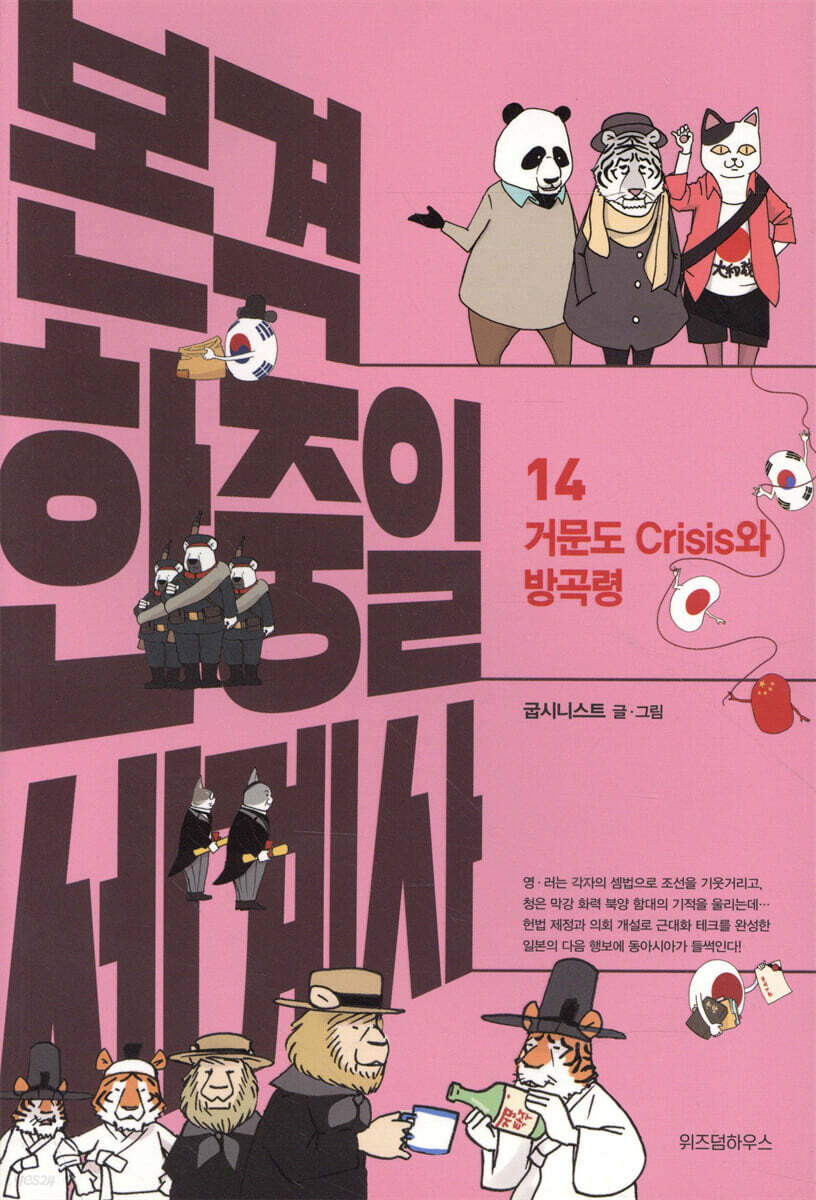
Full-fledged Korean-Chinese-Japanese World History 14
 |
Description
Book Introduction
The Qing Dynasty is trying to strengthen its dominance by using the Anglo-Russian Great Game.
Joseon's eyes are growing increasingly anxious at Japan's bold expansionist thinking!
Volume 14 deals with the rise of the Qing Dynasty, which grew its influence by disrupting the Anglo-Russian Great Game on the Korean Peninsula, and Japan, which has now come to stand shoulder to shoulder with the Western powers.
In this process, Qing once again asserted its sovereignty over Joseon, and Japan, which had adopted expansionism, also turned its claws toward Joseon… .
We examine the tumultuous course of Joseon, whose internal affairs were in turmoil due to the Donghak Peasant Revolution and the rumors of a coup by Daewongun.
Joseon's eyes are growing increasingly anxious at Japan's bold expansionist thinking!
Volume 14 deals with the rise of the Qing Dynasty, which grew its influence by disrupting the Anglo-Russian Great Game on the Korean Peninsula, and Japan, which has now come to stand shoulder to shoulder with the Western powers.
In this process, Qing once again asserted its sovereignty over Joseon, and Japan, which had adopted expansionism, also turned its claws toward Joseon… .
We examine the tumultuous course of Joseon, whose internal affairs were in turmoil due to the Donghak Peasant Revolution and the rumors of a coup by Daewongun.
- You can preview some of the book's contents.
Preview
index
preface
Chapter 1: Geomundo Crisis
Chapter 2: Come Back Home
Chapter 3: The Second Sino-Russian Secret Agreement Theory Controversy
Chapter 4: Closed-door training
Chapter 5 Shipwreck
Chapter 6 Promulgation of the Constitution
Chapter 7 Over the Line
Chapter 8: We Must Revive the Economy
Chapter 9: The Battle of Banggokryeong
Chapter 10 Modernization Loan
Chapter 11: Railroad Loans
Chapter 12: The Otsu Incident
Chapter 13: Chronology of the 1880s
Chapter 14: Chronology of the 1880s, Part 2
Chapter 15: Cheongseon Inner Harbor
Chapter 16 Mutsu Diplomacy
Major events and people
Chapter 1: Geomundo Crisis
Chapter 2: Come Back Home
Chapter 3: The Second Sino-Russian Secret Agreement Theory Controversy
Chapter 4: Closed-door training
Chapter 5 Shipwreck
Chapter 6 Promulgation of the Constitution
Chapter 7 Over the Line
Chapter 8: We Must Revive the Economy
Chapter 9: The Battle of Banggokryeong
Chapter 10 Modernization Loan
Chapter 11: Railroad Loans
Chapter 12: The Otsu Incident
Chapter 13: Chronology of the 1880s
Chapter 14: Chronology of the 1880s, Part 2
Chapter 15: Cheongseon Inner Harbor
Chapter 16 Mutsu Diplomacy
Major events and people
Detailed image

Into the book
In August 1886, Yuan Shikai sent an urgent telegram to his home country.
… … The contents of the telegram received by Li Hongzhang were - “I have obtained the secret letter that the King of Joseon sent to Ambassador Beber in an attempt to involve Russia again!! Min Yeong-ik gave me the original document!!” The second Joseon-Russia secret agreement incident!! … … Joseon and Russia strongly denied this.
Regardless of whether Joseon denied it or not, Yuan Shikai used this as fuel for political intrigue and continued his operations.
“This In-A-Geo-Cheong trick is all because of the King of Joseon’s ungrateful behavior and his desire to betray the Heavenly King’s kindness. I wonder what would happen if we replaced the King of Joseon!”
---From "Chapter 3: The Second Sino-Russian Secret Agreement Theory Wave"
February 11, 1889, the Constitution of the Empire of Japan is promulgated! “As befitting a modern constitution, it includes the rights to private property, freedom of religion, freedom of speech, publication, assembly, and association, freedom of the person, the right to trial, etc.” “But— since these are all His Majesty’s surnames bestowed upon the ‘subjects,’ they can be restricted as necessary...” “The most emphasized thing in this constitution is the authority of the unbroken line of emperors for eternity and the emperor’s supreme power in governing the nation!”
---From “Chapter 6 Promulgation of the Constitution”
After the Sino-French War, the Qing Dynasty established the Prime Minister's Naval Office (Ministry of the Navy) and went all-in on the Beiyang naval operation.
“We put domestically produced warships on hold for the time being and focused on purchasing warships from Britain and Germany.
“Allocate 4 million nyang annually as a budget!” …… As a result of such efforts, the total tonnage of the Beiyang Fleet reached 40,000 tons in the mid-to-late 1880s, surpassing the entire Japanese Navy.
Based on the naval power that had grown so rapidly, in 1886, when Geomundo Island was facing a crisis, Admiral Jeong Yeo-chang of the Northern Sea Command led six warships and set sail for the South Sea in July 1886.
The Qing fleet, which had set out on patrol in the South Sea and East Sea, went to Nagasaki in August for repairs and supplies.
All of Japan was astonished by the majesty of the Qing flagships, the "Jinwon" and "Jinwon," which entered Nagasaki.
---From Chapter 7, Over the Line
On May 11, 1891, Crown Prince Nicholas and his party were touring Lake Biwa and passing through Otsu Town.
Local police officer Tsuda Sanjo was standing guard on the roadside of Shimokogarasaki-cho where the procession was passing.
“His Majesty the Crown Prince of the Great Russian Empire, receive Sanjo’s sword!!” “Huh?!! Could it be that the socialist revolutionaries are even in Japan?!!” … … The government leaders in Tokyo were shocked.
The next morning, the Emperor took the first train straight to Kyoto.
“Japan, this island nation will perish in my generation!!!”
---From "Chapter 12: The Otsu Incident"
July 1891, Yokohama - Dozens of cannon salutes fired by Japanese and Western ships, and the Qing ships' return gunfire shook the harbor.
Six ships of the Qing Beiyang Fleet enter Yokohama! “Wow;; This is the largest warship that has ever come to Japan;;” Admiral Jeong Yeo-chang of the Beiyang Fleet, who led this friendly visitation fleet, pays a courtesy visit to the emperor.
The Beiyang Fleet holds an open house event for Japanese government officials, naval officers, celebrities, and journalists on board the ship.
The core of the Northern Fleet, the strongest and most powerful ship duo in the East! Jeongwon & her sister ship Jinwon! "Krupp 305mm twin cannons;; They'll take out all the Japanese ships in one shot;; Are the Chinese even capable of handling such atrocious equipment? Aren't there any level caps?"
---From "Chapter 15, Inner Harbor of Cheongseon"
"Britain's green light for treaty revision means an excuse for the Korean issue! The opportunity to deal with the Korean issue in one fell swoop is coming!" "No, the Korean issue, the Korean issue. What exactly is the Korean issue?" "The Korean issue is why, at this point, Japan must somehow avoid Korea!" 1.
Russia's southward advance! 2.
Securing economic exploitation! 3.
The cornerstone of the rise of the Empire of Japan! … … “Well, if you set your mind to it, the pretext and opportunity will naturally follow! Signs that a spark will soon fly in Joseon are all coming in through the intelligence lines!”
… … The contents of the telegram received by Li Hongzhang were - “I have obtained the secret letter that the King of Joseon sent to Ambassador Beber in an attempt to involve Russia again!! Min Yeong-ik gave me the original document!!” The second Joseon-Russia secret agreement incident!! … … Joseon and Russia strongly denied this.
Regardless of whether Joseon denied it or not, Yuan Shikai used this as fuel for political intrigue and continued his operations.
“This In-A-Geo-Cheong trick is all because of the King of Joseon’s ungrateful behavior and his desire to betray the Heavenly King’s kindness. I wonder what would happen if we replaced the King of Joseon!”
---From "Chapter 3: The Second Sino-Russian Secret Agreement Theory Wave"
February 11, 1889, the Constitution of the Empire of Japan is promulgated! “As befitting a modern constitution, it includes the rights to private property, freedom of religion, freedom of speech, publication, assembly, and association, freedom of the person, the right to trial, etc.” “But— since these are all His Majesty’s surnames bestowed upon the ‘subjects,’ they can be restricted as necessary...” “The most emphasized thing in this constitution is the authority of the unbroken line of emperors for eternity and the emperor’s supreme power in governing the nation!”
---From “Chapter 6 Promulgation of the Constitution”
After the Sino-French War, the Qing Dynasty established the Prime Minister's Naval Office (Ministry of the Navy) and went all-in on the Beiyang naval operation.
“We put domestically produced warships on hold for the time being and focused on purchasing warships from Britain and Germany.
“Allocate 4 million nyang annually as a budget!” …… As a result of such efforts, the total tonnage of the Beiyang Fleet reached 40,000 tons in the mid-to-late 1880s, surpassing the entire Japanese Navy.
Based on the naval power that had grown so rapidly, in 1886, when Geomundo Island was facing a crisis, Admiral Jeong Yeo-chang of the Northern Sea Command led six warships and set sail for the South Sea in July 1886.
The Qing fleet, which had set out on patrol in the South Sea and East Sea, went to Nagasaki in August for repairs and supplies.
All of Japan was astonished by the majesty of the Qing flagships, the "Jinwon" and "Jinwon," which entered Nagasaki.
---From Chapter 7, Over the Line
On May 11, 1891, Crown Prince Nicholas and his party were touring Lake Biwa and passing through Otsu Town.
Local police officer Tsuda Sanjo was standing guard on the roadside of Shimokogarasaki-cho where the procession was passing.
“His Majesty the Crown Prince of the Great Russian Empire, receive Sanjo’s sword!!” “Huh?!! Could it be that the socialist revolutionaries are even in Japan?!!” … … The government leaders in Tokyo were shocked.
The next morning, the Emperor took the first train straight to Kyoto.
“Japan, this island nation will perish in my generation!!!”
---From "Chapter 12: The Otsu Incident"
July 1891, Yokohama - Dozens of cannon salutes fired by Japanese and Western ships, and the Qing ships' return gunfire shook the harbor.
Six ships of the Qing Beiyang Fleet enter Yokohama! “Wow;; This is the largest warship that has ever come to Japan;;” Admiral Jeong Yeo-chang of the Beiyang Fleet, who led this friendly visitation fleet, pays a courtesy visit to the emperor.
The Beiyang Fleet holds an open house event for Japanese government officials, naval officers, celebrities, and journalists on board the ship.
The core of the Northern Fleet, the strongest and most powerful ship duo in the East! Jeongwon & her sister ship Jinwon! "Krupp 305mm twin cannons;; They'll take out all the Japanese ships in one shot;; Are the Chinese even capable of handling such atrocious equipment? Aren't there any level caps?"
---From "Chapter 15, Inner Harbor of Cheongseon"
"Britain's green light for treaty revision means an excuse for the Korean issue! The opportunity to deal with the Korean issue in one fell swoop is coming!" "No, the Korean issue, the Korean issue. What exactly is the Korean issue?" "The Korean issue is why, at this point, Japan must somehow avoid Korea!" 1.
Russia's southward advance! 2.
Securing economic exploitation! 3.
The cornerstone of the rise of the Empire of Japan! … … “Well, if you set your mind to it, the pretext and opportunity will naturally follow! Signs that a spark will soon fly in Joseon are all coming in through the intelligence lines!”
---From "Chapter 16 Mutsu Diplomacy"
Publisher's Review
Qing, who monopolized Joseon with fake news and scandals.
The way of international politics has fallen to the ground!
After the Im-o Incident, as Qing interference intensified for the sake of stability in East Asia and Joseon, Gojong attempted to check Qing by bringing in Russia.
However, this is a diplomatic technique that only knows one thing and not the other, and it only ends up attracting Britain, which is surprised by Russia's expansion of power.
Eventually, in April 1885, Britain occupied Geomundo as a base to check Russia, leaving Joseon in a situation where it could neither do this nor that.
This was a difficult situation for the Qing Dynasty, which was trying to monopolize Joseon, so they first negotiated to get both Britain and Russia to withdraw from Joseon, and secretly pressured Emperor Gojong by sending Prince Daewongun, who was being held captive in Tianjin, to Joseon, threatening that if he continued to cause trouble, the throne would change hands.
With Qing in control of the situation, Yuan Shikai, who came to Joseon with Daewongun, was able to carry out secret activities with ease, and it was even claimed that Emperor Gojong had sent a secret letter to the Russian ambassador requesting protection.
Qing is furious even though he knows this is 'fake news', and Russia backs away to avoid unnecessary misunderstandings.
With Russia gone, Britain, which had lost its justification for advancing into Joseon, also withdrew, and many pro-Russian forces in the Joseon government also fell from power.
As a result, the Qing Dynasty easily seized Joseon, which was temporarily in a power vacuum.
In May 1891, he unveiled the strongest fleet in the East, the Beiyang Fleet, which he had worked on for a long time, and even crushed his rival, Japan…
Will this allow the Qing to regain its status as a powerful nation ruling the East?
Or is it just a last ember burning before collapsing?
The fate of East Asia will depend on Qing's next move!
Japan succeeded in establishing a constitution and establishing a parliament.
Aiming at the great powers with the national strength forged through 'Home Training'!
While Qing was stirring up Joseon, Japan was quietly but surely strengthening its internal structure.
At that time, in order to be recognized by the international community, one had to possess not only 'fighting' skills but also political 'level'.
Therefore, Japan strives to introduce a modern constitution and parliamentary system.
This was important because only then could the various existing unequal political and economic treaties with the Western powers be revised.
First, Japan, which changed its form of government to a cabinet system in 1885, accelerated the construction of a modern nation under the leadership of its first prime minister, Ito Hirobumi.
After going through many twists and turns, including the Normanton incident, in which the British captain, who did not actively rescue Japanese passengers from a sinking ship, was acquitted under an unequal treaty, and the fierce anti-government struggles of the opposition movement, which blamed the incompetence of the new cabinet, a modern constitution was finally established in February 1889, and a parliament was finally established in November 1890.
Just as they were about to catch their breath, something happened across the sea in Joseon, where Japanese merchants opened their eyes and had their noses cut off.
At that time, Japanese merchants made profits by purchasing large quantities of rice from Joseon at a low price and selling it at a high price in their home country.
However, some corrupt officials in Hwanghae-do and Hamgyeong-do issued a curfew to forcibly block the outflow of rice, and committed the act of taking the rice themselves first.
Japanese merchants had to pay twice as much as usual to buy rice from them or return empty-handed…
A massive crop failure has struck Japan! As complaints grow that the Constitution and the Diet are of no use to the nation, Japan's gaze is turning to expansionism to divert attention from external enemies, and its eyes are becoming increasingly suspicious.
The 『Authentic Korean-Chinese-Japanese World History』 series
This is foul play, how can you not lose the humor while still having depth in the content?
Easily overcome the historical convention that 'you have to memorize it to understand it'!
When we talk about 'history', we often have the common perception that it is 'boring' and that 'you have to memorize it to understand it'.
This may be because the memories of memorizing the years and processes of each event in middle and high school history classes are all that remain of our image of history.
In contrast, this series deviates significantly from the conventional wisdom that history must be memorized.
This series is a historical comic series written by cartoonist Gupsinist, who uses his major to cover the modern history of Korea, China, and Japan. It describes the modern history of 19th century East Asia, while naturally incorporating various subcultures such as games, military, animation, and dramas.
As you slowly follow the author's extensive knowledge of history, the various parodies and wordplay that are sprinkled throughout, the zeitgeist and world situation of the time will naturally come to mind.
Through this series, readers will experience a significant reduction in the barriers to entry into history, which was once perceived as difficult.
In the face of the tidal wave of Western imperialist powers entering the world,
How did Korea, China, and Japan resist or comply?
Why must we read world history through the lens of "Korea, China, and Japan"? To observe the tree of Korean history, our own history, we must first see the forest of East Asian history. Without understanding this, we cannot grasp the larger picture of world history.
To understand our country's past and present, and the global situation, we will compare the history of three East Asian countries.
World history up to now has not strayed far from the form of a brief description of the history of Western powers and the surrounding nations and peoples within the global historical flow they created.
However, not only the military and diplomacy of powerful nations, but also the resistance and identity of weak nations occupy a large portion of history.
This series is an attempt to break away from the conventional Western-centric historical narrative and look at history from an East Asian perspective.
Among these, we will take a closer look at the period from the mid-19th century to the mid-20th century, when Korea, China, and Japan were most closely connected.
The way of international politics has fallen to the ground!
After the Im-o Incident, as Qing interference intensified for the sake of stability in East Asia and Joseon, Gojong attempted to check Qing by bringing in Russia.
However, this is a diplomatic technique that only knows one thing and not the other, and it only ends up attracting Britain, which is surprised by Russia's expansion of power.
Eventually, in April 1885, Britain occupied Geomundo as a base to check Russia, leaving Joseon in a situation where it could neither do this nor that.
This was a difficult situation for the Qing Dynasty, which was trying to monopolize Joseon, so they first negotiated to get both Britain and Russia to withdraw from Joseon, and secretly pressured Emperor Gojong by sending Prince Daewongun, who was being held captive in Tianjin, to Joseon, threatening that if he continued to cause trouble, the throne would change hands.
With Qing in control of the situation, Yuan Shikai, who came to Joseon with Daewongun, was able to carry out secret activities with ease, and it was even claimed that Emperor Gojong had sent a secret letter to the Russian ambassador requesting protection.
Qing is furious even though he knows this is 'fake news', and Russia backs away to avoid unnecessary misunderstandings.
With Russia gone, Britain, which had lost its justification for advancing into Joseon, also withdrew, and many pro-Russian forces in the Joseon government also fell from power.
As a result, the Qing Dynasty easily seized Joseon, which was temporarily in a power vacuum.
In May 1891, he unveiled the strongest fleet in the East, the Beiyang Fleet, which he had worked on for a long time, and even crushed his rival, Japan…
Will this allow the Qing to regain its status as a powerful nation ruling the East?
Or is it just a last ember burning before collapsing?
The fate of East Asia will depend on Qing's next move!
Japan succeeded in establishing a constitution and establishing a parliament.
Aiming at the great powers with the national strength forged through 'Home Training'!
While Qing was stirring up Joseon, Japan was quietly but surely strengthening its internal structure.
At that time, in order to be recognized by the international community, one had to possess not only 'fighting' skills but also political 'level'.
Therefore, Japan strives to introduce a modern constitution and parliamentary system.
This was important because only then could the various existing unequal political and economic treaties with the Western powers be revised.
First, Japan, which changed its form of government to a cabinet system in 1885, accelerated the construction of a modern nation under the leadership of its first prime minister, Ito Hirobumi.
After going through many twists and turns, including the Normanton incident, in which the British captain, who did not actively rescue Japanese passengers from a sinking ship, was acquitted under an unequal treaty, and the fierce anti-government struggles of the opposition movement, which blamed the incompetence of the new cabinet, a modern constitution was finally established in February 1889, and a parliament was finally established in November 1890.
Just as they were about to catch their breath, something happened across the sea in Joseon, where Japanese merchants opened their eyes and had their noses cut off.
At that time, Japanese merchants made profits by purchasing large quantities of rice from Joseon at a low price and selling it at a high price in their home country.
However, some corrupt officials in Hwanghae-do and Hamgyeong-do issued a curfew to forcibly block the outflow of rice, and committed the act of taking the rice themselves first.
Japanese merchants had to pay twice as much as usual to buy rice from them or return empty-handed…
A massive crop failure has struck Japan! As complaints grow that the Constitution and the Diet are of no use to the nation, Japan's gaze is turning to expansionism to divert attention from external enemies, and its eyes are becoming increasingly suspicious.
The 『Authentic Korean-Chinese-Japanese World History』 series
This is foul play, how can you not lose the humor while still having depth in the content?
Easily overcome the historical convention that 'you have to memorize it to understand it'!
When we talk about 'history', we often have the common perception that it is 'boring' and that 'you have to memorize it to understand it'.
This may be because the memories of memorizing the years and processes of each event in middle and high school history classes are all that remain of our image of history.
In contrast, this series deviates significantly from the conventional wisdom that history must be memorized.
This series is a historical comic series written by cartoonist Gupsinist, who uses his major to cover the modern history of Korea, China, and Japan. It describes the modern history of 19th century East Asia, while naturally incorporating various subcultures such as games, military, animation, and dramas.
As you slowly follow the author's extensive knowledge of history, the various parodies and wordplay that are sprinkled throughout, the zeitgeist and world situation of the time will naturally come to mind.
Through this series, readers will experience a significant reduction in the barriers to entry into history, which was once perceived as difficult.
In the face of the tidal wave of Western imperialist powers entering the world,
How did Korea, China, and Japan resist or comply?
Why must we read world history through the lens of "Korea, China, and Japan"? To observe the tree of Korean history, our own history, we must first see the forest of East Asian history. Without understanding this, we cannot grasp the larger picture of world history.
To understand our country's past and present, and the global situation, we will compare the history of three East Asian countries.
World history up to now has not strayed far from the form of a brief description of the history of Western powers and the surrounding nations and peoples within the global historical flow they created.
However, not only the military and diplomacy of powerful nations, but also the resistance and identity of weak nations occupy a large portion of history.
This series is an attempt to break away from the conventional Western-centric historical narrative and look at history from an East Asian perspective.
Among these, we will take a closer look at the period from the mid-19th century to the mid-20th century, when Korea, China, and Japan were most closely connected.
GOODS SPECIFICS
- Publication date: August 10, 2022
- Page count, weight, size: 296 pages | 540g | 152*225*22mm
- ISBN13: 9791168123960
- ISBN10: 1168123968
You may also like
카테고리
korean


korean

![GQ KOREA Mark (Monthly): December [2025]](http://librairie.coreenne.fr/cdn/shop/files/8ef265dbbfbf186523ed75ba7319009d.jpg?v=1765340328&width=3840)


