

Study food
 |
Description
Book Introduction
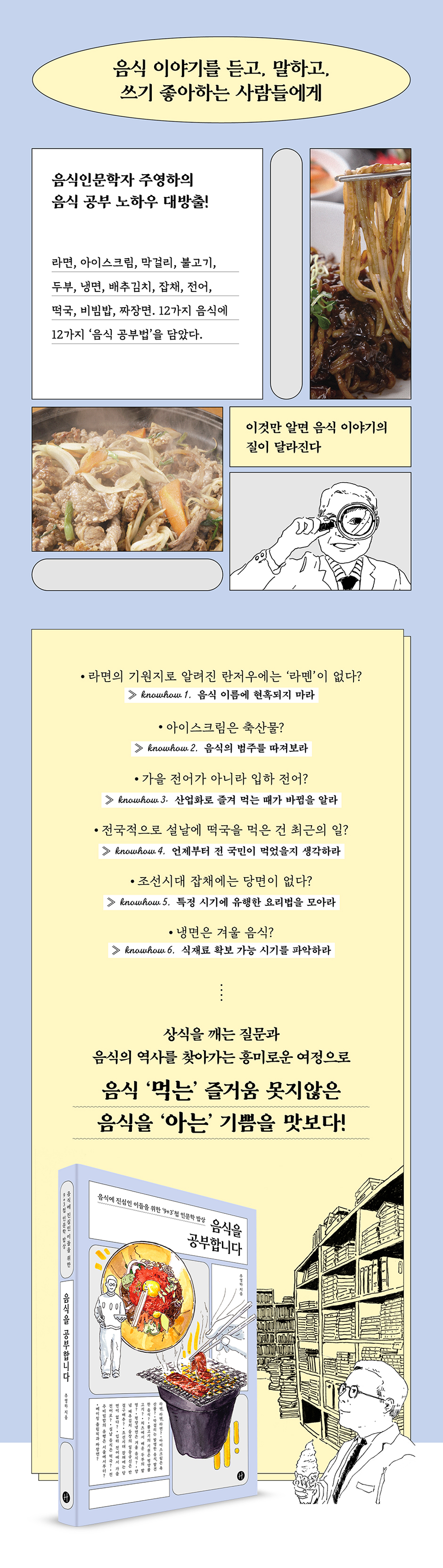
Because I'm serious about food For people who love to listen, talk, and write about food Food humanist Joo Young-ha reveals his food study know-how! Professor Joo Young-ha, a food humanist who meticulously analyzes a vast and diverse range of data to provide the most reliable history of food culture. I wrote this book to generously share with readers the know-how in 'food study' that I have acquired over 35 years of studying the history and culture of food. It provides 12 'food study methods' in an easy and tasty way, using one food as an example that is most suitable for each study method. Lanzhou, known as the birthplace of ramen, doesn't have "lamian" (lamian). Is ice cream a livestock product? Is it the autumn gizzard shad, not the autumn gizzard shad? Is it only recently that tteokguk (rice cake soup) has become a national tradition on Seollal? Is there no dangmyeon (glass noodles) in Joseon-era japchae? Is naengmyeon (cold noodles) a winter dish? This captivating journey through common sense questions and the history of food offers the joy of "knowing" food, no less than the joy of "eating." |
- You can preview some of the book's contents.
Preview
index
In publishing the book
Lesson 1: Ramen, ramen, ramen?
knowhow 1.
Look into the history of the name
2nd lecture: Is ice cream a livestock product?
knowhow 2.
Consider the categories of food
Is Makgeolli a food that was invented or discovered?
knowhow 3.
Outline the core of the manufacturing process
TIP.
How to find old recipes
Is the origin of the 4-strong bulgogi Pyongyang bulgogi?
knowhow 4.
The time and place of the trend are the criteria.
TIP.
How to Find and Read Food Articles in Modern and Contemporary Publications
Lesson 5: The invention of tofu learned from cheese?
knowhow 5.
Be skeptical of even old literary records.
6. Pyongyang Naengmyeon is a winter food?
knowhow 6.
Know when ingredients are available
TIP.
How to study the history of agricultural and marine products
Is the semi-cooked cabbage the main contributor to the emergence of seasoned cabbage kimchi?
knowhow 7.
Pay attention to the varieties that change with the times.
8. Joseon Dynasty Japchae doesn't have noodles?
knowhow 8.
Collect recipes that were popular at a certain time.
TIP.
How to Read Old Korean Cookbooks
From the 9th grade entrance exam to the fall exam?
knowhow 9.
Know that the times when you enjoy food have changed due to industrialization.
Top 10 Lunar New Year Foods: Tteokguk?
knowhow 10.
Think about when the whole nation started eating it.
Lesson 11: Did the Jeonju Bibimbap trend start in Seoul?
knowhow 11.
Find out where the famous place is
Round of 12 Beijing Olympics and Jjajangmyeon?
knowhow 12.
Don't be fooled by the traditions of 'made' food.
Epilogue
Appendix: My Food Study Resume
References | Image Sources and Locations
Lesson 1: Ramen, ramen, ramen?
knowhow 1.
Look into the history of the name
2nd lecture: Is ice cream a livestock product?
knowhow 2.
Consider the categories of food
Is Makgeolli a food that was invented or discovered?
knowhow 3.
Outline the core of the manufacturing process
TIP.
How to find old recipes
Is the origin of the 4-strong bulgogi Pyongyang bulgogi?
knowhow 4.
The time and place of the trend are the criteria.
TIP.
How to Find and Read Food Articles in Modern and Contemporary Publications
Lesson 5: The invention of tofu learned from cheese?
knowhow 5.
Be skeptical of even old literary records.
6. Pyongyang Naengmyeon is a winter food?
knowhow 6.
Know when ingredients are available
TIP.
How to study the history of agricultural and marine products
Is the semi-cooked cabbage the main contributor to the emergence of seasoned cabbage kimchi?
knowhow 7.
Pay attention to the varieties that change with the times.
8. Joseon Dynasty Japchae doesn't have noodles?
knowhow 8.
Collect recipes that were popular at a certain time.
TIP.
How to Read Old Korean Cookbooks
From the 9th grade entrance exam to the fall exam?
knowhow 9.
Know that the times when you enjoy food have changed due to industrialization.
Top 10 Lunar New Year Foods: Tteokguk?
knowhow 10.
Think about when the whole nation started eating it.
Lesson 11: Did the Jeonju Bibimbap trend start in Seoul?
knowhow 11.
Find out where the famous place is
Round of 12 Beijing Olympics and Jjajangmyeon?
knowhow 12.
Don't be fooled by the traditions of 'made' food.
Epilogue
Appendix: My Food Study Resume
References | Image Sources and Locations
Detailed image
Into the book
The history of ice cream should not begin with the history of ice.
It would be right to look back from the time when full-fledged ice cream, a combination of 'milk and ice', appeared.
The fact that ice cream is classified as a livestock product tells us where to begin tracing the history of ice cream.
In this way, knowledge of food science is very important in the study of food history.
Knowing how food science defines the food you want to study will also determine the scope of your research.
---From "Lecture 2: Is Ice Cream a Livestock Product?"
To understand the origins of food, I look at whether a particular food was invented or discovered.
Discovery and invention are concepts that are always covered in introductory cultural anthropology textbooks when explaining cultural change and diffusion.
(Omitted) Since my master's degree, I have been organizing various cooking methods to distinguish between the discovery and invention of food.
And we drew a world map showing the distribution of discovered and invented foods.
In the process, I realized that wine is a discovered food, and makgeolli is an invented food.
---From "Lecture 3: Is Makgeolli an Invented Food or a Discovered Food?"
Looking at the history of bulgogi that I have traced, the period when bulgogi was most popular was the 1930s, and the location was Moran-dae in Pyongyang.
At that time, grilled ribs were popular in Seoul.
This Pyongyang bulgogi went north along the railroad to become Kaoluo in Shenyang, China, and then became Joseon Kaoluo in Beijing.
Around the same time, Pyongyang's bulgogi, which had been brought to Japan, was renamed "yakiniku," and after Japan's defeat in 1945, it was transformed into Japanese food with the addition of Japanese seasoning.
After the Korean War, Pyongyang residents who fled to South Korea brought Pyongyang-style bulgogi to Seoul.
(Omitted) My tracing of the spread of Pyongyang Bulgogi can be divided into the following eras in the history of Bulgogi based on the time and place of its popularity: “Pyongyang Bulgogi Era ▶ Shenyang’s Joseon Kaoluo Era ▶ Japan’s Yakiniku Era ▶ South Korea’s Bulgogi Era.”
---From "Part 4: Is the Origin of Bulgogi Pyongyang Bulgogi?"
Pyongyang Naengmyeon was originally a winter food.
However, after the 20th century, ice became available even in the summer, and with the addition of MSG called 'Ajinomoto' as a substitute for dongchimi broth, Pyongyang Naengmyeon became a summer food.
Pyongyang Naengmyeon, a summer dish, made its way to Seoul in the 1920s and captured people's taste buds.
It would not be an exaggeration to say that the era of midsummer Seoul Naengmyeon has begun.
---From "Lecture 6: Is Pyongyang Naengmyeon a Winter Food?
After liberation, dangmyeon japchae became one of the Korean dishes and took its place proudly on banquet tables.
And by the 1960s, even food scholars studying Korean food didn't even know that people in the Joseon Dynasty ate japchae without noodles.
So, 'Dangmyeon Japchae' pushed out 'Japchae' and became Japchae itself.
(Omitted) There are many stories behind the history of how japchae changed to dangmyeon japchae.
There are many hidden stories, such as the Imo Incident of 1882, which led to the immigration of many Chinese to the Korean Peninsula, and the fact that the Chinese restaurants they ran became quite popular with the Korean people; the fact that when Imperial Japan established the fake state of Manchukuo in northeastern China, Koreans, who were subjects of the colony, could travel to Manchuria more easily than before; and the fact that Imperial Japan's factory-made soy sauce gradually took over the tables of restaurants in the Korean Peninsula and Manchuria.
---From "Episode 8: "There are no noodles in Joseon Dynasty Japchae?"
After the New Year's Day ancestral rites were held at noon on New Year's Eve, the villagers sent the alcohol and fruit offered for the ancestral rites to Lee Ok through a child.
The saying, “Calculating age by the bowl of rice cake soup” is something Lee Ok said with a smile to a child who came to run an errand.
From the perspective of Lee Ok, who lived mainly in her hometown of Hwaseong and Seoul, she might have felt like she was in another world, as she was not only performing ancestral rites on the day before Seollal, but also not preparing tteokguk, the food that symbolizes Seollal.
---From "Lesson 10: Is Tteokguk the Lunar New Year Food?"
Jinju Bibimbap is a local dish that was on the lips of Seoul intellectuals to the point that it was even featured in colonial-era magazines.
The bibimbap restaurant in Jinju that opened at that time is still in business in the same location.
However, in 1990, most people in Taiwan who were not from Jinju did not even know about the existence of Jinju Bibimbap.
Unlike Jinju Bibimbap, Jeonju Bibimbap has been well known to Seoul opinion leaders along with various Korean dishes from Jeonju since the 1960s.
That's how well-known Jeonju Bibimbap was among foreigners.
(Omitted) The process by which Jeonju Bibimbap became recognized as a national dish is similar to the history of pizza becoming a global food.
The only difference is that while pizza is a global food, Jeonju Bibimbap is a national food.
It would be right to look back from the time when full-fledged ice cream, a combination of 'milk and ice', appeared.
The fact that ice cream is classified as a livestock product tells us where to begin tracing the history of ice cream.
In this way, knowledge of food science is very important in the study of food history.
Knowing how food science defines the food you want to study will also determine the scope of your research.
---From "Lecture 2: Is Ice Cream a Livestock Product?"
To understand the origins of food, I look at whether a particular food was invented or discovered.
Discovery and invention are concepts that are always covered in introductory cultural anthropology textbooks when explaining cultural change and diffusion.
(Omitted) Since my master's degree, I have been organizing various cooking methods to distinguish between the discovery and invention of food.
And we drew a world map showing the distribution of discovered and invented foods.
In the process, I realized that wine is a discovered food, and makgeolli is an invented food.
---From "Lecture 3: Is Makgeolli an Invented Food or a Discovered Food?"
Looking at the history of bulgogi that I have traced, the period when bulgogi was most popular was the 1930s, and the location was Moran-dae in Pyongyang.
At that time, grilled ribs were popular in Seoul.
This Pyongyang bulgogi went north along the railroad to become Kaoluo in Shenyang, China, and then became Joseon Kaoluo in Beijing.
Around the same time, Pyongyang's bulgogi, which had been brought to Japan, was renamed "yakiniku," and after Japan's defeat in 1945, it was transformed into Japanese food with the addition of Japanese seasoning.
After the Korean War, Pyongyang residents who fled to South Korea brought Pyongyang-style bulgogi to Seoul.
(Omitted) My tracing of the spread of Pyongyang Bulgogi can be divided into the following eras in the history of Bulgogi based on the time and place of its popularity: “Pyongyang Bulgogi Era ▶ Shenyang’s Joseon Kaoluo Era ▶ Japan’s Yakiniku Era ▶ South Korea’s Bulgogi Era.”
---From "Part 4: Is the Origin of Bulgogi Pyongyang Bulgogi?"
Pyongyang Naengmyeon was originally a winter food.
However, after the 20th century, ice became available even in the summer, and with the addition of MSG called 'Ajinomoto' as a substitute for dongchimi broth, Pyongyang Naengmyeon became a summer food.
Pyongyang Naengmyeon, a summer dish, made its way to Seoul in the 1920s and captured people's taste buds.
It would not be an exaggeration to say that the era of midsummer Seoul Naengmyeon has begun.
---From "Lecture 6: Is Pyongyang Naengmyeon a Winter Food?
After liberation, dangmyeon japchae became one of the Korean dishes and took its place proudly on banquet tables.
And by the 1960s, even food scholars studying Korean food didn't even know that people in the Joseon Dynasty ate japchae without noodles.
So, 'Dangmyeon Japchae' pushed out 'Japchae' and became Japchae itself.
(Omitted) There are many stories behind the history of how japchae changed to dangmyeon japchae.
There are many hidden stories, such as the Imo Incident of 1882, which led to the immigration of many Chinese to the Korean Peninsula, and the fact that the Chinese restaurants they ran became quite popular with the Korean people; the fact that when Imperial Japan established the fake state of Manchukuo in northeastern China, Koreans, who were subjects of the colony, could travel to Manchuria more easily than before; and the fact that Imperial Japan's factory-made soy sauce gradually took over the tables of restaurants in the Korean Peninsula and Manchuria.
---From "Episode 8: "There are no noodles in Joseon Dynasty Japchae?"
After the New Year's Day ancestral rites were held at noon on New Year's Eve, the villagers sent the alcohol and fruit offered for the ancestral rites to Lee Ok through a child.
The saying, “Calculating age by the bowl of rice cake soup” is something Lee Ok said with a smile to a child who came to run an errand.
From the perspective of Lee Ok, who lived mainly in her hometown of Hwaseong and Seoul, she might have felt like she was in another world, as she was not only performing ancestral rites on the day before Seollal, but also not preparing tteokguk, the food that symbolizes Seollal.
---From "Lesson 10: Is Tteokguk the Lunar New Year Food?"
Jinju Bibimbap is a local dish that was on the lips of Seoul intellectuals to the point that it was even featured in colonial-era magazines.
The bibimbap restaurant in Jinju that opened at that time is still in business in the same location.
However, in 1990, most people in Taiwan who were not from Jinju did not even know about the existence of Jinju Bibimbap.
Unlike Jinju Bibimbap, Jeonju Bibimbap has been well known to Seoul opinion leaders along with various Korean dishes from Jeonju since the 1960s.
That's how well-known Jeonju Bibimbap was among foreigners.
(Omitted) The process by which Jeonju Bibimbap became recognized as a national dish is similar to the history of pizza becoming a global food.
The only difference is that while pizza is a global food, Jeonju Bibimbap is a national food.
---From "Lecture 11: "Did the Jeonju Bibimbap Trend Originate in Seoul?"
Publisher's Review
If you want to be someone who knows the difference between bulgogi and yakiniku!
-The first book to teach you how to 'study' food
French lawyer and gastronomy critic Jean Anthelme Brillat-Savarin once said, “Tell me what you eat.
“Then I will tell you what kind of person you are,” he said, adding that he could understand his life through his personal food experiences and tastes.
For modern people, food has long gone beyond a means of survival.
They enjoy eating together or alone, and even express themselves through food.
So, for those who are serious about food, food stories are more than just a source of entertainment.
Readers who want to go beyond simply hearing interesting food stories, and who want to weed out baseless "rumors" and "made-up traditions," and find trustworthy food stories, are encouraged to open this book.
This is because this book generously shares the study secrets of a food humanist with 35 years of experience.
The author, Professor Joo Young-ha, has explored the history and culture of food based on a variety of sources, including old cookbooks, ancient documents, paintings, modern and contemporary newspapers and magazines, and is the pioneer of the genre of food humanities (if you're curious about the reliability of the author's food studies, you can first check out 'Appendix: My Food Studies Resume').
We have already met readers with various food humanities books, but this time, we are going beyond just serving a table full of food and revealing the kitchen where the food is made.
This is to fully share his study method, which he has honed over many years.
From entertainment programs that cover the history of food without filtering out errors to all sorts of food articles on unsubstantiated websites and the claims of various food columnists, this book provides readers who want to find the right food stories in the information overflow.
It's about imparting the secrets to having your own voice in the conversation surrounding the history of food, like the bulgogi vs. yakiniku debate that arose from a food columnist's argument a few years ago.
We'll kindly explain the 'unknown' history of 'known' food.
-From small talk at the dinner table to serious academic inquiry
A Useful Way to Study Food History
Is gizzard shad a fall dish, and naengmyeon a summer dish? Is tteokguk the New Year's dish, and Jeonju bibimbap the bibimbap? Does the history of ice cream begin with ice, and the emergence of seasoned kimchi with chili peppers? How can we verify the truth about the origins, history, and culture of food we believe in? Professor Joo Young-ha provides detailed guidance on finding, reading, and interpreting old cookbooks, modern and contemporary newspapers and magazines, and ancient documents, making it accessible even to beginners in the study of food.
Furthermore, we reveal 12 key questions that must not be overlooked in uncovering the history of food.
In a world where there aren't many experts in food humanities, these 12 "Food History Study Methods" are useful knowledge even for those engaged in serious academic research.
This book is especially recommended to readers who were curious about food humanities but had put the book down because of the excessive number of footnotes and the somewhat long and difficult text.
Because it is short and friendly and reaches out to readers.
Additionally, for readers who enjoy Professor Joo Young-ha's books, the virtue of this book lies in its systematic delivery of methods for studying food history.
12 study methods for 12 foods
-Ramen, ice cream, makgeolli, bulgogi, tofu, cold noodles, kimchi,
Studying food with japchae, octopus, tteokguk, bibimbap, and jajangmyeon
Here's a taste of some of the food study techniques covered in this book.
Even foods that seem to have been enjoyed for a long time, such as mackerel in the fall and tteokguk on New Year's Day, sometimes turn out not to be so when you trace their history.
This is because the times when people enjoy food may have changed due to industrialization, and it may only be recently that holiday foods have become homogenized nationwide.
Even during the Joseon Dynasty, people enjoyed summer gizzard shad instead of autumn gizzard shad due to differences in fishing methods.
During the Joseon Dynasty, fish that could not escape during low tide were caught by setting up fishing nets around the time of the beginning of summer, but with the industrialization of the fishing industry, people began to go out to the open sea and catch large quantities, and people began to enjoy autumn mackerel.
This is a fact that we would not have known if we had not looked into industrialization and industrial food.
Meanwhile, these days, when we think of Seollal food, we inevitably think of tteokguk, but if we look at the writings of Lee Ok or the diary of Jo Geuk-seon from the Joseon Dynasty, we can see that this is not a given.
Since the 17th century, the aristocracy in Seoul began eating tteokguk instead of wheat or buckwheat dumplings as a holiday food on Seollal. The aristocracy in the provinces also imitated this and ate tteokguk, but only to a limited extent. It was only in the 1970s that tteokguk became a national holiday food.
The history of ice cream begins with ice, and the emergence of seasoned kimchi can be traced back only to the introduction of chili peppers. For example, the history of ice cream often focuses on ice, covering the history of ice storage and the story of the first person to taste it. However, there's something important to note.
It is a matter of examining the food science definition of the food in question.
According to the Food Codex, ice cream is a type of animal product derived from milk.
In other words, the core raw materials of ice cream are raw milk or dairy products, and cream is the main ingredient of ice cream.
Meanwhile, examining the varieties that change over time is also very important in the history of food.
A representative example is seasoned cabbage kimchi.
Although the seasoning called chili pepper is important, the seasoned cabbage kimchi that came to be on the table might not have been possible without the improvement of cabbage varieties.
When the main ingredient was unseasoned cabbage, people cooked white kimchi or cabbage kimchi with little seasoning, and enjoyed radish kimchi more than cabbage kimchi.
However, during the exchange with the Qing Dynasty in the 18th century, improved varieties of semi-column cabbage were introduced, and later, as column cabbage was introduced through overseas Chinese, seasoned cabbage kimchi came to occupy an important place on our tables.
Lanzhou, known as the birthplace of ramen, does not have a dish called 'lamian'.
There, 'ramyeon' is a method of making noodles, not a specific food.
This is why we should not be fooled by the name of the food but rather look into the history behind the name of the food.
Also, if you summarize the core of the manufacturing process, you can tell whether the food is a 'discovered food' or an 'invented food'.
Wine is a discovered food, makgeolli is an invented food, and this answers the debate about the origins of food.
In addition, it is packed with essential know-how for studying the history of food, such as questioning old literary records, determining when ingredients could be obtained, collecting recipes popular during a certain period, and distinguishing between the place of origin and the place of popularity.
What is food to Professor Joo Young-ha?
“For me, food is study.
No matter where you go, domestically or internationally, food is a window into people's lives.
The local market is a popular study room for local food ingredients.
Their favorite restaurant is a museum that provides insight into the local socio-cultural context.
The food we encounter in historical documents is like a time machine that allows us to understand the thoughts and actions of people who lived in a certain era.
So, for me, food is a treasure that teaches me the wisdom of life.”
-The first book to teach you how to 'study' food
French lawyer and gastronomy critic Jean Anthelme Brillat-Savarin once said, “Tell me what you eat.
“Then I will tell you what kind of person you are,” he said, adding that he could understand his life through his personal food experiences and tastes.
For modern people, food has long gone beyond a means of survival.
They enjoy eating together or alone, and even express themselves through food.
So, for those who are serious about food, food stories are more than just a source of entertainment.
Readers who want to go beyond simply hearing interesting food stories, and who want to weed out baseless "rumors" and "made-up traditions," and find trustworthy food stories, are encouraged to open this book.
This is because this book generously shares the study secrets of a food humanist with 35 years of experience.
The author, Professor Joo Young-ha, has explored the history and culture of food based on a variety of sources, including old cookbooks, ancient documents, paintings, modern and contemporary newspapers and magazines, and is the pioneer of the genre of food humanities (if you're curious about the reliability of the author's food studies, you can first check out 'Appendix: My Food Studies Resume').
We have already met readers with various food humanities books, but this time, we are going beyond just serving a table full of food and revealing the kitchen where the food is made.
This is to fully share his study method, which he has honed over many years.
From entertainment programs that cover the history of food without filtering out errors to all sorts of food articles on unsubstantiated websites and the claims of various food columnists, this book provides readers who want to find the right food stories in the information overflow.
It's about imparting the secrets to having your own voice in the conversation surrounding the history of food, like the bulgogi vs. yakiniku debate that arose from a food columnist's argument a few years ago.
We'll kindly explain the 'unknown' history of 'known' food.
-From small talk at the dinner table to serious academic inquiry
A Useful Way to Study Food History
Is gizzard shad a fall dish, and naengmyeon a summer dish? Is tteokguk the New Year's dish, and Jeonju bibimbap the bibimbap? Does the history of ice cream begin with ice, and the emergence of seasoned kimchi with chili peppers? How can we verify the truth about the origins, history, and culture of food we believe in? Professor Joo Young-ha provides detailed guidance on finding, reading, and interpreting old cookbooks, modern and contemporary newspapers and magazines, and ancient documents, making it accessible even to beginners in the study of food.
Furthermore, we reveal 12 key questions that must not be overlooked in uncovering the history of food.
In a world where there aren't many experts in food humanities, these 12 "Food History Study Methods" are useful knowledge even for those engaged in serious academic research.
This book is especially recommended to readers who were curious about food humanities but had put the book down because of the excessive number of footnotes and the somewhat long and difficult text.
Because it is short and friendly and reaches out to readers.
Additionally, for readers who enjoy Professor Joo Young-ha's books, the virtue of this book lies in its systematic delivery of methods for studying food history.
12 study methods for 12 foods
-Ramen, ice cream, makgeolli, bulgogi, tofu, cold noodles, kimchi,
Studying food with japchae, octopus, tteokguk, bibimbap, and jajangmyeon
Here's a taste of some of the food study techniques covered in this book.
Even foods that seem to have been enjoyed for a long time, such as mackerel in the fall and tteokguk on New Year's Day, sometimes turn out not to be so when you trace their history.
This is because the times when people enjoy food may have changed due to industrialization, and it may only be recently that holiday foods have become homogenized nationwide.
Even during the Joseon Dynasty, people enjoyed summer gizzard shad instead of autumn gizzard shad due to differences in fishing methods.
During the Joseon Dynasty, fish that could not escape during low tide were caught by setting up fishing nets around the time of the beginning of summer, but with the industrialization of the fishing industry, people began to go out to the open sea and catch large quantities, and people began to enjoy autumn mackerel.
This is a fact that we would not have known if we had not looked into industrialization and industrial food.
Meanwhile, these days, when we think of Seollal food, we inevitably think of tteokguk, but if we look at the writings of Lee Ok or the diary of Jo Geuk-seon from the Joseon Dynasty, we can see that this is not a given.
Since the 17th century, the aristocracy in Seoul began eating tteokguk instead of wheat or buckwheat dumplings as a holiday food on Seollal. The aristocracy in the provinces also imitated this and ate tteokguk, but only to a limited extent. It was only in the 1970s that tteokguk became a national holiday food.
The history of ice cream begins with ice, and the emergence of seasoned kimchi can be traced back only to the introduction of chili peppers. For example, the history of ice cream often focuses on ice, covering the history of ice storage and the story of the first person to taste it. However, there's something important to note.
It is a matter of examining the food science definition of the food in question.
According to the Food Codex, ice cream is a type of animal product derived from milk.
In other words, the core raw materials of ice cream are raw milk or dairy products, and cream is the main ingredient of ice cream.
Meanwhile, examining the varieties that change over time is also very important in the history of food.
A representative example is seasoned cabbage kimchi.
Although the seasoning called chili pepper is important, the seasoned cabbage kimchi that came to be on the table might not have been possible without the improvement of cabbage varieties.
When the main ingredient was unseasoned cabbage, people cooked white kimchi or cabbage kimchi with little seasoning, and enjoyed radish kimchi more than cabbage kimchi.
However, during the exchange with the Qing Dynasty in the 18th century, improved varieties of semi-column cabbage were introduced, and later, as column cabbage was introduced through overseas Chinese, seasoned cabbage kimchi came to occupy an important place on our tables.
Lanzhou, known as the birthplace of ramen, does not have a dish called 'lamian'.
There, 'ramyeon' is a method of making noodles, not a specific food.
This is why we should not be fooled by the name of the food but rather look into the history behind the name of the food.
Also, if you summarize the core of the manufacturing process, you can tell whether the food is a 'discovered food' or an 'invented food'.
Wine is a discovered food, makgeolli is an invented food, and this answers the debate about the origins of food.
In addition, it is packed with essential know-how for studying the history of food, such as questioning old literary records, determining when ingredients could be obtained, collecting recipes popular during a certain period, and distinguishing between the place of origin and the place of popularity.
What is food to Professor Joo Young-ha?
“For me, food is study.
No matter where you go, domestically or internationally, food is a window into people's lives.
The local market is a popular study room for local food ingredients.
Their favorite restaurant is a museum that provides insight into the local socio-cultural context.
The food we encounter in historical documents is like a time machine that allows us to understand the thoughts and actions of people who lived in a certain era.
So, for me, food is a treasure that teaches me the wisdom of life.”
GOODS SPECIFICS
- Publication date: November 22, 2021
- Page count, weight, size: 272 pages | 482g | 135*200*20mm
- ISBN13: 9791160807332
- ISBN10: 1160807337
You may also like
카테고리
korean


korean

![GQ KOREA Mark (Monthly): December [2025]](http://librairie.coreenne.fr/cdn/shop/files/8ef265dbbfbf186523ed75ba7319009d.jpg?v=1765340328&width=3840)


