

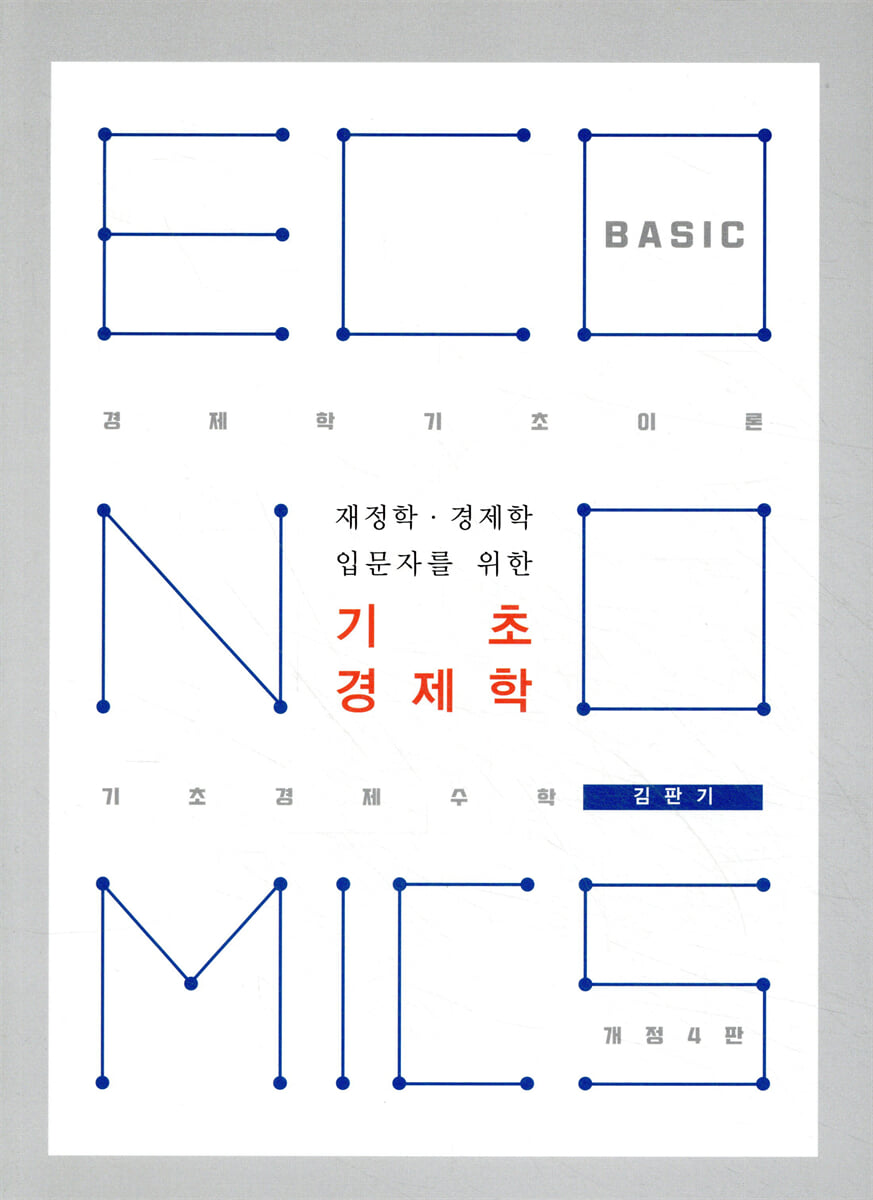
Basic Economics
 |
Description
Book Introduction
This book is an introductory economics textbook for students who wish to study economics systematically and for those preparing for economics or finance-related exams.
This book is largely divided into two parts: basic economics theory and basic economic mathematics.
In the basic theory of economics, the main contents of microeconomics are focused on, and the core concepts of macroeconomics, differences in perspectives by school of thought, and exchange rate theory in international economics are covered.
In addition, we have organized useful concepts that are not well covered in general economics textbooks but are essential for studying economics and finance in earnest.
In Basic Economic Mathematics, we have summarized the mathematical concepts necessary for studying economics, including linear functions, quadratic functions, exponents, sequences, differentiation, and natural logarithms.
Examples have been added to aid understanding in the middle of the explanation, and questions from actual exams have also been provided.
However, we have tried to reduce the weight of the textbook and maintain its purpose as an introductory book by boldly omitting overly detailed parts of economic theory or content that would be covered repeatedly in full-fledged economics and public finance theory lectures.
If you study consistently alongside your lectures, you'll quickly build a solid foundation for studying economics and finance, laying a solid foundation for achieving high scores on the actual exam.
This book is largely divided into two parts: basic economics theory and basic economic mathematics.
In the basic theory of economics, the main contents of microeconomics are focused on, and the core concepts of macroeconomics, differences in perspectives by school of thought, and exchange rate theory in international economics are covered.
In addition, we have organized useful concepts that are not well covered in general economics textbooks but are essential for studying economics and finance in earnest.
In Basic Economic Mathematics, we have summarized the mathematical concepts necessary for studying economics, including linear functions, quadratic functions, exponents, sequences, differentiation, and natural logarithms.
Examples have been added to aid understanding in the middle of the explanation, and questions from actual exams have also been provided.
However, we have tried to reduce the weight of the textbook and maintain its purpose as an introductory book by boldly omitting overly detailed parts of economic theory or content that would be covered repeatedly in full-fledged economics and public finance theory lectures.
If you study consistently alongside your lectures, you'll quickly build a solid foundation for studying economics and finance, laying a solid foundation for achieving high scores on the actual exam.
index
Part 1: Fundamentals of Economics
Chapter 1: Definition and Basic Concepts of Economics
Chapter 2 Economic Theory
Part 2: Supply and Demand
Chapter 3 Supply and Demand
Chapter 4 Elasticity of Supply and Demand
Part 3: Consumer Theory
Chapter 5 Marginal Utility Theory
Chapter 6 Indifference Curve Theory
Chapter 7: Applications of Consumer Theory
Part 4: Producer Theory
Chapter 8 Production Theory
Chapter 9 Cost Theory
Part 5: Market Theory
Chapter 10 Perfectly Competitive Markets
Chapter 11 Monopoly Markets
Chapter 12 Monopolistic Competitive Markets
Chapter 13 Oligopoly Markets
Chapter 14 Game Theory
Part 6: Macroeconomics and International Economics Basics
Chapter 15: Fundamentals of Macroeconomics
Chapter 16: Measurement of National Income
Chapter 17: Keynes's Determination of National Income
Chapter 18 Fiscal and Monetary Policy
Chapter 19 Exchange Rate Theory
Part 7: Basic Economic Mathematics
Chapter 20 Economic Models and Functions
Chapter 21: Indices and the Time Value of Money
Chapter 22: Sequences and the Value of Perpetual Bonds
Chapter 23 Differentiation and the Slope of a Tangent Line
Chapter 24 Logarithms, Natural Logarithms, and Rates of Change
Chapter 25 Nominal VS.
substance
Chapter 1: Definition and Basic Concepts of Economics
Chapter 2 Economic Theory
Part 2: Supply and Demand
Chapter 3 Supply and Demand
Chapter 4 Elasticity of Supply and Demand
Part 3: Consumer Theory
Chapter 5 Marginal Utility Theory
Chapter 6 Indifference Curve Theory
Chapter 7: Applications of Consumer Theory
Part 4: Producer Theory
Chapter 8 Production Theory
Chapter 9 Cost Theory
Part 5: Market Theory
Chapter 10 Perfectly Competitive Markets
Chapter 11 Monopoly Markets
Chapter 12 Monopolistic Competitive Markets
Chapter 13 Oligopoly Markets
Chapter 14 Game Theory
Part 6: Macroeconomics and International Economics Basics
Chapter 15: Fundamentals of Macroeconomics
Chapter 16: Measurement of National Income
Chapter 17: Keynes's Determination of National Income
Chapter 18 Fiscal and Monetary Policy
Chapter 19 Exchange Rate Theory
Part 7: Basic Economic Mathematics
Chapter 20 Economic Models and Functions
Chapter 21: Indices and the Time Value of Money
Chapter 22: Sequences and the Value of Perpetual Bonds
Chapter 23 Differentiation and the Slope of a Tangent Line
Chapter 24 Logarithms, Natural Logarithms, and Rates of Change
Chapter 25 Nominal VS.
substance
Publisher's Review
Preface to the First Edition
This book is an introductory economics textbook for students who wish to study economics systematically and for those preparing for economics or finance-related exams.
Economics is a practical and interesting discipline, but it is also a very rigorous one.
Especially for exams, it is essential to be able to use various approaches to solve given problems, not just simply understanding the theory, and to have a thorough understanding of the basic concepts of economics and the mathematical logic system.
Because a castle built on a weak foundation can easily collapse.
However, after teaching economics and finance for a long time, I have come to realize that surprisingly many economics students are studying economics without a clear conceptual foundation, and as a result, they are experiencing unnecessary trial and error or repeating inefficient study methods.
In particular, public finance is an applied field of economics that studies the interaction between the private and public sectors, primarily based on microeconomic foundations.
Therefore, to get a high score on a financial exam like the CPA exam, you must first understand the basics of economics, especially microeconomics.
Additionally, a solid mathematical foundation is necessary to understand content that requires a mathematical approach or to solve computational problems.
Based on my experience in these lectures, I wrote this introductory economics textbook, which aims to enable even beginners and non-majors with no prior experience in economics to study economics and finance easily and efficiently.
This book is largely divided into two parts: basic economics theory and basic economic mathematics.
In the basic theory of economics, the main contents of microeconomics are focused on, and the core concepts of macroeconomics, differences in perspectives by school of thought, and exchange rate theory in international economics are covered.
In addition, we have organized useful concepts that are not well covered in general economics textbooks but are essential for studying economics and finance in earnest.
In Basic Economic Mathematics, we have summarized the mathematical concepts necessary for studying economics, including linear functions, quadratic functions, exponents, sequences, differentiation, and natural logarithms.
Examples have been added to aid understanding in the middle of the explanation, and questions from actual exams have also been provided.
However, we have tried to reduce the weight of the textbook and maintain its purpose as an introductory book by boldly omitting overly detailed parts of economic theory or content that would be covered repeatedly in full-fledged economics and public finance theory lectures.
If you study consistently alongside your lectures, you'll quickly build a solid foundation for studying economics and finance, laying a solid foundation for achieving high scores on the actual exam.
I received a lot of help in getting this book published.
I would like to thank Jang Woo-cheol, Yoo Seung-chan, and Park Seung-beom for their meticulous corrections and advice despite their busy schedules at work and school.
I would also like to express my gratitude to Yoo Seo-young and Jo Se-yeon, who worked with the author throughout the editing and publishing process.
Lastly, I express my deep love to my wife, Chae-woon, Jun-woo, and Seo-yul, who still work hard to polish and shine the insignificant person.
April 2015
Kim Pan-gi
This book is an introductory economics textbook for students who wish to study economics systematically and for those preparing for economics or finance-related exams.
Economics is a practical and interesting discipline, but it is also a very rigorous one.
Especially for exams, it is essential to be able to use various approaches to solve given problems, not just simply understanding the theory, and to have a thorough understanding of the basic concepts of economics and the mathematical logic system.
Because a castle built on a weak foundation can easily collapse.
However, after teaching economics and finance for a long time, I have come to realize that surprisingly many economics students are studying economics without a clear conceptual foundation, and as a result, they are experiencing unnecessary trial and error or repeating inefficient study methods.
In particular, public finance is an applied field of economics that studies the interaction between the private and public sectors, primarily based on microeconomic foundations.
Therefore, to get a high score on a financial exam like the CPA exam, you must first understand the basics of economics, especially microeconomics.
Additionally, a solid mathematical foundation is necessary to understand content that requires a mathematical approach or to solve computational problems.
Based on my experience in these lectures, I wrote this introductory economics textbook, which aims to enable even beginners and non-majors with no prior experience in economics to study economics and finance easily and efficiently.
This book is largely divided into two parts: basic economics theory and basic economic mathematics.
In the basic theory of economics, the main contents of microeconomics are focused on, and the core concepts of macroeconomics, differences in perspectives by school of thought, and exchange rate theory in international economics are covered.
In addition, we have organized useful concepts that are not well covered in general economics textbooks but are essential for studying economics and finance in earnest.
In Basic Economic Mathematics, we have summarized the mathematical concepts necessary for studying economics, including linear functions, quadratic functions, exponents, sequences, differentiation, and natural logarithms.
Examples have been added to aid understanding in the middle of the explanation, and questions from actual exams have also been provided.
However, we have tried to reduce the weight of the textbook and maintain its purpose as an introductory book by boldly omitting overly detailed parts of economic theory or content that would be covered repeatedly in full-fledged economics and public finance theory lectures.
If you study consistently alongside your lectures, you'll quickly build a solid foundation for studying economics and finance, laying a solid foundation for achieving high scores on the actual exam.
I received a lot of help in getting this book published.
I would like to thank Jang Woo-cheol, Yoo Seung-chan, and Park Seung-beom for their meticulous corrections and advice despite their busy schedules at work and school.
I would also like to express my gratitude to Yoo Seo-young and Jo Se-yeon, who worked with the author throughout the editing and publishing process.
Lastly, I express my deep love to my wife, Chae-woon, Jun-woo, and Seo-yul, who still work hard to polish and shine the insignificant person.
April 2015
Kim Pan-gi
GOODS SPECIFICS
- Publication date: April 15, 2022
- Page count, weight, size: 296 pages | 188*257*20mm
- ISBN13: 9791186849309
- ISBN10: 1186849304
You may also like
카테고리
korean


korean

![GQ KOREA Mark (Monthly): December [2025]](http://librairie.coreenne.fr/cdn/shop/files/8ef265dbbfbf186523ed75ba7319009d.jpg?v=1765340328&width=3840)


