

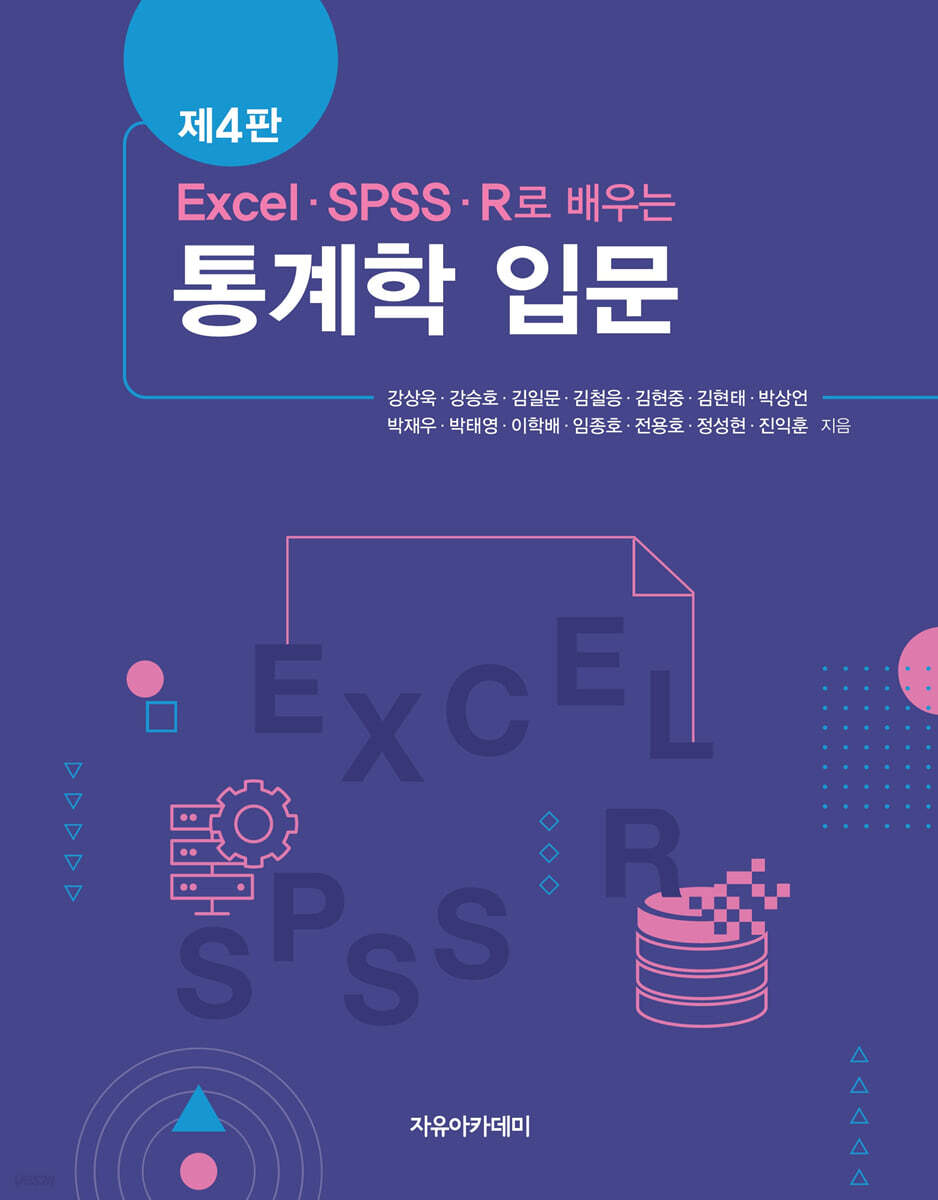
Introduction to Statistics with Excel, SPSS, and R
 |
Description
Book Introduction
As new possibilities expand, it is important to remain faithful to the basic concepts and have a solid foundation.
The concepts and way of thinking of statistics are different from those of other scientific fields, making it quite difficult to learn at the introductory level.
What is commonly referred to as a high barrier to entry.
However, once the basic concepts and framework of thinking are established, statistics will become an 'enjoyable' discipline.
The 4th edition adds an introduction to 'Functional Data' in Chapter 1 and 'Data Dependencies' in Chapter 8, and also supplements several 'References'.
We have also added practice problems, especially those related to regression analysis in Chapters 14, 15, and 16.
Additionally, R scripts for practice have been added to chapters after Chapter 12.
The concepts and way of thinking of statistics are different from those of other scientific fields, making it quite difficult to learn at the introductory level.
What is commonly referred to as a high barrier to entry.
However, once the basic concepts and framework of thinking are established, statistics will become an 'enjoyable' discipline.
The 4th edition adds an introduction to 'Functional Data' in Chapter 1 and 'Data Dependencies' in Chapter 8, and also supplements several 'References'.
We have also added practice problems, especially those related to regression analysis in Chapters 14, 15, and 16.
Additionally, R scripts for practice have been added to chapters after Chapter 12.
- You can preview some of the book's contents.
Preview
index
Chapter 1 Introduction
1.1 Creating and Saving Statistics
1.2 Use of Statistics
1.3 Population and Sample
1.4 Measurement scale
1.5 Data Hierarchy
1.6 Time series and cross-sectional data
1.7 Functional data
Chapter 2: Descriptive Statistics in Tables and Graphs
2.1 Frequency distribution table
2.2 Bar and Pie Charts
2.3 Histogram
2.4 Stem-Leaf Display
2.5 Boxplot
2.6 Time series plot
2.7 Scatterplot
2.8 Parallel Coordinates Diagram
2.9 Partition Table
2.10 Mosaic Drawing
2.11 Aspect ratio
2.12 Singular values
Chapter 3 Numerical Descriptive Statistics
3.1 Measure of central location
3.2 Volatility Measures
3.3 Finding singular values
3.4 Relevance scale
3.5 Mean and variance of group data
Chapter 4 Probability
4.1 Definition of probability
4.2 Bayes' theorem
4.3 Tree Drawing
Chapter 5 Discrete Random Variables
5.1 Random variables
5.2 Discrete probability distributions
5.3 Mean and standard deviation
5.4 Binomial distribution
5.5 Poisson distribution
Chapter 6 Continuous Random Variables
6.1 Continuous random variables
6.2 Uniform distribution
6.3 Normal distribution
6.4 Exponential distribution
Chapter 7 Sampling and Sampling Distribution
7.1 Case Study - Population and Housing Census and Economically Active Population Survey
7.2 Sample survey and census survey
7.3 Characteristics of the sampling survey
7.4 Probability sampling
7.5 Simple probability sampling
7.6 Sampling Method
7.7 Sampling Procedure
7.8 Sampling distribution of the mean
7.9 ratio sampling distribution
Chapter 8 Estimation
8.1 Point Estimation
8.2 Interval estimation
8.3 Interval estimation for the population mean
8.4 Interval estimation for the population ratio
8.5 Determination of sample size
8.6 The Importance of Data Dependency
Chapter 9 Hypothesis Testing
9.1 Elements of Hypothesis Testing
9.2 Test for population mean: When known
9.3 Test for population mean: When is not known
9.4 Test for Population Mean: Representative Survey
9.5 Test for the population ratio
Chapter 10 Two-Population Inference
Sampling distribution of 10.1
10.2 Inference about the difference between two population means: When σ²₁σ²₂ is known
10.3 Inference about the difference between two population means: When σ²₁σ²₂ is not known
10.4 Inference about the difference in means of paired populations
10.5 Inference about the difference in the population proportions of the two groups
Chapter 11 Inference about Variance
11.1 Inference about the Population Variance 376
11.2 Inference about the Variances of Two Populations 382
Chapter 12 Chi-Square Test
12.1 Categorical Variables and Contingency Tables
12.2 One categorical variable
12.3 Goodness-of-fit test
12.4 Two categorical variables
Chapter 13 Analysis of Variance
13.1 Introduction to Analysis of Variance
13.2 One-way ANOVA
13.3 Procedure for performing one-way ANOVA
13.4 Multiple comparisons
13.5 Two-way ANOVA
13.6 Procedure for performing two-way ANOVA
13.7 Probabilistic Block Design
Chapter 14: Simple Linear Regression Analysis
14.1 Simple linear regression
14.2 Least Squares Estimation
14.3 Assumptions of the Simple Regression Model
14.4 Regression coefficient significance test
14.5 Coefficient of Determination
14.6 Prediction using regression models
14.7 Regression Model Diagnosis and Prescription
14.8 Demonstration Example
Chapter 15: Multiple Linear Regression Analysis
15.1 Multiple linear regression
15.2 Significance Test
15.3 Coefficient of Determination
15.4 Assumptions and Diagnosis of Multiple Regression Models
15.5 Variables
15.6 Polynomial Regression
Chapter 16: Model Building
16.1 Variable transformation
16.2 Model Comparison
16.3 Logistic Regression
16.4 Variable Selection
Chapter 17 Nonparametric Statistics
17.1 Signs and Ranks
17.2 Sign Test: Median Test
17.3 Signed-rank test: Median test
17.4 Wilcoxon Rank Sum Test: Comparing Two Groups
17.5 Kruskal-Wallis Test: Comparing Multiple Groups
17.6 Spearman rank correlation coefficient
Appendix A: Key Probability Distribution Tables
A.1 Binomial distribution table
A.2 Standard normal distribution table
A.3 Distribution Table
A.4 Chi-square distribution table
A.5 Distribution Table
A.6 Studentized Range Distribution Table
A.7 Critical values for the Wilcoxon signed-rank test
A.8 Values of the Wilcoxon (Mann-Whitney) two-group test
A.9 Spearman rank correlation coefficient distribution table
Appendix B: Practice Problems and Answers
Appendix C References
C.1 Proof of theorem
C.2 Greek letters
C.3 Statistical Package
Search
1.1 Creating and Saving Statistics
1.2 Use of Statistics
1.3 Population and Sample
1.4 Measurement scale
1.5 Data Hierarchy
1.6 Time series and cross-sectional data
1.7 Functional data
Chapter 2: Descriptive Statistics in Tables and Graphs
2.1 Frequency distribution table
2.2 Bar and Pie Charts
2.3 Histogram
2.4 Stem-Leaf Display
2.5 Boxplot
2.6 Time series plot
2.7 Scatterplot
2.8 Parallel Coordinates Diagram
2.9 Partition Table
2.10 Mosaic Drawing
2.11 Aspect ratio
2.12 Singular values
Chapter 3 Numerical Descriptive Statistics
3.1 Measure of central location
3.2 Volatility Measures
3.3 Finding singular values
3.4 Relevance scale
3.5 Mean and variance of group data
Chapter 4 Probability
4.1 Definition of probability
4.2 Bayes' theorem
4.3 Tree Drawing
Chapter 5 Discrete Random Variables
5.1 Random variables
5.2 Discrete probability distributions
5.3 Mean and standard deviation
5.4 Binomial distribution
5.5 Poisson distribution
Chapter 6 Continuous Random Variables
6.1 Continuous random variables
6.2 Uniform distribution
6.3 Normal distribution
6.4 Exponential distribution
Chapter 7 Sampling and Sampling Distribution
7.1 Case Study - Population and Housing Census and Economically Active Population Survey
7.2 Sample survey and census survey
7.3 Characteristics of the sampling survey
7.4 Probability sampling
7.5 Simple probability sampling
7.6 Sampling Method
7.7 Sampling Procedure
7.8 Sampling distribution of the mean
7.9 ratio sampling distribution
Chapter 8 Estimation
8.1 Point Estimation
8.2 Interval estimation
8.3 Interval estimation for the population mean
8.4 Interval estimation for the population ratio
8.5 Determination of sample size
8.6 The Importance of Data Dependency
Chapter 9 Hypothesis Testing
9.1 Elements of Hypothesis Testing
9.2 Test for population mean: When known
9.3 Test for population mean: When is not known
9.4 Test for Population Mean: Representative Survey
9.5 Test for the population ratio
Chapter 10 Two-Population Inference
Sampling distribution of 10.1
10.2 Inference about the difference between two population means: When σ²₁σ²₂ is known
10.3 Inference about the difference between two population means: When σ²₁σ²₂ is not known
10.4 Inference about the difference in means of paired populations
10.5 Inference about the difference in the population proportions of the two groups
Chapter 11 Inference about Variance
11.1 Inference about the Population Variance 376
11.2 Inference about the Variances of Two Populations 382
Chapter 12 Chi-Square Test
12.1 Categorical Variables and Contingency Tables
12.2 One categorical variable
12.3 Goodness-of-fit test
12.4 Two categorical variables
Chapter 13 Analysis of Variance
13.1 Introduction to Analysis of Variance
13.2 One-way ANOVA
13.3 Procedure for performing one-way ANOVA
13.4 Multiple comparisons
13.5 Two-way ANOVA
13.6 Procedure for performing two-way ANOVA
13.7 Probabilistic Block Design
Chapter 14: Simple Linear Regression Analysis
14.1 Simple linear regression
14.2 Least Squares Estimation
14.3 Assumptions of the Simple Regression Model
14.4 Regression coefficient significance test
14.5 Coefficient of Determination
14.6 Prediction using regression models
14.7 Regression Model Diagnosis and Prescription
14.8 Demonstration Example
Chapter 15: Multiple Linear Regression Analysis
15.1 Multiple linear regression
15.2 Significance Test
15.3 Coefficient of Determination
15.4 Assumptions and Diagnosis of Multiple Regression Models
15.5 Variables
15.6 Polynomial Regression
Chapter 16: Model Building
16.1 Variable transformation
16.2 Model Comparison
16.3 Logistic Regression
16.4 Variable Selection
Chapter 17 Nonparametric Statistics
17.1 Signs and Ranks
17.2 Sign Test: Median Test
17.3 Signed-rank test: Median test
17.4 Wilcoxon Rank Sum Test: Comparing Two Groups
17.5 Kruskal-Wallis Test: Comparing Multiple Groups
17.6 Spearman rank correlation coefficient
Appendix A: Key Probability Distribution Tables
A.1 Binomial distribution table
A.2 Standard normal distribution table
A.3 Distribution Table
A.4 Chi-square distribution table
A.5 Distribution Table
A.6 Studentized Range Distribution Table
A.7 Critical values for the Wilcoxon signed-rank test
A.8 Values of the Wilcoxon (Mann-Whitney) two-group test
A.9 Spearman rank correlation coefficient distribution table
Appendix B: Practice Problems and Answers
Appendix C References
C.1 Proof of theorem
C.2 Greek letters
C.3 Statistical Package
Search
Publisher's Review
'The match between Lee Sedol and AlphaGo in March 2016 became an opportunity to change people's thoughts about artificial intelligence (AI).
Although it is difficult to draw a definitive line, the term "big data" began to appear frequently around this time, and has now become a word that can be easily encountered in everyday life.
In 2019, Google unveiled a quantum computer that could perform calculations in 200 seconds that would take a supercomputer 10,000 years to perform.
As a result, things that were previously only imaginable but impossible to calculate in practice have become possible.
Quantum computing will now play a significant role in statistical calculations.
Additionally, methods for analyzing unstructured data such as pictures, music, videos, books, and newspapers are also emerging.
As new possibilities expand, we must remain faithful to the basic concepts and have a solid foundation.
The concepts and way of thinking of statistics are different from those of other scientific fields, making it quite difficult to learn at the introductory level.
What is commonly referred to as a high barrier to entry.
However, once the basic concepts and framework of thinking are established, statistics will become an 'enjoyable' discipline.
The 4th edition adds an introduction to 'Functional Data' in Chapter 1 and 'Data Dependencies' in Chapter 8, and also supplements several 'References'.
We have also added practice problems, especially those related to regression analysis in Chapters 14, 15, and 16.
Additionally, R scripts for practice have been added to chapters after Chapter 12.
I did my best to make this a good book, but there may be some shortcomings.
We ask for the understanding of our readers on this point, and if there are any revisions after publication, we will provide them in the data room of the Free Academy website (www.freeaca.com), so please refer to them.
Although it is difficult to draw a definitive line, the term "big data" began to appear frequently around this time, and has now become a word that can be easily encountered in everyday life.
In 2019, Google unveiled a quantum computer that could perform calculations in 200 seconds that would take a supercomputer 10,000 years to perform.
As a result, things that were previously only imaginable but impossible to calculate in practice have become possible.
Quantum computing will now play a significant role in statistical calculations.
Additionally, methods for analyzing unstructured data such as pictures, music, videos, books, and newspapers are also emerging.
As new possibilities expand, we must remain faithful to the basic concepts and have a solid foundation.
The concepts and way of thinking of statistics are different from those of other scientific fields, making it quite difficult to learn at the introductory level.
What is commonly referred to as a high barrier to entry.
However, once the basic concepts and framework of thinking are established, statistics will become an 'enjoyable' discipline.
The 4th edition adds an introduction to 'Functional Data' in Chapter 1 and 'Data Dependencies' in Chapter 8, and also supplements several 'References'.
We have also added practice problems, especially those related to regression analysis in Chapters 14, 15, and 16.
Additionally, R scripts for practice have been added to chapters after Chapter 12.
I did my best to make this a good book, but there may be some shortcomings.
We ask for the understanding of our readers on this point, and if there are any revisions after publication, we will provide them in the data room of the Free Academy website (www.freeaca.com), so please refer to them.
GOODS SPECIFICS
- Date of issue: March 5, 2022
- Page count, weight, size: 824 pages | 215*275*40mm
- ISBN13: 9791158083540
- ISBN10: 1158083548
You may also like
카테고리
korean


korean

![GQ KOREA Mark (Monthly): December [2025]](http://librairie.coreenne.fr/cdn/shop/files/8ef265dbbfbf186523ed75ba7319009d.jpg?v=1765340328&width=3840)


