

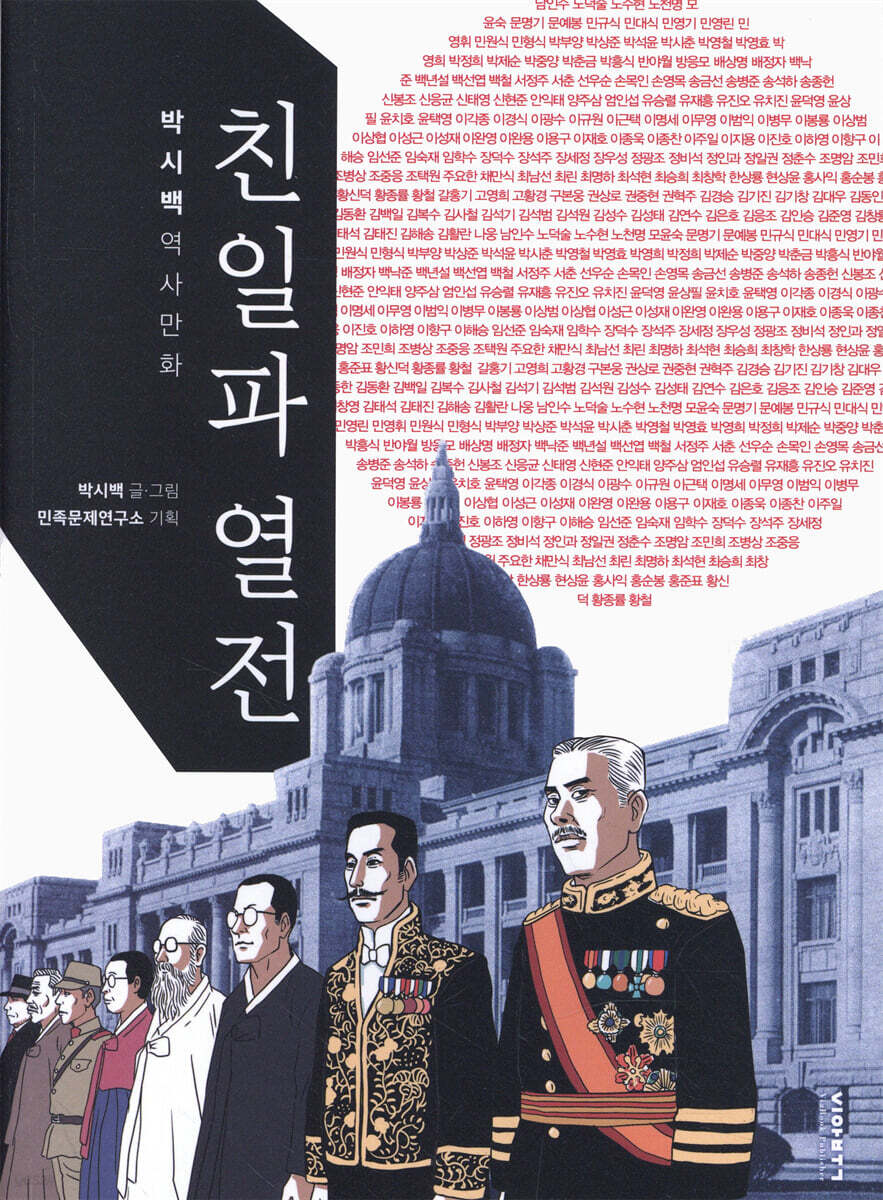
Pro-Japanese collaborators
 |
Description
Book Introduction
Park Si-baek, the author of "35 Years," a comic book that depicts the 35 years of Japanese colonial rule, from the forced annexation of Japan in 1910 to the liberation in 1945, has returned with "Biographies of Pro-Japanese Collaborators."
By narrowing the focus to the history of pro-Japanese collaborators and meticulously examining the vast history of the 35 years of Japanese colonial rule, we once again breathe new life into the often-tedious term "liquidation of pro-Japanese collaborators."
In the author's note, the author explains why the liquidation of pro-Japanese collaborators remains a current issue.
“Even after liberation, pro-Japanese collaborators were not only not eliminated, but instead became established as the mainstream of our society.
Can we understand the current situation without considering this history? Yes.
Pro-Japanese elements are still alive and well.
“Those who sided with the invaders during the Japanese colonial period, betrayed their nation, and then became the mainstream and flourished even after liberation have now reached the end of their biological lifespan and disappeared, but their blood and ideological descendants still form a central axis of our society.”
By narrowing the focus to the history of pro-Japanese collaborators and meticulously examining the vast history of the 35 years of Japanese colonial rule, we once again breathe new life into the often-tedious term "liquidation of pro-Japanese collaborators."
In the author's note, the author explains why the liquidation of pro-Japanese collaborators remains a current issue.
“Even after liberation, pro-Japanese collaborators were not only not eliminated, but instead became established as the mainstream of our society.
Can we understand the current situation without considering this history? Yes.
Pro-Japanese elements are still alive and well.
“Those who sided with the invaders during the Japanese colonial period, betrayed their nation, and then became the mainstream and flourished even after liberation have now reached the end of their biological lifespan and disappeared, but their blood and ideological descendants still form a central axis of our society.”
- You can preview some of the book's contents.
Preview
index
Chapter 1: History of Pro-Japanese Collaboration
Chapter 2: We Are Imperial Subjects
Chapter 3: Students, Come to the Temple
Special Appendix | Biographies of Pro-Japanese Figures
Chapter 2: We Are Imperial Subjects
Chapter 3: Students, Come to the Temple
Special Appendix | Biographies of Pro-Japanese Figures
Detailed image

Publisher's Review
Park Si-baek,
Speaking of unfinished history
Earlier this year, a person sparked controversy when he brought up a photo revealing the housing gap between the descendants of pro-Japanese collaborators and those of independence activists and asked, "While the descendants of pro-Japanese collaborators are working so hard, what on earth have the descendants of independence activists been doing? A hundred years ago, weren't the pro-Japanese collaborators hard workers and the independence activists just living a careless life?"
Furthermore, among the mainstream perspectives on the historical conflicts between Korea and Japan, such as the "comfort women" issue and compensation for victims of forced labor, there are many who agree with Japan's position and point out our mistakes.
Author Park Si-baek says this:
“Pro-Japanese collaborators are still alive and well.”
Park Si-baek, the author of "35 Years," a comic book that depicts the 35 years of Japanese colonial rule, from the forced annexation of Japan in 1910 to the liberation in 1945, has returned with "Biographies of Pro-Japanese Collaborators."
By narrowing the focus to the history of pro-Japanese collaborators and meticulously examining the vast history of the 35 years of Japanese colonial rule, we once again breathe new life into the often-tedious term "liquidation of pro-Japanese collaborators."
In the author's note, the author explains why the liquidation of pro-Japanese collaborators remains a current issue.
“Even after liberation, pro-Japanese collaborators were not only not eliminated, but instead became established as the mainstream of our society.
Can we understand the current situation without considering this history? Yes.
Pro-Japanese elements are still alive and well.
“Those who sided with the invaders during the Japanese colonial period, betrayed their nation, and then became the mainstream and flourished even after liberation have now reached the end of their biological lifespan and disappeared, but their blood and ideological descendants still form a central axis of our society.”
What do we learn from history?
The question posed by 『35 Years』
Answering with "Biographies of Pro-Japanese Collaborators"
In his previous work, “35 Years,” which deals with the history of the Japanese colonial period, the author called the March 1st Movement a “revolution.”
Although it did not lead to independence, the nature of the independence movement changed significantly after the March 1st Revolution, and the people of Joseon were reborn as modern people.
Japan was also greatly embarrassed and changed its colonial policy, and its surveillance became more subtle and persistent.
In the midst of all this, there were those who saw the March 1st Revolution as a ‘golden opportunity.’
“A country cannot become prosperous without ability,” “Young Koreans, stop acting rashly,” “Reflection is the only way to survive,” and other such warnings and reprimands directed at the “unruly and foolish Koreans” poured out through newspapers and lectures, and some even took to the streets, clutching batons.
For them, the March 1st Revolution was a ‘big deal’ and a golden opportunity to catch the eye of the Governor-General.
Innocent lives were lost at the hands of those who did not miss any 'opportunity', such as the student anti-Japanese movement that spread like wildfire across the country and the large and small independence groups that moved secretly.
Pro-Japanese collaborators did not suddenly ‘emerge’.
"Biographies of Pro-Japanese Collaborators" traces in detail the origins of pro-Japanese collaborators, from the Ganghwa Island Treaty that deprived them of diplomatic rights to the post-liberation period, how they grew in power and wealth, and how they avoided punishment for their crimes after liberation.
In 『35 Years』, the author said this about the reason for learning history.
“Why do we learn history?
The common answer is to learn from the past and not repeat past mistakes.
Some say that we gain wisdom to live from history.
However, the path of anti-Japanese struggle was a path of hardship and death, while the path of collaboration with Japan was a path of comfort and glory.
“If living like the latter becomes the wisdom we gain from history, then learning history becomes a very miserable thing.”
『Biographies of Pro-Japanese Collaborators』 is one solution the author has proposed to this problem.
Beneath the path of comfort and glory that the descendants of pro-Japanese collaborators are currently walking, countless lives, now forgotten, lie laid out.
After liberation, countless pro-Japanese collaborators avoided punishment by making shallow excuses such as saying that they had no choice but to do so in order to survive.
This book meticulously traces and depicts how the actions commonly lumped together as "collaboration with the Japanese" actually actively drove innocent people to their deaths and how many tragedies resulted from them, adding a tinge of truth to dry facts.
By doing so, I wanted to correct the distorted order.
Only when we confront the wounds of our society that have been hidden for so long and punish them accordingly will we be able to build a history worthy of wisdom.
From the Ganghwa Island Treaty to liberation,
Uncovering the Birth and History of Pro-Japanese Collaboration
This book selects 150 representative pro-Japanese collaborators who deserve special attention among the 4,389 people included in the Dictionary of Pro-Japanese Collaborators published by the Committee for the Compilation of the Dictionary of Pro-Japanese Collaborators, and discloses their activities in detail.
It is divided into three chapters so that the characters can be examined in accordance with the flow of the times.
First, Chapter 1, “History of Collaboration with Japan,” broadly examines the formation and history of collaboration with Japan from the Ganghwa Treaty to immediately after liberation.
To enhance understanding of the pro-Japanese figures from all walks of life, we will focus on the passage of time and introduce the actions of prominent figures.
Chapter 2, “We are Imperial Subjects,” introduces nationalities such as the Eulsa Five Traitors, Jeongmi Seven Traitors, and Gyeongsul Nationality Traitors, pro-Japanese collaborators who received noble titles, police officers and spies, and pro-Japanese collaborators who were active in Manchuria, categorized by category.
Chapter 3, “Students, Come Out to the Temple,” introduces in detail the pro-Japanese activities of prominent figures who dominated Joseon during the Japanese colonial period, as well as pro-Japanese figures active in various fields, including government officials, military personnel, literary circles, theater, film, and music circles.
The appendix, “Biographies of Pro-Japanese Figures,” provides a convenient summary of the activities of approximately 150 representative pro-Japanese figures who appear in this book.
The Second Special Committee on Anti-Japanese Collaborators, Carrying on the Spirit of the "Dictionary of Pro-Japanese Collaborators"!
Special project commemorating the 30th anniversary of the Institute for Research in Collaborationist Activities
After Professor Im Jong-guk, who devoted his life to researching pro-Japanese issues, passed away in 1989, his successors who continued his legacy opened the Institute for Research on Anti-National Issues in 1991 (renamed the Institute for Research on National Issues in 1995).
In 1999, a movement was launched to create a 'second special committee on pro-Japanese collaborators' and a 'dictionary of pro-Japanese figures', and on November 8, 2009, the 'dictionary of pro-Japanese figures' containing a list of 4,389 pro-Japanese collaborators was finally published.
Author Park Si-baek received the 14th Im Jong-guk Award from the Im Jong-guk Memorial Foundation, which honors the late writer Im Jong-guk, for his work “35 Years.”
The commemorative society chose the artist as the recipient, "highly praising the artist for his remarkable achievements in shedding light on blind spots in history and giving them new meaning, and paying tribute to the artist's hard work and spirit of challenge, which greatly contributed to the popularization of history through his works at a time when historical distortion is taking place both domestically and internationally."
It was precisely because of this connection that the Institute for Research in Collaborationist Activities proposed to writer Park the publication of a historical comic book that reconstructed the birth and history of pro-Japanese collaborators as a special project for its 30th anniversary.
Author Park Si-baek, following the will of Professor Im Jong-guk, also published “Biographies of Pro-Japanese Collaborators” with the belief that “the most important part of the task of our time, which is to liquidate pro-Japanese collaborators, is to make pro-Japanese collaborators in each field widely known and to correct their absurd position in our modern history.”
Speaking of unfinished history
Earlier this year, a person sparked controversy when he brought up a photo revealing the housing gap between the descendants of pro-Japanese collaborators and those of independence activists and asked, "While the descendants of pro-Japanese collaborators are working so hard, what on earth have the descendants of independence activists been doing? A hundred years ago, weren't the pro-Japanese collaborators hard workers and the independence activists just living a careless life?"
Furthermore, among the mainstream perspectives on the historical conflicts between Korea and Japan, such as the "comfort women" issue and compensation for victims of forced labor, there are many who agree with Japan's position and point out our mistakes.
Author Park Si-baek says this:
“Pro-Japanese collaborators are still alive and well.”
Park Si-baek, the author of "35 Years," a comic book that depicts the 35 years of Japanese colonial rule, from the forced annexation of Japan in 1910 to the liberation in 1945, has returned with "Biographies of Pro-Japanese Collaborators."
By narrowing the focus to the history of pro-Japanese collaborators and meticulously examining the vast history of the 35 years of Japanese colonial rule, we once again breathe new life into the often-tedious term "liquidation of pro-Japanese collaborators."
In the author's note, the author explains why the liquidation of pro-Japanese collaborators remains a current issue.
“Even after liberation, pro-Japanese collaborators were not only not eliminated, but instead became established as the mainstream of our society.
Can we understand the current situation without considering this history? Yes.
Pro-Japanese elements are still alive and well.
“Those who sided with the invaders during the Japanese colonial period, betrayed their nation, and then became the mainstream and flourished even after liberation have now reached the end of their biological lifespan and disappeared, but their blood and ideological descendants still form a central axis of our society.”
What do we learn from history?
The question posed by 『35 Years』
Answering with "Biographies of Pro-Japanese Collaborators"
In his previous work, “35 Years,” which deals with the history of the Japanese colonial period, the author called the March 1st Movement a “revolution.”
Although it did not lead to independence, the nature of the independence movement changed significantly after the March 1st Revolution, and the people of Joseon were reborn as modern people.
Japan was also greatly embarrassed and changed its colonial policy, and its surveillance became more subtle and persistent.
In the midst of all this, there were those who saw the March 1st Revolution as a ‘golden opportunity.’
“A country cannot become prosperous without ability,” “Young Koreans, stop acting rashly,” “Reflection is the only way to survive,” and other such warnings and reprimands directed at the “unruly and foolish Koreans” poured out through newspapers and lectures, and some even took to the streets, clutching batons.
For them, the March 1st Revolution was a ‘big deal’ and a golden opportunity to catch the eye of the Governor-General.
Innocent lives were lost at the hands of those who did not miss any 'opportunity', such as the student anti-Japanese movement that spread like wildfire across the country and the large and small independence groups that moved secretly.
Pro-Japanese collaborators did not suddenly ‘emerge’.
"Biographies of Pro-Japanese Collaborators" traces in detail the origins of pro-Japanese collaborators, from the Ganghwa Island Treaty that deprived them of diplomatic rights to the post-liberation period, how they grew in power and wealth, and how they avoided punishment for their crimes after liberation.
In 『35 Years』, the author said this about the reason for learning history.
“Why do we learn history?
The common answer is to learn from the past and not repeat past mistakes.
Some say that we gain wisdom to live from history.
However, the path of anti-Japanese struggle was a path of hardship and death, while the path of collaboration with Japan was a path of comfort and glory.
“If living like the latter becomes the wisdom we gain from history, then learning history becomes a very miserable thing.”
『Biographies of Pro-Japanese Collaborators』 is one solution the author has proposed to this problem.
Beneath the path of comfort and glory that the descendants of pro-Japanese collaborators are currently walking, countless lives, now forgotten, lie laid out.
After liberation, countless pro-Japanese collaborators avoided punishment by making shallow excuses such as saying that they had no choice but to do so in order to survive.
This book meticulously traces and depicts how the actions commonly lumped together as "collaboration with the Japanese" actually actively drove innocent people to their deaths and how many tragedies resulted from them, adding a tinge of truth to dry facts.
By doing so, I wanted to correct the distorted order.
Only when we confront the wounds of our society that have been hidden for so long and punish them accordingly will we be able to build a history worthy of wisdom.
From the Ganghwa Island Treaty to liberation,
Uncovering the Birth and History of Pro-Japanese Collaboration
This book selects 150 representative pro-Japanese collaborators who deserve special attention among the 4,389 people included in the Dictionary of Pro-Japanese Collaborators published by the Committee for the Compilation of the Dictionary of Pro-Japanese Collaborators, and discloses their activities in detail.
It is divided into three chapters so that the characters can be examined in accordance with the flow of the times.
First, Chapter 1, “History of Collaboration with Japan,” broadly examines the formation and history of collaboration with Japan from the Ganghwa Treaty to immediately after liberation.
To enhance understanding of the pro-Japanese figures from all walks of life, we will focus on the passage of time and introduce the actions of prominent figures.
Chapter 2, “We are Imperial Subjects,” introduces nationalities such as the Eulsa Five Traitors, Jeongmi Seven Traitors, and Gyeongsul Nationality Traitors, pro-Japanese collaborators who received noble titles, police officers and spies, and pro-Japanese collaborators who were active in Manchuria, categorized by category.
Chapter 3, “Students, Come Out to the Temple,” introduces in detail the pro-Japanese activities of prominent figures who dominated Joseon during the Japanese colonial period, as well as pro-Japanese figures active in various fields, including government officials, military personnel, literary circles, theater, film, and music circles.
The appendix, “Biographies of Pro-Japanese Figures,” provides a convenient summary of the activities of approximately 150 representative pro-Japanese figures who appear in this book.
The Second Special Committee on Anti-Japanese Collaborators, Carrying on the Spirit of the "Dictionary of Pro-Japanese Collaborators"!
Special project commemorating the 30th anniversary of the Institute for Research in Collaborationist Activities
After Professor Im Jong-guk, who devoted his life to researching pro-Japanese issues, passed away in 1989, his successors who continued his legacy opened the Institute for Research on Anti-National Issues in 1991 (renamed the Institute for Research on National Issues in 1995).
In 1999, a movement was launched to create a 'second special committee on pro-Japanese collaborators' and a 'dictionary of pro-Japanese figures', and on November 8, 2009, the 'dictionary of pro-Japanese figures' containing a list of 4,389 pro-Japanese collaborators was finally published.
Author Park Si-baek received the 14th Im Jong-guk Award from the Im Jong-guk Memorial Foundation, which honors the late writer Im Jong-guk, for his work “35 Years.”
The commemorative society chose the artist as the recipient, "highly praising the artist for his remarkable achievements in shedding light on blind spots in history and giving them new meaning, and paying tribute to the artist's hard work and spirit of challenge, which greatly contributed to the popularization of history through his works at a time when historical distortion is taking place both domestically and internationally."
It was precisely because of this connection that the Institute for Research in Collaborationist Activities proposed to writer Park the publication of a historical comic book that reconstructed the birth and history of pro-Japanese collaborators as a special project for its 30th anniversary.
Author Park Si-baek, following the will of Professor Im Jong-guk, also published “Biographies of Pro-Japanese Collaborators” with the belief that “the most important part of the task of our time, which is to liquidate pro-Japanese collaborators, is to make pro-Japanese collaborators in each field widely known and to correct their absurd position in our modern history.”
GOODS SPECIFICS
- Date of issue: August 2, 2021
- Page count, weight, size: 340 pages | 618g | 170*235*30mm
- ISBN13: 9791191019445
- ISBN10: 1191019446
You may also like
카테고리
korean


korean

![GQ KOREA Mark (Monthly): December [2025]](http://librairie.coreenne.fr/cdn/shop/files/8ef265dbbfbf186523ed75ba7319009d.jpg?v=1765340328&width=3840)


