

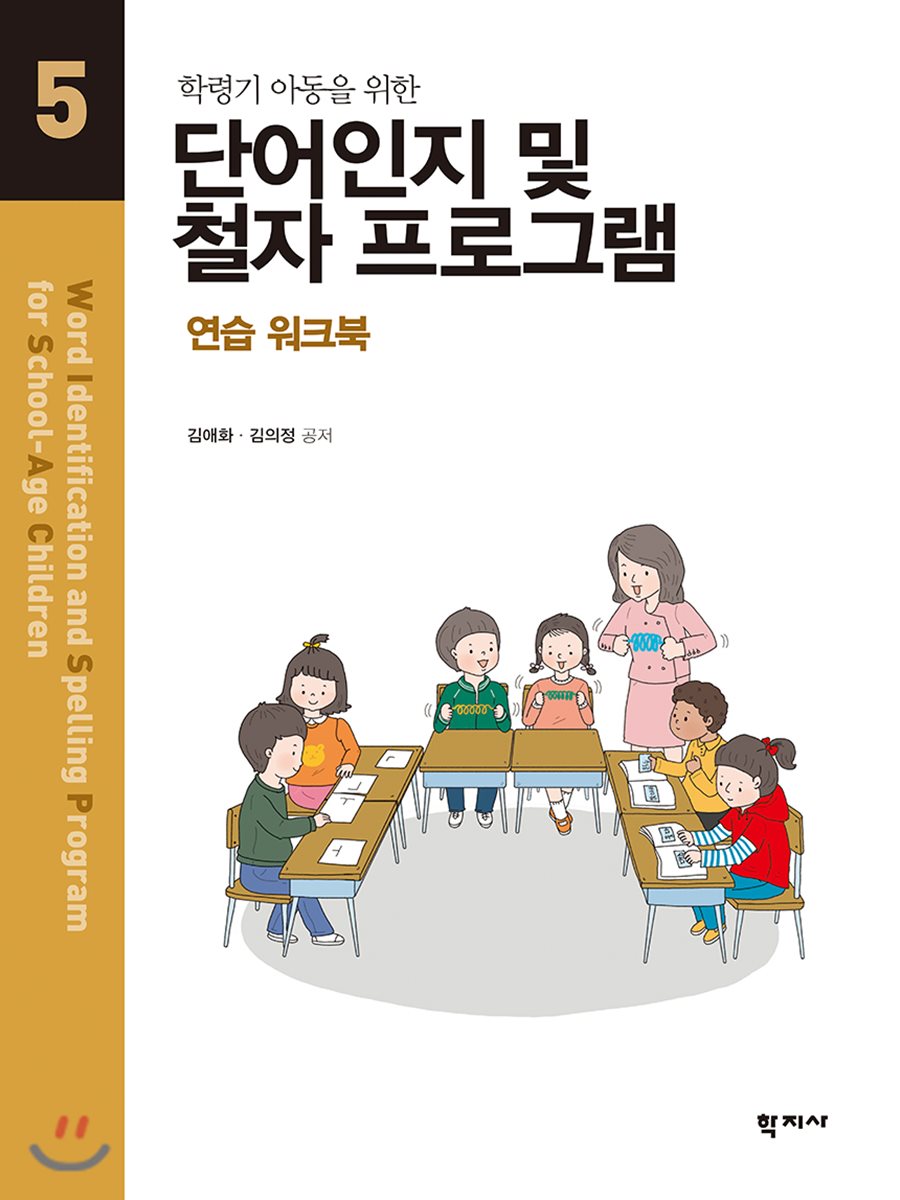
Word Recognition and Spelling Program 5
 |
Description
Book Introduction
In today's educational landscape, there are more diverse learners than ever before.
There are students with diverse learning needs, including general students who do not have significant difficulties in academic achievement, underachieving students who have learning difficulties, slow learners who learn at a slower pace than their peers, students from multicultural families whose native language is not Korean or who have difficulty acquiring Korean in their native language, and students with learning disabilities who have serious difficulties in learning, such as reading, writing, and math.
Therefore, it is necessary to identify the learning needs of these diverse learners and provide educational support accordingly.
Among various learning skills, reading and writing skills are essential to all academic learning and are very important for successful academic achievement.
Accordingly, the developers of this program developed a program that focuses on word recognition and spelling, which are the foundation for the reading and writing skills of the various learners mentioned above.
Key features of the word recognition and spelling program include:
First, it was systematically developed so that students could gradually acquire the ability to read and spell words without final consonants and then to read and spell words with double final consonants.
Second, we have additionally provided practice workbooks (5 volumes) so that you can practice what you have learned rather than just learning it once.
Third, it was developed by applying evidence-based teaching methods that have been proven effective in improving word recognition and spelling skills through domestic and international prior research.
Therefore, we recommend that this program be used to support school-age students, including elementary school students, who need to improve word recognition and spelling skills both within the school setting, such as after school, and outside of the school setting, such as in learning clinics and individual cognitive learning treatment centers.
It is also recommended for use at home to guide your child's word recognition and spelling skills as needed.
The developers of this program anticipate that this word recognition and spelling program will not only provide learning opportunities tailored to the needs of a diverse range of learners, but will also serve as a valuable resource for improving their word recognition and writing skills.
There are students with diverse learning needs, including general students who do not have significant difficulties in academic achievement, underachieving students who have learning difficulties, slow learners who learn at a slower pace than their peers, students from multicultural families whose native language is not Korean or who have difficulty acquiring Korean in their native language, and students with learning disabilities who have serious difficulties in learning, such as reading, writing, and math.
Therefore, it is necessary to identify the learning needs of these diverse learners and provide educational support accordingly.
Among various learning skills, reading and writing skills are essential to all academic learning and are very important for successful academic achievement.
Accordingly, the developers of this program developed a program that focuses on word recognition and spelling, which are the foundation for the reading and writing skills of the various learners mentioned above.
Key features of the word recognition and spelling program include:
First, it was systematically developed so that students could gradually acquire the ability to read and spell words without final consonants and then to read and spell words with double final consonants.
Second, we have additionally provided practice workbooks (5 volumes) so that you can practice what you have learned rather than just learning it once.
Third, it was developed by applying evidence-based teaching methods that have been proven effective in improving word recognition and spelling skills through domestic and international prior research.
Therefore, we recommend that this program be used to support school-age students, including elementary school students, who need to improve word recognition and spelling skills both within the school setting, such as after school, and outside of the school setting, such as in learning clinics and individual cognitive learning treatment centers.
It is also recommended for use at home to guide your child's word recognition and spelling skills as needed.
The developers of this program anticipate that this word recognition and spelling program will not only provide learning opportunities tailored to the needs of a diverse range of learners, but will also serve as a valuable resource for improving their word recognition and writing skills.
index
preface
How to structure and use the program
I.
Workbook for practicing words and spelling without final consonants
1.
Words composed of basic consonants and basic vowels
2.
A word composed of aspirated consonants and vowels
II.
Single-letter word and spelling practice workbook
1.
Single consonant words pronounced with a representative sound
2.
Single consonant words to which phonetic changes are applied
1) Single consonant linking
2) Single consonant ㅎ eliminated
3) Single-letter contraction
4) Nasalization of single consonants
III.
Double Consonant Words and Spelling Practice Workbook
1.
Double consonant words pronounced with a representative sound
2.
Double consonant words with phonetic changes
1) Double consonant linking
(1) Double consonants ㄺ ㄵ ㄼ ㄻ + words starting with 'ㅇ'
(2) Words starting with double consonant ㅄ + 'ㅇ'
2) Double consonant ㅎ dropout sound
3) Overlapping contraction
4) Nasalization of double consonants
◆ Answer sheet
How to structure and use the program
I.
Workbook for practicing words and spelling without final consonants
1.
Words composed of basic consonants and basic vowels
2.
A word composed of aspirated consonants and vowels
II.
Single-letter word and spelling practice workbook
1.
Single consonant words pronounced with a representative sound
2.
Single consonant words to which phonetic changes are applied
1) Single consonant linking
2) Single consonant ㅎ eliminated
3) Single-letter contraction
4) Nasalization of single consonants
III.
Double Consonant Words and Spelling Practice Workbook
1.
Double consonant words pronounced with a representative sound
2.
Double consonant words with phonetic changes
1) Double consonant linking
(1) Double consonants ㄺ ㄵ ㄼ ㄻ + words starting with 'ㅇ'
(2) Words starting with double consonant ㅄ + 'ㅇ'
2) Double consonant ㅎ dropout sound
3) Overlapping contraction
4) Nasalization of double consonants
◆ Answer sheet
GOODS SPECIFICS
- Date of issue: January 30, 2018
- Page count, weight, size: 224 pages | 580g | 210*297*20mm
- ISBN13: 9788999714658
- ISBN10: 8999714659
You may also like
카테고리
korean


korean

![ELLE 엘르 스페셜 에디션 A형 : 12월 [2025]](http://librairie.coreenne.fr/cdn/shop/files/b8e27a3de6c9538896439686c6b0e8fb.jpg?v=1766436872&width=3840)


