

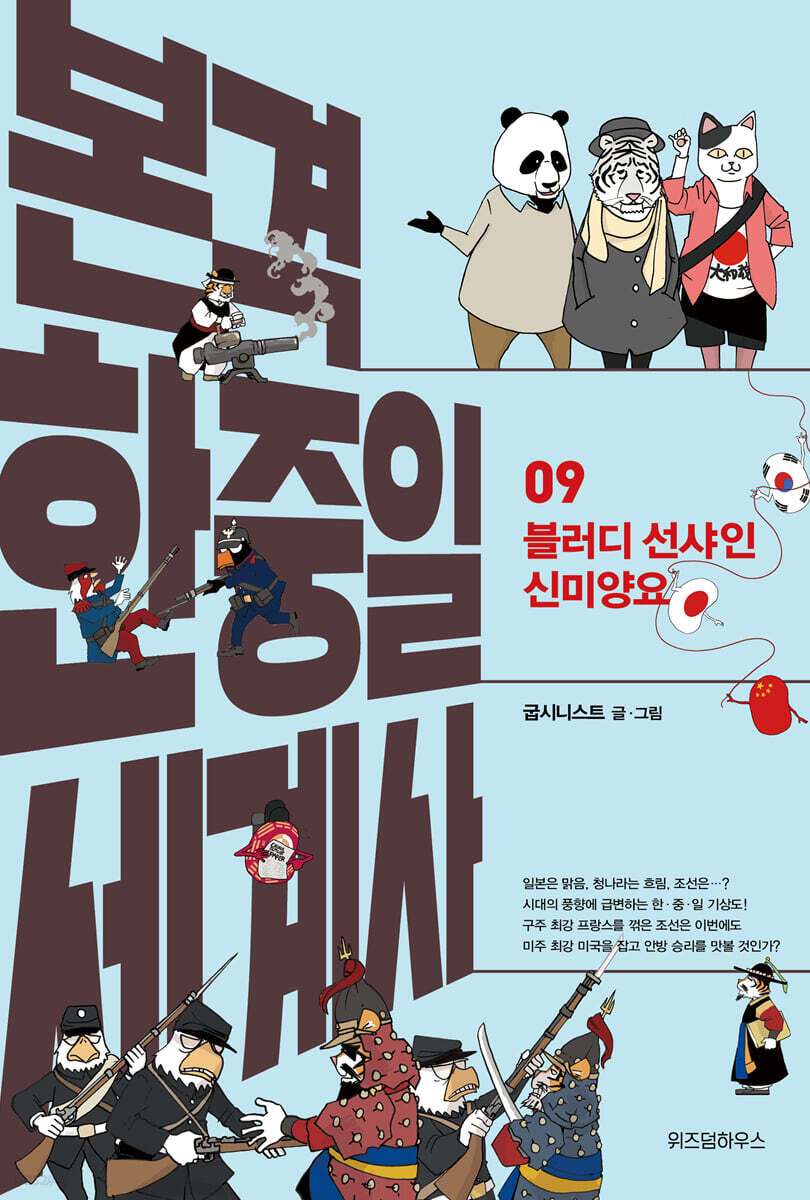
Authentic Korean-Chinese-Japanese World History 9
 |
Description
Book Introduction
Where did the fates of the two countries, Joseon and Japan, diverge: the path of empire and the path of colony?
Volume 9 depicts the contrasting fates of Japan, which accelerated modernization after the Meiji government took office, and Joseon, which chose isolation amidst the triple whammy of disaster, rebellion, and invasion by foreign powers.
The new Japanese government, which had completed the dissolution of the shogunate through the Boshin War, sent a diplomatic document (a letter) to Joseon to reestablish diplomatic relations, but Joseon refused to accept it, citing the terminology and format as issues.
We take a look at the single moments that changed the fate of Korea and Japan, two countries that shared the common task of reforming the old system and repelling foreign invasion.
Volume 9 depicts the contrasting fates of Japan, which accelerated modernization after the Meiji government took office, and Joseon, which chose isolation amidst the triple whammy of disaster, rebellion, and invasion by foreign powers.
The new Japanese government, which had completed the dissolution of the shogunate through the Boshin War, sent a diplomatic document (a letter) to Joseon to reestablish diplomatic relations, but Joseon refused to accept it, citing the terminology and format as issues.
We take a look at the single moments that changed the fate of Korea and Japan, two countries that shared the common task of reforming the old system and repelling foreign invasion.
- You can preview some of the book's contents.
Preview
index
Chapter 1.
Meiji opening
Chapter 2.
Forbidden Tomb
Chapter 3.
Hi Busan, Bye Dooman
Chapter 4.
1860s Chronicle Part 1
Chapter 5.
1860s Chronicle Part 2
Chapter 6.
Dieu et L'Empereur
Chapter 7.
Franco-Prussian War
Chapter 8.
Towards the North Sea
Chapter 9.
Together and apart
Chapter 10.
Yang Gui after the traitor
Chapter 11.
Shinmiyangyo (Part 1)
Chapter 12.
Shinmiyangyo (Part 2)
Chapter 13.
US troop withdrawal
Chapter 14.
Abolition of the feudal system and establishment of counties and equality for all
Chapter 15.
Iwakura Mission
Meiji opening
Chapter 2.
Forbidden Tomb
Chapter 3.
Hi Busan, Bye Dooman
Chapter 4.
1860s Chronicle Part 1
Chapter 5.
1860s Chronicle Part 2
Chapter 6.
Dieu et L'Empereur
Chapter 7.
Franco-Prussian War
Chapter 8.
Towards the North Sea
Chapter 9.
Together and apart
Chapter 10.
Yang Gui after the traitor
Chapter 11.
Shinmiyangyo (Part 1)
Chapter 12.
Shinmiyangyo (Part 2)
Chapter 13.
US troop withdrawal
Chapter 14.
Abolition of the feudal system and establishment of counties and equality for all
Chapter 15.
Iwakura Mission
Into the book
On November 26, 1868, the Meiji government moved the capital to Tokyo.
1) First of all, the most efficient choice is to utilize the 250-year-old capital's national management infrastructure as it is, and 2) to prevent the enormous energy of Kanto, the center of the shogunate, from being released in the direction of resistance, the strategy is to place the government itself on top of 1 million Edo as a block.
3) And the desire to isolate the new government as much as possible from the dark conspiracy energy of the Kyoto court nobles and the sticky influence of the Satsuma domain lords.
The capital was moved, the Battle of Mujin ended in victory, and in June 1869, the suppression of the Enomoto gang in Hokkaido was completed.
--- p.21~22, from “Chapter 1_The Opening of the Meiji Era”
In 1880, Oppert wrote a book about his experiences in Joseon.
《The Forbidden Land, Joseon》This book is famous for its descriptions that are very friendly to Joseon.
If it were today, it would have been a huge hit with pro-Korean nationalist YouTubers.
For example - “Koreans have good conduct and character, so there are not many serious crimes in the country.” “Koreans are taller and bigger than their neighbors.
“You have a white face, so are you perhaps Caucasian?” “They are more gentle, friendly, honest, and pure than the people of their neighbors.” Oppert, who was so friendly to Koreans, must have thought that all his actions were to break down the oppression of the Daewongun who was oppressing these wonderful Koreans, to liberate them, and to lead them into the civilized world.
--- p.43~44, from “Chapter 2_Forbidden Tomb”
From 1867 onward, Joseon was plagued by a series of natural disasters—floods! Cold damage! Insect damage! By 1869, the northern region, in particular, was a living hell.
Accordingly, the people began to leave in search of a way to survive, and although they could have been executed for crossing the border without permission, over three years, starting in 1869, over 60,000 people crossed the Tumen River.
The Joseonjok remember it as the 'Gisa Famine' in 1869 (the year of Gisa), and the Koryo people remember it as the 'Gyeongo Dogang' in 1870 (the year of Gyeongo).
--- p.56~58, from 「Chapter 3_Hi Boosan, bye Dooman」
For a long time, rumors about Western churches harvesting human organs and using them to make all sorts of medicines and chemicals have been spreading throughout China.
Meanwhile, in Tianjin, the Injingang Church Convent, founded by the Daughters of Charity of Saint Vincent de Paul, was running an orphanage, taking in dozens of orphans.
In the summer of 1870, an epidemic broke out, resulting in the mass deaths of 30 to 40 infants and children at the Injadang Orphanage.
This led to a surge in suspicion among Tianjin residents about the Injadang Church.
--- p.124~125, from 「Chapter 6_Dieu et L'Empereur」
Bismarck, having received a telegram from Ems, distributed a press release to foreign media.
The German press reported that - the French ambassador rudely barged into His Majesty the King's presence while he was resting! He threatened to swear to abdicate the Spanish throne!! Meanwhile, in the French press, the Prussian king roughly kicked out the French ambassador, and then a Prussian deputy (mistranslation) refused to let him in!! The French government and the public were ablaze with calls for the conquest of Germany, coinciding with Bastille Day.
A mood of retribution against France erupts in Prussia and throughout Germany.
--- p.133~135, from 「Chapter 6_Dieu et L'Empereur」
On the morning of June 11, after eating, the US military advanced toward Gwangseongbo.
The North Korean army at Deokjinjin, located in the middle, withdrew before the arrival of the US military.
US military forces occupy Deokjinjin without bloodshed.
And immediately secure the Daemosan high ground! Daemosan, the high ground that dominates the entrance to the Gwangseongbo Pocket.
By securing Daemosan, the US military blocked threats from behind and made the movements of the North Korean army in Gwangseongbo difficult.
Instead of the difficult-to-guard plains of Gwangseong Fortress, Jaeyeon Eo made the hilltop Sondolmok Fortress his main base.
Gwangseongbo concentrated most of its 500 troops at Sondolmok Dondae.
Of course, the US military did not give the North Korean army a moment's rest and immediately launched an attack at 10:00 AM.
Two 12-pounder field guns deployed at the mouth of Mt. Daemosan spit fire, and the gunboats Monocacy and Palos provided support fire from the sea.
The firepower of the Sondolmok Fortress was neutralized without causing any significant damage to the enemy, as the piled up gunpowder exploded when hit by enemy bullets. The internal area of the Sondolmok Fortress was approximately 235 pyeong.
With hundreds of people crammed into a space the size of a large gym, casualties from the shelling were also significant.
1) First of all, the most efficient choice is to utilize the 250-year-old capital's national management infrastructure as it is, and 2) to prevent the enormous energy of Kanto, the center of the shogunate, from being released in the direction of resistance, the strategy is to place the government itself on top of 1 million Edo as a block.
3) And the desire to isolate the new government as much as possible from the dark conspiracy energy of the Kyoto court nobles and the sticky influence of the Satsuma domain lords.
The capital was moved, the Battle of Mujin ended in victory, and in June 1869, the suppression of the Enomoto gang in Hokkaido was completed.
--- p.21~22, from “Chapter 1_The Opening of the Meiji Era”
In 1880, Oppert wrote a book about his experiences in Joseon.
《The Forbidden Land, Joseon》This book is famous for its descriptions that are very friendly to Joseon.
If it were today, it would have been a huge hit with pro-Korean nationalist YouTubers.
For example - “Koreans have good conduct and character, so there are not many serious crimes in the country.” “Koreans are taller and bigger than their neighbors.
“You have a white face, so are you perhaps Caucasian?” “They are more gentle, friendly, honest, and pure than the people of their neighbors.” Oppert, who was so friendly to Koreans, must have thought that all his actions were to break down the oppression of the Daewongun who was oppressing these wonderful Koreans, to liberate them, and to lead them into the civilized world.
--- p.43~44, from “Chapter 2_Forbidden Tomb”
From 1867 onward, Joseon was plagued by a series of natural disasters—floods! Cold damage! Insect damage! By 1869, the northern region, in particular, was a living hell.
Accordingly, the people began to leave in search of a way to survive, and although they could have been executed for crossing the border without permission, over three years, starting in 1869, over 60,000 people crossed the Tumen River.
The Joseonjok remember it as the 'Gisa Famine' in 1869 (the year of Gisa), and the Koryo people remember it as the 'Gyeongo Dogang' in 1870 (the year of Gyeongo).
--- p.56~58, from 「Chapter 3_Hi Boosan, bye Dooman」
For a long time, rumors about Western churches harvesting human organs and using them to make all sorts of medicines and chemicals have been spreading throughout China.
Meanwhile, in Tianjin, the Injingang Church Convent, founded by the Daughters of Charity of Saint Vincent de Paul, was running an orphanage, taking in dozens of orphans.
In the summer of 1870, an epidemic broke out, resulting in the mass deaths of 30 to 40 infants and children at the Injadang Orphanage.
This led to a surge in suspicion among Tianjin residents about the Injadang Church.
--- p.124~125, from 「Chapter 6_Dieu et L'Empereur」
Bismarck, having received a telegram from Ems, distributed a press release to foreign media.
The German press reported that - the French ambassador rudely barged into His Majesty the King's presence while he was resting! He threatened to swear to abdicate the Spanish throne!! Meanwhile, in the French press, the Prussian king roughly kicked out the French ambassador, and then a Prussian deputy (mistranslation) refused to let him in!! The French government and the public were ablaze with calls for the conquest of Germany, coinciding with Bastille Day.
A mood of retribution against France erupts in Prussia and throughout Germany.
--- p.133~135, from 「Chapter 6_Dieu et L'Empereur」
On the morning of June 11, after eating, the US military advanced toward Gwangseongbo.
The North Korean army at Deokjinjin, located in the middle, withdrew before the arrival of the US military.
US military forces occupy Deokjinjin without bloodshed.
And immediately secure the Daemosan high ground! Daemosan, the high ground that dominates the entrance to the Gwangseongbo Pocket.
By securing Daemosan, the US military blocked threats from behind and made the movements of the North Korean army in Gwangseongbo difficult.
Instead of the difficult-to-guard plains of Gwangseong Fortress, Jaeyeon Eo made the hilltop Sondolmok Fortress his main base.
Gwangseongbo concentrated most of its 500 troops at Sondolmok Dondae.
Of course, the US military did not give the North Korean army a moment's rest and immediately launched an attack at 10:00 AM.
Two 12-pounder field guns deployed at the mouth of Mt. Daemosan spit fire, and the gunboats Monocacy and Palos provided support fire from the sea.
The firepower of the Sondolmok Fortress was neutralized without causing any significant damage to the enemy, as the piled up gunpowder exploded when hit by enemy bullets. The internal area of the Sondolmok Fortress was approximately 235 pyeong.
With hundreds of people crammed into a space the size of a large gym, casualties from the shelling were also significant.
--- p.236~240, from 「Chapter 12_Shinmiyangyo, Part 2」
Publisher's Review
Joseon, which defeated France, the strongest team in Europe, once again
Will they be able to defeat the strongest team in the Americas, the United States, and enjoy a home victory?
In the late 1860s, Joseon, which had barely regained stability after the Byeong-in Yangyo, was once again struck by severe famine and successive rebellions.
Meanwhile, a pro-Joseon German named Oppert makes a surprise appearance and attempts to rob the tomb of Prince Namyeon, the father of Heungseon Daewongun, and steal his body, but fails. This leads to a surge of antipathy towards the West throughout Joseon.
Meanwhile, in late 1870, the U.S. authorities, having received a report on the disappearance of the General Sherman, ordered an expedition to Joseon (Shinmiyangyo) under the pretext of compensation for the incident and the opening of Joseon to foreign trade.
Thus, on May 16, 1871, the Minister to China, Frederick F.
Admiral John Rogers, commander of the Asiatic Fleet, sets sail for Joseon with five ships and 1,200 troops.
Having narrowly repelled the French five years ago, Joseon has strengthened its defenses on Ganghwa Island in preparation for a possible invasion. However, its opponent is the United States, a nation with the strongest fighting force, having just ended its civil war! The bloody sunlight pours down on Ganghwa Island once again...
Joseon, in its golden age, where is the 'Mr. Sunshine' who will save the country?
After the success of the Yushin coup, Japan embarked on full-scale modernization reforms.
I'm looking for a fun overseas event to calm the internal turmoil...
After the success of the Yushin coup and the subsequent end to the Boshin War, the new Japanese government announced the "Five-Point Statement," a new revolutionary pledge for nation-building, and accelerated modernization reforms.
After 1,200 years, it abolished the imperial court and declared a new political system based on the separation of powers, while also moving the capital to Tokyo and pursuing a transition to a centralized modern state.
However, during the reform process, all kinds of opposition and noise erupt, and the assassination of governors by both sides continues unabated.
At a time when even the entire nation's concerted efforts to modernize are not enough, the new government seeks out plausible external events to quell internal strife.
The diplomatic document (Seo-gye) sent to Joseon requesting the resumption of diplomatic relations was not accepted, and the Seikanron theory began to creep up among the war-hungry samurai...
What was the dark intention of the Meiji government, which suddenly pulled out the card of establishing diplomatic relations with the Qing Dynasty at a time when subtle tensions were forming between the peninsula and the archipelago?
The 『Authentic Korean-Chinese-Japanese World History』 series
This is foul play! They're not even losing their sense of humor while still providing profound content!
Easily overcoming the historical convention that "you have to memorize it to understand it."
When we talk about 'history', we often have the common perception that it is 'boring' and that 'you have to memorize it to understand it'.
This may be because the memories of memorizing the years and events that occurred during middle and high school history classes are all that remain of our image of history.
In contrast, this series deviates significantly from the conventional wisdom that history must be memorized.
This time, cartoonist Gupsinist has published a historical cartoon that covers the modern history of Korea, China, and Japan, utilizing his major.
This series describes the modern history of 19th-century East Asia, naturally incorporating various subcultures such as games, military, animation, and dramas into it.
As you slowly follow the author's extensive knowledge of history, the various parodies and wordplay that are sprinkled throughout, the zeitgeist and world situation of the time will naturally come to mind.
Through this series, readers will experience a significant reduction in the barriers to entry into history, which has often been perceived as difficult.
In the face of the tidal wave of Western imperialist powers entering the world,
How did Korea, China, and Japan resist or comply?
Why must we read world history through the lens of "Korea, China, and Japan"? To observe the tree of Korean history, our own history, we must first see the forest of Eastern history. Without understanding this, we cannot grasp the larger picture of world history.
To understand our country's past and present, and the global situation, we will compare the history of three East Asian countries.
World history up to now has not strayed far from the form of a brief description of the history of Western powers and the surrounding nations and peoples within the global historical flow they created.
However, history is not only about the military and diplomacy of powerful nations, but also about the resistance and identity of weak nations.
This series is an attempt to break away from the traditional Western-centric historical narrative and look at history from our East Asian perspective.
Among them, we will take a closer look at the period from the mid-19th century to the mid-20th century, when Korea, China, and Japan were most closely connected.
01.
The beginning of the West Sea branch
02.
Taiping Heavenly Kingdom Rising
03.
Japan's opening
04.
Taiping Heavenly Kingdom Downfall
05.
Archipelago Games
06.
Tsunami of Dawn
07.
Heungseon Daewongun and the Byeongin Yangyo
08.
The fall of the shogunate and the Boshin War
09.
Bloody Sunshine Shinmiyangyo
10.
Towards the Ganghwa Island Treaty (Preliminary)
Will they be able to defeat the strongest team in the Americas, the United States, and enjoy a home victory?
In the late 1860s, Joseon, which had barely regained stability after the Byeong-in Yangyo, was once again struck by severe famine and successive rebellions.
Meanwhile, a pro-Joseon German named Oppert makes a surprise appearance and attempts to rob the tomb of Prince Namyeon, the father of Heungseon Daewongun, and steal his body, but fails. This leads to a surge of antipathy towards the West throughout Joseon.
Meanwhile, in late 1870, the U.S. authorities, having received a report on the disappearance of the General Sherman, ordered an expedition to Joseon (Shinmiyangyo) under the pretext of compensation for the incident and the opening of Joseon to foreign trade.
Thus, on May 16, 1871, the Minister to China, Frederick F.
Admiral John Rogers, commander of the Asiatic Fleet, sets sail for Joseon with five ships and 1,200 troops.
Having narrowly repelled the French five years ago, Joseon has strengthened its defenses on Ganghwa Island in preparation for a possible invasion. However, its opponent is the United States, a nation with the strongest fighting force, having just ended its civil war! The bloody sunlight pours down on Ganghwa Island once again...
Joseon, in its golden age, where is the 'Mr. Sunshine' who will save the country?
After the success of the Yushin coup, Japan embarked on full-scale modernization reforms.
I'm looking for a fun overseas event to calm the internal turmoil...
After the success of the Yushin coup and the subsequent end to the Boshin War, the new Japanese government announced the "Five-Point Statement," a new revolutionary pledge for nation-building, and accelerated modernization reforms.
After 1,200 years, it abolished the imperial court and declared a new political system based on the separation of powers, while also moving the capital to Tokyo and pursuing a transition to a centralized modern state.
However, during the reform process, all kinds of opposition and noise erupt, and the assassination of governors by both sides continues unabated.
At a time when even the entire nation's concerted efforts to modernize are not enough, the new government seeks out plausible external events to quell internal strife.
The diplomatic document (Seo-gye) sent to Joseon requesting the resumption of diplomatic relations was not accepted, and the Seikanron theory began to creep up among the war-hungry samurai...
What was the dark intention of the Meiji government, which suddenly pulled out the card of establishing diplomatic relations with the Qing Dynasty at a time when subtle tensions were forming between the peninsula and the archipelago?
The 『Authentic Korean-Chinese-Japanese World History』 series
This is foul play! They're not even losing their sense of humor while still providing profound content!
Easily overcoming the historical convention that "you have to memorize it to understand it."
When we talk about 'history', we often have the common perception that it is 'boring' and that 'you have to memorize it to understand it'.
This may be because the memories of memorizing the years and events that occurred during middle and high school history classes are all that remain of our image of history.
In contrast, this series deviates significantly from the conventional wisdom that history must be memorized.
This time, cartoonist Gupsinist has published a historical cartoon that covers the modern history of Korea, China, and Japan, utilizing his major.
This series describes the modern history of 19th-century East Asia, naturally incorporating various subcultures such as games, military, animation, and dramas into it.
As you slowly follow the author's extensive knowledge of history, the various parodies and wordplay that are sprinkled throughout, the zeitgeist and world situation of the time will naturally come to mind.
Through this series, readers will experience a significant reduction in the barriers to entry into history, which has often been perceived as difficult.
In the face of the tidal wave of Western imperialist powers entering the world,
How did Korea, China, and Japan resist or comply?
Why must we read world history through the lens of "Korea, China, and Japan"? To observe the tree of Korean history, our own history, we must first see the forest of Eastern history. Without understanding this, we cannot grasp the larger picture of world history.
To understand our country's past and present, and the global situation, we will compare the history of three East Asian countries.
World history up to now has not strayed far from the form of a brief description of the history of Western powers and the surrounding nations and peoples within the global historical flow they created.
However, history is not only about the military and diplomacy of powerful nations, but also about the resistance and identity of weak nations.
This series is an attempt to break away from the traditional Western-centric historical narrative and look at history from our East Asian perspective.
Among them, we will take a closer look at the period from the mid-19th century to the mid-20th century, when Korea, China, and Japan were most closely connected.
01.
The beginning of the West Sea branch
02.
Taiping Heavenly Kingdom Rising
03.
Japan's opening
04.
Taiping Heavenly Kingdom Downfall
05.
Archipelago Games
06.
Tsunami of Dawn
07.
Heungseon Daewongun and the Byeongin Yangyo
08.
The fall of the shogunate and the Boshin War
09.
Bloody Sunshine Shinmiyangyo
10.
Towards the Ganghwa Island Treaty (Preliminary)
GOODS SPECIFICS
- Publication date: October 23, 2020
- Page count, weight, size: 312 pages | 578g | 152*225*25mm
- ISBN13: 9791191119275
- ISBN10: 1191119270
You may also like
카테고리
korean


korean

![GQ KOREA Mark (Monthly): December [2025]](http://librairie.coreenne.fr/cdn/shop/files/8ef265dbbfbf186523ed75ba7319009d.jpg?v=1765340328&width=3840)


