

International Relations
 |
Description
Book Introduction
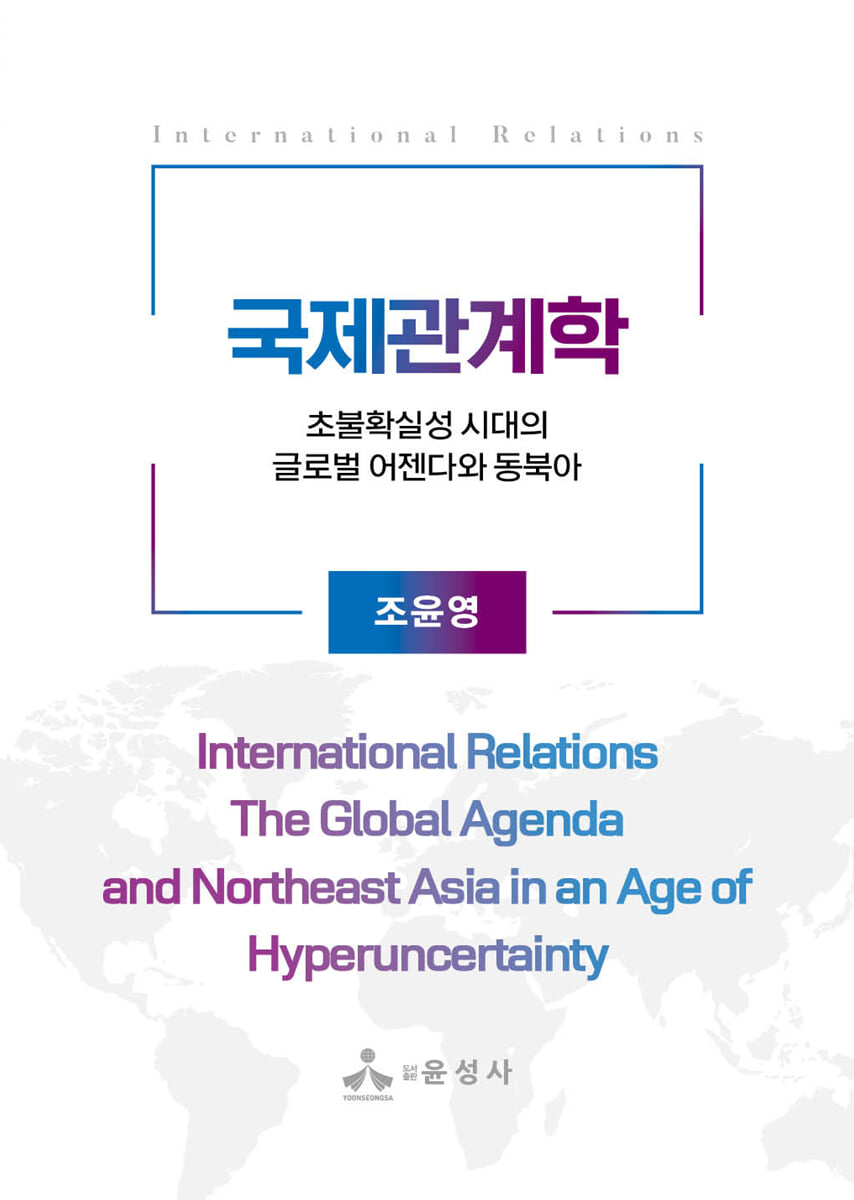
This book presents the theory, historical facts, and current context of international relations (international politics).
This book presents a comprehensive overview of international relations and Korea's trends and cases, organized by subheadings to aid readers' understanding.
This book presents a comprehensive overview of international relations and Korea's trends and cases, organized by subheadings to aid readers' understanding.
index
Chapter 1 What are International Relations?
Section 1: Entering the Field of Interest of International Relations: Why Should We Be Interested in the Study of International Relations?
Section 2 International Relations and the State
Section 3: History of Changes in the National System
Section 4 International Relations and National Interests
Section 5 International Relations and Anarchy
Section 6: International System and International Society
Section 7 International Relations and Sovereignty
Section 8 International Relations and Power
Chapter 2: History and Theory of International Relations
Section 1: Historical Evolution of International Relations
Section 2 International Relations Theory: Meaning and Necessity
Section 3: Realism: Peace Through Strength
Section 4: Liberalism: The Possibility of Cooperation and Peace
Section 5 Marxism: A World of Inequality
Section 6 Constructivism: Norms and Identity
Section 7: International Social Theory
Chapter 3 Diplomacy and Foreign Policy
Section 1 International Relations and Diplomacy
Section 2 What is foreign policy?
Section 3: Foreign Policy Determinants and Analysis Level
Section 4 Foreign Policy Theory
Chapter 4 International Relations and Security
Section 1 International Relations and War
Section 2 International Relations and Peace
Section 3 National Security and Emerging Security
Chapter 5 International Organizations and International Political Economy
Section 1 International Relations and International Organizations
Section 2 International Relations and Global Governance
Section 3 International Relations and the United Nations
Section 4 What is international political economy?
Section 5 International Trade Order
Section 6 International Monetary Order
Chapter 6 East Asia and International Relations
Section 1: The Collapse and Formation of the 20th-Century East Asian International Order
Section 2: The Rise and Special Characteristics of the East Asian Region
Section 3 America and East Asia: From Japan's Opening to the Korean War
Section 4: Cold War International Relations between the United States and East Asia
Section 5: The United States and East Asian International Relations in the First Post-Cold War Era
Section 6: The United States and East Asian International Relations in the Second Post-Cold War Era
Section 7. Japan's normalization and changes in defense policy
Section 8: China's Rise and Superpower Strategy
Section 9: Historical Development and Strategic Competition in US-China Relations
Chapter 7: The Korean Peninsula and International Relations
Section 1: Formation and Historical Changes in Inter-Korean Relations
Section 2: Formation and Historical Changes of the ROK-US Alliance
Section 3: Historical Development of Korea-Japan Relations and Cooperation through Overcoming Conflict
Section 4: Historical Development of Korea-China Relations: From Confrontation to Cooperation
Section 5: History and Characteristics of North Korea's Nuclear Development
Section 6: Seeking a New Inter-Korean Relations: Toward a Balanced Process of Security and Peace
Section 1: Entering the Field of Interest of International Relations: Why Should We Be Interested in the Study of International Relations?
Section 2 International Relations and the State
Section 3: History of Changes in the National System
Section 4 International Relations and National Interests
Section 5 International Relations and Anarchy
Section 6: International System and International Society
Section 7 International Relations and Sovereignty
Section 8 International Relations and Power
Chapter 2: History and Theory of International Relations
Section 1: Historical Evolution of International Relations
Section 2 International Relations Theory: Meaning and Necessity
Section 3: Realism: Peace Through Strength
Section 4: Liberalism: The Possibility of Cooperation and Peace
Section 5 Marxism: A World of Inequality
Section 6 Constructivism: Norms and Identity
Section 7: International Social Theory
Chapter 3 Diplomacy and Foreign Policy
Section 1 International Relations and Diplomacy
Section 2 What is foreign policy?
Section 3: Foreign Policy Determinants and Analysis Level
Section 4 Foreign Policy Theory
Chapter 4 International Relations and Security
Section 1 International Relations and War
Section 2 International Relations and Peace
Section 3 National Security and Emerging Security
Chapter 5 International Organizations and International Political Economy
Section 1 International Relations and International Organizations
Section 2 International Relations and Global Governance
Section 3 International Relations and the United Nations
Section 4 What is international political economy?
Section 5 International Trade Order
Section 6 International Monetary Order
Chapter 6 East Asia and International Relations
Section 1: The Collapse and Formation of the 20th-Century East Asian International Order
Section 2: The Rise and Special Characteristics of the East Asian Region
Section 3 America and East Asia: From Japan's Opening to the Korean War
Section 4: Cold War International Relations between the United States and East Asia
Section 5: The United States and East Asian International Relations in the First Post-Cold War Era
Section 6: The United States and East Asian International Relations in the Second Post-Cold War Era
Section 7. Japan's normalization and changes in defense policy
Section 8: China's Rise and Superpower Strategy
Section 9: Historical Development and Strategic Competition in US-China Relations
Chapter 7: The Korean Peninsula and International Relations
Section 1: Formation and Historical Changes in Inter-Korean Relations
Section 2: Formation and Historical Changes of the ROK-US Alliance
Section 3: Historical Development of Korea-Japan Relations and Cooperation through Overcoming Conflict
Section 4: Historical Development of Korea-China Relations: From Confrontation to Cooperation
Section 5: History and Characteristics of North Korea's Nuclear Development
Section 6: Seeking a New Inter-Korean Relations: Toward a Balanced Process of Security and Peace
Publisher's Review
[preface]
Studying international politics is not simply about listing events between nations or observing diplomatic phenomena.
It is ultimately an attempt to understand the world, and at the same time, to question the fate of the land we stand on.
International politics operates on the logic of power and cooperation, of order and balance, conflict and compromise.
At first glance, it may seem distant from our personal lives, but in reality, it has always existed as the closest reality to us.
In particular, living in a space called the Korean Peninsula is no different from living within the logic of international politics.
The geopolitical conditions where the interests of great powers intersect, the history of division and the Cold War, and the changes and instabilities of East Asia have always shaped our lives.
Therefore, understanding international politics can be said to be a process of reflecting on our conditions and preparing for the future.
It took a long time to write this book.
Writing has always been arduous, and I've often hesitated under its weight.
However, faced with the reality that Korea's international political environment is becoming increasingly complex and unstable, I felt that I could no longer delay.
The starting point of this book was a commitment to writing something more accessible than existing textbooks, yet one that simultaneously incorporates theory, history, and the current international political context.
As I finish the book, I still feel like I have a long way to go in fulfilling that promise.
Above all, what was most troubling during the writing process was the confusion of the terms ‘international politics’ and ‘international relations.’
Academically, international politics refers to political relations centered on diplomacy and security, while international relations refers to a broader analytical framework that includes interactions at various levels, such as economic, social, and cultural.
However, in reality, the two concepts are used interchangeably rather than strictly distinguished, and even the academic world often fails to clearly define them.
I confess that in this book I have used the two terms interchangeably without making a strict distinction between them.
Rather than being a confusion of concepts, this was a choice to explain the flow of international relations more comprehensively through the language of international politics.
I hope readers will be generous in understanding this point.
The first part of the book covers the basic concepts and theories of international relations.
It attempted to explain basic concepts such as the state, sovereignty, anarchy, national interest, and power in everyday language, and to easily convey the ways in which major theories such as realism, liberalism, and constructivism view the world.
The development of international relations is not simply a series of events, but is interpreted as a historical framework for understanding the present. Foreign policy, international organizations, war and peace, and international political economy are also explained through the examples of Korea and the Korean Peninsula.
Based on this foundation, we took a close look at East Asian international politics and the reality of the Korean Peninsula.
The paths chosen by Korea, China, and Japan amid the shock of imperialism and Western power convergence, the US's East Asia strategy and changes, China and Japan's regional vision, and the structural tensions created by US-China strategic competition still cast a shadow over our lives.
The development of inter-Korean relations, the North Korean nuclear issue, and the ROK-US alliance were also reinterpreted within this framework.
International politics is not a backdrop, it is a condition of our lives.
However, many people still do not experience international politics and are only focused on domestic politics.
This book is an attempt to narrow that gap, even if only a little.
If this book can be of any help in providing readers with a framework for thinking and interpreting on their own, that is enough.
This book originally started as a compilation of lecture notes.
Therefore, there are many shortcomings in terms of the faithfulness of footnotes and references and academic rigor.
As this book is based on materials written for reading and discussion with students in class, it focuses on concisely introducing concepts, theories, and historical facts, but does not go so far as to examine every academic debate in detail or compile an exhaustive list of literature.
In this respect, it can be said to be closer to an introductory textbook than an academic study.
Furthermore, because it covers the vast subject of international politics and international relations, there may be parts where old knowledge is directly transferred or new research findings are not sufficiently reflected.
Furthermore, the author's interpretation may be biased or inconsistent with the facts.
All these issues are the author's limitations and responsibility.
Nevertheless, the reason I decided to publish it was because I wanted to share the basic framework for understanding international politics and Korea with more readers.
I thought it was the duty of a scholar to put something out into the world, even if it was imperfect, and then continue with further revisions and additions.
The greatest benefit of this book would be if readers would be tolerant of the errors and shortcomings they may discover while reading it, and if they would go further and offer sharp criticism and suggestions.
Finally, I would like to express my gratitude to those who have been of the greatest help in writing this book.
I express my deepest respect and gratitude to my parents for always supporting me with their unwavering faith and encouragement.
Their teachings and example of a faithful life have sustained me to this day.
I also express my special gratitude to my wife Hye-won and my son Se-yong, who have always been by my side with warm understanding and patience.
Thanks to their consideration and support, I was able to complete this book.
On the occasion of the publication of this book, I would like to once again express my sincere gratitude to my beloved family.
In my lab
Jo Yoon-young
Studying international politics is not simply about listing events between nations or observing diplomatic phenomena.
It is ultimately an attempt to understand the world, and at the same time, to question the fate of the land we stand on.
International politics operates on the logic of power and cooperation, of order and balance, conflict and compromise.
At first glance, it may seem distant from our personal lives, but in reality, it has always existed as the closest reality to us.
In particular, living in a space called the Korean Peninsula is no different from living within the logic of international politics.
The geopolitical conditions where the interests of great powers intersect, the history of division and the Cold War, and the changes and instabilities of East Asia have always shaped our lives.
Therefore, understanding international politics can be said to be a process of reflecting on our conditions and preparing for the future.
It took a long time to write this book.
Writing has always been arduous, and I've often hesitated under its weight.
However, faced with the reality that Korea's international political environment is becoming increasingly complex and unstable, I felt that I could no longer delay.
The starting point of this book was a commitment to writing something more accessible than existing textbooks, yet one that simultaneously incorporates theory, history, and the current international political context.
As I finish the book, I still feel like I have a long way to go in fulfilling that promise.
Above all, what was most troubling during the writing process was the confusion of the terms ‘international politics’ and ‘international relations.’
Academically, international politics refers to political relations centered on diplomacy and security, while international relations refers to a broader analytical framework that includes interactions at various levels, such as economic, social, and cultural.
However, in reality, the two concepts are used interchangeably rather than strictly distinguished, and even the academic world often fails to clearly define them.
I confess that in this book I have used the two terms interchangeably without making a strict distinction between them.
Rather than being a confusion of concepts, this was a choice to explain the flow of international relations more comprehensively through the language of international politics.
I hope readers will be generous in understanding this point.
The first part of the book covers the basic concepts and theories of international relations.
It attempted to explain basic concepts such as the state, sovereignty, anarchy, national interest, and power in everyday language, and to easily convey the ways in which major theories such as realism, liberalism, and constructivism view the world.
The development of international relations is not simply a series of events, but is interpreted as a historical framework for understanding the present. Foreign policy, international organizations, war and peace, and international political economy are also explained through the examples of Korea and the Korean Peninsula.
Based on this foundation, we took a close look at East Asian international politics and the reality of the Korean Peninsula.
The paths chosen by Korea, China, and Japan amid the shock of imperialism and Western power convergence, the US's East Asia strategy and changes, China and Japan's regional vision, and the structural tensions created by US-China strategic competition still cast a shadow over our lives.
The development of inter-Korean relations, the North Korean nuclear issue, and the ROK-US alliance were also reinterpreted within this framework.
International politics is not a backdrop, it is a condition of our lives.
However, many people still do not experience international politics and are only focused on domestic politics.
This book is an attempt to narrow that gap, even if only a little.
If this book can be of any help in providing readers with a framework for thinking and interpreting on their own, that is enough.
This book originally started as a compilation of lecture notes.
Therefore, there are many shortcomings in terms of the faithfulness of footnotes and references and academic rigor.
As this book is based on materials written for reading and discussion with students in class, it focuses on concisely introducing concepts, theories, and historical facts, but does not go so far as to examine every academic debate in detail or compile an exhaustive list of literature.
In this respect, it can be said to be closer to an introductory textbook than an academic study.
Furthermore, because it covers the vast subject of international politics and international relations, there may be parts where old knowledge is directly transferred or new research findings are not sufficiently reflected.
Furthermore, the author's interpretation may be biased or inconsistent with the facts.
All these issues are the author's limitations and responsibility.
Nevertheless, the reason I decided to publish it was because I wanted to share the basic framework for understanding international politics and Korea with more readers.
I thought it was the duty of a scholar to put something out into the world, even if it was imperfect, and then continue with further revisions and additions.
The greatest benefit of this book would be if readers would be tolerant of the errors and shortcomings they may discover while reading it, and if they would go further and offer sharp criticism and suggestions.
Finally, I would like to express my gratitude to those who have been of the greatest help in writing this book.
I express my deepest respect and gratitude to my parents for always supporting me with their unwavering faith and encouragement.
Their teachings and example of a faithful life have sustained me to this day.
I also express my special gratitude to my wife Hye-won and my son Se-yong, who have always been by my side with warm understanding and patience.
Thanks to their consideration and support, I was able to complete this book.
On the occasion of the publication of this book, I would like to once again express my sincere gratitude to my beloved family.
In my lab
Jo Yoon-young
GOODS SPECIFICS
- Date of issue: September 14, 2025
- Format: Paperback book binding method guide
- Page count, weight, size: 280 pages | 173*243*20mm
- ISBN13: 9791199390256
- ISBN10: 1199390259
You may also like
카테고리
korean


korean

![ELLE 엘르 스페셜 에디션 A형 : 12월 [2025]](http://librairie.coreenne.fr/cdn/shop/files/b8e27a3de6c9538896439686c6b0e8fb.jpg?v=1766436872&width=3840)


