

Reading Modern Korean History Through Debate
 |
Description
Book Introduction
Liberation and division, military dictatorship and the democratization movement, neoliberalism and civil movements…
At the watershed of history, what debates did we have and what history did we choose?
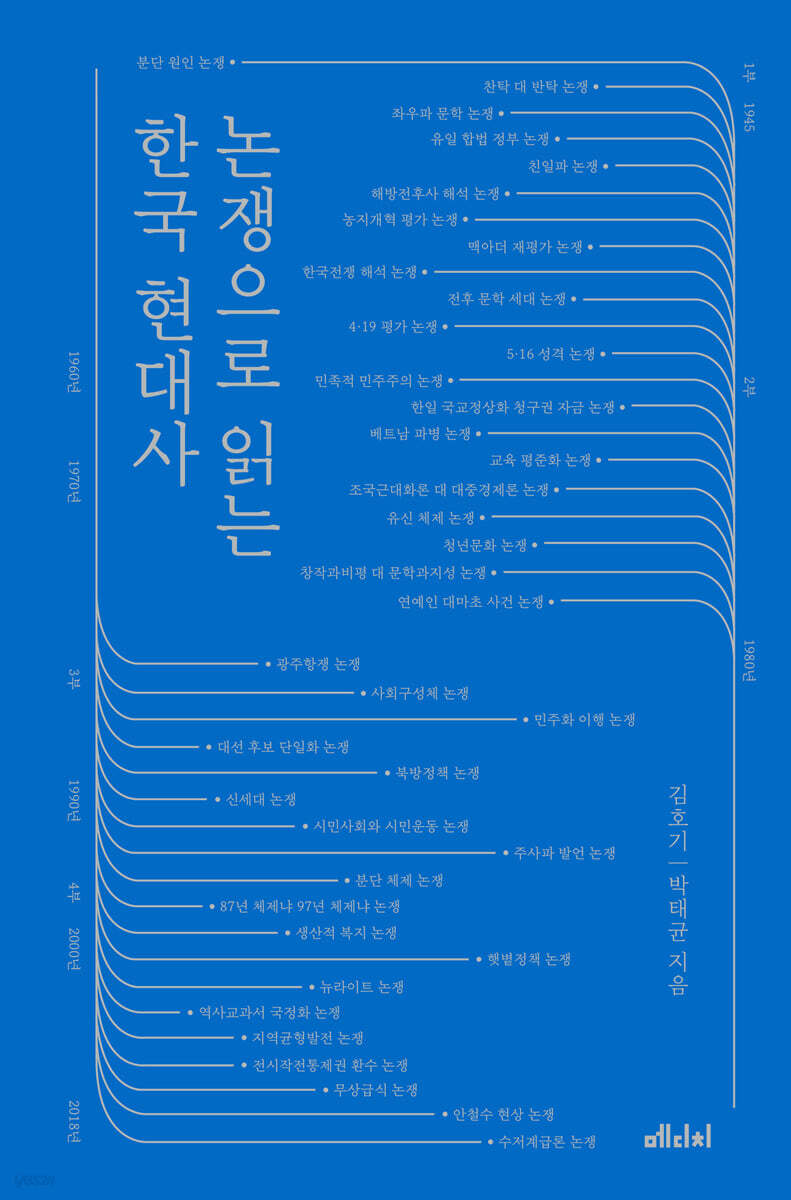
This book, written by sociologist Professor Kim Ho-gi and historian Professor Park Tae-gyun, sheds light on and evaluates 40 controversies that shook modern Korean history from 1945 to 2018.
There are three criteria for selecting the debate.
The first is a debate about events and discourses that had a decisive impact on social development.
The second is the debate between conservatives and progressives.
The third is a debate of great current significance.
The modern Korean history and controversies discussed in this book are by no means history as the past.
We still live under its influence, and the debate is still ongoing.
Part 1 of the book traces the genesis of modern Korean time and space by examining the debates surrounding liberation, the establishment of the government, and the formation of a divided system.
Part 2 looks back at the controversies that captured the light and shadow of the Park Chung-hee era, and examines the political, diplomatic, cultural, and economic framework of the time that still influences Korean society today.
Part 3 examines the debates that heralded the beginning and progress of the era of democratization.
It analyzes everything from the battle over the truth of the Gwangju Uprising to the debate surrounding civil society and the civic movement that led to democratization.
Part 4 focuses on the controversies that shaped Korean society after the 1997 foreign exchange crisis.
The debates that make up Part 4 will likely be of considerable interest to readers as they address issues that shape the present state of our society.
In some cases, you may strongly agree with the point or present an argument from a completely opposite position.
Looking back on our modern history of over 70 years, there were times of hardship and times of glory.
Throughout this history of suffering and glory, we have always clarified issues through debate and found better solutions.
New challenges now await our society.
These challenges will invite our people into the 'square of debate.'
This book, which reflects on the path that modern Korean history has taken, centering on debates, will be of great help in exploring the path to take in the future.
At the watershed of history, what debates did we have and what history did we choose?
This book, written by sociologist Professor Kim Ho-gi and historian Professor Park Tae-gyun, sheds light on and evaluates 40 controversies that shook modern Korean history from 1945 to 2018.
There are three criteria for selecting the debate.
The first is a debate about events and discourses that had a decisive impact on social development.
The second is the debate between conservatives and progressives.
The third is a debate of great current significance.
The modern Korean history and controversies discussed in this book are by no means history as the past.
We still live under its influence, and the debate is still ongoing.
Part 1 of the book traces the genesis of modern Korean time and space by examining the debates surrounding liberation, the establishment of the government, and the formation of a divided system.
Part 2 looks back at the controversies that captured the light and shadow of the Park Chung-hee era, and examines the political, diplomatic, cultural, and economic framework of the time that still influences Korean society today.
Part 3 examines the debates that heralded the beginning and progress of the era of democratization.
It analyzes everything from the battle over the truth of the Gwangju Uprising to the debate surrounding civil society and the civic movement that led to democratization.
Part 4 focuses on the controversies that shaped Korean society after the 1997 foreign exchange crisis.
The debates that make up Part 4 will likely be of considerable interest to readers as they address issues that shape the present state of our society.
In some cases, you may strongly agree with the point or present an argument from a completely opposite position.
Looking back on our modern history of over 70 years, there were times of hardship and times of glory.
Throughout this history of suffering and glory, we have always clarified issues through debate and found better solutions.
New challenges now await our society.
These challenges will invite our people into the 'square of debate.'
This book, which reflects on the path that modern Korean history has taken, centering on debates, will be of great help in exploring the path to take in the future.
- You can preview some of the book's contents.
Preview
index
prolog
Part 1: Liberation, Establishment of the Government, and Formation of the Division System (1945–1960)
1.
Debate over the cause of division
2.
Pro-trusteeship vs. anti-trusteeship debate
3.
Left-right literary debate
4.
The sole legitimate government debate
5.
Pro-Japanese controversy
6.
Debate on the interpretation of pre- and post-liberation history
7.
Debate on the evaluation of land reform
8.
MacArthur reevaluation debate
9.
Debate over the interpretation of the Korean War
10.
Post-war literary generation debate
11.
April 19th Evaluation Debate
Part 2: Light and Shadow of the Park Chung-hee Era (1961–1979)
12.
The May 16th personality debate
13.
National democracy debate
14.
The dispute over the funding for the claims for normalization of Korea-Japan diplomatic relations
15.
Vietnam troop deployment controversy
16.
Education equalization debate
17.
The debate between the theory of national modernization and the theory of mass economy
18.
Yushin regime controversy
19.
Youth culture debate
20.
The debate between creation and criticism and literature and intellect
21.
Celebrity marijuana controversy
Part 3: The Beginning and Progress of the Democracy Era (1980–1996)
22.
Gwangju Uprising debate
23.
Social structure debate
24.
Debate on the transition to democratization
25.
Debate on unifying presidential candidates
26.
Northern Policy debate
27.
New Generation Debate
28.
Debate on civil society and civil movements
29.
Controversy over the injection party's remarks
30.
The division system debate
Part 4: Korean Society after the Foreign Exchange Crisis (1997–2018)
31.
The debate over the 1987 system or the 1997 system
32.
The productive welfare debate
33.
Sunshine Policy debate
34.
New Right Debate
35.
The debate over nationalizing history textbooks
36.
Regional balanced development debate
37.
Debate over the return of wartime operational control
38.
Free school lunch debate
39.
Ahn Cheol-soo phenomenon controversy
40.
The spoon class theory debate
Epilogue: Candlelight Revolution and Korean Democracy
Key References
Part 1: Liberation, Establishment of the Government, and Formation of the Division System (1945–1960)
1.
Debate over the cause of division
2.
Pro-trusteeship vs. anti-trusteeship debate
3.
Left-right literary debate
4.
The sole legitimate government debate
5.
Pro-Japanese controversy
6.
Debate on the interpretation of pre- and post-liberation history
7.
Debate on the evaluation of land reform
8.
MacArthur reevaluation debate
9.
Debate over the interpretation of the Korean War
10.
Post-war literary generation debate
11.
April 19th Evaluation Debate
Part 2: Light and Shadow of the Park Chung-hee Era (1961–1979)
12.
The May 16th personality debate
13.
National democracy debate
14.
The dispute over the funding for the claims for normalization of Korea-Japan diplomatic relations
15.
Vietnam troop deployment controversy
16.
Education equalization debate
17.
The debate between the theory of national modernization and the theory of mass economy
18.
Yushin regime controversy
19.
Youth culture debate
20.
The debate between creation and criticism and literature and intellect
21.
Celebrity marijuana controversy
Part 3: The Beginning and Progress of the Democracy Era (1980–1996)
22.
Gwangju Uprising debate
23.
Social structure debate
24.
Debate on the transition to democratization
25.
Debate on unifying presidential candidates
26.
Northern Policy debate
27.
New Generation Debate
28.
Debate on civil society and civil movements
29.
Controversy over the injection party's remarks
30.
The division system debate
Part 4: Korean Society after the Foreign Exchange Crisis (1997–2018)
31.
The debate over the 1987 system or the 1997 system
32.
The productive welfare debate
33.
Sunshine Policy debate
34.
New Right Debate
35.
The debate over nationalizing history textbooks
36.
Regional balanced development debate
37.
Debate over the return of wartime operational control
38.
Free school lunch debate
39.
Ahn Cheol-soo phenomenon controversy
40.
The spoon class theory debate
Epilogue: Candlelight Revolution and Korean Democracy
Key References
Into the book
Debate is important because it allows us to clarify issues and find better solutions.
Just as the debates that have taken place over the past 70 years have guided our society since liberation, we believe that we can open up the future of our society through productive debates.
I sincerely hope that future debates will become more lively, focusing on a concrete blueprint for a new nation and a new society beyond industrialization and democratization.
---From the "Prologue"
There is a big difference between areas where war criminals were properly dealt with and areas where they were not.
In areas where war criminals have been dealt with, the far right does not exist.
Without the far right, the far left cannot coexist.
There is only left, right, and center.
However, in areas where war criminals have resurfaced, the far right and the far left coexist hostilely.
It is a situation where it is difficult for either the left or the center to gain power.
---From "Chapter 1: Debate on the Causes of Division"
Literary debates were inevitably linked to the political process of building a new nation and society.
As Kim Yun-sik, a Korean literature scholar who has produced outstanding research on the literary debate immediately following liberation, has pointed out, the period of liberation was a "truly rare space where one could choose history," and this characteristic of the era intensified the ideological confrontation in literature.
---From "Chapter 3: The Left-Right Literary Debate"
The mainstream of Korean society, which continues the legacy of pro-Japanese forces, did not just watch the liquidation process by the non-mainstream.
(…) The problem of the past has become a political issue because the problems that need to be solved are not solved in a timely manner.
And it has become one of the most important issues in the conflict between men and women.
---From "Chapter 5: Pro-Japanese Debate"
The debate surrounding “Recognition of the History Before and After Liberation” and “Re-recognition of the History Before and After Liberation” makes us realize once again that history is a “dialogue between the past and the present.”
(…) In any country, there is not just one perspective in interpreting history.
The restoration and evaluation of historical facts are also not fixed.
In short, history is reconstructed and reinterpreted through the discovery of new facts and the restoration of memories.
---From "Chapter 6: Debate on the Interpretation of History Before and After Liberation"
Park Myeong-rim's research deserves attention for its comprehensive and detailed tracing of the structural origins and behavioral causes of war.
[The Outbreak and Origins of the Korean War 1·2] can be evaluated as a study that has established the pride of our academic community in the international debate on the Korean War.
---From "Chapter 9: Debate on the Interpretation of the Korean War"
The spirit of April 19 will continue to be a touchstone for protecting democracy in our society.
When historians a hundred years from now look back on history, they might describe the April 19 Revolution as continuing, following the May 18th and June 10th incidents, the impeachment of President Roh Moo-hyun, the mad cow disease crisis, and the Sewol Ferry disaster.
---From "Chapter 11, April 19 Evaluation Debate"
However, presenting revolutionary goals does not make a coup a 'revolution'.
We must examine whether the ideology pursued by the ruling power, the composition of the ruling power, and the policies and results implemented after the coup had a 'revolutionary' character.
---From "Chapter 12, May 16 Personality Debate"
A surprising twist emerged in the debate between the Korean and Japanese governments over treaty interpretation.
The two governments each decided to interpret it according to their own opinions.
(…) So, Japan gave an independence celebration fund instead of compensation, and Korea interpreted it as including the nature of compensation by calling it ‘claims funds.’
(…) However, due to the failure to reach an agreement on the issues that are actually controversial between the Korean and Japanese governments in order to resolve the urgent matters at hand, the recent Korea-Japan relationship has reached its worst state in 50 years, and the aftereffects continue.
---From "Chapter 14: Debate on Funds for the Claim for Normalization of Korea-Japan Relations"
The discussion about sending troops to Vietnam must be approached from a different perspective.
Has the original purpose of dispatching troops to Vietnam—namely, to maintain the ROK-US alliance and security—been achieved? (…) A cautious approach is also needed regarding the special wartime situation, the Yushin Declaration, and the Agent Orange issues.
If the war's impact was so significant, why did the foreign exchange crisis and the insolvent corporate crisis occur in the late 1960s? (…) Are investigations and compensation for veterans and Agent Orange victims being properly conducted in Korea?
---From "Chapter 15: The Vietnam Troop Deployment Debate"
However, the question of why secondary education equalization was implemented in the late 1960s still remains valid.
1968 was the peak of the security crisis on the Korean Peninsula, and 1969 was the year of the third constitutional amendment.
The equalization policy was implemented along with the National Education Charter announced in November 1968.
Was it because everyone had to become citizens dedicated to the 'infinite development of the country and people' through equal education?
---From "Chapter 16: Debate on Educational Equalization"
The question was whether the Yushin regime was necessary in terms of economic growth and developmental dictatorship.
The argument that it was necessary is based on the need for a restructuring of the economic structure from the light industry-centered to the heavy chemical industry-centered of the 1960s and the threat posed by the reduction of US troops in Korea and détente.
On the other hand, the argument that it was not necessary is that the Yushin system was created by personal desire for long-term power, and that it would have been more desirable if economic growth had been achieved under a democratic system. Most historians and progressive social science researchers hold this negative stance.
---From "Chapter 18: The Yushin Regime Debate"
However, this does not mean that all controversies have been resolved.
Even now, it is not clear exactly who was ultimately responsible for the shooting in Gwangju.
The parties involved are still alive, but no one is speaking out.
(…) Recently, there has been a serious distortion of the truth about the Gwangju Uprising by members of ‘Daily Best Storage’.
(…) Considering that these claims became social issues despite being baseless, Gwangju is still an ongoing issue.
---From "Chapter 22: The Gwangju Uprising Debate"
But more than anything, what mattered most was the sentiment of a particular region.
Even within the student movement factions, there was a phenomenon of groups splitting up according to candidate and region.
(…) Isn’t the true lesson of the 1987 presidential election that the trick of trying to win an election through an event of unification does not work?
---From "Chapter 25: The Debate on Unifying Presidential Candidates"
The significance of the controversy surrounding President Park's remarks was not the existence of the injection faction.
The point was that his remarks, which had no basis whatsoever, swayed public opinion.
Since then, a social atmosphere has spread that has led progressive figures to become pro-North Korea forces.
Conservative media, which wields significant social influence, began manipulating public opinion in the manner of President Park.
From then on, McCarthyism (extreme anti-communism) began to run rampant in Korean society.
No evidence was needed.
Terms such as ‘pro-North Korea leftist’, ‘left-wing communist’, and ‘North Korea follower’ began to be overused.
From this point on, ‘common sense’ disappeared from Korean society.
---From "Chapter 29: The Injectionist Remarks Debate"
Looking back from the perspective of 2015, during the era of democratization, two periods of time flowed simultaneously in our society: the 'time of democratization' in 1987 and the 'time of globalization' in 1997.
Since 1987, our society has longed for a new change called democratization, but that change has slipped from our grasp and has been forced upon us by the external force of globalization.
The centripetal force of social reform that characterized the era of democratization was gradually overwhelmed by the centrifugal force of structural coercion that characterized the era of globalization. This was the landscape of our society after 1997.
---From "Chapter 31: The Debate on the 87 System or the 97 System"
The bigger problem in the current situation is that North Korea policy changes from day to night depending on the administration, and even continues to change even under the same administration.
North Korea policy is a matter of such importance that it can determine the future of the nation, and therefore must be sustained regardless of a change in government.
(…) Another lesson learned from the Sunshine Policy is that sufficient social consensus is necessary for North Korea policy.
---From "Chapter 33: The Sunshine Policy Debate"
After the September 11, 2001 terrorist attacks, the U.S. government once again pushed for the reduction of U.S. troops stationed in Korea and their conversion to a rapid response force through the overseas redeployment plan.
(…) And this created a situation where it was inevitable to push for the transfer of wartime operational control to the Korean military in the mid-2000s.
This is likely why the U.S. government said it would transfer wartime operational control in 2009, earlier than the South Korean government's request.
---From "Chapter 37: The Debate on the Recovery of Wartime Operational Control"
The important policy implications of the free school lunch debate were how to realize the construction of a welfare state that protects the socially vulnerable and resolves social polarization.
To properly implement any welfare policy, the government must maximize its strategic choices while taking into account the structural constraints and path dependencies that influence national development strategies.
In these strategic choices, we must carefully consider how to strike a balance between fiscal and welfare policies.
This is precisely why political leadership is important in welfare policy.
---From "Chapter 38: The Free School Lunch Debate"
'Ahn Cheol-soo's challenge is ongoing, but the '2011-2012 Ahn Cheol-soo phenomenon' appears to have declined.
The reason was that Ahn Cheol-soo's personal political weakness and the centripetal force of the established political society did not allow the Ahn Cheol-soo phenomenon to become a political force.
It is noteworthy that the decline of the Ahn Cheol-soo phenomenon does not mean that civil society's desire to reform the state and the market has disappeared.
---From "Chapter 39: The Ahn Cheol-soo Phenomenon Debate"
From the perspective of generational sociology, the gap in perception between the 'efforts' of the older generation and the 'failure to make efforts' of the younger generation clearly shows the generational gap in Korean society.
The fact that the ladder of class mobility is gradually disappearing is a self-portrait of our society.
Without addressing growing inequality, our society can no longer move forward and it will be difficult to reach the level of an advanced nation.
Solutions to address inequality have already been proposed.
---From "Chapter 40: The Spoon Class Theory Debate"
What is interesting is that Munch deals with the Korean case.
Munch believes that Korea prevented a retreat into authoritarianism and preserved liberal democracy through candlelight vigils.
The driving force behind the candlelight vigils was to reject leaders who seek to rule over the people and to protect democracy based on popular sovereignty.
South Korea, which led the democratization movement in Asia through the June Struggle of 1987, breathed new life into democracy in crisis through the Candlelight Revolution.
Just as the debates that have taken place over the past 70 years have guided our society since liberation, we believe that we can open up the future of our society through productive debates.
I sincerely hope that future debates will become more lively, focusing on a concrete blueprint for a new nation and a new society beyond industrialization and democratization.
---From the "Prologue"
There is a big difference between areas where war criminals were properly dealt with and areas where they were not.
In areas where war criminals have been dealt with, the far right does not exist.
Without the far right, the far left cannot coexist.
There is only left, right, and center.
However, in areas where war criminals have resurfaced, the far right and the far left coexist hostilely.
It is a situation where it is difficult for either the left or the center to gain power.
---From "Chapter 1: Debate on the Causes of Division"
Literary debates were inevitably linked to the political process of building a new nation and society.
As Kim Yun-sik, a Korean literature scholar who has produced outstanding research on the literary debate immediately following liberation, has pointed out, the period of liberation was a "truly rare space where one could choose history," and this characteristic of the era intensified the ideological confrontation in literature.
---From "Chapter 3: The Left-Right Literary Debate"
The mainstream of Korean society, which continues the legacy of pro-Japanese forces, did not just watch the liquidation process by the non-mainstream.
(…) The problem of the past has become a political issue because the problems that need to be solved are not solved in a timely manner.
And it has become one of the most important issues in the conflict between men and women.
---From "Chapter 5: Pro-Japanese Debate"
The debate surrounding “Recognition of the History Before and After Liberation” and “Re-recognition of the History Before and After Liberation” makes us realize once again that history is a “dialogue between the past and the present.”
(…) In any country, there is not just one perspective in interpreting history.
The restoration and evaluation of historical facts are also not fixed.
In short, history is reconstructed and reinterpreted through the discovery of new facts and the restoration of memories.
---From "Chapter 6: Debate on the Interpretation of History Before and After Liberation"
Park Myeong-rim's research deserves attention for its comprehensive and detailed tracing of the structural origins and behavioral causes of war.
[The Outbreak and Origins of the Korean War 1·2] can be evaluated as a study that has established the pride of our academic community in the international debate on the Korean War.
---From "Chapter 9: Debate on the Interpretation of the Korean War"
The spirit of April 19 will continue to be a touchstone for protecting democracy in our society.
When historians a hundred years from now look back on history, they might describe the April 19 Revolution as continuing, following the May 18th and June 10th incidents, the impeachment of President Roh Moo-hyun, the mad cow disease crisis, and the Sewol Ferry disaster.
---From "Chapter 11, April 19 Evaluation Debate"
However, presenting revolutionary goals does not make a coup a 'revolution'.
We must examine whether the ideology pursued by the ruling power, the composition of the ruling power, and the policies and results implemented after the coup had a 'revolutionary' character.
---From "Chapter 12, May 16 Personality Debate"
A surprising twist emerged in the debate between the Korean and Japanese governments over treaty interpretation.
The two governments each decided to interpret it according to their own opinions.
(…) So, Japan gave an independence celebration fund instead of compensation, and Korea interpreted it as including the nature of compensation by calling it ‘claims funds.’
(…) However, due to the failure to reach an agreement on the issues that are actually controversial between the Korean and Japanese governments in order to resolve the urgent matters at hand, the recent Korea-Japan relationship has reached its worst state in 50 years, and the aftereffects continue.
---From "Chapter 14: Debate on Funds for the Claim for Normalization of Korea-Japan Relations"
The discussion about sending troops to Vietnam must be approached from a different perspective.
Has the original purpose of dispatching troops to Vietnam—namely, to maintain the ROK-US alliance and security—been achieved? (…) A cautious approach is also needed regarding the special wartime situation, the Yushin Declaration, and the Agent Orange issues.
If the war's impact was so significant, why did the foreign exchange crisis and the insolvent corporate crisis occur in the late 1960s? (…) Are investigations and compensation for veterans and Agent Orange victims being properly conducted in Korea?
---From "Chapter 15: The Vietnam Troop Deployment Debate"
However, the question of why secondary education equalization was implemented in the late 1960s still remains valid.
1968 was the peak of the security crisis on the Korean Peninsula, and 1969 was the year of the third constitutional amendment.
The equalization policy was implemented along with the National Education Charter announced in November 1968.
Was it because everyone had to become citizens dedicated to the 'infinite development of the country and people' through equal education?
---From "Chapter 16: Debate on Educational Equalization"
The question was whether the Yushin regime was necessary in terms of economic growth and developmental dictatorship.
The argument that it was necessary is based on the need for a restructuring of the economic structure from the light industry-centered to the heavy chemical industry-centered of the 1960s and the threat posed by the reduction of US troops in Korea and détente.
On the other hand, the argument that it was not necessary is that the Yushin system was created by personal desire for long-term power, and that it would have been more desirable if economic growth had been achieved under a democratic system. Most historians and progressive social science researchers hold this negative stance.
---From "Chapter 18: The Yushin Regime Debate"
However, this does not mean that all controversies have been resolved.
Even now, it is not clear exactly who was ultimately responsible for the shooting in Gwangju.
The parties involved are still alive, but no one is speaking out.
(…) Recently, there has been a serious distortion of the truth about the Gwangju Uprising by members of ‘Daily Best Storage’.
(…) Considering that these claims became social issues despite being baseless, Gwangju is still an ongoing issue.
---From "Chapter 22: The Gwangju Uprising Debate"
But more than anything, what mattered most was the sentiment of a particular region.
Even within the student movement factions, there was a phenomenon of groups splitting up according to candidate and region.
(…) Isn’t the true lesson of the 1987 presidential election that the trick of trying to win an election through an event of unification does not work?
---From "Chapter 25: The Debate on Unifying Presidential Candidates"
The significance of the controversy surrounding President Park's remarks was not the existence of the injection faction.
The point was that his remarks, which had no basis whatsoever, swayed public opinion.
Since then, a social atmosphere has spread that has led progressive figures to become pro-North Korea forces.
Conservative media, which wields significant social influence, began manipulating public opinion in the manner of President Park.
From then on, McCarthyism (extreme anti-communism) began to run rampant in Korean society.
No evidence was needed.
Terms such as ‘pro-North Korea leftist’, ‘left-wing communist’, and ‘North Korea follower’ began to be overused.
From this point on, ‘common sense’ disappeared from Korean society.
---From "Chapter 29: The Injectionist Remarks Debate"
Looking back from the perspective of 2015, during the era of democratization, two periods of time flowed simultaneously in our society: the 'time of democratization' in 1987 and the 'time of globalization' in 1997.
Since 1987, our society has longed for a new change called democratization, but that change has slipped from our grasp and has been forced upon us by the external force of globalization.
The centripetal force of social reform that characterized the era of democratization was gradually overwhelmed by the centrifugal force of structural coercion that characterized the era of globalization. This was the landscape of our society after 1997.
---From "Chapter 31: The Debate on the 87 System or the 97 System"
The bigger problem in the current situation is that North Korea policy changes from day to night depending on the administration, and even continues to change even under the same administration.
North Korea policy is a matter of such importance that it can determine the future of the nation, and therefore must be sustained regardless of a change in government.
(…) Another lesson learned from the Sunshine Policy is that sufficient social consensus is necessary for North Korea policy.
---From "Chapter 33: The Sunshine Policy Debate"
After the September 11, 2001 terrorist attacks, the U.S. government once again pushed for the reduction of U.S. troops stationed in Korea and their conversion to a rapid response force through the overseas redeployment plan.
(…) And this created a situation where it was inevitable to push for the transfer of wartime operational control to the Korean military in the mid-2000s.
This is likely why the U.S. government said it would transfer wartime operational control in 2009, earlier than the South Korean government's request.
---From "Chapter 37: The Debate on the Recovery of Wartime Operational Control"
The important policy implications of the free school lunch debate were how to realize the construction of a welfare state that protects the socially vulnerable and resolves social polarization.
To properly implement any welfare policy, the government must maximize its strategic choices while taking into account the structural constraints and path dependencies that influence national development strategies.
In these strategic choices, we must carefully consider how to strike a balance between fiscal and welfare policies.
This is precisely why political leadership is important in welfare policy.
---From "Chapter 38: The Free School Lunch Debate"
'Ahn Cheol-soo's challenge is ongoing, but the '2011-2012 Ahn Cheol-soo phenomenon' appears to have declined.
The reason was that Ahn Cheol-soo's personal political weakness and the centripetal force of the established political society did not allow the Ahn Cheol-soo phenomenon to become a political force.
It is noteworthy that the decline of the Ahn Cheol-soo phenomenon does not mean that civil society's desire to reform the state and the market has disappeared.
---From "Chapter 39: The Ahn Cheol-soo Phenomenon Debate"
From the perspective of generational sociology, the gap in perception between the 'efforts' of the older generation and the 'failure to make efforts' of the younger generation clearly shows the generational gap in Korean society.
The fact that the ladder of class mobility is gradually disappearing is a self-portrait of our society.
Without addressing growing inequality, our society can no longer move forward and it will be difficult to reach the level of an advanced nation.
Solutions to address inequality have already been proposed.
---From "Chapter 40: The Spoon Class Theory Debate"
What is interesting is that Munch deals with the Korean case.
Munch believes that Korea prevented a retreat into authoritarianism and preserved liberal democracy through candlelight vigils.
The driving force behind the candlelight vigils was to reject leaders who seek to rule over the people and to protect democracy based on popular sovereignty.
South Korea, which led the democratization movement in Asia through the June Struggle of 1987, breathed new life into democracy in crisis through the Candlelight Revolution.
---From "Epilogue: Candlelight Revolution and Korean Democracy"
Publisher's Review
Life is always being rewritten, and therefore all historical debates are ongoing.
What kind of historical debate are we living in now?
“Those who do not remember history are condemned to repeat it.” These are the words of Spanish-born American philosopher George Santayana.
We learn history so that we do not repeat the mistakes made in that history and at the same time further develop the achievements made in that history.
There is no teacher as good as history, whether for an individual or for society.
There is perhaps no greater nourishment for a healthy society than historical debate.
In that sense, we must pay attention to the debates that have taken place in our modern history at this point in time.
The 40 debates since liberation discussed in this book make us reflect on the path our society has taken, confirm our current standing, and consider the direction we should take.
Part 1 covers the period from liberation in 1945 to the April 19 Revolution in 1960.
It examines why we had to endure division, war, and dictatorship, despite the rare opportunity at the time to choose for ourselves what kind of nation and society we would create.
The division of North and South Korea, the establishment of the government, and the Korean War are historical events that have had a lasting impact on our modern history, and examining the controversies surrounding them is a crucial task for understanding the present state of our society.
Part 2 deals with the controversies that shook Korean society during the May 16 military coup in 1961 and the Yushin regime.
How to view the Park Chung-hee era is still a hotly debated issue.
With this in mind, this book traces how the Park Chung-hee government pursued its political, economic, and educational policies and what impact these policies had.
After reading Part 2, you will understand why the shadow of the Park Chung-hee era remains so long and dark to this day.
Part 3, which examines Korean society from 1980 to 1996, covers the era of democratization, which was the most turbulent period in our modern history.
The Gwangju Uprising, social structure theory, democratization transition, Northern Policy, new generation, civil society and civic movements, and division theory can be said to be keywords for understanding the era of democratization.
Examining the debates surrounding these events, concepts, and discourses will be of great help in understanding the ongoing era of democratization.
Part 4 covers the controversies that have shaped Korean society today from 1997 to 2018.
From the Sunshine Policy to the spoon class theory, if we look back at the debates that have taken place over the past 20 years, from the Kim Dae-jung administration to the Park Geun-hye administration, we will find the answer to the question, "Why are we living like this?"
In particular, Part 4 will provide readers living in Korean society today with a chance to reflect on the current state of affairs and the path forward, as they themselves are likely to be involved in the debate.
Taboo debates and debates that have been distorted for political reasons:
Re-examining the conflict between men and women is necessary.
This book addresses three interesting debates.
The first is a debate that was once taboo to even discuss; the second is a debate that seemed to have been concluded in the past; and the third is a debate that we were unaware of or knew about but ignored.
The first thing to note is that this is a debate that was impossible to even consider as a debate.
In this regard, the 'Chapter 8 MacArthur Reevaluation Debate' regarding Douglas MacArthur stands out.
This book examines issues such as "Is MacArthur not responsible for the hasty northward advance strategy that brought the Chinese army into the war?" and "How did a misjudgment of the war situation lead to a complete revision of the United States' foreign military and diplomatic strategy for the next several decades?" through materials such as "The Korean War" published by the U.S. Joint Chiefs of Staff.
One debate that seemed to have been concluded in the past was the 'Chapter 18 Yushin Regime Debate'.
This book argues that the debate over the Park Chung-hee era and the Yushin regime must be conducted in a different way than before.
Specifically, it introduces issues such as, "What path did the Park Chung-hee government's development dictatorship and market distortion take to lead to the economic crisis in Korea in the early 1980s?" and "Why was the economic growth rate of the post-democratization government (1987~) higher than that of the dictatorship (1962~1986) with its economic development plan?"
On the other hand, it also deals with historical debates that have been politically exploited and ultimately distorted.
Representative examples include the 'Chapter 5 Pro-Japanese Collaborators Controversy', 'Chapter 14 Funding Controversy for the Claim for Normalization of Korea-Japan Diplomatic Relations', and 'Chapter 37 Wartime Operational Control Recovery Controversy'.
The debates that arose in the process of the mainstream of Korean society, which continues the legacy of pro-Japanese forces, once again liquidating the non-mainstream, surrounding the 'Special Act on the Investigation of Pro-Japanese Collaborators', which provided one axis of the pro-Japanese controversy, will heat up the minds of readers.
Furthermore, regarding the return of wartime operational control, which the South Korean government had been enthusiastically pursuing, we will examine the reasons for the discord between the South Korean and US governments, and in the process, we will shed light on the US government's global military strategy, which has not received much attention domestically.
Historical debates regarding crucial national governance and government policies that will determine the future of the nation:
Problems with the previous administration's North Korea and welfare policies and the path forward.
Historical debates concerning crucial national administration and policies that will determine the future of the nation are by no means small in significance.
After presenting several related arguments, the authors advise that we must avoid the kind of society that becomes divided and polarized, leading to stagnation in social development and external isolation.
Chapter 26, "The Northern Policy Debate," and Chapter 33, "The Sunshine Policy Debate," address the issues surrounding the implementation of major national policies that failed to gain sufficient social consensus and ultimately failed.
In particular, Chapter 26, Northern Policy, examines why the North-South Declaration, which led to the agreement on the Northern Limit Line (NLL) with North Korea, was not accepted in our society and ultimately failed to be ratified by the National Assembly.
Chapter 33: The Sunshine Policy Debate examines the internal conflicts within Korean society, including public fatigue with North Korea policy and the lack of transparency in North Korea projects and policies, and the various issues that arise from them.
After reexamining the North Korea policies and social debates of past administrations, the authors express concern that policies are constantly changing with each administration, and even within a single administration, they are constantly in turmoil.
Furthermore, because the approval ratings and evaluations of North Korea policy fluctuate between the progressive and conservative camps, now is the time for the government to clearly assess the pros and cons of past North Korea policies and exercise caution in order to gain the support of the majority of the people.
Since the 1997 foreign exchange crisis, Korean society has been experiencing various social and economic difficulties as neoliberal globalization has been promoted.
Among them, the areas where the most heated debate is taking place are welfare policy and balanced development.
In Chapter 32, "The Productive Welfare Debate," we analyze the process by which the Kim Dae-jung administration adopted Western Europe's "Third Way" approach. We then examine why, following the foreign exchange crisis, Korea's welfare policy has been sharply contested: some argue that it is a policy based on neoliberalism, while others argue that it is a policy that strengthens state responsibility.
We also look back at the welfare models and successes and failures of European countries and explore the path forward for Korea as a welfare state.
In addition, Chapter 36, ‘Regional Balanced Development Debate’, focuses on the regional imbalance in development between the metropolitan and non-metropolitan areas and emphasizes balanced development as a national task that goes beyond a government task.
Debates on 'generational theory' and 'culture' that permeate modern Korea:
Conflicting interpretations of youth culture and solutions to generational conflict
Meanwhile, this book contains not only the events that changed the course of history, but also debates about who “we” are, the main actors of that history.
The 'generational debate' that has been going on since liberation has a long history, with its origins dating back to the 1950s.
'Chapter 10: The Literary Generation Debate' deals with the generational debate between Kim Dong-ri and Lee Eo-ryeong, representatives of the new and old generations in the literary world, and its significance.
Furthermore, 'Chapter 19 Youth Culture Debate' examines the conflicting claims that youth culture in the 1970s was a 'anti-authoritarian counterculture' and that it was 'nothing more than a decadent culture.'
Chapter 27, The New Generation Debate, considers the new generation that emerged in the early 1990s as the first 'individualistic generation' observable in our modern history from the perspectives of individualism, de-authoritarianism, emotionalism, and consumerism.
This book points out that while historical events are important, the debate and process of finding answers to the question, "Who are we?" is also important.
This book argues that just as historical progress is achieved through challenge and response, cultural maturity is achieved through the inertia of the older generation and the challenges of the younger generation.
Furthermore, he emphasizes that in order for a desirable generational debate to become active, the older generation must first free the youth who are currently surrounded and bound.
What kind of historical debate are we living in now?
“Those who do not remember history are condemned to repeat it.” These are the words of Spanish-born American philosopher George Santayana.
We learn history so that we do not repeat the mistakes made in that history and at the same time further develop the achievements made in that history.
There is no teacher as good as history, whether for an individual or for society.
There is perhaps no greater nourishment for a healthy society than historical debate.
In that sense, we must pay attention to the debates that have taken place in our modern history at this point in time.
The 40 debates since liberation discussed in this book make us reflect on the path our society has taken, confirm our current standing, and consider the direction we should take.
Part 1 covers the period from liberation in 1945 to the April 19 Revolution in 1960.
It examines why we had to endure division, war, and dictatorship, despite the rare opportunity at the time to choose for ourselves what kind of nation and society we would create.
The division of North and South Korea, the establishment of the government, and the Korean War are historical events that have had a lasting impact on our modern history, and examining the controversies surrounding them is a crucial task for understanding the present state of our society.
Part 2 deals with the controversies that shook Korean society during the May 16 military coup in 1961 and the Yushin regime.
How to view the Park Chung-hee era is still a hotly debated issue.
With this in mind, this book traces how the Park Chung-hee government pursued its political, economic, and educational policies and what impact these policies had.
After reading Part 2, you will understand why the shadow of the Park Chung-hee era remains so long and dark to this day.
Part 3, which examines Korean society from 1980 to 1996, covers the era of democratization, which was the most turbulent period in our modern history.
The Gwangju Uprising, social structure theory, democratization transition, Northern Policy, new generation, civil society and civic movements, and division theory can be said to be keywords for understanding the era of democratization.
Examining the debates surrounding these events, concepts, and discourses will be of great help in understanding the ongoing era of democratization.
Part 4 covers the controversies that have shaped Korean society today from 1997 to 2018.
From the Sunshine Policy to the spoon class theory, if we look back at the debates that have taken place over the past 20 years, from the Kim Dae-jung administration to the Park Geun-hye administration, we will find the answer to the question, "Why are we living like this?"
In particular, Part 4 will provide readers living in Korean society today with a chance to reflect on the current state of affairs and the path forward, as they themselves are likely to be involved in the debate.
Taboo debates and debates that have been distorted for political reasons:
Re-examining the conflict between men and women is necessary.
This book addresses three interesting debates.
The first is a debate that was once taboo to even discuss; the second is a debate that seemed to have been concluded in the past; and the third is a debate that we were unaware of or knew about but ignored.
The first thing to note is that this is a debate that was impossible to even consider as a debate.
In this regard, the 'Chapter 8 MacArthur Reevaluation Debate' regarding Douglas MacArthur stands out.
This book examines issues such as "Is MacArthur not responsible for the hasty northward advance strategy that brought the Chinese army into the war?" and "How did a misjudgment of the war situation lead to a complete revision of the United States' foreign military and diplomatic strategy for the next several decades?" through materials such as "The Korean War" published by the U.S. Joint Chiefs of Staff.
One debate that seemed to have been concluded in the past was the 'Chapter 18 Yushin Regime Debate'.
This book argues that the debate over the Park Chung-hee era and the Yushin regime must be conducted in a different way than before.
Specifically, it introduces issues such as, "What path did the Park Chung-hee government's development dictatorship and market distortion take to lead to the economic crisis in Korea in the early 1980s?" and "Why was the economic growth rate of the post-democratization government (1987~) higher than that of the dictatorship (1962~1986) with its economic development plan?"
On the other hand, it also deals with historical debates that have been politically exploited and ultimately distorted.
Representative examples include the 'Chapter 5 Pro-Japanese Collaborators Controversy', 'Chapter 14 Funding Controversy for the Claim for Normalization of Korea-Japan Diplomatic Relations', and 'Chapter 37 Wartime Operational Control Recovery Controversy'.
The debates that arose in the process of the mainstream of Korean society, which continues the legacy of pro-Japanese forces, once again liquidating the non-mainstream, surrounding the 'Special Act on the Investigation of Pro-Japanese Collaborators', which provided one axis of the pro-Japanese controversy, will heat up the minds of readers.
Furthermore, regarding the return of wartime operational control, which the South Korean government had been enthusiastically pursuing, we will examine the reasons for the discord between the South Korean and US governments, and in the process, we will shed light on the US government's global military strategy, which has not received much attention domestically.
Historical debates regarding crucial national governance and government policies that will determine the future of the nation:
Problems with the previous administration's North Korea and welfare policies and the path forward.
Historical debates concerning crucial national administration and policies that will determine the future of the nation are by no means small in significance.
After presenting several related arguments, the authors advise that we must avoid the kind of society that becomes divided and polarized, leading to stagnation in social development and external isolation.
Chapter 26, "The Northern Policy Debate," and Chapter 33, "The Sunshine Policy Debate," address the issues surrounding the implementation of major national policies that failed to gain sufficient social consensus and ultimately failed.
In particular, Chapter 26, Northern Policy, examines why the North-South Declaration, which led to the agreement on the Northern Limit Line (NLL) with North Korea, was not accepted in our society and ultimately failed to be ratified by the National Assembly.
Chapter 33: The Sunshine Policy Debate examines the internal conflicts within Korean society, including public fatigue with North Korea policy and the lack of transparency in North Korea projects and policies, and the various issues that arise from them.
After reexamining the North Korea policies and social debates of past administrations, the authors express concern that policies are constantly changing with each administration, and even within a single administration, they are constantly in turmoil.
Furthermore, because the approval ratings and evaluations of North Korea policy fluctuate between the progressive and conservative camps, now is the time for the government to clearly assess the pros and cons of past North Korea policies and exercise caution in order to gain the support of the majority of the people.
Since the 1997 foreign exchange crisis, Korean society has been experiencing various social and economic difficulties as neoliberal globalization has been promoted.
Among them, the areas where the most heated debate is taking place are welfare policy and balanced development.
In Chapter 32, "The Productive Welfare Debate," we analyze the process by which the Kim Dae-jung administration adopted Western Europe's "Third Way" approach. We then examine why, following the foreign exchange crisis, Korea's welfare policy has been sharply contested: some argue that it is a policy based on neoliberalism, while others argue that it is a policy that strengthens state responsibility.
We also look back at the welfare models and successes and failures of European countries and explore the path forward for Korea as a welfare state.
In addition, Chapter 36, ‘Regional Balanced Development Debate’, focuses on the regional imbalance in development between the metropolitan and non-metropolitan areas and emphasizes balanced development as a national task that goes beyond a government task.
Debates on 'generational theory' and 'culture' that permeate modern Korea:
Conflicting interpretations of youth culture and solutions to generational conflict
Meanwhile, this book contains not only the events that changed the course of history, but also debates about who “we” are, the main actors of that history.
The 'generational debate' that has been going on since liberation has a long history, with its origins dating back to the 1950s.
'Chapter 10: The Literary Generation Debate' deals with the generational debate between Kim Dong-ri and Lee Eo-ryeong, representatives of the new and old generations in the literary world, and its significance.
Furthermore, 'Chapter 19 Youth Culture Debate' examines the conflicting claims that youth culture in the 1970s was a 'anti-authoritarian counterculture' and that it was 'nothing more than a decadent culture.'
Chapter 27, The New Generation Debate, considers the new generation that emerged in the early 1990s as the first 'individualistic generation' observable in our modern history from the perspectives of individualism, de-authoritarianism, emotionalism, and consumerism.
This book points out that while historical events are important, the debate and process of finding answers to the question, "Who are we?" is also important.
This book argues that just as historical progress is achieved through challenge and response, cultural maturity is achieved through the inertia of the older generation and the challenges of the younger generation.
Furthermore, he emphasizes that in order for a desirable generational debate to become active, the older generation must first free the youth who are currently surrounded and bound.
GOODS SPECIFICS
- Date of issue: April 30, 2019
- Page count, weight, size: 344 pages | 488g | 147*220*22mm
- ISBN13: 9791157061587
- ISBN10: 1157061583
You may also like
카테고리
korean


korean

![GQ KOREA Mark (Monthly): December [2025]](http://librairie.coreenne.fr/cdn/shop/files/8ef265dbbfbf186523ed75ba7319009d.jpg?v=1765340328&width=3840)


