

Authentic Korean-Chinese-Japanese World History 5
 |
Description
Book Introduction
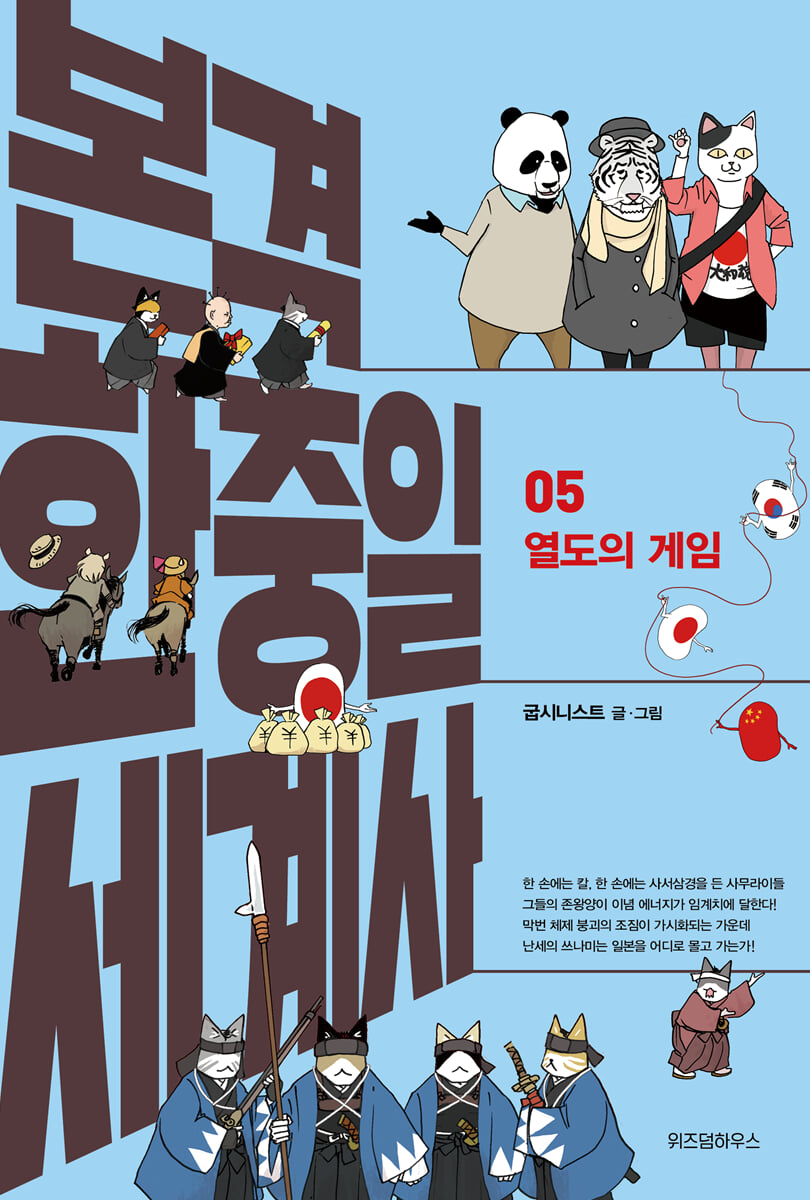
China, where heaven has closed its doors, and Japan, caught in the tsunami of troubled times.
Nanjing, the stronghold of the Taiping Heavenly Kingdom in China, was in danger of falling, and with the death of Emperor Hong Xiuquan and the execution of Prince Chong Li Shoucheng and Hong Xiuquan's son Hong Tianguifu, the Taiping Heavenly Kingdom began to decline.
After the assassination of Ii Naosuke, the Nanki faction, which had been leading central politics in Japan, fell and the Hitotsubashi faction began to gain power again.
In addition, the energy of the shogunate among the lower-ranking samurai reaches a critical level, and the chaos accelerates with sword fights occurring frequently on the streets.
To resolve this political situation, the shogunate played the card of a marriage between the imperial family and the shogun.
Nanjing, the stronghold of the Taiping Heavenly Kingdom in China, was in danger of falling, and with the death of Emperor Hong Xiuquan and the execution of Prince Chong Li Shoucheng and Hong Xiuquan's son Hong Tianguifu, the Taiping Heavenly Kingdom began to decline.
After the assassination of Ii Naosuke, the Nanki faction, which had been leading central politics in Japan, fell and the Hitotsubashi faction began to gain power again.
In addition, the energy of the shogunate among the lower-ranking samurai reaches a critical level, and the chaos accelerates with sword fights occurring frequently on the streets.
To resolve this political situation, the shogunate played the card of a marriage between the imperial family and the shogun.
- You can preview some of the book's contents.
Preview
index
preface
Chapter 1: We'll Meet Across the Yangtze River
Chapter 2: The Siege of Cheon-gyeong
Chapter 3 Noble and Common
Chapter 4 After Heaven
Chapter 5: Ugh, Ugh, The Gyeonmi Mission
Chapter 6: The Sad Covenant Ceremony
Chapter 7 Royal Wedding
Chapter 8: Long Live the Fatherland
Chapter 9: Bunkyu Bunkyu
Chapter 10: The Shogun's Approach to the Capital
Chapter 11: The sheep cries and cries
Chapter 12: The Satsuei War!
Chapter 13: The August 18th Coup!
Chapter 14 Sanyo Council
Chapter 15: The Changes of the Golden Gate
Major events and people
Chapter 1: We'll Meet Across the Yangtze River
Chapter 2: The Siege of Cheon-gyeong
Chapter 3 Noble and Common
Chapter 4 After Heaven
Chapter 5: Ugh, Ugh, The Gyeonmi Mission
Chapter 6: The Sad Covenant Ceremony
Chapter 7 Royal Wedding
Chapter 8: Long Live the Fatherland
Chapter 9: Bunkyu Bunkyu
Chapter 10: The Shogun's Approach to the Capital
Chapter 11: The sheep cries and cries
Chapter 12: The Satsuei War!
Chapter 13: The August 18th Coup!
Chapter 14 Sanyo Council
Chapter 15: The Changes of the Golden Gate
Major events and people
Into the book
The story of a man groping for the destiny of the Central Plains in a hazy paradise, amidst the opium smoke, eventually heads across the sea to the archipelago, unable to endure the fine dust.
In the twilight of the archipelago, the pale blade of the Japanese sword reflects the bloody color of the troubled times of the late Edo period.
After the death of Ii Naosuke, the Nanki faction fell and the Hitotsubashi faction emerged from local powers.
Yoshinobu, who was thus pushed to the center of power, unfolded his own political ideas.
The story unfolds with the rhythm of swordsmanship and the sound of cannons from Western warships as background music.
---From the "Preface"
It is the first time in human history that a billion people have lived so closely together, relying on the bounty of the Yangtze River.
To maintain the regional food balance, numerous ships loaded with grain and various supplies traveled up and down the Yangtze River and the Grand Canal.
This distribution system completely collapsed during the Taiping Rebellion, which took place along the Yangtze River.
The food there can no longer solve the hunger here.
Some of those who become refugees to escape this living hell end up going abroad.
Many of them went to Southeast Asia, where Chinese communities had already formed, to become low-wage workers on farms and mines, and some went to work on sugarcane farms in Hawaii, mines in South America, or railroad companies in the United States.
---From "Chapter 4_ After Heaven"
In March 1860, after the death of Ii Naosuke, the senior Roju, Ando Nobumasa, took charge of the political situation as the head of the Roju.
Following Lee's assassination, his hard-line stance was abolished and his followers were expelled.
The samurai code of conduct states that not only is the one who stabs someone with a sword a sinner, but the one who is struck by the sword is also a sinner.
---From "Chapter 6_Sad Covenant Ceremony"
If the shogunate were to weaken and the shogunate system were to loosen up into a system similar to that of a German territorial agglomeration, wouldn't the national leader be aiming for independent power, similar to that of the Satsuma-Ryukyu vassal state?
But thanks to this, the Satsuma clan's powerful influence can also be leveraged by the Satsuma movement, so isn't this a mutually beneficial mutual benefit? In any case, the flames of this movement will ultimately burn so large that the petty ambitions of a single local lord will be beyond all consideration.
---From "Chapter 8_Long Live the Fatherland"
To the elite leaders, Choshu's disobedience and the Yangi War were nothing but a madhouse of nonsense, but to the majority of lower-ranking samurai and commoners, Choshu was seen as a single-handedly defending Japan's pride against Western powers.
If the shogunate and the alliance of clans attacked Choshu in such an atmosphere, it would inevitably be seen as a picture of the ruling class controlling Choshu, which was fighting alone against the West.
In the twilight of the archipelago, the pale blade of the Japanese sword reflects the bloody color of the troubled times of the late Edo period.
After the death of Ii Naosuke, the Nanki faction fell and the Hitotsubashi faction emerged from local powers.
Yoshinobu, who was thus pushed to the center of power, unfolded his own political ideas.
The story unfolds with the rhythm of swordsmanship and the sound of cannons from Western warships as background music.
---From the "Preface"
It is the first time in human history that a billion people have lived so closely together, relying on the bounty of the Yangtze River.
To maintain the regional food balance, numerous ships loaded with grain and various supplies traveled up and down the Yangtze River and the Grand Canal.
This distribution system completely collapsed during the Taiping Rebellion, which took place along the Yangtze River.
The food there can no longer solve the hunger here.
Some of those who become refugees to escape this living hell end up going abroad.
Many of them went to Southeast Asia, where Chinese communities had already formed, to become low-wage workers on farms and mines, and some went to work on sugarcane farms in Hawaii, mines in South America, or railroad companies in the United States.
---From "Chapter 4_ After Heaven"
In March 1860, after the death of Ii Naosuke, the senior Roju, Ando Nobumasa, took charge of the political situation as the head of the Roju.
Following Lee's assassination, his hard-line stance was abolished and his followers were expelled.
The samurai code of conduct states that not only is the one who stabs someone with a sword a sinner, but the one who is struck by the sword is also a sinner.
---From "Chapter 6_Sad Covenant Ceremony"
If the shogunate were to weaken and the shogunate system were to loosen up into a system similar to that of a German territorial agglomeration, wouldn't the national leader be aiming for independent power, similar to that of the Satsuma-Ryukyu vassal state?
But thanks to this, the Satsuma clan's powerful influence can also be leveraged by the Satsuma movement, so isn't this a mutually beneficial mutual benefit? In any case, the flames of this movement will ultimately burn so large that the petty ambitions of a single local lord will be beyond all consideration.
---From "Chapter 8_Long Live the Fatherland"
To the elite leaders, Choshu's disobedience and the Yangi War were nothing but a madhouse of nonsense, but to the majority of lower-ranking samurai and commoners, Choshu was seen as a single-handedly defending Japan's pride against Western powers.
If the shogunate and the alliance of clans attacked Choshu in such an atmosphere, it would inevitably be seen as a picture of the ruling class controlling Choshu, which was fighting alone against the West.
---From "Chapter 14_Sanyo Council"
Publisher's Review
The shogunate seeks a way out through marriage between the imperial family and the shogun family.
Will it be possible to sweep away the evil spirits and bring peace to the archipelago?
In 1860s Japan, the streets were dominated by the pro-Emperor Joi faction, who would frequently commit massacres while shouting, "Yang-gwi (ghosts from the West), go home."
One of the fundamental causes of all this commotion is the discrepancy between the power that actually ruled Japan (the shogunate) and the power that held the highest authority in Japan (the imperial court).
To resolve this dilemma, the shogunate reached out to the imperial family, and the imperial family also joined the shogunate's hand to achieve its goal of national isolation, forming a public-private partnership.
In order to consolidate the government and the clan, Emperor Komei's half-sister, Kazunomiya Chikako, and Shogun Iemochi were strategically married.
Could the unification of the Emperor and the Imperial Family truly be the only power solution that can usher in a peaceful and stable modern era for Japan? Or will it drag Japan into a maelstrom of even greater chaos?
The nobles are rather angry in front of the beautiful national wedding!
Where will the samurai rebellion take the Far Eastern island nation?
Even though the marriage between the Imperial family and the Shogun family brought about the unification of public and private affairs, the anger of the pro-emperor faction did not subside.
This soon led to terrorism, with enraged Mito ronin attacking the British embassy in July 1861, and assassins attacking the procession of the local leader Ando Nobumasa on February 17, 1862.
The era of divine punishment has arrived in Kyoto.
As political turmoil continued due to the opening of the ports, succession disputes, and the assassination of Tairo, the authority of the shogunate had long since fallen to the ground, and the young shogun was unable to handle this chaos.
The Choshu clan, determined to disobey the weakened shogunate, set fire to the British embassy and blockaded the Kanmon Straits, vowing to wage war on the Choshu clan alone.
The Satsuma clan fought a fierce battle with the seven British ships that invaded Kagoshima in the wake of the Namamugi Incident...
Will the shogunate be able to safely extinguish the burning flames of the Sonnojoi?
The 『Authentic Korean-Chinese-Japanese World History』 series
This is foul play! They're not even losing their sense of humor while still providing profound content!
Easily overcoming the historical convention that "you have to memorize it to understand it."
When we talk about 'history', we often have the common perception that it is 'boring' and that 'you have to memorize it to understand it'.
This may be because the memories of memorizing the years and events that occurred during middle and high school history classes are all that remain of our image of history.
In contrast, this series deviates significantly from the conventional wisdom that history must be memorized.
This time, cartoonist Gupsinist has published a historical cartoon that covers the modern history of Korea, China, and Japan, utilizing his major.
This series describes the modern history of 19th-century East Asia, naturally incorporating various subcultures such as games, military, animation, and dramas into it.
As you slowly follow the author's extensive knowledge of history, the various parodies and wordplay that are sprinkled throughout, the zeitgeist and world situation of the time will naturally come to mind.
Through this series, readers will experience a significant reduction in the barriers to entry into history, which has often been perceived as difficult.
In the face of the tidal wave of Western imperialist powers entering the world,
How did Korea, China, and Japan resist or comply?
Why must we read world history through the lens of "Korea, China, and Japan"? To observe the tree of Korean history, our own history, we must first see the forest of Eastern history. Without understanding this, we cannot grasp the larger picture of world history.
To understand our country's past and present, and the global situation, we will compare the history of three East Asian countries.
World history up to now has not strayed far from the form of a brief description of the history of Western powers and the surrounding nations and peoples within the global historical flow they created.
However, in history, not only the military and diplomacy of powerful nations, but also the resistance and identity of weak nations occupy a large portion.
This series is an attempt to break away from the traditional Western-centric historical narrative and look at history from our East Asian perspective.
Among these, we will take a closer look at the period from the mid-19th century to the mid-20th century, when Korea, China, and Japan were most closely connected.
01.
The beginning of the West Sea branch
02.
Typhoon Heaven Rising
03.
Japan's opening
04.
Taiping Heavenly Kingdom Downfall
05.
Archipelago Games
06.
Tsunami of Dawn (Basis)…
* Will continue to be published.
Will it be possible to sweep away the evil spirits and bring peace to the archipelago?
In 1860s Japan, the streets were dominated by the pro-Emperor Joi faction, who would frequently commit massacres while shouting, "Yang-gwi (ghosts from the West), go home."
One of the fundamental causes of all this commotion is the discrepancy between the power that actually ruled Japan (the shogunate) and the power that held the highest authority in Japan (the imperial court).
To resolve this dilemma, the shogunate reached out to the imperial family, and the imperial family also joined the shogunate's hand to achieve its goal of national isolation, forming a public-private partnership.
In order to consolidate the government and the clan, Emperor Komei's half-sister, Kazunomiya Chikako, and Shogun Iemochi were strategically married.
Could the unification of the Emperor and the Imperial Family truly be the only power solution that can usher in a peaceful and stable modern era for Japan? Or will it drag Japan into a maelstrom of even greater chaos?
The nobles are rather angry in front of the beautiful national wedding!
Where will the samurai rebellion take the Far Eastern island nation?
Even though the marriage between the Imperial family and the Shogun family brought about the unification of public and private affairs, the anger of the pro-emperor faction did not subside.
This soon led to terrorism, with enraged Mito ronin attacking the British embassy in July 1861, and assassins attacking the procession of the local leader Ando Nobumasa on February 17, 1862.
The era of divine punishment has arrived in Kyoto.
As political turmoil continued due to the opening of the ports, succession disputes, and the assassination of Tairo, the authority of the shogunate had long since fallen to the ground, and the young shogun was unable to handle this chaos.
The Choshu clan, determined to disobey the weakened shogunate, set fire to the British embassy and blockaded the Kanmon Straits, vowing to wage war on the Choshu clan alone.
The Satsuma clan fought a fierce battle with the seven British ships that invaded Kagoshima in the wake of the Namamugi Incident...
Will the shogunate be able to safely extinguish the burning flames of the Sonnojoi?
The 『Authentic Korean-Chinese-Japanese World History』 series
This is foul play! They're not even losing their sense of humor while still providing profound content!
Easily overcoming the historical convention that "you have to memorize it to understand it."
When we talk about 'history', we often have the common perception that it is 'boring' and that 'you have to memorize it to understand it'.
This may be because the memories of memorizing the years and events that occurred during middle and high school history classes are all that remain of our image of history.
In contrast, this series deviates significantly from the conventional wisdom that history must be memorized.
This time, cartoonist Gupsinist has published a historical cartoon that covers the modern history of Korea, China, and Japan, utilizing his major.
This series describes the modern history of 19th-century East Asia, naturally incorporating various subcultures such as games, military, animation, and dramas into it.
As you slowly follow the author's extensive knowledge of history, the various parodies and wordplay that are sprinkled throughout, the zeitgeist and world situation of the time will naturally come to mind.
Through this series, readers will experience a significant reduction in the barriers to entry into history, which has often been perceived as difficult.
In the face of the tidal wave of Western imperialist powers entering the world,
How did Korea, China, and Japan resist or comply?
Why must we read world history through the lens of "Korea, China, and Japan"? To observe the tree of Korean history, our own history, we must first see the forest of Eastern history. Without understanding this, we cannot grasp the larger picture of world history.
To understand our country's past and present, and the global situation, we will compare the history of three East Asian countries.
World history up to now has not strayed far from the form of a brief description of the history of Western powers and the surrounding nations and peoples within the global historical flow they created.
However, in history, not only the military and diplomacy of powerful nations, but also the resistance and identity of weak nations occupy a large portion.
This series is an attempt to break away from the traditional Western-centric historical narrative and look at history from our East Asian perspective.
Among these, we will take a closer look at the period from the mid-19th century to the mid-20th century, when Korea, China, and Japan were most closely connected.
01.
The beginning of the West Sea branch
02.
Typhoon Heaven Rising
03.
Japan's opening
04.
Taiping Heavenly Kingdom Downfall
05.
Archipelago Games
06.
Tsunami of Dawn (Basis)…
* Will continue to be published.
GOODS SPECIFICS
- Date of issue: April 19, 2019
- Page count, weight, size: 352 pages | 648g | 152*225*30mm
- ISBN13: 9791190065092
- ISBN10: 1190065096
You may also like
카테고리
korean


korean

![GQ KOREA Mark (Monthly): December [2025]](http://librairie.coreenne.fr/cdn/shop/files/8ef265dbbfbf186523ed75ba7319009d.jpg?v=1765340328&width=3840)


