

Full-fledged Korean-Chinese-Japanese World History 2
 |
Description
Book Introduction
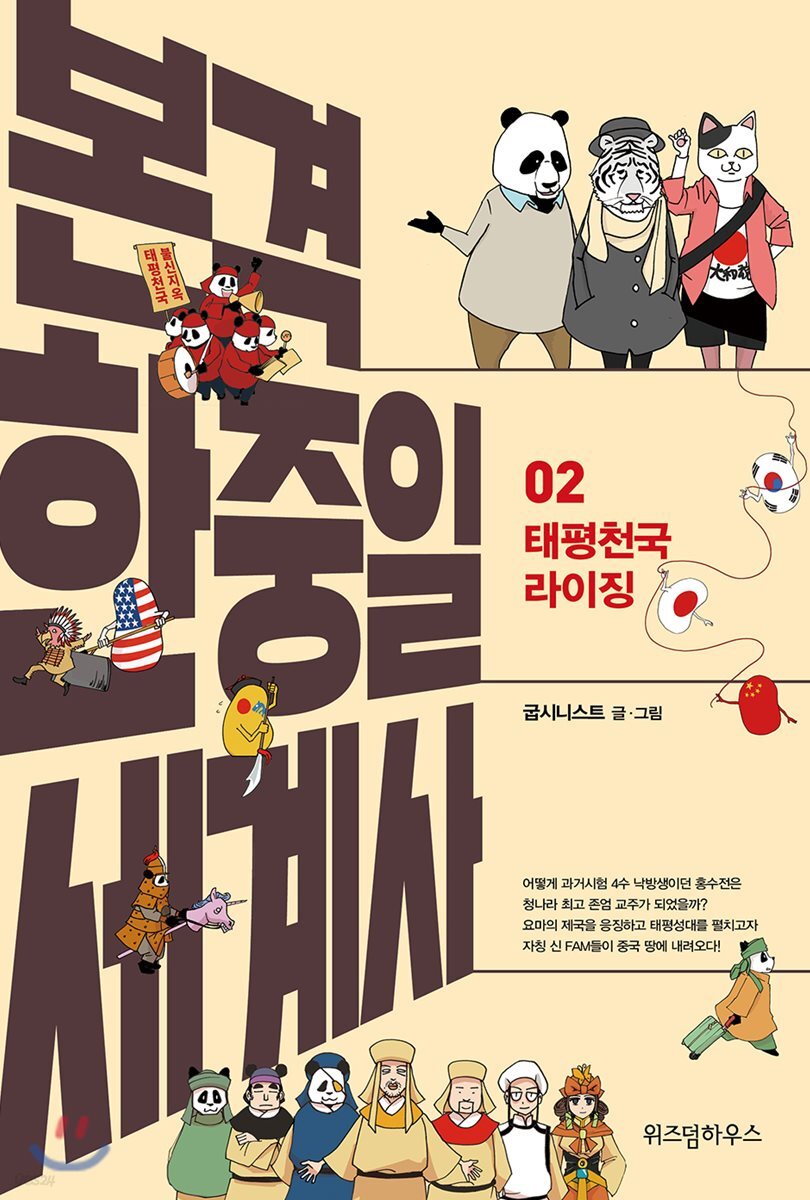
Children of God, come down to China to bring about an era of peace!
The second volume of “Authentic Korean-Chinese-Japanese World History.”
Volume 2 examines the flow of East Asia in the 19th century after the Opium War, a turning point for Western powers, through comics, including China engulfed in civil war due to the Taiping Rebellion that broke out after the Opium War, Japan beginning to crack its isolationist policies, and Joseon falling into a long and deep slumber under the rule of the powerful faction.
In particular, it focuses on the rise and fall of the Taiping Heavenly Kingdom, which was established by Hong Xiuquan to defeat the Qing Dynasty and usher in an era of peace.
The second volume of “Authentic Korean-Chinese-Japanese World History.”
Volume 2 examines the flow of East Asia in the 19th century after the Opium War, a turning point for Western powers, through comics, including China engulfed in civil war due to the Taiping Rebellion that broke out after the Opium War, Japan beginning to crack its isolationist policies, and Joseon falling into a long and deep slumber under the rule of the powerful faction.
In particular, it focuses on the rise and fall of the Taiping Heavenly Kingdom, which was established by Hong Xiuquan to defeat the Qing Dynasty and usher in an era of peace.
- You can preview some of the book's contents.
Preview
index
preface
Chapter 1_I'm a Whale?!
Chapter 2: A World Perfect for Obsessive Compulsive Disorder
Chapter 3_Pacific Lake
Chapter 4: Chronology of the 1840s
Chapter 5_The Beginning of the End
Chapter 6: You are my son
Chapter 7: The Rising of the Taiping Heavenly Kingdom
Chapter 8: The Castle in Heaven, Cheonkyung
Chapter 9_First Half of the 19th Century, China
Chapter 10: The Northern Expedition to Beijing
Chapter 11: A Lyric to Wuhan
Chapter 12: Days of Heaven
Chapter 13: The Cheonkyung Incident
Major events and people
Chapter 1_I'm a Whale?!
Chapter 2: A World Perfect for Obsessive Compulsive Disorder
Chapter 3_Pacific Lake
Chapter 4: Chronology of the 1840s
Chapter 5_The Beginning of the End
Chapter 6: You are my son
Chapter 7: The Rising of the Taiping Heavenly Kingdom
Chapter 8: The Castle in Heaven, Cheonkyung
Chapter 9_First Half of the 19th Century, China
Chapter 10: The Northern Expedition to Beijing
Chapter 11: A Lyric to Wuhan
Chapter 12: Days of Heaven
Chapter 13: The Cheonkyung Incident
Major events and people
Into the book
If history is a "story" that each chef creates with their own unique recipes and seasonings using the ingredient called history, I hope that this story can also be enjoyed with a decent flavor, as long as it doesn't significantly damage the original flavor of the ingredients.
… … Please join us in the turmoil of 19th-century East Asia with generosity, perseverance, and a spirit of adventure.
---p.5,〈Preface〉
As you know, the Indian Ocean is the sea of Britain, America's number one potential enemy! Western powers heading to China all pass through British waters, wary of Britain's reaction. BUT! God bless, America now has another sea! It's now possible to reach China via the Pacific Ocean! ---p.72-73, 〈Chapter 3_ Pacific Lake〉
In a world filled with rottenness, the Taiping Heavenly Kingdom's ascetic performances felt refreshing to the people, and its propaganda, hymns, and pamphlet distribution techniques, benchmarking Western missionary techniques, were cutting-edge marketing techniques that were enough to captivate the 19th-century Chinese.
The doomsday rumors spread by the wind catchers dispatched to various places also had a great effect.
And the brainwashed believers, with their religious fanaticism, displayed a morale and fighting power that was incomparable to that of the trash government troops.
Some intellectuals who observed this reflected on the historical experience of successfully changing the dynasty through peasant rebellions and pseudo-religious rebellions.
Some loser intellectuals (who failed the exam in the past) also joined the Taiping Heavenly Kingdom.
---p.216~218, 〈Chapter 9_ Early 19th Century, China Setting〉
Because the people, language, and customs of North China were different, it was not possible to increase power by having the people join the Taiping Heavenly Kingdom like in South China and Central China.
The food and water were different, and above all, the Northern Expeditionary Force soldiers who had encountered snow for the first time in their lives in Tianjin were extremely cruel to the cold of northern China.
It was thanks to the support of the Northern Expeditionary Forces that the Northern Expeditionary Force was able to continue fighting.
Anyway, the lesson learned from this Northern Expedition is that the Taiping Heavenly Kingdom's traditional guerrilla-style locust swarm strategy cannot win this war.
An arrow flying strongly toward its target may seem lethal at first glance, but if it misses its target, it will eventually lose its strength and fall to the ground.
---p.242~243,〈Chapter 10_ Northern Expedition to Beijing〉
Until 1856, the Taiping Heavenly Kingdom boasted such prosperity that the Qing Dynasty was worried about its downfall, but the Tianjing Incident led to the destruction of the Eastern Royal Family, which served as the administrative branch, the disintegration of the leadership, the massacre of numerous officials and experts, and the exodus of hundreds of thousands of people.
After the Tianjing Incident of 1856, the later Taiping Heavenly Kingdom lost much of its former formidable momentum and was considered a somewhat manageable threat.
… … Please join us in the turmoil of 19th-century East Asia with generosity, perseverance, and a spirit of adventure.
---p.5,〈Preface〉
As you know, the Indian Ocean is the sea of Britain, America's number one potential enemy! Western powers heading to China all pass through British waters, wary of Britain's reaction. BUT! God bless, America now has another sea! It's now possible to reach China via the Pacific Ocean! ---p.72-73, 〈Chapter 3_ Pacific Lake〉
In a world filled with rottenness, the Taiping Heavenly Kingdom's ascetic performances felt refreshing to the people, and its propaganda, hymns, and pamphlet distribution techniques, benchmarking Western missionary techniques, were cutting-edge marketing techniques that were enough to captivate the 19th-century Chinese.
The doomsday rumors spread by the wind catchers dispatched to various places also had a great effect.
And the brainwashed believers, with their religious fanaticism, displayed a morale and fighting power that was incomparable to that of the trash government troops.
Some intellectuals who observed this reflected on the historical experience of successfully changing the dynasty through peasant rebellions and pseudo-religious rebellions.
Some loser intellectuals (who failed the exam in the past) also joined the Taiping Heavenly Kingdom.
---p.216~218, 〈Chapter 9_ Early 19th Century, China Setting〉
Because the people, language, and customs of North China were different, it was not possible to increase power by having the people join the Taiping Heavenly Kingdom like in South China and Central China.
The food and water were different, and above all, the Northern Expeditionary Force soldiers who had encountered snow for the first time in their lives in Tianjin were extremely cruel to the cold of northern China.
It was thanks to the support of the Northern Expeditionary Forces that the Northern Expeditionary Force was able to continue fighting.
Anyway, the lesson learned from this Northern Expedition is that the Taiping Heavenly Kingdom's traditional guerrilla-style locust swarm strategy cannot win this war.
An arrow flying strongly toward its target may seem lethal at first glance, but if it misses its target, it will eventually lose its strength and fall to the ground.
---p.242~243,〈Chapter 10_ Northern Expedition to Beijing〉
Until 1856, the Taiping Heavenly Kingdom boasted such prosperity that the Qing Dynasty was worried about its downfall, but the Tianjing Incident led to the destruction of the Eastern Royal Family, which served as the administrative branch, the disintegration of the leadership, the massacre of numerous officials and experts, and the exodus of hundreds of thousands of people.
After the Tianjing Incident of 1856, the later Taiping Heavenly Kingdom lost much of its former formidable momentum and was considered a somewhat manageable threat.
---p.329, 〈Chapter 13_ Cheonkyung Incident〉
Publisher's Review
The second volume of "Authentic Korean-Chinese-Japanese World History" has been published!
The uprising caused by the leader of a cult swallows up the empire!
The second volume of the "Authentic Korean-Chinese-Japanese World History" series, which covers modern and contemporary East Asian history by Gupshinist, "Taiping Heavenly Kingdom Rising," has been published.
Volume 2 covers the history of the Taiping Heavenly Kingdom, founded by Hong Xiuquan, who claimed to be the son of God, from 1851, when the kingdom rose to the point of threatening the Qing Empire, until 1856, when the Taiping Heavenly Kingdom, which had been on a tear, was brought to ruin by the Tianjing Incident, an internal strife within its leadership.
Thanks to the familiar cartoon depicting the rapid rise and fall of the Taiping Heavenly Kingdom, even those without basic knowledge of 19th-century East Asian modern history can naturally grasp the flow of the times.
Additionally, the book includes an unpublished article titled “Gup’s Arrogance and Miscellany” to help readers gain a richer understanding of the historical background.
The worst bloody civil war caused by the "Chinese sons and daughters of God"
Reading the Flow of Modern China through the Taiping Rebellion
It is true that the Taiping Heavenly Kingdom Movement is so important that it is only briefly mentioned once or twice in our country's world history textbooks.
The period of rise and fall of the Taiping Heavenly Kingdom was also relatively short, lasting only about 14 years.
However, during this period, the Taiping Army was so powerful that it passed through every province in China at least once, except for Gansu Province in the northwestern corner.
It was also the largest and bloodiest civil war in history, with a total of 20 to 30 million deaths.
Considering that the Taiping Rebellion was an event that exploded due to the decline of the Qing Dynasty, which was subjugated by the West in the wake of the Opium Wars, the full-scale introduction of Christian civilization into East Asia, the incompetence and corruption of Qing officials who had not come to their senses even after the Opium Wars, and the internal strife between indigenous people and outsiders that had accumulated over thousands of years, it is not a history that can be briefly reviewed.
What epochal demands brought the Taiping Heavenly Kingdom into history? What qualities of the Taiping Heavenly Kingdom captivated the hearts of the Qing people? Through the rise and decline of the Taiping Heavenly Kingdom, readers will be able to glimpse key unique aspects of modern East Asia and the historical trends of the time.
This is foul play! They're not even losing their sense of humor while still providing profound content!
Easily overcoming the historical convention that "you have to memorize it to understand it."
When we talk about 'history', we often have the common perception that it is 'boring' and that 'you have to memorize it to understand it'.
This may be because the memories of memorizing the years and events that occurred during middle and high school history classes are all that remain of our image of history.
In contrast, this series deviates significantly from the conventional wisdom that history must be memorized.
This time, cartoonist Gupsinist has published a historical cartoon that covers the modern history of Korea, China, and Japan, utilizing his major.
This series describes the modern history of 19th-century East Asia, naturally incorporating various subcultures such as games, military, animation, and dramas into it.
As you slowly follow the author's extensive knowledge of history, the various parodies and wordplay that are sprinkled throughout, the zeitgeist and world situation of the time will naturally come to mind.
Through this series, readers will experience a significant reduction in the barriers to entry into history, which has often been perceived as difficult.
In the face of the tidal wave of Western imperialist powers entering the world,
How did Korea, China, and Japan resist or comply?
Why must we read world history through the lens of "Korea, China, and Japan"? To observe the tree of Korean history, our own history, we must first see the forest of Eastern history. Without understanding this, we cannot grasp the larger picture of world history.
To understand our country's past and present, and the global situation, we will compare the history of three East Asian countries.
World history up to now has not strayed far from the form of a brief description of the history of Western powers and the surrounding nations and peoples within the global historical flow they created.
However, history is not only about the military and diplomacy of powerful nations, but also about the resistance and identity of weak nations.
This series is an attempt to break away from the traditional Western-centric historical narrative and look at history from our East Asian perspective.
Among them, we will take a closer look at the period from the mid-19th century to the mid-20th century, when Korea, China, and Japan were most closely connected.
01.
The beginning of the West Sea branch
02.
Typhoon Heaven Rising
03.
Chrysanthemum and gun (root)
04.
Game of Asia (Release)…
* Will continue to be published.
The uprising caused by the leader of a cult swallows up the empire!
The second volume of the "Authentic Korean-Chinese-Japanese World History" series, which covers modern and contemporary East Asian history by Gupshinist, "Taiping Heavenly Kingdom Rising," has been published.
Volume 2 covers the history of the Taiping Heavenly Kingdom, founded by Hong Xiuquan, who claimed to be the son of God, from 1851, when the kingdom rose to the point of threatening the Qing Empire, until 1856, when the Taiping Heavenly Kingdom, which had been on a tear, was brought to ruin by the Tianjing Incident, an internal strife within its leadership.
Thanks to the familiar cartoon depicting the rapid rise and fall of the Taiping Heavenly Kingdom, even those without basic knowledge of 19th-century East Asian modern history can naturally grasp the flow of the times.
Additionally, the book includes an unpublished article titled “Gup’s Arrogance and Miscellany” to help readers gain a richer understanding of the historical background.
The worst bloody civil war caused by the "Chinese sons and daughters of God"
Reading the Flow of Modern China through the Taiping Rebellion
It is true that the Taiping Heavenly Kingdom Movement is so important that it is only briefly mentioned once or twice in our country's world history textbooks.
The period of rise and fall of the Taiping Heavenly Kingdom was also relatively short, lasting only about 14 years.
However, during this period, the Taiping Army was so powerful that it passed through every province in China at least once, except for Gansu Province in the northwestern corner.
It was also the largest and bloodiest civil war in history, with a total of 20 to 30 million deaths.
Considering that the Taiping Rebellion was an event that exploded due to the decline of the Qing Dynasty, which was subjugated by the West in the wake of the Opium Wars, the full-scale introduction of Christian civilization into East Asia, the incompetence and corruption of Qing officials who had not come to their senses even after the Opium Wars, and the internal strife between indigenous people and outsiders that had accumulated over thousands of years, it is not a history that can be briefly reviewed.
What epochal demands brought the Taiping Heavenly Kingdom into history? What qualities of the Taiping Heavenly Kingdom captivated the hearts of the Qing people? Through the rise and decline of the Taiping Heavenly Kingdom, readers will be able to glimpse key unique aspects of modern East Asia and the historical trends of the time.
This is foul play! They're not even losing their sense of humor while still providing profound content!
Easily overcoming the historical convention that "you have to memorize it to understand it."
When we talk about 'history', we often have the common perception that it is 'boring' and that 'you have to memorize it to understand it'.
This may be because the memories of memorizing the years and events that occurred during middle and high school history classes are all that remain of our image of history.
In contrast, this series deviates significantly from the conventional wisdom that history must be memorized.
This time, cartoonist Gupsinist has published a historical cartoon that covers the modern history of Korea, China, and Japan, utilizing his major.
This series describes the modern history of 19th-century East Asia, naturally incorporating various subcultures such as games, military, animation, and dramas into it.
As you slowly follow the author's extensive knowledge of history, the various parodies and wordplay that are sprinkled throughout, the zeitgeist and world situation of the time will naturally come to mind.
Through this series, readers will experience a significant reduction in the barriers to entry into history, which has often been perceived as difficult.
In the face of the tidal wave of Western imperialist powers entering the world,
How did Korea, China, and Japan resist or comply?
Why must we read world history through the lens of "Korea, China, and Japan"? To observe the tree of Korean history, our own history, we must first see the forest of Eastern history. Without understanding this, we cannot grasp the larger picture of world history.
To understand our country's past and present, and the global situation, we will compare the history of three East Asian countries.
World history up to now has not strayed far from the form of a brief description of the history of Western powers and the surrounding nations and peoples within the global historical flow they created.
However, history is not only about the military and diplomacy of powerful nations, but also about the resistance and identity of weak nations.
This series is an attempt to break away from the traditional Western-centric historical narrative and look at history from our East Asian perspective.
Among them, we will take a closer look at the period from the mid-19th century to the mid-20th century, when Korea, China, and Japan were most closely connected.
01.
The beginning of the West Sea branch
02.
Typhoon Heaven Rising
03.
Chrysanthemum and gun (root)
04.
Game of Asia (Release)…
* Will continue to be published.
GOODS SPECIFICS
- Date of publication: June 29, 2018
- Page count, weight, size: 344 pages | 644g | 153*225*30mm
- ISBN13: 9791162204948
- ISBN10: 116220494X
You may also like
카테고리
korean


korean

![GQ KOREA Mark (Monthly): December [2025]](http://librairie.coreenne.fr/cdn/shop/files/8ef265dbbfbf186523ed75ba7319009d.jpg?v=1765340328&width=3840)


