

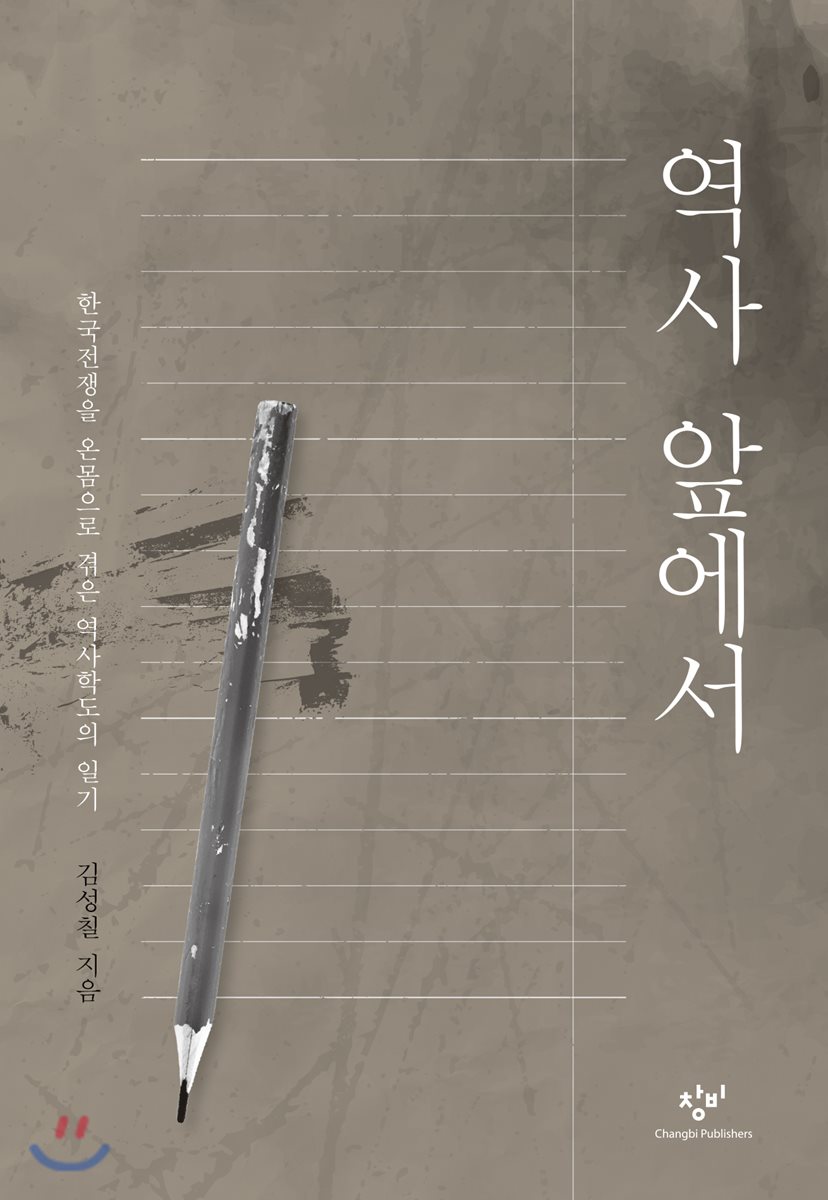
In front of history
 |
Description
Book Introduction
An account of the Korean War, with outstanding insight and cultural sensibility.
A true record from a history student who sees through the reality of the left and right!
A revised and popular edition of Kim Seong-chil's Korean War diary, "In Front of History," which has been consistently cited as a steady seller since its first publication in 1993, has been published.
“In Front of History” is a diary written by Kim Seong-chil, a 38-year-old full-time lecturer in the Department of History at Seoul National University during the Korean War in 1950, in which he vividly records what he saw and experienced.
This diary, which coldly portrays the social conditions after liberation and the hectic early days of the Korean War from November 1945 to April 1951, has gained more contemporary meaning and a poignant feeling, despite the fact that 25 years have passed since its publication, as discussions on the 'end-of-war declaration' and 'peace agreement' have been actively progressing.
It unvarnishedly shows the stark reality of the changing left and right wings depending on the situation and the changing circumstances of the war, and it fully captures the agony of a centrist intellectual yearning for peace, and it makes us realize anew what our responsibilities as a father with a wife and young children are.
Moreover, the depiction of the horrors of war unfolding before our eyes and the interesting portrayal of various characters provide an enjoyment comparable to that of literary works.
In particular, the author, who studied and taught history, seems to have experienced more internal conflict than anyone else regarding conflict and war between people of the same ethnicity, and such records are found throughout the diary.
Although they speak a strong northwestern dialect, they are of the same race as us, sharing the same language, customs, and bloodline, and somehow they do not seem like enemy soldiers.
It feels like a brother who has been away far away is coming back to his hometown after a long time.
When I see them smiling and talking kindly, I can't help but feel no hostility.
This may not be just because I have particularly little loyalty to the Republic of Korea.
What's the difference between the army I saw yesterday and these people?
If they are different, it's just that their clothing is a little odd, so why should only one be on our side and the other be considered the enemy?
Since when has such an insoluble enmity developed between them that they must face each other with bayonets in hand on the battlefield of death?
Those who should be hugging each other and calling each other brother and sister, why are they fighting today and for whom?
I felt like I wanted to collapse on the street, beat my fists, and cry. (Diary entry, June 28, 1950, pp. 115-16)
The 1/50,000 map that was supposed to be used by the Place Name Research Society was mostly in disrepair, and many of the valuable data that the research society had painstakingly researched was wasted as waste paper.
Thinking about all the hard work I've put into this over the past year makes me feel relieved.
Is this what war is like? How can we, not even foreigners, be so oblivious to our precious cultural heritage?
Thinking about losing my card makes me want to collapse and cry. (July 19, 1950, Diary, p. 173)
The newly published 『In Front of History』 revives all of Kim Seong-chil's diary by adding 39 diary entries and 1 travelogue that were excluded from the first edition. It also excludes material-oriented writings (memoirs by Ko Byeong-ik and others and extensive commentary and annotations by Professor Jeong Byeong-jun) that were included in the first and revised editions. It also reorganizes the format so that younger readers can focus more on the 'diary'.
And, we included the preface, “Farewell to Father’s Diary,” by Kim Ki-hyeop (historian), the third son of Kim Seong-chil, who appears in the diary.
The newly added travelogue, "Soknisan Travelogue," depicts a journey to Beopjusa Temple. It is a masterpiece that depicts the customs of a mountain village in the midst of harvest and the mountain scenery on a moonlit late autumn night with outstanding writing skills and linguistic sense.
A true record from a history student who sees through the reality of the left and right!
A revised and popular edition of Kim Seong-chil's Korean War diary, "In Front of History," which has been consistently cited as a steady seller since its first publication in 1993, has been published.
“In Front of History” is a diary written by Kim Seong-chil, a 38-year-old full-time lecturer in the Department of History at Seoul National University during the Korean War in 1950, in which he vividly records what he saw and experienced.
This diary, which coldly portrays the social conditions after liberation and the hectic early days of the Korean War from November 1945 to April 1951, has gained more contemporary meaning and a poignant feeling, despite the fact that 25 years have passed since its publication, as discussions on the 'end-of-war declaration' and 'peace agreement' have been actively progressing.
It unvarnishedly shows the stark reality of the changing left and right wings depending on the situation and the changing circumstances of the war, and it fully captures the agony of a centrist intellectual yearning for peace, and it makes us realize anew what our responsibilities as a father with a wife and young children are.
Moreover, the depiction of the horrors of war unfolding before our eyes and the interesting portrayal of various characters provide an enjoyment comparable to that of literary works.
In particular, the author, who studied and taught history, seems to have experienced more internal conflict than anyone else regarding conflict and war between people of the same ethnicity, and such records are found throughout the diary.
Although they speak a strong northwestern dialect, they are of the same race as us, sharing the same language, customs, and bloodline, and somehow they do not seem like enemy soldiers.
It feels like a brother who has been away far away is coming back to his hometown after a long time.
When I see them smiling and talking kindly, I can't help but feel no hostility.
This may not be just because I have particularly little loyalty to the Republic of Korea.
What's the difference between the army I saw yesterday and these people?
If they are different, it's just that their clothing is a little odd, so why should only one be on our side and the other be considered the enemy?
Since when has such an insoluble enmity developed between them that they must face each other with bayonets in hand on the battlefield of death?
Those who should be hugging each other and calling each other brother and sister, why are they fighting today and for whom?
I felt like I wanted to collapse on the street, beat my fists, and cry. (Diary entry, June 28, 1950, pp. 115-16)
The 1/50,000 map that was supposed to be used by the Place Name Research Society was mostly in disrepair, and many of the valuable data that the research society had painstakingly researched was wasted as waste paper.
Thinking about all the hard work I've put into this over the past year makes me feel relieved.
Is this what war is like? How can we, not even foreigners, be so oblivious to our precious cultural heritage?
Thinking about losing my card makes me want to collapse and cry. (July 19, 1950, Diary, p. 173)
The newly published 『In Front of History』 revives all of Kim Seong-chil's diary by adding 39 diary entries and 1 travelogue that were excluded from the first edition. It also excludes material-oriented writings (memoirs by Ko Byeong-ik and others and extensive commentary and annotations by Professor Jeong Byeong-jun) that were included in the first and revised editions. It also reorganizes the format so that younger readers can focus more on the 'diary'.
And, we included the preface, “Farewell to Father’s Diary,” by Kim Ki-hyeop (historian), the third son of Kim Seong-chil, who appears in the diary.
The newly added travelogue, "Soknisan Travelogue," depicts a journey to Beopjusa Temple. It is a masterpiece that depicts the customs of a mountain village in the midst of harvest and the mountain scenery on a moonlit late autumn night with outstanding writing skills and linguistic sense.
- You can preview some of the book's contents.
Preview
GOODS SPECIFICS
- Date of publication: June 15, 2018
- Format: Hardcover book binding method guide
- Page count, weight, size: 452 pages | 520g | 136*195*25mm
- ISBN13: 9788936475963
- ISBN10: 8936475967
You may also like
카테고리
korean


korean

![GQ KOREA Mark (Monthly): December [2025]](http://librairie.coreenne.fr/cdn/shop/files/8ef265dbbfbf186523ed75ba7319009d.jpg?v=1765340328&width=3840)


