

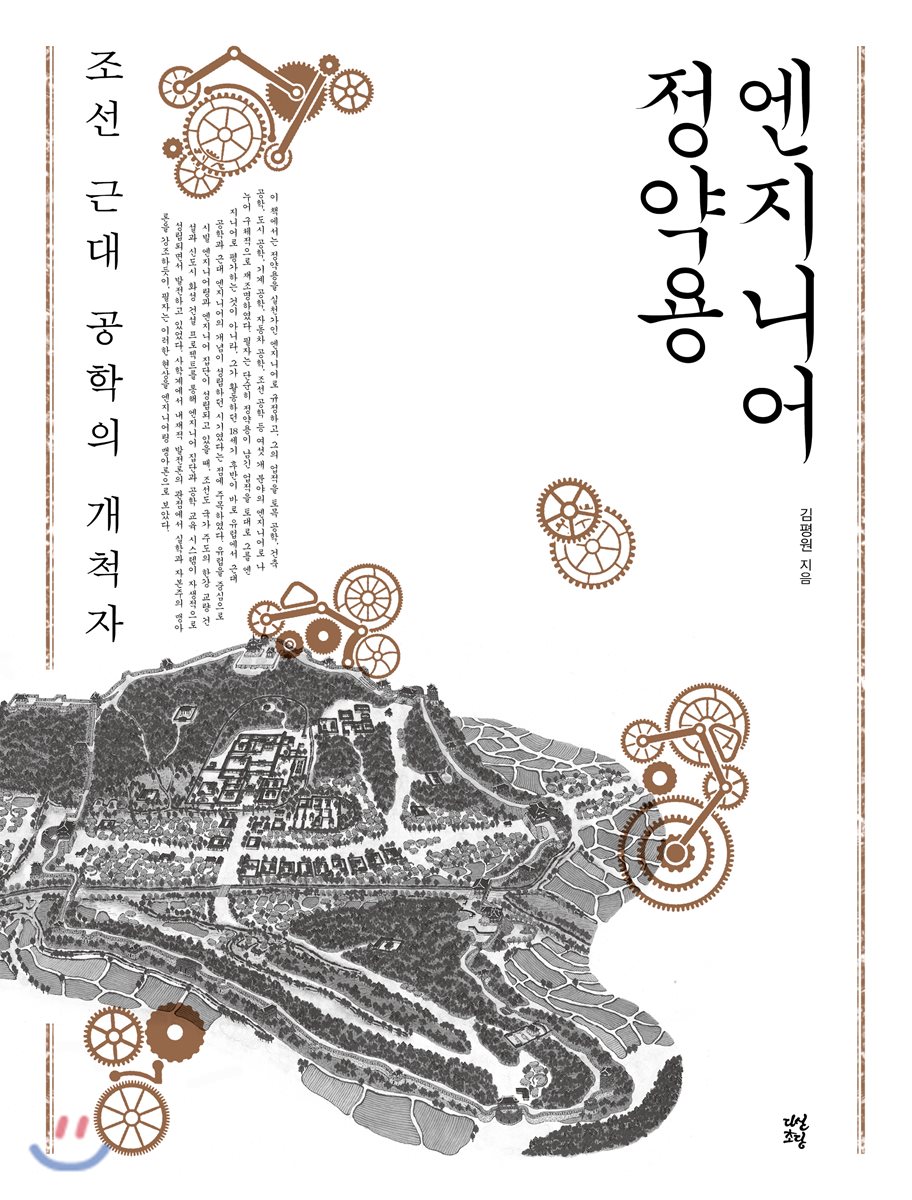
Engineer Jeong Yak-yong
 |
Description
Book Introduction
After 17 years of research, it was completed with over 200 plates.
A pioneer of modern Joseon engineering vividly recreated
Jeong Yak-yong, Korea's first UNESCO Person of the Year
Re-evaluated as Joseon's best engineer!
A book that breaks free from the stereotype of Jeong Yak-yong as a Silhak scholar and reexamines him as a Joseon engineer.
Jeong Yak-yong is a world-renowned thinker and practitioner, but we tend to view him only as a scholar who brought Silhak to its zenith.
However, during his youth, he distinguished himself as an engineer, designing the new city of Suwon Hwaseong and inventing various construction machines, including a crane.
It was after he was exiled that he left behind numerous writings.
So, should we view Jeong Yak-yong as a scholar or as an engineer?
The author of this book, Professor Kim Pyeong-won, spent 17 years researching a vast amount of historical materials, from epitaphs written by Jeong Yak-yong himself to the Annals of the Joseon Dynasty, in order to shed new light on Jeong Yak-yong as an engineer.
This book contains the results of meticulous research that crosses the boundaries between humanities and engineering, including deducing the Han River bridge most similar to Jeong Yak-yong's design and creating models of a crane and a potter's wheel.
This book examines Jeong Yak-yong's achievements in detail, divided into six fields including civil engineering, architecture, urban planning, machinery, automobiles, and shipbuilding engineering, with over 200 illustrations. It also sharply points out the movements of modern engineering in Joseon that were emerging during the time Jeong Yak-yong was active. Through this book, readers will be able to vividly experience Jeong Yak-yong's engineering achievements that cannot be found in other books, and meet 'Engineer Jeong Yak-yong', Joseon's greatest convergence talent recognized worldwide.
A pioneer of modern Joseon engineering vividly recreated
Jeong Yak-yong, Korea's first UNESCO Person of the Year
Re-evaluated as Joseon's best engineer!
A book that breaks free from the stereotype of Jeong Yak-yong as a Silhak scholar and reexamines him as a Joseon engineer.
Jeong Yak-yong is a world-renowned thinker and practitioner, but we tend to view him only as a scholar who brought Silhak to its zenith.
However, during his youth, he distinguished himself as an engineer, designing the new city of Suwon Hwaseong and inventing various construction machines, including a crane.
It was after he was exiled that he left behind numerous writings.
So, should we view Jeong Yak-yong as a scholar or as an engineer?
The author of this book, Professor Kim Pyeong-won, spent 17 years researching a vast amount of historical materials, from epitaphs written by Jeong Yak-yong himself to the Annals of the Joseon Dynasty, in order to shed new light on Jeong Yak-yong as an engineer.
This book contains the results of meticulous research that crosses the boundaries between humanities and engineering, including deducing the Han River bridge most similar to Jeong Yak-yong's design and creating models of a crane and a potter's wheel.
This book examines Jeong Yak-yong's achievements in detail, divided into six fields including civil engineering, architecture, urban planning, machinery, automobiles, and shipbuilding engineering, with over 200 illustrations. It also sharply points out the movements of modern engineering in Joseon that were emerging during the time Jeong Yak-yong was active. Through this book, readers will be able to vividly experience Jeong Yak-yong's engineering achievements that cannot be found in other books, and meet 'Engineer Jeong Yak-yong', Joseon's greatest convergence talent recognized worldwide.
index
Chapter 1: From Silhak Scholar to Engineer, from Writer to Practitioner
What was J's occupation?│Was it really thanks to the crane?│Did Jeong Yak-yong consider himself a Silhak scholar?│Why is it awkward to call Jeong Yak-yong an engineer?
Chapter 2: Urban Engineer Jeong Yak-yong Designs the New City of Hwaseong
Where are Jeong Yak-yong's Hwaseong blueprints? │ "Seongseol," the guideline for the construction of the new city of Hwaseong │ The economic path that even Ongseong couldn't stop │ The waterway that divides Hwaseong into east and west
Chapter 3: Architectural Engineer Jeong Yak-yong Presents a New Construction Method
PC construction method of manufacturing, moving, and then assembling│Jeong Yak-yong's design modified and supplemented during construction│Jeong Yak-yong's design ignored during construction
Chapter 4: Mechanical engineer Jeong Yak-yong improves and invents the crane and the potter's wheel.
What is a crane used for? │The phenomenon of simultaneous discovery of compound pulleys │The prototype crane and the finished crane │The jib crane wheel of Joseon │If we had referred to Ramelli's drawings instead of Terenz
Chapter 5: Automotive engineer Jeong Yak-yong invents the Yuhyeong-geo
Narrow width and high center of gravity, overturning the common sense of carts│A multipurpose device that combines the functions of a crane and a cart│It pulls oxen and shakes people, is it a type of cart or a type of behemoth│Its shape is modified to absorb the shocks that the cart receives│It obtains auxiliary propulsion through pumping
Chapter 6: Joseon engineer Jeong Yak-yong designs a floating bridge
Guidelines for the construction of floating bridges on the Han River, 『Bridge Guide』│The lower structure of floating bridges designed by measuring draft and freeboard│Jeong Yak-yong's floating plank bridge and Gunsan's floating bridge
Chapter 7: Civil Engineer Jeong Yak-yong Designs a Girder Bridge
The superstructure of a pontoon bridge designed as a girder bridge│Where and how were the beams joined?│Why bundling is more efficient than fitting│Engineer Jeong Yak-yong's earthquake-resistant design philosophy
Chapter 8: The Establishment of Modern Engineering in the Late Joseon Dynasty and the Formation of a Group of Engineers
How to Make People Work Hard│The Formation of a Group of Engineers and Technicians│Engineer Jeong Yak-yong and Technician Jang Yeong-sil│Modern Engineering in Joseon Sprouts from the Construction Sites of Baedari Bridges and New Towns│Engineer Jeong Yak-yong's Engineering Thinking
supplement
References
List of illustrations
Table of Contents
What was J's occupation?│Was it really thanks to the crane?│Did Jeong Yak-yong consider himself a Silhak scholar?│Why is it awkward to call Jeong Yak-yong an engineer?
Chapter 2: Urban Engineer Jeong Yak-yong Designs the New City of Hwaseong
Where are Jeong Yak-yong's Hwaseong blueprints? │ "Seongseol," the guideline for the construction of the new city of Hwaseong │ The economic path that even Ongseong couldn't stop │ The waterway that divides Hwaseong into east and west
Chapter 3: Architectural Engineer Jeong Yak-yong Presents a New Construction Method
PC construction method of manufacturing, moving, and then assembling│Jeong Yak-yong's design modified and supplemented during construction│Jeong Yak-yong's design ignored during construction
Chapter 4: Mechanical engineer Jeong Yak-yong improves and invents the crane and the potter's wheel.
What is a crane used for? │The phenomenon of simultaneous discovery of compound pulleys │The prototype crane and the finished crane │The jib crane wheel of Joseon │If we had referred to Ramelli's drawings instead of Terenz
Chapter 5: Automotive engineer Jeong Yak-yong invents the Yuhyeong-geo
Narrow width and high center of gravity, overturning the common sense of carts│A multipurpose device that combines the functions of a crane and a cart│It pulls oxen and shakes people, is it a type of cart or a type of behemoth│Its shape is modified to absorb the shocks that the cart receives│It obtains auxiliary propulsion through pumping
Chapter 6: Joseon engineer Jeong Yak-yong designs a floating bridge
Guidelines for the construction of floating bridges on the Han River, 『Bridge Guide』│The lower structure of floating bridges designed by measuring draft and freeboard│Jeong Yak-yong's floating plank bridge and Gunsan's floating bridge
Chapter 7: Civil Engineer Jeong Yak-yong Designs a Girder Bridge
The superstructure of a pontoon bridge designed as a girder bridge│Where and how were the beams joined?│Why bundling is more efficient than fitting│Engineer Jeong Yak-yong's earthquake-resistant design philosophy
Chapter 8: The Establishment of Modern Engineering in the Late Joseon Dynasty and the Formation of a Group of Engineers
How to Make People Work Hard│The Formation of a Group of Engineers and Technicians│Engineer Jeong Yak-yong and Technician Jang Yeong-sil│Modern Engineering in Joseon Sprouts from the Construction Sites of Baedari Bridges and New Towns│Engineer Jeong Yak-yong's Engineering Thinking
supplement
References
List of illustrations
Table of Contents
Detailed image
Into the book
If someone spent their entire life treating patients and then retired without writing a book, or if they didn't treat patients but instead studied medicine after retiring from the civil service and wrote a book, which would we consider a "doctor"? Even if an engineer retired and researched a variety of fields, if they were active in their careers as an engineer, wouldn't it be reasonable to consider them an engineer by profession?
Chapter 1: From Silhak Scholar to Engineer, from Writer to Practitioner
If the perspectives on the concept and reality of Silhak in the late Joseon Dynasty, which has been considered truth through textbooks, have become so diverse, it is also meaningful to boldly break away from the narrow view of Jeong Yak-yong as a writer who summarized Silhak.
In an era where interdisciplinary integration is becoming increasingly important, it is necessary to bring Jeong Yak-yong and Geojunggi out of textbooks and classrooms and look back on the engineer Jeong Yak-yong and his engineering achievements.
Chapter 1: From Silhak Scholar to Engineer, from Writer to Practitioner
Jeong Yak-yong established the principles of grading stones in advance and cutting them in the 5th guideline of “Seongseol.”
Large stones were carried in one cartload, medium stones in two cartloads, and small stones in three or four cartloads, all of which were meticulously planned to provide a certain amount of material to build a fortress.
There is a big difference between moving and trimming, and trimming and then moving.
Jeong Yak-yong's strategy was not to move stones from the stone quarry to the construction site and then trim them as needed while building the castle, but to standardize the size of the stones and purchase pre-trimmed stones from the stone quarry and then move them, thereby saving on transportation costs and shortening the construction period.
Chapter 3: Architectural Engineer Jeong Yak-yong Presents a New Construction Method
Considering the structural limitations of the crane, which had only a simple path to lift and lower stones and had limited freedom, the crane would have been used only to the extent of holding the heaviest stone in place.
It is believed that the crane was mainly used in stone mills.
It is reasonable to view it as a piece of equipment used to solve the problem of it being too difficult to drag stones from the quarry to the construction site and it being difficult to load stones onto a tall cart.
The crane was not a jib crane that lifted objects to high places like a gantry crane, but a fixed gantry crane used to load stones onto carts.
Chapter 4: Mechanical Engineer Jeong Yak-yong Invents and Improves the Crane and the Green Wheel
How can a cart, a mere cart without any power of its own, be considered highly engineered? The word "cart" literally means "a wobbly balance beam," and ultimately, a cart is "like a wobbly balance beam."
Jeong Yak-yong broke the common sense that a cart needs to have a low center of gravity and a wide width to move without shaking, and intentionally raised the loading area with a semicircular piece of wood called bokto, and narrowed the width to make the cart itself very unstable.
It is designed in the exact opposite way to today's cars, which are designed to be wider and lower to improve driving stability and to minimize shaking by absorbing shocks through advanced suspension systems.
In light of this, it can be said that the type of cart cannot be simply a cart.
The Yoo Hyeong-geo was Jeong Yak-yong's invention, which featured a forklift that could load loads, a suspension that absorbed shocks, and a system that utilized pumping as an auxiliary propulsion force.
Chapter 5: Automotive Engineer Jeong Yak-yong Invents the Yuhyeong-geo
Jeong Yak-yong, who was close to King Jeongjo as a scholar-official, suggested an innovative construction method equivalent to today's girder bridge to King Jeongjo, who was contemplating on construction methods.
On July 1, 1790, King Jeongjo announced 『Jugyojinam』, which was a major revision of the 21 articles of 『Jugyojeolmok』 into 15 items based on Jeong Yak-yong's design.
Chapter 6: Joseon engineer Jeong Yak-yong designs a floating bridge
The first design, "Bishop's Cross," proposed a method of attaching rings to each ship and tying them together with ropes.
However, it was rejected during the review process due to the fatal flaw that the bridge deck could shake greatly when a large number of people cross.
Jeong Yak-yong proposed a stable structure in which the beams support the upper deck, similar to the superstructure of a modern girder bridge.
The weight is equivalent to the girder of a modern bridge.
Jeong Yak-yong abandoned the traditional method of using long poles to stretch them across multiple ships, and chose a modular method of dividing the weights into pieces and connecting them individually.
Chapter 7: Civil Engineer Jeong Yak-yong Designs a Girder Bridge
So what's the difference between Jang Yeong-sil, known for his prodigious talent in mechanical engineering from a young age, and Jeong Yak-yong? Jeong Yak-yong can be considered an engineer in that he developed machines like the crane and the potter's wheel out of necessity for large-scale state-led construction projects during the late Joseon Dynasty, a period when a large engineering community was forming. He systematically explained the principles and components of these machines, along with drawings, and left behind a technical manual in the "Hwaseongseongyeok Uigwe."
In contrast, Jang Yeong-sil was an outstanding mechanical engineer who was ahead of his time in the early Joseon Dynasty, when there was no system for training and educating engineers.
Chapter 8: The Establishment of Modern Engineering in the Late Joseon Dynasty and the Formation of a Group of Engineers
Chapter 1: From Silhak Scholar to Engineer, from Writer to Practitioner
If the perspectives on the concept and reality of Silhak in the late Joseon Dynasty, which has been considered truth through textbooks, have become so diverse, it is also meaningful to boldly break away from the narrow view of Jeong Yak-yong as a writer who summarized Silhak.
In an era where interdisciplinary integration is becoming increasingly important, it is necessary to bring Jeong Yak-yong and Geojunggi out of textbooks and classrooms and look back on the engineer Jeong Yak-yong and his engineering achievements.
Chapter 1: From Silhak Scholar to Engineer, from Writer to Practitioner
Jeong Yak-yong established the principles of grading stones in advance and cutting them in the 5th guideline of “Seongseol.”
Large stones were carried in one cartload, medium stones in two cartloads, and small stones in three or four cartloads, all of which were meticulously planned to provide a certain amount of material to build a fortress.
There is a big difference between moving and trimming, and trimming and then moving.
Jeong Yak-yong's strategy was not to move stones from the stone quarry to the construction site and then trim them as needed while building the castle, but to standardize the size of the stones and purchase pre-trimmed stones from the stone quarry and then move them, thereby saving on transportation costs and shortening the construction period.
Chapter 3: Architectural Engineer Jeong Yak-yong Presents a New Construction Method
Considering the structural limitations of the crane, which had only a simple path to lift and lower stones and had limited freedom, the crane would have been used only to the extent of holding the heaviest stone in place.
It is believed that the crane was mainly used in stone mills.
It is reasonable to view it as a piece of equipment used to solve the problem of it being too difficult to drag stones from the quarry to the construction site and it being difficult to load stones onto a tall cart.
The crane was not a jib crane that lifted objects to high places like a gantry crane, but a fixed gantry crane used to load stones onto carts.
Chapter 4: Mechanical Engineer Jeong Yak-yong Invents and Improves the Crane and the Green Wheel
How can a cart, a mere cart without any power of its own, be considered highly engineered? The word "cart" literally means "a wobbly balance beam," and ultimately, a cart is "like a wobbly balance beam."
Jeong Yak-yong broke the common sense that a cart needs to have a low center of gravity and a wide width to move without shaking, and intentionally raised the loading area with a semicircular piece of wood called bokto, and narrowed the width to make the cart itself very unstable.
It is designed in the exact opposite way to today's cars, which are designed to be wider and lower to improve driving stability and to minimize shaking by absorbing shocks through advanced suspension systems.
In light of this, it can be said that the type of cart cannot be simply a cart.
The Yoo Hyeong-geo was Jeong Yak-yong's invention, which featured a forklift that could load loads, a suspension that absorbed shocks, and a system that utilized pumping as an auxiliary propulsion force.
Chapter 5: Automotive Engineer Jeong Yak-yong Invents the Yuhyeong-geo
Jeong Yak-yong, who was close to King Jeongjo as a scholar-official, suggested an innovative construction method equivalent to today's girder bridge to King Jeongjo, who was contemplating on construction methods.
On July 1, 1790, King Jeongjo announced 『Jugyojinam』, which was a major revision of the 21 articles of 『Jugyojeolmok』 into 15 items based on Jeong Yak-yong's design.
Chapter 6: Joseon engineer Jeong Yak-yong designs a floating bridge
The first design, "Bishop's Cross," proposed a method of attaching rings to each ship and tying them together with ropes.
However, it was rejected during the review process due to the fatal flaw that the bridge deck could shake greatly when a large number of people cross.
Jeong Yak-yong proposed a stable structure in which the beams support the upper deck, similar to the superstructure of a modern girder bridge.
The weight is equivalent to the girder of a modern bridge.
Jeong Yak-yong abandoned the traditional method of using long poles to stretch them across multiple ships, and chose a modular method of dividing the weights into pieces and connecting them individually.
Chapter 7: Civil Engineer Jeong Yak-yong Designs a Girder Bridge
So what's the difference between Jang Yeong-sil, known for his prodigious talent in mechanical engineering from a young age, and Jeong Yak-yong? Jeong Yak-yong can be considered an engineer in that he developed machines like the crane and the potter's wheel out of necessity for large-scale state-led construction projects during the late Joseon Dynasty, a period when a large engineering community was forming. He systematically explained the principles and components of these machines, along with drawings, and left behind a technical manual in the "Hwaseongseongyeok Uigwe."
In contrast, Jang Yeong-sil was an outstanding mechanical engineer who was ahead of his time in the early Joseon Dynasty, when there was no system for training and educating engineers.
Chapter 8: The Establishment of Modern Engineering in the Late Joseon Dynasty and the Formation of a Group of Engineers
--- From the text
Publisher's Review
Korea's first UNESCO Person of the Year and a key figure in the construction of the Suwon Hwaseong Fortress, a World Heritage Site
Meet Jeong Yak-yong, a pioneer of modern engineering in Joseon.
To mark the 250th anniversary of Jeong Yak-yong's birth, UNESCO selected him as Person of the Year, along with Hermann Hesse and Jean-Jacques Rousseau.
This is the first time a Korean figure has been selected.
Prior to this, Hwaseong Fortress in Suwon, designed by Jeong Yak-yong, was designated as a UNESCO World Heritage Site.
Although Jeong Yak-yong is a world-renowned thinker and practitioner, we tend to view him as simply the greatest Silhak scholar of the late Joseon Dynasty.
This is because in elementary, middle, and high schools, his over 500 books are studied more importantly than his engineering achievements.
Professor Kim Pyeong-won, the author of this book, says that it is appropriate to view engineer as Jeong Yak-yong's occupation, as he displayed exceptional talent during his youth as a government official.
Appointed to a government post at the age of 28, Jeong Yak-yong was recognized by King Jeongjo for his ability in solving problems in the construction of the Han River bridge. This led to his designing the new city of Suwon Hwaseong, and he invented various construction machines such as the crane and the potter's wheel.
The numerous writings he left behind were his achievements after he was exiled.
So, should we view Jeong Yak-yong as a scholar who brought Silhak to its zenith, or as an engineer?
This book boldly breaks away from the limited view of Jeong Yak-yong as a scholar who brought Silhak to fruition, and reexamines him as a Joseon engineer, sharply pointing out the movements of modern engineering that were emerging during Jeong Yak-yong's time.
At a time when the convergence of humanities and engineering is more important than ever, this book, which freely crosses history and engineering to highlight Jeong Yak-yong's engineering achievements, will allow readers to encounter Jeong Yak-yong, Joseon's greatest convergence-minded engineer, recognized worldwide.
Jeong Yak-yong, civil, urban, architectural, mechanical, automobile, and shipbuilding engineer
Engineering that was burgeoning in Joseon in the late 18th century
This book divides Jeong Yak-yong's engineering achievements into six fields and reexamines him as an engineer based on a vast amount of historical materials, from the "Self-Chan Epitaph" to the "Annals of the Joseon Dynasty."
The first achievement in which Jeong Yak-yong demonstrated his skills as an engineer was not the design of Suwon Hwaseong Fortress or the invention of the crane, but the construction project for the Han River Bridge in 1795.
1795 was a significant year, marking the 20th anniversary of King Jeongjo's accession to the throne and the 60th birthday of Lady Hyegyeong Hong, and a large-scale event was planned to celebrate this.
The event began as a long journey for many people from Hanyang to Hwaseong in Suwon, and the major challenge was finding a way to build a bridge that could carry 1,000 people at a time.
The person who solved this problem was engineer Jeong Yak-yong.
Jeong Yak-yong designed a 340-meter-long pontoon bridge using 36 ships, and then distributed the weight of the upper part in a similar arrangement to a modern arch bridge, and proposed the pontoon method of the Gunsan Bujan Bridge, which was installed during the Japanese colonial period, to prevent the dock from collapsing due to changes in water level.
Through this, we can see not only Jeong Yak-yong's engineering thinking that was ahead of its time, but also his side as a civil engineer who designed the upper structure of the Han River bridge to allow large numbers of people to cross the bridge at the same time.
In addition, this book defines Jeong Yak-yong as an urban engineer and architectural engineer in that he designed the new city of Hwaseong; a mechanical engineer in that he improved and invented the crane and the potter's wheel, which were necessary equipment for the construction of Hwaseong; an automobile engineer in that he invented a special transport vehicle type that could control the vehicle's shock absorber with human power; and a shipbuilding engineer in that he systematically quantified the buoyancy of a ship and designed the lower structure of a pontoon bridge. This is proven with solid logic.
The author is not satisfied with evaluating Jeong Yak-yong as a modern engineer.
Furthermore, by noting that in 18th-century Joseon, when Jeong Yak-yong was active, a group of engineers and an engineering education system were developing spontaneously, similar to those in Europe during the same period, the discussion concludes by borrowing the logic of endogenous development theory to present the 'engineering budding theory.'
Helping you understand with over 200 images
A professor's 17-year research on convergence knowledge
The author of this book, Professor Kim Pyeong-won, has been striving for 17 years to create customized knowledge for language skills education by integrating science, technology, engineering, art, literature, and philosophy, based on the belief that knowledge that combines various fields is the most effective for language skills education.
This book is an excerpt of Jeong Yak-yong's achievements in the field of engineering, among the convergence knowledge that the author applied to frontline educational sites through integrated curriculum writing and Korean-style convergence project education activities from 2001 to 2017. Some of the content is an easy-to-understand revision of the author's papers published in the professional academic journals Dasanhak and the Journal of the Korean Society for the History of Science.
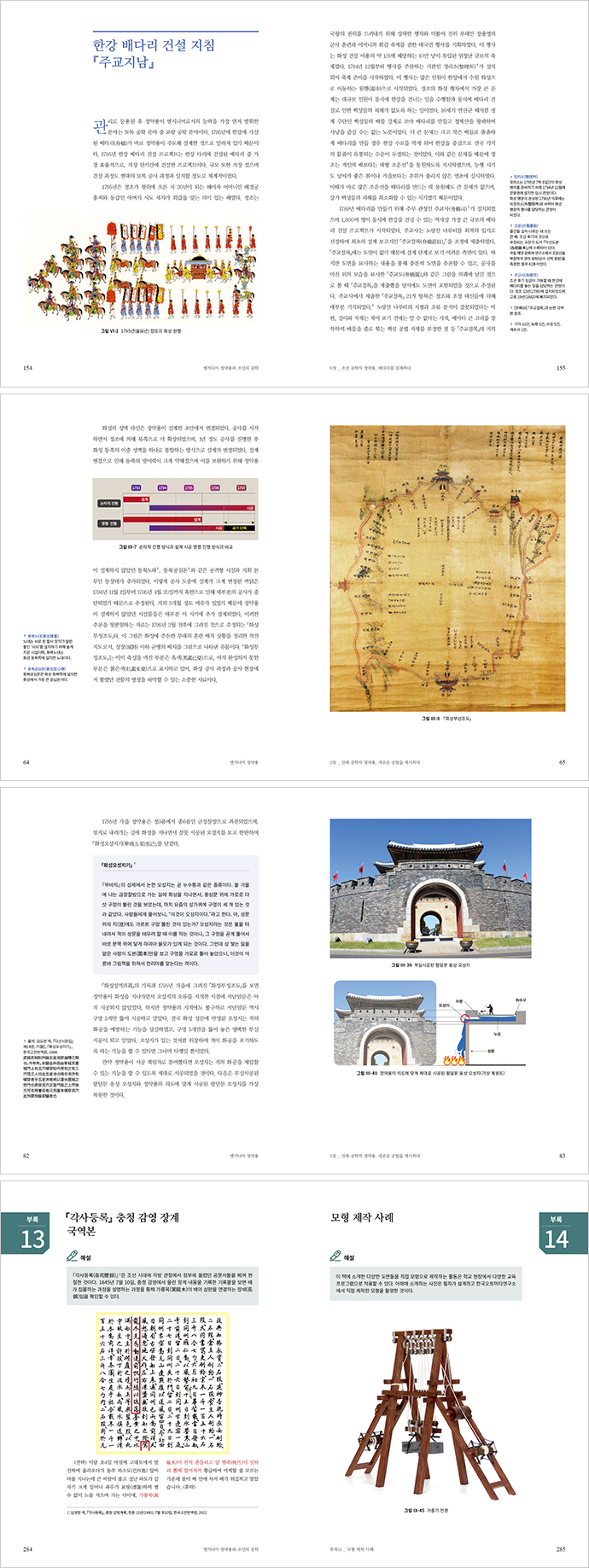
Additionally, to aid readers' understanding, over 200 image materials, including infographics, illustrations, and photos of artifacts, have been included.
The book includes a modern user manual that explains how to load stones onto a cart using a crane, how to load stones onto a shovel, and how to transport them. The author also created models of the cranes, wheelbarrows, and pontoon bridges introduced in the book and included them at the end of the book.
This book thoroughly analyzes and explains Jeong Yak-yong's achievements using modern engineering principles, and corrects previously incorrectly inferred aspects of Jeong Yak-yong's engineering achievements based on records rather than imagination.
"Engineer Jeong Yak-yong" is filled with clear explanations that even readers encountering Jeong Yak-yong for the first time as an engineer can easily understand. It will not only be the easiest guide to understanding Jeong Yak-yong, Joseon's greatest engineer, but also the most suitable text for fostering creative and convergent talent in today's era.
Meet Jeong Yak-yong, a pioneer of modern engineering in Joseon.
To mark the 250th anniversary of Jeong Yak-yong's birth, UNESCO selected him as Person of the Year, along with Hermann Hesse and Jean-Jacques Rousseau.
This is the first time a Korean figure has been selected.
Prior to this, Hwaseong Fortress in Suwon, designed by Jeong Yak-yong, was designated as a UNESCO World Heritage Site.
Although Jeong Yak-yong is a world-renowned thinker and practitioner, we tend to view him as simply the greatest Silhak scholar of the late Joseon Dynasty.
This is because in elementary, middle, and high schools, his over 500 books are studied more importantly than his engineering achievements.
Professor Kim Pyeong-won, the author of this book, says that it is appropriate to view engineer as Jeong Yak-yong's occupation, as he displayed exceptional talent during his youth as a government official.
Appointed to a government post at the age of 28, Jeong Yak-yong was recognized by King Jeongjo for his ability in solving problems in the construction of the Han River bridge. This led to his designing the new city of Suwon Hwaseong, and he invented various construction machines such as the crane and the potter's wheel.
The numerous writings he left behind were his achievements after he was exiled.
So, should we view Jeong Yak-yong as a scholar who brought Silhak to its zenith, or as an engineer?
This book boldly breaks away from the limited view of Jeong Yak-yong as a scholar who brought Silhak to fruition, and reexamines him as a Joseon engineer, sharply pointing out the movements of modern engineering that were emerging during Jeong Yak-yong's time.
At a time when the convergence of humanities and engineering is more important than ever, this book, which freely crosses history and engineering to highlight Jeong Yak-yong's engineering achievements, will allow readers to encounter Jeong Yak-yong, Joseon's greatest convergence-minded engineer, recognized worldwide.
Jeong Yak-yong, civil, urban, architectural, mechanical, automobile, and shipbuilding engineer
Engineering that was burgeoning in Joseon in the late 18th century
This book divides Jeong Yak-yong's engineering achievements into six fields and reexamines him as an engineer based on a vast amount of historical materials, from the "Self-Chan Epitaph" to the "Annals of the Joseon Dynasty."
The first achievement in which Jeong Yak-yong demonstrated his skills as an engineer was not the design of Suwon Hwaseong Fortress or the invention of the crane, but the construction project for the Han River Bridge in 1795.
1795 was a significant year, marking the 20th anniversary of King Jeongjo's accession to the throne and the 60th birthday of Lady Hyegyeong Hong, and a large-scale event was planned to celebrate this.
The event began as a long journey for many people from Hanyang to Hwaseong in Suwon, and the major challenge was finding a way to build a bridge that could carry 1,000 people at a time.
The person who solved this problem was engineer Jeong Yak-yong.
Jeong Yak-yong designed a 340-meter-long pontoon bridge using 36 ships, and then distributed the weight of the upper part in a similar arrangement to a modern arch bridge, and proposed the pontoon method of the Gunsan Bujan Bridge, which was installed during the Japanese colonial period, to prevent the dock from collapsing due to changes in water level.
Through this, we can see not only Jeong Yak-yong's engineering thinking that was ahead of its time, but also his side as a civil engineer who designed the upper structure of the Han River bridge to allow large numbers of people to cross the bridge at the same time.
In addition, this book defines Jeong Yak-yong as an urban engineer and architectural engineer in that he designed the new city of Hwaseong; a mechanical engineer in that he improved and invented the crane and the potter's wheel, which were necessary equipment for the construction of Hwaseong; an automobile engineer in that he invented a special transport vehicle type that could control the vehicle's shock absorber with human power; and a shipbuilding engineer in that he systematically quantified the buoyancy of a ship and designed the lower structure of a pontoon bridge. This is proven with solid logic.
The author is not satisfied with evaluating Jeong Yak-yong as a modern engineer.
Furthermore, by noting that in 18th-century Joseon, when Jeong Yak-yong was active, a group of engineers and an engineering education system were developing spontaneously, similar to those in Europe during the same period, the discussion concludes by borrowing the logic of endogenous development theory to present the 'engineering budding theory.'
Helping you understand with over 200 images
A professor's 17-year research on convergence knowledge
The author of this book, Professor Kim Pyeong-won, has been striving for 17 years to create customized knowledge for language skills education by integrating science, technology, engineering, art, literature, and philosophy, based on the belief that knowledge that combines various fields is the most effective for language skills education.
This book is an excerpt of Jeong Yak-yong's achievements in the field of engineering, among the convergence knowledge that the author applied to frontline educational sites through integrated curriculum writing and Korean-style convergence project education activities from 2001 to 2017. Some of the content is an easy-to-understand revision of the author's papers published in the professional academic journals Dasanhak and the Journal of the Korean Society for the History of Science.
Additionally, to aid readers' understanding, over 200 image materials, including infographics, illustrations, and photos of artifacts, have been included.
The book includes a modern user manual that explains how to load stones onto a cart using a crane, how to load stones onto a shovel, and how to transport them. The author also created models of the cranes, wheelbarrows, and pontoon bridges introduced in the book and included them at the end of the book.
This book thoroughly analyzes and explains Jeong Yak-yong's achievements using modern engineering principles, and corrects previously incorrectly inferred aspects of Jeong Yak-yong's engineering achievements based on records rather than imagination.
"Engineer Jeong Yak-yong" is filled with clear explanations that even readers encountering Jeong Yak-yong for the first time as an engineer can easily understand. It will not only be the easiest guide to understanding Jeong Yak-yong, Joseon's greatest engineer, but also the most suitable text for fostering creative and convergent talent in today's era.
GOODS SPECIFICS
- Date of publication: August 28, 2017
- Page count, weight, size: 316 pages | 690g | 190*250*23mm
- ISBN13: 9791130614113
- ISBN10: 1130614115
You may also like
카테고리
korean


korean

![GQ KOREA Mark (Monthly): December [2025]](http://librairie.coreenne.fr/cdn/shop/files/8ef265dbbfbf186523ed75ba7319009d.jpg?v=1765340328&width=3840)


