

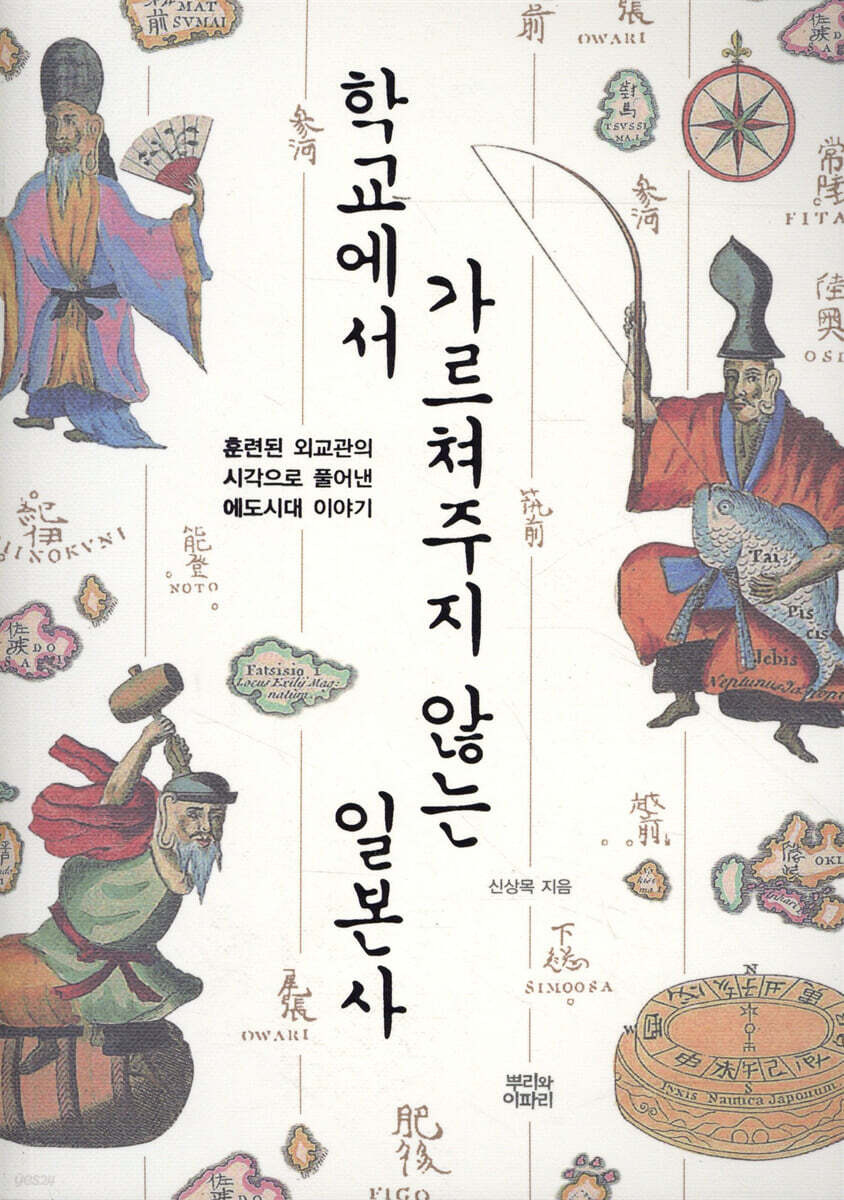
Japanese history not taught in school
 |
Description
Book Introduction
What made Japan a model student of modernization?
The Edo period, a time of 'accumulation' and 'bridging' that Koreans were unaware of.
Through an analysis of Japan's 'Edo period', which determined the fate of the modernization path of the three East Asian countries,
Asking for a new path for history in the 21st century!
Every time we celebrate Liberation Day on August 15th, we reflect on the meaning of liberation, when we regained our light after being freed from Japan's brutal invasion and exploitation, and we elevate our anti-Japanese nationalism.
But we rarely face our own internal problems.
What kind of society was Joseon, and why did it become a colony? During the period of Western expansion and Eastward Progress in the late 19th century, facing the test of establishing a modern nation, Japan was considered a top performer, China a bottom performer, and Joseon a failing student. What accounted for these differences?
Could it be that we are suffering from historical trauma regarding Japan, a barbaric nation that wore loincloths and carried swords, yet repaid our kindness with enmity, despite having bestowed it upon us since ancient times? Indeed, we haven't given much thought to the reason why, among the three East Asian nations of China, Korea, and Japan, Japan alone has pursued a different path since the mid-19th century.
The Japan of the Edo period, which appears in Korean history textbooks, is a country on the periphery of civilization that learned advanced civilization by learning from potters kidnapped during the Imjin War and from Joseon Tongsinsa.
However, it is certain that Korea is the only country that views Japan's 260 years of modern history in that way.
As of 2017, Japan has produced a total of 25 Nobel Prize winners.
In Korea, people point to the Meiji Restoration every time, and envy the modernization process that followed.
When I come across such analysis, I can't help but ask again:
Was it truly those 100 years that created Japan's strength? Was it truly possible to accumulate such national capabilities in just 100 years? This book is a record of a journey that begins with these questions and continues to find answers.
The final destination of such a journey is the ‘rediscovery of modern Japan.’
The Edo period, a time of 'accumulation' and 'bridging' that Koreans were unaware of.
Through an analysis of Japan's 'Edo period', which determined the fate of the modernization path of the three East Asian countries,
Asking for a new path for history in the 21st century!
Every time we celebrate Liberation Day on August 15th, we reflect on the meaning of liberation, when we regained our light after being freed from Japan's brutal invasion and exploitation, and we elevate our anti-Japanese nationalism.
But we rarely face our own internal problems.
What kind of society was Joseon, and why did it become a colony? During the period of Western expansion and Eastward Progress in the late 19th century, facing the test of establishing a modern nation, Japan was considered a top performer, China a bottom performer, and Joseon a failing student. What accounted for these differences?
Could it be that we are suffering from historical trauma regarding Japan, a barbaric nation that wore loincloths and carried swords, yet repaid our kindness with enmity, despite having bestowed it upon us since ancient times? Indeed, we haven't given much thought to the reason why, among the three East Asian nations of China, Korea, and Japan, Japan alone has pursued a different path since the mid-19th century.
The Japan of the Edo period, which appears in Korean history textbooks, is a country on the periphery of civilization that learned advanced civilization by learning from potters kidnapped during the Imjin War and from Joseon Tongsinsa.
However, it is certain that Korea is the only country that views Japan's 260 years of modern history in that way.
As of 2017, Japan has produced a total of 25 Nobel Prize winners.
In Korea, people point to the Meiji Restoration every time, and envy the modernization process that followed.
When I come across such analysis, I can't help but ask again:
Was it truly those 100 years that created Japan's strength? Was it truly possible to accumulate such national capabilities in just 100 years? This book is a record of a journey that begins with these questions and continues to find answers.
The final destination of such a journey is the ‘rediscovery of modern Japan.’
- You can preview some of the book's contents.
Preview
index
prolog
Chapter 1: The Meaning of a 200-Year-Old Soba Restaurant in the Heart of Edo
Chapter 2: The Coincidence That Changed History (1): The Birth of Edo
Beginning in the Wild Plains | He who controls water controls the world | Building infrastructure by extracting the backbone of the daimyo
Chapter 3: The Coincidence That Changed History (2): The Alternation of the Cham-Gun
A Prelude to Modernization: The Cham-Gun-Yodae System | A Trickle-Down Effect | Money Circulates and Cities Develop | The Commoners Emerge as a New Powerhouse | The Establishment of a National Network
Chapter 4: Modern Japanese Political Economy through the Lens of "Miso"
Miso Becomes a Strategic Good | Sendai Miso Embraces the Dream of a Rich and Strong Nation | Penetrating the Edo Market with Quality and Trust | Where Will Miso Become the Number One in a New Era? | A Miso Culture Blossomed Through Competition and Autonomy
Chapter 5: A Travel Paradise: The Era of Tourism
A once-in-a-lifetime pilgrimage to Ise... … | All roads lead to Edo | The popularization of travel: long-term tours, lectures, ryokans, and brothels | The birth of "Gwangwang," a style ahead of its time
Chapter 6: Keywords for the Prosperity of Publishing Culture: Pornography, Copyright, and Rentals
The Beginning of the Publishing Revolution: Pornography | The Emergence of a Super Bestseller That Captured the Era | The Perfection of Confucian Ideals: 『Gyeongjeon Yeosa』 | The Birth of the Japanese Copyright, "Publication Rights" | The Emergence of "Daebongup" and the Sharing Economy | Cultural Prosperity is a Synonym for Market Activation
Chapter 7: The Power of Education: Schools, Terakoya, and Juku
The core of public education: the hanko (feudal school) | The three major educational institutions directly controlled by the shogunate, leading to the University of Tokyo | Terakoya, the center of education for the common people | Juku (school), the birthplace of new intellectuals
Chapter 8: The Prototypes of News and Advertising Flyers: "Yomiuri" and "Hikifuda"
The Yomiuri, a newspaper from the Edo period | Hikifuda, the pioneer of advertising papers
Chapter 9: The New Book of Disassembly, which opened the door to scientific thinking
Western anatomy takes the Japanese intellectual world by storm | Japan's first full-scale translation of "Kaiteishinshō" | Hanaoka Seishū's world-first general anesthesia surgery | Hoshino sets out to create a human skeleton
Chapter 10: Inozu, a Map Ahead of Its Time
Ino, a surveying enthusiast, begins studying astronomy after retirement | Ino's walk to Ezochi | Ten surveying trips over 17 years | Ino's secret to accuracy
Chapter 11: Creating a Conduit for Western Civilization and Language through Dictionaries
The Challenge of Creating 1 from 0 | The Treasure of Japanese Rangaku Scholars, "Dufuharuma" | Japan's First English-Japanese Dictionary | A Linguistic Pathway That Promoted Modernization
Chapter 12: The Power of a Consumption-Driven Economy: The Textile Revolution
Early Modern East Asian Trade | The Spread of Cotton and the Embryos of Capitalism | The Expansion of New Markets in Edo, the Urban Center
Chapter 13: The Evolution of Urban Culture: Fashion Trends and the "Iki" Culture
The cultural evolution of regulation and interference | The aesthetic of 'Iki': Pursuing simple sophistication
Chapter 14: From Culture to Industry: The Birth of a Ceramics Powerhouse
The Tea Ceremony Trend and the Ceramics Wars | The God of Ceramics, Lee Sam-pyeong | The Evolution of Arita Ware | From High-End to Popular Porcelain
Chapter 15: The Development of the Ceramic Industry: "Patronage of the Arts" and Fierce Competition
Opening up markets through world expositions | Exploring overseas markets through a public-private-academic joint system | While Joseon's ceramics stagnated...
Chapter 16: Portrait of an Edo Intellectual: As Times Change, So Does Knowledge
The Teachings of Confucius: Finding the Way of Confucius | Ishida Baigan, Illuminating the Path of Merchants | Open Your Heart and See the World
Chapter 17: The Long-Awaited Currency Unification: The Three Harmonies and Currency Reform
Gold, silver, and copper coins become standard currency | Currency reform takes a hit
Chapter 18: The "Money Trap" and the Limitations of the Shogunate System
The Dual Currency Circulation Structure and the Ryogaesho | The Contradiction of a Currency-Based Economy and a Rice-Based Economy | The Contradiction of the Coexistence of Central and Local Currencies
Epilogue
Source of the illustration
Chapter 1: The Meaning of a 200-Year-Old Soba Restaurant in the Heart of Edo
Chapter 2: The Coincidence That Changed History (1): The Birth of Edo
Beginning in the Wild Plains | He who controls water controls the world | Building infrastructure by extracting the backbone of the daimyo
Chapter 3: The Coincidence That Changed History (2): The Alternation of the Cham-Gun
A Prelude to Modernization: The Cham-Gun-Yodae System | A Trickle-Down Effect | Money Circulates and Cities Develop | The Commoners Emerge as a New Powerhouse | The Establishment of a National Network
Chapter 4: Modern Japanese Political Economy through the Lens of "Miso"
Miso Becomes a Strategic Good | Sendai Miso Embraces the Dream of a Rich and Strong Nation | Penetrating the Edo Market with Quality and Trust | Where Will Miso Become the Number One in a New Era? | A Miso Culture Blossomed Through Competition and Autonomy
Chapter 5: A Travel Paradise: The Era of Tourism
A once-in-a-lifetime pilgrimage to Ise... … | All roads lead to Edo | The popularization of travel: long-term tours, lectures, ryokans, and brothels | The birth of "Gwangwang," a style ahead of its time
Chapter 6: Keywords for the Prosperity of Publishing Culture: Pornography, Copyright, and Rentals
The Beginning of the Publishing Revolution: Pornography | The Emergence of a Super Bestseller That Captured the Era | The Perfection of Confucian Ideals: 『Gyeongjeon Yeosa』 | The Birth of the Japanese Copyright, "Publication Rights" | The Emergence of "Daebongup" and the Sharing Economy | Cultural Prosperity is a Synonym for Market Activation
Chapter 7: The Power of Education: Schools, Terakoya, and Juku
The core of public education: the hanko (feudal school) | The three major educational institutions directly controlled by the shogunate, leading to the University of Tokyo | Terakoya, the center of education for the common people | Juku (school), the birthplace of new intellectuals
Chapter 8: The Prototypes of News and Advertising Flyers: "Yomiuri" and "Hikifuda"
The Yomiuri, a newspaper from the Edo period | Hikifuda, the pioneer of advertising papers
Chapter 9: The New Book of Disassembly, which opened the door to scientific thinking
Western anatomy takes the Japanese intellectual world by storm | Japan's first full-scale translation of "Kaiteishinshō" | Hanaoka Seishū's world-first general anesthesia surgery | Hoshino sets out to create a human skeleton
Chapter 10: Inozu, a Map Ahead of Its Time
Ino, a surveying enthusiast, begins studying astronomy after retirement | Ino's walk to Ezochi | Ten surveying trips over 17 years | Ino's secret to accuracy
Chapter 11: Creating a Conduit for Western Civilization and Language through Dictionaries
The Challenge of Creating 1 from 0 | The Treasure of Japanese Rangaku Scholars, "Dufuharuma" | Japan's First English-Japanese Dictionary | A Linguistic Pathway That Promoted Modernization
Chapter 12: The Power of a Consumption-Driven Economy: The Textile Revolution
Early Modern East Asian Trade | The Spread of Cotton and the Embryos of Capitalism | The Expansion of New Markets in Edo, the Urban Center
Chapter 13: The Evolution of Urban Culture: Fashion Trends and the "Iki" Culture
The cultural evolution of regulation and interference | The aesthetic of 'Iki': Pursuing simple sophistication
Chapter 14: From Culture to Industry: The Birth of a Ceramics Powerhouse
The Tea Ceremony Trend and the Ceramics Wars | The God of Ceramics, Lee Sam-pyeong | The Evolution of Arita Ware | From High-End to Popular Porcelain
Chapter 15: The Development of the Ceramic Industry: "Patronage of the Arts" and Fierce Competition
Opening up markets through world expositions | Exploring overseas markets through a public-private-academic joint system | While Joseon's ceramics stagnated...
Chapter 16: Portrait of an Edo Intellectual: As Times Change, So Does Knowledge
The Teachings of Confucius: Finding the Way of Confucius | Ishida Baigan, Illuminating the Path of Merchants | Open Your Heart and See the World
Chapter 17: The Long-Awaited Currency Unification: The Three Harmonies and Currency Reform
Gold, silver, and copper coins become standard currency | Currency reform takes a hit
Chapter 18: The "Money Trap" and the Limitations of the Shogunate System
The Dual Currency Circulation Structure and the Ryogaesho | The Contradiction of a Currency-Based Economy and a Rice-Based Economy | The Contradiction of the Coexistence of Central and Local Currencies
Epilogue
Source of the illustration
Into the book
Ieyasu was a creative thinker who found opportunity in every moment of crisis.
This time, his wit comes into play again.
Rather than going inland to secure land, they decided to fill in the sea and create land.
The site targeted for reclamation was 'Hibiya Irie'.
The Hibiya area near the Imperial Palace, now the center of Tokyo, was originally not land but the sea corresponding to the river mouth, as can be seen from the name "Irukou."
Ieyasu filled in the sea and created land by digging up the soil and sand from Mount Kanda, located to the north of the castle.
All the dirt that came out while digging the downtown canal
I poured it out.
It was the so-called 'stone-piercing construction' that was completed quickly and without incident.
Tens of thousands of people carved mountains, transported dirt, filled in the sea, and compacted the ground to create a vast landfill half the size of Yeouido in just one year.
It is the area that stretches from the current Hibiya Park through Shinbashi to Hamacho.
It is surprising to learn that the area from City Hall to Yongsan in Seoul was reclaimed land during the reign of King Seonjo of the Joseon Dynasty.
(Pages 40-41)
There is a Roman proverb that says, 'Roads are made by the strong, broken by the weak.'
This means that a country with a well-organized system has a solid social infrastructure, while a country with a poor system has a low level of social infrastructure.
In Japan's unique political situation, where warriors competed based on their abilities, Tokugawa Ieyasu's decision to locate the shogunate in Edo, coupled with the Tenka Hōshō and the Sankin-Kōtai system, ushered in an innovative urban civilization.
This is the essence of the Edo period.
(Page 48)
First is the economic ripple effect.
Shift work requires a huge amount of money.
Large groups of people, from as few as 100 to as many as 500, traveled hundreds of kilometers, and the costs were entirely borne by the daimyo.
It was the price to pay for the right to collect taxes independently.
Because arriving even one day later than the agreed date would result in reprimands from the shogunate and huge losses in costs, each clan dispatched an advance party in advance and meticulously planned its schedule. In addition, if the road conditions were poor, they had to pay for road repairs themselves, putting on a tremendous psychological and economic burden.
If we assume that the cost of food and lodging per person in modern currency for actual travel is approximately 6,000 yen per day, the average cost for a one-way trip is approximately 300 to 400 million yen.
There were about 270 such daimyo families scattered throughout the country, so in today's money, it would amount to trillions of won being thrown around on the streets every year.
Adding to this the enormous cost of staying in Edo, which was incomparably greater than travel expenses, the cost of sankin kōtai was a staggering sum, exceeding half of the daimyo's tax revenue. (p. 53)
The greatest byproduct of the Sankin-kyōtai was the remarkable development of Edo.
The socioeconomic impact of having the highest elite groups from both the central and local governments reside in one city called Edo was truly enormous.
As hundreds of thousands of daimyo and their retinues flowed in as "pure consumers," a huge consumer market was formed in Edo.
Civil engineering, construction, and architecture for their mansions, their attendant lodgings, and public infrastructure; restaurants, crafts, and transportation for the daimyo's public and private social life; textile and clothing industries in line with the then-popular "ikisu" clothing culture; various publishing, performance, and entertainment industries for the cultural life of the masses; commercial activities in various fields reminiscent of a modern city were actively carried out.
(Pages 55-56)
Even in Europe, which had become aware of the modern era, the popularization of travel among the common people was a phenomenon that began after the 19th century.
Only after the railway network was developed did the socio-cultural phenomenon of people leaving their homes and traveling to other regions begin to spread.
Japan, uniquely, has seen a significant level of popularization of travel among the general public since the mid-Edo period.
Compared to the West, it is a full 100 years ahead.
The travel ecosystem, established within a unique religious, social, and cultural environment since the early modern period, has had a significant impact on Japan's modernization.
Travel essentially means the movement and exchange of people, and this has a much greater ripple effect than the movement of goods in terms of the distribution of information.
For travel to become popular, material and social conditions must be met.
There must be a transportation network, accommodations, public safety, desired landmarks and attractions, entertainment or pleasure facilities, and above all, free time away from work and freedom of movement, even if only temporarily, must be permitted.
Japan, uniquely, despite being a pre-modern society, has met the conditions for popularizing travel and removed restrictions.
By the mid-18th century, Japan was already the world's leading travel paradise, with over a million travelers traveling throughout the country annually (pp. 73-74).
Until the 16th century, Japan's publishing culture lagged behind that of Europe, China, and even Joseon.
But when the era of war ends and the era of peace arrives, the situation is reversed.
Since the 17th century, Japan's publishing culture has grown at an incredible pace.
By the mid-17th century, there were about 200 publishers competing, by the mid-18th century, about 1,000 new books were pouring into bookstores each year, and by the 19th century, the country had become a "publishing powerhouse" where almost all citizens used books as an essential part of their daily lives.
How was such a miraculous transformation possible in a pre-modern society? The secret lies in pornography, copyright, and the rental business.
(Page 89)
As the concept of 'books', previously considered rigid and boring, changed into an entertainment product, the commercial publishing market grew at a frightening rate thanks to developed commercial capital and distribution networks.
By the end of the 18th century, publishers had gathered in Edo, the political and economic center of a city with a population of one million, and the era of full-scale commercial publishing blossomed, with hundreds of new books being published annually.
As books such as the Kusajoshi and ukiyo-e, as well as the full-fledged monogatari "Yomihon" gained great popularity, Edo surpassed Kyoto to become the leading publishing market.
In the Edo publishing market, various genres such as entertainment, practical books, and travel guidebooks were pioneered, and a business ecosystem reminiscent of the modern publishing market was established, with "full-time writers" emerging as professions who specialized in reporting, writing, and drawing upon the commission of publishers.
(Pages 94-95)
One thing to note about the education system of the Edo period is that it was not public education for the ruling class, but rather private education for the common people.
A characteristic of education that permeates the Edo period is the social consensus that common people, as members of society, have knowledge and culture that they must acquire in order to maintain and develop a healthy society.
Accordingly, practical education necessary for daily life, public service education necessary for professional life, and moral education necessary for communal life were emphasized as the central contents of education for the common people.
Although there was a limitation in that it could not go beyond the framework of the caste system, the prevailing perception that all members of society needed basic education to lead a communal life was a developed view of education for a pre-modern society.
(Page 111)
The publication of the 『Kaetei Shinsho』 in 1774 was a major event in Japanese intellectual society.
Until then, Western civilization had only been accessible in the form of objects or fragments of content could be grasped through conversation, and Western 'books' were nothing more than a pie in the sky.
Books, which are supposed to be treasure troves of knowledge, were of little help in absorbing knowledge, as they could only be guessed at through pictures or a few familiar words.
In such a situation, when 『Haeche Shinseo』 was published, a desire for ‘translation’ to use the book as a tool for conveying knowledge arose among Dutch scholars.
In fact, I had known from before that if I could only understand the meaning of the crooked letters written in Western books, I could make all that knowledge my own.
Nevertheless, the reason there was no translation before 『Haeche Shinseo』 was because there was no ‘dictionary.’
(Page 153)
Comparing the shogunate's ban on luxury goods with Joseon's ban on luxury goods around the same time provides interesting insights.
Joseon, which was strongly influenced by Confucianism, also issued a ban on extravagance and regulated extravagant clothing.
As the consumption of dyed fabrics increases, the cultivation of cash crops, which are the raw material for dyes, increases, which affects the cultivation of food crops such as rice.
The frequent occurrence of famine and crop failures during the modern period, corresponding to the Little Ice Age, also influenced the clothing regulations of the two countries' governments.
Although it was the same regulation, the sumptuary edict had a greater impact on Japanese society than on Joseon society.
This is because Koreans had no problem wearing white clothes by bleaching and discoloring cotton cloth without dyeing it at all, regardless of clothing color regulations.
The government regulated white clothing, saying that it was against etiquette to wear white clothing, which was only worn as mourning clothes, on a daily basis. However, as time passed, white clothing became more and more preferred by both nobles and commoners, and became the standard for everyday clothing.
The preference for white clothing caused Joseon's dyeing technology to remain stagnant.
The dyed cloth market was not properly formed, and the technicians were subordinate to the government, limiting their technical and artistic autonomy.
(Pages 184-185)
The giant vase, measuring two meters in length, displayed at the Japanese pavilion was a surprise that even Westerners had never seen before.
Arita porcelain, which surpasses ceramics from other countries in size and catches two birds with one stone in terms of artistry and topicality, received rave reviews from visitors and quickly became the most popular exhibit at the Japan Pavilion.
At the time, the World's Fair was an enormous international event that cannot be compared to its status today.
The Vienna World Fair, held under the theme of 'Education and Culture', attracted millions of European visitors, and Japanese paintings and crafts, including Arita ware, left a strong impression on the minds of the visitors.
As Arita ware was a hot topic throughout the exhibition, it also achieved great commercial success.
The teacups, plates, and other small items prepared by the participating group sold out like hotcakes at the event, and additional orders poured in from within Japan.
The value of Japanese porcelain exports, which was 45,000 yen in 1872, exploded by more than 2.5 times to 116,000 yen in 1873 when the Vienna World Fair was held.
Arita ware exhibited at the Vienna World Exposition had the power to drive all of Japan's ceramic exports.
(Page 207)
Edo-period Japanese society continued to face limitations that could no longer be addressed with existing knowledge and ideas due to the advancement of urbanization, capitalization, and marketization. In the process of intellectuals constantly pondering these limitations with a sense of mission for the times, a diverse and solid intellectual foundation was built.
The phenomenon of new knowledge being produced and consumed across social classes to respond to the changing times can be said to be the emergence of a kind of knowledge market.
The intellectual dynamism and diversity of modern Japan, which boasts a high level of science and technology, humanities, and social sciences and produces numerous Nobel Prize winners, can be seen as having its roots in the birth of the knowledge market in the Edo period, where knowledge was not monopolized but competed in the public sphere.
(Page 235)
This time, his wit comes into play again.
Rather than going inland to secure land, they decided to fill in the sea and create land.
The site targeted for reclamation was 'Hibiya Irie'.
The Hibiya area near the Imperial Palace, now the center of Tokyo, was originally not land but the sea corresponding to the river mouth, as can be seen from the name "Irukou."
Ieyasu filled in the sea and created land by digging up the soil and sand from Mount Kanda, located to the north of the castle.
All the dirt that came out while digging the downtown canal
I poured it out.
It was the so-called 'stone-piercing construction' that was completed quickly and without incident.
Tens of thousands of people carved mountains, transported dirt, filled in the sea, and compacted the ground to create a vast landfill half the size of Yeouido in just one year.
It is the area that stretches from the current Hibiya Park through Shinbashi to Hamacho.
It is surprising to learn that the area from City Hall to Yongsan in Seoul was reclaimed land during the reign of King Seonjo of the Joseon Dynasty.
(Pages 40-41)
There is a Roman proverb that says, 'Roads are made by the strong, broken by the weak.'
This means that a country with a well-organized system has a solid social infrastructure, while a country with a poor system has a low level of social infrastructure.
In Japan's unique political situation, where warriors competed based on their abilities, Tokugawa Ieyasu's decision to locate the shogunate in Edo, coupled with the Tenka Hōshō and the Sankin-Kōtai system, ushered in an innovative urban civilization.
This is the essence of the Edo period.
(Page 48)
First is the economic ripple effect.
Shift work requires a huge amount of money.
Large groups of people, from as few as 100 to as many as 500, traveled hundreds of kilometers, and the costs were entirely borne by the daimyo.
It was the price to pay for the right to collect taxes independently.
Because arriving even one day later than the agreed date would result in reprimands from the shogunate and huge losses in costs, each clan dispatched an advance party in advance and meticulously planned its schedule. In addition, if the road conditions were poor, they had to pay for road repairs themselves, putting on a tremendous psychological and economic burden.
If we assume that the cost of food and lodging per person in modern currency for actual travel is approximately 6,000 yen per day, the average cost for a one-way trip is approximately 300 to 400 million yen.
There were about 270 such daimyo families scattered throughout the country, so in today's money, it would amount to trillions of won being thrown around on the streets every year.
Adding to this the enormous cost of staying in Edo, which was incomparably greater than travel expenses, the cost of sankin kōtai was a staggering sum, exceeding half of the daimyo's tax revenue. (p. 53)
The greatest byproduct of the Sankin-kyōtai was the remarkable development of Edo.
The socioeconomic impact of having the highest elite groups from both the central and local governments reside in one city called Edo was truly enormous.
As hundreds of thousands of daimyo and their retinues flowed in as "pure consumers," a huge consumer market was formed in Edo.
Civil engineering, construction, and architecture for their mansions, their attendant lodgings, and public infrastructure; restaurants, crafts, and transportation for the daimyo's public and private social life; textile and clothing industries in line with the then-popular "ikisu" clothing culture; various publishing, performance, and entertainment industries for the cultural life of the masses; commercial activities in various fields reminiscent of a modern city were actively carried out.
(Pages 55-56)
Even in Europe, which had become aware of the modern era, the popularization of travel among the common people was a phenomenon that began after the 19th century.
Only after the railway network was developed did the socio-cultural phenomenon of people leaving their homes and traveling to other regions begin to spread.
Japan, uniquely, has seen a significant level of popularization of travel among the general public since the mid-Edo period.
Compared to the West, it is a full 100 years ahead.
The travel ecosystem, established within a unique religious, social, and cultural environment since the early modern period, has had a significant impact on Japan's modernization.
Travel essentially means the movement and exchange of people, and this has a much greater ripple effect than the movement of goods in terms of the distribution of information.
For travel to become popular, material and social conditions must be met.
There must be a transportation network, accommodations, public safety, desired landmarks and attractions, entertainment or pleasure facilities, and above all, free time away from work and freedom of movement, even if only temporarily, must be permitted.
Japan, uniquely, despite being a pre-modern society, has met the conditions for popularizing travel and removed restrictions.
By the mid-18th century, Japan was already the world's leading travel paradise, with over a million travelers traveling throughout the country annually (pp. 73-74).
Until the 16th century, Japan's publishing culture lagged behind that of Europe, China, and even Joseon.
But when the era of war ends and the era of peace arrives, the situation is reversed.
Since the 17th century, Japan's publishing culture has grown at an incredible pace.
By the mid-17th century, there were about 200 publishers competing, by the mid-18th century, about 1,000 new books were pouring into bookstores each year, and by the 19th century, the country had become a "publishing powerhouse" where almost all citizens used books as an essential part of their daily lives.
How was such a miraculous transformation possible in a pre-modern society? The secret lies in pornography, copyright, and the rental business.
(Page 89)
As the concept of 'books', previously considered rigid and boring, changed into an entertainment product, the commercial publishing market grew at a frightening rate thanks to developed commercial capital and distribution networks.
By the end of the 18th century, publishers had gathered in Edo, the political and economic center of a city with a population of one million, and the era of full-scale commercial publishing blossomed, with hundreds of new books being published annually.
As books such as the Kusajoshi and ukiyo-e, as well as the full-fledged monogatari "Yomihon" gained great popularity, Edo surpassed Kyoto to become the leading publishing market.
In the Edo publishing market, various genres such as entertainment, practical books, and travel guidebooks were pioneered, and a business ecosystem reminiscent of the modern publishing market was established, with "full-time writers" emerging as professions who specialized in reporting, writing, and drawing upon the commission of publishers.
(Pages 94-95)
One thing to note about the education system of the Edo period is that it was not public education for the ruling class, but rather private education for the common people.
A characteristic of education that permeates the Edo period is the social consensus that common people, as members of society, have knowledge and culture that they must acquire in order to maintain and develop a healthy society.
Accordingly, practical education necessary for daily life, public service education necessary for professional life, and moral education necessary for communal life were emphasized as the central contents of education for the common people.
Although there was a limitation in that it could not go beyond the framework of the caste system, the prevailing perception that all members of society needed basic education to lead a communal life was a developed view of education for a pre-modern society.
(Page 111)
The publication of the 『Kaetei Shinsho』 in 1774 was a major event in Japanese intellectual society.
Until then, Western civilization had only been accessible in the form of objects or fragments of content could be grasped through conversation, and Western 'books' were nothing more than a pie in the sky.
Books, which are supposed to be treasure troves of knowledge, were of little help in absorbing knowledge, as they could only be guessed at through pictures or a few familiar words.
In such a situation, when 『Haeche Shinseo』 was published, a desire for ‘translation’ to use the book as a tool for conveying knowledge arose among Dutch scholars.
In fact, I had known from before that if I could only understand the meaning of the crooked letters written in Western books, I could make all that knowledge my own.
Nevertheless, the reason there was no translation before 『Haeche Shinseo』 was because there was no ‘dictionary.’
(Page 153)
Comparing the shogunate's ban on luxury goods with Joseon's ban on luxury goods around the same time provides interesting insights.
Joseon, which was strongly influenced by Confucianism, also issued a ban on extravagance and regulated extravagant clothing.
As the consumption of dyed fabrics increases, the cultivation of cash crops, which are the raw material for dyes, increases, which affects the cultivation of food crops such as rice.
The frequent occurrence of famine and crop failures during the modern period, corresponding to the Little Ice Age, also influenced the clothing regulations of the two countries' governments.
Although it was the same regulation, the sumptuary edict had a greater impact on Japanese society than on Joseon society.
This is because Koreans had no problem wearing white clothes by bleaching and discoloring cotton cloth without dyeing it at all, regardless of clothing color regulations.
The government regulated white clothing, saying that it was against etiquette to wear white clothing, which was only worn as mourning clothes, on a daily basis. However, as time passed, white clothing became more and more preferred by both nobles and commoners, and became the standard for everyday clothing.
The preference for white clothing caused Joseon's dyeing technology to remain stagnant.
The dyed cloth market was not properly formed, and the technicians were subordinate to the government, limiting their technical and artistic autonomy.
(Pages 184-185)
The giant vase, measuring two meters in length, displayed at the Japanese pavilion was a surprise that even Westerners had never seen before.
Arita porcelain, which surpasses ceramics from other countries in size and catches two birds with one stone in terms of artistry and topicality, received rave reviews from visitors and quickly became the most popular exhibit at the Japan Pavilion.
At the time, the World's Fair was an enormous international event that cannot be compared to its status today.
The Vienna World Fair, held under the theme of 'Education and Culture', attracted millions of European visitors, and Japanese paintings and crafts, including Arita ware, left a strong impression on the minds of the visitors.
As Arita ware was a hot topic throughout the exhibition, it also achieved great commercial success.
The teacups, plates, and other small items prepared by the participating group sold out like hotcakes at the event, and additional orders poured in from within Japan.
The value of Japanese porcelain exports, which was 45,000 yen in 1872, exploded by more than 2.5 times to 116,000 yen in 1873 when the Vienna World Fair was held.
Arita ware exhibited at the Vienna World Exposition had the power to drive all of Japan's ceramic exports.
(Page 207)
Edo-period Japanese society continued to face limitations that could no longer be addressed with existing knowledge and ideas due to the advancement of urbanization, capitalization, and marketization. In the process of intellectuals constantly pondering these limitations with a sense of mission for the times, a diverse and solid intellectual foundation was built.
The phenomenon of new knowledge being produced and consumed across social classes to respond to the changing times can be said to be the emergence of a kind of knowledge market.
The intellectual dynamism and diversity of modern Japan, which boasts a high level of science and technology, humanities, and social sciences and produces numerous Nobel Prize winners, can be seen as having its roots in the birth of the knowledge market in the Edo period, where knowledge was not monopolized but competed in the public sphere.
(Page 235)
--- From the text
Publisher's Review
How was today's Japan created?
Edo was already the world's largest city in the mid-18th century, boasting a population of one million, a thriving commercial activity, and a robust urban infrastructure (at that time, comparable European cities included London with one million and Paris with 500,000).
There were only 20 cities in all of Europe with a population of over 100,000.
The first things Ieyasu did after moving to Edo were flood control projects, the opening of waterworks, and land reclamation work to create residential land.
(The reclaimed land that spans Shinbashi and Hamacho in the current Hibiya Park is equivalent to reclaiming the area from City Hall to Yongsan during the reign of King Seonjo of the Joseon Dynasty.) As the urban infrastructure expanded, industries that formed the basis of the local economy were encouraged, and human resources such as technicians, merchants, and scholars were expanded, the city of Edo was able to acquire infrastructure that was unrivaled compared to European countries at the same time.
Tokugawa Ieyasu's decision to locate the shogunate in Edo, coupled with the "Tenka Hosei" (the "regular shift system") and the "Sankin-Kotai" (the "alternate shift system"), marked the beginning of an innovative urban civilization.
Among them, the greatest by-product of the Sankin-kyōtai was the remarkable development of Edo.
As hundreds of thousands of daimyo and their retinues flowed in as "pure consumers," a huge consumer market was formed in Edo.
Civil engineering, construction, and architecture for their mansions, their attendant lodgings, and public infrastructure; restaurants, crafts, and transportation for the daimyo's public and private social life; textile and clothing industries in line with the then-popular "ikisu" clothing culture; various publishing, performance, and entertainment industries for the cultural life of the masses; all these were actively engaged in various commercial activities reminiscent of a modern city.
A Diplomat-turned-Udon Restaurant Owner Weaves Warp and Weft to Tell the Story of Edo
This book focuses on the Edo period as a "time of accumulation" and a "period of bridge building" that contributed to Japan's successful modernization.
The subject is to examine how the seeds of modernization were born and how the prerequisites were met during the Edo period.
In the process, he analyzes from his own perspective how the elements of modernity such as capital, market, competition, movement, integration, autonomy, and public, which lie beyond the simple appearance, have undergone ‘acceptance, transformation, and internalization.’
Such analysis was influenced by the author's perspective on Japan as a professional diplomat.
There is a saying in the world of diplomacy: “A competent diplomat should know a little bit about everything, and everything about one thing.”
This would emphasize the professional characteristics of a diplomat, who values a multifaceted interest and the ability to read the overall flow.
The comprehensive framework of understanding, which weaves together the comprehensive interrelationships of each field that constitutes a society in a diachronic and synchronic manner and constructs a framework of understanding within world-historical and regional coordinates, includes an approach from the history of life culture as an important element.
A significant portion of this book reflects an attempt to capture the various aspects of the Edo period as the prototype of modern Japan, based on this perspective of cultural history.
The emotional attitudes and lifestyles of the members formed at that time were quite solid and continued into modern Japanese society, forming the basis of "Japanese identity."
How can a soba restaurant open in the heart of the city? The trickle-down effect of the Sankin-Kyutai system, the political economics of miso, the country of travel paradise, the secrets of a thriving publishing culture, the world's first general anesthesia surgery, Inozu, a map ahead of its time, the power of translation, the revolutionary changes brought about by the Kaitai Shinsho, pottery and tea culture, and more. These are just a few of the many instrumental achievements and characteristics of the Edo period, which emerged as a process of moving away from abstract ideas and toward a world of practicality and empirical evidence.
Why did Korea fall behind Japan on the threshold of modernization?
Koreans' interest in Japanese history is focused on the heroic military stories of Japan's Sengoku period, represented by "Daemang" (Great Hope), and war stories from the Meiji Restoration, the Russo-Japanese War, and the Pacific War.
Koreans' knowledge of the Edo period, from the establishment of the Edo shogunate in the early 17th century to the Meiji Restoration in the mid-19th century, is the history of the triple minor league.
However, the Edo period was a time of transition and accumulation comparable to the Renaissance and Age of Exploration in the West.
Almost all the prerequisites that would determine the fate of the modernization paths of the three East Asian countries were decided during that period.
George Santayana said, “Those who cannot remember the past are condemned to repeat it.”
If we are to never forget the humiliation of having our country taken away by Japan, we must understand why it was taken away.
The theory of good and evil that Joseon was good and Japan was evil and took over the country is looking at only half of history.
No matter which historical perspective you choose, the undeniable fact is that at the dawn of the 20th century, Joseon was weak and Japan was strong.
Therefore, the question must begin with, 'Why was Japan strong and Joseon weak?'
Japan's modern history is a mirror of Joseon's modern history and two sides of the same coin.
When we look at Japan's modern history, we can clearly see Joseon's modern history.
This book was written to help Koreans, who have a painful history of losing their country to Japan, to increase interest in and understanding of modern Japan, a history that is most noteworthy but also the most 'unnoticed'.
This book argues that in order to find the roots of Korean modernization, it is necessary to seriously examine Japan's modern history.
Edo was already the world's largest city in the mid-18th century, boasting a population of one million, a thriving commercial activity, and a robust urban infrastructure (at that time, comparable European cities included London with one million and Paris with 500,000).
There were only 20 cities in all of Europe with a population of over 100,000.
The first things Ieyasu did after moving to Edo were flood control projects, the opening of waterworks, and land reclamation work to create residential land.
(The reclaimed land that spans Shinbashi and Hamacho in the current Hibiya Park is equivalent to reclaiming the area from City Hall to Yongsan during the reign of King Seonjo of the Joseon Dynasty.) As the urban infrastructure expanded, industries that formed the basis of the local economy were encouraged, and human resources such as technicians, merchants, and scholars were expanded, the city of Edo was able to acquire infrastructure that was unrivaled compared to European countries at the same time.
Tokugawa Ieyasu's decision to locate the shogunate in Edo, coupled with the "Tenka Hosei" (the "regular shift system") and the "Sankin-Kotai" (the "alternate shift system"), marked the beginning of an innovative urban civilization.
Among them, the greatest by-product of the Sankin-kyōtai was the remarkable development of Edo.
As hundreds of thousands of daimyo and their retinues flowed in as "pure consumers," a huge consumer market was formed in Edo.
Civil engineering, construction, and architecture for their mansions, their attendant lodgings, and public infrastructure; restaurants, crafts, and transportation for the daimyo's public and private social life; textile and clothing industries in line with the then-popular "ikisu" clothing culture; various publishing, performance, and entertainment industries for the cultural life of the masses; all these were actively engaged in various commercial activities reminiscent of a modern city.
A Diplomat-turned-Udon Restaurant Owner Weaves Warp and Weft to Tell the Story of Edo
This book focuses on the Edo period as a "time of accumulation" and a "period of bridge building" that contributed to Japan's successful modernization.
The subject is to examine how the seeds of modernization were born and how the prerequisites were met during the Edo period.
In the process, he analyzes from his own perspective how the elements of modernity such as capital, market, competition, movement, integration, autonomy, and public, which lie beyond the simple appearance, have undergone ‘acceptance, transformation, and internalization.’
Such analysis was influenced by the author's perspective on Japan as a professional diplomat.
There is a saying in the world of diplomacy: “A competent diplomat should know a little bit about everything, and everything about one thing.”
This would emphasize the professional characteristics of a diplomat, who values a multifaceted interest and the ability to read the overall flow.
The comprehensive framework of understanding, which weaves together the comprehensive interrelationships of each field that constitutes a society in a diachronic and synchronic manner and constructs a framework of understanding within world-historical and regional coordinates, includes an approach from the history of life culture as an important element.
A significant portion of this book reflects an attempt to capture the various aspects of the Edo period as the prototype of modern Japan, based on this perspective of cultural history.
The emotional attitudes and lifestyles of the members formed at that time were quite solid and continued into modern Japanese society, forming the basis of "Japanese identity."
How can a soba restaurant open in the heart of the city? The trickle-down effect of the Sankin-Kyutai system, the political economics of miso, the country of travel paradise, the secrets of a thriving publishing culture, the world's first general anesthesia surgery, Inozu, a map ahead of its time, the power of translation, the revolutionary changes brought about by the Kaitai Shinsho, pottery and tea culture, and more. These are just a few of the many instrumental achievements and characteristics of the Edo period, which emerged as a process of moving away from abstract ideas and toward a world of practicality and empirical evidence.
Why did Korea fall behind Japan on the threshold of modernization?
Koreans' interest in Japanese history is focused on the heroic military stories of Japan's Sengoku period, represented by "Daemang" (Great Hope), and war stories from the Meiji Restoration, the Russo-Japanese War, and the Pacific War.
Koreans' knowledge of the Edo period, from the establishment of the Edo shogunate in the early 17th century to the Meiji Restoration in the mid-19th century, is the history of the triple minor league.
However, the Edo period was a time of transition and accumulation comparable to the Renaissance and Age of Exploration in the West.
Almost all the prerequisites that would determine the fate of the modernization paths of the three East Asian countries were decided during that period.
George Santayana said, “Those who cannot remember the past are condemned to repeat it.”
If we are to never forget the humiliation of having our country taken away by Japan, we must understand why it was taken away.
The theory of good and evil that Joseon was good and Japan was evil and took over the country is looking at only half of history.
No matter which historical perspective you choose, the undeniable fact is that at the dawn of the 20th century, Joseon was weak and Japan was strong.
Therefore, the question must begin with, 'Why was Japan strong and Joseon weak?'
Japan's modern history is a mirror of Joseon's modern history and two sides of the same coin.
When we look at Japan's modern history, we can clearly see Joseon's modern history.
This book was written to help Koreans, who have a painful history of losing their country to Japan, to increase interest in and understanding of modern Japan, a history that is most noteworthy but also the most 'unnoticed'.
This book argues that in order to find the roots of Korean modernization, it is necessary to seriously examine Japan's modern history.
GOODS SPECIFICS
- Date of issue: August 7, 2017
- Page count, weight, size: 276 pages | 416g | 154*215*20mm
- ISBN13: 9788964620885
- ISBN10: 8964620887
You may also like
카테고리
korean


korean

![GQ KOREA Mark (Monthly): December [2025]](http://librairie.coreenne.fr/cdn/shop/files/8ef265dbbfbf186523ed75ba7319009d.jpg?v=1765340328&width=3840)


