

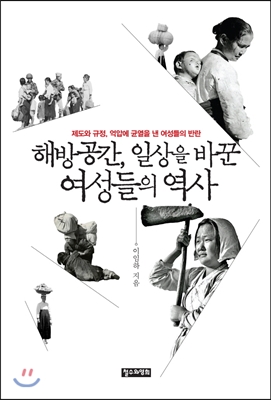
Liberation Space: The History of Women Who Changed Everyday Life
 |
Description
Book Introduction
A record of the "aspirations and small rebellions of daily life" of women in the liberated space.
This book is a record of 'Women's Aspirations and Small Rebellions in Daily Life in the Liberation Space' by historian Lee Im-ha, who has been deeply interested in the lives of women in modern Korean history, commemorating the 70th anniversary of liberation.
Although much research has been conducted on the liberation period, it has mainly focused on political history from a male perspective.
There has been little research on liberation spaces from a female perspective and with women as the subject.
Because the liberated space was viewed only from a male perspective, there were limitations in understanding the diverse lives of the people in the liberated space in a three-dimensional way.
The main topics of the liberation period were ‘elimination of the remnants of Japanese imperialism’ and ‘nation-building.’
The author wrote this book with the question in mind: How might women of the time have practiced this in their daily lives?
It covers the history of women, which was not given much attention during the US military government period after liberation, through various topics such as women as "female citizens," women as workers, women who took to the streets as political actors, and the creation of the Women's Bureau and Women's Police Stations in state institutions.
After liberation, women were in a dualistic and two-faced position.
The demands to "come out of the kitchen and start building a new country" and the limits of women's actions and activities were clearly defined, such as "you must not engage in excessive activities that go beyond your role as a woman."
However, women in the liberated space tried to change their daily lives by making small cracks in the demands of this society.
Today's Korean women have not been properly informed of the life experiences of women in the past.
Now it is difficult to find even a trace of it.
The lives of women who dreamed of a new life in the liberated space, defying discipline and regulations, are richly illustrated in this book, providing a glimpse into the lives of the people of the liberated space and providing a starting point for a more detailed look into the history of the liberated space.
This book is a record of 'Women's Aspirations and Small Rebellions in Daily Life in the Liberation Space' by historian Lee Im-ha, who has been deeply interested in the lives of women in modern Korean history, commemorating the 70th anniversary of liberation.
Although much research has been conducted on the liberation period, it has mainly focused on political history from a male perspective.
There has been little research on liberation spaces from a female perspective and with women as the subject.
Because the liberated space was viewed only from a male perspective, there were limitations in understanding the diverse lives of the people in the liberated space in a three-dimensional way.
The main topics of the liberation period were ‘elimination of the remnants of Japanese imperialism’ and ‘nation-building.’
The author wrote this book with the question in mind: How might women of the time have practiced this in their daily lives?
It covers the history of women, which was not given much attention during the US military government period after liberation, through various topics such as women as "female citizens," women as workers, women who took to the streets as political actors, and the creation of the Women's Bureau and Women's Police Stations in state institutions.
After liberation, women were in a dualistic and two-faced position.
The demands to "come out of the kitchen and start building a new country" and the limits of women's actions and activities were clearly defined, such as "you must not engage in excessive activities that go beyond your role as a woman."
However, women in the liberated space tried to change their daily lives by making small cracks in the demands of this society.
Today's Korean women have not been properly informed of the life experiences of women in the past.
Now it is difficult to find even a trace of it.
The lives of women who dreamed of a new life in the liberated space, defying discipline and regulations, are richly illustrated in this book, providing a glimpse into the lives of the people of the liberated space and providing a starting point for a more detailed look into the history of the liberated space.
- You can preview some of the book's contents.
Preview
index
Preface_I hope to be a salmon swimming against the current
Chapter 1.
Seocheon Flower Garden, Haebang Space
Dawn, the Streets of Seoul / Everyday Life and History / Discontinuity and Continuity / Female Subjects
Chapter 2.
The birth of the Republic of Korea, the first son of the UN
New Joseon construction and exclusion
Let's wipe out the national pride / Calling women as mothers and wives of Joseon / Changes in everyday life and women as citizens
Gendering of State Apparatus
Establishment of the Women's Affairs Bureau of the Ministry of Health and Welfare / Establishment of the Women's Police Station / Others within the national organization
Chapter 3.
Daily life and labor in the workplace
A time and space for reflection, strike
Strikes at the workplace / The eight-month-long Hwasin Department Store dispute / The origin of the struggle to go to Seoul, the Dongyang Textile Incheon factory / Korean capital, Gyeongseong Textile / The Central Department Store designated as a PX / Disputes at other workplaces
The everyday is political
Freedom of movement: Let me move freely between dorm rooms! / Physical violence: Beaten all night long! / Freedom to assemble and participate in demonstrations: Workers are thinking people too! / Reject the alienation and division of capital (managers)
Their voices in the workshop
"A herring costs 100 won" / Calling "young" female workers and industrial warriors / The voices of female workers
Chapter 4.
Sexuality and the 'Female Nation'
A national 'humiliation' incident or a 'too trivial' crime
Incident and Trial / Female Victims / Reactions and Discourse Surrounding the Incident
Ordinance No. 70 and Law No. 7 (Prohibition of Human Trafficking and Abolition of Public Prostitution)
Health checkups, management of the body by the state
Chapter 5.
Women taking to the streets
The founding convention of the Korean Women's Federation / The National Women's Representative Convention of the Patriotic Women's Association for the Acceleration of Independence / Commentary on the Women's Convention / Chronology of Women's Organizations and Activities / Gendering of the Movement
Conclusion: Liberation Space, Calling Women's Names
Chapter 1.
Seocheon Flower Garden, Haebang Space
Dawn, the Streets of Seoul / Everyday Life and History / Discontinuity and Continuity / Female Subjects
Chapter 2.
The birth of the Republic of Korea, the first son of the UN
New Joseon construction and exclusion
Let's wipe out the national pride / Calling women as mothers and wives of Joseon / Changes in everyday life and women as citizens
Gendering of State Apparatus
Establishment of the Women's Affairs Bureau of the Ministry of Health and Welfare / Establishment of the Women's Police Station / Others within the national organization
Chapter 3.
Daily life and labor in the workplace
A time and space for reflection, strike
Strikes at the workplace / The eight-month-long Hwasin Department Store dispute / The origin of the struggle to go to Seoul, the Dongyang Textile Incheon factory / Korean capital, Gyeongseong Textile / The Central Department Store designated as a PX / Disputes at other workplaces
The everyday is political
Freedom of movement: Let me move freely between dorm rooms! / Physical violence: Beaten all night long! / Freedom to assemble and participate in demonstrations: Workers are thinking people too! / Reject the alienation and division of capital (managers)
Their voices in the workshop
"A herring costs 100 won" / Calling "young" female workers and industrial warriors / The voices of female workers
Chapter 4.
Sexuality and the 'Female Nation'
A national 'humiliation' incident or a 'too trivial' crime
Incident and Trial / Female Victims / Reactions and Discourse Surrounding the Incident
Ordinance No. 70 and Law No. 7 (Prohibition of Human Trafficking and Abolition of Public Prostitution)
Health checkups, management of the body by the state
Chapter 5.
Women taking to the streets
The founding convention of the Korean Women's Federation / The National Women's Representative Convention of the Patriotic Women's Association for the Acceleration of Independence / Commentary on the Women's Convention / Chronology of Women's Organizations and Activities / Gendering of the Movement
Conclusion: Liberation Space, Calling Women's Names
Into the book
Chapter 1.
Seocheon Flower Garden, Haebang Space
Seoul in the post-liberation period was no different from any other city in terms of the stench it gave off.
However, the liberated Seoul was filled with people who dreamed of building a new nation and jumped into making that dream come true.
Those dreams were enough to sweep away the stench of Seoul.
That is also the meaning of liberated space.
This is why we must once again sing of the power of the liberated space of Seoul, not the stench of the city, and of the splendid and beautiful times of the liberated space.
So, I would like to talk about the liberated space where brilliant and beautiful dreams bloomed within the framework of everyday life, disconnection and continuity, and female subjectivity.
Chapter 2.
The birth of the Republic of Korea, the first son of the UN
In both 1945 and 1946, nation-building came first, and women were asked to step out of the kitchen for the sake of the nation and the people. They responded to this demand with words like sacrifice and patriotism.
However, in 1947 and 1948, criticism was leveled at women's social activities, with people asking, "How can women who don't even know how to cook participate in politics?"
As mentioned above, women who advocate for gender equality but neglect housework, that is, women who neglect their roles, actually undermine women's status.
Chapter 3.
Daily life and labor in the workplace
In 1945, a strike in the workplace shook the regulations and discipline of Japanese capital.
We must examine what aspects of daily life were changed by the strikes in the liberated workplaces that attempted to change the discipline imposed by Japanese capital.
And a large part of this movement was in workplaces where the majority of workers were women.
Chapter 4.
Sexuality and the 'Female Nation'
On March 16, 1946, 800 gisaengs belonging to the four major districts in Seoul received a notice from the Gyeonggi Provincial Government Quarantine Department that they would be conducting regular physical examinations once a month. They resolved that “this is an insult to Korean gisaengs, and we will never comply with the authorities’ notice, even if it means closing down all 800 gisaengs.”
Chapter 5.
Women taking to the streets
"Hye-ran's Diary" describes the joy of liberation that came suddenly.
Female workers also shed “tears of joy for liberation on August 15th… thousands of them marched through the streets under the guidance of the factory, shouting ‘Long Live the Independence of Korea.’”
For women, too, the street of liberation was a street of politics, a street of excitement, and a place where they were reborn as subjects of action.
Women joined street politics by organizing various groups.
Seocheon Flower Garden, Haebang Space
Seoul in the post-liberation period was no different from any other city in terms of the stench it gave off.
However, the liberated Seoul was filled with people who dreamed of building a new nation and jumped into making that dream come true.
Those dreams were enough to sweep away the stench of Seoul.
That is also the meaning of liberated space.
This is why we must once again sing of the power of the liberated space of Seoul, not the stench of the city, and of the splendid and beautiful times of the liberated space.
So, I would like to talk about the liberated space where brilliant and beautiful dreams bloomed within the framework of everyday life, disconnection and continuity, and female subjectivity.
Chapter 2.
The birth of the Republic of Korea, the first son of the UN
In both 1945 and 1946, nation-building came first, and women were asked to step out of the kitchen for the sake of the nation and the people. They responded to this demand with words like sacrifice and patriotism.
However, in 1947 and 1948, criticism was leveled at women's social activities, with people asking, "How can women who don't even know how to cook participate in politics?"
As mentioned above, women who advocate for gender equality but neglect housework, that is, women who neglect their roles, actually undermine women's status.
Chapter 3.
Daily life and labor in the workplace
In 1945, a strike in the workplace shook the regulations and discipline of Japanese capital.
We must examine what aspects of daily life were changed by the strikes in the liberated workplaces that attempted to change the discipline imposed by Japanese capital.
And a large part of this movement was in workplaces where the majority of workers were women.
Chapter 4.
Sexuality and the 'Female Nation'
On March 16, 1946, 800 gisaengs belonging to the four major districts in Seoul received a notice from the Gyeonggi Provincial Government Quarantine Department that they would be conducting regular physical examinations once a month. They resolved that “this is an insult to Korean gisaengs, and we will never comply with the authorities’ notice, even if it means closing down all 800 gisaengs.”
Chapter 5.
Women taking to the streets
"Hye-ran's Diary" describes the joy of liberation that came suddenly.
Female workers also shed “tears of joy for liberation on August 15th… thousands of them marched through the streets under the guidance of the factory, shouting ‘Long Live the Independence of Korea.’”
For women, too, the street of liberation was a street of politics, a street of excitement, and a place where they were reborn as subjects of action.
Women joined street politics by organizing various groups.
--- From the text
Publisher's Review
Liberation Space, Calling Women's Names
Women in the liberated space, who were just beginning to live their daily lives after the Japanese colonial period, spoke out in various situations and conditions.
It wasn't just the voices of female intellectuals or women's groups that resonated.
Not only female workers, but also poor, lower-class women, as protagonists of history during the period of new national construction, sought to change their circumstances and confidently demanded their rights.
Female workers went on strike at the workplace, demanding things like "Let's go on a picnic," "Freedom to go out," and "Guarantee freedom of movement within the dormitory," and rejected the various regulations and surveillance that had bound them.
This strike fever also spread to the red-light district.
The parasites went on strike several times to protest the US military government's unilateral sexually transmitted disease screenings.
Their strike was a show of anger at the treatment of parasites as sex workers.
Furthermore, their actions were a protest against the unilateral and violent attitude and policy of the US military government, which regarded all women accessible to US soldiers as prostitutes.
Women activists also actively formed groups and raised their voices.
Their voices were heard widely through group organizing, forums, lectures, conversations, and the publication of newspapers and magazines aimed at women.
In this way, the practices and voices of women in the liberated space were not uniform but diverse.
This book emphasizes that labor disputes and protests in liberated spaces cannot be characterized as "political struggles or economic struggles."
To truly understand the passion, hardships, and hopes of women in the liberated space, we must read about their small but significant daily practices.
Women in the liberated space, who were just beginning to live their daily lives after the Japanese colonial period, spoke out in various situations and conditions.
It wasn't just the voices of female intellectuals or women's groups that resonated.
Not only female workers, but also poor, lower-class women, as protagonists of history during the period of new national construction, sought to change their circumstances and confidently demanded their rights.
Female workers went on strike at the workplace, demanding things like "Let's go on a picnic," "Freedom to go out," and "Guarantee freedom of movement within the dormitory," and rejected the various regulations and surveillance that had bound them.
This strike fever also spread to the red-light district.
The parasites went on strike several times to protest the US military government's unilateral sexually transmitted disease screenings.
Their strike was a show of anger at the treatment of parasites as sex workers.
Furthermore, their actions were a protest against the unilateral and violent attitude and policy of the US military government, which regarded all women accessible to US soldiers as prostitutes.
Women activists also actively formed groups and raised their voices.
Their voices were heard widely through group organizing, forums, lectures, conversations, and the publication of newspapers and magazines aimed at women.
In this way, the practices and voices of women in the liberated space were not uniform but diverse.
This book emphasizes that labor disputes and protests in liberated spaces cannot be characterized as "political struggles or economic struggles."
To truly understand the passion, hardships, and hopes of women in the liberated space, we must read about their small but significant daily practices.
GOODS SPECIFICS
- Date of issue: November 7, 2015
- Page count, weight, size: 412 pages | 724g | 152*224*25mm
- ISBN13: 9788993463842
- ISBN10: 8993463840
You may also like
카테고리
korean


korean

![GQ KOREA Mark (Monthly): December [2025]](http://librairie.coreenne.fr/cdn/shop/files/8ef265dbbfbf186523ed75ba7319009d.jpg?v=1765340328&width=3840)


