

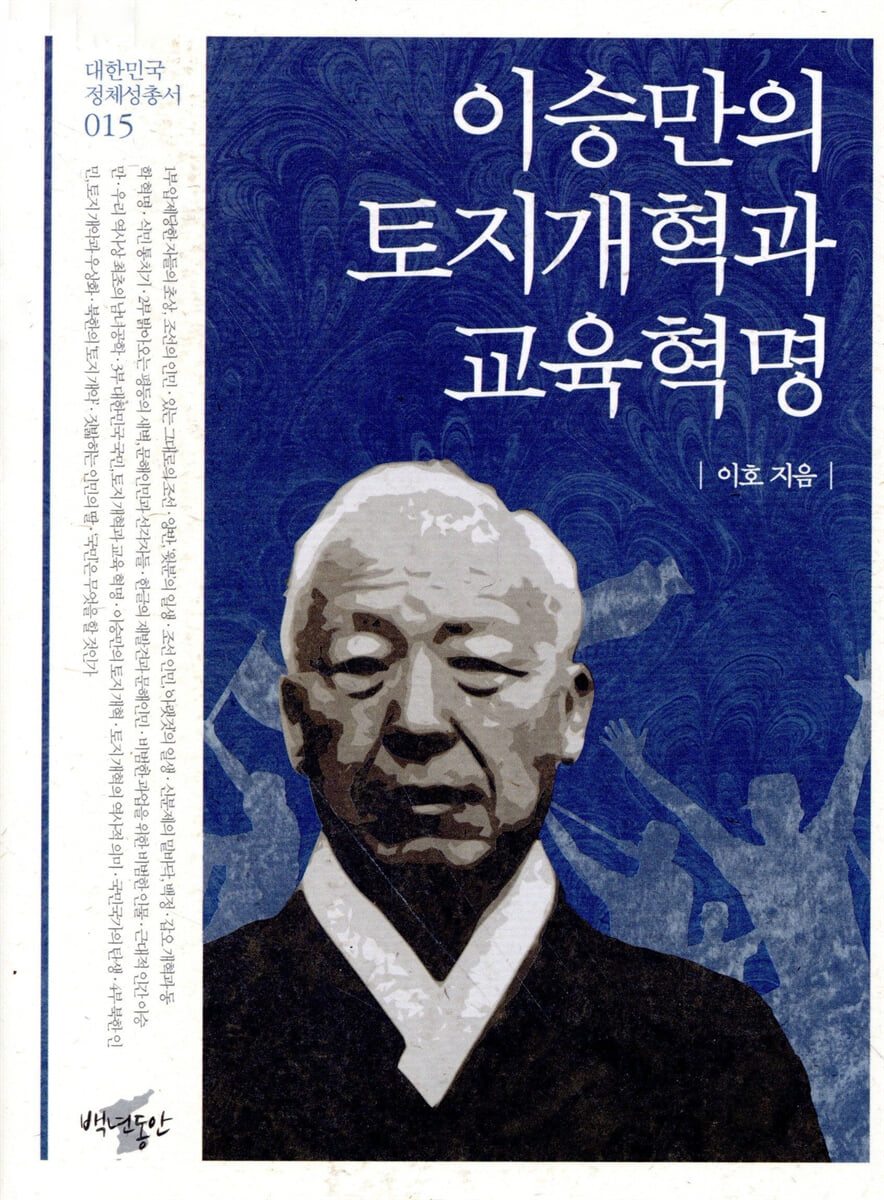
Syngman Rhee's land reform and educational revolution
 |
Description
Book Introduction
This book looks back on the significance of the land reform and educational revolution achieved by President Syngman Rhee.
It is true that there is a lot of controversy about Syngman Rhee.
However, this book argues that it is not right to simply criticize and slander him as a 'dictator'.
It is up to each individual to explore whether this is a correct claim and what happened during that time.
It is true that there is a lot of controversy about Syngman Rhee.
However, this book argues that it is not right to simply criticize and slander him as a 'dictator'.
It is up to each individual to explore whether this is a correct claim and what happened during that time.
index
preface
Part 1: Portraits of the Oppressed, the People of Joseon
Part 2: The Dawn of Equality: Literate People and Visionaries
Part 3: The People of the Republic of Korea, Land Reform, and the Education Revolution
Part 4: The North Korean People, Land Reform, and Idolization
Conclusion: What Will the 'People' Do?
Part 1: Portraits of the Oppressed, the People of Joseon
Part 2: The Dawn of Equality: Literate People and Visionaries
Part 3: The People of the Republic of Korea, Land Reform, and the Education Revolution
Part 4: The North Korean People, Land Reform, and Idolization
Conclusion: What Will the 'People' Do?
Into the book
Korea today is a mystery.
Of the 140 or so countries that gained independence after World War II, it was the only one to successfully industrialize, the only one to achieve democratization, and the only one to transform from an aid-recipient to an aid-giving country, but few remember its achievements.
When it comes to monumental, record-breaking, and miraculous achievements, the younger generation responds with cynicism rather than smiles.
--- p.6
The first example that Syngman Rhee listed when listing the shackles of customs that must be broken is the discrimination between the yangban and commoners.
The argument is that no matter how talented a person is, if they are suppressed by their status, they cannot function as human beings, and such a country cannot prosper.
The caste system was the root cause of “the decline of the nation by losing excellent citizens.”
Syngman Rhee believed that education was the most important thing to keep people alive.
If the caste system could kill even the most talented people, then education could save even the most seemingly inferior people.
--- p.46
The Constitution, enacted in 1948 according to Syngman Rhee's plan, stipulated in Article 86 that "Agricultural land shall be distributed to farmers, and the method of distribution, the limits of ownership, and the content and limitations of ownership shall be determined by law."
In this way, land reform in South Korea was carried out according to legal procedures.
From the time the country was founded, the principle that farmers own farmland was established in the constitution.
The work of enacting the bill was carried out in accordance with the Constitution.
In order to create a law, first and foremost, accurate data on rural conditions and land ownership status was needed.
However, there was no proper data or statistics for the poorest country in the world, which had experienced national ruin and colonialism.
--- p.63
At the same time, he was looking further ahead.
There was a vision that we would not just survive, but develop into a global powerhouse.
The foundation for achieving that vision was the establishment of a ‘college of engineering.’
The founding president's judgment was that rapid growth was possible only by transforming the country, which had been an agricultural nation for 5,000 years, into an industrial nation.
In December 1952, Syngman Rhee instructed the Ministry of Education to establish a university tentatively named 'Inha Institute of Technology.'
The university's name is a combination of one letter from Incheon, where the school is located, and Hawaii, the country that sent the donation.
--- p.84
North Korea's land reform was carried out under the name of the Provisional People's Committee of North Korea, a puppet state under Stalin's orders and the leadership of the Soviet military.
The purpose of land reform was not the abolition of class distinctions and the liberation of peasants, but the so-called 'people's democratic movement', or in other words, communization.
It was not land reform for the people, but land reform for communism.
--- p.104
At least during the Kim Il-sung era, it was possible to live in North Korea even if you had to wear a mask.
As the Kim Jong-il era began, a stream of compatriots, especially women, who were exhausted from hunger, began to escape.
The women, who had endured the hardships by eating tree bark and rats, could no longer endure it, so they crossed the river and went to China.
Since she had nothing but her body, she sold it to Chinese men as if it were an object.
--- p.127
It's a fight between David and Goliath.
History seeks David.
We call upon David to throw the stone of truth and shatter the gigantic illusion, like Goliath, created by North Korea and its pro-North Korean allies through false propaganda, instigation, and conspiracy.
Another name for David is 'the people'.
The subject of this fight, which cannot be given up, compromised, or retreated, is the ‘people.’
These are the people who were liberated from economic slavery through Syngman Rhee's land reform.
They are a nation that has become mentally independent and free from blindness thanks to the educational revolution of the founding president.
Of the 140 or so countries that gained independence after World War II, it was the only one to successfully industrialize, the only one to achieve democratization, and the only one to transform from an aid-recipient to an aid-giving country, but few remember its achievements.
When it comes to monumental, record-breaking, and miraculous achievements, the younger generation responds with cynicism rather than smiles.
--- p.6
The first example that Syngman Rhee listed when listing the shackles of customs that must be broken is the discrimination between the yangban and commoners.
The argument is that no matter how talented a person is, if they are suppressed by their status, they cannot function as human beings, and such a country cannot prosper.
The caste system was the root cause of “the decline of the nation by losing excellent citizens.”
Syngman Rhee believed that education was the most important thing to keep people alive.
If the caste system could kill even the most talented people, then education could save even the most seemingly inferior people.
--- p.46
The Constitution, enacted in 1948 according to Syngman Rhee's plan, stipulated in Article 86 that "Agricultural land shall be distributed to farmers, and the method of distribution, the limits of ownership, and the content and limitations of ownership shall be determined by law."
In this way, land reform in South Korea was carried out according to legal procedures.
From the time the country was founded, the principle that farmers own farmland was established in the constitution.
The work of enacting the bill was carried out in accordance with the Constitution.
In order to create a law, first and foremost, accurate data on rural conditions and land ownership status was needed.
However, there was no proper data or statistics for the poorest country in the world, which had experienced national ruin and colonialism.
--- p.63
At the same time, he was looking further ahead.
There was a vision that we would not just survive, but develop into a global powerhouse.
The foundation for achieving that vision was the establishment of a ‘college of engineering.’
The founding president's judgment was that rapid growth was possible only by transforming the country, which had been an agricultural nation for 5,000 years, into an industrial nation.
In December 1952, Syngman Rhee instructed the Ministry of Education to establish a university tentatively named 'Inha Institute of Technology.'
The university's name is a combination of one letter from Incheon, where the school is located, and Hawaii, the country that sent the donation.
--- p.84
North Korea's land reform was carried out under the name of the Provisional People's Committee of North Korea, a puppet state under Stalin's orders and the leadership of the Soviet military.
The purpose of land reform was not the abolition of class distinctions and the liberation of peasants, but the so-called 'people's democratic movement', or in other words, communization.
It was not land reform for the people, but land reform for communism.
--- p.104
At least during the Kim Il-sung era, it was possible to live in North Korea even if you had to wear a mask.
As the Kim Jong-il era began, a stream of compatriots, especially women, who were exhausted from hunger, began to escape.
The women, who had endured the hardships by eating tree bark and rats, could no longer endure it, so they crossed the river and went to China.
Since she had nothing but her body, she sold it to Chinese men as if it were an object.
--- p.127
It's a fight between David and Goliath.
History seeks David.
We call upon David to throw the stone of truth and shatter the gigantic illusion, like Goliath, created by North Korea and its pro-North Korean allies through false propaganda, instigation, and conspiracy.
Another name for David is 'the people'.
The subject of this fight, which cannot be given up, compromised, or retreated, is the ‘people.’
These are the people who were liberated from economic slavery through Syngman Rhee's land reform.
They are a nation that has become mentally independent and free from blindness thanks to the educational revolution of the founding president.
--- p.149
Publisher's Review
Where does the secret to South Korea's survival and prosperity lie?
A nation-state established in the southern part of the Korean Peninsula, and a people's state established in the north.
The foresight of the great father of the nation, Syngman Rhee, that made the decisive difference.
"This was a revolution, a miracle, the first of its kind in half a millennium of our history.
It was the first time that farmers had land and the first time that most of the people were literate.
It was the breaking of class distinctions and the liberation of humanity.
The two things that only the nobles of Joseon possessed were land and letters.
Because they monopolized economic and intellectual resources, the Yangban were able to reign as the ruling class for over 500 years.
Syngman Rhee's land reform and educational revolution were great feats that distributed land and literacy, previously held only by the yangban class, to all citizens.
- From the text
Even when Korea was liberated in 1945, the perception of communism was not that bad.
Many intellectuals were accepting communism (or socialism) as a means to achieve ‘people’s liberation.’
It's even become a trend.
Even the United States was unable to detect the true nature of the Soviet Union at the time.
During the post-war negotiations, the United States was indecisive in its negotiations with the Soviet Union.
This immaturity ultimately led to astronomical amounts of budget waste and the Cold War, which shook the world with nuclear fear.
At that time, the Korean Peninsula was one of the regions where this conflict was most acute.
After repeated political struggles and terrorism, it was not until 1948 that Syngman Rhee established the Republic of Korea, a liberal democracy, in the South, and Kim Il-sung established the People's Democratic Republic of Korea, a people's democratic republic of Korea, in the North.
It is said that one of the most acute political issues at the time was land reform.
In the North, they had already started shouting for 'free confiscation and free distribution' and were taking away the land from the landlords and giving it to the farmers.
Of course, it wasn't actually handed out.
It was simply a change of status from the landlord's 'tenant farmer' to the state's 'tenant farmer'.
What happened to the North Korean people who were stripped of their ownership and property rights? The answer can already be found by examining the current state of North Korea.
Meanwhile, what happened in the South? President Syngman Rhee's land reform of "paid confiscation and paid distribution" faced many challenges, but ultimately succeeded, and 95.7% of all cultivated land in Korea became owner-owned land, not tenant farms.
It was the first time that economic equality and the possibility of self-sufficiency were established in South Korea.
This is not the only achievement of Syngman Rhee.
He implemented general education for all citizens, thereby eliminating the distinction between the yangban and commoners that had remained until then.
It turned the illiteracy rate, which had reached 80%, around in an instant, making it possible for the majority of the population to read.
It was the moment when equality in political and cultural dimensions was finally achieved and democracy was established in this land.
On the other hand, what about North Korea? Can political and cultural equality and true democracy truly be achieved in a place where uniform indoctrination, worshipping "Comrade Kim Il-sung" as a deity, is openly practiced?
This book looks back on the significance of the land reform and educational revolution achieved by President Syngman Rhee.
Through this book, we can see how far ahead of his time he was.
Although it is true that there is a lot of controversy about Syngman Rhee.
However, this book argues that it is not right to simply criticize and slander him as a 'dictator'.
That is, we must be fully aware of and grateful for the achievements and contributions he has made for the people of this land.
In that respect, this book is a must-read for countless young students and young adults who only have a superficial understanding of Syngman Rhee.
For those of us who did not live through that era, it may be our duty to explore what really happened during that time.
A nation-state established in the southern part of the Korean Peninsula, and a people's state established in the north.
The foresight of the great father of the nation, Syngman Rhee, that made the decisive difference.
"This was a revolution, a miracle, the first of its kind in half a millennium of our history.
It was the first time that farmers had land and the first time that most of the people were literate.
It was the breaking of class distinctions and the liberation of humanity.
The two things that only the nobles of Joseon possessed were land and letters.
Because they monopolized economic and intellectual resources, the Yangban were able to reign as the ruling class for over 500 years.
Syngman Rhee's land reform and educational revolution were great feats that distributed land and literacy, previously held only by the yangban class, to all citizens.
- From the text
Even when Korea was liberated in 1945, the perception of communism was not that bad.
Many intellectuals were accepting communism (or socialism) as a means to achieve ‘people’s liberation.’
It's even become a trend.
Even the United States was unable to detect the true nature of the Soviet Union at the time.
During the post-war negotiations, the United States was indecisive in its negotiations with the Soviet Union.
This immaturity ultimately led to astronomical amounts of budget waste and the Cold War, which shook the world with nuclear fear.
At that time, the Korean Peninsula was one of the regions where this conflict was most acute.
After repeated political struggles and terrorism, it was not until 1948 that Syngman Rhee established the Republic of Korea, a liberal democracy, in the South, and Kim Il-sung established the People's Democratic Republic of Korea, a people's democratic republic of Korea, in the North.
It is said that one of the most acute political issues at the time was land reform.
In the North, they had already started shouting for 'free confiscation and free distribution' and were taking away the land from the landlords and giving it to the farmers.
Of course, it wasn't actually handed out.
It was simply a change of status from the landlord's 'tenant farmer' to the state's 'tenant farmer'.
What happened to the North Korean people who were stripped of their ownership and property rights? The answer can already be found by examining the current state of North Korea.
Meanwhile, what happened in the South? President Syngman Rhee's land reform of "paid confiscation and paid distribution" faced many challenges, but ultimately succeeded, and 95.7% of all cultivated land in Korea became owner-owned land, not tenant farms.
It was the first time that economic equality and the possibility of self-sufficiency were established in South Korea.
This is not the only achievement of Syngman Rhee.
He implemented general education for all citizens, thereby eliminating the distinction between the yangban and commoners that had remained until then.
It turned the illiteracy rate, which had reached 80%, around in an instant, making it possible for the majority of the population to read.
It was the moment when equality in political and cultural dimensions was finally achieved and democracy was established in this land.
On the other hand, what about North Korea? Can political and cultural equality and true democracy truly be achieved in a place where uniform indoctrination, worshipping "Comrade Kim Il-sung" as a deity, is openly practiced?
This book looks back on the significance of the land reform and educational revolution achieved by President Syngman Rhee.
Through this book, we can see how far ahead of his time he was.
Although it is true that there is a lot of controversy about Syngman Rhee.
However, this book argues that it is not right to simply criticize and slander him as a 'dictator'.
That is, we must be fully aware of and grateful for the achievements and contributions he has made for the people of this land.
In that respect, this book is a must-read for countless young students and young adults who only have a superficial understanding of Syngman Rhee.
For those of us who did not live through that era, it may be our duty to explore what really happened during that time.
GOODS SPECIFICS
- Date of issue: May 1, 2015
- Format: Paperback book binding method guide
- Page count, weight, size: 156 pages | 234g | 150*198*11mm
- ISBN13: 9791186061183
- ISBN10: 1186061189
You may also like
카테고리
korean


korean

![GQ KOREA Mark (Monthly): December [2025]](http://librairie.coreenne.fr/cdn/shop/files/8ef265dbbfbf186523ed75ba7319009d.jpg?v=1765340328&width=3840)


