

Ancient documents tell the history of Joseon
 |
Description
Book Introduction
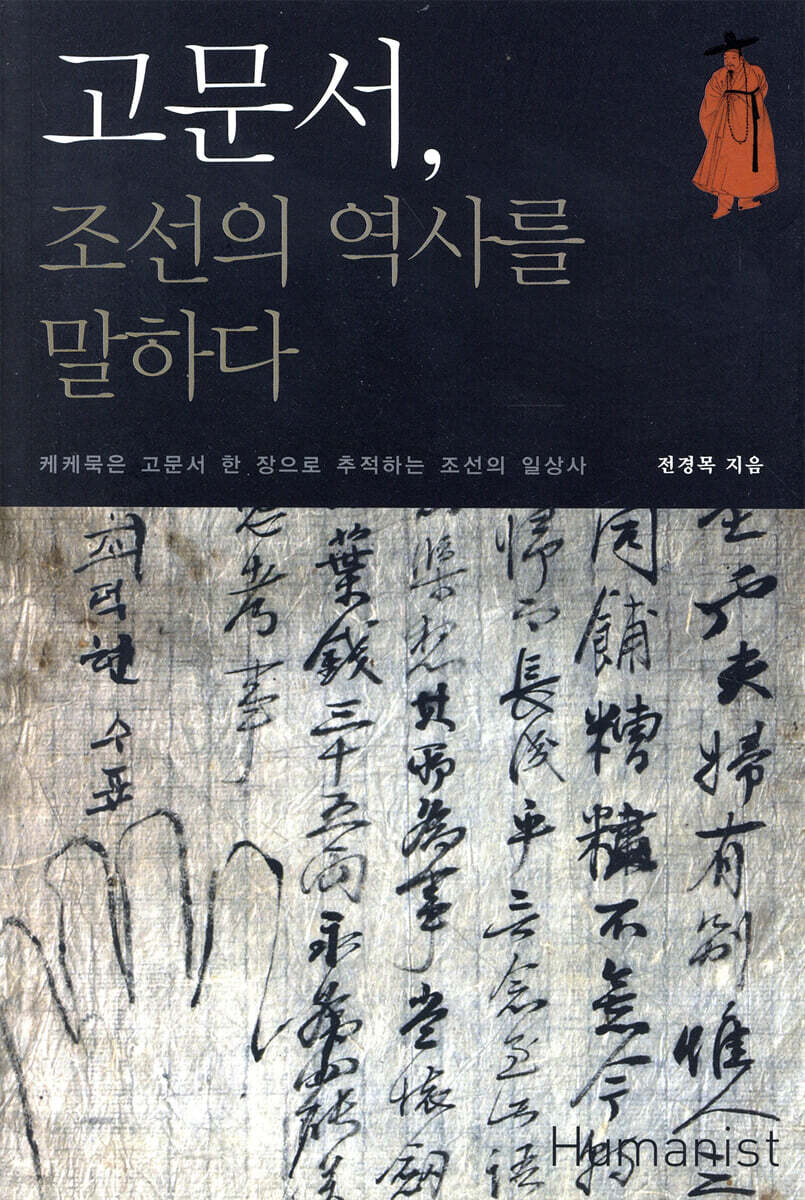
This whole story started with a single piece of ancient document.
An old document that appears to contain no particular content.
The author uses a single page of a husband's memoir permitting his wife to remarry and a petition requesting proof of repayment of a gambling debt as clues to unravel the story by tracing the author of the document, the community he belonged to, and the times at the time.
The process of interpretation, of reading, turning over, and questioning ancient documents in depth within the context of related people and social networks, like a detective solving a mystery, is surprising and wondrous.
The story this interpretation uncovers restores, scene by scene, the daily life of Joseon hidden within the grand history.
It is not about the solemn expressions of the nobles, but rather the trivial matters experienced by ordinary people, such as divorce, gambling, and division of property, that are clearly revealed.
The voices they leave behind sometimes overturn existing historical conventions, and sometimes vividly recreate facts we vaguely know before our eyes.
In this way, ancient documents unfold hidden stories of the Joseon Dynasty like a secret box of history.
An old document that appears to contain no particular content.
The author uses a single page of a husband's memoir permitting his wife to remarry and a petition requesting proof of repayment of a gambling debt as clues to unravel the story by tracing the author of the document, the community he belonged to, and the times at the time.
The process of interpretation, of reading, turning over, and questioning ancient documents in depth within the context of related people and social networks, like a detective solving a mystery, is surprising and wondrous.
The story this interpretation uncovers restores, scene by scene, the daily life of Joseon hidden within the grand history.
It is not about the solemn expressions of the nobles, but rather the trivial matters experienced by ordinary people, such as divorce, gambling, and division of property, that are clearly revealed.
The voices they leave behind sometimes overturn existing historical conventions, and sometimes vividly recreate facts we vaguely know before our eyes.
In this way, ancient documents unfold hidden stories of the Joseon Dynasty like a secret box of history.
- You can preview some of the book's contents.
Preview
index
Introduction: Old Documents, Sneezes, and a Runny Nose: Opening the Secret Box of History
[Introspection] Choi Deok-hyeon's Memoir: A Penetrating Look into Joseon Dynasty Divorce Customs
1.
He accepted 35 nyang of coins and allowed his wife to remarry.
2.
Was divorce possible during the Joseon Dynasty?
3.
A nobleman who stole a commoner's wife, and a husband who was beaten by his wife.
[Revisited] Yang Sa-heon's petition reveals the gambling addiction of the late Joseon Dynasty.
1.
Please provide proof that you have repaid your gambling debt.
2.
Yang Sa-heon, ruined by gambling
3.
Late Joseon society stained by gambling
[Through the Terms] Hwang Woo-young's "Goshin": A Secret Relationship Between Officials and Seori
1.
I leave my name on the back of Nari's appointment letter.
2.
A secret network of local aristocrats and regulars
3.
A manager who gives debt relief and a regular who gives books
[Questioning] Choi Chun-geon's Gongmyeongcheop: Breaking the Conventional Notion that Money Bought the Noble
1.
Please don't let me buy a fake certificate of merit.
2.
Would buying a resonance book really make you a nobleman?
3.
The survival strategy of the Yohobumin to become a nobleman
[Double-sided or multi-sided view] Kim Hae's marriage book reveals the differences and discrimination between wives and concubines.
1.
I am sending a marriage letter to take your daughter as my daughter-in-law.
2.
A gift to the wife, a ransom to the concubine
3.
A government official's second wife rather than a scholar's wife
4.
Men who became successful by taking wealthy concubines
main
[Appendix] Original text
[Introspection] Choi Deok-hyeon's Memoir: A Penetrating Look into Joseon Dynasty Divorce Customs
1.
He accepted 35 nyang of coins and allowed his wife to remarry.
2.
Was divorce possible during the Joseon Dynasty?
3.
A nobleman who stole a commoner's wife, and a husband who was beaten by his wife.
[Revisited] Yang Sa-heon's petition reveals the gambling addiction of the late Joseon Dynasty.
1.
Please provide proof that you have repaid your gambling debt.
2.
Yang Sa-heon, ruined by gambling
3.
Late Joseon society stained by gambling
[Through the Terms] Hwang Woo-young's "Goshin": A Secret Relationship Between Officials and Seori
1.
I leave my name on the back of Nari's appointment letter.
2.
A secret network of local aristocrats and regulars
3.
A manager who gives debt relief and a regular who gives books
[Questioning] Choi Chun-geon's Gongmyeongcheop: Breaking the Conventional Notion that Money Bought the Noble
1.
Please don't let me buy a fake certificate of merit.
2.
Would buying a resonance book really make you a nobleman?
3.
The survival strategy of the Yohobumin to become a nobleman
[Double-sided or multi-sided view] Kim Hae's marriage book reveals the differences and discrimination between wives and concubines.
1.
I am sending a marriage letter to take your daughter as my daughter-in-law.
2.
A gift to the wife, a ransom to the concubine
3.
A government official's second wife rather than a scholar's wife
4.
Men who became successful by taking wealthy concubines
main
[Appendix] Original text
Publisher's Review
1.
A single, musty document overturns our understanding of Joseon history.
The boundless value of ancient documents, a blue ocean in the field of historical scholarship.
The ancient documents have received little attention, not only from the general public but also from historians.
While official historical records such as the Annals of the Joseon Dynasty, the Diaries of the Royal Secretariat, and the Records of the Office of the Inspector General have been constantly discussed and interpreted, there are few professional researchers who can even consider ancient documents that can be considered true primary sources because they were written directly by the people who lived during that time.
This is because it was treated as a historical document with little research value in the existing academic world, which focuses on political history, as it contained seemingly trivial and insignificant content.
But are ancient documents really useless?
《Old Documents, Telling the History of Joseon》 examines the Joseon Dynasty starting from a single old document.
For example, 'Choi Deok-hyeon's Diary' contains the voice of a husband who has no choice but to accept divorce as a reality and sends his wife away for 35 nyang.
It is a divorce document from the late Joseon Dynasty that proves the fact of divorce.
The author uses this single page of the document as a starting point to closely investigate who wrote the document, when it was written, and who paid to take Choi Deok-hyeon's wife.
Furthermore, as the diary states, it reveals whether divorce was actually possible in the Joseon Dynasty and how the customs of divorce and remarriage differed depending on social status or time period.
As a result, it is concluded that commoners and low-class people were free to divorce even during the Joseon Dynasty, and that even royalty and nobles could divorce until the early Joseon Dynasty.
This is a story that is far from the historical common sense that divorce and remarriage were impossible during the Joseon Dynasty, when Confucianism was deeply rooted.
By looking into the inner workings of ancient documents like this, we can see the true face of the Joseon Dynasty that we did not know about.
If we simply decipher the contents, the ancient documents will be nothing more than old documents. However, if we interpret them with keen insight and connect the scattered pieces of the ancient documents, they will be reborn as a treasure trove of storytelling filled with infinite stories.
Moreover, this book does not stop at telling the story discovered in this way, but shows the process of discovering questions and finding answers in ancient documents step by step.
Through this, readers experience reading ancient documents, where one ancient document is connected to another, and these documents, like a mosaic, create a complete picture of daily life in Joseon.
Rather than reading a given story, you can experience the pleasure of reading history through ancient documents by directly tracing the daily lives of Joseon.
This book's unique feature is that it reveals the true value of ancient documents and provides a reading experience that restores the hidden daily lives of Joseon through them.
2.
A glimpse into Joseon's daily life, including divorce, gambling, inheritance, and the appointment of officials.
- Joseon's daily life vividly recreated through records left by the common people.
The Joseon Dynasty revealed in ancient documents is unique.
This is because not only the lives of the dignified aristocrats but also the traces of the lives of commoners and commoners, such as divorce, gambling, and division of property, remain intact.
These traces are the facial expressions of people in the Joseon Dynasty.
We often think of men in the Joseon Dynasty as authoritarian and strict patriarchs.
However, the petition of Kim Gwang-pal, the father of a troublemaker son named Yong-an, reveals the father's heart that is deeply concerned about his son.
I can almost hear his voice worrying that his son will cause a big accident if he works at the government office.
He is not like the patriarchs of the Joseon Dynasty who bark orders in a loud voice like we see in movies and dramas, but rather like our ordinary fathers who can't sleep because they worry about their children.
The reason I exempted Yong-an from government slavery was not only because of my own wishes, but also because the previous leader anticipated that if Yong-an was left as a government slave, there would be great problems later on.
So, the leader at the time took this into consideration and received money, specially exempting Yong-an from government slavery.
But now, the newly appointed leader has suddenly registered Yong-an as a government slave again without even looking into this process. If he continues like this, I have no hope of settling down and living here.
(Omitted) With these reasons in mind, I dare to appeal to you, so please consider it carefully and instruct me to exempt my son Yong-an from the government service imposed on him.
_From 'Kim Gwang-pal's Petition' (page 116).
There are also ancient documents that clearly reveal married life, with repeated infidelity and remarriage, like the Joseon Dynasty version of “Love and War.”
On March 10, 1602 (the 35th year of King Seonjo's reign), Park Ui-hwon distributed his property to his eight children and left behind a document called Bunjaegi (a document written when distributing property).
According to this 'Park Ui-Hwon's Diary', he had relationships with five women, and all four of his ex-wives left him because of his infidelity.
His voice in the censure is calm, but there is a sense of coolness as he denounces his ex-wives' misdeeds one by one.
On the one hand, one can also read the meticulousness of his preparations to prevent his ex-wives' wrongdoings from being exaggerated and stealing his property in order to pass it on to his two young sons with his then-wife, Yeobae.
His first wife, Eunhwa, secretly committed adultery with another man's husband, Park Eon-geon, and lived with him until she died.
My second wife, Jin-dae, was quite a woman when she came to live with me when I was young, but later committed a crime worthy of death by having sex with a male servant.
(Omitted) My third wife, Mongji, the mother of my son Park Cheon-seok, had an affair with Hong Cheon-gwi and had many children, but she died after Hong Cheon-gwi died.
(Omitted) My fourth wife, Gajeolgeum, was taken as my wife when I was young and was entering and exiting the gate, and I made her live far away in town.
At the time of the affair, she gave birth to a daughter, but she was a woman of corrupt nature, and later secretly committed adultery with five or six men, changing husbands as she pleased.
Then… … she followed her daughter to the village where I lived… … and prayed to heaven day and night to let her die immediately.
_From 'Park Ui-Hwon's Diary of a Divine Being' (pp. 35-36).
In addition, 'Kim Yong-gap's Petition (pp. 45-47)', in which he denounces his wife for kicking him out and swearing at his mother, and 'Yang Gyeong-won's Last Words (pp. 109-111)', in which a father with a gambler son laments his life while worrying about his eldest grandson as he faces death, are records that solely contain what ordinary people of the Joseon Dynasty experienced and what they thought.
These ancient documents, which contain the expressions and voices of individuals who lived during that time, accurately recreate the daily lives of people in the Joseon Dynasty.
3.
A true Joseon landscape, blending specific events and historical context.
- A new historical interpretation that crosses microhistory and macrohistory
Although ancient documents contain small and detailed events, the history we read through them does not remain limited to microhistory.
This is because interpreting ancient documents requires a historical perspective that encompasses the institutional context and customs of the times.
The topics covered in this book, such as divorce, gambling, local officials and central secretaries, the Yohobumin, and wives and concubines, are stories of individuals who lived during the Joseon Dynasty, and are also customs that formed an axis of the culture of the time and were influenced by that culture.
Therefore, if you decipher ancient documents without a foundation in macro-history, you may easily make the mistake of hastily generalizing small facts or events.
This book unfolds its story based on ancient documents, but it also examines the daily life and customs of the Joseon Dynasty by moving through various official historical books and records, such as the Annals of the Joseon Dynasty, the Diaries of the Royal Secretariat, local histories, anthologies, and genealogies.
Detailed and specific events confirmed through ancient documents create accurate microhistory, which in turn becomes the foundation for a solid macrohistory.
Microhistory, understood in a macroscopic context encompassing all of history, enables rich historical narratives.
This explanation, which blends micro-history and macro-history, shows the living, breathing Joseon Dynasty, something that cannot be confirmed in existing flat historical narratives.
Author Interview
▶ “Old Documents, Telling the History of Joseon” is a book that examines Joseon’s history through old documents.
However, ancient documents are very unfamiliar to the general public.
I'm curious about what made you interested in ancient documents.
I entered graduate school and was assigned to a museum as an assistant.
When I entered the museum's archives, I saw a pile of newspapers and documents in one corner.
It was paper used as a cushioning material to prevent the ceramics from breaking when purchasing them.
But among them, there was an ancient document similar to what I learned in class.
Although important ceramics were handled with great care, no attention was paid to ancient documents.
At that time, even in museums, only ceramics and folk artifacts were considered relics, and ancient documents were treated like waste paper.
There were even instances where these remaining documents were burned, not being considered relics.
But I think it's a shame to lose these old documents and I'm curious about their contents.
From then on, I started collecting old documents one by one.
▶ Most historians will study history books as their source material.
What are the advantages of studying history based on ancient documents?
In our country, there are still organized records such as the Annals of the Joseon Dynasty and the Diaries of the Royal Secretariat.
When a king passed away, our ancestors compiled the historical records and created the Annals of the King.
Or, after a certain period of time, officers would organize the notes and make a diary.
However, in the process, important records remained, but the documents that formed the basis of the history were often destroyed.
On the other hand, Japan did not have a library compilation project, so although there are many documents left, there are no organized libraries.
So, if you want to study history in Japan, you need to be able to read documents.
We didn't need to do that, so we studied with the Annals of the Joseon Dynasty and the Diaries of the Royal Secretariat, and we were satisfied with that.
Instead, the documents were neither studied nor valued.
However, the Annals of the Joseon Dynasty do not contain any detailed information about the culture and daily lives of the people of the Joseon Dynasty.
I wasn't interested.
The Annals of the Joseon Dynasty do not provide specific information about what people wore and ate at the time.
But such things are in the old documents.
People think of the Annals as primary sources, but they are actually secondary sources in that they were compiled again by someone else.
Old documents are primary sources written directly by the people of that time.
Only by studying primary sources such as ancient documents can we gain a detailed understanding of the lives of people at that time, and based on this, we can conduct new research.
▶ So, what historical significance does the specific information contained in these ancient documents hold? Perhaps it's so trivial that it's unimportant.
As mentioned in the book, it is generally said that in the late Joseon Dynasty, wealthy commoners tried to become nobles by purchasing Gongmyeongcheop.
But when I actually started researching ancient documents, I found that wasn't the case.
Rather, commoners were reluctant to purchase the Gongmyeongcheop, and the state tried to force them to buy it.
Even if a commoner bought a public offering, his neighbors would not accept it because they already knew that he was a commoner.
This is a completely different story from the existing historical consensus.
By looking at ancient documents, we can confirm specific facts like these and find errors in historical consensus.
Another great advantage of studying ancient documents is that it allows us to hear the vivid voices of people from the Joseon Dynasty and reconstruct their daily lives.
▶ It is interesting how the content starts from one ancient document and continues to other ancient documents.
It's like reading a mystery novel.
It's fun to read, but the effort it took to write it must have been extraordinary, right?
It is not easy to connect multiple documents to create a single story.
“Old Documents Speak of Joseon’s History” is a book that compiles the results I gained from researching old documents for over 20 years.
The process of finding ancient documents is also very tedious. Sometimes, you find another ancient document 10 years later that is connected to an ancient document discovered 10 years ago, or you discover a story related to an ancient document from one family while looking through an ancient document from another family.
So, writing an article by linking various old documents is not a task that can be done by gathering materials in one or two years.
I put all the materials I had collected over a long period of time together, and when writing, I structured it in such a way that I found a question in one old document, discovered a clue, and then moved on to other old documents one by one to solve the mystery.
The reason I wrote this is because I wanted to give readers the fun of reading history.
I wanted to connect with the general public interested in history through engaging and free-flowing writing based on interesting material.
▶ Readers of this book will likely have high expectations for the teacher's future research.
Please tell us about your future plans.
My main research interest is people who live between classes.
For example, there is a class system between the yangban and commoners, and through research on the class system, we can talk in more detail about not only these people but also what the yangban and commoners were like.
I also plan to compile a book about the redeemed slaves who were between the commoners and the low-class.
I also want to conduct research by accumulating historical documents.
If we collected all the old documents that recorded housing prices in Seoul during the Joseon Dynasty, we could conduct a wide variety of research.
It is possible to determine which regions developed during which periods, and the statistical data also enables research that encompasses both micro- and macro-history.
A single, musty document overturns our understanding of Joseon history.
The boundless value of ancient documents, a blue ocean in the field of historical scholarship.
The ancient documents have received little attention, not only from the general public but also from historians.
While official historical records such as the Annals of the Joseon Dynasty, the Diaries of the Royal Secretariat, and the Records of the Office of the Inspector General have been constantly discussed and interpreted, there are few professional researchers who can even consider ancient documents that can be considered true primary sources because they were written directly by the people who lived during that time.
This is because it was treated as a historical document with little research value in the existing academic world, which focuses on political history, as it contained seemingly trivial and insignificant content.
But are ancient documents really useless?
《Old Documents, Telling the History of Joseon》 examines the Joseon Dynasty starting from a single old document.
For example, 'Choi Deok-hyeon's Diary' contains the voice of a husband who has no choice but to accept divorce as a reality and sends his wife away for 35 nyang.
It is a divorce document from the late Joseon Dynasty that proves the fact of divorce.
The author uses this single page of the document as a starting point to closely investigate who wrote the document, when it was written, and who paid to take Choi Deok-hyeon's wife.
Furthermore, as the diary states, it reveals whether divorce was actually possible in the Joseon Dynasty and how the customs of divorce and remarriage differed depending on social status or time period.
As a result, it is concluded that commoners and low-class people were free to divorce even during the Joseon Dynasty, and that even royalty and nobles could divorce until the early Joseon Dynasty.
This is a story that is far from the historical common sense that divorce and remarriage were impossible during the Joseon Dynasty, when Confucianism was deeply rooted.
By looking into the inner workings of ancient documents like this, we can see the true face of the Joseon Dynasty that we did not know about.
If we simply decipher the contents, the ancient documents will be nothing more than old documents. However, if we interpret them with keen insight and connect the scattered pieces of the ancient documents, they will be reborn as a treasure trove of storytelling filled with infinite stories.
Moreover, this book does not stop at telling the story discovered in this way, but shows the process of discovering questions and finding answers in ancient documents step by step.
Through this, readers experience reading ancient documents, where one ancient document is connected to another, and these documents, like a mosaic, create a complete picture of daily life in Joseon.
Rather than reading a given story, you can experience the pleasure of reading history through ancient documents by directly tracing the daily lives of Joseon.
This book's unique feature is that it reveals the true value of ancient documents and provides a reading experience that restores the hidden daily lives of Joseon through them.
2.
A glimpse into Joseon's daily life, including divorce, gambling, inheritance, and the appointment of officials.
- Joseon's daily life vividly recreated through records left by the common people.
The Joseon Dynasty revealed in ancient documents is unique.
This is because not only the lives of the dignified aristocrats but also the traces of the lives of commoners and commoners, such as divorce, gambling, and division of property, remain intact.
These traces are the facial expressions of people in the Joseon Dynasty.
We often think of men in the Joseon Dynasty as authoritarian and strict patriarchs.
However, the petition of Kim Gwang-pal, the father of a troublemaker son named Yong-an, reveals the father's heart that is deeply concerned about his son.
I can almost hear his voice worrying that his son will cause a big accident if he works at the government office.
He is not like the patriarchs of the Joseon Dynasty who bark orders in a loud voice like we see in movies and dramas, but rather like our ordinary fathers who can't sleep because they worry about their children.
The reason I exempted Yong-an from government slavery was not only because of my own wishes, but also because the previous leader anticipated that if Yong-an was left as a government slave, there would be great problems later on.
So, the leader at the time took this into consideration and received money, specially exempting Yong-an from government slavery.
But now, the newly appointed leader has suddenly registered Yong-an as a government slave again without even looking into this process. If he continues like this, I have no hope of settling down and living here.
(Omitted) With these reasons in mind, I dare to appeal to you, so please consider it carefully and instruct me to exempt my son Yong-an from the government service imposed on him.
_From 'Kim Gwang-pal's Petition' (page 116).
There are also ancient documents that clearly reveal married life, with repeated infidelity and remarriage, like the Joseon Dynasty version of “Love and War.”
On March 10, 1602 (the 35th year of King Seonjo's reign), Park Ui-hwon distributed his property to his eight children and left behind a document called Bunjaegi (a document written when distributing property).
According to this 'Park Ui-Hwon's Diary', he had relationships with five women, and all four of his ex-wives left him because of his infidelity.
His voice in the censure is calm, but there is a sense of coolness as he denounces his ex-wives' misdeeds one by one.
On the one hand, one can also read the meticulousness of his preparations to prevent his ex-wives' wrongdoings from being exaggerated and stealing his property in order to pass it on to his two young sons with his then-wife, Yeobae.
His first wife, Eunhwa, secretly committed adultery with another man's husband, Park Eon-geon, and lived with him until she died.
My second wife, Jin-dae, was quite a woman when she came to live with me when I was young, but later committed a crime worthy of death by having sex with a male servant.
(Omitted) My third wife, Mongji, the mother of my son Park Cheon-seok, had an affair with Hong Cheon-gwi and had many children, but she died after Hong Cheon-gwi died.
(Omitted) My fourth wife, Gajeolgeum, was taken as my wife when I was young and was entering and exiting the gate, and I made her live far away in town.
At the time of the affair, she gave birth to a daughter, but she was a woman of corrupt nature, and later secretly committed adultery with five or six men, changing husbands as she pleased.
Then… … she followed her daughter to the village where I lived… … and prayed to heaven day and night to let her die immediately.
_From 'Park Ui-Hwon's Diary of a Divine Being' (pp. 35-36).
In addition, 'Kim Yong-gap's Petition (pp. 45-47)', in which he denounces his wife for kicking him out and swearing at his mother, and 'Yang Gyeong-won's Last Words (pp. 109-111)', in which a father with a gambler son laments his life while worrying about his eldest grandson as he faces death, are records that solely contain what ordinary people of the Joseon Dynasty experienced and what they thought.
These ancient documents, which contain the expressions and voices of individuals who lived during that time, accurately recreate the daily lives of people in the Joseon Dynasty.
3.
A true Joseon landscape, blending specific events and historical context.
- A new historical interpretation that crosses microhistory and macrohistory
Although ancient documents contain small and detailed events, the history we read through them does not remain limited to microhistory.
This is because interpreting ancient documents requires a historical perspective that encompasses the institutional context and customs of the times.
The topics covered in this book, such as divorce, gambling, local officials and central secretaries, the Yohobumin, and wives and concubines, are stories of individuals who lived during the Joseon Dynasty, and are also customs that formed an axis of the culture of the time and were influenced by that culture.
Therefore, if you decipher ancient documents without a foundation in macro-history, you may easily make the mistake of hastily generalizing small facts or events.
This book unfolds its story based on ancient documents, but it also examines the daily life and customs of the Joseon Dynasty by moving through various official historical books and records, such as the Annals of the Joseon Dynasty, the Diaries of the Royal Secretariat, local histories, anthologies, and genealogies.
Detailed and specific events confirmed through ancient documents create accurate microhistory, which in turn becomes the foundation for a solid macrohistory.
Microhistory, understood in a macroscopic context encompassing all of history, enables rich historical narratives.
This explanation, which blends micro-history and macro-history, shows the living, breathing Joseon Dynasty, something that cannot be confirmed in existing flat historical narratives.
Author Interview
▶ “Old Documents, Telling the History of Joseon” is a book that examines Joseon’s history through old documents.
However, ancient documents are very unfamiliar to the general public.
I'm curious about what made you interested in ancient documents.
I entered graduate school and was assigned to a museum as an assistant.
When I entered the museum's archives, I saw a pile of newspapers and documents in one corner.
It was paper used as a cushioning material to prevent the ceramics from breaking when purchasing them.
But among them, there was an ancient document similar to what I learned in class.
Although important ceramics were handled with great care, no attention was paid to ancient documents.
At that time, even in museums, only ceramics and folk artifacts were considered relics, and ancient documents were treated like waste paper.
There were even instances where these remaining documents were burned, not being considered relics.
But I think it's a shame to lose these old documents and I'm curious about their contents.
From then on, I started collecting old documents one by one.
▶ Most historians will study history books as their source material.
What are the advantages of studying history based on ancient documents?
In our country, there are still organized records such as the Annals of the Joseon Dynasty and the Diaries of the Royal Secretariat.
When a king passed away, our ancestors compiled the historical records and created the Annals of the King.
Or, after a certain period of time, officers would organize the notes and make a diary.
However, in the process, important records remained, but the documents that formed the basis of the history were often destroyed.
On the other hand, Japan did not have a library compilation project, so although there are many documents left, there are no organized libraries.
So, if you want to study history in Japan, you need to be able to read documents.
We didn't need to do that, so we studied with the Annals of the Joseon Dynasty and the Diaries of the Royal Secretariat, and we were satisfied with that.
Instead, the documents were neither studied nor valued.
However, the Annals of the Joseon Dynasty do not contain any detailed information about the culture and daily lives of the people of the Joseon Dynasty.
I wasn't interested.
The Annals of the Joseon Dynasty do not provide specific information about what people wore and ate at the time.
But such things are in the old documents.
People think of the Annals as primary sources, but they are actually secondary sources in that they were compiled again by someone else.
Old documents are primary sources written directly by the people of that time.
Only by studying primary sources such as ancient documents can we gain a detailed understanding of the lives of people at that time, and based on this, we can conduct new research.
▶ So, what historical significance does the specific information contained in these ancient documents hold? Perhaps it's so trivial that it's unimportant.
As mentioned in the book, it is generally said that in the late Joseon Dynasty, wealthy commoners tried to become nobles by purchasing Gongmyeongcheop.
But when I actually started researching ancient documents, I found that wasn't the case.
Rather, commoners were reluctant to purchase the Gongmyeongcheop, and the state tried to force them to buy it.
Even if a commoner bought a public offering, his neighbors would not accept it because they already knew that he was a commoner.
This is a completely different story from the existing historical consensus.
By looking at ancient documents, we can confirm specific facts like these and find errors in historical consensus.
Another great advantage of studying ancient documents is that it allows us to hear the vivid voices of people from the Joseon Dynasty and reconstruct their daily lives.
▶ It is interesting how the content starts from one ancient document and continues to other ancient documents.
It's like reading a mystery novel.
It's fun to read, but the effort it took to write it must have been extraordinary, right?
It is not easy to connect multiple documents to create a single story.
“Old Documents Speak of Joseon’s History” is a book that compiles the results I gained from researching old documents for over 20 years.
The process of finding ancient documents is also very tedious. Sometimes, you find another ancient document 10 years later that is connected to an ancient document discovered 10 years ago, or you discover a story related to an ancient document from one family while looking through an ancient document from another family.
So, writing an article by linking various old documents is not a task that can be done by gathering materials in one or two years.
I put all the materials I had collected over a long period of time together, and when writing, I structured it in such a way that I found a question in one old document, discovered a clue, and then moved on to other old documents one by one to solve the mystery.
The reason I wrote this is because I wanted to give readers the fun of reading history.
I wanted to connect with the general public interested in history through engaging and free-flowing writing based on interesting material.
▶ Readers of this book will likely have high expectations for the teacher's future research.
Please tell us about your future plans.
My main research interest is people who live between classes.
For example, there is a class system between the yangban and commoners, and through research on the class system, we can talk in more detail about not only these people but also what the yangban and commoners were like.
I also plan to compile a book about the redeemed slaves who were between the commoners and the low-class.
I also want to conduct research by accumulating historical documents.
If we collected all the old documents that recorded housing prices in Seoul during the Joseon Dynasty, we could conduct a wide variety of research.
It is possible to determine which regions developed during which periods, and the statistical data also enables research that encompasses both micro- and macro-history.
GOODS SPECIFICS
- Date of issue: December 9, 2013
- Page count, weight, size: 384 pages | 573g | 152*225*30mm
- ISBN13: 9788958626763
- ISBN10: 8958626763
You may also like
카테고리
korean


korean

![GQ KOREA Mark (Monthly): December [2025]](http://librairie.coreenne.fr/cdn/shop/files/8ef265dbbfbf186523ed75ba7319009d.jpg?v=1765340328&width=3840)


