

30 Tips for Qualitative Research
 |
Description
Book Introduction
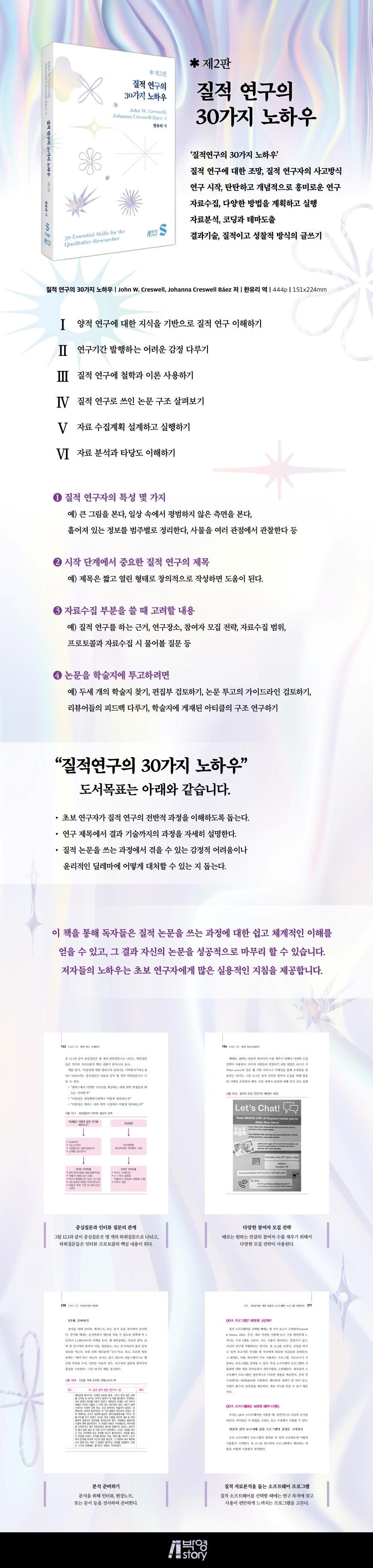
The second edition of 『30 Tips for Qualitative Research』 includes the following additions:
Updated citation and reference list (including the 2020 APA Style Manual).
Added table on qualitative validity strategies and interview types.
Added content on note-taking, quotation use, researcher reflection, working with reviewers, research questions and sub-questions, specific validity checks, and criteria for assessing the quality of qualitative research.
Updated content related to qualitative data analysis software items.
Partial editing of text to improve readability and clarity.
Updated citation and reference list (including the 2020 APA Style Manual).
Added table on qualitative validity strategies and interview types.
Added content on note-taking, quotation use, researcher reflection, working with reviewers, research questions and sub-questions, specific validity checks, and criteria for assessing the quality of qualitative research.
Updated content related to qualitative data analysis software items.
Partial editing of text to improve readability and clarity.
- You can preview some of the book's contents.
Preview
index
PART
01
Overview of qualitative research
01│Thinking Like a Qualitative Researcher 3
First Know-How_3
Why is it important?_3
Research Process_4
Several approaches that follow this research process_4
What do qualitative researchers think_5
Boat Photo_6
Characteristics of Qualitative Research_8
Some Misconceptions About Qualitative Research_12
02│Understanding Qualitative Research Based on Knowledge of Quantitative Research 15
Second Know-How_15
Why is it important?_15
Characteristics of Quantitative Research Published in Quantitative Journals_16
Characteristics of Qualitative Research Published in Qualitative Journals_17
Comparing the characteristics of qualitative and quantitative research along the same lines_20
Elements that are easily visible or difficult to see_21
03│Making Your Qualitative Research Solid and Conceptually Interesting 25
Third Know-How_25
Why is it important?_25
Choosing a Research Topic_26
Be careful to study your surroundings_27
Making Your Research Topic Conceptually Interesting_28
Adding Interesting Elements to Your Research Title_30
04│Handling Difficult Emotions During Research 34
Fourth Know-How_34
Why is it important?_34
Emotional Journeys in Qualitative Research_34
Stages of the Emotional Journey_35
Positive Aspects of Qualitative Research_38
The Difficulties of Qualitative Research_38
05│Working with Your Advisor and Thesis Examiners 44
Fifth Know-How_44
Why is it important?_44
Informing Your Reviewers About Qualitative Research_45
Submit your best essay_46
Getting Feedback_46
Meeting with thesis review committee_47
PART
02
Considering the precautions
06│Using Philosophy and Theory in Qualitative Research 55
Sixth Know-How_55
Why is it important?_55
The Philosophy Behind Qualitative Research_56
Describing Philosophy in Your Qualitative Research_62
Using Theory in Qualitative Research_63
07│Predicting Ethical Issues 71
Seventh Know-How_71
Why is it important?_71
Protecting Participants in Qualitative Research_72
Ethical Issues Arising at Various Stages of Research_74
Ethical Issues Facing Authors as Qualitative Researchers_77
Permission to use borrowed materials_80
Ethics Checklist_81
08│Developing a Literature Map 85
Eighth Know-How_85
Why is it important?_85
Challenges in Reviewing Literature_86
Alternatives for Placing Literature in Qualitative Research_87
Literature Review Stage_89
Priority_90 when reviewing literature
How to Design a Bibliographic Map_91
Additional Ideas Related to Bibliographic Map Design_94
Example of a Bibliographic Map Technique_94
09│Examining the Structure of Qualitative Research Ph.D. and Master's Theses 97
Ninth Know-How_97
Why is it important?_97
Contents Commonly Included in Qualitative Proposals or Plans_98
Structure of a Qualitative Dissertation Proposal_99
Conceptual diagram showing the structure of a qualitative journal article_102
PART
03
Introducing Qualitative Research
10│Writing a Qualitative Research Title and Abstract 109
Tenth Know-How_109
Why is it important?_109
Good Quality Title_110
Improved Title_113
Definition of Green_114
Number of words in green_114
Components of a Well-Written Abstract_115
Example of Green_116
11│Writing a Good Introduction and First Sentence 120
Eleventh Know-How_120
Why is it important?_120
The Place of the Introduction in Qualitative Research_121
Five Key Elements of a Good Introduction_122
First sentence of the introduction_129
12│Writing a Statement of Purpose and Research Questions 133
Twelfth Know-How_133
Why is it important?_133
Connecting Purpose, Research Questions, and Research Methods_134
Statement of Purpose_135
Research Question 139
Central Question 139
Examples of how revisions can improve the central question_140
Central Phenomenon_143
PART
04
Collecting qualitative data
13│Understanding the Qualitative Data Collection Process 149
Thirteenth Know-How_149
Why is it important?_149
Parts of Qualitative Data Collection_150
Qualitative Data Collection Checklist_166
14│Observation 168
Fourteenth Know-How_168
Why is it important?_168
Observation as a Developed Technology _169
The Essence of Observation_170
Observation Process_170
Additional Guidelines to Help You Observe_176
Challenges in Observation_177
Observation Checkpoint_178
15│Designing and Implementing an Interview Protocol 182
Fifteenth Know-How_182
Why is it important?_182
Types of Interviews_183
Interview Implementation Step 185
Interview Protocol_188
Example Interview Protocol_191
Additional Interview Ideas_193
Interview Checklist_195
Challenges of Interviewing_195
16│Collecting Data from Marginalized Targets 200
Sixteenth Know-How_200
Why is it important?_200
Marginalized Groups_201
Concerns When Collecting Data from Marginalized Groups_202
Addressing Potential Concerns_206
17│Developing the Capacity to Recognize Diverse Cultural Differences for Global Qualitative Research 211
Seventeenth Know-How_211
Why is it important?_211
Key Concepts Related to Global Qualitative Research_212
Cultural Competence_213
Developing National-Level Expertise_213
Global Research Policy_215
Methodological Trends and Data Collection Methods_215
Qualitative Research Design and Process_216
Suggestions for Global Qualitative Researchers_217
PART
05
Data analysis and validation
18│Coding Text Data 221
Eighteenth Know-How_221
Why is it important?_221
The Overall Process of Qualitative Data Analysis_222
From source to code_224
From the original source to the theme_225
What is Coding?_227
Starting from the theme article and working backwards through the coding process_227
Coding Process_229
19│Coding Visual Materials 241
Nineteenth Know-How_241
Why is it important?_241
Types of Qualitative Visual Materials_242
Potential Concerns When Using Images_244
Analyzing Images_245
20│Writing a Theme Post 254
Twentieth Know-How_254
Why is it important?_254
Four Steps of Evidence in Qualitative Data Analysis_255
Elements of the theme article_256
Table 261: Themes, Codes, and Quotes
21│Using Computer Software Programs for Data Analysis 264
Twenty-First Know-How_264
Why is it important?_264
Using QDA Software for Data Analysis and Report Writing_265
Should I Use QDA Software?_267
Major Software Programs Available_269
How to Choose a QDA Program_271
Steps for Using QDA Software_271
22│Running a Validity Review 277
Twenty-Second Know-How_277
Why is it important?_277
What is Validity in Qualitative Research?_278
Types of Validity in Qualitative Research_279
What validity strategy should I use?_284
23│Implementing inter-coder agreement 289
Twenty-Third Know-How_289
Why is it important?_289
What is inter-coder agreement?_290
Process of conducting inter-coder agreement_290
Examples of Inter-Coder Agreement Review: From Informal to More Systematic Methods_294
PART
06
Writing and Publishing Qualitative Research
24│Academic Writing 303
Twenty-Fourth Know-How_303
Why is it important?_303
Writing Training_304
Writing to Think About a Topic_307
Developing a Writing Habit_308
Developing Thoughts Step by Step_309
Using the Principles of Good Writing_310
Other Strategies for Writing Well_312
25│Writing in a Qualitative Way 315
Twenty-fifth Know-How_315
Why is it important?_315
Writing Using Descriptive Intuition_316
Consistent Writing_321
Writing Using Metaphors_324
Writing with Quotes_325
26│Reflective Writing 329
Twenty-sixth Know-How_329
Why is it important?_329
What is Reflection?_331
Reflections for Researchers_331
Reflection for Participants_333
Reflections for Readers_333
How to Promote Reflective Writing_334
In which section of the study should I write my personal reflections?_335
27│Writing the “Conclusion” Chapter 342
Twenty-Seventh Know-How_342
Why is it important?_342
How to Conclude Qualitative Research_343
Perspectives on What Should Be Included in the "Conclusion" Section_345
Two Approaches to Concluding Qualitative Research_350
28│Publishing Qualitative Articles in Academic Journals 358
Twenty-eighth Know-How_358
Why is it important?_358
Academic Career and Journal Publications_359
Reviewing Journals Before Submitting a Paper_362
PART
07
Using research quality assessment and qualitative design
29│Choosing Criteria for Assessing the Quality of Qualitative Research 373
Twenty-ninth Know-How_373
Why is it important?_373
Are Criteria Important in Qualitative Research?_374
Some Perspectives on Standards_375
What criteria should we use?_382
30│Choosing a Qualitative Design 385
Thirty Know-How_385
Why is it important?_385
Moving from General Types of Qualitative Research to Specific Qualitative Designs_388
Five Research Designs_389
How to Choose the Right Research Design for Your Project_397
Example of changing the story_399
01
Overview of qualitative research
01│Thinking Like a Qualitative Researcher 3
First Know-How_3
Why is it important?_3
Research Process_4
Several approaches that follow this research process_4
What do qualitative researchers think_5
Boat Photo_6
Characteristics of Qualitative Research_8
Some Misconceptions About Qualitative Research_12
02│Understanding Qualitative Research Based on Knowledge of Quantitative Research 15
Second Know-How_15
Why is it important?_15
Characteristics of Quantitative Research Published in Quantitative Journals_16
Characteristics of Qualitative Research Published in Qualitative Journals_17
Comparing the characteristics of qualitative and quantitative research along the same lines_20
Elements that are easily visible or difficult to see_21
03│Making Your Qualitative Research Solid and Conceptually Interesting 25
Third Know-How_25
Why is it important?_25
Choosing a Research Topic_26
Be careful to study your surroundings_27
Making Your Research Topic Conceptually Interesting_28
Adding Interesting Elements to Your Research Title_30
04│Handling Difficult Emotions During Research 34
Fourth Know-How_34
Why is it important?_34
Emotional Journeys in Qualitative Research_34
Stages of the Emotional Journey_35
Positive Aspects of Qualitative Research_38
The Difficulties of Qualitative Research_38
05│Working with Your Advisor and Thesis Examiners 44
Fifth Know-How_44
Why is it important?_44
Informing Your Reviewers About Qualitative Research_45
Submit your best essay_46
Getting Feedback_46
Meeting with thesis review committee_47
PART
02
Considering the precautions
06│Using Philosophy and Theory in Qualitative Research 55
Sixth Know-How_55
Why is it important?_55
The Philosophy Behind Qualitative Research_56
Describing Philosophy in Your Qualitative Research_62
Using Theory in Qualitative Research_63
07│Predicting Ethical Issues 71
Seventh Know-How_71
Why is it important?_71
Protecting Participants in Qualitative Research_72
Ethical Issues Arising at Various Stages of Research_74
Ethical Issues Facing Authors as Qualitative Researchers_77
Permission to use borrowed materials_80
Ethics Checklist_81
08│Developing a Literature Map 85
Eighth Know-How_85
Why is it important?_85
Challenges in Reviewing Literature_86
Alternatives for Placing Literature in Qualitative Research_87
Literature Review Stage_89
Priority_90 when reviewing literature
How to Design a Bibliographic Map_91
Additional Ideas Related to Bibliographic Map Design_94
Example of a Bibliographic Map Technique_94
09│Examining the Structure of Qualitative Research Ph.D. and Master's Theses 97
Ninth Know-How_97
Why is it important?_97
Contents Commonly Included in Qualitative Proposals or Plans_98
Structure of a Qualitative Dissertation Proposal_99
Conceptual diagram showing the structure of a qualitative journal article_102
PART
03
Introducing Qualitative Research
10│Writing a Qualitative Research Title and Abstract 109
Tenth Know-How_109
Why is it important?_109
Good Quality Title_110
Improved Title_113
Definition of Green_114
Number of words in green_114
Components of a Well-Written Abstract_115
Example of Green_116
11│Writing a Good Introduction and First Sentence 120
Eleventh Know-How_120
Why is it important?_120
The Place of the Introduction in Qualitative Research_121
Five Key Elements of a Good Introduction_122
First sentence of the introduction_129
12│Writing a Statement of Purpose and Research Questions 133
Twelfth Know-How_133
Why is it important?_133
Connecting Purpose, Research Questions, and Research Methods_134
Statement of Purpose_135
Research Question 139
Central Question 139
Examples of how revisions can improve the central question_140
Central Phenomenon_143
PART
04
Collecting qualitative data
13│Understanding the Qualitative Data Collection Process 149
Thirteenth Know-How_149
Why is it important?_149
Parts of Qualitative Data Collection_150
Qualitative Data Collection Checklist_166
14│Observation 168
Fourteenth Know-How_168
Why is it important?_168
Observation as a Developed Technology _169
The Essence of Observation_170
Observation Process_170
Additional Guidelines to Help You Observe_176
Challenges in Observation_177
Observation Checkpoint_178
15│Designing and Implementing an Interview Protocol 182
Fifteenth Know-How_182
Why is it important?_182
Types of Interviews_183
Interview Implementation Step 185
Interview Protocol_188
Example Interview Protocol_191
Additional Interview Ideas_193
Interview Checklist_195
Challenges of Interviewing_195
16│Collecting Data from Marginalized Targets 200
Sixteenth Know-How_200
Why is it important?_200
Marginalized Groups_201
Concerns When Collecting Data from Marginalized Groups_202
Addressing Potential Concerns_206
17│Developing the Capacity to Recognize Diverse Cultural Differences for Global Qualitative Research 211
Seventeenth Know-How_211
Why is it important?_211
Key Concepts Related to Global Qualitative Research_212
Cultural Competence_213
Developing National-Level Expertise_213
Global Research Policy_215
Methodological Trends and Data Collection Methods_215
Qualitative Research Design and Process_216
Suggestions for Global Qualitative Researchers_217
PART
05
Data analysis and validation
18│Coding Text Data 221
Eighteenth Know-How_221
Why is it important?_221
The Overall Process of Qualitative Data Analysis_222
From source to code_224
From the original source to the theme_225
What is Coding?_227
Starting from the theme article and working backwards through the coding process_227
Coding Process_229
19│Coding Visual Materials 241
Nineteenth Know-How_241
Why is it important?_241
Types of Qualitative Visual Materials_242
Potential Concerns When Using Images_244
Analyzing Images_245
20│Writing a Theme Post 254
Twentieth Know-How_254
Why is it important?_254
Four Steps of Evidence in Qualitative Data Analysis_255
Elements of the theme article_256
Table 261: Themes, Codes, and Quotes
21│Using Computer Software Programs for Data Analysis 264
Twenty-First Know-How_264
Why is it important?_264
Using QDA Software for Data Analysis and Report Writing_265
Should I Use QDA Software?_267
Major Software Programs Available_269
How to Choose a QDA Program_271
Steps for Using QDA Software_271
22│Running a Validity Review 277
Twenty-Second Know-How_277
Why is it important?_277
What is Validity in Qualitative Research?_278
Types of Validity in Qualitative Research_279
What validity strategy should I use?_284
23│Implementing inter-coder agreement 289
Twenty-Third Know-How_289
Why is it important?_289
What is inter-coder agreement?_290
Process of conducting inter-coder agreement_290
Examples of Inter-Coder Agreement Review: From Informal to More Systematic Methods_294
PART
06
Writing and Publishing Qualitative Research
24│Academic Writing 303
Twenty-Fourth Know-How_303
Why is it important?_303
Writing Training_304
Writing to Think About a Topic_307
Developing a Writing Habit_308
Developing Thoughts Step by Step_309
Using the Principles of Good Writing_310
Other Strategies for Writing Well_312
25│Writing in a Qualitative Way 315
Twenty-fifth Know-How_315
Why is it important?_315
Writing Using Descriptive Intuition_316
Consistent Writing_321
Writing Using Metaphors_324
Writing with Quotes_325
26│Reflective Writing 329
Twenty-sixth Know-How_329
Why is it important?_329
What is Reflection?_331
Reflections for Researchers_331
Reflection for Participants_333
Reflections for Readers_333
How to Promote Reflective Writing_334
In which section of the study should I write my personal reflections?_335
27│Writing the “Conclusion” Chapter 342
Twenty-Seventh Know-How_342
Why is it important?_342
How to Conclude Qualitative Research_343
Perspectives on What Should Be Included in the "Conclusion" Section_345
Two Approaches to Concluding Qualitative Research_350
28│Publishing Qualitative Articles in Academic Journals 358
Twenty-eighth Know-How_358
Why is it important?_358
Academic Career and Journal Publications_359
Reviewing Journals Before Submitting a Paper_362
PART
07
Using research quality assessment and qualitative design
29│Choosing Criteria for Assessing the Quality of Qualitative Research 373
Twenty-ninth Know-How_373
Why is it important?_373
Are Criteria Important in Qualitative Research?_374
Some Perspectives on Standards_375
What criteria should we use?_382
30│Choosing a Qualitative Design 385
Thirty Know-How_385
Why is it important?_385
Moving from General Types of Qualitative Research to Specific Qualitative Designs_388
Five Research Designs_389
How to Choose the Right Research Design for Your Project_397
Example of changing the story_399
Detailed image
Publisher's Review
West Gate
purpose
We wrote this book to be used as a textbook for introductory courses in qualitative research in graduate schools.
This is because I felt that among the methodology books on the market, there was no textbook that properly covered the general principles of conducting qualitative research.
Some books focus too heavily on specific research designs, while others are so complex that it's difficult to recommend them to students.
We felt that we needed a book that covered the “practical” steps involved in conducting qualitative research.
By “practical” here, I don’t mean a set of rigid steps that everyone must follow, but rather how qualitative research actually proceeds, as one of the authors of this book, Johanna, found necessary when writing her dissertation.
How do I code qualitative data, such as transcribed text or photos received from participants? How do I formulate qualitative central questions and what steps should I take to analyze interview data? Other introductory books lack practical advice on these questions.
Without this discussion, graduate students and beginning qualitative researchers are left to figure out how to conduct this type of research on their own.
Furthermore, John wanted to share the techniques and processes he had learned while running qualitative projects over the past 30 years.
I'm not trying to say, "This is the only way," but rather, I'm trying to share with you the techniques and processes that have worked for me as an approach.
In other books, the author's unique know-how is often not revealed.
So in this book, John shares many of the ideas he's learned through his own research, his teaching, and his writing about qualitative research.
Therefore, some of the previously written textbook contents on research design, qualitative inquiry, and mixed methods were used as examples.
I've also cited other authors, in this case to share their specific approaches and then contrast them with John's ideas.
In this book, readers will find several novel topics not usually covered in existing “qualitative methodology” books.
For example, there are scripts to help you write important parts of your research, such as how to think like a qualitative researcher, how to handle emotions when conducting qualitative research, how to check inter-coder agreement, how to code images, how to write conclusions, and how to write purpose statements.
In other words, the purpose of this book is to present 30 core techniques that you can use when conducting qualitative research.
Of course, I have summarized it into 30, but in actual research, more or fewer techniques may be used.
However, these 30 items do a good job of conveying the core content that beginning researchers need to begin their own qualitative research.
Not all techniques introduced in every chapter will be equally important to readers.
You can refer to the relevant chapters according to your given time and needs.
We also know that a fundamental characteristic of qualitative research is the pursuit of understanding.
However, from a pragmatic perspective, we believe there are some solid skills that beginning researchers must master to conduct rigorous and sophisticated qualitative research.
A skill is a developable ability or a type of expertise that, once acquired, helps in conducting solid qualitative research.
Each chapter in this book begins by introducing one technique.
Developing technology is an important prerequisite for conducting your own creative research.
To compose music, you must first have a solid understanding of music theory, and to design groundbreaking architecture, you must first have basic architectural skills.
Therefore, while we strongly support innovative and creative qualitative research, we believe that beginning researchers must master basic techniques.
How does this book differ from Creswell and Poth's (Sage, 2018) Qualitative Inquiry and Research Design: Five Approaches?
We consider this book to be a fundamental text in qualitative research.
Therefore, it is suitable as a basic course in qualitative research or as a guide for beginning researchers.
On the other hand, Creswell and Poth's (2018) book should be considered an intermediate textbook.
Therefore, it is more suitable for experienced researchers who seek specific approaches beyond basic qualitative research, such as narrative research, phenomenology, grounded theory, ethnography, and case studies.
To summarize, I suggest beginners start with this book and learn the five approaches thereafter.
What's new in the 2nd edition
For this second edition, Johanna Creswell Baez joins as co-author.
Her lived experience in qualitative research is reflected in this book, and as a sociologist, Johanna is interested in giving voice to and supporting individuals, families, communities, and systems that have been underrepresented or oppressed.
Furthermore, the following was added in the second edition:
· Updated citation and reference lists (including the 2020 APA Style Manual)
· Added table of qualitative validity strategies and interview types.
· Added content on note-taking, quotation use, researcher reflection, working with reviewers, research questions and sub-questions, specific validity reviews, and criteria for assessing the quality of qualitative research.
· Updated content related to qualitative data analysis software
· Partial editing of phrases to improve readability and clarity
Reader
This book is written for researchers who wish to conduct qualitative research in the social, behavioral, and health sciences.
It is especially aimed at beginning researchers who are conducting qualitative research for the first time.
This could include graduate students, professors, or researchers who wish to conduct qualitative research outside of academia.
For experienced researchers, it provides an opportunity to review core techniques and share the authors' work as qualitative researchers.
Structure of this book
John has a writing style that is easy to understand.
Talk about your own experiences, use first-person pronouns, and try to write conversationally with the reader in mind as much as possible.
The writing mentor John aspires to emulate is the late Dr. Harry Wolcott, who conveyed all the essential information related to qualitative methods while writing in a narrative manner (see Wolcott, 2009, 2010).
Additionally, this book includes activities to help you apply what you've learned, and references are kept to a minimum to avoid distracting you from reading.
Each chapter is designed to be as short as possible, allowing readers to focus on one skill.
Johanna also provides examples of her own research throughout the book.
Part 1 covers the basics of understanding qualitative research.
Readers will learn how qualitative researchers think and how this differs from the thinking required in quantitative research, how to make qualitative research conceptually and methodologically more interesting, how to deal with the emotional ups and downs of doing qualitative research, and how to work with research advisors and dissertation committees.
Part 2 covers key ideas needed before designing a qualitative study.
Explore the philosophical ideas and theories that will influence your research throughout.
Additionally, anticipate ethical issues and develop a literature map to determine how your research will contribute to existing knowledge.
Finally, to write your own paper well, look at the general structure of papers already published in academic journals.
Part 3 covers qualitative research from beginning to end.
Write a title, clearly structure the abstract, write an introduction, and specifically state the purpose and research questions of the study.
We provide a framework in the form of a script to help you through this process.
Part 4 discusses data collection, first looking at the types of data available and then discussing methods for conducting observations and interviews effectively.
It also covers how to collect data from marginalized groups and how to conduct global qualitative research that considers participants and readers with different social identities, such as culture, gender, race, and socioeconomic status, from the researcher.
In Part 5, we move on to the next step of analyzing the data and validating the results.
We will first look at the process of starting from coding text or image data and moving to more abstract themes.
In this process, we discuss how to use software to assist with qualitative data analysis, followed by methods for validating validity and measuring agreement between multiple coders.
In Part 6, we move on to the crucial step of transforming the accumulated qualitative research findings into academic writing and exploring the core elements of qualitative writing.
We will also explore the concept of researcher reflection, how to describe it in writing, and what writing should be like for concluding a qualitative project.
Finally, we add advice on how to publish qualitative research in academic journals.
Part 7 introduces methods for assessing research quality and concludes the book with a discussion of more advanced research designs, such as narrative research, phenomenology, grounded theory, ethnography, and case studies.
Writing Elements
We considered several writing elements to make this book more practical and conversational for readers.
Each chapter begins by mentioning a key technology to focus on and explaining why that technology is important.
Chapters are written briefly, listing key points to make the content easy to digest.
On the other hand, this book does not aim to comprehensively evaluate qualitative research, discuss philosophical ideas at length, emphasize “one approach,” or address every issue that may arise throughout the research process.
Instead, we have tried to present alternatives for consideration and provide sufficient information so that readers can make their own choices when conducting qualitative research.
Acknowledgements
This book would not have been possible without the excellent examples of student research included throughout the book.
We also owe much to Tim Guetterman, John's former PhD supervisor, who devoted considerable time to revising and reviewing this book, and to Rachel Sinley, another supervisor, who helped shape several chapters.
Both students worked together in John's lab.
We also express our gratitude to SAGE Publishers for recognizing the need for this book and encouraging the publication of a second edition.
Vichi Knight, the original editor and publisher, has been instrumental in the development of this book for the past six years, and it was her insight, direction, and wisdom that made this book possible.
Recently, Leah Fargostein has been assisting me as editor and has always provided helpful and supportive advice.
We also thank the following reviewers at SAGE Publishers for their helpful feedback in producing the first edition of this book:
Ahmed Ibrahim, Johns Hopkins University
Belinda Dunnick Karge, Concordia University Irvine
Scott Liebertz, University of South Alabama
Geraldine Lyn-Piluso, Seneca College
Lisa Schelbe, Florida State University
Margaret Schneider, Wilfrid Laurier University
Ronald Shope, University of Nebraska Medical Center
Julie Zadinsky, Augusta University
Materials for Instructors
Instructor resources are available at study.sagepub.com/30skills2e (password required).
Materials include PowerPoint slides, discussion questions, test questions, suggested activities, and assignments.
Translator's Preface
Since the publication of the first translated edition of this book, I have heard many times from graduate students beginning qualitative research that "the pink book is full of useful information and has been very helpful."
However, I, the translator, was so focused on the translation that I didn't feel like I could read the entire book comfortably.
Even after I learned that a second edition had been published with an additional author, I was only interested in what had been added.
The value of this book came into focus when I began translating the second edition in earnest and revisited the existing content.
I felt that John Cresswell had a genuine interest in helping beginning qualitative researchers.
I hope that the authors' sincerity will be conveyed to the readers, and that as a translator, I have played a role in the middle, without being too lacking.
I would like to express my gratitude to CEO Noh Hyeon of Park Young Story, who trusted me with the work, and to Ms. Kim Da-hye of the editorial team, who always handled the many revisions and discussions leading up to the publication of the book with meticulous care and kindness.
In the fall of 2024
Translator: Han Yu-ri
purpose
We wrote this book to be used as a textbook for introductory courses in qualitative research in graduate schools.
This is because I felt that among the methodology books on the market, there was no textbook that properly covered the general principles of conducting qualitative research.
Some books focus too heavily on specific research designs, while others are so complex that it's difficult to recommend them to students.
We felt that we needed a book that covered the “practical” steps involved in conducting qualitative research.
By “practical” here, I don’t mean a set of rigid steps that everyone must follow, but rather how qualitative research actually proceeds, as one of the authors of this book, Johanna, found necessary when writing her dissertation.
How do I code qualitative data, such as transcribed text or photos received from participants? How do I formulate qualitative central questions and what steps should I take to analyze interview data? Other introductory books lack practical advice on these questions.
Without this discussion, graduate students and beginning qualitative researchers are left to figure out how to conduct this type of research on their own.
Furthermore, John wanted to share the techniques and processes he had learned while running qualitative projects over the past 30 years.
I'm not trying to say, "This is the only way," but rather, I'm trying to share with you the techniques and processes that have worked for me as an approach.
In other books, the author's unique know-how is often not revealed.
So in this book, John shares many of the ideas he's learned through his own research, his teaching, and his writing about qualitative research.
Therefore, some of the previously written textbook contents on research design, qualitative inquiry, and mixed methods were used as examples.
I've also cited other authors, in this case to share their specific approaches and then contrast them with John's ideas.
In this book, readers will find several novel topics not usually covered in existing “qualitative methodology” books.
For example, there are scripts to help you write important parts of your research, such as how to think like a qualitative researcher, how to handle emotions when conducting qualitative research, how to check inter-coder agreement, how to code images, how to write conclusions, and how to write purpose statements.
In other words, the purpose of this book is to present 30 core techniques that you can use when conducting qualitative research.
Of course, I have summarized it into 30, but in actual research, more or fewer techniques may be used.
However, these 30 items do a good job of conveying the core content that beginning researchers need to begin their own qualitative research.
Not all techniques introduced in every chapter will be equally important to readers.
You can refer to the relevant chapters according to your given time and needs.
We also know that a fundamental characteristic of qualitative research is the pursuit of understanding.
However, from a pragmatic perspective, we believe there are some solid skills that beginning researchers must master to conduct rigorous and sophisticated qualitative research.
A skill is a developable ability or a type of expertise that, once acquired, helps in conducting solid qualitative research.
Each chapter in this book begins by introducing one technique.
Developing technology is an important prerequisite for conducting your own creative research.
To compose music, you must first have a solid understanding of music theory, and to design groundbreaking architecture, you must first have basic architectural skills.
Therefore, while we strongly support innovative and creative qualitative research, we believe that beginning researchers must master basic techniques.
How does this book differ from Creswell and Poth's (Sage, 2018) Qualitative Inquiry and Research Design: Five Approaches?
We consider this book to be a fundamental text in qualitative research.
Therefore, it is suitable as a basic course in qualitative research or as a guide for beginning researchers.
On the other hand, Creswell and Poth's (2018) book should be considered an intermediate textbook.
Therefore, it is more suitable for experienced researchers who seek specific approaches beyond basic qualitative research, such as narrative research, phenomenology, grounded theory, ethnography, and case studies.
To summarize, I suggest beginners start with this book and learn the five approaches thereafter.
What's new in the 2nd edition
For this second edition, Johanna Creswell Baez joins as co-author.
Her lived experience in qualitative research is reflected in this book, and as a sociologist, Johanna is interested in giving voice to and supporting individuals, families, communities, and systems that have been underrepresented or oppressed.
Furthermore, the following was added in the second edition:
· Updated citation and reference lists (including the 2020 APA Style Manual)
· Added table of qualitative validity strategies and interview types.
· Added content on note-taking, quotation use, researcher reflection, working with reviewers, research questions and sub-questions, specific validity reviews, and criteria for assessing the quality of qualitative research.
· Updated content related to qualitative data analysis software
· Partial editing of phrases to improve readability and clarity
Reader
This book is written for researchers who wish to conduct qualitative research in the social, behavioral, and health sciences.
It is especially aimed at beginning researchers who are conducting qualitative research for the first time.
This could include graduate students, professors, or researchers who wish to conduct qualitative research outside of academia.
For experienced researchers, it provides an opportunity to review core techniques and share the authors' work as qualitative researchers.
Structure of this book
John has a writing style that is easy to understand.
Talk about your own experiences, use first-person pronouns, and try to write conversationally with the reader in mind as much as possible.
The writing mentor John aspires to emulate is the late Dr. Harry Wolcott, who conveyed all the essential information related to qualitative methods while writing in a narrative manner (see Wolcott, 2009, 2010).
Additionally, this book includes activities to help you apply what you've learned, and references are kept to a minimum to avoid distracting you from reading.
Each chapter is designed to be as short as possible, allowing readers to focus on one skill.
Johanna also provides examples of her own research throughout the book.
Part 1 covers the basics of understanding qualitative research.
Readers will learn how qualitative researchers think and how this differs from the thinking required in quantitative research, how to make qualitative research conceptually and methodologically more interesting, how to deal with the emotional ups and downs of doing qualitative research, and how to work with research advisors and dissertation committees.
Part 2 covers key ideas needed before designing a qualitative study.
Explore the philosophical ideas and theories that will influence your research throughout.
Additionally, anticipate ethical issues and develop a literature map to determine how your research will contribute to existing knowledge.
Finally, to write your own paper well, look at the general structure of papers already published in academic journals.
Part 3 covers qualitative research from beginning to end.
Write a title, clearly structure the abstract, write an introduction, and specifically state the purpose and research questions of the study.
We provide a framework in the form of a script to help you through this process.
Part 4 discusses data collection, first looking at the types of data available and then discussing methods for conducting observations and interviews effectively.
It also covers how to collect data from marginalized groups and how to conduct global qualitative research that considers participants and readers with different social identities, such as culture, gender, race, and socioeconomic status, from the researcher.
In Part 5, we move on to the next step of analyzing the data and validating the results.
We will first look at the process of starting from coding text or image data and moving to more abstract themes.
In this process, we discuss how to use software to assist with qualitative data analysis, followed by methods for validating validity and measuring agreement between multiple coders.
In Part 6, we move on to the crucial step of transforming the accumulated qualitative research findings into academic writing and exploring the core elements of qualitative writing.
We will also explore the concept of researcher reflection, how to describe it in writing, and what writing should be like for concluding a qualitative project.
Finally, we add advice on how to publish qualitative research in academic journals.
Part 7 introduces methods for assessing research quality and concludes the book with a discussion of more advanced research designs, such as narrative research, phenomenology, grounded theory, ethnography, and case studies.
Writing Elements
We considered several writing elements to make this book more practical and conversational for readers.
Each chapter begins by mentioning a key technology to focus on and explaining why that technology is important.
Chapters are written briefly, listing key points to make the content easy to digest.
On the other hand, this book does not aim to comprehensively evaluate qualitative research, discuss philosophical ideas at length, emphasize “one approach,” or address every issue that may arise throughout the research process.
Instead, we have tried to present alternatives for consideration and provide sufficient information so that readers can make their own choices when conducting qualitative research.
Acknowledgements
This book would not have been possible without the excellent examples of student research included throughout the book.
We also owe much to Tim Guetterman, John's former PhD supervisor, who devoted considerable time to revising and reviewing this book, and to Rachel Sinley, another supervisor, who helped shape several chapters.
Both students worked together in John's lab.
We also express our gratitude to SAGE Publishers for recognizing the need for this book and encouraging the publication of a second edition.
Vichi Knight, the original editor and publisher, has been instrumental in the development of this book for the past six years, and it was her insight, direction, and wisdom that made this book possible.
Recently, Leah Fargostein has been assisting me as editor and has always provided helpful and supportive advice.
We also thank the following reviewers at SAGE Publishers for their helpful feedback in producing the first edition of this book:
Ahmed Ibrahim, Johns Hopkins University
Belinda Dunnick Karge, Concordia University Irvine
Scott Liebertz, University of South Alabama
Geraldine Lyn-Piluso, Seneca College
Lisa Schelbe, Florida State University
Margaret Schneider, Wilfrid Laurier University
Ronald Shope, University of Nebraska Medical Center
Julie Zadinsky, Augusta University
Materials for Instructors
Instructor resources are available at study.sagepub.com/30skills2e (password required).
Materials include PowerPoint slides, discussion questions, test questions, suggested activities, and assignments.
Translator's Preface
Since the publication of the first translated edition of this book, I have heard many times from graduate students beginning qualitative research that "the pink book is full of useful information and has been very helpful."
However, I, the translator, was so focused on the translation that I didn't feel like I could read the entire book comfortably.
Even after I learned that a second edition had been published with an additional author, I was only interested in what had been added.
The value of this book came into focus when I began translating the second edition in earnest and revisited the existing content.
I felt that John Cresswell had a genuine interest in helping beginning qualitative researchers.
I hope that the authors' sincerity will be conveyed to the readers, and that as a translator, I have played a role in the middle, without being too lacking.
I would like to express my gratitude to CEO Noh Hyeon of Park Young Story, who trusted me with the work, and to Ms. Kim Da-hye of the editorial team, who always handled the many revisions and discussions leading up to the publication of the book with meticulous care and kindness.
In the fall of 2024
Translator: Han Yu-ri
GOODS SPECIFICS
- Date of issue: October 10, 2024
- Page count, weight, size: 444 pages | 153*224*30mm
- ISBN13: 9791165194222
- ISBN10: 1165194228
You may also like
카테고리
korean


korean

![GQ KOREA Mark (Monthly): December [2025]](http://librairie.coreenne.fr/cdn/shop/files/8ef265dbbfbf186523ed75ba7319009d.jpg?v=1765340328&width=3840)


