

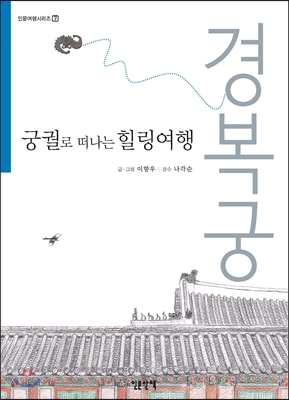
A healing trip to the palace: Gyeongbokgung Palace
 |
Description
Book Introduction
This book was planned by the author, who has been active as a ‘Guardian of Our Palaces’ for over 10 years, to help people gain a correct understanding of our palaces.
The author recalls feeling sorry whenever he saw people hurrying past our beautiful palace as if they were taking a quick peek at someone else's house, or people who came in a noisy crowd and just glanced around the building.
This is because a palace is not a boring space buried in history for a long time and accessible only through records, but rather a space that breathes with the scent of the people who lived there in the past.
There are five palaces in Seoul: Gyeongbokgung, Changdeokgung, Changgyeonggung, Deoksugung, and Gyeonghuigung.
The first part of the "Healing Journey to the Palace" begins at Gwanghwamun Square in Sejong-ro, renewing our historical awareness and awakening our dry sensibilities.
As we follow the author's sensibility as he interprets the history of Sejong-ro and Gwanghwamun, the heart of South Korea's politics and economy, along with the joys and sorrows of Gyeongbokgung Palace, we discover that hidden histories lie in places we have not yet paid attention to, and that these histories are connected to our own wounds.
By listening to the wounds of our history, the palace tour realizes that 'my healing' is directly connected to 'the healing of our history', delivering the fun of a unique perspective and a touching emotion.
The author recalls feeling sorry whenever he saw people hurrying past our beautiful palace as if they were taking a quick peek at someone else's house, or people who came in a noisy crowd and just glanced around the building.
This is because a palace is not a boring space buried in history for a long time and accessible only through records, but rather a space that breathes with the scent of the people who lived there in the past.
There are five palaces in Seoul: Gyeongbokgung, Changdeokgung, Changgyeonggung, Deoksugung, and Gyeonghuigung.
The first part of the "Healing Journey to the Palace" begins at Gwanghwamun Square in Sejong-ro, renewing our historical awareness and awakening our dry sensibilities.
As we follow the author's sensibility as he interprets the history of Sejong-ro and Gwanghwamun, the heart of South Korea's politics and economy, along with the joys and sorrows of Gyeongbokgung Palace, we discover that hidden histories lie in places we have not yet paid attention to, and that these histories are connected to our own wounds.
By listening to the wounds of our history, the palace tour realizes that 'my healing' is directly connected to 'the healing of our history', delivering the fun of a unique perspective and a touching emotion.
- You can preview some of the book's contents.
Preview
index
Note
Author's Note: Palaces, Awakening Beautiful Emotions
1.
The way to Gwanghwamun
2.
Crossing the Yeongje Bridge
3.
Geunjeongjeon, dreaming of an era of peace
4.
Sajeongjeon, Thinking of the People
5.
Before the revision, meet the scholars of Jiphyeonjeon
6.
Gyeonghoeru, holding a banquet
7.
Gangnyeongjeon, the king's royal chamber
8.
Gyotaejeon, the queen's chamberlain
9.
Intoxicated by the flower wall of Jagyeongjeon
10.
Charity Party, for the Crown Prince
11.
Hamhwadang and Jipkyeongdang, enjoying contemplation
12.
Carried by the fragrance of lotus flowers at Hyangwonjeong
13.
Geoncheonggung Palace, the royal family's reign unfolds
14.
Jibokjae, Reflecting on Modern History
15.
Taewonjeon, following the laws of heaven
supplement
Ten Scenic Views of Gyeongbokgung Palace
The history of Gyeongbokgung Palace restoration
Gyeongbokgung Palace Chronology
Joseon Dynasty Family Tree
References
Author's Note: Palaces, Awakening Beautiful Emotions
1.
The way to Gwanghwamun
2.
Crossing the Yeongje Bridge
3.
Geunjeongjeon, dreaming of an era of peace
4.
Sajeongjeon, Thinking of the People
5.
Before the revision, meet the scholars of Jiphyeonjeon
6.
Gyeonghoeru, holding a banquet
7.
Gangnyeongjeon, the king's royal chamber
8.
Gyotaejeon, the queen's chamberlain
9.
Intoxicated by the flower wall of Jagyeongjeon
10.
Charity Party, for the Crown Prince
11.
Hamhwadang and Jipkyeongdang, enjoying contemplation
12.
Carried by the fragrance of lotus flowers at Hyangwonjeong
13.
Geoncheonggung Palace, the royal family's reign unfolds
14.
Jibokjae, Reflecting on Modern History
15.
Taewonjeon, following the laws of heaven
supplement
Ten Scenic Views of Gyeongbokgung Palace
The history of Gyeongbokgung Palace restoration
Gyeongbokgung Palace Chronology
Joseon Dynasty Family Tree
References
Detailed image
Into the book
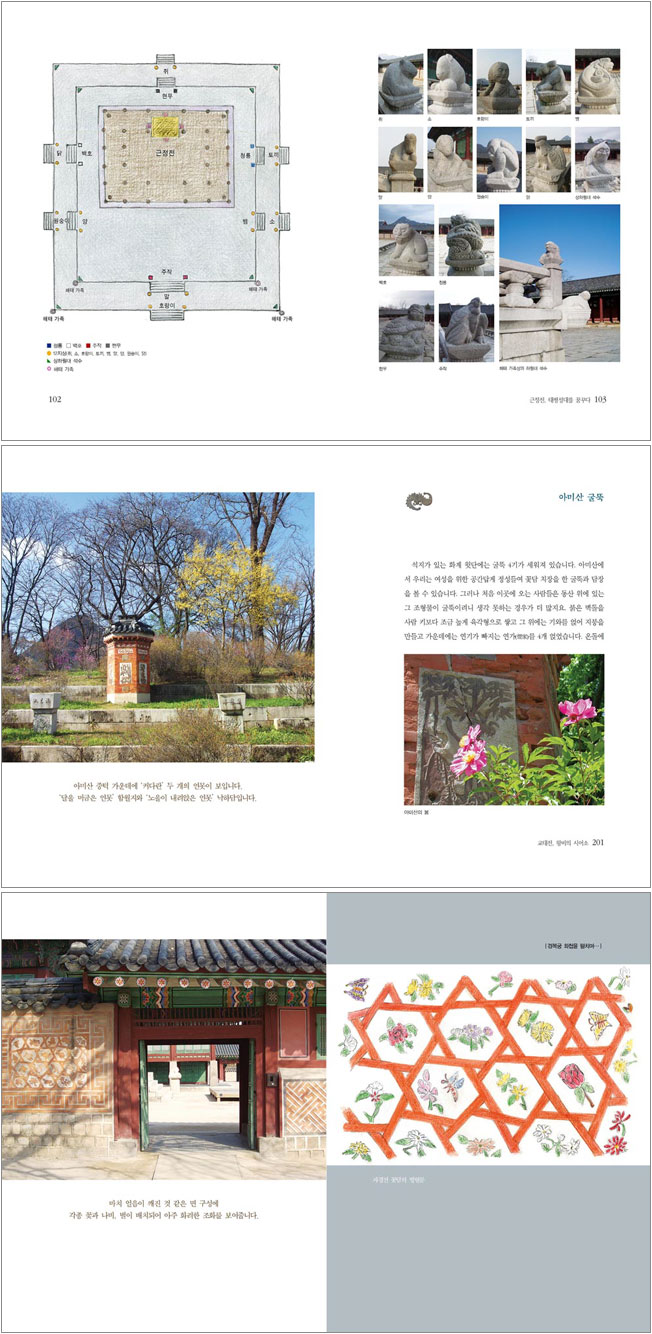
When we look at the ordinal sculptures of Chinese or Japanese palaces, we are shocked by the realistic appearance of their murderous appearance and are actually afraid.
In fact, it is only by having such a scary impression that one can feel a sense of dignity and intimidation towards those approaching the palace.
Granite is a hard, rough stone.
If you try to depict such a stone in such a realistic and detailed way, you might end up going against the nature of the stone.
Our ancient Joseon stonemasons would have known the properties of stone and allowed the stone to create the impression it wanted to create.
The stone carvings of Geunjeongjeon Hall demonstrate the outstanding skill of Joseon stonemasons who brought out the rough, rough, yet warm nature of granite, the most common stone excavated from this land. --- p.100
On each side of the chimney, auspicious patterns such as the ten symbols of longevity, the four noble plants, swastikas, and arabesques were baked and inlaid along with evil spirit patterns such as dragons and starfishes, transforming the chimney, which can easily become dull, into a beautiful sculpture.
The plum blossoms painted on each side of the Amisan chimney are a painting of birds and flowers, containing the songs of birds announcing the arrival of spring.
Plum blossoms and birds, bats and cranes that bring good fortune, harmonize with the flower wall of the chimney and decorate the garden.
I wonder if there is another nation in the world that so beautifully decorates its chimneys, designates them as treasures, and appreciates their beauty.
I cannot help but admire the poetic sense of our ancestors who decorated a small mountain and named it Amisan, where immortals live.
Moreover, the Nakhwadam and Hamwolji are ponds filled with the sunset and the moon, so how great is this nature?
It is a very high-level borrowing culture. --- p.202
On the wall, there is a painting of a plum tree with a full moon in the background, with a young bird flying in and resting.
Here we can read a metaphor describing the woman living within this wall as the beautiful Moon Palace (月宮) Hang'er (姮娥).
But for whom was the flower wall installed on the outer wall of this Jakyeongjeon painting intended?
If the original flower wall decoration was done in the courtyard where the owner of the house could see it, the owner of this plum flower wall would have been Hang-a, who lived in Jamidang.
It makes us think again about the fact that we knew that the flower wall was for Queen Dowager Jo, who was the owner of Jagyeongjeon.
Some say that this bird sitting on the plum branch of the flower wall of Jagyeongjeon is a whistling bird that sings with the most beautiful voice.
The whistle-bird perched on a hundred-year-old plum branch in the flower wall may be singing the song of spring, along with the apricot blossoms that bloom every year at the Jamidang site and announce spring. --- p.227
Even now, the stones that were burned during the great earthquake are peeling off their flesh in the shade of the Noksan forest.
The fact that the remains are located in the very place where the Japanese burned Empress Myeongseong's body makes us feel heartbroken once again about our powerless history at that time.
When a country is lost, not only people but also buildings suffer like this.
In fact, it is only by having such a scary impression that one can feel a sense of dignity and intimidation towards those approaching the palace.
Granite is a hard, rough stone.
If you try to depict such a stone in such a realistic and detailed way, you might end up going against the nature of the stone.
Our ancient Joseon stonemasons would have known the properties of stone and allowed the stone to create the impression it wanted to create.
The stone carvings of Geunjeongjeon Hall demonstrate the outstanding skill of Joseon stonemasons who brought out the rough, rough, yet warm nature of granite, the most common stone excavated from this land. --- p.100
On each side of the chimney, auspicious patterns such as the ten symbols of longevity, the four noble plants, swastikas, and arabesques were baked and inlaid along with evil spirit patterns such as dragons and starfishes, transforming the chimney, which can easily become dull, into a beautiful sculpture.
The plum blossoms painted on each side of the Amisan chimney are a painting of birds and flowers, containing the songs of birds announcing the arrival of spring.
Plum blossoms and birds, bats and cranes that bring good fortune, harmonize with the flower wall of the chimney and decorate the garden.
I wonder if there is another nation in the world that so beautifully decorates its chimneys, designates them as treasures, and appreciates their beauty.
I cannot help but admire the poetic sense of our ancestors who decorated a small mountain and named it Amisan, where immortals live.
Moreover, the Nakhwadam and Hamwolji are ponds filled with the sunset and the moon, so how great is this nature?
It is a very high-level borrowing culture. --- p.202
On the wall, there is a painting of a plum tree with a full moon in the background, with a young bird flying in and resting.
Here we can read a metaphor describing the woman living within this wall as the beautiful Moon Palace (月宮) Hang'er (姮娥).
But for whom was the flower wall installed on the outer wall of this Jakyeongjeon painting intended?
If the original flower wall decoration was done in the courtyard where the owner of the house could see it, the owner of this plum flower wall would have been Hang-a, who lived in Jamidang.
It makes us think again about the fact that we knew that the flower wall was for Queen Dowager Jo, who was the owner of Jagyeongjeon.
Some say that this bird sitting on the plum branch of the flower wall of Jagyeongjeon is a whistling bird that sings with the most beautiful voice.
The whistle-bird perched on a hundred-year-old plum branch in the flower wall may be singing the song of spring, along with the apricot blossoms that bloom every year at the Jamidang site and announce spring. --- p.227
Even now, the stones that were burned during the great earthquake are peeling off their flesh in the shade of the Noksan forest.
The fact that the remains are located in the very place where the Japanese burned Empress Myeongseong's body makes us feel heartbroken once again about our powerless history at that time.
When a country is lost, not only people but also buildings suffer like this.
--- p.305
Publisher's Review
During the 36 years of Japanese colonial rule, our palaces endured times of destruction and wounds.
Now, the palace is a healing space for us, a place that heals our dry emotions.
At the same time, the palace also needs healing by telling its own wounds and history.
1.
The palace is healing!
Built in 1873, Geoncheonggung Palace is another palace within the palace complex, where King Gojong emerged from the shadow of his father, Heungseong Daewongun, and demonstrated his will to rule the nation.
However, in 1895, the Eulmi Incident occurred, in which Empress Myeongseong was assassinated by the Japanese.
As a result of this incident, Emperor Gojong took refuge in the Russian legation in 1896, and Geoncheonggung Palace disappeared in 1909 after evidence was destroyed by the Japanese.
Perhaps this history of humiliation began in Geoncheonggung Palace, where the sky was clear and the sorrow was even greater.
Until October 2007, when the restored Geoncheonggung Palace was opened to the public, over 100 years after the Eulmi Incident, we were unaware of the tragic scene.
Soon after, on August 22, 1910, the Japan-Korea Annexation Treaty was forcibly signed, robbing Joseon of its sovereignty. Following this, the Japanese began to destroy palaces in earnest, starting with the Joseon Products Exhibition in 1915, commemorating the fifth anniversary of the Japanese occupation.
Gyeongbokgung Palace was completely destroyed by the Japanese around 1915. The first to disappear was the site of Gwolnaegaksa, a small government office in the palace, leaving only Sujeongjeon Hall. Seosipjagak and other buildings were destroyed, leaving only one-tenth of its original appearance.
In 1926, the building of the Government-General of Korea was completed, and Gwanghwamun, the main gate of Gyeongbokgung Palace, was moved to Geonchunmun, the west gate.
Moreover, from around 1935 onwards, it was destined to be opened to the public as an amusement park.
Gyeongbokgung Palace, the first palace and legal palace of Joseon, was a space where the spirit of our people lived and breathed, but it was thoroughly destroyed during the 36 years of Japanese colonial rule, and the lives of our people were stained with humiliation, pain, and wounds.
Having endured that humiliating time, and half a century after liberation, the restoration of our history is now in full swing. The author suggests a palace walk as a space to rediscover the beauty of the restored palace and heal our parched sensibilities.
2.
A tour of Gyeongbokgung Palace told by a palace guard!
This book begins its journey to Gyeongbokgung Palace at Gwanghwamun Square in Sejong-ro.
Built in 1395 as the main gate of Gyeongbokgung Palace, Gwanghwamun holds a sad yet admirable history, having endured the suffering of the Joseon Dynasty during the Japanese colonial period.
The author orders us to look at Gwanghwamun from the front, and then encourages us to muster up the courage to see the 'Commemorative Vision' located in front of the Kyobo Building.
Because no one is interested in it, just wandering around there will attract attention.
This passage reminds us that we must have the courage to know our history.
When you enter the palace facing Gwanghwamun Gate, cute stone animals of Yeongjegyo greet you.
You will see the cute sight of stone beasts sticking out their tongues and making 'merong' sounds as they drive away evil spirits, and when you pass through Heungryemun and Geunjeongmun and reach Geunjeongjeon, you will come across numerous stone statues decorating the Sangwoldae and Hawoldae.
Through the stone sculptures with comical expressions, such as a monkey that seems to have experienced all the hardships of life in a dignified palace and a baby haetae sucking vigorously at its mother's milk, we can read about the excellent skills and simple hearts of the ancient Joseon stonemasons.
When you enter Sajeongjeon or Gangnyeongjeon, the king's quarters, you are reminded of the heated debates between the king and his subjects, who worked tirelessly day and night for the people. And when you enter the flower walls of Gyotaejeon and Jagyeongjeon, the women's quarters, you are amazed by the beauty of our palaces, which cannot be found in any other country in the world.
Moreover, they create great nature by carving flowers and birds into even the smallest chimney, calling a small hill a mountain where immortals live, and referring to a small rocky spot as a pond filled with sunset and moon.
It also offers the fun of exploring the palace's side rooms with their splendid Dancheong paintings and the view of the Inwangjesaek from the second-floor pavilion of Gyeonghoeru.
If you continue walking north, you will see Hyangwonjeong, Geoncheonggung, and Jibokjae, which will give you a chance to look back on the painful modern history.
The fact that the introduction of electric civilization two years before China and Japan is indicated by a small signpost on the north side of Hyangwonjeong Pavilion, but it is regrettable that we can only leave the historical significance of this whirlwind to the imagination.
In Geoncheonggung Palace and Jibokjae, you can see that Emperor Gojong, who was stripped of his national sovereignty and was considered an incompetent monarch, made efforts to reform the country. In Noksan Mountain, which leads to Cheonghwimun Gate, you can picture the spirit of Empress Myeongseong.
When you turn around and arrive at Sinmumun, the north gate of Gyeongbokgung Palace, you will see the Blue House right in front of you.
The author urges that this be a time to reflect on our history today while looking at the distant Baekak and Cheong Wa Dae, and to rediscover the meaning of palace tours.
3.
Alive, our palace!
The old people are gone, and now we have to read their lives and pain through the spaces they lived in, but our palaces, which preserve 500 years of history, are slowly awakening and telling their own stories.
The author, who walked into the history of the palace to hear its story, discovered its beauty and story above all else, and discovered its value as a living palace.
To convey the vivid voice of history, we delve into historical records and express its beauty through paintings and photographs.
He finds ordinary places that no one pays attention to, such as the Gwanghwamun Palace, the stone slabs of Geunjeongjeon Hall, the stone pillars and animal statues of Geunjeongjeon Hall, the alleys between the pavilions, and the overlapping roof lines of the pavilions, and expresses them in paintings. He does not miss even the slightest detail, such as expressing the ice ridge patterns carved into the monochrome bricks with brilliant colors.
The Gyeongbokgung Palace painting album is completed by breathing life into the palace's changing colors according to the four seasons of spring, summer, fall, and winter.
Additionally, the author points out viewpoints for each area and shows those scenes in photographs so that readers can deeply appreciate the beauty of the palace. Readers only need to pause at each location for a moment and look at the lines and surfaces of the palace horizontally and vertically.
The book presents our palaces from various perspectives, including historical, cultural, and artistic, awakening us with a unique sensibility to the inevitability of cherishing and loving our palaces.
Now, the palace is a healing space for us, a place that heals our dry emotions.
At the same time, the palace also needs healing by telling its own wounds and history.
1.
The palace is healing!
Built in 1873, Geoncheonggung Palace is another palace within the palace complex, where King Gojong emerged from the shadow of his father, Heungseong Daewongun, and demonstrated his will to rule the nation.
However, in 1895, the Eulmi Incident occurred, in which Empress Myeongseong was assassinated by the Japanese.
As a result of this incident, Emperor Gojong took refuge in the Russian legation in 1896, and Geoncheonggung Palace disappeared in 1909 after evidence was destroyed by the Japanese.
Perhaps this history of humiliation began in Geoncheonggung Palace, where the sky was clear and the sorrow was even greater.
Until October 2007, when the restored Geoncheonggung Palace was opened to the public, over 100 years after the Eulmi Incident, we were unaware of the tragic scene.
Soon after, on August 22, 1910, the Japan-Korea Annexation Treaty was forcibly signed, robbing Joseon of its sovereignty. Following this, the Japanese began to destroy palaces in earnest, starting with the Joseon Products Exhibition in 1915, commemorating the fifth anniversary of the Japanese occupation.
Gyeongbokgung Palace was completely destroyed by the Japanese around 1915. The first to disappear was the site of Gwolnaegaksa, a small government office in the palace, leaving only Sujeongjeon Hall. Seosipjagak and other buildings were destroyed, leaving only one-tenth of its original appearance.
In 1926, the building of the Government-General of Korea was completed, and Gwanghwamun, the main gate of Gyeongbokgung Palace, was moved to Geonchunmun, the west gate.
Moreover, from around 1935 onwards, it was destined to be opened to the public as an amusement park.
Gyeongbokgung Palace, the first palace and legal palace of Joseon, was a space where the spirit of our people lived and breathed, but it was thoroughly destroyed during the 36 years of Japanese colonial rule, and the lives of our people were stained with humiliation, pain, and wounds.
Having endured that humiliating time, and half a century after liberation, the restoration of our history is now in full swing. The author suggests a palace walk as a space to rediscover the beauty of the restored palace and heal our parched sensibilities.
2.
A tour of Gyeongbokgung Palace told by a palace guard!
This book begins its journey to Gyeongbokgung Palace at Gwanghwamun Square in Sejong-ro.
Built in 1395 as the main gate of Gyeongbokgung Palace, Gwanghwamun holds a sad yet admirable history, having endured the suffering of the Joseon Dynasty during the Japanese colonial period.
The author orders us to look at Gwanghwamun from the front, and then encourages us to muster up the courage to see the 'Commemorative Vision' located in front of the Kyobo Building.
Because no one is interested in it, just wandering around there will attract attention.
This passage reminds us that we must have the courage to know our history.
When you enter the palace facing Gwanghwamun Gate, cute stone animals of Yeongjegyo greet you.
You will see the cute sight of stone beasts sticking out their tongues and making 'merong' sounds as they drive away evil spirits, and when you pass through Heungryemun and Geunjeongmun and reach Geunjeongjeon, you will come across numerous stone statues decorating the Sangwoldae and Hawoldae.
Through the stone sculptures with comical expressions, such as a monkey that seems to have experienced all the hardships of life in a dignified palace and a baby haetae sucking vigorously at its mother's milk, we can read about the excellent skills and simple hearts of the ancient Joseon stonemasons.
When you enter Sajeongjeon or Gangnyeongjeon, the king's quarters, you are reminded of the heated debates between the king and his subjects, who worked tirelessly day and night for the people. And when you enter the flower walls of Gyotaejeon and Jagyeongjeon, the women's quarters, you are amazed by the beauty of our palaces, which cannot be found in any other country in the world.
Moreover, they create great nature by carving flowers and birds into even the smallest chimney, calling a small hill a mountain where immortals live, and referring to a small rocky spot as a pond filled with sunset and moon.
It also offers the fun of exploring the palace's side rooms with their splendid Dancheong paintings and the view of the Inwangjesaek from the second-floor pavilion of Gyeonghoeru.
If you continue walking north, you will see Hyangwonjeong, Geoncheonggung, and Jibokjae, which will give you a chance to look back on the painful modern history.
The fact that the introduction of electric civilization two years before China and Japan is indicated by a small signpost on the north side of Hyangwonjeong Pavilion, but it is regrettable that we can only leave the historical significance of this whirlwind to the imagination.
In Geoncheonggung Palace and Jibokjae, you can see that Emperor Gojong, who was stripped of his national sovereignty and was considered an incompetent monarch, made efforts to reform the country. In Noksan Mountain, which leads to Cheonghwimun Gate, you can picture the spirit of Empress Myeongseong.
When you turn around and arrive at Sinmumun, the north gate of Gyeongbokgung Palace, you will see the Blue House right in front of you.
The author urges that this be a time to reflect on our history today while looking at the distant Baekak and Cheong Wa Dae, and to rediscover the meaning of palace tours.
3.
Alive, our palace!
The old people are gone, and now we have to read their lives and pain through the spaces they lived in, but our palaces, which preserve 500 years of history, are slowly awakening and telling their own stories.
The author, who walked into the history of the palace to hear its story, discovered its beauty and story above all else, and discovered its value as a living palace.
To convey the vivid voice of history, we delve into historical records and express its beauty through paintings and photographs.
He finds ordinary places that no one pays attention to, such as the Gwanghwamun Palace, the stone slabs of Geunjeongjeon Hall, the stone pillars and animal statues of Geunjeongjeon Hall, the alleys between the pavilions, and the overlapping roof lines of the pavilions, and expresses them in paintings. He does not miss even the slightest detail, such as expressing the ice ridge patterns carved into the monochrome bricks with brilliant colors.
The Gyeongbokgung Palace painting album is completed by breathing life into the palace's changing colors according to the four seasons of spring, summer, fall, and winter.
Additionally, the author points out viewpoints for each area and shows those scenes in photographs so that readers can deeply appreciate the beauty of the palace. Readers only need to pause at each location for a moment and look at the lines and surfaces of the palace horizontally and vertically.
The book presents our palaces from various perspectives, including historical, cultural, and artistic, awakening us with a unique sensibility to the inevitability of cherishing and loving our palaces.
GOODS SPECIFICS
- Date of issue: April 20, 2013
- Page count, weight, size: 344 pages | 596g | 153*210*30mm
- ISBN13: 9788998259020
- ISBN10: 8998259028
You may also like
카테고리
korean


korean

![GQ KOREA Mark (Monthly): December [2025]](http://librairie.coreenne.fr/cdn/shop/files/8ef265dbbfbf186523ed75ba7319009d.jpg?v=1765340328&width=3840)


