

Roman Tales 6
 |
Description
Book Introduction
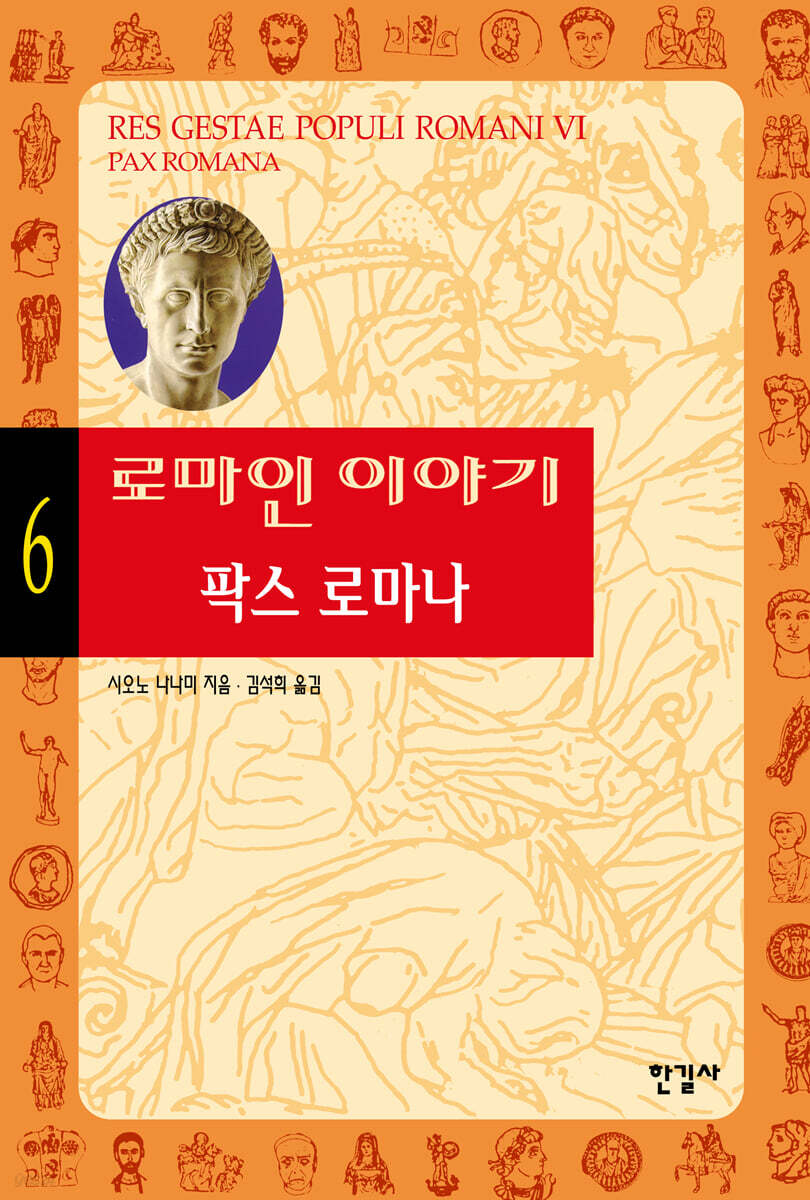
Augustus, the first emperor who inherited Caesar's grand Great Roman Policy and finally established Pax Romana.
Who is the Augustus of our time?
Who is the Augustus of our time?
- You can preview some of the book's contents.
Preview
index
Chapter 1: Early Reign
Young supreme power / Arms cuts / National census / Construction of mausoleums / Disclosure of information / 'Reorganization' of the Senate / Declaration of restoration of the Republic / 'Augustus' / Image operation / Augustus as seen by the author / Creation of 'cabinet' / Basic policy of provincial rule / 'Security guarantee' / Reorganization of the West / Creation of 'National Tax Service' / 'Lucky Arabia' / 'Tribunal privilege' / Currency reform / Electoral system reform / 'Nomenklatura' in the Roman era / Obsession with bloodlines / 'Food security' / Reorganization of the East
The Jewish Question / The Parthian Question / Egypt / Return to the Capital Rome
Chapter 2: Middle Reign
Countermeasures against the trend of having fewer children / Religious beliefs / Alps / Danube River / 'Altar of Peace' / Army reorganization / Comprehensive strategy / Creation of the Praetorian Guard / Tax reform / Agrippa / Maecenas / Germanic peoples / Administrative reform / Death of Drusus / Retirement of Tiberius
Chapter 3: The Later Reign
Grandfather Augustus's daughter's scandal / 'Father of the State' / Tiberius's return / Rebellion / Family misfortune / Poet Ovid / 'The forest is the mother of the Germans' / Death
- Chronology
- References
Young supreme power / Arms cuts / National census / Construction of mausoleums / Disclosure of information / 'Reorganization' of the Senate / Declaration of restoration of the Republic / 'Augustus' / Image operation / Augustus as seen by the author / Creation of 'cabinet' / Basic policy of provincial rule / 'Security guarantee' / Reorganization of the West / Creation of 'National Tax Service' / 'Lucky Arabia' / 'Tribunal privilege' / Currency reform / Electoral system reform / 'Nomenklatura' in the Roman era / Obsession with bloodlines / 'Food security' / Reorganization of the East
The Jewish Question / The Parthian Question / Egypt / Return to the Capital Rome
Chapter 2: Middle Reign
Countermeasures against the trend of having fewer children / Religious beliefs / Alps / Danube River / 'Altar of Peace' / Army reorganization / Comprehensive strategy / Creation of the Praetorian Guard / Tax reform / Agrippa / Maecenas / Germanic peoples / Administrative reform / Death of Drusus / Retirement of Tiberius
Chapter 3: The Later Reign
Grandfather Augustus's daughter's scandal / 'Father of the State' / Tiberius's return / Rebellion / Family misfortune / Poet Ovid / 'The forest is the mother of the Germans' / Death
- Chronology
- References
Into the book
Augustus was not a man who opened his heart to just anyone.
Caesar's bright and cheerful personality, which always brought laughter to those around him regardless of whether the situation was difficult or happy, attracted people and brightened the atmosphere.
In contrast to Caesar, there was always silence around Augustus, and people watched him from a distance.
That was Augustus' interpersonal relationship.
If Caesar captivated people with his emotions, Augustus filled them with admiration.
Caesar's bright and cheerful personality, which always brought laughter to those around him regardless of whether the situation was difficult or happy, attracted people and brightened the atmosphere.
In contrast to Caesar, there was always silence around Augustus, and people watched him from a distance.
That was Augustus' interpersonal relationship.
If Caesar captivated people with his emotions, Augustus filled them with admiration.
--- p.292
Thanks to you.
It is also how our lives are made.
Thanks to you.
So that we can travel safely.
Thanks to you.
So that we can live freely and peacefully.
This unexpected praise made old Augustus truly happy.
He instructed them to give each person 40 gold pieces.
However, conditions were placed on the use of the gold coins.
The idea was to use the money to buy Egyptian goods and sell them elsewhere.
Even in his old age, Augustus remained a practical man.
Only when goods are freely circulated can the economic power of the entire empire improve and the standard of living rise.
And it was Pax that made that possible.
Thanks to you.
It is also how our lives are made.
Thanks to you.
So that we can travel safely.
Thanks to you.
So that we can live freely and peacefully.
This unexpected praise made old Augustus truly happy.
He instructed them to give each person 40 gold pieces.
However, conditions were placed on the use of the gold coins.
The idea was to use the money to buy Egyptian goods and sell them elsewhere.
Even in his old age, Augustus remained a practical man.
Only when goods are freely circulated can the economic power of the entire empire improve and the standard of living rise.
And it was Pax that made that possible.
It is also how our lives are made.
Thanks to you.
So that we can travel safely.
Thanks to you.
So that we can live freely and peacefully.
This unexpected praise made old Augustus truly happy.
He instructed them to give each person 40 gold pieces.
However, conditions were placed on the use of the gold coins.
The idea was to use the money to buy Egyptian goods and sell them elsewhere.
Even in his old age, Augustus remained a practical man.
Only when goods are freely circulated can the economic power of the entire empire improve and the standard of living rise.
And it was Pax that made that possible.
Thanks to you.
It is also how our lives are made.
Thanks to you.
So that we can travel safely.
Thanks to you.
So that we can live freely and peacefully.
This unexpected praise made old Augustus truly happy.
He instructed them to give each person 40 gold pieces.
However, conditions were placed on the use of the gold coins.
The idea was to use the money to buy Egyptian goods and sell them elsewhere.
Even in his old age, Augustus remained a practical man.
Only when goods are freely circulated can the economic power of the entire empire improve and the standard of living rise.
And it was Pax that made that possible.
--- p.379
Even the republican historian Tacitus praised Caesar as having a talent comparable to that of a god.
Later historian Mommsen also evaluated Caesar as the only creative genius Rome produced.
Augustus was a genius in building a solid and lasting empire where the signs were set.
But it was Caesar who put up the sign.
If we adopt the mindset that true intelligence is only possible if one possesses creativity, then wouldn't Augustus receive a score of 80?
The problem is 'persuasiveness'.
It is the ability to convey one's thoughts to others through sentences or speeches and convince them of them.
What you convey is important, but how you convey it is also important.
Only when these two things are combined can you persuade others.
In this regard, how many points would it be appropriate to give Augustus?
Even the republican historian Tacitus praised Caesar as having a talent comparable to that of a god.
Later historian Mommsen also evaluated Caesar as the only creative genius Rome produced.
Augustus was a genius in building a solid and lasting empire where the signs were set.
But it was Caesar who put up the sign.
If we adopt the mindset that true intelligence is only possible if one possesses creativity, then wouldn't Augustus receive a score of 80?
The problem is 'persuasiveness'.
It is the ability to convey one's thoughts to others through sentences or speeches and convince them of them.
What you convey is important, but how you convey it is also important.
Only when these two things are combined can you persuade others.
In this regard, how many points would it be appropriate to give Augustus?
Later historian Mommsen also evaluated Caesar as the only creative genius Rome produced.
Augustus was a genius in building a solid and lasting empire where the signs were set.
But it was Caesar who put up the sign.
If we adopt the mindset that true intelligence is only possible if one possesses creativity, then wouldn't Augustus receive a score of 80?
The problem is 'persuasiveness'.
It is the ability to convey one's thoughts to others through sentences or speeches and convince them of them.
What you convey is important, but how you convey it is also important.
Only when these two things are combined can you persuade others.
In this regard, how many points would it be appropriate to give Augustus?
Even the republican historian Tacitus praised Caesar as having a talent comparable to that of a god.
Later historian Mommsen also evaluated Caesar as the only creative genius Rome produced.
Augustus was a genius in building a solid and lasting empire where the signs were set.
But it was Caesar who put up the sign.
If we adopt the mindset that true intelligence is only possible if one possesses creativity, then wouldn't Augustus receive a score of 80?
The problem is 'persuasiveness'.
It is the ability to convey one's thoughts to others through sentences or speeches and convince them of them.
What you convey is important, but how you convey it is also important.
Only when these two things are combined can you persuade others.
In this regard, how many points would it be appropriate to give Augustus?
--- p.256
Publisher's Review
There is no doubt that Shiono Nanami is a sincere and diligent writer.
He has kept his promise to write a comprehensive history of the Roman Empire, one volume per year, totaling 15 volumes, by the year 2006.
Moreover, when we consider that this was not a promise made in a half-hearted manner, but rather a promise made through meticulous preparation and tenacious persistence, we realize anew that we cannot dismiss that slender Japanese woman as a writer.
Countless readers awaited the publication of "The Roman Story," and Shiono did not disappoint.
He has prepared a story that is perfect for today, when we are closing the millennium and opening the new one.
"A serious crisis befell the Roman Empire, which lasted five hundred years! How did the Romans overcome it?" This is the theme Shiono explores in Volume 8, "Crisis and Overcoming."
What Shiono possesses as a writer is, above all, his exquisite ability to capture the timeliness of his writing.
Shiono never neglects to read the present and look to the future using the meticulously revealed history of the Romans as a mirror.
He has kept his promise to write a comprehensive history of the Roman Empire, one volume per year, totaling 15 volumes, by the year 2006.
Moreover, when we consider that this was not a promise made in a half-hearted manner, but rather a promise made through meticulous preparation and tenacious persistence, we realize anew that we cannot dismiss that slender Japanese woman as a writer.
Countless readers awaited the publication of "The Roman Story," and Shiono did not disappoint.
He has prepared a story that is perfect for today, when we are closing the millennium and opening the new one.
"A serious crisis befell the Roman Empire, which lasted five hundred years! How did the Romans overcome it?" This is the theme Shiono explores in Volume 8, "Crisis and Overcoming."
What Shiono possesses as a writer is, above all, his exquisite ability to capture the timeliness of his writing.
Shiono never neglects to read the present and look to the future using the meticulously revealed history of the Romans as a mirror.
GOODS SPECIFICS
- Date of issue: August 25, 1997
- Page count, weight, size: 396 pages | 451g | 148*210*30mm
- ISBN13: 9788935610853
- ISBN10: 8935610852
You may also like
카테고리
korean


korean

![GQ KOREA Mark (Monthly): December [2025]](http://librairie.coreenne.fr/cdn/shop/files/8ef265dbbfbf186523ed75ba7319009d.jpg?v=1765340328&width=3840)


