

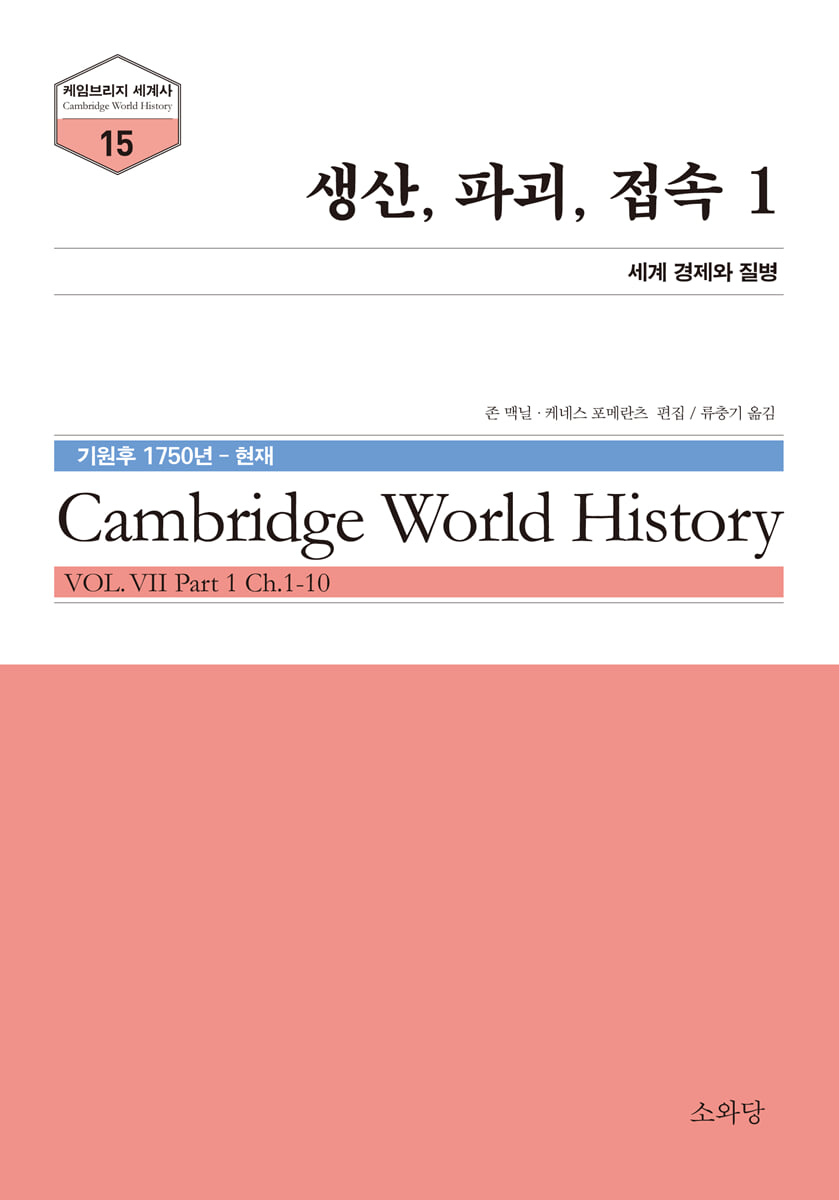
Production, Destruction, Connection 1
 |
Description
Book Introduction
Volumes 15-18 of the Cambridge World History series examine the changing world since 1750 as it has become increasingly interconnected.
First, volumes 15 and 16 deal with the structure, space, and process by which the modern world was created.
It covers a wide range of topics, including the environment, energy, technology, population, disease, law, industrialization, imperialism, decolonization, nationalism, socialism, and the history of major regions.
Additionally, volumes 17 and 18 examine social phenomena such as urbanization, population movement (migration), and changes in family and gender.
It also covers various cultural exchanges such as religion, science, music, and sports.
We also looked at the history of rubber, drugs, and automobiles, which are key elements of globalization.
First, volumes 15 and 16 deal with the structure, space, and process by which the modern world was created.
It covers a wide range of topics, including the environment, energy, technology, population, disease, law, industrialization, imperialism, decolonization, nationalism, socialism, and the history of major regions.
Additionally, volumes 17 and 18 examine social phenomena such as urbanization, population movement (migration), and changes in family and gender.
It also covers various cultural exchanges such as religion, science, music, and sports.
We also looked at the history of rubber, drugs, and automobiles, which are key elements of globalization.
- You can preview some of the book's contents.
Preview
index
PART 1 Material Basis
CHAPTER 1 Introduction: Production, Destruction, and Access: 1750–Present
CHAPTER 2 Energy, Population, and Environmental Change
CHAPTER 3 Agricultural Economics
CHAPTER 4: Global Industrialization from a Polycentric Perspective
CHAPTER 5: A World History of Technology
CHAPTER 6: THE WORLD OF NEW ENERGY
PART 2 POPULATION AND DISEASE
CHAPTER 7 POPULATION TRENDS AND POPULATION
CHAPTER 8 POPULATION POLICY
CHAPTER 9 Disease and World History
CHAPTER 10: ERADICATION OF SMALLPOX
CHAPTER 1 Introduction: Production, Destruction, and Access: 1750–Present
CHAPTER 2 Energy, Population, and Environmental Change
CHAPTER 3 Agricultural Economics
CHAPTER 4: Global Industrialization from a Polycentric Perspective
CHAPTER 5: A World History of Technology
CHAPTER 6: THE WORLD OF NEW ENERGY
PART 2 POPULATION AND DISEASE
CHAPTER 7 POPULATION TRENDS AND POPULATION
CHAPTER 8 POPULATION POLICY
CHAPTER 9 Disease and World History
CHAPTER 10: ERADICATION OF SMALLPOX
Publisher's Review
The 15th book in the Cambridge World History series (18 volumes)
The Cambridge World History Series is a vast world history series in which over 200 scholars from around the world have participated.
The Korean version is scheduled to be published in 18 volumes.
This book is the 15th in the series, and the first of four volumes that discuss the modern and contemporary period.
Part 1 deals with the material foundations of modern and contemporary times.
This book focuses on the modern and contemporary epochal transitions centered on energy.
So, in Part 1, we discussed in depth the material foundations, namely changes in energy, agriculture, industrialization, and technology.
The discussion continues with the process of overcoming resource constraints in different ways depending on the conditions around the world, the interconnectedness of various regions and technologies, and the common environmental problems that result.
The purpose of Part 1 is to examine the history of the structural inequalities that shaped modern and contemporary transformations and to move forward with the design of a new, sustainable future.
Part 2 examines the population problem and the problem of disease.
The material foundation of modern times ultimately led to population problems.
Over the past 300 years, the world's population has exploded from 700 million to 7 billion.
This was the result of disease control and population changes, and the problem of low birth rates and aging populations finally emerged as a global issue.
Part 2 examines, through specific examples, why and how regional population policies differed, and examines how world powers cooperated or clashed in the name of disease eradication.
The Cambridge World History Series is a vast world history series in which over 200 scholars from around the world have participated.
The Korean version is scheduled to be published in 18 volumes.
This book is the 15th in the series, and the first of four volumes that discuss the modern and contemporary period.
Part 1 deals with the material foundations of modern and contemporary times.
This book focuses on the modern and contemporary epochal transitions centered on energy.
So, in Part 1, we discussed in depth the material foundations, namely changes in energy, agriculture, industrialization, and technology.
The discussion continues with the process of overcoming resource constraints in different ways depending on the conditions around the world, the interconnectedness of various regions and technologies, and the common environmental problems that result.
The purpose of Part 1 is to examine the history of the structural inequalities that shaped modern and contemporary transformations and to move forward with the design of a new, sustainable future.
Part 2 examines the population problem and the problem of disease.
The material foundation of modern times ultimately led to population problems.
Over the past 300 years, the world's population has exploded from 700 million to 7 billion.
This was the result of disease control and population changes, and the problem of low birth rates and aging populations finally emerged as a global issue.
Part 2 examines, through specific examples, why and how regional population policies differed, and examines how world powers cooperated or clashed in the name of disease eradication.
GOODS SPECIFICS
- Date of issue: October 25, 2025
- Page count, weight, size: 476 pages | 150*215*30mm
- ISBN13: 9788967220433
- ISBN10: 896722043X
You may also like
카테고리
korean


korean

![GQ KOREA Mark (Monthly): December [2025]](http://librairie.coreenne.fr/cdn/shop/files/8ef265dbbfbf186523ed75ba7319009d.jpg?v=1765340328&width=3840)


