

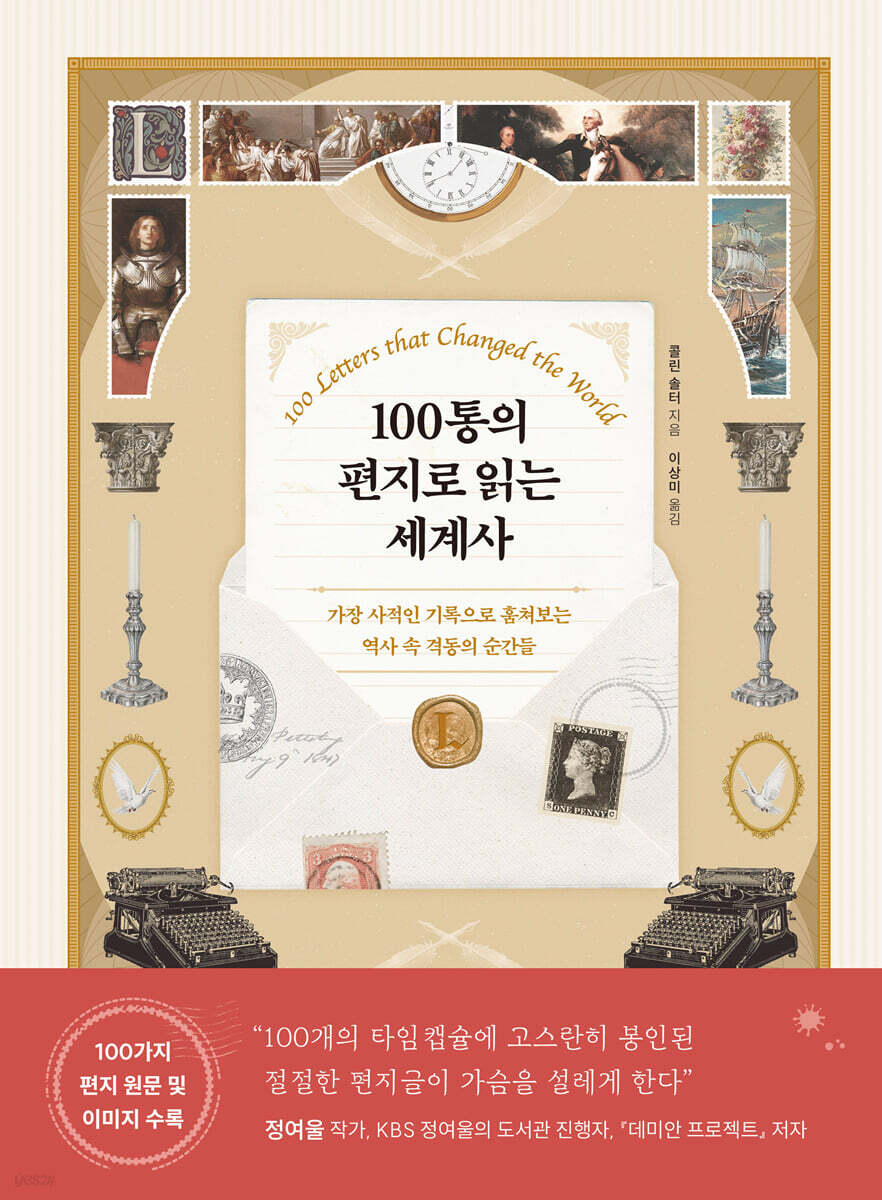
World History in 100 Letters
 |
Description
Book Introduction
True history began not in a huge library, but in a single letter in an old drawer!
How did the most intimate sentences, which were a confession of love to some and the beginning of rebellion to others, end up in history?
★★★ Highly recommended by Big Star Teacher Choi Tae-seong and author Jeong Yeo-ul
★★★ Includes 100 original letters and images
We read world history in many different ways.
You can view the trajectory of humanity over time, like a textbook, or you can examine how the world has changed, focusing on a specific topic like war or city.
In the latter case, we gain fresh insights by discovering a side of history that is not revealed in the syntax.
In that sense, ‘letter’ is a very special and fascinating subject.
A letter is a secret conversation between two people, a voice to the public and the world, and in itself becomes history.
Did anyone ever truly anticipate that their letters would one day become historical documents? That's precisely why letters contain more truthful stories than any historical record.
It is literally a 'piece of intimate history written by hand.'
This book features countless letters that have changed history across the centuries, from Pliny the Great's letter witnessing the eruption of Pompeii, to the autobiography of Renaissance genius artist Leonardo da Vinci, to Martin Luther King's appeal letter, to Bill Gates' warning letter targeting piracy.
These letters, strangely enough, make readers today feel as if they are present at the scene of history, beyond the sender and recipient of the past.
This book offers a new perspective to readers tired of stereotypical historical narratives, and offers deeper reflection to readers who love history.
It also reminds readers of the AI era, which only pursues efficiency, of the physical value and human warmth of analog handwritten letters.
This book, filled with compelling narratives and solid historical materials, as well as original letters and color images to aid readers' understanding, will allow you to experience the breath of countless people who lived, transformed, and created an era.
How did the most intimate sentences, which were a confession of love to some and the beginning of rebellion to others, end up in history?
★★★ Highly recommended by Big Star Teacher Choi Tae-seong and author Jeong Yeo-ul
★★★ Includes 100 original letters and images
We read world history in many different ways.
You can view the trajectory of humanity over time, like a textbook, or you can examine how the world has changed, focusing on a specific topic like war or city.
In the latter case, we gain fresh insights by discovering a side of history that is not revealed in the syntax.
In that sense, ‘letter’ is a very special and fascinating subject.
A letter is a secret conversation between two people, a voice to the public and the world, and in itself becomes history.
Did anyone ever truly anticipate that their letters would one day become historical documents? That's precisely why letters contain more truthful stories than any historical record.
It is literally a 'piece of intimate history written by hand.'
This book features countless letters that have changed history across the centuries, from Pliny the Great's letter witnessing the eruption of Pompeii, to the autobiography of Renaissance genius artist Leonardo da Vinci, to Martin Luther King's appeal letter, to Bill Gates' warning letter targeting piracy.
These letters, strangely enough, make readers today feel as if they are present at the scene of history, beyond the sender and recipient of the past.
This book offers a new perspective to readers tired of stereotypical historical narratives, and offers deeper reflection to readers who love history.
It also reminds readers of the AI era, which only pursues efficiency, of the physical value and human warmth of analog handwritten letters.
This book, filled with compelling narratives and solid historical materials, as well as original letters and color images to aid readers' understanding, will allow you to experience the breath of countless people who lived, transformed, and created an era.
- You can preview some of the book's contents.
Preview
index
Recommendation
Letter from the Author
1.
A short reply from the Spartans to Philip II of Macedon, circa 346 BC.
2.
In 44 BC, Caesar's assassins exchanged letters to determine their future course of action.
3.
Around 50 AD, the Apostle Paul taught the principles of Christianity through letters.
4.
A letter carved on a woodblock around 100 AD reveals life on the outskirts of the empire.
5.
Pliny describes the eruption of Pompeii around 106/107 AD.
6.
Around 450 AD, when the empire collapsed, the Britons appealed to Rome for help.
7.
1215: English nobles attempt to demonstrate their legal power after the Magna Carta
8.
1429 Joan of Arc tells Henry VI that God is on her side
9.
Leonardo da Vinci sends a letter of introduction to the Duke of Milan in the 1480s.
10.
1485 Henry VII writes to the English nobility asking for support
11.
Columbus explains his new discovery to the King of Spain in 1493.
12.
1521 Martin Luther says, "Let your sins become stronger."
13.
1528 Henry VIII writes a love letter to Anne Boleyn
14.
Exposing Spanish atrocities in the New World in 1542
15.
In 1554, Elizabeth I wrote to Bloody Mary, begging for her life.
16.
The conspiracy was uncovered in 1586 when Babington sent a coded letter to the Queen of Scotland.
17.
In 1588, the King of Spain ordered the Armada to attack England.
18.
Lord Monteagle receives a carefully written warning in 1605.
19.
Describing Galileo's first sighting of Jupiter's moons in 1610
20.
Charles II writes to reassure Parliament in 1660
21.
1688: English nobles propose rebellion against Prince William
22.
Ben Franklin's stolen mail in 1773 exposes political scandal
23.
Abigail Adams tells her husband, John, "Remember the women" in 1776.
24.
1777: George Washington hires the first spy in the Revolutionary War.
25.
1787 Jefferson advises his nephew to question the existence of God
26.
Mozart struggles to complete the Requiem in 1791.
27.
Alexander Hamilton's affair is discovered in 1791.
28.
1793 Thomas Jefferson commissions a French botanist to explore the American Northwest.
29.
Corday justifies his own murder after the French Revolution of 1793.
30.
Nelson sends a message of encouragement to the fleet on the eve of the battle in 1805.
31.
1812 Napoleon informs Alexander I that the country is now at war.
32.
Captain Swing poses a threat as machines replace labor in 1830.
33.
In 1831, Charles Darwin was offered the position of naturalist on a survey ship.
34.
The first postage stamp in 1840 changed the way letters were sent.
35.
In 1844, Fred Engels began a lifelong correspondence with Moore Marx.
36.
In 1845, Baudelaire left a will to his lover… and survived.
37.
Major Robert Anderson reports the surrender of Fort Sumter in 1861.
38.
Sullivan Ballou writes a letter to his wife during the American Civil War, 1861.
39.
Abraham Lincoln issues an ultimatum to General McClellan in 1862.
40.
Abraham Lincoln outlines his priorities for the Civil War in 1862.
41.
In 1863, William Banting wanted to share his weight loss method with the world.
42.
In 1864, General Sherman reminded the citizens of Atlanta of the horrors of war.
43.
Vincent van Gogh sends a touching letter to his brother Theo in 1880.
44.
In 1888, the Chicago Methodist Training School sent out its first "chain letter."
45.
In 1890, Williams sent an open letter of anger to the King of Belgium.
46.
1892 Bell writes a letter to Helen Keller's teacher, Sullivan
47.
Beatrix Potter illustrated a letter for five-year-old Noel Moore in 1893.
48.
Pierre Curie sends a love letter to Maria in 1894
49.
Oscar Wilde writes a letter from Reading Gaol in 1897.
50.
Émile Zola exposes a conspiracy by the French army in 1898.
51.
The Wright brothers tell their father the news of their success in 1903.
52.
John Muir lobbied for conservation in 1907.
53.
In 1909, Louise Wicks Hein exposed the reality of child labor.
54.
Captain Scott of the 1912 Antarctic Expedition leaves his final letter.
55.
The last unsent letter from the Titanic in 1912 was discovered.
56.
In 1917, Germany offered Mexico the return of Texas, Arizona, and New Mexico.
57.
1917: Lord Stamfordham proposes a new name for the British royal family.
58.
Siegfried Sassoon sends an open letter to The Times in 1917.
59.
A 1919 letter from Adolf Hitler reveals his anti-Semitic tendencies.
60.
In 1935, communist spy Guy Burgess received a letter of recommendation for a job at the BBC.
61.
Eleanor Roosevelt fights racial discrimination in 1939
62.
Albert Einstein warns President Roosevelt in 1939
63.
Mussolini celebrates the German-Russian agreement in 1939
64.
Winston Churchill writes a blunt reply to his personal secretary in 1940.
65.
In 1941, Roosevelt sent Churchill a poem that impressed Abraham Lincoln.
66.
Virginia Woolf writes her final letter to her husband, Leonard, in 1941.
67.
Codebreakers send urgent request to Winston Churchill in 1941
68.
In 1941, he announced the attack on Pearl Harbor in just eight words.
69.
In 1943, General Nye forged a letter to confuse the Germans.
70.
Oppenheimer receives permission to research the atomic bomb in 1943.
71.
In 1943 J.
Edgar Hoover receives an anonymous tip-off letter.
72.
In 1943, Kennedy, stranded on the island, delivered a message to two Solomon Islanders.
73.
Tito warns Stalin to stop sending assassination squads in 1948
74.
Lillian Hellman sends a bold message to Senator McCarthy in 1952.
75.
William Borden identifies Oppenheimer as a Soviet spy in 1953.
76.
Jackie Robinson tells Eisenhower in 1958 that black people are tired of waiting.
77.
Wallace Stegner composes a hymn to American nature in 1960.
78.
Nelson Mandela issues an ultimatum to the South African Prime Minister in 1961.
79.
Decca Records sent a rejection letter to the Beatles' manager in 1962.
80.
In 1962, just before the war, Khrushchev sent a letter of reconciliation to Kennedy.
81.
Kennedy responds to Khrushchev in 1962 as tensions ease
82.
Martin Luther King Jr. writes a letter from a Birmingham jail in 1963.
83.
Profumo's resignation in 1963 ended the biggest sex scandal in British politics.
84.
1965 Che Guevara tells Fidel Castro he wants to continue the fight.
85.
James McCord writes a letter to the judge after the Watergate trial in 1973.
86.
In 1976, Ronald Wayne sold his 10 percent stake in Apple for $800.
87.
In 1976, Bill Gates wrote an open letter to stop piracy.
88.
In 1991, Michael Schumacher erased one word and became world champion.
89.
In 1999, Boris Yeltsin admitted that ruling Russia was harder than expected.
90.
Sherron Watkins criticizes Enron's questionable accounting practices in 2001.
91.
In 2003, Dr. Kelly claimed he was the source of the BBC report.
92.
Bobby Henderson calls for recognition of the Spaghetti Monster in 2005
93.
Chelsea Manning sent sensitive data to WikiLeaks in 2010.
94.
Astronauts lament America's weakening space competitiveness in 2010.
95.
The band Pussy Riot discusses philosophy with Slavoj Zizek in 2013.
96.
In 2013, Edward Snowden revealed shocking facts to German media.
97.
2013 Whistleblowers Appeal to Future Whistleblowers
98.
2017 ~ Following the art boom, letter investment boom begins.
99.
Women in the Entertainment Industry Demand Change in 2018
100.
Greta Thunberg reads a letter to the Indian Prime Minister in 2019.
Appendix: Helen Keller and Bell's Lifelong Friendship
Acknowledgements
Letter from the Author
1.
A short reply from the Spartans to Philip II of Macedon, circa 346 BC.
2.
In 44 BC, Caesar's assassins exchanged letters to determine their future course of action.
3.
Around 50 AD, the Apostle Paul taught the principles of Christianity through letters.
4.
A letter carved on a woodblock around 100 AD reveals life on the outskirts of the empire.
5.
Pliny describes the eruption of Pompeii around 106/107 AD.
6.
Around 450 AD, when the empire collapsed, the Britons appealed to Rome for help.
7.
1215: English nobles attempt to demonstrate their legal power after the Magna Carta
8.
1429 Joan of Arc tells Henry VI that God is on her side
9.
Leonardo da Vinci sends a letter of introduction to the Duke of Milan in the 1480s.
10.
1485 Henry VII writes to the English nobility asking for support
11.
Columbus explains his new discovery to the King of Spain in 1493.
12.
1521 Martin Luther says, "Let your sins become stronger."
13.
1528 Henry VIII writes a love letter to Anne Boleyn
14.
Exposing Spanish atrocities in the New World in 1542
15.
In 1554, Elizabeth I wrote to Bloody Mary, begging for her life.
16.
The conspiracy was uncovered in 1586 when Babington sent a coded letter to the Queen of Scotland.
17.
In 1588, the King of Spain ordered the Armada to attack England.
18.
Lord Monteagle receives a carefully written warning in 1605.
19.
Describing Galileo's first sighting of Jupiter's moons in 1610
20.
Charles II writes to reassure Parliament in 1660
21.
1688: English nobles propose rebellion against Prince William
22.
Ben Franklin's stolen mail in 1773 exposes political scandal
23.
Abigail Adams tells her husband, John, "Remember the women" in 1776.
24.
1777: George Washington hires the first spy in the Revolutionary War.
25.
1787 Jefferson advises his nephew to question the existence of God
26.
Mozart struggles to complete the Requiem in 1791.
27.
Alexander Hamilton's affair is discovered in 1791.
28.
1793 Thomas Jefferson commissions a French botanist to explore the American Northwest.
29.
Corday justifies his own murder after the French Revolution of 1793.
30.
Nelson sends a message of encouragement to the fleet on the eve of the battle in 1805.
31.
1812 Napoleon informs Alexander I that the country is now at war.
32.
Captain Swing poses a threat as machines replace labor in 1830.
33.
In 1831, Charles Darwin was offered the position of naturalist on a survey ship.
34.
The first postage stamp in 1840 changed the way letters were sent.
35.
In 1844, Fred Engels began a lifelong correspondence with Moore Marx.
36.
In 1845, Baudelaire left a will to his lover… and survived.
37.
Major Robert Anderson reports the surrender of Fort Sumter in 1861.
38.
Sullivan Ballou writes a letter to his wife during the American Civil War, 1861.
39.
Abraham Lincoln issues an ultimatum to General McClellan in 1862.
40.
Abraham Lincoln outlines his priorities for the Civil War in 1862.
41.
In 1863, William Banting wanted to share his weight loss method with the world.
42.
In 1864, General Sherman reminded the citizens of Atlanta of the horrors of war.
43.
Vincent van Gogh sends a touching letter to his brother Theo in 1880.
44.
In 1888, the Chicago Methodist Training School sent out its first "chain letter."
45.
In 1890, Williams sent an open letter of anger to the King of Belgium.
46.
1892 Bell writes a letter to Helen Keller's teacher, Sullivan
47.
Beatrix Potter illustrated a letter for five-year-old Noel Moore in 1893.
48.
Pierre Curie sends a love letter to Maria in 1894
49.
Oscar Wilde writes a letter from Reading Gaol in 1897.
50.
Émile Zola exposes a conspiracy by the French army in 1898.
51.
The Wright brothers tell their father the news of their success in 1903.
52.
John Muir lobbied for conservation in 1907.
53.
In 1909, Louise Wicks Hein exposed the reality of child labor.
54.
Captain Scott of the 1912 Antarctic Expedition leaves his final letter.
55.
The last unsent letter from the Titanic in 1912 was discovered.
56.
In 1917, Germany offered Mexico the return of Texas, Arizona, and New Mexico.
57.
1917: Lord Stamfordham proposes a new name for the British royal family.
58.
Siegfried Sassoon sends an open letter to The Times in 1917.
59.
A 1919 letter from Adolf Hitler reveals his anti-Semitic tendencies.
60.
In 1935, communist spy Guy Burgess received a letter of recommendation for a job at the BBC.
61.
Eleanor Roosevelt fights racial discrimination in 1939
62.
Albert Einstein warns President Roosevelt in 1939
63.
Mussolini celebrates the German-Russian agreement in 1939
64.
Winston Churchill writes a blunt reply to his personal secretary in 1940.
65.
In 1941, Roosevelt sent Churchill a poem that impressed Abraham Lincoln.
66.
Virginia Woolf writes her final letter to her husband, Leonard, in 1941.
67.
Codebreakers send urgent request to Winston Churchill in 1941
68.
In 1941, he announced the attack on Pearl Harbor in just eight words.
69.
In 1943, General Nye forged a letter to confuse the Germans.
70.
Oppenheimer receives permission to research the atomic bomb in 1943.
71.
In 1943 J.
Edgar Hoover receives an anonymous tip-off letter.
72.
In 1943, Kennedy, stranded on the island, delivered a message to two Solomon Islanders.
73.
Tito warns Stalin to stop sending assassination squads in 1948
74.
Lillian Hellman sends a bold message to Senator McCarthy in 1952.
75.
William Borden identifies Oppenheimer as a Soviet spy in 1953.
76.
Jackie Robinson tells Eisenhower in 1958 that black people are tired of waiting.
77.
Wallace Stegner composes a hymn to American nature in 1960.
78.
Nelson Mandela issues an ultimatum to the South African Prime Minister in 1961.
79.
Decca Records sent a rejection letter to the Beatles' manager in 1962.
80.
In 1962, just before the war, Khrushchev sent a letter of reconciliation to Kennedy.
81.
Kennedy responds to Khrushchev in 1962 as tensions ease
82.
Martin Luther King Jr. writes a letter from a Birmingham jail in 1963.
83.
Profumo's resignation in 1963 ended the biggest sex scandal in British politics.
84.
1965 Che Guevara tells Fidel Castro he wants to continue the fight.
85.
James McCord writes a letter to the judge after the Watergate trial in 1973.
86.
In 1976, Ronald Wayne sold his 10 percent stake in Apple for $800.
87.
In 1976, Bill Gates wrote an open letter to stop piracy.
88.
In 1991, Michael Schumacher erased one word and became world champion.
89.
In 1999, Boris Yeltsin admitted that ruling Russia was harder than expected.
90.
Sherron Watkins criticizes Enron's questionable accounting practices in 2001.
91.
In 2003, Dr. Kelly claimed he was the source of the BBC report.
92.
Bobby Henderson calls for recognition of the Spaghetti Monster in 2005
93.
Chelsea Manning sent sensitive data to WikiLeaks in 2010.
94.
Astronauts lament America's weakening space competitiveness in 2010.
95.
The band Pussy Riot discusses philosophy with Slavoj Zizek in 2013.
96.
In 2013, Edward Snowden revealed shocking facts to German media.
97.
2013 Whistleblowers Appeal to Future Whistleblowers
98.
2017 ~ Following the art boom, letter investment boom begins.
99.
Women in the Entertainment Industry Demand Change in 2018
100.
Greta Thunberg reads a letter to the Indian Prime Minister in 2019.
Appendix: Helen Keller and Bell's Lifelong Friendship
Acknowledgements
Detailed image

Into the book
As is often the case in history, what makes Pliny's letters come alive are his vivid descriptions of ordinary people.
“A torrential downpour of burning stones and ash threatened to destroy everything,” he says, noting scenes of people fleeing their quake-swaying homes and fleeing into the fields.
“They tied a pillow with a towel over their head and ran out.
“This was the only way to stop the storm of stones falling from all directions,” he recalls.
The people's fear is vividly felt in his description.
“I heard women screaming, children crying, and men shouting.
Some people called for their children, some for their parents, some for their husbands… Some wanted to die because they were afraid of death, and others prayed to God to save them.
But most people were now convinced that God was nowhere to be found, and that this was the last night we had ever heard of.”
--- p.38
Anne gave birth to a daughter, the future Elizabeth I, but, like Catherine, did not have a son.
And Henry started looking for another woman (Jane Seymour) as he had before.
Anne was beheaded on trumped-up charges of treason, adultery, and incest.
This unprecedented scandal began with love and ended in hate.
Henry signed his letter pledging to marry Anne Boleyn like a teenage boy carving his initials into a tree.
“King Henry will love only Anne Boleyn (H aultre AB ne cherse R).” And the letters AB were surrounded by hearts.
--- p.73
Nelson trusted his men to do their best and instructed his signal officer to send a message saying, “England confides that every man will do his duty.”
'Confide' means 'to trust'.
However, Lt. John Pascoe, the signal officer, pointed out that it would take a long time to send this signal because there was no signal flag called 'confide'.
“Admiral, if you could change 'confides' to 'expects,' the signal would be completed more quickly.
“The word ‘expects’ is on the signal list, but ‘confides’ is not, so we have to spell it out one letter at a time,” Nelson agreed, but the resulting message took on a more commanding tone than the original intention.
--- p.150
While slavery may have been the reason some Southern states seceded, it was their secession from the Union, not slavery, that angered Lincoln.
“The object I hold most important in this struggle is to save the Union, not to save or destroy slavery.
If I could save the Union without freeing the slaves, I would do it; and if I could save the Union by freeing all the slaves, I would do it.
And if I could save the Union by freeing some slaves and leaving others alone, I would do so.”
--- p.190
Hitler began to feverishly write a reply to Gemlich.
He told Gemlich that Jews had separated themselves from other peoples through race, religion, wealth, and “thousands of years of inbreeding.”
“There is a people living among us who are not Germans,” he argued, “and (the Jews) have neither the will nor the ability to sacrifice their racial characteristics or to deny their feelings, thoughts, and efforts.”
He added that all the Jews want is to accumulate wealth for the nation.
“Their dance around the golden calf is turning into a merciless struggle for all the possessions we cherish most on earth.”
“A torrential downpour of burning stones and ash threatened to destroy everything,” he says, noting scenes of people fleeing their quake-swaying homes and fleeing into the fields.
“They tied a pillow with a towel over their head and ran out.
“This was the only way to stop the storm of stones falling from all directions,” he recalls.
The people's fear is vividly felt in his description.
“I heard women screaming, children crying, and men shouting.
Some people called for their children, some for their parents, some for their husbands… Some wanted to die because they were afraid of death, and others prayed to God to save them.
But most people were now convinced that God was nowhere to be found, and that this was the last night we had ever heard of.”
--- p.38
Anne gave birth to a daughter, the future Elizabeth I, but, like Catherine, did not have a son.
And Henry started looking for another woman (Jane Seymour) as he had before.
Anne was beheaded on trumped-up charges of treason, adultery, and incest.
This unprecedented scandal began with love and ended in hate.
Henry signed his letter pledging to marry Anne Boleyn like a teenage boy carving his initials into a tree.
“King Henry will love only Anne Boleyn (H aultre AB ne cherse R).” And the letters AB were surrounded by hearts.
--- p.73
Nelson trusted his men to do their best and instructed his signal officer to send a message saying, “England confides that every man will do his duty.”
'Confide' means 'to trust'.
However, Lt. John Pascoe, the signal officer, pointed out that it would take a long time to send this signal because there was no signal flag called 'confide'.
“Admiral, if you could change 'confides' to 'expects,' the signal would be completed more quickly.
“The word ‘expects’ is on the signal list, but ‘confides’ is not, so we have to spell it out one letter at a time,” Nelson agreed, but the resulting message took on a more commanding tone than the original intention.
--- p.150
While slavery may have been the reason some Southern states seceded, it was their secession from the Union, not slavery, that angered Lincoln.
“The object I hold most important in this struggle is to save the Union, not to save or destroy slavery.
If I could save the Union without freeing the slaves, I would do it; and if I could save the Union by freeing all the slaves, I would do it.
And if I could save the Union by freeing some slaves and leaving others alone, I would do so.”
--- p.190
Hitler began to feverishly write a reply to Gemlich.
He told Gemlich that Jews had separated themselves from other peoples through race, religion, wealth, and “thousands of years of inbreeding.”
“There is a people living among us who are not Germans,” he argued, “and (the Jews) have neither the will nor the ability to sacrifice their racial characteristics or to deny their feelings, thoughts, and efforts.”
He added that all the Jews want is to accumulate wealth for the nation.
“Their dance around the golden calf is turning into a merciless struggle for all the possessions we cherish most on earth.”
--- p.267
Publisher's Review
Love and friendship, death and even deception…
A Piece of History in 100 Letters
Most of the history we know is written by the victors or written by later generations.
Because of this, there are many cases where facts are embellished to suit the winner's taste, or the truth is distorted due to differences in the time of the incident and the year of the record.
Sima Qian's Records of the Grand Historian covers history from 2,000 years ago, and Herodotus's Histories was also written about 700 years after the Persian Wars.
However, the numerous letters contained in 『World History in 100 Letters』 are full of the vivid emotions and breath of those who directly witnessed historical events.
Millions of historical letters remain in museums and archives around the world.
Moreover, letters of historical value are still being discovered, and new letters that will one day become history are being written.
These include letters confessing love, expressing one's beliefs, informing of new scientific discoveries, and warnings to political enemies.
This book selects 100 letters with historical significance and presents them through interesting storytelling.
A letter is not simply a text describing an event; it is a living text filled with the inner self of a person and the voice of an era.
Therefore, in this record, we can fully sense the human anger, sorrow, hesitation, and conviction that cannot be glimpsed in history textbooks.
Entrusted to us across time
The joys and sorrows of ordinary people throughout history
This book is not simply a collection of letters from celebrities.
By weaving together the historical context, events, and personal stories of each letter, the author explores how a single personal record became universal history.
Pliny's letters, written after witnessing the tragedy of Pompeii, go beyond mere observations to reveal the will of ordinary people to survive.
In the letter Galileo wrote after discovering Jupiter's satellites with the telescope he invented, we can sense the end of the age of gods and the dawn of the age of reason.
The letter accusing Oppenheimer of being a Soviet spy offers a glimpse into the terrifying madness of McCarthyism that swept America after the war.
Martin Luther King's "Letter from a Birmingham Jail" was a plea for justice, and Bill Gates' letter was a warning against the dangers of rapid technological advancement.
Greta Thunberg's video letter to the Indian Prime Minister is also a cry to us living in the era of climate crisis.
In addition, the book introduces numerous letters that are personal yet contain universal values.
These letters speak to readers across time, showing how the thoughts and feelings of ordinary individuals have moved vast civilizations.
Focus on 'people' rather than 'events'
A Heartwarming World History on Old Paper
The author shows that history is not a series of major events, but a collection of stories that began at the fingertips of one person.
While we have primarily addressed history through the lens of war, politics, and revolution, this book restores the living, breathing human voices within those gaps.
The person in these 100 letters is not a great man, a stuffed hero, or an emperor depicted in a splendid portrait, but just an ordinary person.
They feared, hesitated, and agonized like us, yet at the same time they loved to the end, fought for their beliefs with unwavering determination, and did not give up justice even in the face of fear.
This book offers a new perspective to readers tired of stereotypical historical narratives, and offers deeper reflection to readers who love history.
It also reminds readers of the AI era, which only pursues efficiency, of the physical value and human warmth of analog handwritten letters.
This book, filled with compelling narratives and solid sources, as well as original letters and color images to aid readers' understanding, will allow readers to experience the breath of countless people who lived, transformed, and created an era.
A Piece of History in 100 Letters
Most of the history we know is written by the victors or written by later generations.
Because of this, there are many cases where facts are embellished to suit the winner's taste, or the truth is distorted due to differences in the time of the incident and the year of the record.
Sima Qian's Records of the Grand Historian covers history from 2,000 years ago, and Herodotus's Histories was also written about 700 years after the Persian Wars.
However, the numerous letters contained in 『World History in 100 Letters』 are full of the vivid emotions and breath of those who directly witnessed historical events.
Millions of historical letters remain in museums and archives around the world.
Moreover, letters of historical value are still being discovered, and new letters that will one day become history are being written.
These include letters confessing love, expressing one's beliefs, informing of new scientific discoveries, and warnings to political enemies.
This book selects 100 letters with historical significance and presents them through interesting storytelling.
A letter is not simply a text describing an event; it is a living text filled with the inner self of a person and the voice of an era.
Therefore, in this record, we can fully sense the human anger, sorrow, hesitation, and conviction that cannot be glimpsed in history textbooks.
Entrusted to us across time
The joys and sorrows of ordinary people throughout history
This book is not simply a collection of letters from celebrities.
By weaving together the historical context, events, and personal stories of each letter, the author explores how a single personal record became universal history.
Pliny's letters, written after witnessing the tragedy of Pompeii, go beyond mere observations to reveal the will of ordinary people to survive.
In the letter Galileo wrote after discovering Jupiter's satellites with the telescope he invented, we can sense the end of the age of gods and the dawn of the age of reason.
The letter accusing Oppenheimer of being a Soviet spy offers a glimpse into the terrifying madness of McCarthyism that swept America after the war.
Martin Luther King's "Letter from a Birmingham Jail" was a plea for justice, and Bill Gates' letter was a warning against the dangers of rapid technological advancement.
Greta Thunberg's video letter to the Indian Prime Minister is also a cry to us living in the era of climate crisis.
In addition, the book introduces numerous letters that are personal yet contain universal values.
These letters speak to readers across time, showing how the thoughts and feelings of ordinary individuals have moved vast civilizations.
Focus on 'people' rather than 'events'
A Heartwarming World History on Old Paper
The author shows that history is not a series of major events, but a collection of stories that began at the fingertips of one person.
While we have primarily addressed history through the lens of war, politics, and revolution, this book restores the living, breathing human voices within those gaps.
The person in these 100 letters is not a great man, a stuffed hero, or an emperor depicted in a splendid portrait, but just an ordinary person.
They feared, hesitated, and agonized like us, yet at the same time they loved to the end, fought for their beliefs with unwavering determination, and did not give up justice even in the face of fear.
This book offers a new perspective to readers tired of stereotypical historical narratives, and offers deeper reflection to readers who love history.
It also reminds readers of the AI era, which only pursues efficiency, of the physical value and human warmth of analog handwritten letters.
This book, filled with compelling narratives and solid sources, as well as original letters and color images to aid readers' understanding, will allow readers to experience the breath of countless people who lived, transformed, and created an era.
GOODS SPECIFICS
- Date of issue: November 21, 2025
- Format: Hardcover book binding method guide
- Page count, weight, size: 440 pages | 170*235*30mm
- ISBN13: 9791139728477
- ISBN10: 1139728474
You may also like
카테고리
korean


korean

![GQ KOREA Mark (Monthly): December [2025]](http://librairie.coreenne.fr/cdn/shop/files/8ef265dbbfbf186523ed75ba7319009d.jpg?v=1765340328&width=3840)


