

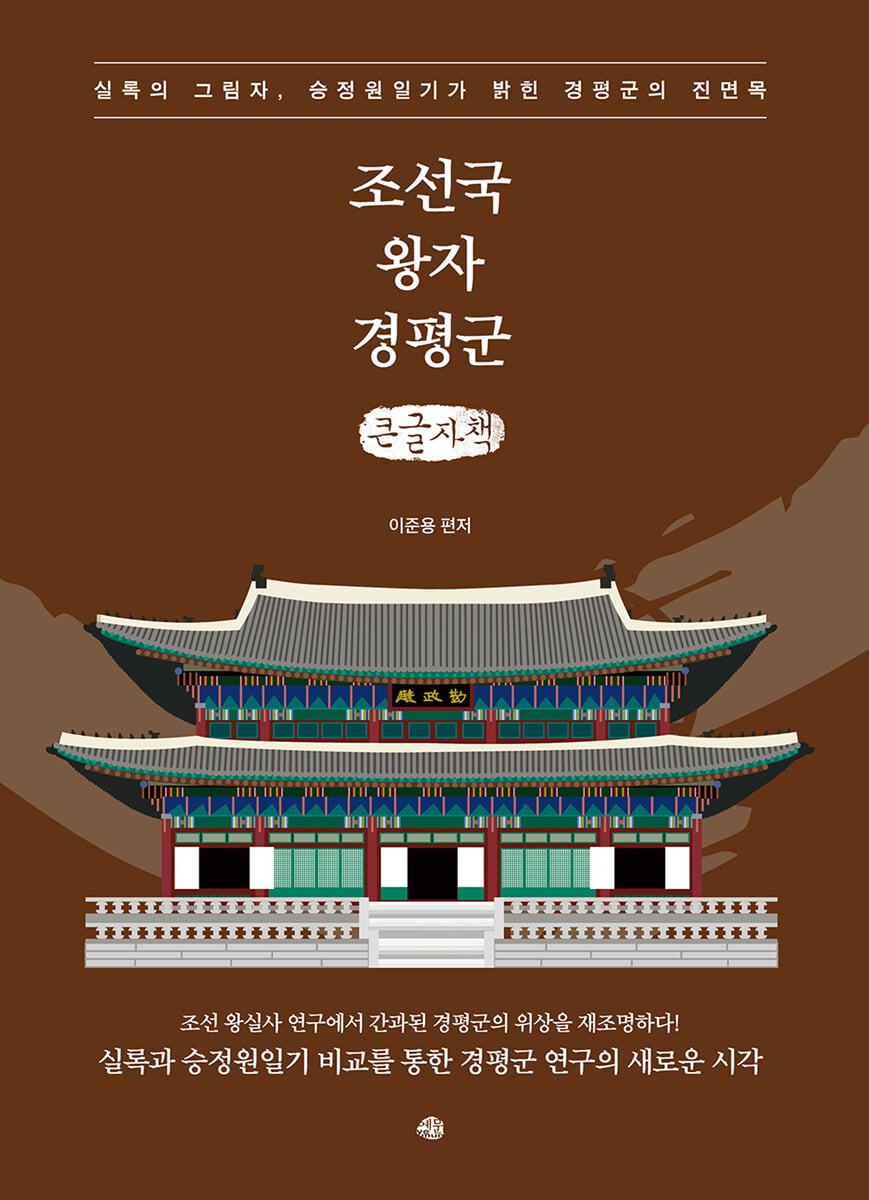
Prince Gyeongpyeong of Joseon (large print book)
 |
Description
Book Introduction
Beyond distorted records,
Rereading the Life of Prince Gyeongpyeong of Joseon
- An engaging historical exploration that questions the truth of records and dispels historical bias.
Prince Gyeongpyeong Lee Reuk, the son of King Seonjo, who endured the times with his upright character and scholarship even during the bloody power struggles of King Gwanghaegun's dethronement and the Injo Restoration.
Discover the hidden truths of his life and the mid-Joseon period, restored based on the Seungjeongwon Diaries.
『Prince Gyeongpyeong of Joseon』 brings back to life the life of a prince who walked a straight path even amidst the tragedy and conspiracy of the Joseon royal family.
King Seonjo's 11th son, Prince Gyeongpyeong, Lee Reuk, experienced the turmoil of power through five dynasties, including the dethronement of King Gwanghaegun, the Injo Restoration, and the Byeongja Horan.
Even in a reality where his brothers were murdered one after another and princes became victims of politics, he did not pursue power, but devoted himself to his studies, cultivation, and the responsibilities of head of the royal family.
However, 『Injo Sillok』 recorded him as a wicked prince.
A 16-year-old boy was even falsely accused of 'raping a widow'.
Is everything the Annals of the Joseon Dynasty truly true? The author uses the extensive primary source, the Seungjeongwon Diaries, to correct distorted records.
The Seungjeongwon Diary, meticulously recorded like a daily report, is a vivid original of history, with a much larger volume and greater truthfulness than the Annals of the Joseon Dynasty.
This book goes beyond the personal biography of Prince Gyeongpyeong and reveals the hidden side of the political history of the mid-Joseon Dynasty.
It reinterprets the true nature of the Injo Restoration, the struggle between King Gwanghaegun and his succession, and the true meaning of the Byeongja Horan, and portrays the lives of the royal family and their institutional status in a three-dimensional manner.
It is not a simple history book, but a new perspective on people and events obscured by the logic of power.
『Prince Gyeongpyeong of Joseon』 asks the reader:
“From whose perspective was the history we have believed written?” The process of tracing historical truth means revisiting Joseon through our own eyes.
The uprightness, restraint, and vanity of power revealed through the life of the forgotten prince resonate deeply with today's readers.
Rereading the Life of Prince Gyeongpyeong of Joseon
- An engaging historical exploration that questions the truth of records and dispels historical bias.
Prince Gyeongpyeong Lee Reuk, the son of King Seonjo, who endured the times with his upright character and scholarship even during the bloody power struggles of King Gwanghaegun's dethronement and the Injo Restoration.
Discover the hidden truths of his life and the mid-Joseon period, restored based on the Seungjeongwon Diaries.
『Prince Gyeongpyeong of Joseon』 brings back to life the life of a prince who walked a straight path even amidst the tragedy and conspiracy of the Joseon royal family.
King Seonjo's 11th son, Prince Gyeongpyeong, Lee Reuk, experienced the turmoil of power through five dynasties, including the dethronement of King Gwanghaegun, the Injo Restoration, and the Byeongja Horan.
Even in a reality where his brothers were murdered one after another and princes became victims of politics, he did not pursue power, but devoted himself to his studies, cultivation, and the responsibilities of head of the royal family.
However, 『Injo Sillok』 recorded him as a wicked prince.
A 16-year-old boy was even falsely accused of 'raping a widow'.
Is everything the Annals of the Joseon Dynasty truly true? The author uses the extensive primary source, the Seungjeongwon Diaries, to correct distorted records.
The Seungjeongwon Diary, meticulously recorded like a daily report, is a vivid original of history, with a much larger volume and greater truthfulness than the Annals of the Joseon Dynasty.
This book goes beyond the personal biography of Prince Gyeongpyeong and reveals the hidden side of the political history of the mid-Joseon Dynasty.
It reinterprets the true nature of the Injo Restoration, the struggle between King Gwanghaegun and his succession, and the true meaning of the Byeongja Horan, and portrays the lives of the royal family and their institutional status in a three-dimensional manner.
It is not a simple history book, but a new perspective on people and events obscured by the logic of power.
『Prince Gyeongpyeong of Joseon』 asks the reader:
“From whose perspective was the history we have believed written?” The process of tracing historical truth means revisiting Joseon through our own eyes.
The uprightness, restraint, and vanity of power revealed through the life of the forgotten prince resonate deeply with today's readers.
index
Publisher's Note: A Correct Reevaluation of Prince Gyeongpyeong as Described in the Seungjeongwon Diary
Part 1: The Story of Prince Gyeongpyeong of Joseon
Part 1: The Life of Prince Gyeongpyeong Ireuk
Pharmacist Ireuk of Gyeongpyeong-gun
The placenta chamber and stone chamber of the Seosamneung Royal Tomb of Ireuk, Gyeongpyeong-gun
Gyeongpyeonggun and Gwanghaegun
Annals of Gyeongpyeong-gun
Gyeongpyeong-gun's later years
Seungjeongwon Diary on Prince Gyeongpyeong (Hyojong, Hyeonjong)
Jongchinbu
Ranks of royal relatives in the Joseon Dynasty
Poetry of Lee Reuk of Gyeongpyeong-gun
Gyeongpyeong County's family
Part 2: Descendants of Gyeongpyeonggun, Gyeongpyeonggunpa
Gyeongpyeonggunpa Pharmacist: The 104 Princes of Joseon
Royal family titles, ranks, and relatives
The descendants of the Gyeongpyeonggunpa clan inherited military titles and passed civil and military examinations
The spirit of the Gyeongpyeonggunpa and his activities after the reign of King Jeongjo
Part 3: Family Relations of King Seonjo, the Father of Gyeongpyeonggun
King Seonjo
King Seonjo's parents and spouse
King Seonjo's children: 14 princes and 11 princesses
Part 2: Joseon Dynasty Treasures
Part 4: Records and Politics of the Joseon Dynasty
Annals of the Joseon Dynasty
Major characteristics of Joseon Dynasty politics
Part 5: A Historical Reexamination of the Mid-Joseon Period
The Reality of the Injo Restoration: The Gyehae Coup
The struggle for succession after Gwanghaegun: the Myeongbun faction and the Neungyanggun faction
Heungangun's Rebellion: The Seven-Day Joseon King
The story of the "Sangsiga" about the Injo Restoration and the Byeongja Horan
A historical reexamination of King Gwanghaegun
Part 6: Reexamining King Seonjo and the Imjin War
Reexamining King Seonjo: The Mokneung Dynasty
Seonjo and Yi Sun-sin
Part 3: 500 Years of History: The Lineage of the Kings of Joseon
Part 7: The Family Tree of the Joseon Kings
The Four Kings and the Two Generals
Kings of Joseon
Classification of the direct lineage genealogy of the Joseon Dynasty kings and the genealogy of the kings
Appendix: Highest Records, Titles, and Ranks of the Joseon Dynasty
500 Years of History, the Best and First Records
Joseon Dynasty Ranks and Official Positions (18 Ranks and 30 Grades): Jeong 1st to Jong 4th
Joseon Dynasty Ranks and Official Positions: 5th rank and below
Joseon Dynasty Military Rank Table
Editorial review
Part 1: The Story of Prince Gyeongpyeong of Joseon
Part 1: The Life of Prince Gyeongpyeong Ireuk
Pharmacist Ireuk of Gyeongpyeong-gun
The placenta chamber and stone chamber of the Seosamneung Royal Tomb of Ireuk, Gyeongpyeong-gun
Gyeongpyeonggun and Gwanghaegun
Annals of Gyeongpyeong-gun
Gyeongpyeong-gun's later years
Seungjeongwon Diary on Prince Gyeongpyeong (Hyojong, Hyeonjong)
Jongchinbu
Ranks of royal relatives in the Joseon Dynasty
Poetry of Lee Reuk of Gyeongpyeong-gun
Gyeongpyeong County's family
Part 2: Descendants of Gyeongpyeonggun, Gyeongpyeonggunpa
Gyeongpyeonggunpa Pharmacist: The 104 Princes of Joseon
Royal family titles, ranks, and relatives
The descendants of the Gyeongpyeonggunpa clan inherited military titles and passed civil and military examinations
The spirit of the Gyeongpyeonggunpa and his activities after the reign of King Jeongjo
Part 3: Family Relations of King Seonjo, the Father of Gyeongpyeonggun
King Seonjo
King Seonjo's parents and spouse
King Seonjo's children: 14 princes and 11 princesses
Part 2: Joseon Dynasty Treasures
Part 4: Records and Politics of the Joseon Dynasty
Annals of the Joseon Dynasty
Major characteristics of Joseon Dynasty politics
Part 5: A Historical Reexamination of the Mid-Joseon Period
The Reality of the Injo Restoration: The Gyehae Coup
The struggle for succession after Gwanghaegun: the Myeongbun faction and the Neungyanggun faction
Heungangun's Rebellion: The Seven-Day Joseon King
The story of the "Sangsiga" about the Injo Restoration and the Byeongja Horan
A historical reexamination of King Gwanghaegun
Part 6: Reexamining King Seonjo and the Imjin War
Reexamining King Seonjo: The Mokneung Dynasty
Seonjo and Yi Sun-sin
Part 3: 500 Years of History: The Lineage of the Kings of Joseon
Part 7: The Family Tree of the Joseon Kings
The Four Kings and the Two Generals
Kings of Joseon
Classification of the direct lineage genealogy of the Joseon Dynasty kings and the genealogy of the kings
Appendix: Highest Records, Titles, and Ranks of the Joseon Dynasty
500 Years of History, the Best and First Records
Joseon Dynasty Ranks and Official Positions (18 Ranks and 30 Grades): Jeong 1st to Jong 4th
Joseon Dynasty Ranks and Official Positions: 5th rank and below
Joseon Dynasty Military Rank Table
Editorial review
Into the book
In fact, as was the case with all of Seonjo's children, Prince Gyeongpyeong also had to constantly suffer from the checks and balances of the powerful and political forces due to the restrictions of his status as a prince. In addition, due to the reign of Gwanghaegun, the Injo Restoration, and the Rebellion of Prince Heungan, he was a thorn in the eye of King Injo and the Seoin, and was watched as the first prince to be eliminated by framing him for treason at all costs. He conducted himself well and survived his middle age, and in his later years, as the head of the highest government office and the most senior person in the royal family, he was treated with "royal treatment" for 20 years, enjoying the longest tenure and the greatest glory among the 104 princes and grand princes of the Joseon Dynasty.
--- p.20
From the perspective of King Injo and the Seoin faction, Prince Gyeongpyeong would have always been a thorn in their side and the number one prince who had to be eliminated.
Because Injo killed Prince Heungan and Prince Inseong in order to usurp the throne.
Injo's atrocities did not end here, and he even suspected and killed his eldest son, Crown Prince Sohyeon, and his daughter-in-law, Lady Min Hee-bin Kang.
It is believed that one of the reasons why Prince Gyeongpyeong does not appear in the Annals of the Joseon Dynasty is because King Injo died (after his death).
--- p.44
In an official ceremony, there is a record that says, “When the highest ranking adult head of the royal family entered, the three dukes (the first rank Prime Minister, the left and right ministers, and the right ministers) and the nine ministers (the second rank Left and Right Vice-Ministers, the third rank Six Ministries Minister, and the second rank Hanseong Panyun) all stood up immediately…”
The only rank that both the three prime ministers and the six ministers must rise to is “King.”
However, considering that treating them with the same courtesy was a “precedent that has been passed down from the past,” it can be seen that the rank of the highest ranking senior head of the royal family is a position that receives courtesy equivalent to that of the king.
--- p.49
Although the younger princes who worked with him passed away, Prince Gyeongpyeong led the royal family without any disturbance, and for over 20 years, he served silently while receiving “royal treatment” as the highest adult head of the royal family.
During this period, there are several articles in which he takes the lead in making suggestions to the government on behalf of the royal family.
Prince Gyeongpyeong, who was treated like a thorn in the eye by the Seoin (coup forces) who so despised the royal family's office, spoke ill of him, framed him as a madman, and was treated like a thorn in their eye, was the highest-ranking head of the royal family's office (treated with courtesy to the king), and for 20 years, in numerous official events, he was the longest-serving head of the royal family's office who never appeared in the annals due to impeachment or any unpleasant incident, silently dedicating himself to the Joseon royal family, and passed away at the age of 74.
--- p.20
From the perspective of King Injo and the Seoin faction, Prince Gyeongpyeong would have always been a thorn in their side and the number one prince who had to be eliminated.
Because Injo killed Prince Heungan and Prince Inseong in order to usurp the throne.
Injo's atrocities did not end here, and he even suspected and killed his eldest son, Crown Prince Sohyeon, and his daughter-in-law, Lady Min Hee-bin Kang.
It is believed that one of the reasons why Prince Gyeongpyeong does not appear in the Annals of the Joseon Dynasty is because King Injo died (after his death).
--- p.44
In an official ceremony, there is a record that says, “When the highest ranking adult head of the royal family entered, the three dukes (the first rank Prime Minister, the left and right ministers, and the right ministers) and the nine ministers (the second rank Left and Right Vice-Ministers, the third rank Six Ministries Minister, and the second rank Hanseong Panyun) all stood up immediately…”
The only rank that both the three prime ministers and the six ministers must rise to is “King.”
However, considering that treating them with the same courtesy was a “precedent that has been passed down from the past,” it can be seen that the rank of the highest ranking senior head of the royal family is a position that receives courtesy equivalent to that of the king.
--- p.49
Although the younger princes who worked with him passed away, Prince Gyeongpyeong led the royal family without any disturbance, and for over 20 years, he served silently while receiving “royal treatment” as the highest adult head of the royal family.
During this period, there are several articles in which he takes the lead in making suggestions to the government on behalf of the royal family.
Prince Gyeongpyeong, who was treated like a thorn in the eye by the Seoin (coup forces) who so despised the royal family's office, spoke ill of him, framed him as a madman, and was treated like a thorn in their eye, was the highest-ranking head of the royal family's office (treated with courtesy to the king), and for 20 years, in numerous official events, he was the longest-serving head of the royal family's office who never appeared in the annals due to impeachment or any unpleasant incident, silently dedicating himself to the Joseon royal family, and passed away at the age of 74.
--- p.52
Publisher's Review
Looking back at the 500-year history of the Joseon Dynasty, there are many figures who have not been properly illuminated, overshadowed by stories of kings, subjects, power, and conspiracies.
『Prince Gyeongpyeong of Joseon』 is an attempt to shed new light on the life and times of Gyeongpyeong Ireuk, the son of King Seonjo who has been overshadowed.
Prince Gyeongpyeong was born as the 11th son of King Seonjo, the 14th king of the Joseon Dynasty, and the second son of Lady Han of the Onbin clan.
His life unfolded amid turbulent politics and brutal power struggles.
His full-blooded brother, Prince Heungan, was at the center of Yi Gwal's Rebellion and died tragically, and his other brothers were also sacrificed one after another in the whirlwind of rebellion and treason.
From the dethronement of King Gwanghaegun, to the Injo Restoration, to the Byeongja Horan, Prince Gyeongpyeong witnessed the transience of power and the transience of life and death more closely than anyone else.
But he did not cling to power or fight back with tricks.
Rather, he humbled himself, devoted himself to learning and science, and devoted his efforts to looking after the well-being of the royal family as the head of the royal family department.
He was so virtuous and learned that he was called “the Mencius of today,” and he was treated with special respect by King Yeongjo.
Although he was born the son of a king, his attitude of distancing himself from power struggles and valuing scholarship and virtue stands in stark contrast to that of many princes who fell from the heights of power.
In particular, in a reality where the average lifespan of the 14 princes of King Seonjo was less than 40 years, Prince Gyeongpyeong lived a relatively peaceful life until the age of 74.
This is a passage that shows his wisdom and conviction in navigating the turbulent times.
Nevertheless, the evaluation of Gyeongpyeong-gun was by no means complete.
In the Annals of King Injo, there is even a record that he, along with his older brother Prince Heungan, forcibly demolished people's houses and abused widows.
However, at the time this record was written, Gyeongpyeong-gun was only a 16-year-old boy.
Could these accounts actually be true? The author meticulously examines a vast array of primary sources, including the Seungjeongwon Diaries, to demonstrate that King Injo's efforts to bolster his own legitimacy by denigrating his uncles led to the distortion of Prince Gyeongpyeong's reputation.
In order to correct the historical truth, we must pay attention to the 『Diary of the Royal Secretariat』, which contains the daily political and social events as they actually happened, rather than the edited 『Sillok』.
This book is largely divided into three parts.
Part 1 summarizes the life of Prince Gyeongpyeong, his descendants, and the family history of King Seonjo, showing the human and familial context in which Prince Gyeongpyeong was placed.
Part 2 reexamines the political history of the mid-Joseon period based on the Seungjeongwon Diary and various historical materials.
It corrects distorted records and presents new interpretations of historical turning points such as the truth of the Injo Restoration, the conflict between King Gwanghaegun and the Mingbun faction, and the Byeongja Horan.
Part 3 covers the 500-year history of the Joseon Dynasty, its lineage and institutional framework, and provides a genealogical overview of how the lives of the princes and royal relatives unfolded.
In the midst of the irony that “even if it is fiction, if it is recorded in the Annals, it is considered official history, and even if it is fact, if it is not recorded in the Annals, it is considered unofficial history,” what kind of historical awareness should we have?
『Prince Gyeongpyeong of Joseon』 is an attempt to approach the truth of history through primary sources, going beyond the distorted records of the Annals of the Joseon Dynasty, and at the same time, it is a work that seeks a correct evaluation of a figure who has long been marginalized in Korean history.
While it is valuable as an academic achievement, it also provides us with a lesson that reminds us of the futility of power and the importance of human dignity.
In Joseon history, Prince Gyeongpyeong was never a protagonist.
However, he was a man who lived quietly, away from the center of power, but with an upright character.
By restoring his life, this book shows us another side of Joseon that we have forgotten.
Furthermore, it reminds us that historical records cannot always be objective, and suggests a path for academic reflection in search of the truth.
『Prince Gyeongpyeong of Joseon』 is an attempt to shed new light on the life and times of Gyeongpyeong Ireuk, the son of King Seonjo who has been overshadowed.
Prince Gyeongpyeong was born as the 11th son of King Seonjo, the 14th king of the Joseon Dynasty, and the second son of Lady Han of the Onbin clan.
His life unfolded amid turbulent politics and brutal power struggles.
His full-blooded brother, Prince Heungan, was at the center of Yi Gwal's Rebellion and died tragically, and his other brothers were also sacrificed one after another in the whirlwind of rebellion and treason.
From the dethronement of King Gwanghaegun, to the Injo Restoration, to the Byeongja Horan, Prince Gyeongpyeong witnessed the transience of power and the transience of life and death more closely than anyone else.
But he did not cling to power or fight back with tricks.
Rather, he humbled himself, devoted himself to learning and science, and devoted his efforts to looking after the well-being of the royal family as the head of the royal family department.
He was so virtuous and learned that he was called “the Mencius of today,” and he was treated with special respect by King Yeongjo.
Although he was born the son of a king, his attitude of distancing himself from power struggles and valuing scholarship and virtue stands in stark contrast to that of many princes who fell from the heights of power.
In particular, in a reality where the average lifespan of the 14 princes of King Seonjo was less than 40 years, Prince Gyeongpyeong lived a relatively peaceful life until the age of 74.
This is a passage that shows his wisdom and conviction in navigating the turbulent times.
Nevertheless, the evaluation of Gyeongpyeong-gun was by no means complete.
In the Annals of King Injo, there is even a record that he, along with his older brother Prince Heungan, forcibly demolished people's houses and abused widows.
However, at the time this record was written, Gyeongpyeong-gun was only a 16-year-old boy.
Could these accounts actually be true? The author meticulously examines a vast array of primary sources, including the Seungjeongwon Diaries, to demonstrate that King Injo's efforts to bolster his own legitimacy by denigrating his uncles led to the distortion of Prince Gyeongpyeong's reputation.
In order to correct the historical truth, we must pay attention to the 『Diary of the Royal Secretariat』, which contains the daily political and social events as they actually happened, rather than the edited 『Sillok』.
This book is largely divided into three parts.
Part 1 summarizes the life of Prince Gyeongpyeong, his descendants, and the family history of King Seonjo, showing the human and familial context in which Prince Gyeongpyeong was placed.
Part 2 reexamines the political history of the mid-Joseon period based on the Seungjeongwon Diary and various historical materials.
It corrects distorted records and presents new interpretations of historical turning points such as the truth of the Injo Restoration, the conflict between King Gwanghaegun and the Mingbun faction, and the Byeongja Horan.
Part 3 covers the 500-year history of the Joseon Dynasty, its lineage and institutional framework, and provides a genealogical overview of how the lives of the princes and royal relatives unfolded.
In the midst of the irony that “even if it is fiction, if it is recorded in the Annals, it is considered official history, and even if it is fact, if it is not recorded in the Annals, it is considered unofficial history,” what kind of historical awareness should we have?
『Prince Gyeongpyeong of Joseon』 is an attempt to approach the truth of history through primary sources, going beyond the distorted records of the Annals of the Joseon Dynasty, and at the same time, it is a work that seeks a correct evaluation of a figure who has long been marginalized in Korean history.
While it is valuable as an academic achievement, it also provides us with a lesson that reminds us of the futility of power and the importance of human dignity.
In Joseon history, Prince Gyeongpyeong was never a protagonist.
However, he was a man who lived quietly, away from the center of power, but with an upright character.
By restoring his life, this book shows us another side of Joseon that we have forgotten.
Furthermore, it reminds us that historical records cannot always be objective, and suggests a path for academic reflection in search of the truth.
GOODS SPECIFICS
- Date of issue: November 24, 2025
- Page count, weight, size: 368 pages | 210*290*16mm
- ISBN13: 9788956594965
- ISBN10: 8956594961
You may also like
카테고리
korean


korean

![GQ KOREA Mark (Monthly): December [2025]](http://librairie.coreenne.fr/cdn/shop/files/8ef265dbbfbf186523ed75ba7319009d.jpg?v=1765340328&width=3840)


