

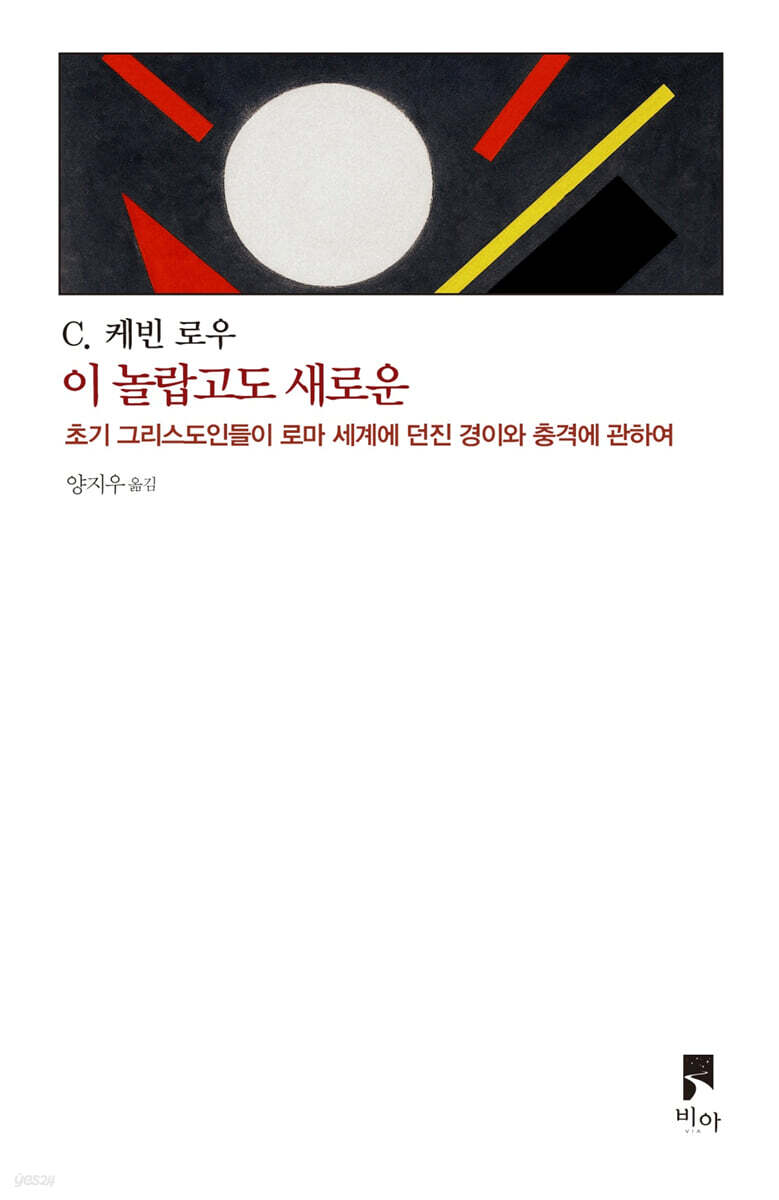
This amazing new
 |
Description
Book Introduction
How did Christianity renew the world?
A brief but powerful account of the impact the early Christians made on the world.
What comes to mind when you think of "Christianity"? For some, it might conjure up the bloody stench of the Crusades, the shadow of an imperial church entangled with power, or dark memories of the Inquisition and persecution.
Others might recall the tradition of charity that founded orphanages and hospitals, the struggle for human rights and freedom, and the countless Christian-related arts, literature, and music.
It all makes sense.
The history of Christianity is a vast story of darkness and light.
But before such a complex and multifaceted picture emerged, before it had tasted power, become corrupted from time to time, built splendid cathedrals and churches, and established a magnificent theological system, Christianity was a 'surprise'.
This movement, which started as a small movement, fundamentally brought 'surprise' to the ancient world.
What made this group so special? This book, exploring the wonders of Christianity, powerfully demonstrates the immense and unexpected impact the early believers made on the world.
A brief but powerful account of the impact the early Christians made on the world.
What comes to mind when you think of "Christianity"? For some, it might conjure up the bloody stench of the Crusades, the shadow of an imperial church entangled with power, or dark memories of the Inquisition and persecution.
Others might recall the tradition of charity that founded orphanages and hospitals, the struggle for human rights and freedom, and the countless Christian-related arts, literature, and music.
It all makes sense.
The history of Christianity is a vast story of darkness and light.
But before such a complex and multifaceted picture emerged, before it had tasted power, become corrupted from time to time, built splendid cathedrals and churches, and established a magnificent theological system, Christianity was a 'surprise'.
This movement, which started as a small movement, fundamentally brought 'surprise' to the ancient world.
What made this group so special? This book, exploring the wonders of Christianity, powerfully demonstrates the immense and unexpected impact the early believers made on the world.
index
Acknowledgements
1.
introduction
2.
A story that encompasses all things
The Wonder of the Crucifixion and Resurrection - The Origins of the "All-Encompassing Story"
Living in a time where the new creation and the old creation coexist
The Cross and Resurrection: The Flow That Forms the All-Encompassing Story
Results, Effects, and Implications - One Story and Other Stories
conclusion
3.
human being
Jesus of Nazareth is human
Man is 'Christ'
Human Sin and Change
Death and Life - What Does Our Future Hold?
conclusion
4.
institutions
Structure and hierarchy
education
care
conclusion
5.
conclusion
God and Not God - A Story to Relearn
The Autonomous Individual - A Story to Strip and Forget
surprise
Character Index and Introductions
1.
introduction
2.
A story that encompasses all things
The Wonder of the Crucifixion and Resurrection - The Origins of the "All-Encompassing Story"
Living in a time where the new creation and the old creation coexist
The Cross and Resurrection: The Flow That Forms the All-Encompassing Story
Results, Effects, and Implications - One Story and Other Stories
conclusion
3.
human being
Jesus of Nazareth is human
Man is 'Christ'
Human Sin and Change
Death and Life - What Does Our Future Hold?
conclusion
4.
institutions
Structure and hierarchy
education
care
conclusion
5.
conclusion
God and Not God - A Story to Relearn
The Autonomous Individual - A Story to Strip and Forget
surprise
Character Index and Introductions
Into the book
We think we already know what Christianity is.
In some ways, that's true.
Christianity has deeply permeated all levels of North Atlantic Western society and culture from its origins to the present day.
If we remove Christianity from the complex and organic structure of Western history, the whole will disintegrate.
From pure art and architecture to popular culture and sports stars, local churches, political debates, intellectual discourse, and policy decisions, the language, imagery, influence, and legacy of Christianity abound.
Even those who hate religion usually have Christianity in mind when they attack it (although they often have misconceptions about Christianity).
But in an equally important respect, we were wrong.
In fact, we don't really know what Christianity is.
The currents of thought that have exerted such a powerful influence over the past two or three centuries have not only alienated us from the Christian way of understanding humanity and the world, but also from the habits of life that have emerged from Christianity's long history (and that once formed the basis of our shared life).
The God of the Bible is no longer the horizon of human life.
Today's world views humans as autonomous individuals who decide for themselves what they want and what they should do.
People believe that religious people should not express their beliefs in the public sphere.
Now, moral judgments are made solely based on personal taste and feelings, and the church is no different from any other 'voluntary society'.
Economic realities have erased Sunday from its once special day of the week.
These trends are intricately intertwined, but the impact of these changes on our lives today is clear.
We have forgotten what Christianity originally was, and we (still) do not know what it can be.
This is the very nature of Western society today.
Christianity is so close to us, so familiar, and yet so distant that we have no idea what it is.
This is not a sequential change that 'comes first and then disappears'.
Christianity is still here, but at the same time we have lost Christianity.
We are familiar with Christianity, but at the same time we have forgotten Christianity.
This is a dual and paradoxical reality.
This is the world we live in.
This trend is very powerful and very widespread.
Its influence has permeated the lives of Christians, and much of their religious life reflects this trend of the times.
Christians still talk about God, but the discussion takes place within a specific, already secularized framework, such as “justice,” “evangelization,” and many other topics.
As a result, 'God' becomes an appendage that adds transcendent authority to a cause that people already support.
We are still familiar with Christian language and use it freely when dealing with issues that are important to us.
But at the same time, the vibrant flow of the Bible and church traditions that once astonished the world seems unfamiliar to us.
We seem to speak the language of Christianity fluently, but in reality, that language is caught in the framework of our time, not in the world of faith that gave birth to it.
We are speaking Christian language within that framework.
Many Christians today presume they know who the God of the Bible is and what he does in the world, thereby blocking the possibility of new wonder and renewal in our time.
We fail to cultivate a biblically based imagination by assuming that we already know everything there is to know.
Nor do we learn the vital flow of tradition that gives rise to hope and newness rooted in the Christian faith.
We miss out on the potential for recovery that rediscovery can bring.
From the beginning, Christianity was a surprise.
No one expected this.
People were amazed at the many things that Christianity had brought to the world after it came into existence.
No one took Christianity for granted, and no one forgot the meaning and power contained in it.
So sometimes people (especially the Romans) tried to get rid of it, but without success.
Rather, over the centuries, Christianity grew from a small Jewish sect to the dominant force in the Roman world.
Sociologists of religion have proposed various theories to explain this growth.
Some theories are plausible, some are not.
But all of these theories have one thing in common.
No one could have predicted such a development.
To people today, it seems self-evident and perfectly natural that Christianity focuses on Jesus.
After all, Christianity originated from Jesus.
But precisely because of that, we forget how radical and unprecedented this was.
One of the most remarkable things about early Christianity was its incredible focus on one man, a Jew named Jesus of Nazareth.
This had far-reaching and complex consequences that had profound ramifications for history.
There are many ways to explain this repercussion, but a framework is needed to understand why this focus on one figure, Jesus of Nazareth, was and still is so remarkable.
Here, we seek to illuminate the wonder of early Christianity by focusing on three aspects: the all-encompassing story, the human, and the institutional.
These three are not separate from each other, but are closely intertwined, and neither can be fully understood apart from the others.
The purpose of this book is to present a single, big picture that these three elements paint together.
--- pp.13-17
As the philosopher Charles Taylor has repeatedly pointed out, one of the defining characteristics of modern society is the loss of faith in the ability of human beings to change.
In contrast, for the early Christians, change was in some ways central to their faith.
The power of resurrection meant change.
Just as Christ was raised from the dead by the glory of the Father, so we too have been given new life.
(Romans 6:4)
To deny the possibility of change is no different from denying the resurrection (in this sense, it is no coincidence that modern people have given up hope for change and have simultaneously denied belief in the resurrection of Jesus Christ.
The two are intertwined; if you accept one, the other is accepted as well, and if you deny one, the other collapses as well.)
Changes occurred not only in the individual's private life but also in the way he lived in society.
At that time, the religious life and social life of individual Christians were not separated.
I believed that Christians must change their way of life, and that they must naturally resist any structures or customs that run counter to the Christian lifestyle among the practices that are prevalent throughout society.
However, there is something to note about the direction of the change.
The early Christians did not try to change the world by advocating for their own cause on specific issues, as we do today.
Rather, the focus was on bearing witness to Christ in a way that the world could see, whether as a community or as individuals.
They were not social activists or politicians, but distinguished themselves solely by their identity as ‘Christians.’
In some ways, that's true.
Christianity has deeply permeated all levels of North Atlantic Western society and culture from its origins to the present day.
If we remove Christianity from the complex and organic structure of Western history, the whole will disintegrate.
From pure art and architecture to popular culture and sports stars, local churches, political debates, intellectual discourse, and policy decisions, the language, imagery, influence, and legacy of Christianity abound.
Even those who hate religion usually have Christianity in mind when they attack it (although they often have misconceptions about Christianity).
But in an equally important respect, we were wrong.
In fact, we don't really know what Christianity is.
The currents of thought that have exerted such a powerful influence over the past two or three centuries have not only alienated us from the Christian way of understanding humanity and the world, but also from the habits of life that have emerged from Christianity's long history (and that once formed the basis of our shared life).
The God of the Bible is no longer the horizon of human life.
Today's world views humans as autonomous individuals who decide for themselves what they want and what they should do.
People believe that religious people should not express their beliefs in the public sphere.
Now, moral judgments are made solely based on personal taste and feelings, and the church is no different from any other 'voluntary society'.
Economic realities have erased Sunday from its once special day of the week.
These trends are intricately intertwined, but the impact of these changes on our lives today is clear.
We have forgotten what Christianity originally was, and we (still) do not know what it can be.
This is the very nature of Western society today.
Christianity is so close to us, so familiar, and yet so distant that we have no idea what it is.
This is not a sequential change that 'comes first and then disappears'.
Christianity is still here, but at the same time we have lost Christianity.
We are familiar with Christianity, but at the same time we have forgotten Christianity.
This is a dual and paradoxical reality.
This is the world we live in.
This trend is very powerful and very widespread.
Its influence has permeated the lives of Christians, and much of their religious life reflects this trend of the times.
Christians still talk about God, but the discussion takes place within a specific, already secularized framework, such as “justice,” “evangelization,” and many other topics.
As a result, 'God' becomes an appendage that adds transcendent authority to a cause that people already support.
We are still familiar with Christian language and use it freely when dealing with issues that are important to us.
But at the same time, the vibrant flow of the Bible and church traditions that once astonished the world seems unfamiliar to us.
We seem to speak the language of Christianity fluently, but in reality, that language is caught in the framework of our time, not in the world of faith that gave birth to it.
We are speaking Christian language within that framework.
Many Christians today presume they know who the God of the Bible is and what he does in the world, thereby blocking the possibility of new wonder and renewal in our time.
We fail to cultivate a biblically based imagination by assuming that we already know everything there is to know.
Nor do we learn the vital flow of tradition that gives rise to hope and newness rooted in the Christian faith.
We miss out on the potential for recovery that rediscovery can bring.
From the beginning, Christianity was a surprise.
No one expected this.
People were amazed at the many things that Christianity had brought to the world after it came into existence.
No one took Christianity for granted, and no one forgot the meaning and power contained in it.
So sometimes people (especially the Romans) tried to get rid of it, but without success.
Rather, over the centuries, Christianity grew from a small Jewish sect to the dominant force in the Roman world.
Sociologists of religion have proposed various theories to explain this growth.
Some theories are plausible, some are not.
But all of these theories have one thing in common.
No one could have predicted such a development.
To people today, it seems self-evident and perfectly natural that Christianity focuses on Jesus.
After all, Christianity originated from Jesus.
But precisely because of that, we forget how radical and unprecedented this was.
One of the most remarkable things about early Christianity was its incredible focus on one man, a Jew named Jesus of Nazareth.
This had far-reaching and complex consequences that had profound ramifications for history.
There are many ways to explain this repercussion, but a framework is needed to understand why this focus on one figure, Jesus of Nazareth, was and still is so remarkable.
Here, we seek to illuminate the wonder of early Christianity by focusing on three aspects: the all-encompassing story, the human, and the institutional.
These three are not separate from each other, but are closely intertwined, and neither can be fully understood apart from the others.
The purpose of this book is to present a single, big picture that these three elements paint together.
--- pp.13-17
As the philosopher Charles Taylor has repeatedly pointed out, one of the defining characteristics of modern society is the loss of faith in the ability of human beings to change.
In contrast, for the early Christians, change was in some ways central to their faith.
The power of resurrection meant change.
Just as Christ was raised from the dead by the glory of the Father, so we too have been given new life.
(Romans 6:4)
To deny the possibility of change is no different from denying the resurrection (in this sense, it is no coincidence that modern people have given up hope for change and have simultaneously denied belief in the resurrection of Jesus Christ.
The two are intertwined; if you accept one, the other is accepted as well, and if you deny one, the other collapses as well.)
Changes occurred not only in the individual's private life but also in the way he lived in society.
At that time, the religious life and social life of individual Christians were not separated.
I believed that Christians must change their way of life, and that they must naturally resist any structures or customs that run counter to the Christian lifestyle among the practices that are prevalent throughout society.
However, there is something to note about the direction of the change.
The early Christians did not try to change the world by advocating for their own cause on specific issues, as we do today.
Rather, the focus was on bearing witness to Christ in a way that the world could see, whether as a community or as individuals.
They were not social activists or politicians, but distinguished themselves solely by their identity as ‘Christians.’
--- pp.55-56
Publisher's Review
Kevin Lowe is a New Testament scholar at Duke University who has delved deeply into the Christian movement in the ancient Mediterranean world.
But this book is not a cold academic book.
He retells in contemporary language how the early Christians formed their own identity and transformed the world around them.
Beyond simply reproducing ancient history, it leads readers to ask what meaning the original "surprise" of Christianity can have in the present world.
Early Christians could not imagine life without God.
They regarded the 'gift' they had received as a universal truth open to all generations, and believed that it should be shared with everyone.
No one escaped their gaze: city and country, Jew and Gentile, rich and poor, even emperor and slave.
Their community brought together people who had previously been unrelated or even hostile to one another under one roof, and this new solidarity gave a new meaning to what it means to be human.
Rowe vividly describes this process, emphasizing that Christianity did not simply spread religious teachings, but exerted a power to transform the very fabric of human society through a new way of life.
The radical attitude of not abandoning orphans, not leaving the sick to die alone, and considering both the powerless and the powerful as objects of the gospel shook the very norms of ancient society.
But the author does not stop at simply recalling the glory of ancient times.
Lowe poses a sharp question to 'us today'.
If Christianity throughout history invited prisoners into the community, embraced criminals with love and offered them a different life, and creatively dedicated itself to upholding human dignity in the legal, medical, and economic spheres, what is the church doing today? The question is uncomfortably direct and poignant.
At the end of the book, the author emphasizes that the surprise Christianity poses to the world is not simply a 'social program' or an 'alternative theory.'
Christianity is a way of life based on hope.
A life of 'taste and see' God's goodness even in the face of death and downfall - that is the way in which the Church exists in the midst of the world.
"The Surprise of Christianity" is a unique work that transcends theology, history, and society, and is a rare example of how theological writing can be vividly translated into contemporary language.
Through this book, readers will once again be captivated by the story of 'surprise', which arrived in the world a long time ago but still retains its relevance.
How did Christianity renew the world?
A brief but powerful account of the impact the early Christians made on the world.
What comes to mind when you think of "Christianity"? For some, it might conjure up the bloody stench of the Crusades, the shadow of an imperial church entangled with power, or dark memories of the Inquisition and persecution.
Others might recall the tradition of charity that founded orphanages and hospitals, the struggle for human rights and freedom, and the countless Christian-related arts, literature, and music.
It all makes sense.
The history of Christianity is a vast story of darkness and light.
But before it revealed its complexities, before it tasted power, before it became corrupted from time to time, before it built its magnificent cathedrals and churches, before it developed its magnificent theological system, Christianity was a wonder.
This movement, which started as a small movement, fundamentally brought 'surprise' to the ancient world.
What made this group so special? This book, exploring the wonders of Christianity, powerfully demonstrates the immense and unexpected impact the early believers made on the world.
Kevin Lowe is a New Testament scholar at Duke University who has delved deeply into the Christian movement in the ancient Mediterranean world.
But this book is not a cold academic book.
He retells in contemporary language how the early Christians formed their own identity and transformed the world around them.
Beyond simply reproducing ancient history, it leads readers to ask what meaning the original "surprise" of Christianity can have in the present world.
Early Christians could not imagine life without God.
They regarded the 'gift' they had received as a universal truth open to all generations, and believed that it should be shared with everyone.
No one escaped their gaze: city and country, Jew and Gentile, rich and poor, even emperor and slave.
Their community brought together people who had previously been unrelated or even hostile to one another under one roof, and this new solidarity gave a new meaning to what it means to be human.
Rowe vividly describes this process, emphasizing that Christianity did not simply spread religious teachings, but exerted a power to transform the very fabric of human society through a new way of life.
The radical attitude of not abandoning orphans, not leaving the sick to die alone, and considering both the powerless and the powerful as objects of the gospel shook the very norms of ancient society.
But the author does not stop at simply recalling the glory of ancient times.
Lowe poses a sharp question to 'us today'.
If Christianity throughout history invited prisoners into the community, embraced criminals with love and offered them a different life, and creatively dedicated itself to upholding human dignity in the legal, medical, and economic spheres, what is the church doing today? The question is uncomfortably direct and poignant.
At the end of the book, the author emphasizes that the surprise that Christianity poses to the world is not simply a 'social program' or an 'alternative theory'.
Christianity is a way of life based on hope.
A life of 'taste and see' God's goodness even in the face of death and downfall - that is the way in which the Church exists in the midst of the world.
"The Surprise of Christianity" is a unique work that transcends theology, history, and society, and is a rare example of how theological writing can be vividly translated into contemporary language.
Through this book, readers will once again be captivated by the story of 'surprise', which arrived in the world a long time ago but still retains its relevance.
But this book is not a cold academic book.
He retells in contemporary language how the early Christians formed their own identity and transformed the world around them.
Beyond simply reproducing ancient history, it leads readers to ask what meaning the original "surprise" of Christianity can have in the present world.
Early Christians could not imagine life without God.
They regarded the 'gift' they had received as a universal truth open to all generations, and believed that it should be shared with everyone.
No one escaped their gaze: city and country, Jew and Gentile, rich and poor, even emperor and slave.
Their community brought together people who had previously been unrelated or even hostile to one another under one roof, and this new solidarity gave a new meaning to what it means to be human.
Rowe vividly describes this process, emphasizing that Christianity did not simply spread religious teachings, but exerted a power to transform the very fabric of human society through a new way of life.
The radical attitude of not abandoning orphans, not leaving the sick to die alone, and considering both the powerless and the powerful as objects of the gospel shook the very norms of ancient society.
But the author does not stop at simply recalling the glory of ancient times.
Lowe poses a sharp question to 'us today'.
If Christianity throughout history invited prisoners into the community, embraced criminals with love and offered them a different life, and creatively dedicated itself to upholding human dignity in the legal, medical, and economic spheres, what is the church doing today? The question is uncomfortably direct and poignant.
At the end of the book, the author emphasizes that the surprise Christianity poses to the world is not simply a 'social program' or an 'alternative theory.'
Christianity is a way of life based on hope.
A life of 'taste and see' God's goodness even in the face of death and downfall - that is the way in which the Church exists in the midst of the world.
"The Surprise of Christianity" is a unique work that transcends theology, history, and society, and is a rare example of how theological writing can be vividly translated into contemporary language.
Through this book, readers will once again be captivated by the story of 'surprise', which arrived in the world a long time ago but still retains its relevance.
How did Christianity renew the world?
A brief but powerful account of the impact the early Christians made on the world.
What comes to mind when you think of "Christianity"? For some, it might conjure up the bloody stench of the Crusades, the shadow of an imperial church entangled with power, or dark memories of the Inquisition and persecution.
Others might recall the tradition of charity that founded orphanages and hospitals, the struggle for human rights and freedom, and the countless Christian-related arts, literature, and music.
It all makes sense.
The history of Christianity is a vast story of darkness and light.
But before it revealed its complexities, before it tasted power, before it became corrupted from time to time, before it built its magnificent cathedrals and churches, before it developed its magnificent theological system, Christianity was a wonder.
This movement, which started as a small movement, fundamentally brought 'surprise' to the ancient world.
What made this group so special? This book, exploring the wonders of Christianity, powerfully demonstrates the immense and unexpected impact the early believers made on the world.
Kevin Lowe is a New Testament scholar at Duke University who has delved deeply into the Christian movement in the ancient Mediterranean world.
But this book is not a cold academic book.
He retells in contemporary language how the early Christians formed their own identity and transformed the world around them.
Beyond simply reproducing ancient history, it leads readers to ask what meaning the original "surprise" of Christianity can have in the present world.
Early Christians could not imagine life without God.
They regarded the 'gift' they had received as a universal truth open to all generations, and believed that it should be shared with everyone.
No one escaped their gaze: city and country, Jew and Gentile, rich and poor, even emperor and slave.
Their community brought together people who had previously been unrelated or even hostile to one another under one roof, and this new solidarity gave a new meaning to what it means to be human.
Rowe vividly describes this process, emphasizing that Christianity did not simply spread religious teachings, but exerted a power to transform the very fabric of human society through a new way of life.
The radical attitude of not abandoning orphans, not leaving the sick to die alone, and considering both the powerless and the powerful as objects of the gospel shook the very norms of ancient society.
But the author does not stop at simply recalling the glory of ancient times.
Lowe poses a sharp question to 'us today'.
If Christianity throughout history invited prisoners into the community, embraced criminals with love and offered them a different life, and creatively dedicated itself to upholding human dignity in the legal, medical, and economic spheres, what is the church doing today? The question is uncomfortably direct and poignant.
At the end of the book, the author emphasizes that the surprise that Christianity poses to the world is not simply a 'social program' or an 'alternative theory'.
Christianity is a way of life based on hope.
A life of 'taste and see' God's goodness even in the face of death and downfall - that is the way in which the Church exists in the midst of the world.
"The Surprise of Christianity" is a unique work that transcends theology, history, and society, and is a rare example of how theological writing can be vividly translated into contemporary language.
Through this book, readers will once again be captivated by the story of 'surprise', which arrived in the world a long time ago but still retains its relevance.
GOODS SPECIFICS
- Date of issue: September 3, 2025
- Page count, weight, size: 220 pages | 200*130*20mm
- ISBN13: 9791199437609
- ISBN10: 1199437603
You may also like
카테고리
korean


korean

![GQ KOREA Mark (Monthly): December [2025]](http://librairie.coreenne.fr/cdn/shop/files/8ef265dbbfbf186523ed75ba7319009d.jpg?v=1765340328&width=3840)


