

The Inconvenient History of America That Americans Don't Learn
 |
Description
Book Introduction
What America Teaches and Doesn't Teach
The dark side of their country's history that they want to hide
"The Great Republic," "The American Triumph"... American history textbooks, whose titles alone suggest the content, are nearly 1,000 pages long and are filled with the wonderful aspects of American history.
But is that all there is to American history? This book, "The Inconvenient History Americans Don't Learn," analyzes 18 history textbooks to reveal the true history not taught in American history education.
From the Americas before Columbus' arrival to the present day, it honestly describes events and people that textbooks often ignore or whitewash, such as the role of Native Americans in assisting European settlement, the debate over the abolition of slavery that led to the Civil War, racial conflicts since the founding of the country, the gap between the rich and the poor and social class issues, and various wars and operations waged by the United States, including the Vietnam War.
Author James Loewen, who also wrote a history textbook, draws on his own experience and research to trace the ways in which American history education is distorted.
It criticizes the reality that only "feel-good" history is listed from the perspective of the victors, such as "heroization," "ethnocentrism," and "racism," and also criticizes the realistic factors that make it impossible for it to be described this way.
The author's message that we must comprehensively teach uncomfortable truths instead of such history is also meaningful to us, who are constantly embroiled in historical debates.
This book, which not only provides knowledge but also critical thinking skills, helps you look at history properly and cultivate the power to find the truth for yourself.
The original book, Lies My Teacher Told Me, sold over 2 million copies after its publication in 1995, causing a sensation in the American history education world.
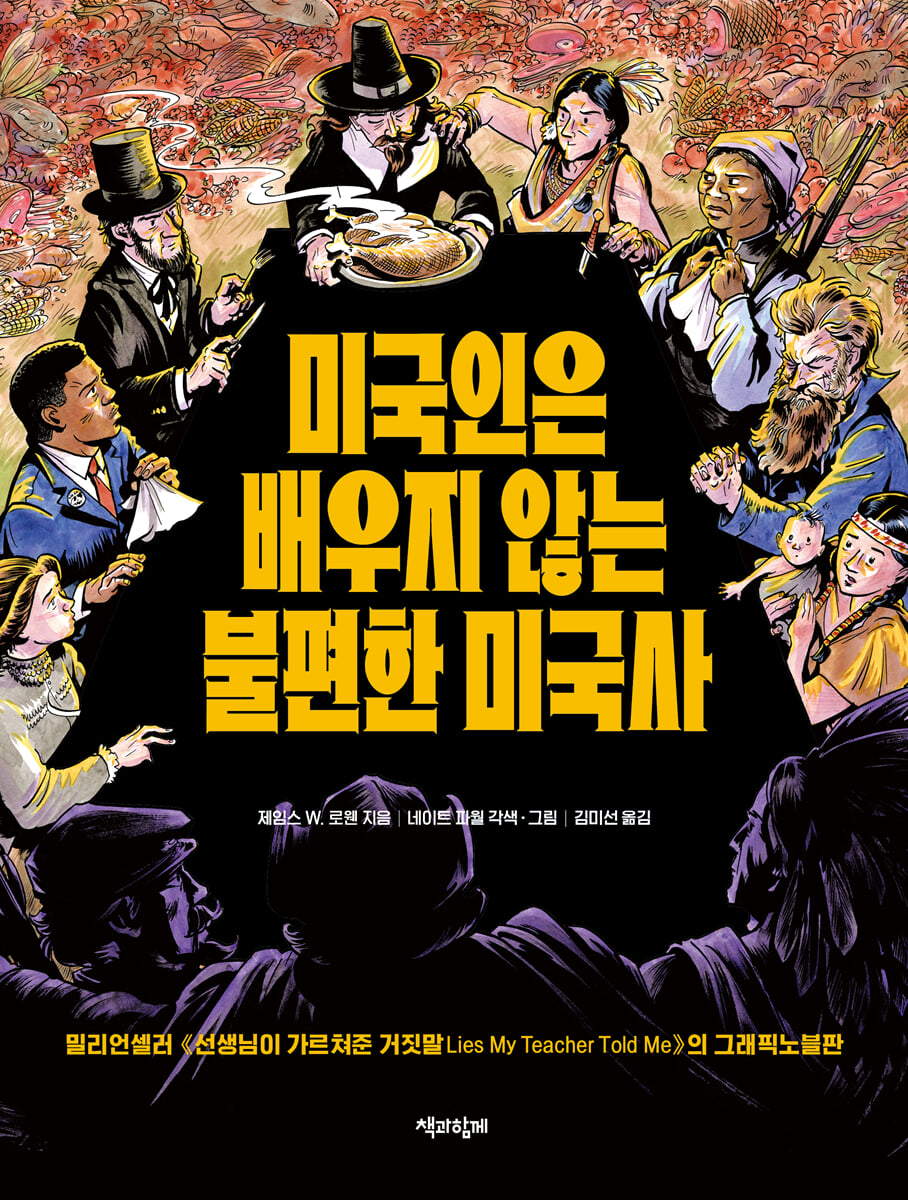
Nate Powell, the first National Book Award-winning cartoonist, has reimagined this modern classic as a graphic novel, powerfully visualizing the original's critical thinking and cleverly adapting the content.
This is proof that the value of this book is still valid even 30 years after the original first edition was published.
The dark side of their country's history that they want to hide
"The Great Republic," "The American Triumph"... American history textbooks, whose titles alone suggest the content, are nearly 1,000 pages long and are filled with the wonderful aspects of American history.
But is that all there is to American history? This book, "The Inconvenient History Americans Don't Learn," analyzes 18 history textbooks to reveal the true history not taught in American history education.
From the Americas before Columbus' arrival to the present day, it honestly describes events and people that textbooks often ignore or whitewash, such as the role of Native Americans in assisting European settlement, the debate over the abolition of slavery that led to the Civil War, racial conflicts since the founding of the country, the gap between the rich and the poor and social class issues, and various wars and operations waged by the United States, including the Vietnam War.
Author James Loewen, who also wrote a history textbook, draws on his own experience and research to trace the ways in which American history education is distorted.
It criticizes the reality that only "feel-good" history is listed from the perspective of the victors, such as "heroization," "ethnocentrism," and "racism," and also criticizes the realistic factors that make it impossible for it to be described this way.
The author's message that we must comprehensively teach uncomfortable truths instead of such history is also meaningful to us, who are constantly embroiled in historical debates.
This book, which not only provides knowledge but also critical thinking skills, helps you look at history properly and cultivate the power to find the truth for yourself.
The original book, Lies My Teacher Told Me, sold over 2 million copies after its publication in 1995, causing a sensation in the American history education world.
Nate Powell, the first National Book Award-winning cartoonist, has reimagined this modern classic as a graphic novel, powerfully visualizing the original's critical thinking and cleverly adapting the content.
This is proof that the value of this book is still valid even 30 years after the original first edition was published.
- You can preview some of the book's contents.
Preview
index
Entering | Something is terribly wrong
Chapter 1 | Disability Made by History: The Making of Heroes
Chapter 2 | 1493: The True Meaning of Christopher Columbus
Chapter 3 | The First Thanksgiving
Chapter 4 | Red Eyes
Chapter 5 | Gone with the Wind: Racism's Loss from American History Textbooks
Chapter 6 | John Brown and Abraham Lincoln: Anti-Racism's Loss from American History Textbooks
Chapter 7 | Land of Opportunity
Chapter 8 | Seeing Big Brother: How Textbooks Teach the Federal Government
Chapter 9 | Seeing the Bad: Turning a Blind Eye on the Vietnam War
Chapter 10 | Into the Memory Hole: The Lost Recent History
Chapter 11 | History and the Future
Chapter 12 | Is it okay to teach history like this?
Coming Out | The Future Awaits: And What Should We Do to Prepare for It?
Illustrator's Note
Chapter 1 | Disability Made by History: The Making of Heroes
Chapter 2 | 1493: The True Meaning of Christopher Columbus
Chapter 3 | The First Thanksgiving
Chapter 4 | Red Eyes
Chapter 5 | Gone with the Wind: Racism's Loss from American History Textbooks
Chapter 6 | John Brown and Abraham Lincoln: Anti-Racism's Loss from American History Textbooks
Chapter 7 | Land of Opportunity
Chapter 8 | Seeing Big Brother: How Textbooks Teach the Federal Government
Chapter 9 | Seeing the Bad: Turning a Blind Eye on the Vietnam War
Chapter 10 | Into the Memory Hole: The Lost Recent History
Chapter 11 | History and the Future
Chapter 12 | Is it okay to teach history like this?
Coming Out | The Future Awaits: And What Should We Do to Prepare for It?
Illustrator's Note
Into the book
High school students hate history.
History is the only subject where students become dumber with each class.
American history classes are filled with fantastical and important stories about the country's journey.
These are all stories directly related to current American society.
Yet, the students sleep throughout the class.
What's wrong? ... Textbook authors don't illuminate the past through the present.
It also does not provide insight into the present through the past.
The past is portrayed as a simple moral drama, drawing out two common messages.
“You have a proud heritage.
“You can see that by looking at what the United States has achieved so far.”
--- From "Entering"
Christopher Columbus brought about two phenomena.
One was that it brought about a radical change in inter-racial relations, and the other was that it ushered in a transition to the modern world.
First, he took away the land, property, and labor of the indigenous peoples of the Americas, driving them to the brink of extinction. Second, he initiated the Atlantic slave trade, creating a racial underclass that has persisted for over 500 years.
--- From "Chapter 2, 1493"
If we compare European technology today with the more 'primitive' Native American technology of the time, it is easy to conclude that the European conquest of America was inevitable.
But that wasn't the case at the time.
Historian Karen Cooperman speculates:
“The technology and culture of the native peoples living on the east coast of America were on par with those of the British.
And at first, it was impossible to know who would win the competition between the two.
…colonization would have proceeded much more slowly if settlers had not been able to occupy the lands worked by the disappeared indigenous farmers.”
--- From "Chapter 3: The First Thanksgiving"
In 1803, the largest land purchase occurred from non-owners.
It is the Louisiana Purchase.
The purchase of Louisiana from France doubled the size of the United States.
History textbooks fail to mention that the true owner of this land was not France! France never discussed the matter with the indigenous owners, and few indigenous people even knew that their land had been sold.
But there is something more to it.
France did not actually sell the land.
They sold only the land rights for $15 million.
--- From "Chapter 4 Red Eyes"
At the heart of America's legacy from slavery is the false idea that a racial hierarchy with whites on top and blacks below is appropriate, even natural.
Half of the textbooks I studied included "racism" in their index, but there were a few books where it wasn't mentioned in the text.
Only in "The Road We've Taken" did the concept of racism get explained, while the other three books dealt with the causes that gave rise to racism.
The longest book I've covered is "An American Adventure."
“[Black Africans] look different from white people.
Because of their skin color, they had difficulty assimilating into mainstream culture.
So I stayed an outsider.” The textbook repeats this again, based on psychology.
But skin color itself does not explain racism.
If the authors had to single out one issue in American history that warrants context, it would be racism.
--- From "Chapter 5 Gone with the Wind"
The madness with which historians have labeled him [John Brown] is not psychological.
It was ideological.
Brown's anti-racist actions would have seemed absurd to textbook authors between 1890 and 1970.
In modern times, John Brown is not considered crazy.
His ideological influence was enormous both before and after his execution.
He broadened the scope of acceptance of ideas and actions regarding slavery and black freedom.
Before the Harpers Ferry incident, even mentioning the emancipation of slaves was considered to be beyond the realm of ideology.
Then, when armed riots, including murder, broke out, John Brown made it seem better to just free the slaves verbally.
--- From “Chapter 6 John Brown and Abraham Lincoln”
Two of my students did an experiment in Burlington, Vermont.
They took turns driving expensive new cars and old, worn-out compact cars, waiting for the traffic light to turn green and only moving forward when the car behind them honked its horn.
When driving an older compact car, the horn honked in less than 7 seconds, while when driving a luxury car, the horn honked in an average of 13.2 seconds.
Americans unconsciously respect the upper class more.
And the experiment found that drivers across all social classes were willing to wait longer for luxury cars.
--- From "Chapter 7: Land of Opportunity"
What do history textbooks tell us about the American government? While they still portray the government as a public servant serving the people, they fail to adequately describe the role that citizens and non-governmental organizations have played in societal development and change.
First of all, it is said that the United States today is the same country that was founded in 1789.
It ignores the possibility that the balance of power (the power divided between the states and individuals, as well as between the branches of government) may have shifted significantly over the past 200 years or so since the founding of the U.S. Constitution.
Authors tend to portray the United States as a heroic nation.
This is the moment when history textbooks are transformed into anti-civilian manuals or silent guides.
--- From "Chapter 8: Watching Big Brother"
Textbooks should at least properly report the atrocities committed by American soldiers against the Vietnamese people.
At the time, the US military was unable to clearly distinguish between friend and foe, so the Vietnam War was a war without a clear 'front line.'
In fact, the commander-in-chief during the war, William C.
As Westmoreland noted about civilian casualties in Vietnam, attacks on civilians were American policy.
The United States evaluated its military performance partly based on the number of deaths.
So, they considered all civilians as 'enemies' and drew up an indiscriminate shelling zone.
Soldiers who carry out such operations inevitably become 'war criminals'.
--- From "Chapter 9: Do Not See Bad Things"
African societies generally divide people into three categories.
People who are still alive on Earth, Sasa and Zamani.
Although the sage has passed away, he remains in the memories of the living.
This expression is an affectionate interpretation of the 'living dead'.
Living people remember their loved ones or create art, music, stories, and anecdotes.
When the last person who remembers an ancestor passes away, the ancestor leaves the world and becomes a vassal.
The dead Zamani are not forgotten and are worshipped outside of people's memories.
Americans don't know Swahili very well, so it's difficult to discern how this concept affects memory.
But anyway, we can apply that link too.
When we read recent history, especially if it's something we remember or experienced firsthand, we read more actively and think more critically.
Although we adopt a critical stance even when studying the relatively distant past, we generally accept history that is not open to comparison or criticism.
--- From "Chapter 10: Into the Hole of Memory"
The textbook's optimistic and happy ending is merely a wishful thinking of history.
If textbook authors fail to seriously discuss past events and trends and provide a realistic perspective on American history, they are saying that America's past has no impact on its future.
As long as we simply bury the connection between past and future, we cannot criticize students for reaching this conclusion.
'Studying history has nothing to do with my life or my future.'
--- From "Chapter 11: History and the Future"
For a long time, students have consistently cited history as their least favorite subject.
But most history classes, with their many regrets, can change! Remember back in the beginning of this book, when a student learned about the first people to sail around Africa through hip-hop lyrics and pointed out a flaw in the lesson? This book could be used in the same way.
Arm yourself with knowledge.
You can lead the change.
History is the only subject where students become dumber with each class.
American history classes are filled with fantastical and important stories about the country's journey.
These are all stories directly related to current American society.
Yet, the students sleep throughout the class.
What's wrong? ... Textbook authors don't illuminate the past through the present.
It also does not provide insight into the present through the past.
The past is portrayed as a simple moral drama, drawing out two common messages.
“You have a proud heritage.
“You can see that by looking at what the United States has achieved so far.”
--- From "Entering"
Christopher Columbus brought about two phenomena.
One was that it brought about a radical change in inter-racial relations, and the other was that it ushered in a transition to the modern world.
First, he took away the land, property, and labor of the indigenous peoples of the Americas, driving them to the brink of extinction. Second, he initiated the Atlantic slave trade, creating a racial underclass that has persisted for over 500 years.
--- From "Chapter 2, 1493"
If we compare European technology today with the more 'primitive' Native American technology of the time, it is easy to conclude that the European conquest of America was inevitable.
But that wasn't the case at the time.
Historian Karen Cooperman speculates:
“The technology and culture of the native peoples living on the east coast of America were on par with those of the British.
And at first, it was impossible to know who would win the competition between the two.
…colonization would have proceeded much more slowly if settlers had not been able to occupy the lands worked by the disappeared indigenous farmers.”
--- From "Chapter 3: The First Thanksgiving"
In 1803, the largest land purchase occurred from non-owners.
It is the Louisiana Purchase.
The purchase of Louisiana from France doubled the size of the United States.
History textbooks fail to mention that the true owner of this land was not France! France never discussed the matter with the indigenous owners, and few indigenous people even knew that their land had been sold.
But there is something more to it.
France did not actually sell the land.
They sold only the land rights for $15 million.
--- From "Chapter 4 Red Eyes"
At the heart of America's legacy from slavery is the false idea that a racial hierarchy with whites on top and blacks below is appropriate, even natural.
Half of the textbooks I studied included "racism" in their index, but there were a few books where it wasn't mentioned in the text.
Only in "The Road We've Taken" did the concept of racism get explained, while the other three books dealt with the causes that gave rise to racism.
The longest book I've covered is "An American Adventure."
“[Black Africans] look different from white people.
Because of their skin color, they had difficulty assimilating into mainstream culture.
So I stayed an outsider.” The textbook repeats this again, based on psychology.
But skin color itself does not explain racism.
If the authors had to single out one issue in American history that warrants context, it would be racism.
--- From "Chapter 5 Gone with the Wind"
The madness with which historians have labeled him [John Brown] is not psychological.
It was ideological.
Brown's anti-racist actions would have seemed absurd to textbook authors between 1890 and 1970.
In modern times, John Brown is not considered crazy.
His ideological influence was enormous both before and after his execution.
He broadened the scope of acceptance of ideas and actions regarding slavery and black freedom.
Before the Harpers Ferry incident, even mentioning the emancipation of slaves was considered to be beyond the realm of ideology.
Then, when armed riots, including murder, broke out, John Brown made it seem better to just free the slaves verbally.
--- From “Chapter 6 John Brown and Abraham Lincoln”
Two of my students did an experiment in Burlington, Vermont.
They took turns driving expensive new cars and old, worn-out compact cars, waiting for the traffic light to turn green and only moving forward when the car behind them honked its horn.
When driving an older compact car, the horn honked in less than 7 seconds, while when driving a luxury car, the horn honked in an average of 13.2 seconds.
Americans unconsciously respect the upper class more.
And the experiment found that drivers across all social classes were willing to wait longer for luxury cars.
--- From "Chapter 7: Land of Opportunity"
What do history textbooks tell us about the American government? While they still portray the government as a public servant serving the people, they fail to adequately describe the role that citizens and non-governmental organizations have played in societal development and change.
First of all, it is said that the United States today is the same country that was founded in 1789.
It ignores the possibility that the balance of power (the power divided between the states and individuals, as well as between the branches of government) may have shifted significantly over the past 200 years or so since the founding of the U.S. Constitution.
Authors tend to portray the United States as a heroic nation.
This is the moment when history textbooks are transformed into anti-civilian manuals or silent guides.
--- From "Chapter 8: Watching Big Brother"
Textbooks should at least properly report the atrocities committed by American soldiers against the Vietnamese people.
At the time, the US military was unable to clearly distinguish between friend and foe, so the Vietnam War was a war without a clear 'front line.'
In fact, the commander-in-chief during the war, William C.
As Westmoreland noted about civilian casualties in Vietnam, attacks on civilians were American policy.
The United States evaluated its military performance partly based on the number of deaths.
So, they considered all civilians as 'enemies' and drew up an indiscriminate shelling zone.
Soldiers who carry out such operations inevitably become 'war criminals'.
--- From "Chapter 9: Do Not See Bad Things"
African societies generally divide people into three categories.
People who are still alive on Earth, Sasa and Zamani.
Although the sage has passed away, he remains in the memories of the living.
This expression is an affectionate interpretation of the 'living dead'.
Living people remember their loved ones or create art, music, stories, and anecdotes.
When the last person who remembers an ancestor passes away, the ancestor leaves the world and becomes a vassal.
The dead Zamani are not forgotten and are worshipped outside of people's memories.
Americans don't know Swahili very well, so it's difficult to discern how this concept affects memory.
But anyway, we can apply that link too.
When we read recent history, especially if it's something we remember or experienced firsthand, we read more actively and think more critically.
Although we adopt a critical stance even when studying the relatively distant past, we generally accept history that is not open to comparison or criticism.
--- From "Chapter 10: Into the Hole of Memory"
The textbook's optimistic and happy ending is merely a wishful thinking of history.
If textbook authors fail to seriously discuss past events and trends and provide a realistic perspective on American history, they are saying that America's past has no impact on its future.
As long as we simply bury the connection between past and future, we cannot criticize students for reaching this conclusion.
'Studying history has nothing to do with my life or my future.'
--- From "Chapter 11: History and the Future"
For a long time, students have consistently cited history as their least favorite subject.
But most history classes, with their many regrets, can change! Remember back in the beginning of this book, when a student learned about the first people to sail around Africa through hip-hop lyrics and pointed out a flaw in the lesson? This book could be used in the same way.
Arm yourself with knowledge.
You can lead the change.
--- From Chapter 12, "Is It Okay to Teach History Like This?"
Publisher's Review
What America Teaches and Doesn't Teach
The dark side of their country's history that they want to hide
"The Great Republic," "The American Triumph"... American history textbooks, whose titles alone suggest the content, are nearly 1,000 pages long and are filled with the wonderful aspects of American history.
But is that all there is to American history? This book, "The Inconvenient History Americans Don't Learn," analyzes 18 history textbooks to reveal the true history not taught in American history education.
From the Americas before Columbus' arrival to the present day, it honestly describes events and people that textbooks often ignore or whitewash, such as the role of Native Americans in assisting European settlement, the debate over the abolition of slavery that led to the Civil War, racial conflicts since the founding of the country, the gap between the rich and the poor and social class issues, and various wars and operations waged by the United States, including the Vietnam War.
Author James Loewen, who also wrote a history textbook, draws on his own experience and research to trace the ways in which American history education is distorted.
It criticizes the reality that only "feel-good" history is listed from the perspective of the victors, such as "heroization," "ethnocentrism," and "racism," and also criticizes the realistic factors that make it impossible for it to be described this way.
The author's message that we must comprehensively teach uncomfortable truths instead of such history is also meaningful to us, who are constantly embroiled in historical debates.
This book, which not only provides knowledge but also critical thinking skills, helps you look at history properly and cultivate the power to find the truth for yourself.
The original book, Lies My Teacher Told Me, sold over 2 million copies after its publication in 1995, causing a sensation in the American history education world.
Nate Powell, the first National Book Award-winning cartoonist, has reimagined this modern classic as a graphic novel, powerfully visualizing the original's critical thinking and cleverly adapting the content.
This is proof that the value of this book is still valid even 30 years after the original first edition was published.
Did the history of America begin with Columbus?
An honest history of the United States that fills in the missing parts of textbooks.
This book, "The Inconvenient History Americans Don't Learn," shatters common sense by empirically examining what truths American history textbooks conceal in an attempt to portray their country's remarkable history and how they cleverly distort historical facts.
A representative example is Columbus.
It's easy to think that America's history began in earnest with Columbus's discovery of the American continent in 1492, but in reality, many people from Africa, Northern Europe, and Asia have been arriving in America for a long time, and Native Americans have even traveled to Europe across the Atlantic.
The Americas were first inhabited between 70,000 and 10,000 BC, and in 1492 the estimated population of the Americas was 100 million, exceeding Europe's 70 million.
The author then corrects Columbus by saying that he was not the first to discover America, but the last.
Furthermore, the historical significance of Columbus is that after his second voyage in 1493, white people began to dominate other races through exploitative tribute systems and the massacre of indigenous peoples, and through this, the modern world was brought about, leading to a look back at American history from the beginning.
American history textbooks also erase the role of Native Americans in the settlement and founding of the nation by British settlers, the ancestors of Americans.
Far from civilizing their settlements with advanced technology, the British survived by obtaining food and learning skills from Native Americans, or by taking over lands devastated by diseases brought in from Europe.
Thanksgiving, considered America's biggest holiday, also originated from the traditions of Native Americans, not British immigrants.
Although the culture and institutions of the indigenous peoples were so advanced that they influenced the establishment of the American federal system and democracy, textbooks portray them as if they were inevitably driven out during the process of American territorial expansion because they could not adapt to white culture.
This book rewrites American history by uncovering the histories that textbooks have consistently reduced and erased to justify American history.
Racial discrimination, the gap between the rich and the poor, secret government operations…
The more you dig, the more hidden truths are revealed.
Another topic hidden from American history textbooks is racism.
It is no exaggeration to say that most of American history is a history of white America dominating black America, but textbooks have cleverly justified white logic on this issue.
It hides the fact that great men like Thomas Jefferson owned black slaves and that the driving force behind America's industrial development was the oppressive labor of black slaves.
And while it is clear that the reason for the Confederacy's secession, which triggered the American Civil War, was opposition to the abolition of slavery, other causes are sought, such as tariffs, the development of domestic industries, the separation of agriculture and industry, and the guarantee of "states' rights."
Furthermore, it erases the efforts of 'anti-racism' that tried to overcome such racial discrimination.
John Brown, a pioneer in the abolitionist movement, is treated as a lunatic, and Lincoln is portrayed as if he was not actively involved in the abolition of slavery, but simply promoted it for the political purpose of ending the Civil War.
Lincoln's famous letter only teaches the sentence, "My object above all else is to save the Union, and not to preserve or destroy slavery," and then adds, "But as I have often declared, I have no intention of changing my personal wishes.
The sentence “I wish that everyone, everywhere, should be free” is being deleted.
Textbooks also don't really address the gap between social classes.
The book blandly describes the fact that America is still a middle-class country, with guaranteed equality, social mobility, and political participation, and when explaining America's immigration history, it emphasizes only the extremely successful white immigrants like Joseph Pulitzer and Andrew Carnegie, portraying America as a "land of opportunity."
But they turn a blind eye to the serious problems of inequality, where the top 1 percent controls 40 percent of the wealth, the harsh discrimination against immigrants, and the labor movement, including various strikes.
Moreover, the U.S. government is portrayed as an idealistic institution serving the people, but the crimes it commits at home and abroad are covered up while pretending to serve the people.
While actively intervening in various overseas issues and claiming to be a "good international friend," the reality is that they are exercising hegemony and profiting from the expansion of multinational corporations, exploiting low-wage labor, and even war.
The Gulf of Tonkin incident, which served as a pretext for the Vietnam War, was also a fabrication by the US government, and during the Iraq War, the US invaded Iraq on the pretext that Iraq possessed "weapons of mass destruction," but no evidence was found to support this.
The U.S. government also carried out various operations within the United States without the knowledge of its citizens.
Textbooks only cover the well-known Watergate scandal among such cases, and do not mention the systematic suppression of civil rights movements by mobilizing the FBI, which undermined democracy.
Not a 'feel-good' history that only teaches progress
Towards an honest and comprehensive history
“The optimistic and happy ending of the textbook is just a wishful thinking of history.
…as long as we simply bury the connection between past and future, we cannot condemn students for reaching this conclusion.
“Studying history has nothing to do with my life or my future.” ─ From Chapter 11, “History and the Future”
The author criticizes the textbook for covering up the truth and containing only biased content, saying that it is because it only lists “feel-good” history from the perspective of the victors, such as “white supremacy,” “heroization,” “ethnocentrism,” and “racism.”
The purpose of American history education is to instill in students the idea that by positively teaching them that their country's history has constantly progressed, they will create a better world and enjoy abundant lives in the future.
The atmosphere in which those who do not describe history in this way are accused of being "leftists" and the reality that textbooks are written by freelance writers rather than professional and authoritative writers for convenience, resulting in a lack of expertise, are further exacerbating the problems with the descriptions in history textbooks.
Due to this kind of education that was out of touch with reality, students became passive and began to increasingly doubt the idea of progress.
Eventually, students lose interest in history.
Of course, this does not mean that we should only highlight the mistakes of American history and teach only critical content.
The key is to teach honest history that also embraces the dark truths.
This emphasizes that in today's world, where misinformation is rampant, everyone must cultivate the ability to closely examine facts through argument and evidence.
Furthermore, it is suggested that the educational method should also change based on this.
Rather than simply listing facts, we must show how history impacts each student's life.
For example, it suggests ways to stimulate emotions through inspiring figures or events, to allow students to experience racism in person, or to narrow down the topics covered and delve deeper into specific ones.
The author offers a hopeful message: if we arm students with knowledge and develop the ability to make their own decisions, things will only get better.
What and how should we teach history?
The reality that certain ideologies or powers distort the truth and impose a "desirable" view of history on the people is not something that only happens to us.
Conflicts related to history, such as the national history textbook controversy, the New Right debate, and the historical distortion issues between China and Japan, continue to arise.
The situation is complicated as some people react extremely harshly to the same content, saying it is an excessively masochistic view of history, while others say it is a "nationalistic" view of history.
In this context, this book, which exposes the biases in American history education and seeks alternatives, holds great significance for us as well.
As interpretations of history become more conflicting and we are exposed to more unverified information, the ability of individual citizens to discern truth and think critically becomes increasingly important.
And that capacity becomes the driving force that protects democracy.
This book provides guidelines for developing such power through history education.
The dark side of their country's history that they want to hide
"The Great Republic," "The American Triumph"... American history textbooks, whose titles alone suggest the content, are nearly 1,000 pages long and are filled with the wonderful aspects of American history.
But is that all there is to American history? This book, "The Inconvenient History Americans Don't Learn," analyzes 18 history textbooks to reveal the true history not taught in American history education.
From the Americas before Columbus' arrival to the present day, it honestly describes events and people that textbooks often ignore or whitewash, such as the role of Native Americans in assisting European settlement, the debate over the abolition of slavery that led to the Civil War, racial conflicts since the founding of the country, the gap between the rich and the poor and social class issues, and various wars and operations waged by the United States, including the Vietnam War.
Author James Loewen, who also wrote a history textbook, draws on his own experience and research to trace the ways in which American history education is distorted.
It criticizes the reality that only "feel-good" history is listed from the perspective of the victors, such as "heroization," "ethnocentrism," and "racism," and also criticizes the realistic factors that make it impossible for it to be described this way.
The author's message that we must comprehensively teach uncomfortable truths instead of such history is also meaningful to us, who are constantly embroiled in historical debates.
This book, which not only provides knowledge but also critical thinking skills, helps you look at history properly and cultivate the power to find the truth for yourself.
The original book, Lies My Teacher Told Me, sold over 2 million copies after its publication in 1995, causing a sensation in the American history education world.
Nate Powell, the first National Book Award-winning cartoonist, has reimagined this modern classic as a graphic novel, powerfully visualizing the original's critical thinking and cleverly adapting the content.
This is proof that the value of this book is still valid even 30 years after the original first edition was published.
Did the history of America begin with Columbus?
An honest history of the United States that fills in the missing parts of textbooks.
This book, "The Inconvenient History Americans Don't Learn," shatters common sense by empirically examining what truths American history textbooks conceal in an attempt to portray their country's remarkable history and how they cleverly distort historical facts.
A representative example is Columbus.
It's easy to think that America's history began in earnest with Columbus's discovery of the American continent in 1492, but in reality, many people from Africa, Northern Europe, and Asia have been arriving in America for a long time, and Native Americans have even traveled to Europe across the Atlantic.
The Americas were first inhabited between 70,000 and 10,000 BC, and in 1492 the estimated population of the Americas was 100 million, exceeding Europe's 70 million.
The author then corrects Columbus by saying that he was not the first to discover America, but the last.
Furthermore, the historical significance of Columbus is that after his second voyage in 1493, white people began to dominate other races through exploitative tribute systems and the massacre of indigenous peoples, and through this, the modern world was brought about, leading to a look back at American history from the beginning.
American history textbooks also erase the role of Native Americans in the settlement and founding of the nation by British settlers, the ancestors of Americans.
Far from civilizing their settlements with advanced technology, the British survived by obtaining food and learning skills from Native Americans, or by taking over lands devastated by diseases brought in from Europe.
Thanksgiving, considered America's biggest holiday, also originated from the traditions of Native Americans, not British immigrants.
Although the culture and institutions of the indigenous peoples were so advanced that they influenced the establishment of the American federal system and democracy, textbooks portray them as if they were inevitably driven out during the process of American territorial expansion because they could not adapt to white culture.
This book rewrites American history by uncovering the histories that textbooks have consistently reduced and erased to justify American history.
Racial discrimination, the gap between the rich and the poor, secret government operations…
The more you dig, the more hidden truths are revealed.
Another topic hidden from American history textbooks is racism.
It is no exaggeration to say that most of American history is a history of white America dominating black America, but textbooks have cleverly justified white logic on this issue.
It hides the fact that great men like Thomas Jefferson owned black slaves and that the driving force behind America's industrial development was the oppressive labor of black slaves.
And while it is clear that the reason for the Confederacy's secession, which triggered the American Civil War, was opposition to the abolition of slavery, other causes are sought, such as tariffs, the development of domestic industries, the separation of agriculture and industry, and the guarantee of "states' rights."
Furthermore, it erases the efforts of 'anti-racism' that tried to overcome such racial discrimination.
John Brown, a pioneer in the abolitionist movement, is treated as a lunatic, and Lincoln is portrayed as if he was not actively involved in the abolition of slavery, but simply promoted it for the political purpose of ending the Civil War.
Lincoln's famous letter only teaches the sentence, "My object above all else is to save the Union, and not to preserve or destroy slavery," and then adds, "But as I have often declared, I have no intention of changing my personal wishes.
The sentence “I wish that everyone, everywhere, should be free” is being deleted.
Textbooks also don't really address the gap between social classes.
The book blandly describes the fact that America is still a middle-class country, with guaranteed equality, social mobility, and political participation, and when explaining America's immigration history, it emphasizes only the extremely successful white immigrants like Joseph Pulitzer and Andrew Carnegie, portraying America as a "land of opportunity."
But they turn a blind eye to the serious problems of inequality, where the top 1 percent controls 40 percent of the wealth, the harsh discrimination against immigrants, and the labor movement, including various strikes.
Moreover, the U.S. government is portrayed as an idealistic institution serving the people, but the crimes it commits at home and abroad are covered up while pretending to serve the people.
While actively intervening in various overseas issues and claiming to be a "good international friend," the reality is that they are exercising hegemony and profiting from the expansion of multinational corporations, exploiting low-wage labor, and even war.
The Gulf of Tonkin incident, which served as a pretext for the Vietnam War, was also a fabrication by the US government, and during the Iraq War, the US invaded Iraq on the pretext that Iraq possessed "weapons of mass destruction," but no evidence was found to support this.
The U.S. government also carried out various operations within the United States without the knowledge of its citizens.
Textbooks only cover the well-known Watergate scandal among such cases, and do not mention the systematic suppression of civil rights movements by mobilizing the FBI, which undermined democracy.
Not a 'feel-good' history that only teaches progress
Towards an honest and comprehensive history
“The optimistic and happy ending of the textbook is just a wishful thinking of history.
…as long as we simply bury the connection between past and future, we cannot condemn students for reaching this conclusion.
“Studying history has nothing to do with my life or my future.” ─ From Chapter 11, “History and the Future”
The author criticizes the textbook for covering up the truth and containing only biased content, saying that it is because it only lists “feel-good” history from the perspective of the victors, such as “white supremacy,” “heroization,” “ethnocentrism,” and “racism.”
The purpose of American history education is to instill in students the idea that by positively teaching them that their country's history has constantly progressed, they will create a better world and enjoy abundant lives in the future.
The atmosphere in which those who do not describe history in this way are accused of being "leftists" and the reality that textbooks are written by freelance writers rather than professional and authoritative writers for convenience, resulting in a lack of expertise, are further exacerbating the problems with the descriptions in history textbooks.
Due to this kind of education that was out of touch with reality, students became passive and began to increasingly doubt the idea of progress.
Eventually, students lose interest in history.
Of course, this does not mean that we should only highlight the mistakes of American history and teach only critical content.
The key is to teach honest history that also embraces the dark truths.
This emphasizes that in today's world, where misinformation is rampant, everyone must cultivate the ability to closely examine facts through argument and evidence.
Furthermore, it is suggested that the educational method should also change based on this.
Rather than simply listing facts, we must show how history impacts each student's life.
For example, it suggests ways to stimulate emotions through inspiring figures or events, to allow students to experience racism in person, or to narrow down the topics covered and delve deeper into specific ones.
The author offers a hopeful message: if we arm students with knowledge and develop the ability to make their own decisions, things will only get better.
What and how should we teach history?
The reality that certain ideologies or powers distort the truth and impose a "desirable" view of history on the people is not something that only happens to us.
Conflicts related to history, such as the national history textbook controversy, the New Right debate, and the historical distortion issues between China and Japan, continue to arise.
The situation is complicated as some people react extremely harshly to the same content, saying it is an excessively masochistic view of history, while others say it is a "nationalistic" view of history.
In this context, this book, which exposes the biases in American history education and seeks alternatives, holds great significance for us as well.
As interpretations of history become more conflicting and we are exposed to more unverified information, the ability of individual citizens to discern truth and think critically becomes increasingly important.
And that capacity becomes the driving force that protects democracy.
This book provides guidelines for developing such power through history education.
GOODS SPECIFICS
- Date of issue: July 18, 2025
- Page count, weight, size: 272 pages | 594g | 174*229*18mm
- ISBN13: 9791194263470
- ISBN10: 119426347X
You may also like
카테고리
korean


korean

![GQ KOREA Mark (Monthly): December [2025]](http://librairie.coreenne.fr/cdn/shop/files/8ef265dbbfbf186523ed75ba7319009d.jpg?v=1765340328&width=3840)


