

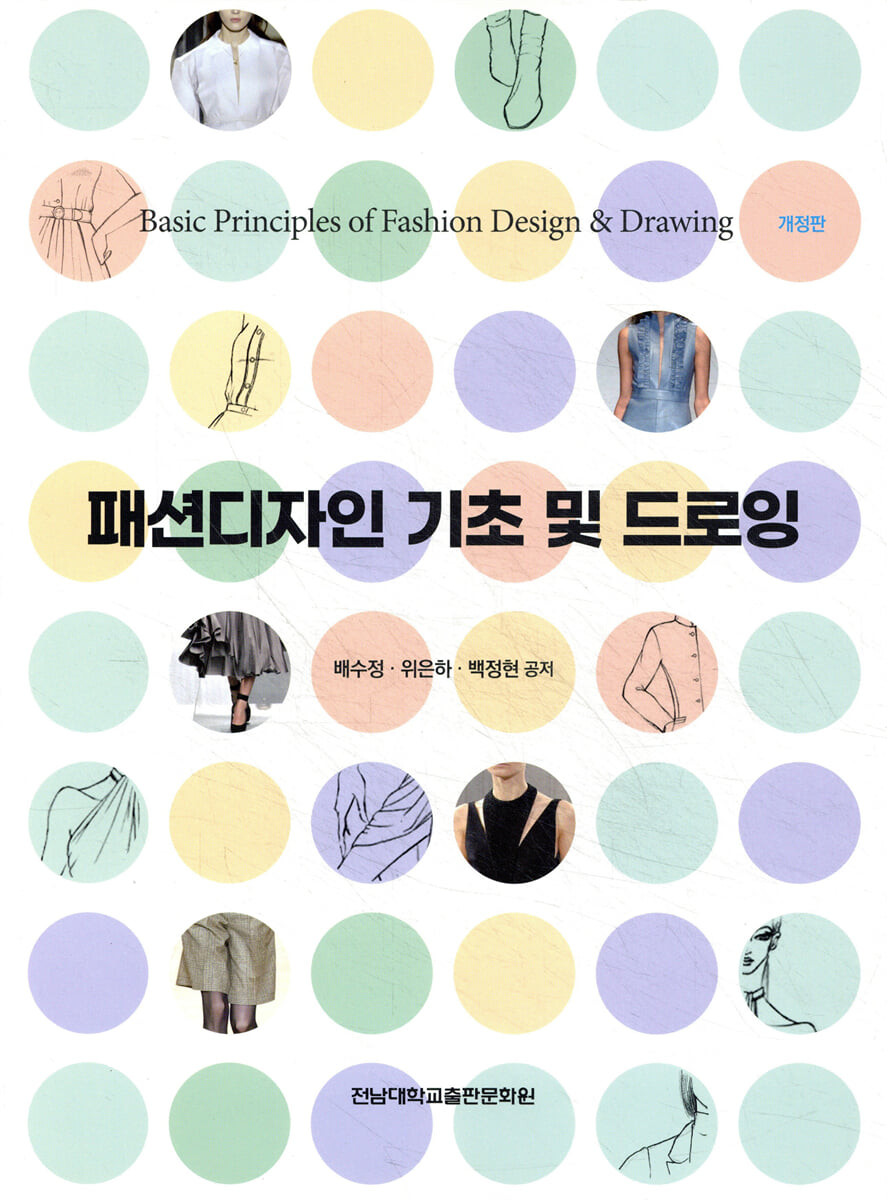
Fashion Design Fundamentals and Drawing
 |
Description
Book Introduction
This book covers both theoretical knowledge of the elements and principles of fashion design and practical training in lines and proportions to learn fashion drawing, helping students develop the fundamental skills essential for future fashion designers.
In the elements of fashion design, we covered shape, color, and material, and presented how they can be applied to actual designs through the works of various designers.
The principles of fashion design introduce proportion, balance, unity, harmony, rhythm, emphasis, economy, and illusion with application examples, showing how to actually realize formative beauty through fashion design.
In order to acquire the qualifications of a fashion designer, the expressive techniques of human figure drawing, schematic drawing, and clothing painting are provided with specific explanations and training techniques to aid understanding, and the method of writing work instructions that can be directly used in field work is covered.
In the elements of fashion design, we covered shape, color, and material, and presented how they can be applied to actual designs through the works of various designers.
The principles of fashion design introduce proportion, balance, unity, harmony, rhythm, emphasis, economy, and illusion with application examples, showing how to actually realize formative beauty through fashion design.
In order to acquire the qualifications of a fashion designer, the expressive techniques of human figure drawing, schematic drawing, and clothing painting are provided with specific explanations and training techniques to aid understanding, and the method of writing work instructions that can be directly used in field work is covered.
index
Preface / 03
Chapter 1: Elements of Fashion Design / 09
1.
Form / 10
2.
Color / 26
3.
Material / 39
Chapter 2: Principles of Fashion Design 49
1.
Proportional / 50
2.
Balance / 55
3.
Unification / 58
4.
Harmony / 59
5.
Rhythm / 62
6.
Emphasis / 65
7.
Economy / 66
8.
Optical illusion / 68
Chapter 3 Fashion Figure Drawing 71
1.
Understanding the Human Body / 72
2.
Fashion Human Proportions and Drawing the Human Body / 76
Chapter 4: Schematics and Detail Drawings 97
1.
Understanding Schematics / 98
2.
Detail Drawings and Schematics / 102
Chapter 5: Material Expression and Drawing Practice 169
1.
Expression of voluminous materials / 170
2.
Expression of Thin Materials / 177
3.
Expression of glossy materials / 184
4.
Expression of Pattern Materials / 191
Chapter 6: Writing Work Instructions 197
References / 210
Search / 211
Chapter 1: Elements of Fashion Design / 09
1.
Form / 10
2.
Color / 26
3.
Material / 39
Chapter 2: Principles of Fashion Design 49
1.
Proportional / 50
2.
Balance / 55
3.
Unification / 58
4.
Harmony / 59
5.
Rhythm / 62
6.
Emphasis / 65
7.
Economy / 66
8.
Optical illusion / 68
Chapter 3 Fashion Figure Drawing 71
1.
Understanding the Human Body / 72
2.
Fashion Human Proportions and Drawing the Human Body / 76
Chapter 4: Schematics and Detail Drawings 97
1.
Understanding Schematics / 98
2.
Detail Drawings and Schematics / 102
Chapter 5: Material Expression and Drawing Practice 169
1.
Expression of voluminous materials / 170
2.
Expression of Thin Materials / 177
3.
Expression of glossy materials / 184
4.
Expression of Pattern Materials / 191
Chapter 6: Writing Work Instructions 197
References / 210
Search / 211
Into the book
The most essential elements to consider when designing clothing are shape, color, and material.
Form includes lines and margins, and refers to the construction lines created when making clothes, the silhouette lines formed after the clothes are completed, and the lines created by details and trimming according to the design.
Color is the most striking element in design, and different color combinations create different moods.
Materials are the most basic ingredients in clothing production, and include natural, artificial, and synthetic materials. They can be viewed as including the texture, which is the visual and tactile sensation of the material's properties.
Additionally, patterns expressed in shape, color, and material through dyeing or weaving were also included in the material.
Therefore, in this chapter, the formal elements such as silhouette, lines, details, and trimming were covered, and in terms of color, the focus was on the color system and color combination of clothing, and in terms of material, the texture of various fabrics according to type, visual and tactile sensations, and patterns were described.
In addition, we attempted to increase understanding by simultaneously covering examples of the application of each element in fashion design.
1.
form
1) Silhouette
SilhouetteThe dictionary definition of silhouette is an image, design, or object with a distinct outline or shadow created using only one color tone.
In general, when we talk about clothing, the term silhouette refers to the overall outline (outline) of the clothing worn. The origin of the name silhouette is a satirical term derived from the austerity measures implemented by Etienne de Silhouette (1709-1767), the French finance minister in the mid-18th century.
Silhouette can be said to be the most basic element of fashion change.
Types of silhouettes include hourglass (X-shaped), straight (H-shaped), tent (A-shaped), and bulk (O-shaped) silhouettes.
(1) Ourglass silhouette
Hourglass SilhouetteThe Hourglass Silhouette is also called an X-shaped silhouette, which is named so because the silhouette, which is tight around the waist to make the waist look slimmer, resembles the letter X.
In Western clothing, all silhouettes that have a narrow waist with a corset fall into this category, and representative silhouettes include crinoline, buttress, romantic, and minaret silhouettes (see Figure 1-1).
In addition, examples include the mermaid silhouette, which was named after the hemline of the skirt that spreads out like a mermaid's tail, and the New Look silhouette announced by Christian Dior (1905-1957) in 1947 (see Figures 1-2, 1-3, and 1-4).
(2) Straight silhouette
Straight SilhouetteStraight Silhouette is also called Sheath Silhouette, Tubular Silhouette, Empire Silhouette, and H-Shaped Silhouette, and refers to a silhouette that is close to a vertical line from the chest, waist, and hips (see Figures 1-5, 1-6, 1-7, and 1-8).
(3) Tent silhouette
Tent Silhouette (Tent Silhouette) Silhouette Tent Silhouette (Tent Silhouette) is also called A-line Silhouette, Trapeze Silhouette, and Trapeze Silhouette. It refers to a silhouette that is narrow at the shoulders but gradually widens as it goes down, forming a shape like the letter A (see Figures 1-9, 1-10, 1-11, 1-12).
(4) Bulk silhouette
Bulk SilhouetteBulk Silhouette is also called barrel silhouette, balloon silhouette, or O-shaped silhouette. It is a silhouette that exaggerates the shape of the letter O in the garment, with the chest and hips puffed out and the hemline tapering (see Figures 1-13, 1-14, 1-15, and 1-16).
2) Line
A line is a connection between two points and is one of the important elements for fashion design.
Lines in clothing determine the shape and silhouette and convey the characteristics or atmosphere of the design. The lines that appear on clothing are largely divided into construction lines such as seams and darts, intentionally created design lines, decorative lines created by details or trimming, and silhouette lines created by the outer perimeter, which are not actual lines but are structural elements that determine the direction of visual interest of clothing.
In fashion design, the use of lines requires understanding the characteristics of the lines, such as thickness, length, continuity, or discontinuity, and applying them to suit the design purpose.
Also, unlike lines used in plastic arts, clothing is worn on the human body, so lines in clothing must be used with consideration for the three-dimensional effect of the human body.
In addition, the feel of the lines used varies depending on the type, thickness, texture, weight, gloss, color, etc. of the fabric due to the nature of the clothing, so it is necessary to use lines that take these into consideration.
(1) Straight line
Straight lines give a hard, strict, masculine feel and can be divided into vertical, horizontal, and diagonal lines depending on their direction.
① Vertical line
Vertical lines guide the eye up and down, creating a sense of length and height. Vertical lines used in clothing are mainly used in styles that make one look taller and in styles that are dignified and authoritative.
It is mainly seen in the front center line, length seam line, pleat line, and button line at regular intervals, and can be found in classic suits, uniforms, and so on.
Therefore, vertical lines in doubles are mainly used in simple and clear designs to give a feeling of nobility, solemnity, authority, dignity, and neatness (see Figures 1-18, 1-19, 1-20, 1-21).
On the other hand, multiple vertical lines guide the gaze left and right, giving the impression of width rather than length (see Figure 1-22).
② Horizon
The horizontal line can easily make you look fat as it emphasizes width by directing the gaze to the left and right, but it is used in clothing styles that create an atmosphere of peace, quiet, and stability because it provides a sense of psychological stability.
Horizontal lines used in clothing are utilized in waist cut lines, yoke lines, and hemlines of skirts, and can be found mainly in everyday wear, sportswear, and designs that require stability (see Figures 1-23, 1-24, and 1-25).
On the other hand, while several consecutive vertical lines emphasize width, consecutive horizontal lines have the effect of leading the eye up and down, creating a sense of length (see Figures 1-26 and 1-27).
③ Diagonal line
Diagonal lines are slightly slanted straight lines that draw the eye in the direction the line flows, giving a dynamic and lively feeling, and have an optical illusion that emphasizes the feeling of width and length depending on the angle.
Diagonal lines used in clothing can be seen in V-necklines, side lines of flared skirts, diagonal seam lines, and decorative lines. These diagonal lines provide a dynamic sense of movement, but they also create a feeling of instability, creating a dramatic and active atmosphere, so caution should be used when using them as the dominant element of a design (see Figures 1-28, 1-29, 1-30, 1-31, and 1-32).
(2) Curve
The curves are soft and flexible, giving off an elegant, feminine feel and gently emphasizing the curves of the body.
Curves are divided into geometric curves such as circles and ellipses, and free curves such as wavy lines, scallops, and spirals.
① Won
The circles used in clothing give a cheerful, young, and cute feeling, and are mainly used in details such as round necklines, round pockets, short puff sleeves, and capes rather than structural composition lines (see Figures 1-33, 1-34, and 1-35).
② Oval
The oval shape used in clothing gives an overall soft, somewhat dull, but elegant feel, and can be seen mainly in seams, necklines, gentle yokes, and pockets (see Figures 1-36 and 1-37).
③ Wave line
Wave lines are rhythmic and flexible, giving a feminine feel, and can be seen in the hemlines of flared or gathered skirts, frills, flounces, and ruffles (see Figures 1-38, 1-39, and 1-40).
④ Scallop
Scallops emphasize softness and femininity with their repeated semicircular curves.
Scallops used in clothing are commonly used for decorative purposes such as necklines, front center lines, and skirt hemlines, or are often used continuously in loop buttonholes, etc.
It is also commonly used in children's clothing to emphasize a cute feel (see Figure 1-41).
⑤ Spiral
A spiral is a shape that resembles a conch shell or a spring, and when used in clothing, it gives a complex, flowing feel.
This can be seen in spiral cut lines or trimming decorations (see Figure 1-42).
3) Details
Detail means 'detail' or 'part', and includes structural details such as necklines, collars, sleeves, cuffs, pockets, and buttons that are created during the clothing production process, and decorative details such as frills, flounces, ruffles, tucks, pleats, shirring, gathers, smocking, and sashes that are created decoratively.
It is mostly necessary for the construction of clothing and is created during the clothing manufacturing process.
① NecklineNeckline
Neckline is the circumference of the neck of a garment that extends from the neck, shoulders, and chest area, and it affects the face shape, neck thickness and length, shoulder width, and shoulder slope.
Necklines include round, V, square, U-shaped, boat, scoop, off-shoulder, halter, surplice, and cowl.
② Color color
The collar is a detail that decorates around the neck and has a significant impact on the wearer's impression.
Like the neckline, it should be designed taking into account the face shape, neck length and thickness, and body type.
Collars come in a variety of styles including band, mandarin, turtleneck, convertible, Peter Pan, shawl, wing, notched, peaked, shirt, bow, and sailor.
③ Sleevesleeves
Sleeves are the part of the upper garment that covers the arms. Depending on the length, they are divided into sleeveless, half sleeve, and long sleeve. Depending on the shape, they are divided into cap sleeves, set-in sleeves, shirt sleeves, bishop sleeves, puff sleeves, leg of mutton sleeves, bell sleeves, raglan sleeves, kimono sleeves, and dolman sleeves.
④ Cuffs Cuffs
Cuffs are details added to finish the sleeves, and include band cuffs, barrel cuffs, French cuffs, roll-up cuffs, and turn-back cuffs.
⑤ Pocket Pocket
Pockets are made for functional and decorative purposes and can be broadly categorized into patch pockets, set-in pockets, and seam pockets.
Patch pockets mainly include patches and kangaroo pockets, and set-in pockets mainly include flap pockets and welt pockets.
⑥ Frill frill
A frill is a decoration that is made by adding a narrow or wide hem that is gathered or pleated, and has pleats at the fixed part (see Figure 1-43).
⑦ Flounce Flounce
A flounce is similar to a frill, but is a single-sided decoration made by cutting a curved shape and fastening the short end, without any pleats at the fastening point (see Figure 1-44).
⑧ Quilting
Quilting is a decorative technique that involves inserting a thin filling material between the outer and inner fabrics and sewing it together to create a pattern using a sewing machine or by hand (see Figure 1-45).
⑨ Chin chin
A tuck is a decoration that folds a portion of fabric and fixes it with a stitch to the desired width. When the width is narrow, it is called a pin-tuck (see Figure 1-46).
⑩ Pleats pleats
Pleats are decorations made with pleats, like machine pleats, with the width and number adjusted to the desired location.
There are side pleats, box pleats, inverted pleats, and accordion pleats (see Figures 1-47, 1-48, and 1-49).
⑪Shirring shirring
Shirring is a decoration that secures thin fabric in place by creating fine pleats.
When fastened with elastic thread, the fabric becomes elastic, and a natural shirring is also formed.
⑫Smoking Smoking
Smoking is a type of decorative pleating that creates regular wrinkles on the surface of a fabric and then stitches them to create a pattern such as a diamond.
Using elastic threads gives the fabric a stretchy feel and creates regular patterns of smocking.
⑬ Other
There are patchwork, cutwork, etc.
4) Trimming
TrimmingTrimming has the same purpose of detailing and decoration, but it is different in that it is a decoration made of a separate material on top of a finished garment.
It is not absolutely necessary to make a garment, but is attached during the garment manufacturing process or after the garment is completed.
Trimming includes braids, sequins, beads, bows, ribbons, embroidery, fringes, patches, appliques, buttons, belts, etc. that are attached to the garment after it has been made.
①Braid Braid
Braid is a tape or string made by weaving together threads or fabrics of various colors and materials, and comes in various widths and shapes.
It is mainly decorated along the construction lines such as the neckline, collar, front hem, sleeve cuffs, and pocket circumference (see Figure 1-50).
②Spangles
Spangles are small circular pieces made of metal or synthetic resin that sparkle when exposed to light. They look gorgeous and are often used in special costumes such as stage costumes and wedding dresses (see Figure 1-51).
③Bow bow
A bow is a ribbon decoration made using the original material of the garment or a contrasting material (see Figure 1-52).
It is mainly used for children's clothing or feminine designs.
④Bizbiz
Beads are small beaded decorations that can be attached directly to fabric or strung together to create a long string.
It gives a feminine and glamorous feel (see Figure 1-53).
It is a decoration often used in wedding dresses and banquet dresses.
⑤Embroidery
Embroidery is the decoration of the surface of fabric with various embroidery techniques. There are hand embroidery and machine embroidery, and sometimes cotton is inserted inside the embroidery to give it a three-dimensional effect (see Figure 1-54).
⑥ Fringe Fringe
Fringing is a decoration made by knotting or attaching ready-made tassels to hemlines, sleeve seams, yoke lines, etc. (see Figure 1-55).
⑦BindingBinding
Binding is a decoration that wraps bias fabric around the construction lines or the ends of details.
Contrasting colors, materials, etc. are used to create various decorative effects depending on the binding width (see Figure 1-56).
⑧WappenWappen
Warpen is a decoration made of various materials, such as a specific shape of a sentence or logo, that gives a casual feel (see Figure 1-57).
⑨Piping piping
Piping is a decoration that emphasizes the seam line by inserting thin bias tape made of a different fabric into the seam.
Bias Tape: String can be inserted into bias tape to further emphasize the lines, and contrasting colors can be used to enhance the decorative effect (see Figure 1-58).
⑩ Other
Other decorative trimmings include tassels, loops, lacing, hot fixes, buttons, and belts (see Figure 1-59).
2.
Colors
Color is created when light strikes an object and some wavelengths are absorbed and others are reflected, resulting in different colors being perceived for each object.
In fashion, color is the most important element that can tell the wearer's sense of style and is the first thing that stands out.
Dressing in well-coordinated colors not only provides self-satisfaction, but also gives a good image to others and helps to compensate for body flaws.
1) The three attributes of color and the color stereotype
Every object has its own color, and even if the color of the object is red, it can be expressed in various ways, such as dark red, deep red, bright red, and vivid red.
This is because color has its own properties such as brightness and darkness, clarity and turbidity due to the wavelength of light.
This same property applies to the color of all objects simultaneously, and we express the color of an object as hue, value, and saturation.
And if you arrange and organize these colors in three dimensions according to their respective properties, a color solid is created.
(1) The three attributes of colorThe three attributes of color
Color generally refers to the properties of color, and color names are used to distinguish colors.
The primary colors that stand out in the spectrum of light are red, orange, yellow, green, blue, and purple, but there are countless gradually varying colors between each color.
To make it easier to understand the location and changes of the many colors developed from the spectrum, the colors are arranged in a circular ring shape adjacent to each other, and this is called a color circle.
Colors that are close together on the color wheel have a small hue difference and are called analogous colors, colors that are relatively far apart have a large hue difference and are called contrasting colors, and colors that are the most distant and opposite colors are called complementary colors.
Brightness refers to the lightness and darkness of a color, and the degree to which light is absorbed by the surface of an object determines how bright or dark a color is.
Brightness is a color attribute that represents the brightness and darkness of a color. It is a property that both chromatic and achromatic colors have in common. When white is added, the brightness increases, and when black is added, the brightness decreases.
The levels of brightness are arranged to gradually change the gray between white and black.
The brightness levels are divided into 11 levels from white to black, and these serve as the brightness standards for all colors.
Saturation refers to the degree of clarity or turbidity of a color. The cleanest and clearest color among colors is said to have the highest saturation, and a color that is cloudy or unclear when mixed with other colors is called turbid and expressed as having low saturation.
Among the clear colors of the same color, the color with the highest saturation is called a pure color.
(2) Color 3D
To create a color solid, first place an achromatic color in the center and arrange it vertically so that the brightness increases as you go up.
Draw a horizontal line perpendicular to each colorless object in the center and arrange the saturation levels along this line (see Figure 1-60).
The closer it is to achromatic, the lower the saturation, and the further it is from the color, the higher the saturation, and the closer it is to pure color.
At the opposite end of the spectrum from the achromatic colors, pure colors that are not mixed with white or black at all are raised, and for each pure color, a plane is created that arranges all colors of each brightness and saturation level. This is called a color plane (see Figure 1-61).
When each color plane is arranged in order on the color wheel based on the brightness axis, a color 3D is completed.
Although the shape of a color sphere is slightly different depending on the color system, the structure with hue, brightness, and saturation as its dimensions is the same.
2) Color system
To display colors more accurately, a color system is used, which is a method of displaying the spatial coordinates of a color three-dimensional object.
The most widely used color systems are the Munsell and Ostwald color systems.
(1) Munsell color system
The Munsell color system was named after the American painter and colorist Albert H.
It was invented in 1905 by Munsell (1858-1919) and later revised and supplemented by the Optical Society of America.
Hue is represented by H, and the five primary colors of red (R), yellow (Y), green (G), blue (B), and purple (P) are divided into 1 to 10 by arranging 10 colors including orange (YR), light green (GY), cyan (BG), and indigo (PB) in a circle, with the fifth color being the representative color.
The representative color of red is 5R (see Figure 1-62).
The value is represented by V and is numbered from 1 to 9.
Complete black (B) is 0, and complete white (W) is 10, so they are not displayed because they do not exist in reality.
Chroma is represented by C, with 0 representing achromatic color, and the closer it is to pure color, the larger the number (see Figure 1-63).
The steps to reach pure color vary depending on the color. 5R, 5Y, 5YR, etc. reach pure color at saturation 14, 5PB, 5RP, etc. reach maximum saturation at saturation 12, 5P at saturation 10, and 5BG at saturation 8.
There is also a difference in the level of brightness that reaches maximum saturation, with 5Y reaching maximum saturation at brightness 7 and 5PB reaching maximum saturation at brightness 3.
Munsell's color system is expressed in the form of HV/C, in the order of hue, value, and saturation.
A color that is 5R, has a brightness of 6, and a saturation of 7 is written as '5R 6/7'.
Achromatic colors are indicated in NV format as 'N5', 'N8', etc.
(2) Ostwald color systemOstwald color system
The color system announced by the German physical chemist Wilhelm Ostwald (1853-1932) systematizes colors according to the mixing ratio of three colors: black (B), white (W), and pure color (C) with B+W+C=100.
The Ostwald color wheel consists of 24 colors in total, divided into 8 colors by adding 4 primary colors of red (R), blue (B), green (G), and yellow (Y) and 4 intermediate colors of orange (O), purple (P), cyan (T), and yellow-green (LG) in between. The standard colors of each color are intermediate colors 2, 5, and 8...
etc. (see Figure 1-64).
When black and white are added to a color to change the brightness and saturation, an isochromatic surface is created, as shown in Figure 1-65.
When a represents white (W), p represents black (B), and pa represents pure color (C), if the amount of p, which is black (B), is the same, a equi-black series is formed, if the amount of a, which is white (W), is the same as the amount of pa, which is pure color (C), a equi-white series is formed, and colors that have something in common are easy to harmonize with each other.
The Ostwald color solid, with these chromatic planes connected at 360˚, has a shape like an abacus bead with the middle part protruding (see Figure 1-66).
3) Color characteristics
(1) Warm colors and cool colors
The sense of temperature varies depending on the color.
That is, if two objects of the same material are painted red and blue, the red one feels warmer even though the materials are the same.
Warm colors include red, orange, and yellow, while cool colors include cyan, blue, and violet.
The other color groups are called neutral colors.
However, this psychological effect is not felt by everyone, and some people feel the opposite.
This sense of color temperature has been found to be related to the personality traits of the person who likes that color. People who like warm colors are generally extroverted, easily accept new things, and quickly adapt to social changes, while people who like cool colors are generally introverted and intellectual, do not get along well with people, are slow to adapt to change, and are reluctant to express themselves.
By utilizing these characteristics in clothing, one can not only express one's individuality or mood through clothing, but also use it to complement the strengths and weaknesses of one's body type or personality.
(2) Advancing color and retreating color
Advancing colors are colors that appear to be protruding forward. Warm colors appear to be advancing more than cool colors, and light colors appear to be advancing more than dark colors.
Additionally, highly saturated colors appear more vibrant than less saturated or achromatic colors.
A receding color is a color that appears to be receding, such as a cool color, a dark color, or an achromatic color.
Form includes lines and margins, and refers to the construction lines created when making clothes, the silhouette lines formed after the clothes are completed, and the lines created by details and trimming according to the design.
Color is the most striking element in design, and different color combinations create different moods.
Materials are the most basic ingredients in clothing production, and include natural, artificial, and synthetic materials. They can be viewed as including the texture, which is the visual and tactile sensation of the material's properties.
Additionally, patterns expressed in shape, color, and material through dyeing or weaving were also included in the material.
Therefore, in this chapter, the formal elements such as silhouette, lines, details, and trimming were covered, and in terms of color, the focus was on the color system and color combination of clothing, and in terms of material, the texture of various fabrics according to type, visual and tactile sensations, and patterns were described.
In addition, we attempted to increase understanding by simultaneously covering examples of the application of each element in fashion design.
1.
form
1) Silhouette
SilhouetteThe dictionary definition of silhouette is an image, design, or object with a distinct outline or shadow created using only one color tone.
In general, when we talk about clothing, the term silhouette refers to the overall outline (outline) of the clothing worn. The origin of the name silhouette is a satirical term derived from the austerity measures implemented by Etienne de Silhouette (1709-1767), the French finance minister in the mid-18th century.
Silhouette can be said to be the most basic element of fashion change.
Types of silhouettes include hourglass (X-shaped), straight (H-shaped), tent (A-shaped), and bulk (O-shaped) silhouettes.
(1) Ourglass silhouette
Hourglass SilhouetteThe Hourglass Silhouette is also called an X-shaped silhouette, which is named so because the silhouette, which is tight around the waist to make the waist look slimmer, resembles the letter X.
In Western clothing, all silhouettes that have a narrow waist with a corset fall into this category, and representative silhouettes include crinoline, buttress, romantic, and minaret silhouettes (see Figure 1-1).
In addition, examples include the mermaid silhouette, which was named after the hemline of the skirt that spreads out like a mermaid's tail, and the New Look silhouette announced by Christian Dior (1905-1957) in 1947 (see Figures 1-2, 1-3, and 1-4).
(2) Straight silhouette
Straight SilhouetteStraight Silhouette is also called Sheath Silhouette, Tubular Silhouette, Empire Silhouette, and H-Shaped Silhouette, and refers to a silhouette that is close to a vertical line from the chest, waist, and hips (see Figures 1-5, 1-6, 1-7, and 1-8).
(3) Tent silhouette
Tent Silhouette (Tent Silhouette) Silhouette Tent Silhouette (Tent Silhouette) is also called A-line Silhouette, Trapeze Silhouette, and Trapeze Silhouette. It refers to a silhouette that is narrow at the shoulders but gradually widens as it goes down, forming a shape like the letter A (see Figures 1-9, 1-10, 1-11, 1-12).
(4) Bulk silhouette
Bulk SilhouetteBulk Silhouette is also called barrel silhouette, balloon silhouette, or O-shaped silhouette. It is a silhouette that exaggerates the shape of the letter O in the garment, with the chest and hips puffed out and the hemline tapering (see Figures 1-13, 1-14, 1-15, and 1-16).
2) Line
A line is a connection between two points and is one of the important elements for fashion design.
Lines in clothing determine the shape and silhouette and convey the characteristics or atmosphere of the design. The lines that appear on clothing are largely divided into construction lines such as seams and darts, intentionally created design lines, decorative lines created by details or trimming, and silhouette lines created by the outer perimeter, which are not actual lines but are structural elements that determine the direction of visual interest of clothing.
In fashion design, the use of lines requires understanding the characteristics of the lines, such as thickness, length, continuity, or discontinuity, and applying them to suit the design purpose.
Also, unlike lines used in plastic arts, clothing is worn on the human body, so lines in clothing must be used with consideration for the three-dimensional effect of the human body.
In addition, the feel of the lines used varies depending on the type, thickness, texture, weight, gloss, color, etc. of the fabric due to the nature of the clothing, so it is necessary to use lines that take these into consideration.
(1) Straight line
Straight lines give a hard, strict, masculine feel and can be divided into vertical, horizontal, and diagonal lines depending on their direction.
① Vertical line
Vertical lines guide the eye up and down, creating a sense of length and height. Vertical lines used in clothing are mainly used in styles that make one look taller and in styles that are dignified and authoritative.
It is mainly seen in the front center line, length seam line, pleat line, and button line at regular intervals, and can be found in classic suits, uniforms, and so on.
Therefore, vertical lines in doubles are mainly used in simple and clear designs to give a feeling of nobility, solemnity, authority, dignity, and neatness (see Figures 1-18, 1-19, 1-20, 1-21).
On the other hand, multiple vertical lines guide the gaze left and right, giving the impression of width rather than length (see Figure 1-22).
② Horizon
The horizontal line can easily make you look fat as it emphasizes width by directing the gaze to the left and right, but it is used in clothing styles that create an atmosphere of peace, quiet, and stability because it provides a sense of psychological stability.
Horizontal lines used in clothing are utilized in waist cut lines, yoke lines, and hemlines of skirts, and can be found mainly in everyday wear, sportswear, and designs that require stability (see Figures 1-23, 1-24, and 1-25).
On the other hand, while several consecutive vertical lines emphasize width, consecutive horizontal lines have the effect of leading the eye up and down, creating a sense of length (see Figures 1-26 and 1-27).
③ Diagonal line
Diagonal lines are slightly slanted straight lines that draw the eye in the direction the line flows, giving a dynamic and lively feeling, and have an optical illusion that emphasizes the feeling of width and length depending on the angle.
Diagonal lines used in clothing can be seen in V-necklines, side lines of flared skirts, diagonal seam lines, and decorative lines. These diagonal lines provide a dynamic sense of movement, but they also create a feeling of instability, creating a dramatic and active atmosphere, so caution should be used when using them as the dominant element of a design (see Figures 1-28, 1-29, 1-30, 1-31, and 1-32).
(2) Curve
The curves are soft and flexible, giving off an elegant, feminine feel and gently emphasizing the curves of the body.
Curves are divided into geometric curves such as circles and ellipses, and free curves such as wavy lines, scallops, and spirals.
① Won
The circles used in clothing give a cheerful, young, and cute feeling, and are mainly used in details such as round necklines, round pockets, short puff sleeves, and capes rather than structural composition lines (see Figures 1-33, 1-34, and 1-35).
② Oval
The oval shape used in clothing gives an overall soft, somewhat dull, but elegant feel, and can be seen mainly in seams, necklines, gentle yokes, and pockets (see Figures 1-36 and 1-37).
③ Wave line
Wave lines are rhythmic and flexible, giving a feminine feel, and can be seen in the hemlines of flared or gathered skirts, frills, flounces, and ruffles (see Figures 1-38, 1-39, and 1-40).
④ Scallop
Scallops emphasize softness and femininity with their repeated semicircular curves.
Scallops used in clothing are commonly used for decorative purposes such as necklines, front center lines, and skirt hemlines, or are often used continuously in loop buttonholes, etc.
It is also commonly used in children's clothing to emphasize a cute feel (see Figure 1-41).
⑤ Spiral
A spiral is a shape that resembles a conch shell or a spring, and when used in clothing, it gives a complex, flowing feel.
This can be seen in spiral cut lines or trimming decorations (see Figure 1-42).
3) Details
Detail means 'detail' or 'part', and includes structural details such as necklines, collars, sleeves, cuffs, pockets, and buttons that are created during the clothing production process, and decorative details such as frills, flounces, ruffles, tucks, pleats, shirring, gathers, smocking, and sashes that are created decoratively.
It is mostly necessary for the construction of clothing and is created during the clothing manufacturing process.
① NecklineNeckline
Neckline is the circumference of the neck of a garment that extends from the neck, shoulders, and chest area, and it affects the face shape, neck thickness and length, shoulder width, and shoulder slope.
Necklines include round, V, square, U-shaped, boat, scoop, off-shoulder, halter, surplice, and cowl.
② Color color
The collar is a detail that decorates around the neck and has a significant impact on the wearer's impression.
Like the neckline, it should be designed taking into account the face shape, neck length and thickness, and body type.
Collars come in a variety of styles including band, mandarin, turtleneck, convertible, Peter Pan, shawl, wing, notched, peaked, shirt, bow, and sailor.
③ Sleevesleeves
Sleeves are the part of the upper garment that covers the arms. Depending on the length, they are divided into sleeveless, half sleeve, and long sleeve. Depending on the shape, they are divided into cap sleeves, set-in sleeves, shirt sleeves, bishop sleeves, puff sleeves, leg of mutton sleeves, bell sleeves, raglan sleeves, kimono sleeves, and dolman sleeves.
④ Cuffs Cuffs
Cuffs are details added to finish the sleeves, and include band cuffs, barrel cuffs, French cuffs, roll-up cuffs, and turn-back cuffs.
⑤ Pocket Pocket
Pockets are made for functional and decorative purposes and can be broadly categorized into patch pockets, set-in pockets, and seam pockets.
Patch pockets mainly include patches and kangaroo pockets, and set-in pockets mainly include flap pockets and welt pockets.
⑥ Frill frill
A frill is a decoration that is made by adding a narrow or wide hem that is gathered or pleated, and has pleats at the fixed part (see Figure 1-43).
⑦ Flounce Flounce
A flounce is similar to a frill, but is a single-sided decoration made by cutting a curved shape and fastening the short end, without any pleats at the fastening point (see Figure 1-44).
⑧ Quilting
Quilting is a decorative technique that involves inserting a thin filling material between the outer and inner fabrics and sewing it together to create a pattern using a sewing machine or by hand (see Figure 1-45).
⑨ Chin chin
A tuck is a decoration that folds a portion of fabric and fixes it with a stitch to the desired width. When the width is narrow, it is called a pin-tuck (see Figure 1-46).
⑩ Pleats pleats
Pleats are decorations made with pleats, like machine pleats, with the width and number adjusted to the desired location.
There are side pleats, box pleats, inverted pleats, and accordion pleats (see Figures 1-47, 1-48, and 1-49).
⑪Shirring shirring
Shirring is a decoration that secures thin fabric in place by creating fine pleats.
When fastened with elastic thread, the fabric becomes elastic, and a natural shirring is also formed.
⑫Smoking Smoking
Smoking is a type of decorative pleating that creates regular wrinkles on the surface of a fabric and then stitches them to create a pattern such as a diamond.
Using elastic threads gives the fabric a stretchy feel and creates regular patterns of smocking.
⑬ Other
There are patchwork, cutwork, etc.
4) Trimming
TrimmingTrimming has the same purpose of detailing and decoration, but it is different in that it is a decoration made of a separate material on top of a finished garment.
It is not absolutely necessary to make a garment, but is attached during the garment manufacturing process or after the garment is completed.
Trimming includes braids, sequins, beads, bows, ribbons, embroidery, fringes, patches, appliques, buttons, belts, etc. that are attached to the garment after it has been made.
①Braid Braid
Braid is a tape or string made by weaving together threads or fabrics of various colors and materials, and comes in various widths and shapes.
It is mainly decorated along the construction lines such as the neckline, collar, front hem, sleeve cuffs, and pocket circumference (see Figure 1-50).
②Spangles
Spangles are small circular pieces made of metal or synthetic resin that sparkle when exposed to light. They look gorgeous and are often used in special costumes such as stage costumes and wedding dresses (see Figure 1-51).
③Bow bow
A bow is a ribbon decoration made using the original material of the garment or a contrasting material (see Figure 1-52).
It is mainly used for children's clothing or feminine designs.
④Bizbiz
Beads are small beaded decorations that can be attached directly to fabric or strung together to create a long string.
It gives a feminine and glamorous feel (see Figure 1-53).
It is a decoration often used in wedding dresses and banquet dresses.
⑤Embroidery
Embroidery is the decoration of the surface of fabric with various embroidery techniques. There are hand embroidery and machine embroidery, and sometimes cotton is inserted inside the embroidery to give it a three-dimensional effect (see Figure 1-54).
⑥ Fringe Fringe
Fringing is a decoration made by knotting or attaching ready-made tassels to hemlines, sleeve seams, yoke lines, etc. (see Figure 1-55).
⑦BindingBinding
Binding is a decoration that wraps bias fabric around the construction lines or the ends of details.
Contrasting colors, materials, etc. are used to create various decorative effects depending on the binding width (see Figure 1-56).
⑧WappenWappen
Warpen is a decoration made of various materials, such as a specific shape of a sentence or logo, that gives a casual feel (see Figure 1-57).
⑨Piping piping
Piping is a decoration that emphasizes the seam line by inserting thin bias tape made of a different fabric into the seam.
Bias Tape: String can be inserted into bias tape to further emphasize the lines, and contrasting colors can be used to enhance the decorative effect (see Figure 1-58).
⑩ Other
Other decorative trimmings include tassels, loops, lacing, hot fixes, buttons, and belts (see Figure 1-59).
2.
Colors
Color is created when light strikes an object and some wavelengths are absorbed and others are reflected, resulting in different colors being perceived for each object.
In fashion, color is the most important element that can tell the wearer's sense of style and is the first thing that stands out.
Dressing in well-coordinated colors not only provides self-satisfaction, but also gives a good image to others and helps to compensate for body flaws.
1) The three attributes of color and the color stereotype
Every object has its own color, and even if the color of the object is red, it can be expressed in various ways, such as dark red, deep red, bright red, and vivid red.
This is because color has its own properties such as brightness and darkness, clarity and turbidity due to the wavelength of light.
This same property applies to the color of all objects simultaneously, and we express the color of an object as hue, value, and saturation.
And if you arrange and organize these colors in three dimensions according to their respective properties, a color solid is created.
(1) The three attributes of colorThe three attributes of color
Color generally refers to the properties of color, and color names are used to distinguish colors.
The primary colors that stand out in the spectrum of light are red, orange, yellow, green, blue, and purple, but there are countless gradually varying colors between each color.
To make it easier to understand the location and changes of the many colors developed from the spectrum, the colors are arranged in a circular ring shape adjacent to each other, and this is called a color circle.
Colors that are close together on the color wheel have a small hue difference and are called analogous colors, colors that are relatively far apart have a large hue difference and are called contrasting colors, and colors that are the most distant and opposite colors are called complementary colors.
Brightness refers to the lightness and darkness of a color, and the degree to which light is absorbed by the surface of an object determines how bright or dark a color is.
Brightness is a color attribute that represents the brightness and darkness of a color. It is a property that both chromatic and achromatic colors have in common. When white is added, the brightness increases, and when black is added, the brightness decreases.
The levels of brightness are arranged to gradually change the gray between white and black.
The brightness levels are divided into 11 levels from white to black, and these serve as the brightness standards for all colors.
Saturation refers to the degree of clarity or turbidity of a color. The cleanest and clearest color among colors is said to have the highest saturation, and a color that is cloudy or unclear when mixed with other colors is called turbid and expressed as having low saturation.
Among the clear colors of the same color, the color with the highest saturation is called a pure color.
(2) Color 3D
To create a color solid, first place an achromatic color in the center and arrange it vertically so that the brightness increases as you go up.
Draw a horizontal line perpendicular to each colorless object in the center and arrange the saturation levels along this line (see Figure 1-60).
The closer it is to achromatic, the lower the saturation, and the further it is from the color, the higher the saturation, and the closer it is to pure color.
At the opposite end of the spectrum from the achromatic colors, pure colors that are not mixed with white or black at all are raised, and for each pure color, a plane is created that arranges all colors of each brightness and saturation level. This is called a color plane (see Figure 1-61).
When each color plane is arranged in order on the color wheel based on the brightness axis, a color 3D is completed.
Although the shape of a color sphere is slightly different depending on the color system, the structure with hue, brightness, and saturation as its dimensions is the same.
2) Color system
To display colors more accurately, a color system is used, which is a method of displaying the spatial coordinates of a color three-dimensional object.
The most widely used color systems are the Munsell and Ostwald color systems.
(1) Munsell color system
The Munsell color system was named after the American painter and colorist Albert H.
It was invented in 1905 by Munsell (1858-1919) and later revised and supplemented by the Optical Society of America.
Hue is represented by H, and the five primary colors of red (R), yellow (Y), green (G), blue (B), and purple (P) are divided into 1 to 10 by arranging 10 colors including orange (YR), light green (GY), cyan (BG), and indigo (PB) in a circle, with the fifth color being the representative color.
The representative color of red is 5R (see Figure 1-62).
The value is represented by V and is numbered from 1 to 9.
Complete black (B) is 0, and complete white (W) is 10, so they are not displayed because they do not exist in reality.
Chroma is represented by C, with 0 representing achromatic color, and the closer it is to pure color, the larger the number (see Figure 1-63).
The steps to reach pure color vary depending on the color. 5R, 5Y, 5YR, etc. reach pure color at saturation 14, 5PB, 5RP, etc. reach maximum saturation at saturation 12, 5P at saturation 10, and 5BG at saturation 8.
There is also a difference in the level of brightness that reaches maximum saturation, with 5Y reaching maximum saturation at brightness 7 and 5PB reaching maximum saturation at brightness 3.
Munsell's color system is expressed in the form of HV/C, in the order of hue, value, and saturation.
A color that is 5R, has a brightness of 6, and a saturation of 7 is written as '5R 6/7'.
Achromatic colors are indicated in NV format as 'N5', 'N8', etc.
(2) Ostwald color systemOstwald color system
The color system announced by the German physical chemist Wilhelm Ostwald (1853-1932) systematizes colors according to the mixing ratio of three colors: black (B), white (W), and pure color (C) with B+W+C=100.
The Ostwald color wheel consists of 24 colors in total, divided into 8 colors by adding 4 primary colors of red (R), blue (B), green (G), and yellow (Y) and 4 intermediate colors of orange (O), purple (P), cyan (T), and yellow-green (LG) in between. The standard colors of each color are intermediate colors 2, 5, and 8...
etc. (see Figure 1-64).
When black and white are added to a color to change the brightness and saturation, an isochromatic surface is created, as shown in Figure 1-65.
When a represents white (W), p represents black (B), and pa represents pure color (C), if the amount of p, which is black (B), is the same, a equi-black series is formed, if the amount of a, which is white (W), is the same as the amount of pa, which is pure color (C), a equi-white series is formed, and colors that have something in common are easy to harmonize with each other.
The Ostwald color solid, with these chromatic planes connected at 360˚, has a shape like an abacus bead with the middle part protruding (see Figure 1-66).
3) Color characteristics
(1) Warm colors and cool colors
The sense of temperature varies depending on the color.
That is, if two objects of the same material are painted red and blue, the red one feels warmer even though the materials are the same.
Warm colors include red, orange, and yellow, while cool colors include cyan, blue, and violet.
The other color groups are called neutral colors.
However, this psychological effect is not felt by everyone, and some people feel the opposite.
This sense of color temperature has been found to be related to the personality traits of the person who likes that color. People who like warm colors are generally extroverted, easily accept new things, and quickly adapt to social changes, while people who like cool colors are generally introverted and intellectual, do not get along well with people, are slow to adapt to change, and are reluctant to express themselves.
By utilizing these characteristics in clothing, one can not only express one's individuality or mood through clothing, but also use it to complement the strengths and weaknesses of one's body type or personality.
(2) Advancing color and retreating color
Advancing colors are colors that appear to be protruding forward. Warm colors appear to be advancing more than cool colors, and light colors appear to be advancing more than dark colors.
Additionally, highly saturated colors appear more vibrant than less saturated or achromatic colors.
A receding color is a color that appears to be receding, such as a cool color, a dark color, or an achromatic color.
--- From the text
GOODS SPECIFICS
- Publication date: February 25, 2021
- Page count, weight, size: 216 pages | 891g | 221*298*14mm
- ISBN13: 9788968497902
- ISBN10: 8968497907
You may also like
카테고리
korean


korean

![GQ KOREA Mark (Monthly): December [2025]](http://librairie.coreenne.fr/cdn/shop/files/8ef265dbbfbf186523ed75ba7319009d.jpg?v=1765340328&width=3840)


