

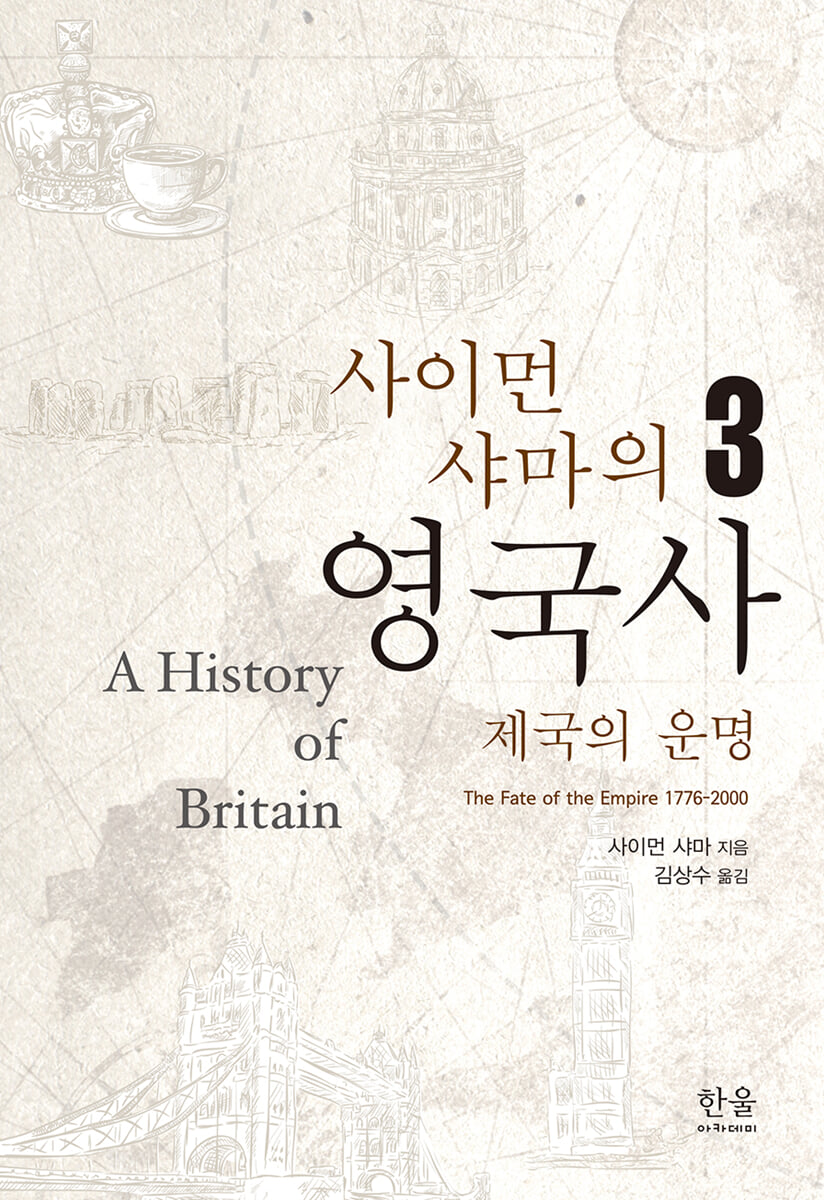
Simon Schama's History of Britain, Vol. 3
 |
Description
Book Introduction
British history illuminated through a 'micro-historical' perspective
From familiar figures to lesser-known ones,
Focus on the lives of various characters
Following volumes 1 and 2 of Simon Schama's History of England, the final volume has been published.
The beginning of this trilogy was 'A History of British Television', planned by the BBC in the UK.
However, this book cannot be said to be simply a derivative work of the television series.
This is because it is not simply a script for a series, but rather deals with themes and issues of British history in much more detail and specificity than the series.
『Simon Schama's History of Britain 3』 covers the period from the late Victorian era to the end of World War II (1776-2000).
The first half of the book is filled with the intellectual and cultural atmosphere surrounding the French Revolution, and the story unfolds through figures such as Romantic philosophers like Jean-Jacques Rousseau, poets like William Wordsworth, and figures like Tom Paine, Mary Wollstonecraft, and William Cobbett.
It also explores Victorian British industry and architecture, including information on the Great Exhibition of 1851 held at London's Crystal Palace.
The second half of the book examines British rule in India and Ireland and the devastating famine, while the final part examines modern Britain through the lives of two men: Winston Churchill and George Orwell.
From familiar figures to lesser-known ones,
Focus on the lives of various characters
Following volumes 1 and 2 of Simon Schama's History of England, the final volume has been published.
The beginning of this trilogy was 'A History of British Television', planned by the BBC in the UK.
However, this book cannot be said to be simply a derivative work of the television series.
This is because it is not simply a script for a series, but rather deals with themes and issues of British history in much more detail and specificity than the series.
『Simon Schama's History of Britain 3』 covers the period from the late Victorian era to the end of World War II (1776-2000).
The first half of the book is filled with the intellectual and cultural atmosphere surrounding the French Revolution, and the story unfolds through figures such as Romantic philosophers like Jean-Jacques Rousseau, poets like William Wordsworth, and figures like Tom Paine, Mary Wollstonecraft, and William Cobbett.
It also explores Victorian British industry and architecture, including information on the Great Exhibition of 1851 held at London's Crystal Palace.
The second half of the book examines British rule in India and Ireland and the devastating famine, while the final part examines modern Britain through the lives of two men: Winston Churchill and George Orwell.
index
introduction
1.
Forces of Nature: The Road to Revolution?
2.
Forces of Nature: The Road Home
3.
queen bee and hive
4.
wife, daughter, widow
5.
Empire of Good Intentions: Investing
6.
Empire of Good Intentions: Dividends
7.
The end of Blazeover?
8.
patience
Selected References
Acknowledgements
Search
Translator's Note
1.
Forces of Nature: The Road to Revolution?
2.
Forces of Nature: The Road Home
3.
queen bee and hive
4.
wife, daughter, widow
5.
Empire of Good Intentions: Investing
6.
Empire of Good Intentions: Dividends
7.
The end of Blazeover?
8.
patience
Selected References
Acknowledgements
Search
Translator's Note
Into the book
In 1769, Day began to build his own family by hand-picking two young girls as potential wives and mothers, as if selecting puppies from a litter.
He intended to raise them according to Rousseau's principles, then marry the one who proved most suitable and provide the funds necessary for the other to become an apprentice.
The twelve-year-old blonde girl, taken from the Shrewsbury orphanage, was renamed Sabrina, and the brunette, taken from London's Foundling Hospital, was called Lucretia, the name of a noble wife in ancient Rome (ignoring the fact that this female heroine's last name was suicide).
To no one's surprise except Thomas Day, the experiment did not go as planned.
…Sabrina was taken to Litchfield and subjected to Day's often inhumane experiments.
They tested her pain limits by pouring hot wax on her arms and fired a gun loaded with blank bullets near her head.
Day finally, overcome with despair at not being able to make her the mate of his dreams, took her to boarding school, an escape for which she was now deeply grateful.
She eventually married a lawyer.
In response to the campaign against chimney-sweeping boys (which inspired Blake's 1789 poem "The Chimney Sweeper"), a law was passed in 1788 prohibiting the employment of children under the age of eight and sending them down burning chimneys.
It also stated that they had to be washed at least once a week.
But this law was largely poorly enforced and far from sufficient for those most concerned about the fate of the poor.
The philosopher's argument, as expressed in the novel "Emile," was that girls should be raised for one supreme purpose - to be comforters and helpers to their spouses and mothers (nursing mothers, of course) to their children.
Divine providence has so defined the sexes as so inseparably different that any woman who acts like a man or tries to be like a man is by definition a biological and moral monster, robbing her family of the quality that makes their dwelling place a home: tendresse.
Mary … wrote a small treatise on the education of her daughters.
Unlike Emile, this text argued that girls, like boys, had the potential to be well educated in all aspects.
--- 「1.
From "The Forces of Nature: The Road to Revolution"
But while Mary was writing this, she became deeply infatuated with one of Johnson's regular customers, a curiously talkative, middle-aged Swiss artist named Henry Fusley.
…Fuseley seemed embarrassed by her obsession, but…Mary impulsively knocked on Sophia’s door and informed the understandably surprised young wife that the three of them were to start a family together: “I have no intention of deceiving you, so I will tell you plainly.
This suggestion comes from my sincere affection for your husband.
I realized that I couldn't live without the satisfaction of seeing him and talking to him every day." She made no demands on him as a husband—a generous concession she left to Sophia—but mentally they had to be together.
Sophia's shocked reaction was to slam the door shut, preventing Mary from ever crossing the threshold again.
Mary is pregnant.
In March 1797, William Godwin married Lady Imlay at St Pancras Church.
…the two declared that they would not continue to live together, would respect each other's independence, and would maintain separate residences, although they would occasionally stay together while meeting other people of the opposite sex.
…As the time of labor approached on August 30, she called the local midwife.
But after the baby was born, a girl (the future author of Frankenstein), there were concerns about sepsis because the placenta did not travel down the birth canal.
The internist called from Westminster did his best, but could not prevent the placenta from breaking apart, and Mary suffered profuse bleeding.
…the next day she seemed so much better that Godwin thought it safe enough for him to go for a walk.
When he returned, he found her writhing in convulsions and running a high fever.
…A week later, on September 10, 1797, Mary Wollstonecraft died of sepsis.
…Wolstonecraft is rightly remembered as the founder of modern feminism; her clear argument that women's entire nature should not be confused with their biology remains powerful.
At least 30,000 Irish people were massacred; a once economically and politically dynamic world was transformed into a charnel house of invasion, oppression, and sectarian pogroms.
More crucially, hopes for Irish freedom were overturned by the fact that Ireland was absorbed into Britain in 1801: the final cross on the Union Jack was now complete.
The Dublin Parliament (which in retrospect was seen as the source of the problem) was dissolved, and Irish representatives would now sit in the Westminster Parliament.
…the number of Irish constituencies and members of Parliament was drastically reduced, and Ireland's debt (unlike Scotland's a century earlier) was kept separate – a serious tax burden on the Irish population.
--- 「2.
From "The Force of Nature: The Way Home"
Of the more than 6 million visitors who visited the fair during the six months from May to October, at least 750,000 used the rail system.
Transports of this scale have previously only been possible when military mobilization was necessary, such as when troops were marching or civilians were fleeing an advance.
But the greatest migration in British history up to this point was of an entirely peaceful character; driven not by state power but by the triumph of curiosity and commerce.
When Albert arrived in England in October, Victoria was immediately struck by his “beautiful” appearance on the very dance floor where she had appeared so pale a few years earlier.
She was particularly struck by that “wonderful neck”; “that pretty mouth, that delicate moustache, and that beautiful figure, with its broad shoulders and strong waist; my heart leaps—it is a delight to watch Albert gallop and waltz.” That “angelic” appearance, coupled with his moral seriousness, evident intelligence, and impeccable virtue, made her decide—quickly.
As the cartoonists had happily drawn, it was clear that the one who had proposed was the Queen.
The New Poor Law, enacted by the Whig government in 1834, was designed with the express aim of preventing people of this habitually lazy type from shamelessly trying to live off the taxpayer's money, and so it made the system within the workhouses so much like that of the prisons that it discouraged anyone capable of obtaining any kind of legal employment from even thinking of entering them.
--- 「3.
From "The Queen Bee and the Hive"
Even royal children inevitably fell ill and sometimes became critically ill.
A heated argument ensued between Victoria and Albert over which of the doctors to trust.
It was precisely at this point that the conflict between the couple's dual roles—husband and wife on the one hand, monarch and spouse on the other—was exacerbated.
When Vicky became desperately ill, an unusually panicked Albert told Victoria, “Dr. Clark mismanaged the child, poisoning him with calomel, and you starved him.
I won't get involved in this anymore! Take the child and do whatever you want with it.
“If she dies, you will continue to suffer from this.”
The queen snapped, as if performing an opera, “If you want it so badly, kill the child yourself!”
In practice, this meant that until the reforms of the late 19th century, married women could not own property or be parties to any kind of contract, and even less so in divorce proceedings.
For example, Elizabeth Gaskell had no right to the income she earned from her novels and had to be content with the allowance her husband gave her.
She exhibited and sold at Paul Colnaghi's gallery and signed a contract with the Autotype Company to publish carbon copies.
To prevent piracy, Julia has registered 505 of her photographs under the recently enacted Copyright Act (1869), demonstrating her intention to maximize her originality and popularity, thereby maximizing her profits.
Her work became famous through the efforts of dealers and publishers.
…her image works gradually lost popularity and eventually stopped selling altogether.
But the power of her achievements was enough to erase the sneers from the faces of those who disparaged “lady artists.”
In June 1887, at Westminster Abbey, she suffered a sudden pain and said, “I sat alone (oh!) without my dear husband, who would have been so proud of me today.” … Victoria ordered a perfectly white funeral.
The queen was draped in a white gown, her body covered with spring flower powder like a well-dressed bride.
But some of those flowers had to be placed with great care, for, embarrassingly, in her left hand, along with a lock of hair, rings, and many other possessions she had ordered placed in the coffin with her, was a picture of John Brown; it was carefully hidden among lilies and freesias.
--- 「4.
From “Wife, Daughter, Widow”
As Emily traveled east through Awadh (Oudh) towards Kanput (Cawnpore), she was forced to face the reality of severe famine.
In the camp's stable, she found a miserably starving baby, "who looked like an old monkey, but with a blank, stupid look in his eyes, being cared for by another child of about six years of age."
She took the baby under her wing and, with the mother's consent, fed it milk every day in the tent as if it were a pet.
But the fear of famine, brought on by the monsoon's failure, loomed constantly, with large groups of wanderers, beggars, and walking scarecrows traversing the drought-stricken countryside.
“The horrific sight we are witnessing is beyond imagination.
“Especially children; most of them are nothing more than skeletons, their bones showing through the skin; and they look like other creatures, without clothes, hardly human.”
The experience of potato crop failures in the 1820s and 1830s would have made it difficult for either the central or local governments to prepare for what would happen in 1845 at such an early date.
…the fungus Phytophthoera infestans has earned the dreaded nickname “American potato cholera.”
This disease, which first appears on the undersides of leaves and turns potatoes into sticky, purplish-black masses, was … thought by most plant experts to be a result of unusually cold and wet weather rather than the cause of the crop decay.
…misunderstandings about how the plague spread were exacerbated by faulty advice.
Anxious about having enough seed potatoes for the following year, farmers were advised only to cut off the rotten parts of the tubers and save the remainder for planting the following spring (at least they were not told not to do so).
It was only natural that a second season of destruction would come when the infected tubers were planted after the microscopic spores had overwintered.
Young girls sold their hair to survive.
Mothers in Donegal walked miles to sell their wool to buy food to feed their families, but women carrying food became prime targets for desperate men.
Charlock—wild cabbage—became almost a staple food… The burial pits were filled, and some families even concealed their deaths to continue receiving aid.
… mothers were also seen carrying their dead children on their backs to remote burial sites.
…it seemed to be the fathers' business to take their dead babies to the ancient limbo at the edge of the sea—the space between water, land, and sky—and dig small graves marked by rough stones hewn from the cliffs.
These circular tombs, made up of 30 or 40 wind-worn and moss-covered stones, are among the saddest little tombs in Irish history, and still stand beside the pounding waves.
Even for those who had resigned themselves to losing their land, the poorhouses, which most Irish looked upon with disgust, could not offer any certain salvation.
No matter how poor and hungry they appeared, mothers and children could be refused admission if it could be proven that the “head” of the household was earning nine pence a day (a mere pittance to support the family).
Denying admission may have been a merciful measure, as the overcrowded workhouses were breeding grounds for deadly cholera, typhus, and tuberculosis.
--- 「5.
From "The Empire of Good Intentions: Investing"
Even before the rebel sepoys reached Delhi, Captain Robert Titler of the 38th Bengal Native Infantry knew something bad was happening.
…Harriet, eight months pregnant with her third child, says, “I could tell something was seriously wrong.”
… In 1848, Harriet's French housekeeper, Marie, who lived in Paris, knew exactly what all this meant: “Madame, this is revolution.” Women and children were ordered to gather at the flagpole.
Robert had ordered her not to leave the house, but she obeyed his new orders and saved her family from massacre.
…Frank, a four-year-old boy, asked, “Mommy, are these bad Sepoys going to kill Dad?”
… “I looked at his little white neck and said to myself, ‘Poor child, that little neck will soon be cut off, and I won’t be able to save you.’”
Educated and urbanized Indians, looking at the economic gains brought by British modernization, saw things that seemed designed to serve the interests of the rulers rather than the interests of the ruled.
For example, as railway construction began in India, it became easier to export Indian grain (in both good and bad years) to stabilize British grain prices.
After a month, the mask of Victorian dignity was shattered.
Deaths from wounds, cholera, dysentery, and smallpox increased by 10 people per day.
Drinking bottled beer and getting drunk was a common occurrence.
There were duels and suicides, and screams were frequent.
No one cared about appearance anymore.
Many people developed boils and pimples on their faces.
To the shock of the prude, wives and mothers threw off their corsets, let their hair down, and walked around in loose, cool clothes that wouldn't drive them mad from heat and fear.
Ironically, after enduring these conditions for months, the people trapped here have become immune to shells and bullets.
… “If a shell grazes our hair, we continue our conversation without saying a word, and if a bullet passes over our hair, we don’t say anything about it.
"Narrow escapes were so common that even women and children were not bothered." Even more frightening was the possibility of discovering tunnels buried beneath the residence, allowing sepoys to climb up from below and enter the base in the middle of the night.
The poor and starving workers begged to be arrested, for they had heard (and it was true) that prison was one of the few places where they could earn a living.
At the same time, the granaries of Madras and Bombay were filled with imported rice, and were guarded tightly by the army and police to prevent theft or riots.
As terrified journalists like William Digby (who published two books on the famine) testified, famine-stricken people died in front of fenced-off stockades.
The bitter irony was that by the end of the century, the regions of India with the most railways and the most developed economies suffered most from famine, as these were the regions most easily able to transport grain to markets where it could be stockpiled to maximize profits from rising prices.
--- 「6.
From "Empire of Good Intentions: The Dividend"
Winston later wrote that he had only three or four extended conversations with Randulph in his entire life.
But one conversation changed his life.
Randulph, seeing Winston commanding a large force of graphite soldiers with a surprisingly keen tactical eye, asked him if he would like to join the army.
Of course, his father meant that Winston was too stupid to have a solid career like a lawyer or a priest, let alone a politician.
Winston secretly repaired the gold watch he had received as a gift from his father after breaking it in a confrontation with another cadet.
But two weeks later, the fateful watch fell out of Winston's pocket and into a stream that flowed into a large pond.
Horrified by this disaster, Winston did what a Churchill would do best: he mobilized a small force of 23 infantrymen and a fire truck to bail out the pond, and the clock was eventually found covered in mud and damaged beyond repair.
To my father, who heard the news of the accident… “I am so sorry for being so foolish and careless.
But I hope you're not angry with me.
…I will always remain your beloved son.” This appeal from the 19-year-old boy to his father was in vain.
He was met with stinging rebuke for his irresponsibility and worthlessness (unlike his much more trustworthy and mature brother Jack; why do you keep bothering me, etc.).
--- 「7.
From "The Last of Blazeover"
In the winter of 1927, Eric Blair's plunge into the underclass with The Road to Wigan Pier was meant to be his reward for five years of policing the British Empire.
He rented a cheap studio apartment next to a craft workshop in Notting Hill and began his new life as a writer.
When it was too cold to write because her fingers were numb, Blair warmed them with a candle.
But considering the meager rent of only 30 shillings a month, he considered it fortunate that he could complete this change in his identity.
It wasn't always fun serving this special man of destiny.
Churchill was often rude and irritable, sometimes squeamish, insulting, or both.
To the uninitiated, his days were a nightmare: lying in bed in a green and gold Chinese dressing gown, reading long mornings over documents mingled with marmalade and melon; the first of nine daily cigars; dictation for writing in the intervening hours between breakfast and lunch (a cigar and a glass of whiskey mixed with water, of which he would drink several throughout the day); a massively rich lunch; and the obligatory one or two-hour nap; then Churchill would rise like a pink cherub, stroll the grounds, and chat animatedly like Dr. Doolittle to his many pets: a pig, two poodles, a black swan, and a fish; take visitors by the arm and walk them through the mansion to show them the latest improvements; or go to Marlborough Pavilion, overlooking beech trees, cows, and the hazy horizon.
Then he would take his second of two daily baths (he would get irritated if the water wasn't 98 degrees), dress for dinner, and only after that would he begin the real work, deep into the night, in a way that would stagger most people, finishing by two or three in the morning.
Churchill was branded a warmonger by Hitler, but of course he never considered himself one.
He too had witnessed the previous war firsthand, understood perfectly the scale and nature of its devastation, and was as anxious as Halifax and Chamberlain to prevent another war.
After the end of World War II, he was deeply saddened, saying repeatedly in his memoirs that it was the most easily preventable war in European history.
But he probably knew in 1933, when the true nature of the Nazi regime was revealed, that the Nazi regime could never be stopped by a guilt-ridden policy of engagement, perhaps through a report by his son-in-law, Duncan Sandys, who was an aide to Horace Rumbold.
At that very moment, late in the afternoon of May 28th, a momentous event occurred that would change British history.
Although described as a Churchillian “coup,” it was psychological rather than political.
…Churchill adjourned the War Cabinet meeting, judging that the discussion was neither to his advantage nor decisively against him.
…he began with the same sad honesty he had on the air.
France will fall; Hitler will come to Paris; Italy will only offer us conditions that we must reject at any cost.
… Churchill is said to have said with a “magnificent” expression that it would be “a wonderful thing” to evacuate just 100,000 men from Dunkirk, and continued his speech with an absolute and irresistible resolve that no one should imagine for a moment that Britain was finished.… Churchill, who had acted with honor and bravery, received a miraculous reward that even he could not believe.
Instead of the 50,000 the government had expected to survive Dunkirk, 330,000 soldiers were rescued, 200,000 of them British, and a flotilla of over 800 ships, including cruise ships, shrimp boats, fishing boats, ferries, and tugboats, formed a fleet unprecedented in any major war.
On January 21, 1950, George Orwell died at University College Hospital in London.
His last published work was a review of Churchill's memoir, Their Finest Hour (1949).
…he paid Churchill the highest tribute, writing that although parts of the book appear to be excerpts from his campaign speeches, it is “more like the memoirs of a man than of a public figure.”
He thought Churchill had “a certain generosity and magnanimity” that ordinary people could not help but cherish.
He intended to raise them according to Rousseau's principles, then marry the one who proved most suitable and provide the funds necessary for the other to become an apprentice.
The twelve-year-old blonde girl, taken from the Shrewsbury orphanage, was renamed Sabrina, and the brunette, taken from London's Foundling Hospital, was called Lucretia, the name of a noble wife in ancient Rome (ignoring the fact that this female heroine's last name was suicide).
To no one's surprise except Thomas Day, the experiment did not go as planned.
…Sabrina was taken to Litchfield and subjected to Day's often inhumane experiments.
They tested her pain limits by pouring hot wax on her arms and fired a gun loaded with blank bullets near her head.
Day finally, overcome with despair at not being able to make her the mate of his dreams, took her to boarding school, an escape for which she was now deeply grateful.
She eventually married a lawyer.
In response to the campaign against chimney-sweeping boys (which inspired Blake's 1789 poem "The Chimney Sweeper"), a law was passed in 1788 prohibiting the employment of children under the age of eight and sending them down burning chimneys.
It also stated that they had to be washed at least once a week.
But this law was largely poorly enforced and far from sufficient for those most concerned about the fate of the poor.
The philosopher's argument, as expressed in the novel "Emile," was that girls should be raised for one supreme purpose - to be comforters and helpers to their spouses and mothers (nursing mothers, of course) to their children.
Divine providence has so defined the sexes as so inseparably different that any woman who acts like a man or tries to be like a man is by definition a biological and moral monster, robbing her family of the quality that makes their dwelling place a home: tendresse.
Mary … wrote a small treatise on the education of her daughters.
Unlike Emile, this text argued that girls, like boys, had the potential to be well educated in all aspects.
--- 「1.
From "The Forces of Nature: The Road to Revolution"
But while Mary was writing this, she became deeply infatuated with one of Johnson's regular customers, a curiously talkative, middle-aged Swiss artist named Henry Fusley.
…Fuseley seemed embarrassed by her obsession, but…Mary impulsively knocked on Sophia’s door and informed the understandably surprised young wife that the three of them were to start a family together: “I have no intention of deceiving you, so I will tell you plainly.
This suggestion comes from my sincere affection for your husband.
I realized that I couldn't live without the satisfaction of seeing him and talking to him every day." She made no demands on him as a husband—a generous concession she left to Sophia—but mentally they had to be together.
Sophia's shocked reaction was to slam the door shut, preventing Mary from ever crossing the threshold again.
Mary is pregnant.
In March 1797, William Godwin married Lady Imlay at St Pancras Church.
…the two declared that they would not continue to live together, would respect each other's independence, and would maintain separate residences, although they would occasionally stay together while meeting other people of the opposite sex.
…As the time of labor approached on August 30, she called the local midwife.
But after the baby was born, a girl (the future author of Frankenstein), there were concerns about sepsis because the placenta did not travel down the birth canal.
The internist called from Westminster did his best, but could not prevent the placenta from breaking apart, and Mary suffered profuse bleeding.
…the next day she seemed so much better that Godwin thought it safe enough for him to go for a walk.
When he returned, he found her writhing in convulsions and running a high fever.
…A week later, on September 10, 1797, Mary Wollstonecraft died of sepsis.
…Wolstonecraft is rightly remembered as the founder of modern feminism; her clear argument that women's entire nature should not be confused with their biology remains powerful.
At least 30,000 Irish people were massacred; a once economically and politically dynamic world was transformed into a charnel house of invasion, oppression, and sectarian pogroms.
More crucially, hopes for Irish freedom were overturned by the fact that Ireland was absorbed into Britain in 1801: the final cross on the Union Jack was now complete.
The Dublin Parliament (which in retrospect was seen as the source of the problem) was dissolved, and Irish representatives would now sit in the Westminster Parliament.
…the number of Irish constituencies and members of Parliament was drastically reduced, and Ireland's debt (unlike Scotland's a century earlier) was kept separate – a serious tax burden on the Irish population.
--- 「2.
From "The Force of Nature: The Way Home"
Of the more than 6 million visitors who visited the fair during the six months from May to October, at least 750,000 used the rail system.
Transports of this scale have previously only been possible when military mobilization was necessary, such as when troops were marching or civilians were fleeing an advance.
But the greatest migration in British history up to this point was of an entirely peaceful character; driven not by state power but by the triumph of curiosity and commerce.
When Albert arrived in England in October, Victoria was immediately struck by his “beautiful” appearance on the very dance floor where she had appeared so pale a few years earlier.
She was particularly struck by that “wonderful neck”; “that pretty mouth, that delicate moustache, and that beautiful figure, with its broad shoulders and strong waist; my heart leaps—it is a delight to watch Albert gallop and waltz.” That “angelic” appearance, coupled with his moral seriousness, evident intelligence, and impeccable virtue, made her decide—quickly.
As the cartoonists had happily drawn, it was clear that the one who had proposed was the Queen.
The New Poor Law, enacted by the Whig government in 1834, was designed with the express aim of preventing people of this habitually lazy type from shamelessly trying to live off the taxpayer's money, and so it made the system within the workhouses so much like that of the prisons that it discouraged anyone capable of obtaining any kind of legal employment from even thinking of entering them.
--- 「3.
From "The Queen Bee and the Hive"
Even royal children inevitably fell ill and sometimes became critically ill.
A heated argument ensued between Victoria and Albert over which of the doctors to trust.
It was precisely at this point that the conflict between the couple's dual roles—husband and wife on the one hand, monarch and spouse on the other—was exacerbated.
When Vicky became desperately ill, an unusually panicked Albert told Victoria, “Dr. Clark mismanaged the child, poisoning him with calomel, and you starved him.
I won't get involved in this anymore! Take the child and do whatever you want with it.
“If she dies, you will continue to suffer from this.”
The queen snapped, as if performing an opera, “If you want it so badly, kill the child yourself!”
In practice, this meant that until the reforms of the late 19th century, married women could not own property or be parties to any kind of contract, and even less so in divorce proceedings.
For example, Elizabeth Gaskell had no right to the income she earned from her novels and had to be content with the allowance her husband gave her.
She exhibited and sold at Paul Colnaghi's gallery and signed a contract with the Autotype Company to publish carbon copies.
To prevent piracy, Julia has registered 505 of her photographs under the recently enacted Copyright Act (1869), demonstrating her intention to maximize her originality and popularity, thereby maximizing her profits.
Her work became famous through the efforts of dealers and publishers.
…her image works gradually lost popularity and eventually stopped selling altogether.
But the power of her achievements was enough to erase the sneers from the faces of those who disparaged “lady artists.”
In June 1887, at Westminster Abbey, she suffered a sudden pain and said, “I sat alone (oh!) without my dear husband, who would have been so proud of me today.” … Victoria ordered a perfectly white funeral.
The queen was draped in a white gown, her body covered with spring flower powder like a well-dressed bride.
But some of those flowers had to be placed with great care, for, embarrassingly, in her left hand, along with a lock of hair, rings, and many other possessions she had ordered placed in the coffin with her, was a picture of John Brown; it was carefully hidden among lilies and freesias.
--- 「4.
From “Wife, Daughter, Widow”
As Emily traveled east through Awadh (Oudh) towards Kanput (Cawnpore), she was forced to face the reality of severe famine.
In the camp's stable, she found a miserably starving baby, "who looked like an old monkey, but with a blank, stupid look in his eyes, being cared for by another child of about six years of age."
She took the baby under her wing and, with the mother's consent, fed it milk every day in the tent as if it were a pet.
But the fear of famine, brought on by the monsoon's failure, loomed constantly, with large groups of wanderers, beggars, and walking scarecrows traversing the drought-stricken countryside.
“The horrific sight we are witnessing is beyond imagination.
“Especially children; most of them are nothing more than skeletons, their bones showing through the skin; and they look like other creatures, without clothes, hardly human.”
The experience of potato crop failures in the 1820s and 1830s would have made it difficult for either the central or local governments to prepare for what would happen in 1845 at such an early date.
…the fungus Phytophthoera infestans has earned the dreaded nickname “American potato cholera.”
This disease, which first appears on the undersides of leaves and turns potatoes into sticky, purplish-black masses, was … thought by most plant experts to be a result of unusually cold and wet weather rather than the cause of the crop decay.
…misunderstandings about how the plague spread were exacerbated by faulty advice.
Anxious about having enough seed potatoes for the following year, farmers were advised only to cut off the rotten parts of the tubers and save the remainder for planting the following spring (at least they were not told not to do so).
It was only natural that a second season of destruction would come when the infected tubers were planted after the microscopic spores had overwintered.
Young girls sold their hair to survive.
Mothers in Donegal walked miles to sell their wool to buy food to feed their families, but women carrying food became prime targets for desperate men.
Charlock—wild cabbage—became almost a staple food… The burial pits were filled, and some families even concealed their deaths to continue receiving aid.
… mothers were also seen carrying their dead children on their backs to remote burial sites.
…it seemed to be the fathers' business to take their dead babies to the ancient limbo at the edge of the sea—the space between water, land, and sky—and dig small graves marked by rough stones hewn from the cliffs.
These circular tombs, made up of 30 or 40 wind-worn and moss-covered stones, are among the saddest little tombs in Irish history, and still stand beside the pounding waves.
Even for those who had resigned themselves to losing their land, the poorhouses, which most Irish looked upon with disgust, could not offer any certain salvation.
No matter how poor and hungry they appeared, mothers and children could be refused admission if it could be proven that the “head” of the household was earning nine pence a day (a mere pittance to support the family).
Denying admission may have been a merciful measure, as the overcrowded workhouses were breeding grounds for deadly cholera, typhus, and tuberculosis.
--- 「5.
From "The Empire of Good Intentions: Investing"
Even before the rebel sepoys reached Delhi, Captain Robert Titler of the 38th Bengal Native Infantry knew something bad was happening.
…Harriet, eight months pregnant with her third child, says, “I could tell something was seriously wrong.”
… In 1848, Harriet's French housekeeper, Marie, who lived in Paris, knew exactly what all this meant: “Madame, this is revolution.” Women and children were ordered to gather at the flagpole.
Robert had ordered her not to leave the house, but she obeyed his new orders and saved her family from massacre.
…Frank, a four-year-old boy, asked, “Mommy, are these bad Sepoys going to kill Dad?”
… “I looked at his little white neck and said to myself, ‘Poor child, that little neck will soon be cut off, and I won’t be able to save you.’”
Educated and urbanized Indians, looking at the economic gains brought by British modernization, saw things that seemed designed to serve the interests of the rulers rather than the interests of the ruled.
For example, as railway construction began in India, it became easier to export Indian grain (in both good and bad years) to stabilize British grain prices.
After a month, the mask of Victorian dignity was shattered.
Deaths from wounds, cholera, dysentery, and smallpox increased by 10 people per day.
Drinking bottled beer and getting drunk was a common occurrence.
There were duels and suicides, and screams were frequent.
No one cared about appearance anymore.
Many people developed boils and pimples on their faces.
To the shock of the prude, wives and mothers threw off their corsets, let their hair down, and walked around in loose, cool clothes that wouldn't drive them mad from heat and fear.
Ironically, after enduring these conditions for months, the people trapped here have become immune to shells and bullets.
… “If a shell grazes our hair, we continue our conversation without saying a word, and if a bullet passes over our hair, we don’t say anything about it.
"Narrow escapes were so common that even women and children were not bothered." Even more frightening was the possibility of discovering tunnels buried beneath the residence, allowing sepoys to climb up from below and enter the base in the middle of the night.
The poor and starving workers begged to be arrested, for they had heard (and it was true) that prison was one of the few places where they could earn a living.
At the same time, the granaries of Madras and Bombay were filled with imported rice, and were guarded tightly by the army and police to prevent theft or riots.
As terrified journalists like William Digby (who published two books on the famine) testified, famine-stricken people died in front of fenced-off stockades.
The bitter irony was that by the end of the century, the regions of India with the most railways and the most developed economies suffered most from famine, as these were the regions most easily able to transport grain to markets where it could be stockpiled to maximize profits from rising prices.
--- 「6.
From "Empire of Good Intentions: The Dividend"
Winston later wrote that he had only three or four extended conversations with Randulph in his entire life.
But one conversation changed his life.
Randulph, seeing Winston commanding a large force of graphite soldiers with a surprisingly keen tactical eye, asked him if he would like to join the army.
Of course, his father meant that Winston was too stupid to have a solid career like a lawyer or a priest, let alone a politician.
Winston secretly repaired the gold watch he had received as a gift from his father after breaking it in a confrontation with another cadet.
But two weeks later, the fateful watch fell out of Winston's pocket and into a stream that flowed into a large pond.
Horrified by this disaster, Winston did what a Churchill would do best: he mobilized a small force of 23 infantrymen and a fire truck to bail out the pond, and the clock was eventually found covered in mud and damaged beyond repair.
To my father, who heard the news of the accident… “I am so sorry for being so foolish and careless.
But I hope you're not angry with me.
…I will always remain your beloved son.” This appeal from the 19-year-old boy to his father was in vain.
He was met with stinging rebuke for his irresponsibility and worthlessness (unlike his much more trustworthy and mature brother Jack; why do you keep bothering me, etc.).
--- 「7.
From "The Last of Blazeover"
In the winter of 1927, Eric Blair's plunge into the underclass with The Road to Wigan Pier was meant to be his reward for five years of policing the British Empire.
He rented a cheap studio apartment next to a craft workshop in Notting Hill and began his new life as a writer.
When it was too cold to write because her fingers were numb, Blair warmed them with a candle.
But considering the meager rent of only 30 shillings a month, he considered it fortunate that he could complete this change in his identity.
It wasn't always fun serving this special man of destiny.
Churchill was often rude and irritable, sometimes squeamish, insulting, or both.
To the uninitiated, his days were a nightmare: lying in bed in a green and gold Chinese dressing gown, reading long mornings over documents mingled with marmalade and melon; the first of nine daily cigars; dictation for writing in the intervening hours between breakfast and lunch (a cigar and a glass of whiskey mixed with water, of which he would drink several throughout the day); a massively rich lunch; and the obligatory one or two-hour nap; then Churchill would rise like a pink cherub, stroll the grounds, and chat animatedly like Dr. Doolittle to his many pets: a pig, two poodles, a black swan, and a fish; take visitors by the arm and walk them through the mansion to show them the latest improvements; or go to Marlborough Pavilion, overlooking beech trees, cows, and the hazy horizon.
Then he would take his second of two daily baths (he would get irritated if the water wasn't 98 degrees), dress for dinner, and only after that would he begin the real work, deep into the night, in a way that would stagger most people, finishing by two or three in the morning.
Churchill was branded a warmonger by Hitler, but of course he never considered himself one.
He too had witnessed the previous war firsthand, understood perfectly the scale and nature of its devastation, and was as anxious as Halifax and Chamberlain to prevent another war.
After the end of World War II, he was deeply saddened, saying repeatedly in his memoirs that it was the most easily preventable war in European history.
But he probably knew in 1933, when the true nature of the Nazi regime was revealed, that the Nazi regime could never be stopped by a guilt-ridden policy of engagement, perhaps through a report by his son-in-law, Duncan Sandys, who was an aide to Horace Rumbold.
At that very moment, late in the afternoon of May 28th, a momentous event occurred that would change British history.
Although described as a Churchillian “coup,” it was psychological rather than political.
…Churchill adjourned the War Cabinet meeting, judging that the discussion was neither to his advantage nor decisively against him.
…he began with the same sad honesty he had on the air.
France will fall; Hitler will come to Paris; Italy will only offer us conditions that we must reject at any cost.
… Churchill is said to have said with a “magnificent” expression that it would be “a wonderful thing” to evacuate just 100,000 men from Dunkirk, and continued his speech with an absolute and irresistible resolve that no one should imagine for a moment that Britain was finished.… Churchill, who had acted with honor and bravery, received a miraculous reward that even he could not believe.
Instead of the 50,000 the government had expected to survive Dunkirk, 330,000 soldiers were rescued, 200,000 of them British, and a flotilla of over 800 ships, including cruise ships, shrimp boats, fishing boats, ferries, and tugboats, formed a fleet unprecedented in any major war.
On January 21, 1950, George Orwell died at University College Hospital in London.
His last published work was a review of Churchill's memoir, Their Finest Hour (1949).
…he paid Churchill the highest tribute, writing that although parts of the book appear to be excerpts from his campaign speeches, it is “more like the memoirs of a man than of a public figure.”
He thought Churchill had “a certain generosity and magnanimity” that ordinary people could not help but cherish.
--- 「8.
From "Patience"
From "Patience"
Publisher's Review
Reading British History Through People and Events: Focusing on the lives of individuals buried in history.
This third volume, the final installment in the series, like volumes 1 and 2, focuses on the stories that influence the flow of the river, while also showing the small droplets that make up the great river of history and all the substances and living things within it.
Just like the once-popular game of finding hidden pictures or finding the bespectacled boy in the striped hat and clothes and his friends, this book features a colorful cast of characters who create an unscripted drama of joy, sorrow, and pleasure.
A great philosopher who suffered from paranoia; a boy who grew up like an unbridled rascal thanks to his parents' belief in the liberalism he preached, but who grew up to be a great politician; a female intellectual who fell in love with a married man and proposed to his wife that the three of them live together; a queen who lived in seclusion for decades after her husband's death, only to find herself in her coffin holding a photograph of another man; a noblewoman who followed her East India Company officer husband to India and suffered death in the Sepoy Mutiny; a famous writer who couldn't sit still while taking pictures and kept moving, creating strange artistic photographs; a writer who deliberately wore rags to experience poverty and ended up contracting tuberculosis; a politician who yearned for revolution and went to France, only to be suspected of being a spy and face execution; Churchill, who failed to live up to his father's expectations and suffered from an inferiority complex, but who eventually became a hero who saved Europe from the Nazis; And countless poor peasants in India and Ireland, who were left to die in the face of starvation under the guise of liberalism, etc.
You will be able to fully experience its emotion and wisdom without having to attend a lecture or seminar on what microhistory is.
The final three volumes of the "Simon Schama History of England" trilogy are now complete! If you're interested in discovering the untold stories of familiar figures like Jean-Jacques Rousseau, William Wordsworth, Mary Wollstonecraft, Winston Churchill, and George Orwell…
Simon Schama unfolds British history with rich storytelling and vivid, colorful detail, skillfully reviving familiar characters and events to create a powerful and compelling narrative.
The candid depiction of the Sepoy Mutiny and the famine, and the drama of the story itself, allows Sharma to portray specific events, such as the struggle between the oppressor and the oppressed, in a gentle and palatable manner.
A master storyteller, Shama has documented over 5,000 years of British history in three volumes, from ancient times through the Roman invasions to the 21st century.
If you want to know about the lives of Rousseau, who suffered from paranoia; Mary Wollstonecraft, the founder of modern feminism who lived a turbulent life; Churchill, who suffered from an inferiority complex after failing to live up to his father's expectations; and George Orwell, read this book, Simon Schama's 3-volume history of England!
This third volume, the final installment in the series, like volumes 1 and 2, focuses on the stories that influence the flow of the river, while also showing the small droplets that make up the great river of history and all the substances and living things within it.
Just like the once-popular game of finding hidden pictures or finding the bespectacled boy in the striped hat and clothes and his friends, this book features a colorful cast of characters who create an unscripted drama of joy, sorrow, and pleasure.
A great philosopher who suffered from paranoia; a boy who grew up like an unbridled rascal thanks to his parents' belief in the liberalism he preached, but who grew up to be a great politician; a female intellectual who fell in love with a married man and proposed to his wife that the three of them live together; a queen who lived in seclusion for decades after her husband's death, only to find herself in her coffin holding a photograph of another man; a noblewoman who followed her East India Company officer husband to India and suffered death in the Sepoy Mutiny; a famous writer who couldn't sit still while taking pictures and kept moving, creating strange artistic photographs; a writer who deliberately wore rags to experience poverty and ended up contracting tuberculosis; a politician who yearned for revolution and went to France, only to be suspected of being a spy and face execution; Churchill, who failed to live up to his father's expectations and suffered from an inferiority complex, but who eventually became a hero who saved Europe from the Nazis; And countless poor peasants in India and Ireland, who were left to die in the face of starvation under the guise of liberalism, etc.
You will be able to fully experience its emotion and wisdom without having to attend a lecture or seminar on what microhistory is.
The final three volumes of the "Simon Schama History of England" trilogy are now complete! If you're interested in discovering the untold stories of familiar figures like Jean-Jacques Rousseau, William Wordsworth, Mary Wollstonecraft, Winston Churchill, and George Orwell…
Simon Schama unfolds British history with rich storytelling and vivid, colorful detail, skillfully reviving familiar characters and events to create a powerful and compelling narrative.
The candid depiction of the Sepoy Mutiny and the famine, and the drama of the story itself, allows Sharma to portray specific events, such as the struggle between the oppressor and the oppressed, in a gentle and palatable manner.
A master storyteller, Shama has documented over 5,000 years of British history in three volumes, from ancient times through the Roman invasions to the 21st century.
If you want to know about the lives of Rousseau, who suffered from paranoia; Mary Wollstonecraft, the founder of modern feminism who lived a turbulent life; Churchill, who suffered from an inferiority complex after failing to live up to his father's expectations; and George Orwell, read this book, Simon Schama's 3-volume history of England!
GOODS SPECIFICS
- Date of issue: May 10, 2024
- Format: Paperback book binding method guide
- Page count, weight, size: 640 pages | 153*224*15mm
- ISBN13: 9788946083073
You may also like
카테고리
korean


korean

![GQ KOREA Mark (Monthly): December [2025]](http://librairie.coreenne.fr/cdn/shop/files/8ef265dbbfbf186523ed75ba7319009d.jpg?v=1765340328&width=3840)


