

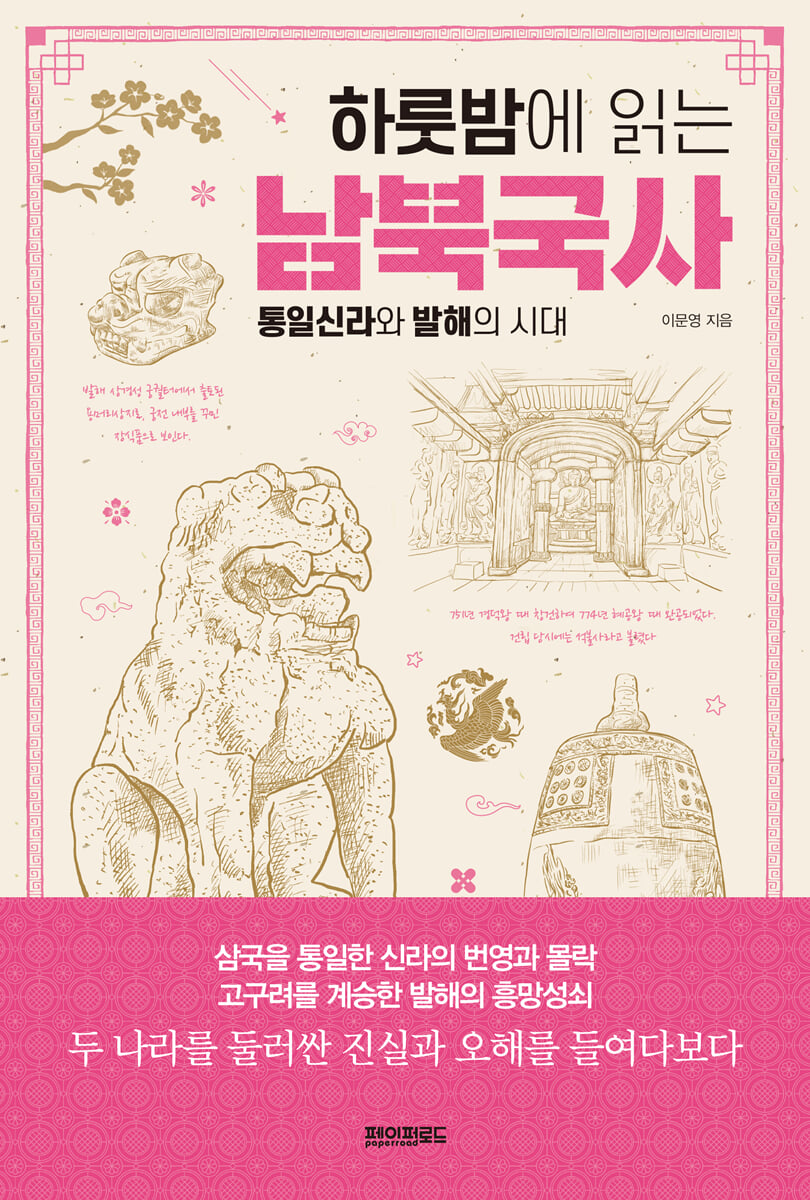
A History of North and South Korea in One Night
 |
Description
Book Introduction
From Unified Silla and Balhae to the advent of the Later Three Kingdoms period and the unification of Goryeo
The last book in the 'Read Korean History in One Night' series chosen by 500,000 readers
Author Lee Mun-yeong, who has written a variety of works in various genres including humanities, fairy tales, science fiction, and game scenarios, has published 『Reading the History of North and South Korea in One Night』, which covers the unification of Unified Silla, Balhae, the Later Three Kingdoms period, and Goryeo.
This book is the final volume in the "Read Korean History in One Night" series, which has been chosen by 500,000 readers over 18 years. It reconstructs the history of the North-South States Period, when Unified Silla and Balhae coexisted, within the context of contemporary East Asia.
Historians who study the modern era of division in the distant future will call this period the 'second North-South States Period.'
Considering this, I wanted to introduce the North-South States Period, which has not been properly highlighted until now, and provide readers with an opportunity to view the Korean Peninsula from outside the Korean Peninsula.
It is not limited to the history of Unified Silla and Balhae, but also describes the interactions between China (Tang Dynasty), Japan, northern nomadic peoples, and the Korean Peninsula in a complex and in-depth manner.
This allows readers to view the history of the Korean Peninsula from a broader and more multi-layered perspective.
Author Lee Mun-young, who kindly explained fascinating stories from history in his previous works, 『Reading Korean Ancient History in One Night』 and 『Reading Joseon Dynasty History in One Night』, captures readers' interest by including various stories in his new book.
While reviewing numerous historical materials to provide a reasonable explanation of history, it occasionally introduces folk tales, hyangga, Chinese poetry, paintings, and relics necessary for understanding the culture of the time.
Additionally, to help readers understand, 15 figures, 17 maps, and 50 photos were inserted, and supplementary explanations were added at the bottom.
To refute the lies and misunderstandings surrounding ancient Korean history, we provide detailed explanations of even the latest academic achievements.
I hope that readers of this book will enjoy learning about the North-South States Period, the final highlight of ancient Korean history.
The last book in the 'Read Korean History in One Night' series chosen by 500,000 readers
Author Lee Mun-yeong, who has written a variety of works in various genres including humanities, fairy tales, science fiction, and game scenarios, has published 『Reading the History of North and South Korea in One Night』, which covers the unification of Unified Silla, Balhae, the Later Three Kingdoms period, and Goryeo.
This book is the final volume in the "Read Korean History in One Night" series, which has been chosen by 500,000 readers over 18 years. It reconstructs the history of the North-South States Period, when Unified Silla and Balhae coexisted, within the context of contemporary East Asia.
Historians who study the modern era of division in the distant future will call this period the 'second North-South States Period.'
Considering this, I wanted to introduce the North-South States Period, which has not been properly highlighted until now, and provide readers with an opportunity to view the Korean Peninsula from outside the Korean Peninsula.
It is not limited to the history of Unified Silla and Balhae, but also describes the interactions between China (Tang Dynasty), Japan, northern nomadic peoples, and the Korean Peninsula in a complex and in-depth manner.
This allows readers to view the history of the Korean Peninsula from a broader and more multi-layered perspective.
Author Lee Mun-young, who kindly explained fascinating stories from history in his previous works, 『Reading Korean Ancient History in One Night』 and 『Reading Joseon Dynasty History in One Night』, captures readers' interest by including various stories in his new book.
While reviewing numerous historical materials to provide a reasonable explanation of history, it occasionally introduces folk tales, hyangga, Chinese poetry, paintings, and relics necessary for understanding the culture of the time.
Additionally, to help readers understand, 15 figures, 17 maps, and 50 photos were inserted, and supplementary explanations were added at the bottom.
To refute the lies and misunderstandings surrounding ancient Korean history, we provide detailed explanations of even the latest academic achievements.
I hope that readers of this book will enjoy learning about the North-South States Period, the final highlight of ancient Korean history.
- You can preview some of the book's contents.
Preview
index
Preface 4
Chapter 1 Unified Silla
King Munmu and King Sinmun, who established the foundation of Unified Silla 18
ㆍSeol Chong's "Hwawanggye" 32
King Hyoso and King Seongdeok, who established the golden age of Unified Silla 35
ㆍSimilarities between the tale of Lady Suro and the tale of King Suro 58
King Hyoseong and King Gyeongdeok, who completed the golden age of Unified Silla 62
The Life of the Goguryeo Refugee Lee Jeong-gi Family, Part 84
The Age of Rebellion, the Shaking Unified Silla 92
ㆍThe Three Dragons of the Patriots and the Yeouiju 114
Jang Bogo and Cheonghaejin 118
ㆍCho Shin's Dream 130
The Road to Ruin 134
ㆍThe Zhengzhang Incident in the Tang Dynasty 143
Chapter 2 Balhae
150 years until the founding of Balhae
ㆍBalhae, which succeeded Goguryeo and imitated the Tang Dynasty, 166
Dae Jo-yeong, founder of Balhae, 173
King Wu, who expanded his territory and confronted the Tang Dynasty in 179
Balhae Raft Exploration Team 192
King Wen's reign 197
ㆍ208 Goguryeo refugees who served as famous generals in the Tang Dynasty
Balhae in Chaos 217
The Age of the East Sea Kingdom 223
The Legend of Hong Ra-nyeo 238
The Fall of Balhae 242
The Eruption of Mount Baekdu and the Fall of Balhae 254
Balhae Revival Movement and Successor States 257
ㆍUnderstanding Balhae History 263
Chapter 3: Later Three Kingdoms Period
Later Baekje is founded in 272
The establishment of Later Goguryeo in 281
ㆍAristocrats and Seon Buddhism in the Late Unified Silla Period 296
Wang Geon's ancestors 301
ㆍHyo-nyeo Ji-eun and Hyo-jong-rang 311
Three Kingdoms: Different Dreams 314
The Fall of Gung Ye 323
Wang Geon and Gyeon Hwon's Battle of the Kings, 333
Goryeo achieved unification in 346
Wang Geon's wives 369
Reference 373
Map 1: Border between Unified Silla and Balhae 8
Map 2: Administrative districts of Unified Silla 28
Map 3 Hyecho's Journey 51
Map 4: The Rise of the Late Thieves 86
Map 5 Kim Heon-chang's Rebellion 107
Map 6: Cheonghaejin and Sillabang 122
Map 7: The Founding of Balhae by Dae Jo-yeong 157
Map 8: Balhae's Administrative Districts and the Location of the Malgal Tribes 163
Map 9 Balhae's Attack on Tang 187
Map 10: Foreign Affairs during the Reign of King Mu of Balhae 188
Map 11 Sogdiana Region 212
Map 12 Balhae Specialties 227
Map 13: International Trade Routes of Unified Silla and Balhae 236
Map 14: The Fall of Balhae 252
Map 15: The Rise of Aristocrats in the Later Three Kingdoms Period 273
Map 16: The Establishment of the Five Religions and Nine Mountains of Unified Silla 299
Map 17 Later Three Kingdoms Period 362
Chapter 1 Unified Silla
King Munmu and King Sinmun, who established the foundation of Unified Silla 18
ㆍSeol Chong's "Hwawanggye" 32
King Hyoso and King Seongdeok, who established the golden age of Unified Silla 35
ㆍSimilarities between the tale of Lady Suro and the tale of King Suro 58
King Hyoseong and King Gyeongdeok, who completed the golden age of Unified Silla 62
The Life of the Goguryeo Refugee Lee Jeong-gi Family, Part 84
The Age of Rebellion, the Shaking Unified Silla 92
ㆍThe Three Dragons of the Patriots and the Yeouiju 114
Jang Bogo and Cheonghaejin 118
ㆍCho Shin's Dream 130
The Road to Ruin 134
ㆍThe Zhengzhang Incident in the Tang Dynasty 143
Chapter 2 Balhae
150 years until the founding of Balhae
ㆍBalhae, which succeeded Goguryeo and imitated the Tang Dynasty, 166
Dae Jo-yeong, founder of Balhae, 173
King Wu, who expanded his territory and confronted the Tang Dynasty in 179
Balhae Raft Exploration Team 192
King Wen's reign 197
ㆍ208 Goguryeo refugees who served as famous generals in the Tang Dynasty
Balhae in Chaos 217
The Age of the East Sea Kingdom 223
The Legend of Hong Ra-nyeo 238
The Fall of Balhae 242
The Eruption of Mount Baekdu and the Fall of Balhae 254
Balhae Revival Movement and Successor States 257
ㆍUnderstanding Balhae History 263
Chapter 3: Later Three Kingdoms Period
Later Baekje is founded in 272
The establishment of Later Goguryeo in 281
ㆍAristocrats and Seon Buddhism in the Late Unified Silla Period 296
Wang Geon's ancestors 301
ㆍHyo-nyeo Ji-eun and Hyo-jong-rang 311
Three Kingdoms: Different Dreams 314
The Fall of Gung Ye 323
Wang Geon and Gyeon Hwon's Battle of the Kings, 333
Goryeo achieved unification in 346
Wang Geon's wives 369
Reference 373
Map 1: Border between Unified Silla and Balhae 8
Map 2: Administrative districts of Unified Silla 28
Map 3 Hyecho's Journey 51
Map 4: The Rise of the Late Thieves 86
Map 5 Kim Heon-chang's Rebellion 107
Map 6: Cheonghaejin and Sillabang 122
Map 7: The Founding of Balhae by Dae Jo-yeong 157
Map 8: Balhae's Administrative Districts and the Location of the Malgal Tribes 163
Map 9 Balhae's Attack on Tang 187
Map 10: Foreign Affairs during the Reign of King Mu of Balhae 188
Map 11 Sogdiana Region 212
Map 12 Balhae Specialties 227
Map 13: International Trade Routes of Unified Silla and Balhae 236
Map 14: The Fall of Balhae 252
Map 15: The Rise of Aristocrats in the Later Three Kingdoms Period 273
Map 16: The Establishment of the Five Religions and Nine Mountains of Unified Silla 299
Map 17 Later Three Kingdoms Period 362
Detailed image
.jpg)
Into the book
As soon as the War of the Three Kingdoms ended, Silla entered into war with Tang.
The Tang Dynasty revealed its ambition to occupy the entire Korean Peninsula, and Silla resisted it.
Because the wars occurred almost consecutively, some people view the Tang-Silla War as part of a war for unification, but I think this is a wrong view.
The Three Kingdoms had already been unified, and Unified Silla had fought and won against the Tang Dynasty, which had emerged as a new enemy.
This war is the Tang-Silla War.
Rather, this war reorganized the refugees of Goguryeo and Baekje under the Silla system, and the people of the three countries were able to be deployed to the front lines, strengthening their will to become a single community.
Furthermore, this war weakened the Tang Dynasty's control over the Korean Peninsula and Manchuria, and allowed Balhae, the successor state of Goguryeo, to be established.
--- From the "Preface"
Silla sent gifts not only to the Japanese emperor and empress, but also to the crown prince and princes, which was not the behavior of a vassal state paying tribute.
The Tang Dynasty, which received tribute and gave thanks, bestowed goods on the Silla royal family in this way.
Meanwhile, in the Samguk Sagi, there are not many records of sending envoys to Japan.
On the other hand, Japanese literature such as the Nihon Shoki describes in detail the visit of the Silla envoy.
In other words, the visit of the Silla envoy was a very important event for Japan.
However, Silla and Japan had different interpretations of the nature of the envoys traveling between the two countries.
Misunderstandings between the two countries ultimately destroy the relationship between the two countries.
It was a little later that relations between the two countries began to deteriorate.
In 757 (the 16th year of King Gyeongdeok's reign), the policy of granting salaries to officials was abolished and the policy of granting fiefs was reverted to.
Green towns symbolize the privileges of the nobility, and their revival could be seen as a growth in the power of the nobility.
However, rather than accepting it as a growth of aristocratic power, it would be more accurate to understand it as a measure to solve the economic problems that were prevalent in Silla society at the time.
Looking at the literature, natural disasters were very severe during the reign of King Gyeongdeok.
In the fourth year of King Gyeongdeok's reign, in midsummer, hail the size of eggs fell.
In the 6th year of King Gyeongdeok's reign, a drought struck, causing the people to starve and epidemic diseases to run rampant.
In the 8th year of King Gyeongdeok's reign, a storm blew.
In the 13th year of King Gyeongdeok's reign, hail the size of eggs fell again in midsummer.
The following year, a famine struck the entire country.
Food was so scarce that a son even cut off his own thigh to support his father.
Then, in the 15th year of King Gyeongdeok's reign, a large hailstorm fell in midsummer.
In this situation, the national finances would not have been sound.
Therefore, it became difficult for the Silla government to individually pay salaries to its subjects.
In the end, he relieved his subjects of their burden by dividing the land among them and asking them to collect taxes on their own.
Of course, King Gyeongdeok's measures were not good in the long run.
The nobles who each acquired land gradually accumulated wealth, which inevitably led to the weakening of royal authority.
At that time, King Hyegong was 19 years old.
He is old enough to rule directly.
It is clear that around this time, King Hyegong began to rule directly.
Queen Manwol, the wife of the deceased King Gyeongdeok, has no need to reverse her husband's policies.
In that case, King Hyegong, who had just started his reign, may have had to reverse one of his father's achievements due to pressure from the nobles.
If we think about it this way, the incident in which Shijung rebelled and was executed may have been a plot by the nobles to cut off King Hyegong's limbs.
It is regrettable that we have to rely on guesswork because the documents recording that time are so brief.
Scholars assume that the “Silla Village Documents” were administrative documents recorded by the local government and then compiled by a higher-level organization.
In other words, it is a document that was recorded in the county, organized in the state, and then reported to the royal capital.
This material shows that Silla classified the provinces according to detailed criteria and thoroughly controlled them.
This document also reveals that the village head's livelihood was guaranteed by providing a separate piece of land called 'chonjuwidap' to the village head.
If the Silla government had any thought for the future, it should have preserved Cheonghaejin, continued to operate the maritime trade route, and secured the benefits of trade.
However, the Silla government, which had already experienced the fear of a group that had become private soldiers, had no time to consider the future.
In 851 (the 13th year of King Munseong's reign), Silla destroyed Cheonghaejin and was never again able to maintain its superiority at sea.
Instead, the Silla royal family became comfortable.
King Munseong suppressed all the rebellions that occurred thereafter.
--- From “Chapter 1 Unified Silla”
At this point, you might be thinking, “Couldn’t the Malgal have originally been a branch of the Korean people?”
And in this case, “the Jurchen people of the Jin and Qing dynasties who established countries after Balhae are Malgal.
So, some people may come up with the absurd idea that “their history also becomes Korean history.”
The main reason for thinking this way is that the concept of 'nation' is considered an attribute that will never change once it is established.
But that's not the case.
For example, many Korean surnames actually originated from China.
So, is South Korea a nation founded by the union of Han Chinese and Koreans from the Korean Peninsula? Of course, no one would think so.
… (omitted) … Balhae was a state that survived during the process of the transition from the Korean people to the Jurchen people who ruled Manchuria.
The Malgal people, who had gradually established their identity as 'Balhae people', lost that identity after 228 years with the fall of Balhae, and eventually established their own country.
In this way, Balhae was a country established at a crossroads where history branched out in two directions.
Today, China is trying to disguise Balhae as nothing more than a local government of China, and the entity that founded the country as a Sokmalgal.
However, Balhae claimed to be the successor state of Goguryeo, and although it did not claim it externally, it called itself an empire within the country.
There is no way that an empire could be a vassal state of another country.
Balhae inherited the culture of Goguryeo and learned the systems of the advanced Tang Dynasty to organize its country.
It was an independent country that had a distinctly different culture.
One of the reasons for the sudden change in Balhae's foreign policy was that the Gokturks attempted to exert influence over the Heishui Malgal.
The Heuksu Malgal were a headache for Balhae.
King Mu of Balhae wanted to subdue the Heuksu Malgal, but he missed the opportunity due to internal strife with his younger brother Daemunye, and the Heuksu Malgal negotiated independently with the Tang Dynasty without being completely subjugated.
Balhae wanted to avoid the difficult situation of the Gokturks joining hands with the Heishui Malgal.
Moreover, since Silla was close to the south of Balhae, the policy of opposing Tang, which was close to Silla, was by no means advantageous to Balhae.
In other words, Balhae did not attack the Khitan, who were trying to get closer to the Tang Dynasty in order to ensure their own survival, and through this, created an opportunity to make peace with the Tang Dynasty.
He also kept away from the Turks who were trying to bring in the Heuksu Malgal.
Accordingly, King Wen, who succeeded King Wu, actively established friendly relations with the Tang Dynasty.
During the reign of the previous king, there were also changes in relations with Japan.
Because Japan regarded Balhae as a tributary state, it had envoys attend the New Year's assembly.
Therefore, Balhae sent envoys in September or October and arranged for them to return home around May.
However, since the time of the previous king, it seems that envoys were sent around November and no one attended the New Year's court.
In response, Japan retaliated by reducing the number of envoys sent.
Envoys are dispatched not only for political purposes but also to achieve the important goal of trade between two countries.
That is, during the reign of King Seonjo, Japan restricted trade by limiting the number of Balhae envoys to once every 12 years.
During the reign of King Seonjo, envoys were sent to Japan six times, so much so that there was a saying in Japan that “Balhae envoys are not guests from a neighboring country, but merely merchants.”
There is also something to know about 'myeon(?)', a specialty product of Balhae, which is the cotton of Okju.
This character is the old character for cotton today.
Cotton generally refers to cotton obtained from cotton plants.
So some people may misunderstand this as evidence that cotton was cultivated even before Mun Ik-jeom of Goryeo.
However, Balhae's climate was not suitable for cotton cultivation.
And the character for cotton(?) existed before cotton was invented.
So, we need to know what word this Chinese character originally refers to.
In the encyclopedia 『Cheon Gong Gae Mul (天工開物)』 compiled during the Ming Dynasty, there is an explanation about cotton.
This book says that silk is made by unraveling the cocoon of a silkworm, and that the remaining cocoon debris after the thread is extracted can be collected and made into cotton.
This is called 'pulsom' or 'gochisom'.
The cotton is used as a ball of cotton or is spun into thread.
Cloth woven from this type of cotton was sold at a very high price.
Therefore, we should not easily assume that cotton existed even before the time of Mun Ik-jeom just because the character for cotton was used.
The fall of Balhae was sudden.
It is hard to believe that the great power of the North could have fallen so foolishly.
In this psychological state, when looking for a plausible reason, when you come across a plausible hypothesis called the ‘Baekdu Mountain eruption,’ you end up believing it with the thought, “Well, then that’s how it is.”
Psychologically, once a person has a wrong belief, it is difficult to give it up.
History is a discipline that develops a critical consciousness that questions these very beliefs.
--- From Chapter 2, Balhae
There are differing opinions regarding the beginning of Later Baekje.
It is said to have started as early as 889, the year when Gyeon Hwon rose up.
Another opinion is that it was in 892 that he declared himself king in Mujinju.
On the one hand, it is also seen as the year 900 when Later Baekje was officially declared.
Each opinion has its own basis.
The reason for such conflicting claims is largely due to the fall of Later Baekje before it could officially establish its own history.
As of now, it can be said that Gyeon Hwon became independent in 889 and that he founded Later Baekje in 900.
Governance is not accomplished through physical force alone.
Religion was necessary to subdue the people spiritually.
The Silla royal family took 'Gyojong' as its ideological pillar, while the local aristocrats accepted the newly emerging 'Seonjong' as their ideological pillar.
If Gyojong is a Buddhism centered on scriptures, Seonjong is a Buddhism that emphasizes enlightenment through meditation.
The people readily accepted Seon Buddhism, which could be seen as a simple act of meditation that leads to enlightenment, rather than the religious sects that required difficult knowledge of Chinese characters.
Seon monks also joined hands with powerful clans who had military power to protect their temples.
In a situation where the Catholic Church had degenerated into a puppet sect that supported the royal family and the nobility, the Seon sect had no choice but to take a line opposing the Catholic Church.
After 780, the number of monks who went to study in Tang China reached 118.
If we consider those who are not recorded, there would be more than this.
Among these Confucian monks, there were many who were not of true bone status.
In Silla, monks had to be of true bone to be successful, so they sought a new path in Tang China.
The newly emerging Zen Buddhism was attractive to such monks.
There was an incident where a large number of these monks who had studied abroad returned to Silla.
This is because Emperor Wuzong of the Tang Dynasty at the time implemented a policy of suppressing Buddhism, known as the ‘anti-Buddhism policy.’
Around 845, Silla monks were forced to return to their country.
Many of the Seon monks who returned to Silla spread their teachings in the provinces rather than in the center.
As mentioned earlier, these people could not rise to prominence in the central government anyway.
The Silla royal family was also not unaware of this change.
There were also efforts to attract Zen monks to the center.
Of course, there were monks who responded, but even so, there was no way to control those who were expanding their influence in the provinces.
Kim Heun, a local nobleman in the Boryeong region, supported the establishment of the Seongjusanpa (Seongjusanmun), Kim C, a local nobleman in the Gangneung region, supported the establishment of the Dogulsanpa (Dogulsanmun), and Kim In-gwang, a local nobleman in the Gimhae region, supported the establishment of the Bongrimsanpa (Bongrimsanmun).
In addition, several powerful clans formed a close alliance with Seon monks.
In the 『History of Jin』, which records the history of the Jin Dynasty, it is written that a man named Hambo (函普), who was about 60 years old and came from Goryeo, entered Wanyanbu (完顔部), the land of the Jurchen people, and that his 7th generation descendant was Akuta, the founder of the Jin Dynasty.
In addition, the Kim family of the Silla royal family has the same Chinese characters as the name of the Jin Dynasty.
In the historical record called “Songmokimun” written by a Southern Song person while he was a prisoner of the Jin Dynasty, it is written that “Akuta’s ancestor’s name was Gambok, and the Jurchen chieftain was from Silla.”
In ancient Korean, there are cases where ㄱ and ㅎ are used interchangeably, and in that sense, if we consider that '감복' and '함보' have the same sound, it is possible that the two are considered the same person.
Or it is possible that the Song people wrote down the name as it sounded to them.
Meanwhile, in the Goryeosa, it is written that the monk Geumjun (also known as Kim Geuksu, son of Kim Haeng) of Pyeongju was the founder of the Jurchen.
However, there is no physical evidence linking these records to Prince Ma-i.
The mere 'record' that Silla or Goryeo people are the ancestors of the Jurchen royal family may be attractive to some people.
The desire for someone more admirable to take his place led to the bizarre situation where the last prince of Silla was called upon as the ancestor of the Jurchen people.
Even if the records in the 『Geumsa』 are true, and even if the founder of the Jin Dynasty nearly 200 years ago was a Goryeo person, it is absurd to say that the history of the Jin Dynasty is ‘the history of our country.’
The Tang Dynasty revealed its ambition to occupy the entire Korean Peninsula, and Silla resisted it.
Because the wars occurred almost consecutively, some people view the Tang-Silla War as part of a war for unification, but I think this is a wrong view.
The Three Kingdoms had already been unified, and Unified Silla had fought and won against the Tang Dynasty, which had emerged as a new enemy.
This war is the Tang-Silla War.
Rather, this war reorganized the refugees of Goguryeo and Baekje under the Silla system, and the people of the three countries were able to be deployed to the front lines, strengthening their will to become a single community.
Furthermore, this war weakened the Tang Dynasty's control over the Korean Peninsula and Manchuria, and allowed Balhae, the successor state of Goguryeo, to be established.
--- From the "Preface"
Silla sent gifts not only to the Japanese emperor and empress, but also to the crown prince and princes, which was not the behavior of a vassal state paying tribute.
The Tang Dynasty, which received tribute and gave thanks, bestowed goods on the Silla royal family in this way.
Meanwhile, in the Samguk Sagi, there are not many records of sending envoys to Japan.
On the other hand, Japanese literature such as the Nihon Shoki describes in detail the visit of the Silla envoy.
In other words, the visit of the Silla envoy was a very important event for Japan.
However, Silla and Japan had different interpretations of the nature of the envoys traveling between the two countries.
Misunderstandings between the two countries ultimately destroy the relationship between the two countries.
It was a little later that relations between the two countries began to deteriorate.
In 757 (the 16th year of King Gyeongdeok's reign), the policy of granting salaries to officials was abolished and the policy of granting fiefs was reverted to.
Green towns symbolize the privileges of the nobility, and their revival could be seen as a growth in the power of the nobility.
However, rather than accepting it as a growth of aristocratic power, it would be more accurate to understand it as a measure to solve the economic problems that were prevalent in Silla society at the time.
Looking at the literature, natural disasters were very severe during the reign of King Gyeongdeok.
In the fourth year of King Gyeongdeok's reign, in midsummer, hail the size of eggs fell.
In the 6th year of King Gyeongdeok's reign, a drought struck, causing the people to starve and epidemic diseases to run rampant.
In the 8th year of King Gyeongdeok's reign, a storm blew.
In the 13th year of King Gyeongdeok's reign, hail the size of eggs fell again in midsummer.
The following year, a famine struck the entire country.
Food was so scarce that a son even cut off his own thigh to support his father.
Then, in the 15th year of King Gyeongdeok's reign, a large hailstorm fell in midsummer.
In this situation, the national finances would not have been sound.
Therefore, it became difficult for the Silla government to individually pay salaries to its subjects.
In the end, he relieved his subjects of their burden by dividing the land among them and asking them to collect taxes on their own.
Of course, King Gyeongdeok's measures were not good in the long run.
The nobles who each acquired land gradually accumulated wealth, which inevitably led to the weakening of royal authority.
At that time, King Hyegong was 19 years old.
He is old enough to rule directly.
It is clear that around this time, King Hyegong began to rule directly.
Queen Manwol, the wife of the deceased King Gyeongdeok, has no need to reverse her husband's policies.
In that case, King Hyegong, who had just started his reign, may have had to reverse one of his father's achievements due to pressure from the nobles.
If we think about it this way, the incident in which Shijung rebelled and was executed may have been a plot by the nobles to cut off King Hyegong's limbs.
It is regrettable that we have to rely on guesswork because the documents recording that time are so brief.
Scholars assume that the “Silla Village Documents” were administrative documents recorded by the local government and then compiled by a higher-level organization.
In other words, it is a document that was recorded in the county, organized in the state, and then reported to the royal capital.
This material shows that Silla classified the provinces according to detailed criteria and thoroughly controlled them.
This document also reveals that the village head's livelihood was guaranteed by providing a separate piece of land called 'chonjuwidap' to the village head.
If the Silla government had any thought for the future, it should have preserved Cheonghaejin, continued to operate the maritime trade route, and secured the benefits of trade.
However, the Silla government, which had already experienced the fear of a group that had become private soldiers, had no time to consider the future.
In 851 (the 13th year of King Munseong's reign), Silla destroyed Cheonghaejin and was never again able to maintain its superiority at sea.
Instead, the Silla royal family became comfortable.
King Munseong suppressed all the rebellions that occurred thereafter.
--- From “Chapter 1 Unified Silla”
At this point, you might be thinking, “Couldn’t the Malgal have originally been a branch of the Korean people?”
And in this case, “the Jurchen people of the Jin and Qing dynasties who established countries after Balhae are Malgal.
So, some people may come up with the absurd idea that “their history also becomes Korean history.”
The main reason for thinking this way is that the concept of 'nation' is considered an attribute that will never change once it is established.
But that's not the case.
For example, many Korean surnames actually originated from China.
So, is South Korea a nation founded by the union of Han Chinese and Koreans from the Korean Peninsula? Of course, no one would think so.
… (omitted) … Balhae was a state that survived during the process of the transition from the Korean people to the Jurchen people who ruled Manchuria.
The Malgal people, who had gradually established their identity as 'Balhae people', lost that identity after 228 years with the fall of Balhae, and eventually established their own country.
In this way, Balhae was a country established at a crossroads where history branched out in two directions.
Today, China is trying to disguise Balhae as nothing more than a local government of China, and the entity that founded the country as a Sokmalgal.
However, Balhae claimed to be the successor state of Goguryeo, and although it did not claim it externally, it called itself an empire within the country.
There is no way that an empire could be a vassal state of another country.
Balhae inherited the culture of Goguryeo and learned the systems of the advanced Tang Dynasty to organize its country.
It was an independent country that had a distinctly different culture.
One of the reasons for the sudden change in Balhae's foreign policy was that the Gokturks attempted to exert influence over the Heishui Malgal.
The Heuksu Malgal were a headache for Balhae.
King Mu of Balhae wanted to subdue the Heuksu Malgal, but he missed the opportunity due to internal strife with his younger brother Daemunye, and the Heuksu Malgal negotiated independently with the Tang Dynasty without being completely subjugated.
Balhae wanted to avoid the difficult situation of the Gokturks joining hands with the Heishui Malgal.
Moreover, since Silla was close to the south of Balhae, the policy of opposing Tang, which was close to Silla, was by no means advantageous to Balhae.
In other words, Balhae did not attack the Khitan, who were trying to get closer to the Tang Dynasty in order to ensure their own survival, and through this, created an opportunity to make peace with the Tang Dynasty.
He also kept away from the Turks who were trying to bring in the Heuksu Malgal.
Accordingly, King Wen, who succeeded King Wu, actively established friendly relations with the Tang Dynasty.
During the reign of the previous king, there were also changes in relations with Japan.
Because Japan regarded Balhae as a tributary state, it had envoys attend the New Year's assembly.
Therefore, Balhae sent envoys in September or October and arranged for them to return home around May.
However, since the time of the previous king, it seems that envoys were sent around November and no one attended the New Year's court.
In response, Japan retaliated by reducing the number of envoys sent.
Envoys are dispatched not only for political purposes but also to achieve the important goal of trade between two countries.
That is, during the reign of King Seonjo, Japan restricted trade by limiting the number of Balhae envoys to once every 12 years.
During the reign of King Seonjo, envoys were sent to Japan six times, so much so that there was a saying in Japan that “Balhae envoys are not guests from a neighboring country, but merely merchants.”
There is also something to know about 'myeon(?)', a specialty product of Balhae, which is the cotton of Okju.
This character is the old character for cotton today.
Cotton generally refers to cotton obtained from cotton plants.
So some people may misunderstand this as evidence that cotton was cultivated even before Mun Ik-jeom of Goryeo.
However, Balhae's climate was not suitable for cotton cultivation.
And the character for cotton(?) existed before cotton was invented.
So, we need to know what word this Chinese character originally refers to.
In the encyclopedia 『Cheon Gong Gae Mul (天工開物)』 compiled during the Ming Dynasty, there is an explanation about cotton.
This book says that silk is made by unraveling the cocoon of a silkworm, and that the remaining cocoon debris after the thread is extracted can be collected and made into cotton.
This is called 'pulsom' or 'gochisom'.
The cotton is used as a ball of cotton or is spun into thread.
Cloth woven from this type of cotton was sold at a very high price.
Therefore, we should not easily assume that cotton existed even before the time of Mun Ik-jeom just because the character for cotton was used.
The fall of Balhae was sudden.
It is hard to believe that the great power of the North could have fallen so foolishly.
In this psychological state, when looking for a plausible reason, when you come across a plausible hypothesis called the ‘Baekdu Mountain eruption,’ you end up believing it with the thought, “Well, then that’s how it is.”
Psychologically, once a person has a wrong belief, it is difficult to give it up.
History is a discipline that develops a critical consciousness that questions these very beliefs.
--- From Chapter 2, Balhae
There are differing opinions regarding the beginning of Later Baekje.
It is said to have started as early as 889, the year when Gyeon Hwon rose up.
Another opinion is that it was in 892 that he declared himself king in Mujinju.
On the one hand, it is also seen as the year 900 when Later Baekje was officially declared.
Each opinion has its own basis.
The reason for such conflicting claims is largely due to the fall of Later Baekje before it could officially establish its own history.
As of now, it can be said that Gyeon Hwon became independent in 889 and that he founded Later Baekje in 900.
Governance is not accomplished through physical force alone.
Religion was necessary to subdue the people spiritually.
The Silla royal family took 'Gyojong' as its ideological pillar, while the local aristocrats accepted the newly emerging 'Seonjong' as their ideological pillar.
If Gyojong is a Buddhism centered on scriptures, Seonjong is a Buddhism that emphasizes enlightenment through meditation.
The people readily accepted Seon Buddhism, which could be seen as a simple act of meditation that leads to enlightenment, rather than the religious sects that required difficult knowledge of Chinese characters.
Seon monks also joined hands with powerful clans who had military power to protect their temples.
In a situation where the Catholic Church had degenerated into a puppet sect that supported the royal family and the nobility, the Seon sect had no choice but to take a line opposing the Catholic Church.
After 780, the number of monks who went to study in Tang China reached 118.
If we consider those who are not recorded, there would be more than this.
Among these Confucian monks, there were many who were not of true bone status.
In Silla, monks had to be of true bone to be successful, so they sought a new path in Tang China.
The newly emerging Zen Buddhism was attractive to such monks.
There was an incident where a large number of these monks who had studied abroad returned to Silla.
This is because Emperor Wuzong of the Tang Dynasty at the time implemented a policy of suppressing Buddhism, known as the ‘anti-Buddhism policy.’
Around 845, Silla monks were forced to return to their country.
Many of the Seon monks who returned to Silla spread their teachings in the provinces rather than in the center.
As mentioned earlier, these people could not rise to prominence in the central government anyway.
The Silla royal family was also not unaware of this change.
There were also efforts to attract Zen monks to the center.
Of course, there were monks who responded, but even so, there was no way to control those who were expanding their influence in the provinces.
Kim Heun, a local nobleman in the Boryeong region, supported the establishment of the Seongjusanpa (Seongjusanmun), Kim C, a local nobleman in the Gangneung region, supported the establishment of the Dogulsanpa (Dogulsanmun), and Kim In-gwang, a local nobleman in the Gimhae region, supported the establishment of the Bongrimsanpa (Bongrimsanmun).
In addition, several powerful clans formed a close alliance with Seon monks.
In the 『History of Jin』, which records the history of the Jin Dynasty, it is written that a man named Hambo (函普), who was about 60 years old and came from Goryeo, entered Wanyanbu (完顔部), the land of the Jurchen people, and that his 7th generation descendant was Akuta, the founder of the Jin Dynasty.
In addition, the Kim family of the Silla royal family has the same Chinese characters as the name of the Jin Dynasty.
In the historical record called “Songmokimun” written by a Southern Song person while he was a prisoner of the Jin Dynasty, it is written that “Akuta’s ancestor’s name was Gambok, and the Jurchen chieftain was from Silla.”
In ancient Korean, there are cases where ㄱ and ㅎ are used interchangeably, and in that sense, if we consider that '감복' and '함보' have the same sound, it is possible that the two are considered the same person.
Or it is possible that the Song people wrote down the name as it sounded to them.
Meanwhile, in the Goryeosa, it is written that the monk Geumjun (also known as Kim Geuksu, son of Kim Haeng) of Pyeongju was the founder of the Jurchen.
However, there is no physical evidence linking these records to Prince Ma-i.
The mere 'record' that Silla or Goryeo people are the ancestors of the Jurchen royal family may be attractive to some people.
The desire for someone more admirable to take his place led to the bizarre situation where the last prince of Silla was called upon as the ancestor of the Jurchen people.
Even if the records in the 『Geumsa』 are true, and even if the founder of the Jin Dynasty nearly 200 years ago was a Goryeo person, it is absurd to say that the history of the Jin Dynasty is ‘the history of our country.’
--- From “Chapter 3, Later Three Kingdoms Period”
Publisher's Review
The controversy surrounding the North-South States Period
The term 'North-South States Period' may be unfamiliar to readers who are not interested in Korean history, as well as those who are familiar with it.
The North-South States Period refers to the period when Silla, which unified the Three Kingdoms, and Balhae, which succeeded Goguryeo, coexisted. Examining the debate surrounding this term makes us ponder how to interpret the times at that time.
The author does not hide this thorny problem.
Rather, he does not hesitate to communicate with readers by directly discussing the issues of perspective and interpretation of the history of North and South Korea.
The term North-South States Period emerged along with the argument that Silla's unification of the three kingdoms was incomplete and that the term "Unified Silla" was inappropriate.
Although Silla managed to conquer Baekje and Goguryeo by inviting the Tang Dynasty, it failed to take over more than half of Goguryeo's territory, and Balhae, the successor to Goguryeo, was established in Manchuria. Therefore, questions were raised about whether the term "Unified Silla" was appropriate.
Therefore, those who want to include Balhae in the category of Korean history, and those who criticize Silla for betraying its own people by bringing in foreign powers, insist that the period should be called the 'North-South States Period.'
The argument that the period during which Silla and Balhae coexisted should be called the North-South States Period is valid.
So, is the name "Unified Silla" inappropriate? To cut to the chase, no.
As the author repeatedly emphasizes in Chapter 1, Unified Silla, the term ‘Iltongsamhan’ has been in use since the time of King Sinmun, who ascended to the throne after the unification of the Three Kingdoms.
Even if we just look at the record that when a Tang envoy asked why King Muyeol Kim Chun-chu's temple name was 'Taejong', he protested by saying, "It is because Kim Chun-chu gained Kim Yu-sin and unified the Three Hans," we can see that a sense of unification was formed among the people living at the time.
Moreover, during the Tang-Silla War, the refugees from Goguryeo and Baekje were reorganized under the system of Silla, and the people of the three countries were mobilized to fight in the war against Tang and became the people of the same country.
Moreover, the Tang Dynasty's control over the Korean Peninsula and Manchuria was weakened by the Tang-Silla War, and conditions were created for the establishment of Balhae, the successor state to Goguryeo.
In other words, the fact that Balhae was founded as a successor to Goguryeo and the fact that Silla destroyed Goguryeo and unified the Korean Peninsula do not conflict.
This means that we cannot assert that the history of Balhae is excluded just because we call Silla after conquering Baekje and Goguryeo “Unified Silla.”
However, the Silla people and the Balhae people cannot be unconditionally considered as one ethnic group.
Silla and Balhae did not understand each other as North and South states, that is, as countries competing for legitimacy.
They didn't even acknowledge each other.
Like South Korea and North Korea today, Silla and Balhae also had little exchange.
As discussed in Chapter 2, Balhae, Silla called Balhae the “nation of the Malgal people,” distinct from the Samhan of the past, and Balhae made efforts in diplomacy with Japan to check Silla, which had formed an alliance with Tang.
It is clear that both countries are branches of our history, but the more I read, the more I realize that Silla and Balhae viewed each other as competitors or potential enemies.
Meanwhile, various media, including textbooks, have put forward a single, grand and robust narrative that Goryeo, as the successor of both countries, reunified the Korean Peninsula.
For this narrative to be legitimate, it would be natural for the Silla people and the Balhae people to share a sense of homogeneity, but such historical materials have not yet been discovered.
If the two countries were enemies, whose successor would Goryeo, which later conquered the Korean Peninsula, truly be? How was the legitimacy of Korean history passed to Goryeo after the Three Kingdoms period? Perhaps anticipating readers' questions, the author has prepared Chapter 3, The Later Three Kingdoms Period, as a solution to this dilemma.
For a better debate
Author Lee Moon-young says that historical materials do not tell a single truth.
Even the records in historical books from the past often conflict with each other.
In the realm of myth and legend, most narratives are unwarranted.
Therefore, modern people must reconstruct events with the past records mentioned in historical materials at their feet.
Just as historical sources do not tell a single truth, neither is there a single historical context.
Balhae was a state that survived during the transition from the Korean people to the Jurchen people who ruled Manchuria.
The Malgal people, who had gradually established their identity as 'Balhae people', lost that identity after 228 years with the fall of Balhae, and eventually established a separate country.
In this way, Balhae was a transitional state established at the crossroads where the Korean people and the Malgal people, who had traditionally resided in the Manchurian region, branched out into two directions.
Furthermore, between the Tang Dynasty and Silla, Balhae had to seek its own survival, and to this end, it actively interacted with northern nomadic peoples and Japan to keep Silla in check.
Considering the complex identity of Balhae and the East Asian political situation surrounding the North and South states at the time, it is not awkward to say that the people of Silla and Balhae did not feel a sense of kinship with each other.
Rather, it is more natural for the two countries to feel unfamiliar with each other.
Ultimately, it is the fault of modern people who distort history to suit their own tastes that they feel awkward or uncomfortable about this issue.
In other words, it is simply the fault of modern people who reinterpret history for a specific concept or purpose.
If we unilaterally judge the past from a modern perspective, we will not only fail to understand history, but we will also end up arbitrarily exploiting it.
So the author asks the readers to change the question.
I urge you to pay attention to the process by which Goryeo absorbed the people of Silla and Balhae during the process of their prosperity and decline.
Silla, which defeated two great powers and conquered the Korean Peninsula, gradually collapsed due to internal corruption and power struggles, and Balhae, which once pacified the north, was unable to properly respond to the rapidly changing external situation and fell into ruin in an instant.
When the systems of Silla and Balhae failed, the era presented an alternative called the Later Three Kingdoms.
Gyeon Hwon's Later Baekje and Gung Ye's Later Goguryeo were unable to embrace the people in distress and instead insisted on an exclusive and self-righteous attitude.
Wang Geon's Goryeo accepted the surrender of the Silla king and absorbed the Balhae refugees, proving that it was an alternative for the times.
If we are to learn lessons from history, if we are to debate historical events, we should pay attention to how a new world emerged after the North-South States Period.
Therefore, I hope that by reading this book, readers will be able to broaden their perspective on the ancient history of the Korean Peninsula by learning about the history of the North-South States Period and the Later Three Kingdoms Period.
The term 'North-South States Period' may be unfamiliar to readers who are not interested in Korean history, as well as those who are familiar with it.
The North-South States Period refers to the period when Silla, which unified the Three Kingdoms, and Balhae, which succeeded Goguryeo, coexisted. Examining the debate surrounding this term makes us ponder how to interpret the times at that time.
The author does not hide this thorny problem.
Rather, he does not hesitate to communicate with readers by directly discussing the issues of perspective and interpretation of the history of North and South Korea.
The term North-South States Period emerged along with the argument that Silla's unification of the three kingdoms was incomplete and that the term "Unified Silla" was inappropriate.
Although Silla managed to conquer Baekje and Goguryeo by inviting the Tang Dynasty, it failed to take over more than half of Goguryeo's territory, and Balhae, the successor to Goguryeo, was established in Manchuria. Therefore, questions were raised about whether the term "Unified Silla" was appropriate.
Therefore, those who want to include Balhae in the category of Korean history, and those who criticize Silla for betraying its own people by bringing in foreign powers, insist that the period should be called the 'North-South States Period.'
The argument that the period during which Silla and Balhae coexisted should be called the North-South States Period is valid.
So, is the name "Unified Silla" inappropriate? To cut to the chase, no.
As the author repeatedly emphasizes in Chapter 1, Unified Silla, the term ‘Iltongsamhan’ has been in use since the time of King Sinmun, who ascended to the throne after the unification of the Three Kingdoms.
Even if we just look at the record that when a Tang envoy asked why King Muyeol Kim Chun-chu's temple name was 'Taejong', he protested by saying, "It is because Kim Chun-chu gained Kim Yu-sin and unified the Three Hans," we can see that a sense of unification was formed among the people living at the time.
Moreover, during the Tang-Silla War, the refugees from Goguryeo and Baekje were reorganized under the system of Silla, and the people of the three countries were mobilized to fight in the war against Tang and became the people of the same country.
Moreover, the Tang Dynasty's control over the Korean Peninsula and Manchuria was weakened by the Tang-Silla War, and conditions were created for the establishment of Balhae, the successor state to Goguryeo.
In other words, the fact that Balhae was founded as a successor to Goguryeo and the fact that Silla destroyed Goguryeo and unified the Korean Peninsula do not conflict.
This means that we cannot assert that the history of Balhae is excluded just because we call Silla after conquering Baekje and Goguryeo “Unified Silla.”
However, the Silla people and the Balhae people cannot be unconditionally considered as one ethnic group.
Silla and Balhae did not understand each other as North and South states, that is, as countries competing for legitimacy.
They didn't even acknowledge each other.
Like South Korea and North Korea today, Silla and Balhae also had little exchange.
As discussed in Chapter 2, Balhae, Silla called Balhae the “nation of the Malgal people,” distinct from the Samhan of the past, and Balhae made efforts in diplomacy with Japan to check Silla, which had formed an alliance with Tang.
It is clear that both countries are branches of our history, but the more I read, the more I realize that Silla and Balhae viewed each other as competitors or potential enemies.
Meanwhile, various media, including textbooks, have put forward a single, grand and robust narrative that Goryeo, as the successor of both countries, reunified the Korean Peninsula.
For this narrative to be legitimate, it would be natural for the Silla people and the Balhae people to share a sense of homogeneity, but such historical materials have not yet been discovered.
If the two countries were enemies, whose successor would Goryeo, which later conquered the Korean Peninsula, truly be? How was the legitimacy of Korean history passed to Goryeo after the Three Kingdoms period? Perhaps anticipating readers' questions, the author has prepared Chapter 3, The Later Three Kingdoms Period, as a solution to this dilemma.
For a better debate
Author Lee Moon-young says that historical materials do not tell a single truth.
Even the records in historical books from the past often conflict with each other.
In the realm of myth and legend, most narratives are unwarranted.
Therefore, modern people must reconstruct events with the past records mentioned in historical materials at their feet.
Just as historical sources do not tell a single truth, neither is there a single historical context.
Balhae was a state that survived during the transition from the Korean people to the Jurchen people who ruled Manchuria.
The Malgal people, who had gradually established their identity as 'Balhae people', lost that identity after 228 years with the fall of Balhae, and eventually established a separate country.
In this way, Balhae was a transitional state established at the crossroads where the Korean people and the Malgal people, who had traditionally resided in the Manchurian region, branched out into two directions.
Furthermore, between the Tang Dynasty and Silla, Balhae had to seek its own survival, and to this end, it actively interacted with northern nomadic peoples and Japan to keep Silla in check.
Considering the complex identity of Balhae and the East Asian political situation surrounding the North and South states at the time, it is not awkward to say that the people of Silla and Balhae did not feel a sense of kinship with each other.
Rather, it is more natural for the two countries to feel unfamiliar with each other.
Ultimately, it is the fault of modern people who distort history to suit their own tastes that they feel awkward or uncomfortable about this issue.
In other words, it is simply the fault of modern people who reinterpret history for a specific concept or purpose.
If we unilaterally judge the past from a modern perspective, we will not only fail to understand history, but we will also end up arbitrarily exploiting it.
So the author asks the readers to change the question.
I urge you to pay attention to the process by which Goryeo absorbed the people of Silla and Balhae during the process of their prosperity and decline.
Silla, which defeated two great powers and conquered the Korean Peninsula, gradually collapsed due to internal corruption and power struggles, and Balhae, which once pacified the north, was unable to properly respond to the rapidly changing external situation and fell into ruin in an instant.
When the systems of Silla and Balhae failed, the era presented an alternative called the Later Three Kingdoms.
Gyeon Hwon's Later Baekje and Gung Ye's Later Goguryeo were unable to embrace the people in distress and instead insisted on an exclusive and self-righteous attitude.
Wang Geon's Goryeo accepted the surrender of the Silla king and absorbed the Balhae refugees, proving that it was an alternative for the times.
If we are to learn lessons from history, if we are to debate historical events, we should pay attention to how a new world emerged after the North-South States Period.
Therefore, I hope that by reading this book, readers will be able to broaden their perspective on the ancient history of the Korean Peninsula by learning about the history of the North-South States Period and the Later Three Kingdoms Period.
GOODS SPECIFICS
- Date of issue: July 1, 2025
- Page count, weight, size: 380 pages | 590g | 153*226*22mm
- ISBN13: 9791192376530
- ISBN10: 1192376536
You may also like
카테고리
korean


korean

![GQ KOREA Mark (Monthly): December [2025]](http://librairie.coreenne.fr/cdn/shop/files/8ef265dbbfbf186523ed75ba7319009d.jpg?v=1765340328&width=3840)


