

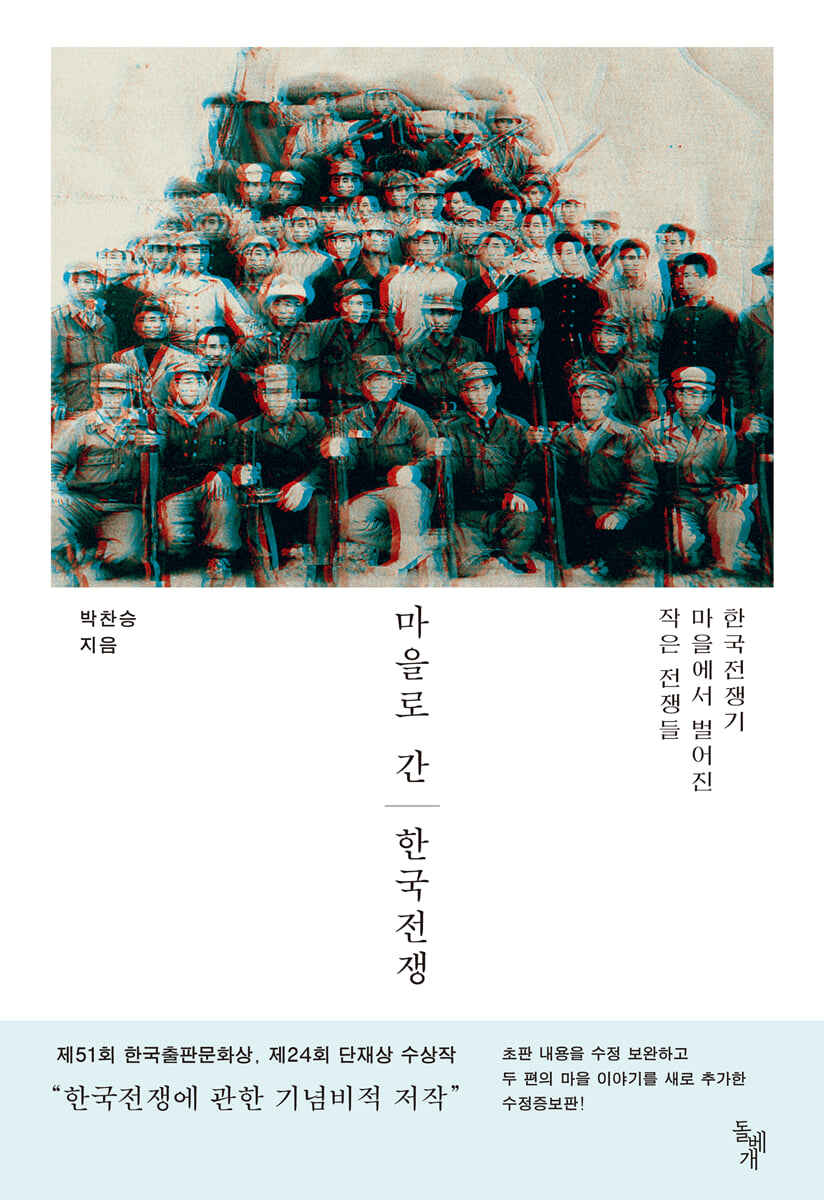
The Korean War that went to the village
 |
Description
Book Introduction
Winner of the 51st Korean Publication Culture Award and the 24th Danjae Award
“A monumental work on the Korean War”
A masterpiece of microhistory of the Korean War!
“Why did the villagers kill each other so much during the Korean War?”
The Korean War, fought by ordinary people in a village
Park Chan-seung's "The Korean War in the Village - Small Wars that Fought in Villages During the Korean War" presents a revised and expanded edition after 15 years.
This revised and expanded edition includes two new village stories (located in Wando and Haenam) based on the author's field research, oral history, and literature. Since the first edition was published, the content has been steadily revised and supplemented with each report from the Truth and Reconciliation Commission (TRC).
"The Korean War in the Village" is evaluated as a masterpiece that provides important insight into understanding the deep-rooted conflict structure of Korean society by reexamining the Korean War as an event that occurred in the small units of a village rather than as a grand national discourse. It also received great attention from both academia and the public, winning the 51st Korean Publication Culture Award for Writing (Academic Category) and the 24th Danjae Award.
Unlike previous studies on the Korean War, which primarily focused on the macroscopic perspective (the background to the outbreak of the war, the conflict between the North and South Korean regimes, etc.), this study focuses on the tragedy and conflict among civilians that occurred in the space of a village from a microscopic perspective.
“A monumental work on the Korean War”
A masterpiece of microhistory of the Korean War!
“Why did the villagers kill each other so much during the Korean War?”
The Korean War, fought by ordinary people in a village
Park Chan-seung's "The Korean War in the Village - Small Wars that Fought in Villages During the Korean War" presents a revised and expanded edition after 15 years.
This revised and expanded edition includes two new village stories (located in Wando and Haenam) based on the author's field research, oral history, and literature. Since the first edition was published, the content has been steadily revised and supplemented with each report from the Truth and Reconciliation Commission (TRC).
"The Korean War in the Village" is evaluated as a masterpiece that provides important insight into understanding the deep-rooted conflict structure of Korean society by reexamining the Korean War as an event that occurred in the small units of a village rather than as a grand national discourse. It also received great attention from both academia and the public, winning the 51st Korean Publication Culture Award for Writing (Academic Category) and the 24th Danjae Award.
Unlike previous studies on the Korean War, which primarily focused on the macroscopic perspective (the background to the outbreak of the war, the conflict between the North and South Korean regimes, etc.), this study focuses on the tragedy and conflict among civilians that occurred in the space of a village from a microscopic perspective.
index
Preface to the Revised and Expanded Edition
Preface to the first edition
General: The Korean War as Seen from the Village
1.
prolog
2.
The conflict structure between war and villagers
Conflicts between social classes and ranks | Conflicts between clans and villages | Conflicts between religions and ideologies
3.
Village leaders, state power, and war
The Influence of Village Leaders | State Power's Intervention in Villages
4.
The village after the war
5.
Epilogue: Complex Conflict Structure Theory
Chapter 1.
The tragedy of genocide between relatives, X-ri, a village in Jindo
1.
What kind of village is X-ri in Jindo?
Major surnames in Jindo and the status of the X-ri Gwak clan|Land ownership by residents of Jindo and X-ri
2.
Participation of X-ri youth in national and social movements in the 1930s
The Formation and Dissolution of the 1933 Awakening Conference | The Formation and Dissolution of the Jindo Red Peasant Association
3.
The movements of X-ri Hyeonpung Gwak immediately after liberation
Participation in the National Foundation Preparatory Committee and the People's Committee | Joining the Police and Forming the Right-Wing Youth League
4.
The explosion of intra-family conflict and repeated massacres during the Korean War
The Onslaught of War and Repeated Massacres | Victims by Faction | Characteristics of the X-Ri Tragedy | The Change in the Status of the Hyeonpung Gwak Clan After the War
5.
Conclusion: Intra-family conflict and the state power behind it
Chapter 2.
'Yeongam's Moscow': The Trials of a Yangban Village
1.
Two noble families, Jeonju Choi and Geochang Shin
2.
National and social movements in Yeongbo Village during the late Joseon Dynasty and Japanese colonial period
The Righteous Army War in Yeongbo Village at the End of the Joseon Dynasty | The Dissolution of the Yeongam Branch of the Singanhoe and the Birth of the Yeongam Farmers' Association | The Full Story of the Yeongam Communist Council and the Yeongbo Farmers' Demonstration
3.
Yeongbori, a turbulent place from liberation to the Korean War
The Song Seok-jeong Incident and the Execution of the "Three Reactionaries" Immediately After Liberation | The "Total Evacuation" and "Total Surrender" of Village Residents During the War
4.
Conclusion: What did the war leave behind in the village?
Chapter 3.
The conflict between noble and commoner villages, two villages of the same ethnic group in Buyeo County.
1.
The history of two ethnic villages in Buyeo County and the shaky caste system
The Cradle of the Anti-Japanese National Movement: Jinju Kang Clan's Minchon Village | The Pungyang Jo Clan's Banchon Village, a Prestigious Family with 400 Years of Tradition | The Dissolution of the Class System and the Conflict Between Two Clan Villages
2.
Clash between two ethnic villages during the Korean War
The establishment of the Southern Labor Party and the Korean Youth Corps in Buyeo County | The Gudre Naru Massacre and the Retaliatory People's Tribunal on the Geumgang River | Land Reform in Two Villages Under the Invasion
3.
The Scars of War and the Launch of the Gangho Comrades Association
4.
Conclusion: Village Wars as a Class Struggle
Chapter 4.
Conflicts over Land and Religion: The People of Hapdeok-myeon, Dangjin-gun
1.
Pre-war conflict between landlords and tenants
What Kind of Village is Hapdeok-myeon? | Distribution of Landowners in Hapdeok-myeon | Formation of the Hapdeok-ri Tenant Association and the Conflict Between Marum and Tenants
2.
Conflicts among villagers during the Korean War
The People's Army's Land Reform and the Park Myong-ryeol Family Raid | The Suffering of Hapdeok Cathedral under the Invasion of Korea | The Clash Between the Nam and Oh Clans of Hapdeok
3.
Conclusion: Village Wars as a Conflict Between Classes and Ideologies
Chapter 5.
The Clash Between Two Prestigious Yangban Families: A Tragedy in Burimyeon, Geumsan County
1.
The Haepyeong Gil and Namwon Yang clans, prestigious families from Burimyeon, Geumsan-gun
2.
The left-right division of the two families
The Geumsan Youth League and the Jeonbuk Korean Communist Party Reconstruction Incident | The Right-Left Division of the Gil and Yang Clans in Burimyeon Immediately After Liberation
3.
The movements of two families during the Korean War and the November 2 Incident
4.
The Unfinished Story: Those Who Remember the War
5.
Conclusion: Village Wars as a Left-Right Ideological Conflict
Chapter 6.
Division, War, and the People of Soan-myeon, Wando-gun
1.
preface
2.
Civilian casualties in Wando County due to division and war
Political and Social Trends in Wando County from Liberation to 1946 | Wando Police's Leftist Suppression Operations, 1947-1949
3.
Massacre of civilians in Wando County after the outbreak of the Korean War
Massacre of members of the National Guidance League | Massacre of members of the Naju Unit | Police and People's Army confrontation: Police massacre of suspected leftists | Massacre of civilians by the People's Army and leftists after the People's Army's advance into Wando | Police massacre of civilians after the People's Army's withdrawal
4.
The sacrifice of the residents of Soan-myeon A Village
Key Figures of Village A | Sacrifices of Left-Wing Youth Before the War | Sacrifices of Village A Residents During the Korean War
5.
The sacrifice of the residents of B Village, Soan-myeon
The conflict between two families in Village B before the outbreak of war | The sacrifices of Village B residents after the outbreak of war
6.
Conclusion
Chapter 7.
Civilian massacres in Haenam County before and after the Korean War
1.
preface
2.
The situation in Haenam County before the Korean War
The Situation in Haenam County During Japanese Colonial Period and Immediately After Liberation | The November 1946 Uprising and Massacre of Participants
3.
Massacre of civilians in Haenam County during the Korean War
Massacre of members of the Press League | Massacre of villagers by the Naju unit | Massacre of right-wing forces by the People's Army and leftists | Massacre of suspected collaborators by the police and youth group
4.
Conclusion
Americas
References
Search
Preface to the first edition
General: The Korean War as Seen from the Village
1.
prolog
2.
The conflict structure between war and villagers
Conflicts between social classes and ranks | Conflicts between clans and villages | Conflicts between religions and ideologies
3.
Village leaders, state power, and war
The Influence of Village Leaders | State Power's Intervention in Villages
4.
The village after the war
5.
Epilogue: Complex Conflict Structure Theory
Chapter 1.
The tragedy of genocide between relatives, X-ri, a village in Jindo
1.
What kind of village is X-ri in Jindo?
Major surnames in Jindo and the status of the X-ri Gwak clan|Land ownership by residents of Jindo and X-ri
2.
Participation of X-ri youth in national and social movements in the 1930s
The Formation and Dissolution of the 1933 Awakening Conference | The Formation and Dissolution of the Jindo Red Peasant Association
3.
The movements of X-ri Hyeonpung Gwak immediately after liberation
Participation in the National Foundation Preparatory Committee and the People's Committee | Joining the Police and Forming the Right-Wing Youth League
4.
The explosion of intra-family conflict and repeated massacres during the Korean War
The Onslaught of War and Repeated Massacres | Victims by Faction | Characteristics of the X-Ri Tragedy | The Change in the Status of the Hyeonpung Gwak Clan After the War
5.
Conclusion: Intra-family conflict and the state power behind it
Chapter 2.
'Yeongam's Moscow': The Trials of a Yangban Village
1.
Two noble families, Jeonju Choi and Geochang Shin
2.
National and social movements in Yeongbo Village during the late Joseon Dynasty and Japanese colonial period
The Righteous Army War in Yeongbo Village at the End of the Joseon Dynasty | The Dissolution of the Yeongam Branch of the Singanhoe and the Birth of the Yeongam Farmers' Association | The Full Story of the Yeongam Communist Council and the Yeongbo Farmers' Demonstration
3.
Yeongbori, a turbulent place from liberation to the Korean War
The Song Seok-jeong Incident and the Execution of the "Three Reactionaries" Immediately After Liberation | The "Total Evacuation" and "Total Surrender" of Village Residents During the War
4.
Conclusion: What did the war leave behind in the village?
Chapter 3.
The conflict between noble and commoner villages, two villages of the same ethnic group in Buyeo County.
1.
The history of two ethnic villages in Buyeo County and the shaky caste system
The Cradle of the Anti-Japanese National Movement: Jinju Kang Clan's Minchon Village | The Pungyang Jo Clan's Banchon Village, a Prestigious Family with 400 Years of Tradition | The Dissolution of the Class System and the Conflict Between Two Clan Villages
2.
Clash between two ethnic villages during the Korean War
The establishment of the Southern Labor Party and the Korean Youth Corps in Buyeo County | The Gudre Naru Massacre and the Retaliatory People's Tribunal on the Geumgang River | Land Reform in Two Villages Under the Invasion
3.
The Scars of War and the Launch of the Gangho Comrades Association
4.
Conclusion: Village Wars as a Class Struggle
Chapter 4.
Conflicts over Land and Religion: The People of Hapdeok-myeon, Dangjin-gun
1.
Pre-war conflict between landlords and tenants
What Kind of Village is Hapdeok-myeon? | Distribution of Landowners in Hapdeok-myeon | Formation of the Hapdeok-ri Tenant Association and the Conflict Between Marum and Tenants
2.
Conflicts among villagers during the Korean War
The People's Army's Land Reform and the Park Myong-ryeol Family Raid | The Suffering of Hapdeok Cathedral under the Invasion of Korea | The Clash Between the Nam and Oh Clans of Hapdeok
3.
Conclusion: Village Wars as a Conflict Between Classes and Ideologies
Chapter 5.
The Clash Between Two Prestigious Yangban Families: A Tragedy in Burimyeon, Geumsan County
1.
The Haepyeong Gil and Namwon Yang clans, prestigious families from Burimyeon, Geumsan-gun
2.
The left-right division of the two families
The Geumsan Youth League and the Jeonbuk Korean Communist Party Reconstruction Incident | The Right-Left Division of the Gil and Yang Clans in Burimyeon Immediately After Liberation
3.
The movements of two families during the Korean War and the November 2 Incident
4.
The Unfinished Story: Those Who Remember the War
5.
Conclusion: Village Wars as a Left-Right Ideological Conflict
Chapter 6.
Division, War, and the People of Soan-myeon, Wando-gun
1.
preface
2.
Civilian casualties in Wando County due to division and war
Political and Social Trends in Wando County from Liberation to 1946 | Wando Police's Leftist Suppression Operations, 1947-1949
3.
Massacre of civilians in Wando County after the outbreak of the Korean War
Massacre of members of the National Guidance League | Massacre of members of the Naju Unit | Police and People's Army confrontation: Police massacre of suspected leftists | Massacre of civilians by the People's Army and leftists after the People's Army's advance into Wando | Police massacre of civilians after the People's Army's withdrawal
4.
The sacrifice of the residents of Soan-myeon A Village
Key Figures of Village A | Sacrifices of Left-Wing Youth Before the War | Sacrifices of Village A Residents During the Korean War
5.
The sacrifice of the residents of B Village, Soan-myeon
The conflict between two families in Village B before the outbreak of war | The sacrifices of Village B residents after the outbreak of war
6.
Conclusion
Chapter 7.
Civilian massacres in Haenam County before and after the Korean War
1.
preface
2.
The situation in Haenam County before the Korean War
The Situation in Haenam County During Japanese Colonial Period and Immediately After Liberation | The November 1946 Uprising and Massacre of Participants
3.
Massacre of civilians in Haenam County during the Korean War
Massacre of members of the Press League | Massacre of villagers by the Naju unit | Massacre of right-wing forces by the People's Army and leftists | Massacre of suspected collaborators by the police and youth group
4.
Conclusion
Americas
References
Search
Detailed image
.jpg)
Publisher's Review
A new microhistory of the Korean War, a monumental work on the Korean War.
Author Park Chan-seung notes that there were far more civilian deaths than military deaths during the Korean War, and emphasizes that the places of death were not the front lines, but the "villages" in the rear.
The author raises a fundamental question about why people in the same village waged a "small war" killing each other before and after the Korean War, and delves into the background and causes.
Violence and Massacre during the Korean War, with its "complex conflict structure"
This book reveals that the violence and massacres that occurred in villages during the Korean War cannot be explained simply by class conflict and ideological confrontation between the left and right.
In fact, the villages studied by the author had a 'complex conflict structure' behind them, including factional conflicts between relatives that had accumulated since the Joseon Dynasty, class conflicts between the yangban and commoners (bansang), class conflicts between landlords and tenant farmers, conflicts and confrontations between competing villages, and religious and ideological conflicts between Christians and socialists.
Conflicts between clans, villages, and social classes played a significant role in massacres at the civilian level.
"The Korean War in the Village" was praised for broadening the horizons of Korean War research by specifically showing not only the causes and consequences of the war but also how the war infiltrated the daily lives of ordinary people.
This proves that our academic community has not been able to conduct in-depth research on the civilian-level civil war in the Korean War.
The author, after reviewing the village cases studied so far, believes that conflicts between kin, village, and social classes played a more important role in civilian massacres than conflicts between ideologies and classes.
And it points out that the state powers of the North and South took advantage of the conflict between the villagers.
In fact, the People's Army often conducted people's trials using the lower classes and marginalized classes of the village.
'Small Wars in the Village' is an explosion of the conflicts and contradictions in our society that accumulated during the Joseon Dynasty and the Japanese colonial period.
The 'small wars that took place in the village' that resulted in countless casualties were an explosion of the various conflicts and contradictions in our society that had accumulated during the Joseon Dynasty and the Japanese colonial period.
And the sudden division of North and South Korea did not provide an opportunity to gradually resolve conflicts within the village community.
Villages that failed to wisely resolve their conflicts were helpless against the infiltration of state power, and indiscriminate massacres took place amidst the incitement and extreme confrontation of state power in both North and South Korea.
Author Park Chan-seung notes that there were far more civilian deaths than military deaths during the Korean War, and emphasizes that the places of death were not the front lines, but the "villages" in the rear.
The author raises a fundamental question about why people in the same village waged a "small war" killing each other before and after the Korean War, and delves into the background and causes.
Violence and Massacre during the Korean War, with its "complex conflict structure"
This book reveals that the violence and massacres that occurred in villages during the Korean War cannot be explained simply by class conflict and ideological confrontation between the left and right.
In fact, the villages studied by the author had a 'complex conflict structure' behind them, including factional conflicts between relatives that had accumulated since the Joseon Dynasty, class conflicts between the yangban and commoners (bansang), class conflicts between landlords and tenant farmers, conflicts and confrontations between competing villages, and religious and ideological conflicts between Christians and socialists.
Conflicts between clans, villages, and social classes played a significant role in massacres at the civilian level.
"The Korean War in the Village" was praised for broadening the horizons of Korean War research by specifically showing not only the causes and consequences of the war but also how the war infiltrated the daily lives of ordinary people.
This proves that our academic community has not been able to conduct in-depth research on the civilian-level civil war in the Korean War.
The author, after reviewing the village cases studied so far, believes that conflicts between kin, village, and social classes played a more important role in civilian massacres than conflicts between ideologies and classes.
And it points out that the state powers of the North and South took advantage of the conflict between the villagers.
In fact, the People's Army often conducted people's trials using the lower classes and marginalized classes of the village.
'Small Wars in the Village' is an explosion of the conflicts and contradictions in our society that accumulated during the Joseon Dynasty and the Japanese colonial period.
The 'small wars that took place in the village' that resulted in countless casualties were an explosion of the various conflicts and contradictions in our society that had accumulated during the Joseon Dynasty and the Japanese colonial period.
And the sudden division of North and South Korea did not provide an opportunity to gradually resolve conflicts within the village community.
Villages that failed to wisely resolve their conflicts were helpless against the infiltration of state power, and indiscriminate massacres took place amidst the incitement and extreme confrontation of state power in both North and South Korea.
GOODS SPECIFICS
- Date of issue: June 13, 2025
- Page count, weight, size: 400 pages | 594g | 154*225*30mm
- ISBN13: 9791194442271
- ISBN10: 1194442277
You may also like
카테고리
korean


korean

![GQ KOREA Mark (Monthly): December [2025]](http://librairie.coreenne.fr/cdn/shop/files/8ef265dbbfbf186523ed75ba7319009d.jpg?v=1765340328&width=3840)


