

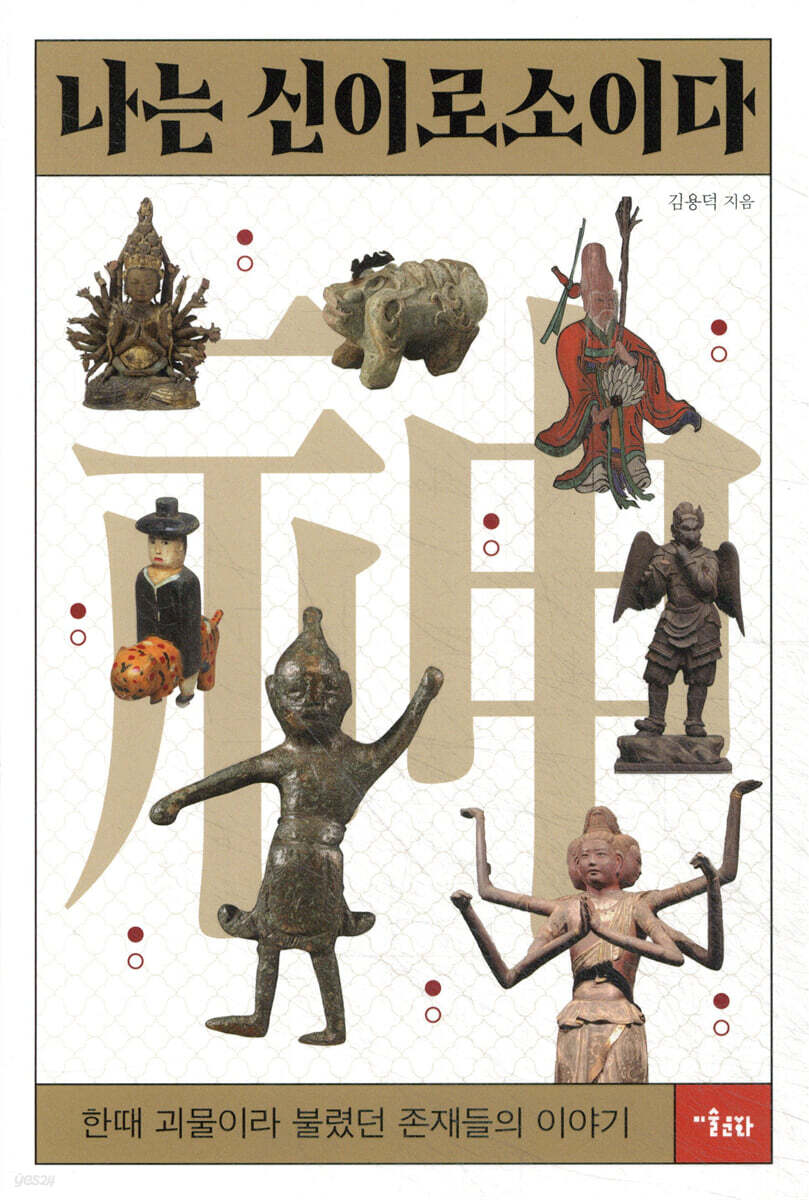
I am God
 |
Description
Book Introduction
Buddhist paintings, folk paintings, sculptures, ancient documents, etc.
With precious and meaningful cultural assets from each Asian country.
Illuminating the great figures in our culture we never knew existed.
From readers who are curious about the stories of mysterious beings
Even art enthusiasts who love cultural assets and traditional art
A collection of humanities and arts resources for anyone interested in the legacy of imagination.
With precious and meaningful cultural assets from each Asian country.
Illuminating the great figures in our culture we never knew existed.
From readers who are curious about the stories of mysterious beings
Even art enthusiasts who love cultural assets and traditional art
A collection of humanities and arts resources for anyone interested in the legacy of imagination.
- You can preview some of the book's contents.
Preview
index
Recommendation: Reading the Thoughts of the Times in the Forms
Prologue: The Face of God, the Shadow of the Monster
1.
free performer, yaksha
A hairy yaksha that appears in folklore
Yaksha, the spirit of India
Become one of the eight gods
Yaksha images in Silla Buddhist art
Endless charm
Author's Note: Yaksha is a master of ever-changing transformations.
2.
Geumgangyeoksa, the temple's gatekeeper
The Birth of the Dharma Guardian
Buddha's Bodyguard, Protecting the Dharma
The humor of the guardian
Author's Note: The history of the Diamond Age is an unchanging love.
3.
Asura, the god of struggle
Asura and the Milk Churner
From dedication to caution
Da-myeon-da-bi, a mystery bursting from the strange
Author's Note: Asura is the embodiment of effort.
4.
Garuda, commanding the sky
The Birth of Garuda
The Mystery of the Baekje Gilt-Bronze Incense Burner
The king of birds who slays the poisonous dragon
Garuda, a symbol of the Buddha's land in Buddhist art
Author's Note: Garuda is the standard of the Middle Way.
5.
Judge of Hell, King of Ten
Sin and Punishment: The World of Hell in Buddhist Culture
Messengers of the living and the dead, messengers of the underworld
Ten Kings, Ten Hells
King of Hell, the leader of Hell
The final gate, the five-wheeled king
Author's Note: The King of Hell will be a being of mercy.
6.
Stars and Fairies, Mercury Old Man
A fairy born from a star
The beginning of a unique image
Three immortals who bring good fortune
A group of immortals heading to Yoji
Immortals infused into Buddhism
Author's Note: Mercury Old Man is the Best Problem Solver
7.
Gods of Creation, Fuxi and Nüwa
A symbol of the devil's temptation, trials, and exorcism
Icon of Regeneration and Immortality
The legendary emperor, Fuxi
Yeo-wa, Mother of Creation
The Birth of a Great Couple
Author's Note: Fuxi and Nüwa are kind parents.
8.
The Ghost-Catching General, Jong-gyu
The new Jong-gyu of the wall
Lookism
Establishment and spread, Jonggyu expressed through art
Cheoyong, the guardian deity of Silla
Jonggyu, who protected the Korean people
Author's Note: Jong-gyu is a true white-clad soldier.
9.
Swim in the sea of fantasy, mermaid
The Roots of Western Mermaids: Scylla and the Sirens
Mermaids in Eastern Culture
Japanese mermaids symbolize longevity and good fortune
Oriental mermaids as seen by Korean scholars
The Korean version of The Little Mermaid, a mermaid from folklore
From Imagination to Reality: Mermaids in Korean Art
Author's Note: Mermaids are a form of imagination that draws out the childlike innocence of children.
Epilogue: The Great Beings in Our Culture We Never Knew
References
List of plates
index
Prologue: The Face of God, the Shadow of the Monster
1.
free performer, yaksha
A hairy yaksha that appears in folklore
Yaksha, the spirit of India
Become one of the eight gods
Yaksha images in Silla Buddhist art
Endless charm
Author's Note: Yaksha is a master of ever-changing transformations.
2.
Geumgangyeoksa, the temple's gatekeeper
The Birth of the Dharma Guardian
Buddha's Bodyguard, Protecting the Dharma
The humor of the guardian
Author's Note: The history of the Diamond Age is an unchanging love.
3.
Asura, the god of struggle
Asura and the Milk Churner
From dedication to caution
Da-myeon-da-bi, a mystery bursting from the strange
Author's Note: Asura is the embodiment of effort.
4.
Garuda, commanding the sky
The Birth of Garuda
The Mystery of the Baekje Gilt-Bronze Incense Burner
The king of birds who slays the poisonous dragon
Garuda, a symbol of the Buddha's land in Buddhist art
Author's Note: Garuda is the standard of the Middle Way.
5.
Judge of Hell, King of Ten
Sin and Punishment: The World of Hell in Buddhist Culture
Messengers of the living and the dead, messengers of the underworld
Ten Kings, Ten Hells
King of Hell, the leader of Hell
The final gate, the five-wheeled king
Author's Note: The King of Hell will be a being of mercy.
6.
Stars and Fairies, Mercury Old Man
A fairy born from a star
The beginning of a unique image
Three immortals who bring good fortune
A group of immortals heading to Yoji
Immortals infused into Buddhism
Author's Note: Mercury Old Man is the Best Problem Solver
7.
Gods of Creation, Fuxi and Nüwa
A symbol of the devil's temptation, trials, and exorcism
Icon of Regeneration and Immortality
The legendary emperor, Fuxi
Yeo-wa, Mother of Creation
The Birth of a Great Couple
Author's Note: Fuxi and Nüwa are kind parents.
8.
The Ghost-Catching General, Jong-gyu
The new Jong-gyu of the wall
Lookism
Establishment and spread, Jonggyu expressed through art
Cheoyong, the guardian deity of Silla
Jonggyu, who protected the Korean people
Author's Note: Jong-gyu is a true white-clad soldier.
9.
Swim in the sea of fantasy, mermaid
The Roots of Western Mermaids: Scylla and the Sirens
Mermaids in Eastern Culture
Japanese mermaids symbolize longevity and good fortune
Oriental mermaids as seen by Korean scholars
The Korean version of The Little Mermaid, a mermaid from folklore
From Imagination to Reality: Mermaids in Korean Art
Author's Note: Mermaids are a form of imagination that draws out the childlike innocence of children.
Epilogue: The Great Beings in Our Culture We Never Knew
References
List of plates
index
Detailed image

Into the book
Yaksha, also called yaksha in Sanskrit, is often used as a general term for superhuman or demonic beings rather than referring to a specific god.
This phenomenon can be seen not only in Yaksha, but also in many gods in early Indian and Buddhist culture.
India is often called 'the land of a thousand faces'.
India is a complex country with many cultures combined, with diverse races and religions.
Therefore, in addition to Yaksha, many Buddhist gods overlap with gods of other religions.
--- p.17
The changed history of Geumgang takes root in our country.
The earliest example is the stone pagoda of Bunhwangsa Temple, built around 634 during the reign of Queen Seondeok, and is the oldest Buddhist pagoda of Silla.
The Vajrapani of the Bunhwangsa Temple's stone pagoda stands at the entrance to the sarira chamber, the place where the Buddha's relics are enshrined.
Geumgang Yeoksa, in a martial arts stance with fluttering clothes, stands tall on a rock and steadfastly guards the shrine, preventing anyone from approaching.
--- p.58
Why did our ancestors portray the Vajrapani, the guardian deity of temples, in such a comical and adorable way? Late Joseon Buddhist art exhibits changes not only in the folk paintings and giant hanging Buddhist paintings on temple murals, but also in the Vajrapani.
With the country devastated by two wars, the tyranny of the yangban class overflowing with corruption, and even a puppet king who was ignorant of the ways of the world and only raised taxes, the people who lived through the difficult late Joseon Dynasty must have felt hellish pain at every moment.
For this reason, temples have incorporated humorous and friendly images into numerous Buddhist icons, such as the Vajrapani, the boy, and the deity.
--- p.70
The scales Asura holds are a warning message to prevent living beings from committing sins, but they also contain the meaning of Asura himself reflecting on his sins.
It is a pledge by Asura, who was a demon and a symbol of evil, to take refuge in Buddha and reflect on his own sins.
--- p.90
As in Indian mythology, Garuda is considered the king of all birds in the world.
In the 『Decision-Making-Vajrapani Sutra』, we find a record of the Buddha saying to his disciple, “What do you think? Can birds like eagles and doves withstand the power of Garuda?” This means that Garuda is the greatest of all birds.
Garuda, who was thus acknowledged by the Buddha, joined the Eightfold Path as a member of the Buddha's teachings and protectors.
In the scriptures, Garuda is always depicted as staying closest to the Buddha, and depending on the situation, he is depicted as chanting sutras or standing quietly with his hands clasped together.
--- p.106
Until 10 years ago, the Grim Reaper was an unpopular figure, wearing a black robe with a hat, a pale face, and dark circles under his eyes that reached down to his chin.
But did you know that the origins of this grim reaper are less than 40 years old? The grim reaper we recognize today first appeared in the 1970s on the TV show "Hometown of Legends," and was created based on shamanistic images produced in modern and contemporary times.
So, who is the true grim reaper of our culture, and what does he look like? Its origin lies in the grim reaper of Buddhism.
--- p.137
Here, the predecessor of King Yeomra appears, a god called Yama or Ima.
The Rig Veda describes Yama as the son of Vivasvan, the sun god, and the first to discover the path to death. He commands four-eyed dogs to observe and judge humans.
As if to support this, the Pali scripture called 『Majjima Nikaya』 describes a scene where Yama interrogates the five sins and the appearance of hell, and the 『Mahavastu』 and 『Saddharmapundarika』, compiled around the 3rd century BC, also refer to Yama as the king or ruler of hell.
--- p.153
What is noteworthy in the Hyeonwangdo is the objects depicted around it.
The painting of the King of Kings features a variety of objects, including a folding screen, a table, scriptures, glasses, and writing instruments. It is a free-spirited composition with strong elements of folk painting, such as books and letters that were popular in the late Joseon Dynasty.
Several phrases are found on the artifacts, and elements related to Buddhism as well as folk beliefs can be seen.
--- p.171
In art, the old man of Mercury is depicted with symbols of longevity such as a white deer, a crane, and a bat that brings good fortune. This can be said to be an element that further enhances the power of the old man of Mercury, who symbolizes longevity and happiness.
The story of the old man Mercury is a mixture of the grotesque and the comical.
Why did people create such stories? Perhaps they wanted to introduce the Mercury Old Man to many people? A bright, positive energy that governs longevity and happiness.
--- p.195
Fuxi is the god who first invented the net and taught humans how to hunt and fish.
These two practices, along with agriculture, are very important survival strategies for humans, so here we can see Fuxi's love for humanity.
Another name for Fuxi, Taihu, means 'the boundless, vast sky' and shows the appearance of a sage king with good virtue and character.
--- p.228
So, what role does Yeo-wa play? As a creator deity, Yeo-wa creates and nurtures all things, and in times of crisis, she also appears as a savior.
Among these, the first thing Yeo-wa did was to create humans.
There is a story like this in several ancient records, including 『Taiping Yulan』 and 『Pungsok Tongyi』.
--- p.234
The term ‘byeoksa(邪)’ means to block or repel evil elements such as ghosts, curses, and plagues, and is a similar concept to exorcism.
However, while exorcism has a direct and strong nature, such as eliminating or driving away ghosts, wall-cracking has a strong indirect and preventative nature, that is, it is a preemptive defense through a medium.
Therefore, the ritual of exorcism is carried out in a way to block out ghosts or epidemics in advance by using mediums imbued with magical powers, such as paintings, sculptures, and talismans depicting the gods, as well as natural objects and places.
--- p.250
In India, there is a god called Matsya.
Matsya, which means fish in Sanskrit, has the upper body of a human and the lower body of a fish, and is the first avatar of Vishnu, the supreme god in charge of preservation and maintenance in Hindu mythology.
Here, avatar refers to the incarnation of Vishnu that changed his form to save humanity whenever it was in danger.
Matsya is the first avatar of Vishnu.
--- p.298
The first example of a mermaid in Korean art is Buddhist art, the Sumidan (須彌壇), installed inside a Buddhist temple to enshrine the Buddha.
Here, Sumeru is a transliteration of the Sanskrit word Sumeru, and refers to Mount Sumeru, which stands tall at the center of the world, that is, the summit of the Buddha land where the Buddha lives.
Sumeru, where the Buddha resides, is a utopia itself, and is thus depicted as a magnificent world engraved with all sorts of auspicious patterns symbolizing happiness.
This phenomenon can be seen not only in Yaksha, but also in many gods in early Indian and Buddhist culture.
India is often called 'the land of a thousand faces'.
India is a complex country with many cultures combined, with diverse races and religions.
Therefore, in addition to Yaksha, many Buddhist gods overlap with gods of other religions.
--- p.17
The changed history of Geumgang takes root in our country.
The earliest example is the stone pagoda of Bunhwangsa Temple, built around 634 during the reign of Queen Seondeok, and is the oldest Buddhist pagoda of Silla.
The Vajrapani of the Bunhwangsa Temple's stone pagoda stands at the entrance to the sarira chamber, the place where the Buddha's relics are enshrined.
Geumgang Yeoksa, in a martial arts stance with fluttering clothes, stands tall on a rock and steadfastly guards the shrine, preventing anyone from approaching.
--- p.58
Why did our ancestors portray the Vajrapani, the guardian deity of temples, in such a comical and adorable way? Late Joseon Buddhist art exhibits changes not only in the folk paintings and giant hanging Buddhist paintings on temple murals, but also in the Vajrapani.
With the country devastated by two wars, the tyranny of the yangban class overflowing with corruption, and even a puppet king who was ignorant of the ways of the world and only raised taxes, the people who lived through the difficult late Joseon Dynasty must have felt hellish pain at every moment.
For this reason, temples have incorporated humorous and friendly images into numerous Buddhist icons, such as the Vajrapani, the boy, and the deity.
--- p.70
The scales Asura holds are a warning message to prevent living beings from committing sins, but they also contain the meaning of Asura himself reflecting on his sins.
It is a pledge by Asura, who was a demon and a symbol of evil, to take refuge in Buddha and reflect on his own sins.
--- p.90
As in Indian mythology, Garuda is considered the king of all birds in the world.
In the 『Decision-Making-Vajrapani Sutra』, we find a record of the Buddha saying to his disciple, “What do you think? Can birds like eagles and doves withstand the power of Garuda?” This means that Garuda is the greatest of all birds.
Garuda, who was thus acknowledged by the Buddha, joined the Eightfold Path as a member of the Buddha's teachings and protectors.
In the scriptures, Garuda is always depicted as staying closest to the Buddha, and depending on the situation, he is depicted as chanting sutras or standing quietly with his hands clasped together.
--- p.106
Until 10 years ago, the Grim Reaper was an unpopular figure, wearing a black robe with a hat, a pale face, and dark circles under his eyes that reached down to his chin.
But did you know that the origins of this grim reaper are less than 40 years old? The grim reaper we recognize today first appeared in the 1970s on the TV show "Hometown of Legends," and was created based on shamanistic images produced in modern and contemporary times.
So, who is the true grim reaper of our culture, and what does he look like? Its origin lies in the grim reaper of Buddhism.
--- p.137
Here, the predecessor of King Yeomra appears, a god called Yama or Ima.
The Rig Veda describes Yama as the son of Vivasvan, the sun god, and the first to discover the path to death. He commands four-eyed dogs to observe and judge humans.
As if to support this, the Pali scripture called 『Majjima Nikaya』 describes a scene where Yama interrogates the five sins and the appearance of hell, and the 『Mahavastu』 and 『Saddharmapundarika』, compiled around the 3rd century BC, also refer to Yama as the king or ruler of hell.
--- p.153
What is noteworthy in the Hyeonwangdo is the objects depicted around it.
The painting of the King of Kings features a variety of objects, including a folding screen, a table, scriptures, glasses, and writing instruments. It is a free-spirited composition with strong elements of folk painting, such as books and letters that were popular in the late Joseon Dynasty.
Several phrases are found on the artifacts, and elements related to Buddhism as well as folk beliefs can be seen.
--- p.171
In art, the old man of Mercury is depicted with symbols of longevity such as a white deer, a crane, and a bat that brings good fortune. This can be said to be an element that further enhances the power of the old man of Mercury, who symbolizes longevity and happiness.
The story of the old man Mercury is a mixture of the grotesque and the comical.
Why did people create such stories? Perhaps they wanted to introduce the Mercury Old Man to many people? A bright, positive energy that governs longevity and happiness.
--- p.195
Fuxi is the god who first invented the net and taught humans how to hunt and fish.
These two practices, along with agriculture, are very important survival strategies for humans, so here we can see Fuxi's love for humanity.
Another name for Fuxi, Taihu, means 'the boundless, vast sky' and shows the appearance of a sage king with good virtue and character.
--- p.228
So, what role does Yeo-wa play? As a creator deity, Yeo-wa creates and nurtures all things, and in times of crisis, she also appears as a savior.
Among these, the first thing Yeo-wa did was to create humans.
There is a story like this in several ancient records, including 『Taiping Yulan』 and 『Pungsok Tongyi』.
--- p.234
The term ‘byeoksa(邪)’ means to block or repel evil elements such as ghosts, curses, and plagues, and is a similar concept to exorcism.
However, while exorcism has a direct and strong nature, such as eliminating or driving away ghosts, wall-cracking has a strong indirect and preventative nature, that is, it is a preemptive defense through a medium.
Therefore, the ritual of exorcism is carried out in a way to block out ghosts or epidemics in advance by using mediums imbued with magical powers, such as paintings, sculptures, and talismans depicting the gods, as well as natural objects and places.
--- p.250
In India, there is a god called Matsya.
Matsya, which means fish in Sanskrit, has the upper body of a human and the lower body of a fish, and is the first avatar of Vishnu, the supreme god in charge of preservation and maintenance in Hindu mythology.
Here, avatar refers to the incarnation of Vishnu that changed his form to save humanity whenever it was in danger.
Matsya is the first avatar of Vishnu.
--- p.298
The first example of a mermaid in Korean art is Buddhist art, the Sumidan (須彌壇), installed inside a Buddhist temple to enshrine the Buddha.
Here, Sumeru is a transliteration of the Sanskrit word Sumeru, and refers to Mount Sumeru, which stands tall at the center of the world, that is, the summit of the Buddha land where the Buddha lives.
Sumeru, where the Buddha resides, is a utopia itself, and is thus depicted as a magnificent world engraved with all sorts of auspicious patterns symbolizing happiness.
--- p.313
Publisher's Review
The icons in cultural properties that look different when you know them
An eye that reads hidden meanings
Open your ears to the hearts of the old people
"I Am a God" is a book that analyzes the iconography of great beings in our culture that we were previously unaware of, such as yakshas, asuras, and garudas, by crossing cultural assets, scriptures, myths, and folktales.
The moment you open this book, cultural assets are no longer stuffed works of art.
It provides a completely new perspective on the murals in temples and sculptures in museums that we may have passed by without a second thought, and the creatures in folk paintings that we are familiar with but did not understand.
The dignified posture of the Geumgang Yeoksa guarding the temple grounds, the expression of the Yaksha carved on the stone pagoda base, and the bizarre figures in folk paintings come to life.
The author goes beyond simply listing the meanings of divine beings. He tells a story about the historical context in which each being was born and how it has evolved to reflect the human mind and beliefs, thereby cultivating readers' insight into traditional paintings and cultural assets.
Only then do familiar figures begin to speak to them, and as they gradually come to understand the meaning of their words, the reader comes to realize that tradition, art, and mythology are no longer unfamiliar, but rather stories that connect with their own lives.
This book is a humanities and arts book that anyone with an interest in art or traditional culture can naturally immerse themselves in, even without any special background knowledge. It is also the first key to interpretation that can be offered to anyone who has ever looked at a work of art and wondered, "What meaning does this element contain?"
The story of beings called monsters
Redrawing the Face of the Lost God
"I Am God" is a humanities and arts book that reveals that beings that we call monsters in modern times were actually divine beings in the past.
The book's main characters are diverse divine beings from East Asian traditional culture, including Yaksha, Asura, Garuda, and the King of Hell.
By including numerous precious illustrations from various countries, including Japan, China, and India, this book goes beyond simply listing how divine beings have been interpreted in art. It meticulously traces the process by which a single being has evolved and been accepted in human imagination and belief over time.
They appear in various forms in folk paintings, Buddhist paintings, and sculptures, and have been by people's side, sometimes as objects of fear, and sometimes as symbols of protection.
This book covers the origins and history of each being, and particularly illuminates in a three-dimensional way how they were reconstructed and shaped in Korea.
In particular, through beings that demonstrate cultural transfer and expansion of meaning, such as Yaksha, who became the guardian deity of the stone pagoda base from an Indian native god, and Mercury, who came to symbolize longevity from the mythology of the South Pole, the author persuasively suggests that myths are not simply fantasies of the past, but cultural texts that condense the emotions and desires of the times.
In this process, the symbols and context of each icon in traditional art come to life vividly, showing how art, mythology, religion, and imagination have developed while reflecting each other.
Through this book, readers can take a fresh look at how unfamiliar and bizarre traditional entities were accepted and reinterpreted in people's beliefs and imaginations.
You will experience the joy of reading that transcends the boundaries of art, religion, and faith, realizing that myths are not simply old stories, but rather a psychological and cultural language that still operates within us today.
An art historian's sensuous perspective on cultural heritage and mythology
Translating past images into today's language
Author Kim Yong-deok, who majored in Korean art history in the Department of Cultural Heritage, has accumulated both practical experience and expertise while working as a curatorial researcher at major domestic museums and art galleries, including the Gyeongju National Museum, Tongdosa Seongbo Museum, and Sojeon Art Museum.
Currently, he is a senior researcher at the Korea Traditional Arts Research Institute and lectures at Cheonggang Cultural Industries University, where he is dedicated to cultural heritage education and public dissemination.
As his motto states, “Art is a medium that represents history,” he views art not as mere visual material, but as a historical record containing the thoughts and emotions of an era, and explores inner culture and philosophy.
Drawing on extensive field experience, the author persistently delves into the symbols and iconography of cultural assets and traditional art, while providing friendly explanations that readers can easily and enjoyably understand.
The author's previous work, "Encyclopedia of Fantastic Beasts and Animals Hidden in Cultural Heritage," was already recognized for its excellence when it was selected as an excellent publication content by the Publication Industry Promotion Agency of Korea. He also won an award at the Korean Society of Folk Art's Academic Paper Contest, and is loved by both the academic community and the public.
In this book, the author's profound insight harmonizes with a friendly and flowing writing style for the general public, achieving a perfect balance as a humanities and arts book.
An eye that reads hidden meanings
Open your ears to the hearts of the old people
"I Am a God" is a book that analyzes the iconography of great beings in our culture that we were previously unaware of, such as yakshas, asuras, and garudas, by crossing cultural assets, scriptures, myths, and folktales.
The moment you open this book, cultural assets are no longer stuffed works of art.
It provides a completely new perspective on the murals in temples and sculptures in museums that we may have passed by without a second thought, and the creatures in folk paintings that we are familiar with but did not understand.
The dignified posture of the Geumgang Yeoksa guarding the temple grounds, the expression of the Yaksha carved on the stone pagoda base, and the bizarre figures in folk paintings come to life.
The author goes beyond simply listing the meanings of divine beings. He tells a story about the historical context in which each being was born and how it has evolved to reflect the human mind and beliefs, thereby cultivating readers' insight into traditional paintings and cultural assets.
Only then do familiar figures begin to speak to them, and as they gradually come to understand the meaning of their words, the reader comes to realize that tradition, art, and mythology are no longer unfamiliar, but rather stories that connect with their own lives.
This book is a humanities and arts book that anyone with an interest in art or traditional culture can naturally immerse themselves in, even without any special background knowledge. It is also the first key to interpretation that can be offered to anyone who has ever looked at a work of art and wondered, "What meaning does this element contain?"
The story of beings called monsters
Redrawing the Face of the Lost God
"I Am God" is a humanities and arts book that reveals that beings that we call monsters in modern times were actually divine beings in the past.
The book's main characters are diverse divine beings from East Asian traditional culture, including Yaksha, Asura, Garuda, and the King of Hell.
By including numerous precious illustrations from various countries, including Japan, China, and India, this book goes beyond simply listing how divine beings have been interpreted in art. It meticulously traces the process by which a single being has evolved and been accepted in human imagination and belief over time.
They appear in various forms in folk paintings, Buddhist paintings, and sculptures, and have been by people's side, sometimes as objects of fear, and sometimes as symbols of protection.
This book covers the origins and history of each being, and particularly illuminates in a three-dimensional way how they were reconstructed and shaped in Korea.
In particular, through beings that demonstrate cultural transfer and expansion of meaning, such as Yaksha, who became the guardian deity of the stone pagoda base from an Indian native god, and Mercury, who came to symbolize longevity from the mythology of the South Pole, the author persuasively suggests that myths are not simply fantasies of the past, but cultural texts that condense the emotions and desires of the times.
In this process, the symbols and context of each icon in traditional art come to life vividly, showing how art, mythology, religion, and imagination have developed while reflecting each other.
Through this book, readers can take a fresh look at how unfamiliar and bizarre traditional entities were accepted and reinterpreted in people's beliefs and imaginations.
You will experience the joy of reading that transcends the boundaries of art, religion, and faith, realizing that myths are not simply old stories, but rather a psychological and cultural language that still operates within us today.
An art historian's sensuous perspective on cultural heritage and mythology
Translating past images into today's language
Author Kim Yong-deok, who majored in Korean art history in the Department of Cultural Heritage, has accumulated both practical experience and expertise while working as a curatorial researcher at major domestic museums and art galleries, including the Gyeongju National Museum, Tongdosa Seongbo Museum, and Sojeon Art Museum.
Currently, he is a senior researcher at the Korea Traditional Arts Research Institute and lectures at Cheonggang Cultural Industries University, where he is dedicated to cultural heritage education and public dissemination.
As his motto states, “Art is a medium that represents history,” he views art not as mere visual material, but as a historical record containing the thoughts and emotions of an era, and explores inner culture and philosophy.
Drawing on extensive field experience, the author persistently delves into the symbols and iconography of cultural assets and traditional art, while providing friendly explanations that readers can easily and enjoyably understand.
The author's previous work, "Encyclopedia of Fantastic Beasts and Animals Hidden in Cultural Heritage," was already recognized for its excellence when it was selected as an excellent publication content by the Publication Industry Promotion Agency of Korea. He also won an award at the Korean Society of Folk Art's Academic Paper Contest, and is loved by both the academic community and the public.
In this book, the author's profound insight harmonizes with a friendly and flowing writing style for the general public, achieving a perfect balance as a humanities and arts book.
GOODS SPECIFICS
- Date of issue: June 3, 2025
- Page count, weight, size: 360 pages | 670g | 153*225*20mm
- ISBN13: 9791192768366
- ISBN10: 1192768361
You may also like
카테고리
korean


korean

![GQ KOREA Mark (Monthly): December [2025]](http://librairie.coreenne.fr/cdn/shop/files/8ef265dbbfbf186523ed75ba7319009d.jpg?v=1765340328&width=3840)


