

A History of World Wars in Infographics
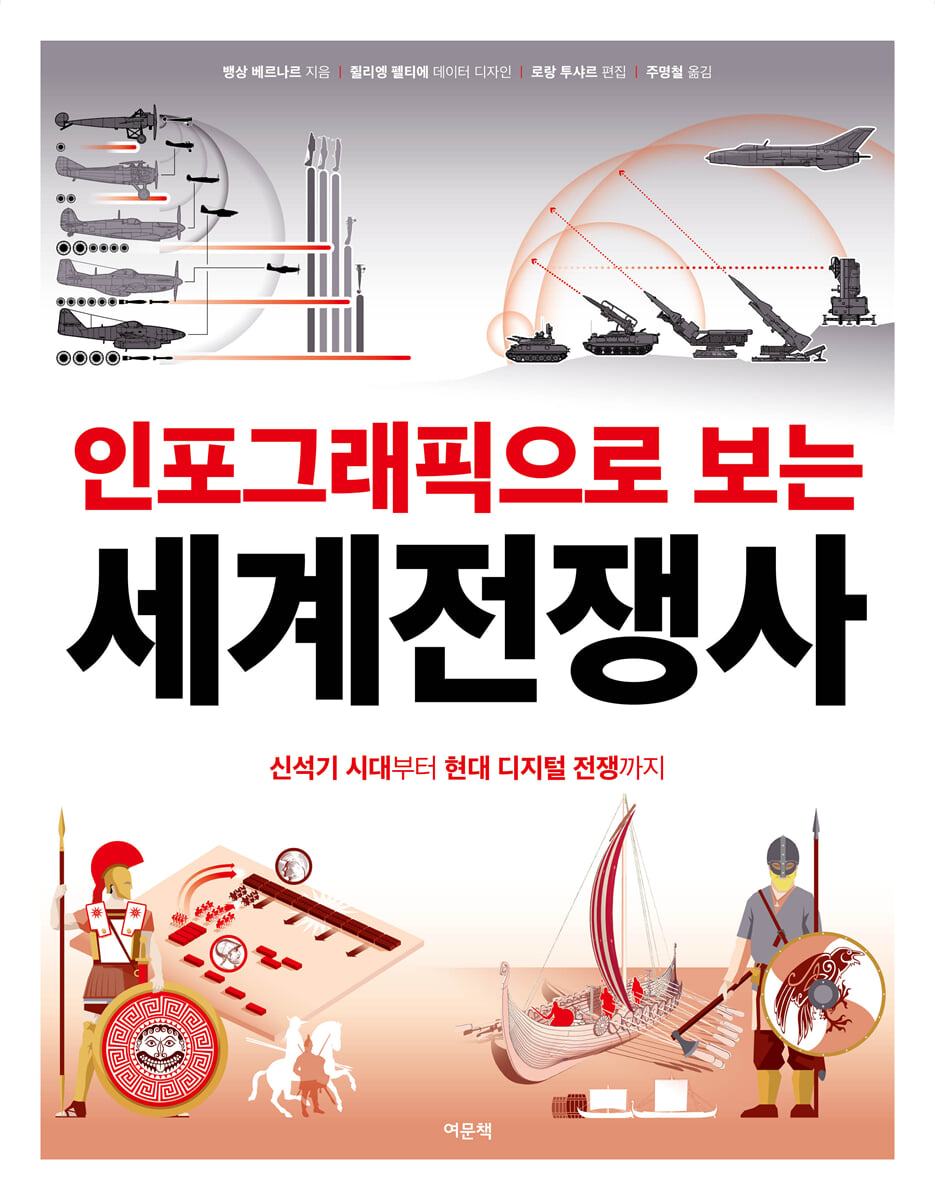 |
Description
Book Introduction
The nature and flow of war that has continued from time immemorial to the present
Get a bird's eye view with beautiful, concise infographics!
This book, which brilliantly covers the history of world wars from prehistoric times to the present day in infographic form, is a truly new challenge.
From the earliest stone tools and bone tools of the prehistoric era, through the first metal smelting, the advent of the wheel, the domestication of animals, the invention of gunpowder and the internal combustion engine, and on to modern digital technologies, the authors address all the major issues related to the phenomenon of war.
They raise key questions in each era.
What people and materials make up an army?
What are they fighting about?
What goals are they trying to achieve?
How many major breaks can you spot over the past 3,000 years?
How can war be prevented?
Is a world without war possible through legislation and regulation alone?
Thanks to the infographics that add depth to the narrative, the authors' responses create a comprehensive, engaging, and accessible picture of the war phenomenon in historical terms.
In this book, readers will not only get a three-dimensional view of Alexander the Great's conquests and the large-scale battles of the World Wars, but will also be able to grasp all the important elements of military history at a glance, without missing a single one, including the organization of the Athenian fleet at the Battle of Salamis, the career of the Mongol general Subutai, the composition of medieval spearmen, the equipment of the Aztec jaguar warriors, the Imjin War, Asia's "first world war," and even from the Roman legions to medieval chivalry, Napoleon's imperial epic, World Wars I and II, the Korean War, and the recent Russo-Ukrainian War.
In short, this 『World War History in Infographics』 is an essential book for understanding the nature and flow of war, which continues to reveal its horrors even in modern times.
Get a bird's eye view with beautiful, concise infographics!
This book, which brilliantly covers the history of world wars from prehistoric times to the present day in infographic form, is a truly new challenge.
From the earliest stone tools and bone tools of the prehistoric era, through the first metal smelting, the advent of the wheel, the domestication of animals, the invention of gunpowder and the internal combustion engine, and on to modern digital technologies, the authors address all the major issues related to the phenomenon of war.
They raise key questions in each era.
What people and materials make up an army?
What are they fighting about?
What goals are they trying to achieve?
How many major breaks can you spot over the past 3,000 years?
How can war be prevented?
Is a world without war possible through legislation and regulation alone?
Thanks to the infographics that add depth to the narrative, the authors' responses create a comprehensive, engaging, and accessible picture of the war phenomenon in historical terms.
In this book, readers will not only get a three-dimensional view of Alexander the Great's conquests and the large-scale battles of the World Wars, but will also be able to grasp all the important elements of military history at a glance, without missing a single one, including the organization of the Athenian fleet at the Battle of Salamis, the career of the Mongol general Subutai, the composition of medieval spearmen, the equipment of the Aztec jaguar warriors, the Imjin War, Asia's "first world war," and even from the Roman legions to medieval chivalry, Napoleon's imperial epic, World Wars I and II, the Korean War, and the recent Russo-Ukrainian War.
In short, this 『World War History in Infographics』 is an essential book for understanding the nature and flow of war, which continues to reveal its horrors even in modern times.
- You can preview some of the book's contents.
Preview
index
Part 1: From the Neolithic Age to the 5th Century: From Stone to Iron
1 War in the Primitive Age
The First Battles of Empires | The First Recorded Battles
2 Greek world
Hoplite Warfare | Macedonian Model
3 Worlds of Asia
The World of China: From the Warring States to a Unified Empire | Empires of India: Armed Giants
4 Roman Time
Rome, the Conquering City-State | From Pax Romana to a Besieged Empire
5 Waging Ancient War
Ranged Combat and Sieges | Naval Powers and Naval Warfare
Part 2 From the 5th to the 15th centuries: From iron to gunpowder
6 War in the Name of God
Islam and Its Expansion | The All-Round Crusades
7 Traveling Conquerors
The Northerners: Conquerors on a Long Journey | The Mongol Empire: Horsemen from the Steppes Conquer the World
8 Feudal Europe
The Age of Chivalry | The Great Return of the "Infantry"
9 Worlds of Warriors
Empires of Africa | Warrior Cultures of the Americas Before Columbus | From Arrows to Bullets
Part 3 From the 15th to the 19th Century: From Gunpowder to Steel
10 A Changing World
Gunpowder Empires | Europe Embarks on World Conquest | Asia Strikes Balance
11 Europe fighting each other
The Great Powers' Clash | Military Advancement or Military Revolution? | The Seven Years' War: The First World War
12 The Age of Revolution
The Great Century of Revolution | French Revolution, Empire, and the Grande D'Armee, 1792–1815 |
Britannia Rules the Seas: The British Empire Dominates the World's Oceans
Part 4 From the 19th Century to 1945: From Steel to Nuclear Reactors
13 The Age of Steam
Semi-Modern Warfare | The Age of Battleships: From Sail to Steam, from Wood to Steel
14 Colonization and Resistance
Colonization fever | Resistance against colonization
15 World War I
The Arms Race and the Road to War, 1880–1914
The era of trench warfare and large-scale battles, 1914–1917
Breaking through the front lines in 1917-1918
16 World War II
Blitzkrieg: Offensive Warfare and the "Mechanization of War" | From Biplanes to Jets: The Aviation Revolution, 1914–1945
Submarines and Aircraft Carriers: A Dual Revolution in 20th-Century Naval Power
The massive offensive and the 'Grand Coalition' of 1944-1945
Part 5: From 1945 to the Present: From the Atomic Bomb to Digital Warfare
17 The Cold War Era
Clash of Factions | Balance of Terror | Cold War: Another Arms Race
18 An Unstable World
West Asia: A Perpetual Powder Keg | Africa, the Battleground of Thousands of Wars
Asia's Dangers: From Rebellion to Proxy War
19 Advanced Technology and Deception
Cyber battlefield
Part 6: Constancy and Continuity: The Eternal War
20 War and the Army
Strategic Sustainability: What War Is It and How Will We Win It? | Organization and Command
Comrades in Arms: Tactical Units and Basic Units | Catastrophe
21 War and Resources
War and Human Resources | 'The Importance of Logistics': Military and Logistic Resources | Finance, the 'Heart of War'
22 War and Society
Women in War | Civil War: Leaving Deep Scars
Rear, wartime domestic support, irregular forces, militia, civilians
23 War and the Environment
Animals and War | Environmental Impact
24 War and Law
Youth ad bellum, youth in bello: Legislation and regulation to limit war
1 War in the Primitive Age
The First Battles of Empires | The First Recorded Battles
2 Greek world
Hoplite Warfare | Macedonian Model
3 Worlds of Asia
The World of China: From the Warring States to a Unified Empire | Empires of India: Armed Giants
4 Roman Time
Rome, the Conquering City-State | From Pax Romana to a Besieged Empire
5 Waging Ancient War
Ranged Combat and Sieges | Naval Powers and Naval Warfare
Part 2 From the 5th to the 15th centuries: From iron to gunpowder
6 War in the Name of God
Islam and Its Expansion | The All-Round Crusades
7 Traveling Conquerors
The Northerners: Conquerors on a Long Journey | The Mongol Empire: Horsemen from the Steppes Conquer the World
8 Feudal Europe
The Age of Chivalry | The Great Return of the "Infantry"
9 Worlds of Warriors
Empires of Africa | Warrior Cultures of the Americas Before Columbus | From Arrows to Bullets
Part 3 From the 15th to the 19th Century: From Gunpowder to Steel
10 A Changing World
Gunpowder Empires | Europe Embarks on World Conquest | Asia Strikes Balance
11 Europe fighting each other
The Great Powers' Clash | Military Advancement or Military Revolution? | The Seven Years' War: The First World War
12 The Age of Revolution
The Great Century of Revolution | French Revolution, Empire, and the Grande D'Armee, 1792–1815 |
Britannia Rules the Seas: The British Empire Dominates the World's Oceans
Part 4 From the 19th Century to 1945: From Steel to Nuclear Reactors
13 The Age of Steam
Semi-Modern Warfare | The Age of Battleships: From Sail to Steam, from Wood to Steel
14 Colonization and Resistance
Colonization fever | Resistance against colonization
15 World War I
The Arms Race and the Road to War, 1880–1914
The era of trench warfare and large-scale battles, 1914–1917
Breaking through the front lines in 1917-1918
16 World War II
Blitzkrieg: Offensive Warfare and the "Mechanization of War" | From Biplanes to Jets: The Aviation Revolution, 1914–1945
Submarines and Aircraft Carriers: A Dual Revolution in 20th-Century Naval Power
The massive offensive and the 'Grand Coalition' of 1944-1945
Part 5: From 1945 to the Present: From the Atomic Bomb to Digital Warfare
17 The Cold War Era
Clash of Factions | Balance of Terror | Cold War: Another Arms Race
18 An Unstable World
West Asia: A Perpetual Powder Keg | Africa, the Battleground of Thousands of Wars
Asia's Dangers: From Rebellion to Proxy War
19 Advanced Technology and Deception
Cyber battlefield
Part 6: Constancy and Continuity: The Eternal War
20 War and the Army
Strategic Sustainability: What War Is It and How Will We Win It? | Organization and Command
Comrades in Arms: Tactical Units and Basic Units | Catastrophe
21 War and Resources
War and Human Resources | 'The Importance of Logistics': Military and Logistic Resources | Finance, the 'Heart of War'
22 War and Society
Women in War | Civil War: Leaving Deep Scars
Rear, wartime domestic support, irregular forces, militia, civilians
23 War and the Environment
Animals and War | Environmental Impact
24 War and Law
Youth ad bellum, youth in bello: Legislation and regulation to limit war
Detailed image
.jpg)
Into the book
Although archaeology and literature reveal traces of very ancient warfare, military events are recorded only from the late 2nd millennium BC.
There is the Battle of Kadesh (c. 1274 BC*), in Syria in the 13th century BC, where the Egyptian Pharaoh Ramses II won a hard-fought victory over the Hittite king Muwatalli II; and thousands of kilometers away in China, the Battle of Muye (c. 1046 BC*), which saw the fall of the Shang Dynasty and the rise of the Zhou Dynasty (the Third Dynasty) in the 11th century.
This large-scale battle is the first in history to have been fully documented, allowing us to understand the circumstances and course of events and analyze the tactics employed.
What these battles, fought over such long distances, have in common is that the ancient chariot played a crucial role as a decisive weapon.
At that time, tanks were at their peak.
* There is still disagreement among scholars.
--- From "The First Recorded Battles"
The semi-barbaric kingdom of Macedon brought about a real revolution in hoplites during the reign of Philip II (359–336 BC).
Philip formed a specialized army combining powerful shock cavalry armed with spears with a phalanx of well-organized and well-trained infantry armed with long spears (sarissa).
At the Battle of Chaeronea in 338 BC, his elite forces defeated the Corinthian League of Greek city-states, excluding Sparta.
After Philip's death, his son Alexander the Great took over the grand plan to invade the Persian Empire in 334 BC.
In ten years, he defeated the armies of Darius III and established a vast Asian empire that stretched to the Indus River, founding dozens of cities that bore his name and giving birth to a new Greco-Persian culture.
Deified, he died in 323 BC at the age of 32 without naming a successor, and his generals, the Diadochi (successors), fought to take over the empire.
As a result, three great Hellenistic kingdoms remained in the 3rd century BC, occupying most of the eastern Mediterranean: the Lachideans (or Ptolemies) in Egypt, the Seleucids in Syria, and the Antigonids in Macedon.
Meanwhile, in the west, Roman power was growing stronger.
--- From the "Macedonian Model"
From its earliest days, Rome, influenced by the Etruscans and Greeks, relied on citizen-armed infantry as the basis of its military power.
The Servian reforms of the 6th century BC strictly classified and stratified society and the military.
Thus was born the manipular legion, arranged in three lines (triple archies).
It was a tactically very flexible organization and became the best army of its time.
However, to compensate for the weaknesses of the cavalry, it was necessary to gradually increase the number of auxiliary troops.
In the 3rd and 2nd centuries BC, Rome expanded beyond Italy, defeated Carthage, and conquered the Hellenistic powers of the eastern Mediterranean, completely replacing the Macedonian phalanx model.
The 'Marian Reforms' of the late 2nd century BC streamlined and unified the legions that had to fight in increasingly distant regions, and soon incorporated Italians and non-Italians into a 20-year service.
At the same time, military colonies proliferated.
As armies became more specialized, soldiers became more loyal to their generals than to Rome.
The last century of the Republic saw not only Caesar's conquest of Gaul (58–51 BC), but also an intensifying conflict between the Optimates (aristocrats) and the Populares (populars), and only after a large-scale civil war did the Empire emerge.
--- From "Rome, the Conquering City-State"
Between the 11th and 16th centuries, the Christian world united to a certain extent against all those identified as enemies of the Christian faith in the Near East, the Iberian Peninsula, and elsewhere.
In northeastern Europe, the idea of fighting for Christianity while occupying territory with rich economic potential also emerged.
Repeated expeditions, in which politics, economics, military, and religion were closely intertwined, incurred enormous costs and casualties, but they had a significant impact on shaping the borders and cultures we know today.
In the context of the Crusades, the famous religious orders of knights, the Knights Templar, were founded in 1129.
Over time, dozens of knightly orders emerged.
The early knights served to protect the Holy Land and pilgrims, but they gradually evolved into religious, political, and military entities with economic power.
--- From "The All-Round Crusades"
The stirrup probably originated in the Central Asian steppes, with the oldest remains dating back to the 1st century BC.
The lampstand was first identified in China in the 4th century, and reached Byzantium in the 6th century via or with the Avars.
Although heavily armored cavalry, the cataphractae, existed much earlier, the stirrup allowed cavalry to remain stable in all combat situations and to enhance their fighting power and impact when wielding spears, swords, maces, and even bows.
--- From "The Lighthouse: Evolution or Revolution?"
From the late Middle Ages to the mid-18th century, Europe underwent significant changes in all areas, including warfare, leading some historians (Geoffrey Parker) to propose the controversial concept of a 'military revolution'.
Improvements in firearms and the widespread use of the bayonet (France, 1703) led to the emergence of a more uniform and disciplined infantry, while spearmen, axemen, archers, and crossbowmen gradually disappeared.
These infantrymen fought in wide formations, using increasingly complex, sophisticated, and precise tactics and maneuvers.
“They valued shooting quickly rather than aiming accurately.
France, Prussia, and Britain all preferred to pour a near-constant stream of bullets onto the battlefield rather than shooting accurately.
What they were after was rapid, continuous firing.” (General Colin) War became a large-scale phenomenon with constantly increasing demands on men, money, and logistics.
--- From "Military Evolution or Military Revolution?"
In 1917, a military stalemate persisted, with both sides suffering heavy losses but no decisive results.
At this time, new tactics and new weapons, especially the tanks developed in Britain and France from 1915, appeared and changed the game.
The two Russian Revolutions of February and November 1917 upset the balance on the Eastern Front, and in the spring of 1918 the Central Powers took advantage of the local peace to divert troops to the Western Front.
Meanwhile, from the time the United States entered the war in April 1917, the Entente powers began to harbor hopes of regaining the initiative.
But it took time for the millions of American soldiers who crossed the Atlantic to be equipped and trained.
Germany used this time to launch a massive spring offensive in a last attempt to restart the war on the Western Front.
1918 again showed the nature of war on the move, and became the bloodiest and costliest year of the war since 1914.
But as summer approached, the weary Central Powers in France, Italy, Macedonia, and elsewhere surrendered one by one.
--- From "Breaking Through the Front Lines 1917-1918"
Who were the main victors of World War II? This question has been interpreted differently across countries and political situations for 80 years.
In fact, it is easy to say that this question has little meaning in the context of a true world war, and that the victory of 1945 was, above all, the result of an unprecedented coalition in history.
In particular, the Soviet Union and to some extent China formed the continental axis of the Grand Coalition, which, at great cost to itself, depleted most of the Axis forces.
But with the powerful support of the Commonwealth, the United States was able to operate across the Atlantic and Pacific with economic mobilization and unprecedented resources, thus becoming the 'world's only' superpower.
(Omitted) In May 1945, the Allied forces met in the heart of ruined Germany.
Months later, Japan, cornered, finally surrendered after the US atomic bombs on Hiroshima and Nagasaki, while Soviet forces invaded Manchuria.
On September 2, 1945, the greatest war in history finally came to an end.
--- From "The Great Offensive and the 'Grand Coalition' of 1944-1945"
On June 25, 1950, North Korea invaded South Korea with a well-organized armored force.
South Korea received support from the United States, while North Korea received support from its communist allies, including China and the Soviet Union.
After a series of defeats, South Korea and its numerous allies, gathered under the UN flag, halted the enemy's advance at Busan and regained the initiative with the Incheon Landing Operation on September 15, 1950.
As South Korea successfully counterattacked and approached the Chinese border, Beijing intervened.
The UN forces suffered heavy losses and were forced to retreat.
The front lines then stabilized to some extent, and the conflict ended on July 27, 1953, but a peace treaty was never signed.
So, South and North Korea are effectively still at war! In addition to the countries directly involved in the conflict, Denmark, India, Italy, Norway, and Sweden sent medical units consisting of several hundred personnel.
--- From "The Korean War, a Miniature World War"
The invasion of Ukraine on February 24, 2022, marked the beginning of the so-called high-intensity conflict.
The belligerents are making extensive use of a wide range of means and operational methods, and, as in all conflicts, are seeking to leverage all available technologies to ensure smooth operation.
As a result, the battlefield has expanded into cyberspace, thanks to digital technologies now readily accessible to everyone (including civilians caught in the middle of the fighting).
Strategically, information superiority has become a more powerful 'invisible' weapon than ever before.
Spreading fake news or disinformation to debunk enemy propaganda has become a crucial element of modern warfare.
Meanwhile, while units in the field often have a better understanding of enemy movements and better ways to respond, the digital age doesn't make war any less deadly.
--- From "Cyber Battlefield"
What is war? Why and how is war waged? How is it won? Ancient thinkers grappled deeply with these questions, but simple answers proved elusive.
In the mid-1st millennium BC, in China, Sun Tzu had already written his classic work, The Art of War.
This work contains the principles of 'indirect warfare' with a strong psychological element, and is considered one of the most important reference books in the world today, transcending the times.
(Omitted) Humanity has experienced two terrible events called world wars.
The phenomenon of 'war' remains a reality that modern society must face and a problem that must be constantly addressed.
--- From "Strategic Sustainability: What War Is It and How Will We Win It?"
War is not just a man's business.
It is a mistake to think that women only play a 'secondary' role in the rear.
Even in supporting roles, women are essential, and they play a vital role, as in the Spartan woman who encouraged her husband (and son) to fight to protect their home.
Moreover, women help the military function properly.
It is true that their support role (or role as a substitute for men in factories and farms) keeps them in the shadows.
But women are also fighters.
Like men, they also kill their enemies.
During World War I, some women disguised themselves as men and were in the trenches.
They can become leaders of armies, inspiring and directing their soldiers to victory or defeat, and sometimes driving them to sacrifice in glory or shame.
Women are as much a part of the war as men; they not only wage war but sometimes decide it.
--- From "Women in War"
The trials led by the Allied powers that won World War II became the de facto basis for international justice in relation to the war.
However, the fact that both sides avoided addressing the issue of civilian airstrikes and granted immunity to the Japanese emperor has become a source of controversy.
There is the Battle of Kadesh (c. 1274 BC*), in Syria in the 13th century BC, where the Egyptian Pharaoh Ramses II won a hard-fought victory over the Hittite king Muwatalli II; and thousands of kilometers away in China, the Battle of Muye (c. 1046 BC*), which saw the fall of the Shang Dynasty and the rise of the Zhou Dynasty (the Third Dynasty) in the 11th century.
This large-scale battle is the first in history to have been fully documented, allowing us to understand the circumstances and course of events and analyze the tactics employed.
What these battles, fought over such long distances, have in common is that the ancient chariot played a crucial role as a decisive weapon.
At that time, tanks were at their peak.
* There is still disagreement among scholars.
--- From "The First Recorded Battles"
The semi-barbaric kingdom of Macedon brought about a real revolution in hoplites during the reign of Philip II (359–336 BC).
Philip formed a specialized army combining powerful shock cavalry armed with spears with a phalanx of well-organized and well-trained infantry armed with long spears (sarissa).
At the Battle of Chaeronea in 338 BC, his elite forces defeated the Corinthian League of Greek city-states, excluding Sparta.
After Philip's death, his son Alexander the Great took over the grand plan to invade the Persian Empire in 334 BC.
In ten years, he defeated the armies of Darius III and established a vast Asian empire that stretched to the Indus River, founding dozens of cities that bore his name and giving birth to a new Greco-Persian culture.
Deified, he died in 323 BC at the age of 32 without naming a successor, and his generals, the Diadochi (successors), fought to take over the empire.
As a result, three great Hellenistic kingdoms remained in the 3rd century BC, occupying most of the eastern Mediterranean: the Lachideans (or Ptolemies) in Egypt, the Seleucids in Syria, and the Antigonids in Macedon.
Meanwhile, in the west, Roman power was growing stronger.
--- From the "Macedonian Model"
From its earliest days, Rome, influenced by the Etruscans and Greeks, relied on citizen-armed infantry as the basis of its military power.
The Servian reforms of the 6th century BC strictly classified and stratified society and the military.
Thus was born the manipular legion, arranged in three lines (triple archies).
It was a tactically very flexible organization and became the best army of its time.
However, to compensate for the weaknesses of the cavalry, it was necessary to gradually increase the number of auxiliary troops.
In the 3rd and 2nd centuries BC, Rome expanded beyond Italy, defeated Carthage, and conquered the Hellenistic powers of the eastern Mediterranean, completely replacing the Macedonian phalanx model.
The 'Marian Reforms' of the late 2nd century BC streamlined and unified the legions that had to fight in increasingly distant regions, and soon incorporated Italians and non-Italians into a 20-year service.
At the same time, military colonies proliferated.
As armies became more specialized, soldiers became more loyal to their generals than to Rome.
The last century of the Republic saw not only Caesar's conquest of Gaul (58–51 BC), but also an intensifying conflict between the Optimates (aristocrats) and the Populares (populars), and only after a large-scale civil war did the Empire emerge.
--- From "Rome, the Conquering City-State"
Between the 11th and 16th centuries, the Christian world united to a certain extent against all those identified as enemies of the Christian faith in the Near East, the Iberian Peninsula, and elsewhere.
In northeastern Europe, the idea of fighting for Christianity while occupying territory with rich economic potential also emerged.
Repeated expeditions, in which politics, economics, military, and religion were closely intertwined, incurred enormous costs and casualties, but they had a significant impact on shaping the borders and cultures we know today.
In the context of the Crusades, the famous religious orders of knights, the Knights Templar, were founded in 1129.
Over time, dozens of knightly orders emerged.
The early knights served to protect the Holy Land and pilgrims, but they gradually evolved into religious, political, and military entities with economic power.
--- From "The All-Round Crusades"
The stirrup probably originated in the Central Asian steppes, with the oldest remains dating back to the 1st century BC.
The lampstand was first identified in China in the 4th century, and reached Byzantium in the 6th century via or with the Avars.
Although heavily armored cavalry, the cataphractae, existed much earlier, the stirrup allowed cavalry to remain stable in all combat situations and to enhance their fighting power and impact when wielding spears, swords, maces, and even bows.
--- From "The Lighthouse: Evolution or Revolution?"
From the late Middle Ages to the mid-18th century, Europe underwent significant changes in all areas, including warfare, leading some historians (Geoffrey Parker) to propose the controversial concept of a 'military revolution'.
Improvements in firearms and the widespread use of the bayonet (France, 1703) led to the emergence of a more uniform and disciplined infantry, while spearmen, axemen, archers, and crossbowmen gradually disappeared.
These infantrymen fought in wide formations, using increasingly complex, sophisticated, and precise tactics and maneuvers.
“They valued shooting quickly rather than aiming accurately.
France, Prussia, and Britain all preferred to pour a near-constant stream of bullets onto the battlefield rather than shooting accurately.
What they were after was rapid, continuous firing.” (General Colin) War became a large-scale phenomenon with constantly increasing demands on men, money, and logistics.
--- From "Military Evolution or Military Revolution?"
In 1917, a military stalemate persisted, with both sides suffering heavy losses but no decisive results.
At this time, new tactics and new weapons, especially the tanks developed in Britain and France from 1915, appeared and changed the game.
The two Russian Revolutions of February and November 1917 upset the balance on the Eastern Front, and in the spring of 1918 the Central Powers took advantage of the local peace to divert troops to the Western Front.
Meanwhile, from the time the United States entered the war in April 1917, the Entente powers began to harbor hopes of regaining the initiative.
But it took time for the millions of American soldiers who crossed the Atlantic to be equipped and trained.
Germany used this time to launch a massive spring offensive in a last attempt to restart the war on the Western Front.
1918 again showed the nature of war on the move, and became the bloodiest and costliest year of the war since 1914.
But as summer approached, the weary Central Powers in France, Italy, Macedonia, and elsewhere surrendered one by one.
--- From "Breaking Through the Front Lines 1917-1918"
Who were the main victors of World War II? This question has been interpreted differently across countries and political situations for 80 years.
In fact, it is easy to say that this question has little meaning in the context of a true world war, and that the victory of 1945 was, above all, the result of an unprecedented coalition in history.
In particular, the Soviet Union and to some extent China formed the continental axis of the Grand Coalition, which, at great cost to itself, depleted most of the Axis forces.
But with the powerful support of the Commonwealth, the United States was able to operate across the Atlantic and Pacific with economic mobilization and unprecedented resources, thus becoming the 'world's only' superpower.
(Omitted) In May 1945, the Allied forces met in the heart of ruined Germany.
Months later, Japan, cornered, finally surrendered after the US atomic bombs on Hiroshima and Nagasaki, while Soviet forces invaded Manchuria.
On September 2, 1945, the greatest war in history finally came to an end.
--- From "The Great Offensive and the 'Grand Coalition' of 1944-1945"
On June 25, 1950, North Korea invaded South Korea with a well-organized armored force.
South Korea received support from the United States, while North Korea received support from its communist allies, including China and the Soviet Union.
After a series of defeats, South Korea and its numerous allies, gathered under the UN flag, halted the enemy's advance at Busan and regained the initiative with the Incheon Landing Operation on September 15, 1950.
As South Korea successfully counterattacked and approached the Chinese border, Beijing intervened.
The UN forces suffered heavy losses and were forced to retreat.
The front lines then stabilized to some extent, and the conflict ended on July 27, 1953, but a peace treaty was never signed.
So, South and North Korea are effectively still at war! In addition to the countries directly involved in the conflict, Denmark, India, Italy, Norway, and Sweden sent medical units consisting of several hundred personnel.
--- From "The Korean War, a Miniature World War"
The invasion of Ukraine on February 24, 2022, marked the beginning of the so-called high-intensity conflict.
The belligerents are making extensive use of a wide range of means and operational methods, and, as in all conflicts, are seeking to leverage all available technologies to ensure smooth operation.
As a result, the battlefield has expanded into cyberspace, thanks to digital technologies now readily accessible to everyone (including civilians caught in the middle of the fighting).
Strategically, information superiority has become a more powerful 'invisible' weapon than ever before.
Spreading fake news or disinformation to debunk enemy propaganda has become a crucial element of modern warfare.
Meanwhile, while units in the field often have a better understanding of enemy movements and better ways to respond, the digital age doesn't make war any less deadly.
--- From "Cyber Battlefield"
What is war? Why and how is war waged? How is it won? Ancient thinkers grappled deeply with these questions, but simple answers proved elusive.
In the mid-1st millennium BC, in China, Sun Tzu had already written his classic work, The Art of War.
This work contains the principles of 'indirect warfare' with a strong psychological element, and is considered one of the most important reference books in the world today, transcending the times.
(Omitted) Humanity has experienced two terrible events called world wars.
The phenomenon of 'war' remains a reality that modern society must face and a problem that must be constantly addressed.
--- From "Strategic Sustainability: What War Is It and How Will We Win It?"
War is not just a man's business.
It is a mistake to think that women only play a 'secondary' role in the rear.
Even in supporting roles, women are essential, and they play a vital role, as in the Spartan woman who encouraged her husband (and son) to fight to protect their home.
Moreover, women help the military function properly.
It is true that their support role (or role as a substitute for men in factories and farms) keeps them in the shadows.
But women are also fighters.
Like men, they also kill their enemies.
During World War I, some women disguised themselves as men and were in the trenches.
They can become leaders of armies, inspiring and directing their soldiers to victory or defeat, and sometimes driving them to sacrifice in glory or shame.
Women are as much a part of the war as men; they not only wage war but sometimes decide it.
--- From "Women in War"
The trials led by the Allied powers that won World War II became the de facto basis for international justice in relation to the war.
However, the fact that both sides avoided addressing the issue of civilian airstrikes and granted immunity to the Japanese emperor has become a source of controversy.
--- From "Nuremberg, Tokyo, and the Major Postwar Trials"
Publisher's Review
A comprehensive and essential visual resource on the theme of 'war', the greatest turning point in human history.
Humanity has been waging war since time immemorial, and even today, dangerous and brutal conflicts continue across the globe.
Is war truly the destiny of humanity? While it would be impossible to cover the entire history of war from its origins to the present in a single volume, the authors, who wrote, illustrated, and edited the book, have spent years engaged in intense discussion, deliberation, and consensus to present the historical overview of this extreme phenomenon as broadly and clearly as possible, resulting in a compelling infographic.
The authors present key moments in major wars from BC to the present, as well as the military systems, weapon systems, and key figures of each country, with colorful illustrations, maps, and timelines.
Although this book is from France, it stands out for its detailed coverage of major wars in both the East and the West, past and present, without being biased towards Europe or the West.
Another advantage is that it attempted to maintain historical objectivity and precision based on a very extensive bibliography.
Book structure
The book is divided into six parts, each chapter and its main topic representing a major turning point in the history of armed force, from the Stone Age with its use of stone and bone tools to the present-day advancements in digital technology.
Parts 1-3 cover the major 'periods' of classical history: ancient, medieval, and modern times, respectively, while Parts 4-5 focus primarily on the 19th and 20th centuries, a period of great change at all levels and in all spheres of society.
The final six parts address key issues related to the phenomenon of war from a long-term perspective, including economics, resource management, the sociology of combatants, causes and mortality rates, nature and the environment, and law.
This book covers a wide range of topics, from the earliest recorded battles, through the wars of Greece, Rome, the Qin Dynasty, India, Persia, and Islam, through the global expansion of the Mongol Empire, through the course of the Crusades, the armament of first-rate warships at Trafalgar, the financing of the American Civil War, wars and rebellions in the Middle East, Africa, and Asia, and even the large-scale introduction of digital technology into modern battlefields. This is made easy to understand thanks to excellent graphic design, including clear illustrations, maps, and timelines.
Understanding the history of war is a shortcut to preserving peace.
As introduced in this book, we have experienced many wars of great historical significance, such as the Mongol invasion, the Imjin War, and the Korean War, but we still live in an era of division.
The Russo-Ukrainian war, which began in 2022, remains far from over, with only occasional talks of a ceasefire, and ominous rumors of an imminent Chinese invasion of Taiwan have been circulating for years.
Recently, the tensions between nuclear-armed states India and Pakistan have become so tense that they have increased anxiety, but have now reached a dramatic ceasefire agreement.
The Palestinian-Israeli war, which has been going on for over a century, is a regular topic of international news.
It is an undeniable reality that there is not a single quiet day on earth.
So, is war an eternal task humanity must bear and endure until the end? After years of collaborative work, the authors reach the following conclusion.
What's the central idea behind all this? The persistent conflict between human groups, tribes, cities, empires, and nations, and therefore the need to maintain, organize, and perpetuate military ideology as an indispensable tool, even while there are good intentions to limit or eliminate these armed conflicts.
History teaches us this, and current events, unfortunately, are a constant reminder of it.
The doors of the temple of Janus are never completely closed.
All wars, large or small, including civil wars, proxy wars, guerrilla wars, territorial disputes, large-scale wars between nations, and world wars, cause enormous damage not only to the fighting parties but also to innocent civilians, animals, and nature.
Many countries are now in a very paradoxical situation where they must strengthen their military power, even if only to increase their deterrence of war.
Looking at the flow of war that has continued from the distant past to the present, we come to realize how important and noble a value 'peace' is.
This book is a valuable reference book on world history for students and adults alike, as it paradoxically demonstrates the values of peace and coexistence through the various aspects of war.
It is also very meaningful in that the parts of each chapter that are particularly interesting naturally lead to interest in related books, broadening the scope of one's reading.
Just as a simple, clear picture that catches the eye leaves a stronger impression on the mind than a hundred words, you will have a unique reading experience as you realize how meticulously each picture in this book was planned.
Humanity has been waging war since time immemorial, and even today, dangerous and brutal conflicts continue across the globe.
Is war truly the destiny of humanity? While it would be impossible to cover the entire history of war from its origins to the present in a single volume, the authors, who wrote, illustrated, and edited the book, have spent years engaged in intense discussion, deliberation, and consensus to present the historical overview of this extreme phenomenon as broadly and clearly as possible, resulting in a compelling infographic.
The authors present key moments in major wars from BC to the present, as well as the military systems, weapon systems, and key figures of each country, with colorful illustrations, maps, and timelines.
Although this book is from France, it stands out for its detailed coverage of major wars in both the East and the West, past and present, without being biased towards Europe or the West.
Another advantage is that it attempted to maintain historical objectivity and precision based on a very extensive bibliography.
Book structure
The book is divided into six parts, each chapter and its main topic representing a major turning point in the history of armed force, from the Stone Age with its use of stone and bone tools to the present-day advancements in digital technology.
Parts 1-3 cover the major 'periods' of classical history: ancient, medieval, and modern times, respectively, while Parts 4-5 focus primarily on the 19th and 20th centuries, a period of great change at all levels and in all spheres of society.
The final six parts address key issues related to the phenomenon of war from a long-term perspective, including economics, resource management, the sociology of combatants, causes and mortality rates, nature and the environment, and law.
This book covers a wide range of topics, from the earliest recorded battles, through the wars of Greece, Rome, the Qin Dynasty, India, Persia, and Islam, through the global expansion of the Mongol Empire, through the course of the Crusades, the armament of first-rate warships at Trafalgar, the financing of the American Civil War, wars and rebellions in the Middle East, Africa, and Asia, and even the large-scale introduction of digital technology into modern battlefields. This is made easy to understand thanks to excellent graphic design, including clear illustrations, maps, and timelines.
Understanding the history of war is a shortcut to preserving peace.
As introduced in this book, we have experienced many wars of great historical significance, such as the Mongol invasion, the Imjin War, and the Korean War, but we still live in an era of division.
The Russo-Ukrainian war, which began in 2022, remains far from over, with only occasional talks of a ceasefire, and ominous rumors of an imminent Chinese invasion of Taiwan have been circulating for years.
Recently, the tensions between nuclear-armed states India and Pakistan have become so tense that they have increased anxiety, but have now reached a dramatic ceasefire agreement.
The Palestinian-Israeli war, which has been going on for over a century, is a regular topic of international news.
It is an undeniable reality that there is not a single quiet day on earth.
So, is war an eternal task humanity must bear and endure until the end? After years of collaborative work, the authors reach the following conclusion.
What's the central idea behind all this? The persistent conflict between human groups, tribes, cities, empires, and nations, and therefore the need to maintain, organize, and perpetuate military ideology as an indispensable tool, even while there are good intentions to limit or eliminate these armed conflicts.
History teaches us this, and current events, unfortunately, are a constant reminder of it.
The doors of the temple of Janus are never completely closed.
All wars, large or small, including civil wars, proxy wars, guerrilla wars, territorial disputes, large-scale wars between nations, and world wars, cause enormous damage not only to the fighting parties but also to innocent civilians, animals, and nature.
Many countries are now in a very paradoxical situation where they must strengthen their military power, even if only to increase their deterrence of war.
Looking at the flow of war that has continued from the distant past to the present, we come to realize how important and noble a value 'peace' is.
This book is a valuable reference book on world history for students and adults alike, as it paradoxically demonstrates the values of peace and coexistence through the various aspects of war.
It is also very meaningful in that the parts of each chapter that are particularly interesting naturally lead to interest in related books, broadening the scope of one's reading.
Just as a simple, clear picture that catches the eye leaves a stronger impression on the mind than a hundred words, you will have a unique reading experience as you realize how meticulously each picture in this book was planned.
GOODS SPECIFICS
- Date of issue: June 2, 2025
- Format: Guide to book binding methods for four-sided binding
- Page count, weight, size: 144 pages | 940g | 232*296*17mm
- ISBN13: 9791187700951
You may also like
카테고리
korean


korean

![GQ KOREA Mark (Monthly): December [2025]](http://librairie.coreenne.fr/cdn/shop/files/8ef265dbbfbf186523ed75ba7319009d.jpg?v=1765340328&width=3840)


