

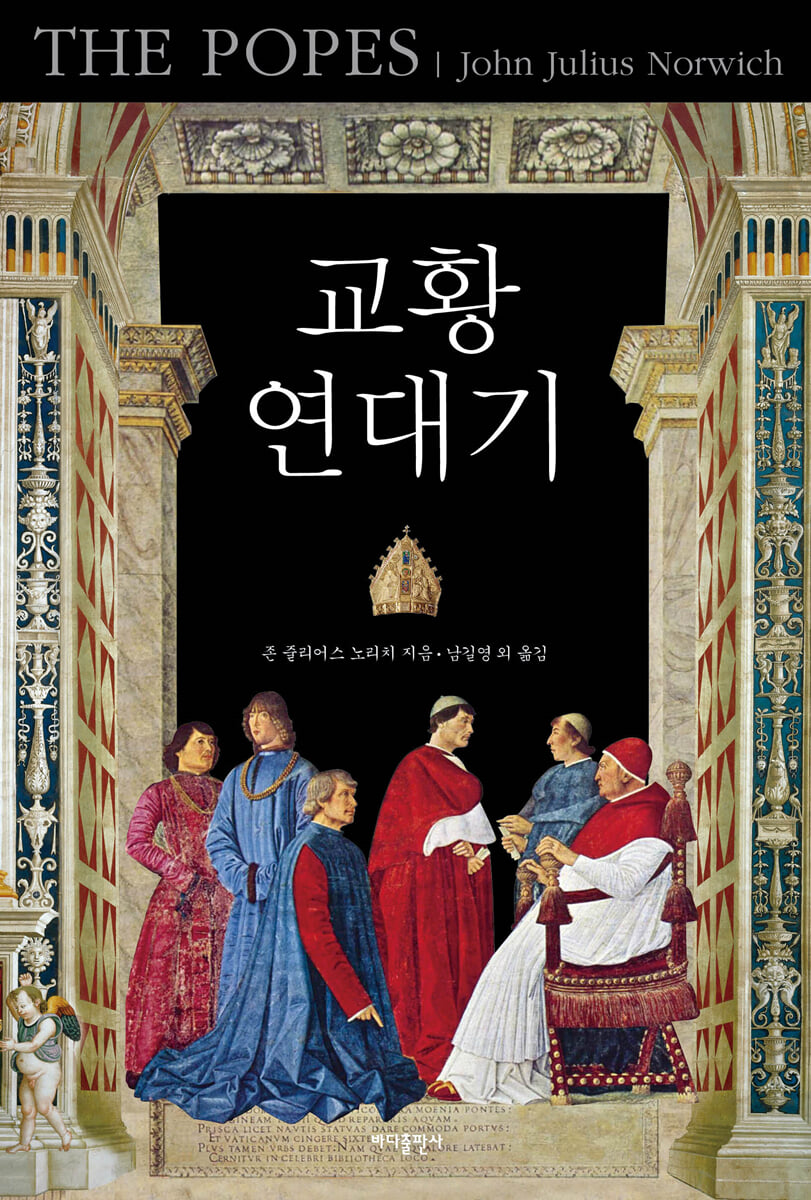
The Chronicles of the Popes (Academy Edition)
 |
Description
Book Introduction
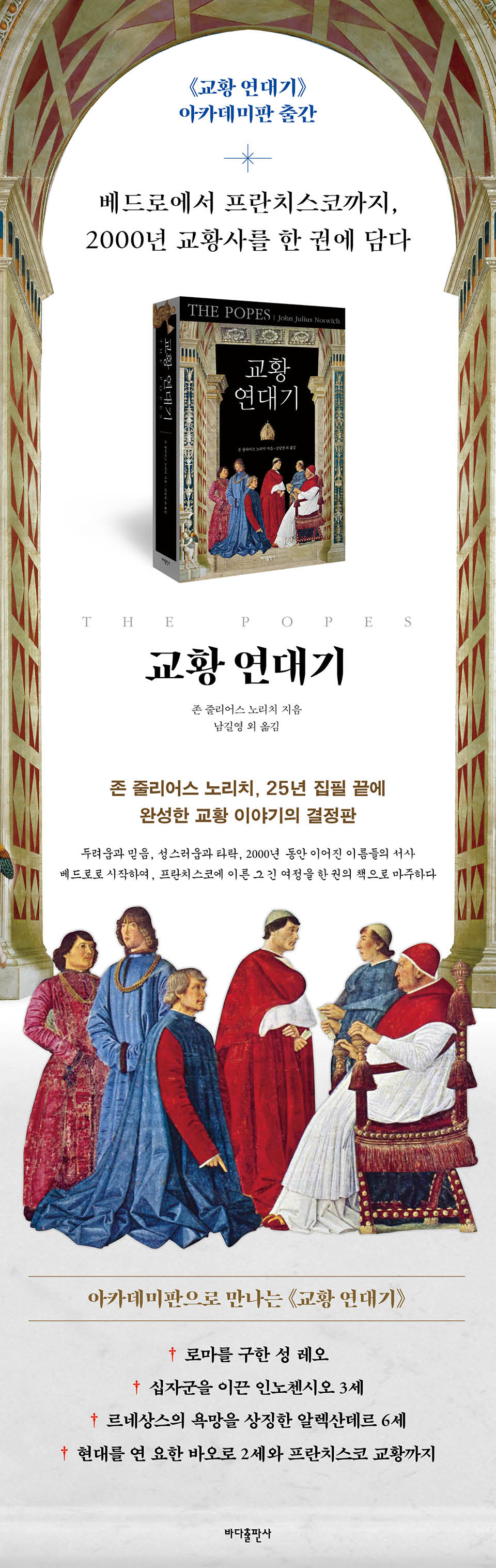
From Peter to Francis,
The Unvarnished Faces of Popes Revealed by 'History's Indiana Jones'
The Catholic Pope is the oldest monarch in human history, having lasted for 2,000 years.
Although he is still revered as a spiritual leader who has a great influence on the lives of people around the world, he was also a secular leader who left a significant mark on European history since the ancient Roman Empire.
But among the 280 or so popes who have come and gone, there were some who were undoubtedly saints, and others who struggled in unimaginable cruelty and sin.
British author John Julius Norwich, known as the 'Indiana Jones of history', provides a glimpse into their activities.
From the assertion of orthodox authority to the heresy controversy, the conflict with the Holy Roman Empire, and the establishment of the Vatican City State, the history of the Popes was viewed with a flexible yet balanced attitude, as if riding a skateboard.
The Unvarnished Faces of Popes Revealed by 'History's Indiana Jones'
The Catholic Pope is the oldest monarch in human history, having lasted for 2,000 years.
Although he is still revered as a spiritual leader who has a great influence on the lives of people around the world, he was also a secular leader who left a significant mark on European history since the ancient Roman Empire.
But among the 280 or so popes who have come and gone, there were some who were undoubtedly saints, and others who struggled in unimaginable cruelty and sin.
British author John Julius Norwich, known as the 'Indiana Jones of history', provides a glimpse into their activities.
From the assertion of orthodox authority to the heresy controversy, the conflict with the Holy Roman Empire, and the establishment of the Vatican City State, the history of the Popes was viewed with a flexible yet balanced attitude, as if riding a skateboard.
- You can preview some of the book's contents.
Preview
index
Map of Italy · Papal Chronology
Preface 18
Chapter 1: Saint Peter (1-100)
Chapter 2: Guardians of the City (100-536)
Chapter 3: Vigilius (537–555)
Chapter 4 Gregory I the Great (590–604)
Chapter 5: Leo III and Charlemagne (622–816)
Chapter 6: Pope Joan (855?–857)
Chapter 7: Nicholas I and the Prostitutes (855–964)
Chapter 8: The Division of Sects (964–1054)
Chapter 9: Gregory VII and the Normans (1055–1085)
Chapter 10: Innocent II and Anacletus II (1086–1138)
Chapter 11: The English Pope (1154–1159)
Chapter 12: Alexander III and Frederick Barbarossa (1159–1198)
Chapter 13: Pope Innocent III (1198–1216)
Chapter 14: The Fall of the Hohenstaufen Dynasty (1216–1303)
Chapter 15: Avignon (1309–1367, 1370–1376)
Chapter 16: Rejoice, O Heaven! (1378-1447)
Chapter 17: Renaissance (1447–1492)
Chapter 18: Monsters (1492–1513)
Chapter 19: Two Medici Men (1513–1534)
Chapter 20: The Counter-Reformation (1534–1605)
Chapter 21: Rome in the Baroque Era (1605–1700)
Chapter 22: The Age of Reason (1700–1748)
Chapter 23: The Jesuits and the Revolution (1750–1799)
Chapter 24: Progress and Reaction (1799–1846)
Chapter 25: Pius IX (1846–1878)
Chapter 26: Leo XIII and World War I (1878–1922)
Chapter 27: Pius XI and Pius XII (1922–1958)
Chapter 28: The Second Vatican Council and Aftermath (1958–Present)
Korean version review 854
References · Index
Preface 18
Chapter 1: Saint Peter (1-100)
Chapter 2: Guardians of the City (100-536)
Chapter 3: Vigilius (537–555)
Chapter 4 Gregory I the Great (590–604)
Chapter 5: Leo III and Charlemagne (622–816)
Chapter 6: Pope Joan (855?–857)
Chapter 7: Nicholas I and the Prostitutes (855–964)
Chapter 8: The Division of Sects (964–1054)
Chapter 9: Gregory VII and the Normans (1055–1085)
Chapter 10: Innocent II and Anacletus II (1086–1138)
Chapter 11: The English Pope (1154–1159)
Chapter 12: Alexander III and Frederick Barbarossa (1159–1198)
Chapter 13: Pope Innocent III (1198–1216)
Chapter 14: The Fall of the Hohenstaufen Dynasty (1216–1303)
Chapter 15: Avignon (1309–1367, 1370–1376)
Chapter 16: Rejoice, O Heaven! (1378-1447)
Chapter 17: Renaissance (1447–1492)
Chapter 18: Monsters (1492–1513)
Chapter 19: Two Medici Men (1513–1534)
Chapter 20: The Counter-Reformation (1534–1605)
Chapter 21: Rome in the Baroque Era (1605–1700)
Chapter 22: The Age of Reason (1700–1748)
Chapter 23: The Jesuits and the Revolution (1750–1799)
Chapter 24: Progress and Reaction (1799–1846)
Chapter 25: Pius IX (1846–1878)
Chapter 26: Leo XIII and World War I (1878–1922)
Chapter 27: Pius XI and Pius XII (1922–1958)
Chapter 28: The Second Vatican Council and Aftermath (1958–Present)
Korean version review 854
References · Index
Detailed image
Into the book
The power struggle between the Pope and the Emperor that lasted 1,500 years
At first, Hadrian IV rode with a dignified bearing to the emperor's camp, escorted by a party of barons sent by Frederick I to welcome him.
But soon problems arose.
Traditionally, it was the king who led the horse the Pope rode on, putting the bridle on it, and holding the stirrup when the Pope got off the horse.
But Frederick I did not do that.
As he dismounted, Hadrian IV seemed to hesitate for a moment, but then dismounted on his own, walked slowly to the seat prepared for him, and sat down.
Only then did Frederick I step forward, kiss the Pope's feet, and rise to receive the traditional kiss of peace from the Pope in return.
This time the Pope has set the tone.
Frederick I had clearly rejected the rites offered by his predecessors to the Pope, the highest authority, and until this was rectified, there could be no kiss of peace from the Pope.
Frederick I objected, saying that acting as a bridesmaid was not part of his duties.
But Hadrian IV was not at all shaken.
He knew that the seemingly trivial diplomatic formalities concealed something more important in reality.
It was a public display of a defiant attitude that fundamentally damaged the relationship between the Emperor and the Pope.
Surprisingly, Frederick I surrendered.
He ordered his barracks to be moved further south, and on the morning of June 11th he repeated the ceremonial rites he had failed to properly perform two days before.
Frederick I welcomed the Pope on horseback, bridled his horse, and held the Pope's stirrup tightly when he dismounted.
After Hadrian IV sat on the restored papal throne and gave the proper kiss of peace, the conversation began.
---From "Chapter 11: The Pope from England"
Pope vs. Pope: Who is More Legitimate?
Western Christianity now faces a dilemma unprecedented in its history.
The problem of antipopes was nothing new, as there had been such problems before, but the current situation is that both contenders were elected by the same cardinals.
The election of Urban VI was undoubtedly a legitimate process, but no one took his dethronement petition seriously. On the other hand, the method by which he was deposed was unprecedented.
Because no one has ever been deposed by the people who elected him as Pope.
Urban VI began to show mental problems, and the European continent was divided.
England, Germany, northern and central Italy, and central Europe remained loyal to Urban VI, while Scotland, France, Savoy, Burgundy, and Naples recognized the authority of Clement VII, and after long hesitation, Aragon and Castile also sided with Clement VII.
The Church managed to survive even when the papacy was exiled to Avignon, but the situation of two popes, one in Avignon and the other in Rome, was truly difficult to deal with.
The existence of two popes meant the existence of two colleges of cardinals and two ecclesiastical assemblies, which meant that each diocese or monastery would have two heads and thus twice as many expenses.
From a financial standpoint, Clement VII, who was staying in Avignon, had the advantage, since the department in charge of finances had not been completely transferred to Rome.
Clement VII decorated the Papal Palace with great luxury and pomp, as if to compete with his namesake, the extravagant Pope Clement VI, and from there he continued his fight against his rival, Urban VI.
In contrast, the people around Urban VI were very busy.
His nearest enemy was Queen Joanna of Naples, who boldly supported Clement VII.
Of course, she soon paid the price she deserved.
Urban VI excommunicated her in 1380 and gave her crown to her cousin, Charles the Younger of Durazzo.
The following year, Charles entered Naples and imprisoned Giovanna in the castle of Muro, where he soon suffocated her to death.
---From "Chapter 16, Heaven, Rejoice!"
The Pazzi family's conspiracy that stained Florence with blood
How far did the Pope intervene?
As relations between the two families deteriorated, a conspiracy was hatched, and on April 26, 1478, under the orders of Archbishop Salviati and Francesco de' Pazzi, the scheme was put into action.
During a solemn mass in Florence Cathedral, at the pre-planned moment—the moment when the Eucharist was to be received—assassins, including Francesco, attacked Lorenzo's brother Giuliano Medici, stabbing him in the chest and back more than a dozen times—witnesses say nineteen times.
The next moment, the assassins rushed at Lorenzo.
He drew his dagger and confronted them, then leaped towards the choir and fled to the sacristy.
Although he was seriously injured, he survived, but Giuliano lost his life.
Immediately an armed uprising broke out throughout Florence.
Those involved in the conspiracy were quickly identified and no mercy was shown to them.
Instead of using the execution grounds outside the eastern walls, Lorenzo chose a different method of punishment, making one punishment a hundred.
Jacopo Bracciolini, son of the great humanist Poggio, was hanged from a high window overlooking the Piazza della Signoria, and Francesco de' Pazzi, the archbishop, and his brother Jacopo Salviati, who met the same fate, were hanged from the top window of the Loggia dei Lanzi [a gallery in the Piazza della Signoria in Florence, Italy].
Angelo Poliziano, a humanist, classical scholar, and disciple of Lorenzo de' Medici, wrote:
'I presume the dying archbishop suddenly had a fit and bit Francis, who was hanging next to him, so cruelly that the mark of his clenched teeth remained on Francis's chest long after he died.'
Was Sixtus IV really involved in the Pazzi conspiracy? He undoubtedly knew the full story and likely actively encouraged it.
Because he was the one who wanted the Medici family to be ousted more than anyone else.
He is said to have said that there should be no bloodshed, but it is puzzling how a conspiracy that had been plotting the assassination from the beginning could have hoped for no bloodshed.
Sixtus IV took out the card he always used as a means of intimidation and excommunicated the Medici family and placed an interdict on all of Florence, and Italy was once again enveloped in the clouds of war.
The Pazzi coup ended in failure, but if Lorenzo of Medici had been a little less fortunate and had fallen to the Pazzi sword like his brother, and thus the Pazzi plot had succeeded, the Florentine government would have changed drastically, and Sixtus IV, more than anyone else, would have welcomed such a change.
---From "Chapter 17: Renaissance"
The Pope who lived with the government and the son who became an outlaw with the Pope's back
With the return of the thorn in his side, Charles VIII, to France, Alexander VI was free to pursue his main task of strengthening his family's position.
His eldest son, Giovanni, who had already achieved the title of lord of Gandia, was destined to wear the crown of Naples.
However, this ambition was dashed when Giovanni disappeared in June 1497.
Giovanni's body was found in the Tiber River two days later.
He suffered a deep wound to his neck, with more than nine stab wounds.
Who could have killed him? At the time, Giovanni was only twenty years old, but his violent and unstable temper and his bad habit of preying on married women had made him many enemies.
The most suspicious person was his younger brother Cesare.
According to rumors, it is unknown whether it was Sancia, the wife of his younger brother Hope, who was their sister-in-law, or Lucrezia, the younger sister, but in any case, the two were said to have competed over the same woman.
Cesare was a man capable of killing his own brothers.
Three years later, he almost killed his sister's second husband and his own brother-in-law, Alfonso of Aragon, and his jealousy of his eldest brother, Giovanni, was well known.
The death of his favorite son left Alexander VI heartbroken (it is said he was deprived of food or water for three days).
But on the other hand, it is curious that the Pope seems to have been relieved that no one was ever formally prosecuted, let alone convicted, for this crime.
If Cesare had truly been upright, shouldn't he have shaken up the entire country to find the person who killed his brother?
---From "Chapter 18 Monsters"
The ascetic pope who turned Rome into a monastery
Pius V (1566-1572)? Some wonder why he did not use the papal name 'Paul'? He was a striking resemblance to Pope Paul IV.
Even after becoming Pope, he kept his hair short, wore the garb of a Dominican monk under his papal vestments, and regularly walked barefoot during penitential processions. He was quite ascetic and expected the same ascetic life from those around him.
Among all the edicts issued, he sought to eradicate blasphemy, imposed heavy fines on the rich and flogged the poor, and ensured the proper observance of holidays and fasting.
Believers who have not gone to confession or have not recently received the Eucharist were not even allowed to see a doctor.
Sexuality has always been a headache.
Realizing that he could not completely abolish prostitution itself, the Pope issued a decree stating that all unmarried prostitutes would be flogged and those found guilty of sodomy would be burned at the stake.
It was difficult to persuade people not to apply the death penalty for adultery.
Therefore, single men were forbidden from hiring women as servants, and nuns were not allowed to keep male dogs.
Among the Vatican's collections, female sculptures were locked away.
The figures in Michelangelo's Last Judgment in the Sistine Chapel were also repainted to appear pure.
After a few months, the citizens of Rome began to complain that Pius V was turning the entire city into a giant monastery.
---From "Chapter 20: Counter-Reformation"
Julius III, who died from indulgence and gluttony
As always, after much intrigue and slander, the French and Italians eventually agreed to a relatively insignificant candidate, albeit against the Emperor's wishes.
His name was Giovanni Maria Giochi del Monte, known as Pope Julius III (1550–1555), a capable canon lawyer who had suffered greatly during the sack of Rome 25 years earlier and who had served as co-president of the Council of Trent.
He was better known for being seduced by a 17-year-old boy named Innocent.
It is said that the boy was brought from the streets of Parma two years ago, and immediately after the coronation ceremony, he was placed on the cardinal's seat.
Julius III began his ministry as Pope.
Now we see once again a typical Renaissance style pope.
He was shamelessly indulgent and did not hesitate to promote his relatives, and the banquets he hosted—which were widely talked about in Rome—always degenerated into gay orgies after the main guests had finished their meals and left.
Pope Julius III spent a fortune on his villa in the suburban town of Villa Giulia—now a city that houses the National Etruscan Museum—and was quite captivated by Michelangelo's work in St. Peter's Basilica.
He employed Palestinians as choirmasters and orchestra conductors for his chapel.
Somewhat surprisingly, he had a fairly firm belief in the need for church reform. He encouraged the Jesuits and did his best to ensure that the Council of Trent proceeded as planned. He was quite pleased when Mary I ascended to the throne and returned England to the Catholic fold.
But there is no doubt that his main interest was the pursuit of pleasure.
Among his many known vices, his gluttony was well known.
Perhaps it was a foregone conclusion, but it was gluttony that brought about his demise.
He died on March 23, 1555, when his digestive system suddenly stopped functioning, apparently from starvation due to an inability to swallow food.
---From "Chapter 20: Counter-Reformation"
“The Pope is the monarch of Rome, but I am the emperor of Rome.”
A year after his accession to the throne, Napoleon won a victory at Austerlitz in Moravia with an army of 68,000 men against a combined Austro-Russian army of 90,000 men.
On the day after Christmas in 1805, the Treaty of Pressburg (now Bratislava) was signed, which forced Austria to return Venice to France, which it had acquired in the Treaty of Campo Formio in 1797, and established Napoleon's new Kingdom of Italy along the Istrian and Dalmatian coasts.
But for Napoleon, all this was just the beginning.
He decided to take over the entire Italian peninsula.
He annexed Ancona, a Papal port, without a declaration of war, which enraged the Pope.
A 40,000-man army under Marshal André Masséna advanced into the Papal States in southern Italy.
Joseph Bonaparte also accompanied them as the Emperor's personal representative.
When the Pope protested sharply, Napoleon responded harshly.
'His Holiness must respect me in matters of the secular world.
Just like I am in the spiritual world.
'The Pope is the Monarch of Rome, but I am the Emperor of Rome.'
---From "Chapter 24 Progress and Reaction"
Pope Leo XIII, respected and admired but not loved
Leo XIII was respected and admired worldwide, but he was not loved.
No secular monarch has ever been more formal in everything he does.
Leo XIII insisted that all visitors remain kneeling during the entire audience.
The attendants were obliged to remain standing by his side.
It is said that he never once said a word to his coachman in 25 years.
So it is understandable that the cardinals wanted change after Leo XIII's death.
And they got the change.
Giuseppe Sarto, who took the papal name Pius X (1903–1914), came from a poor family (the first since Sixtus V more than three centuries earlier) and was the son of a village postman and tailor in Veneto.
After eight years as a parish priest, he later became Bishop of Mantua and Archbishop of Venice, but he remained essentially a parish priest, personally teaching the catechism every Sunday afternoon even during his papacy.
There was nothing in Pius X that resembled his predecessor's majestic and strict, or his indifferent and cold demeanor.
He was a warm and approachable pope who valued reality over theory.
---From “Chapter 26: Leo XIII and World War I”
Pope Pius XII remained silent despite Nazi atrocities
That was all.
This time, there was no mention of Jews, Nazis, or even Germany.
By cleverly adding the phrase “sometimes,” the ethnic element underlying the massacre was blurred.
By Christmas 1942, the number of victims, which had been in the millions, had quietly decreased to 'hundreds of thousands'.
Mussolini heard this broadcast and said to Ciano:
'Just some platitudes that would have been better said by the parish priest of Predappio.' Until then, Jews in Italy had been fortunate compared to other Central European countries.
The 8,000 or so Jewish communities in Rome were furious with the spineless Pope, but most were safe as long as Mussolini remained in power.
Although Mussolini enacted several anti-Semitic laws, they had little effect.
Then, in July 1943, the situation changed completely.
The Allies invaded Sicily, bombed Rome, and Mussolini was arrested.
Almost two years later, on April 29, 1945, Mussolini and Claretta Petacci were summarily executed, their bodies left hanging from the roof of a garage.
On September 11, Rome fell to German hands and General Albert Kesselring declared martial law.
On October 18, Hitler's SS issued an order to arrest Jews.
---From "Chapter 27: Pius XI and Pius XII"
The never-ending controversy: Is it murder or not?
Was John Paul I murdered? There were certainly reasons to believe so.
For 67 years old, he was in excellent health.
There was no autopsy or autopsy.
The Vatican was clearly at a loss and was caught repeatedly telling minor lies about how he died and how his body was found.
And if, as many believe, he was about to expose the massive financial scandal deeply implicated in the Vatican Bank and its president, Archbishop Paul Marcinkus, there were at least three international criminals who would have stopped at nothing to prevent it.
One of them, Roberto Calvi of the Ambrosiano Bank, was later found hanged under Blackfriars Bridge in London.
Furthermore, the Vatican is a place where murder is easy.
It is an independent country without its own police force, and Italian police can only enter when requested, which was not the case at the time.
---From “Chapter 28: The Second Vatican Council and Aftermath”
John Paul II forgave his assassin even after facing death.
Late in the afternoon of May 13, 1981, as the Pope was riding in his papal motorcade through St. Peter's Square during a general audience, a Turkish assassin named Ali Azar fired three shots at him in the face.
John Paul II was rushed to the Gemelli Hospital.
Aja was arrested on the spot and later told the magistrate during questioning that he was a "nationalist atheist" who hated not only the Catholic Church but also American and Russian imperialism.
Azza added that he had planned the assassination during the Pope's visit to Turkey in November 1979, but that his target was overly well-protected.
The Bulgarian government was heavily suspected of being Aza's money-making power, but its authenticity has not been confirmed.
Pope John Paul II, who had recovered his health, announced that he would forgive the attempted assassin.
In 1983, the Pope visited Aza in prison, and something akin to friendship developed between the two.
In his later years, the Pope also received audiences with Aja's mother and brother.
At first, Hadrian IV rode with a dignified bearing to the emperor's camp, escorted by a party of barons sent by Frederick I to welcome him.
But soon problems arose.
Traditionally, it was the king who led the horse the Pope rode on, putting the bridle on it, and holding the stirrup when the Pope got off the horse.
But Frederick I did not do that.
As he dismounted, Hadrian IV seemed to hesitate for a moment, but then dismounted on his own, walked slowly to the seat prepared for him, and sat down.
Only then did Frederick I step forward, kiss the Pope's feet, and rise to receive the traditional kiss of peace from the Pope in return.
This time the Pope has set the tone.
Frederick I had clearly rejected the rites offered by his predecessors to the Pope, the highest authority, and until this was rectified, there could be no kiss of peace from the Pope.
Frederick I objected, saying that acting as a bridesmaid was not part of his duties.
But Hadrian IV was not at all shaken.
He knew that the seemingly trivial diplomatic formalities concealed something more important in reality.
It was a public display of a defiant attitude that fundamentally damaged the relationship between the Emperor and the Pope.
Surprisingly, Frederick I surrendered.
He ordered his barracks to be moved further south, and on the morning of June 11th he repeated the ceremonial rites he had failed to properly perform two days before.
Frederick I welcomed the Pope on horseback, bridled his horse, and held the Pope's stirrup tightly when he dismounted.
After Hadrian IV sat on the restored papal throne and gave the proper kiss of peace, the conversation began.
---From "Chapter 11: The Pope from England"
Pope vs. Pope: Who is More Legitimate?
Western Christianity now faces a dilemma unprecedented in its history.
The problem of antipopes was nothing new, as there had been such problems before, but the current situation is that both contenders were elected by the same cardinals.
The election of Urban VI was undoubtedly a legitimate process, but no one took his dethronement petition seriously. On the other hand, the method by which he was deposed was unprecedented.
Because no one has ever been deposed by the people who elected him as Pope.
Urban VI began to show mental problems, and the European continent was divided.
England, Germany, northern and central Italy, and central Europe remained loyal to Urban VI, while Scotland, France, Savoy, Burgundy, and Naples recognized the authority of Clement VII, and after long hesitation, Aragon and Castile also sided with Clement VII.
The Church managed to survive even when the papacy was exiled to Avignon, but the situation of two popes, one in Avignon and the other in Rome, was truly difficult to deal with.
The existence of two popes meant the existence of two colleges of cardinals and two ecclesiastical assemblies, which meant that each diocese or monastery would have two heads and thus twice as many expenses.
From a financial standpoint, Clement VII, who was staying in Avignon, had the advantage, since the department in charge of finances had not been completely transferred to Rome.
Clement VII decorated the Papal Palace with great luxury and pomp, as if to compete with his namesake, the extravagant Pope Clement VI, and from there he continued his fight against his rival, Urban VI.
In contrast, the people around Urban VI were very busy.
His nearest enemy was Queen Joanna of Naples, who boldly supported Clement VII.
Of course, she soon paid the price she deserved.
Urban VI excommunicated her in 1380 and gave her crown to her cousin, Charles the Younger of Durazzo.
The following year, Charles entered Naples and imprisoned Giovanna in the castle of Muro, where he soon suffocated her to death.
---From "Chapter 16, Heaven, Rejoice!"
The Pazzi family's conspiracy that stained Florence with blood
How far did the Pope intervene?
As relations between the two families deteriorated, a conspiracy was hatched, and on April 26, 1478, under the orders of Archbishop Salviati and Francesco de' Pazzi, the scheme was put into action.
During a solemn mass in Florence Cathedral, at the pre-planned moment—the moment when the Eucharist was to be received—assassins, including Francesco, attacked Lorenzo's brother Giuliano Medici, stabbing him in the chest and back more than a dozen times—witnesses say nineteen times.
The next moment, the assassins rushed at Lorenzo.
He drew his dagger and confronted them, then leaped towards the choir and fled to the sacristy.
Although he was seriously injured, he survived, but Giuliano lost his life.
Immediately an armed uprising broke out throughout Florence.
Those involved in the conspiracy were quickly identified and no mercy was shown to them.
Instead of using the execution grounds outside the eastern walls, Lorenzo chose a different method of punishment, making one punishment a hundred.
Jacopo Bracciolini, son of the great humanist Poggio, was hanged from a high window overlooking the Piazza della Signoria, and Francesco de' Pazzi, the archbishop, and his brother Jacopo Salviati, who met the same fate, were hanged from the top window of the Loggia dei Lanzi [a gallery in the Piazza della Signoria in Florence, Italy].
Angelo Poliziano, a humanist, classical scholar, and disciple of Lorenzo de' Medici, wrote:
'I presume the dying archbishop suddenly had a fit and bit Francis, who was hanging next to him, so cruelly that the mark of his clenched teeth remained on Francis's chest long after he died.'
Was Sixtus IV really involved in the Pazzi conspiracy? He undoubtedly knew the full story and likely actively encouraged it.
Because he was the one who wanted the Medici family to be ousted more than anyone else.
He is said to have said that there should be no bloodshed, but it is puzzling how a conspiracy that had been plotting the assassination from the beginning could have hoped for no bloodshed.
Sixtus IV took out the card he always used as a means of intimidation and excommunicated the Medici family and placed an interdict on all of Florence, and Italy was once again enveloped in the clouds of war.
The Pazzi coup ended in failure, but if Lorenzo of Medici had been a little less fortunate and had fallen to the Pazzi sword like his brother, and thus the Pazzi plot had succeeded, the Florentine government would have changed drastically, and Sixtus IV, more than anyone else, would have welcomed such a change.
---From "Chapter 17: Renaissance"
The Pope who lived with the government and the son who became an outlaw with the Pope's back
With the return of the thorn in his side, Charles VIII, to France, Alexander VI was free to pursue his main task of strengthening his family's position.
His eldest son, Giovanni, who had already achieved the title of lord of Gandia, was destined to wear the crown of Naples.
However, this ambition was dashed when Giovanni disappeared in June 1497.
Giovanni's body was found in the Tiber River two days later.
He suffered a deep wound to his neck, with more than nine stab wounds.
Who could have killed him? At the time, Giovanni was only twenty years old, but his violent and unstable temper and his bad habit of preying on married women had made him many enemies.
The most suspicious person was his younger brother Cesare.
According to rumors, it is unknown whether it was Sancia, the wife of his younger brother Hope, who was their sister-in-law, or Lucrezia, the younger sister, but in any case, the two were said to have competed over the same woman.
Cesare was a man capable of killing his own brothers.
Three years later, he almost killed his sister's second husband and his own brother-in-law, Alfonso of Aragon, and his jealousy of his eldest brother, Giovanni, was well known.
The death of his favorite son left Alexander VI heartbroken (it is said he was deprived of food or water for three days).
But on the other hand, it is curious that the Pope seems to have been relieved that no one was ever formally prosecuted, let alone convicted, for this crime.
If Cesare had truly been upright, shouldn't he have shaken up the entire country to find the person who killed his brother?
---From "Chapter 18 Monsters"
The ascetic pope who turned Rome into a monastery
Pius V (1566-1572)? Some wonder why he did not use the papal name 'Paul'? He was a striking resemblance to Pope Paul IV.
Even after becoming Pope, he kept his hair short, wore the garb of a Dominican monk under his papal vestments, and regularly walked barefoot during penitential processions. He was quite ascetic and expected the same ascetic life from those around him.
Among all the edicts issued, he sought to eradicate blasphemy, imposed heavy fines on the rich and flogged the poor, and ensured the proper observance of holidays and fasting.
Believers who have not gone to confession or have not recently received the Eucharist were not even allowed to see a doctor.
Sexuality has always been a headache.
Realizing that he could not completely abolish prostitution itself, the Pope issued a decree stating that all unmarried prostitutes would be flogged and those found guilty of sodomy would be burned at the stake.
It was difficult to persuade people not to apply the death penalty for adultery.
Therefore, single men were forbidden from hiring women as servants, and nuns were not allowed to keep male dogs.
Among the Vatican's collections, female sculptures were locked away.
The figures in Michelangelo's Last Judgment in the Sistine Chapel were also repainted to appear pure.
After a few months, the citizens of Rome began to complain that Pius V was turning the entire city into a giant monastery.
---From "Chapter 20: Counter-Reformation"
Julius III, who died from indulgence and gluttony
As always, after much intrigue and slander, the French and Italians eventually agreed to a relatively insignificant candidate, albeit against the Emperor's wishes.
His name was Giovanni Maria Giochi del Monte, known as Pope Julius III (1550–1555), a capable canon lawyer who had suffered greatly during the sack of Rome 25 years earlier and who had served as co-president of the Council of Trent.
He was better known for being seduced by a 17-year-old boy named Innocent.
It is said that the boy was brought from the streets of Parma two years ago, and immediately after the coronation ceremony, he was placed on the cardinal's seat.
Julius III began his ministry as Pope.
Now we see once again a typical Renaissance style pope.
He was shamelessly indulgent and did not hesitate to promote his relatives, and the banquets he hosted—which were widely talked about in Rome—always degenerated into gay orgies after the main guests had finished their meals and left.
Pope Julius III spent a fortune on his villa in the suburban town of Villa Giulia—now a city that houses the National Etruscan Museum—and was quite captivated by Michelangelo's work in St. Peter's Basilica.
He employed Palestinians as choirmasters and orchestra conductors for his chapel.
Somewhat surprisingly, he had a fairly firm belief in the need for church reform. He encouraged the Jesuits and did his best to ensure that the Council of Trent proceeded as planned. He was quite pleased when Mary I ascended to the throne and returned England to the Catholic fold.
But there is no doubt that his main interest was the pursuit of pleasure.
Among his many known vices, his gluttony was well known.
Perhaps it was a foregone conclusion, but it was gluttony that brought about his demise.
He died on March 23, 1555, when his digestive system suddenly stopped functioning, apparently from starvation due to an inability to swallow food.
---From "Chapter 20: Counter-Reformation"
“The Pope is the monarch of Rome, but I am the emperor of Rome.”
A year after his accession to the throne, Napoleon won a victory at Austerlitz in Moravia with an army of 68,000 men against a combined Austro-Russian army of 90,000 men.
On the day after Christmas in 1805, the Treaty of Pressburg (now Bratislava) was signed, which forced Austria to return Venice to France, which it had acquired in the Treaty of Campo Formio in 1797, and established Napoleon's new Kingdom of Italy along the Istrian and Dalmatian coasts.
But for Napoleon, all this was just the beginning.
He decided to take over the entire Italian peninsula.
He annexed Ancona, a Papal port, without a declaration of war, which enraged the Pope.
A 40,000-man army under Marshal André Masséna advanced into the Papal States in southern Italy.
Joseph Bonaparte also accompanied them as the Emperor's personal representative.
When the Pope protested sharply, Napoleon responded harshly.
'His Holiness must respect me in matters of the secular world.
Just like I am in the spiritual world.
'The Pope is the Monarch of Rome, but I am the Emperor of Rome.'
---From "Chapter 24 Progress and Reaction"
Pope Leo XIII, respected and admired but not loved
Leo XIII was respected and admired worldwide, but he was not loved.
No secular monarch has ever been more formal in everything he does.
Leo XIII insisted that all visitors remain kneeling during the entire audience.
The attendants were obliged to remain standing by his side.
It is said that he never once said a word to his coachman in 25 years.
So it is understandable that the cardinals wanted change after Leo XIII's death.
And they got the change.
Giuseppe Sarto, who took the papal name Pius X (1903–1914), came from a poor family (the first since Sixtus V more than three centuries earlier) and was the son of a village postman and tailor in Veneto.
After eight years as a parish priest, he later became Bishop of Mantua and Archbishop of Venice, but he remained essentially a parish priest, personally teaching the catechism every Sunday afternoon even during his papacy.
There was nothing in Pius X that resembled his predecessor's majestic and strict, or his indifferent and cold demeanor.
He was a warm and approachable pope who valued reality over theory.
---From “Chapter 26: Leo XIII and World War I”
Pope Pius XII remained silent despite Nazi atrocities
That was all.
This time, there was no mention of Jews, Nazis, or even Germany.
By cleverly adding the phrase “sometimes,” the ethnic element underlying the massacre was blurred.
By Christmas 1942, the number of victims, which had been in the millions, had quietly decreased to 'hundreds of thousands'.
Mussolini heard this broadcast and said to Ciano:
'Just some platitudes that would have been better said by the parish priest of Predappio.' Until then, Jews in Italy had been fortunate compared to other Central European countries.
The 8,000 or so Jewish communities in Rome were furious with the spineless Pope, but most were safe as long as Mussolini remained in power.
Although Mussolini enacted several anti-Semitic laws, they had little effect.
Then, in July 1943, the situation changed completely.
The Allies invaded Sicily, bombed Rome, and Mussolini was arrested.
Almost two years later, on April 29, 1945, Mussolini and Claretta Petacci were summarily executed, their bodies left hanging from the roof of a garage.
On September 11, Rome fell to German hands and General Albert Kesselring declared martial law.
On October 18, Hitler's SS issued an order to arrest Jews.
---From "Chapter 27: Pius XI and Pius XII"
The never-ending controversy: Is it murder or not?
Was John Paul I murdered? There were certainly reasons to believe so.
For 67 years old, he was in excellent health.
There was no autopsy or autopsy.
The Vatican was clearly at a loss and was caught repeatedly telling minor lies about how he died and how his body was found.
And if, as many believe, he was about to expose the massive financial scandal deeply implicated in the Vatican Bank and its president, Archbishop Paul Marcinkus, there were at least three international criminals who would have stopped at nothing to prevent it.
One of them, Roberto Calvi of the Ambrosiano Bank, was later found hanged under Blackfriars Bridge in London.
Furthermore, the Vatican is a place where murder is easy.
It is an independent country without its own police force, and Italian police can only enter when requested, which was not the case at the time.
---From “Chapter 28: The Second Vatican Council and Aftermath”
John Paul II forgave his assassin even after facing death.
Late in the afternoon of May 13, 1981, as the Pope was riding in his papal motorcade through St. Peter's Square during a general audience, a Turkish assassin named Ali Azar fired three shots at him in the face.
John Paul II was rushed to the Gemelli Hospital.
Aja was arrested on the spot and later told the magistrate during questioning that he was a "nationalist atheist" who hated not only the Catholic Church but also American and Russian imperialism.
Azza added that he had planned the assassination during the Pope's visit to Turkey in November 1979, but that his target was overly well-protected.
The Bulgarian government was heavily suspected of being Aza's money-making power, but its authenticity has not been confirmed.
Pope John Paul II, who had recovered his health, announced that he would forgive the attempted assassin.
In 1983, the Pope visited Aza in prison, and something akin to friendship developed between the two.
In his later years, the Pope also received audiences with Aja's mother and brother.
---From “Chapter 28: The Second Vatican Council and Aftermath”
Publisher's Review
Popes, were they saints?
Was he a corrupt worldly power holder?
The bare faces of the popes come to life through the pen of John Norwich!
From Peter to Francis: A Breathtaking 2,000-Year Papal History
What kind of book is the Chronicle of the Popes?
The Popes Chronicles is the latest work by John Norwich, the historian famous for his Byzantine Chronicles.
It is also a masterpiece of his life, conceived and written over 25 years and completed when he was 81 years old.
The excellent storytelling and balanced perspective demonstrated in the previous work, which restored the history of the thousand-year-old Byzantine Empire, a gap in Western history, are clearly demonstrated in this work as well.
The Pope is the Bishop of Rome, the spiritual leader of the Roman Catholic Church, and the head of state of Vatican City.
For many, the Pope is seen as Christ's representative on earth, the most reliable interpreter of God's revelation.
The papacy is the oldest complete monarchy in history, and its lineage has continued for about 280 generations, including the current Pope Francis, who is called the reforming pope.
This book is a brief history of the papacy over the past 2,000 years.
The author has compiled a wide range of research findings and reconstructed the vast history of the Popes into a single volume, like a dramatic drama.
Rather than simply listing the achievements of the popes, it weaves together their human aspects and important historical events, exploring whether numerous popes, including antipopes, were true saints of the religion or corrupt secular power holders.
A book that provides a glimpse into the vast history of Europe.
Pope Saint Leo defended Rome from the Huns and the Goths, and Leo III established the status of the Pope over the Emperor by crowning Charlemagne as Emperor.
Pope Gregory the Great and his successors fought for supremacy, primarily against the incoming emperors, and the book covers Pope Innocent III, who led the Crusades, the Avignon Papacy, and the High Renaissance Popes Alexander VI, Julius II, and Leo X of Medici.
It also covers the story of the Reformation that arose in response to the corruption of the Vatican, the Counter-Reformation, Paul III who spearheaded the Reformation, Pius VII who fought against Napoleon, and Pius X who led the papacy in the movement for Italian unification and attempted many changes but failed.
In the 20th century, it covers Pope Leo XIII, Pope Benedict XV who served during two world wars, Pope Pius XII who hated anti-Semitism, and Pope John XXIII who was his favorite.
We unravel the mystery of John Paul I, who died less than two weeks after taking office, and examine John Paul II and Benedict XVI.
There have been three popes in history who have resigned mid-term, including Benedict XVI.
Pope Francis was elected in 2013, succeeding Benedict XVI.
In the Korean edition review, author Norwich expressed his hope that Pope Francis would refrain from using public transportation, and while it is still difficult to evaluate, the author also has high expectations.
A narrative style that seeks answers to questions
The general view is that the papacy began with Peter.
Is that view correct? Norwich questions the view that Peter was the first pope.
The basis for viewing Peter as the first pope is weak, other than the passage in Matthew 16 (18-19).
It appears to be true that Peter was martyred in Rome, but if the bishop of Rome is called the pope, then Peter never served as a bishop.
Should we really recognize Peter as the first pope?
About 300 years after the fall of the Western Roman Empire, Pope Leo III crowned Charlemagne of the Frankish Kingdom as Holy Roman Emperor.
From this time on, Rome had two emperors.
Why did Pope Leo III act in such a way? Did he not foresee that it would lead to the division of the Roman Empire? One wonders whether by crowning the emperor, he was granting the pope greater authority and honor, allowing him to bestow the crown and royal power upon himself.
Norwich's narrative style does not convey fragmentary information, but draws readers into the story throughout with historical basis.
His writing style, which allows him to easily tell a story without delving into academic details, is truly amazing.
Full of strange and exciting stories
There are many strange and exciting stories in the book.
When you think of the Pope, you might think of a religious leader who is far removed from the world, but in reality, there are many Popes who have been caught up in unimaginable cruelty, wealth accumulation, nepotism, rape, murder, and conspiracy, among other sins.
This book vividly recreates the lives and actions of the popes.
This book has received international media reviews saying it is “full of the most bizarre and interesting stories of any history book I have ever read.”
The Story of Pope Joan
“To this day, that chair still stands in the same place and is used in the election of the Pope.
To prove that he is a man, one of the lower priests touches his testicles and proves that he is a man.
When it is confirmed that he is a man, the person who touched the testicles shouts loudly.
'He has testicles!' Then all the priests respond, 'Praise be to you, Lord.'
And they joyfully proceed with the sacred task of electing a Pope.”
He specifically confirms that all this happened because of Pope Joan, and that the person who made the holey chair was Joan's successor, Benedict III.
What can we conclude from all this? Can we honestly believe that subsequent popes, including Alexander VI, who reportedly had multiple children, were subjected to such degrading acts as groping?
Page 142, Chapter 6 Pope Joan
The story of Pope Joan is so beloved by people that it has even been made into a movie.
It is a truly unbelievable story that she became the Pope while hiding her gender, but then gave birth on the street while on a procession because she did not know the exact date of her birth, and then her gender was revealed.
Why do we continue to believe that Pope Joan of Arc existed between Leo IV and Benedict III, despite the conclusion that there was no gap in time between them to allow her to assume the papacy? It's hard not to suspect that the chair with the hole in it in the Vatican Museum might be related to Pope Joan of Arc.
The Story of Pope Formos's Posthumous Trial
One of the shocking events was the posthumous trial of Pope Formosus.
The body of the Pope, who had already been buried for several months, was exhumed, dressed in papal vestments, placed on the papal throne, and then put on trial.
By order of his successor, Stephen VI, in March 896 Formosus's body was exhumed, and eight months after his death, he was dressed in papal vestments, placed on the papal throne, and put on trial.
He was accused of perjury and of showing ambition for the papacy, having accepted the see of Rome while he was bishop of another diocese (which is not a crime today).
As was expected, he was found guilty and all legal acts relating to him, including his priestly ordination, were declared null and void.
This decision caused great confusion, and Formosus' body (except for the three fingers on his right hand that he had used in blessing) was thrown into the Tiber River.
Page 161, Chapter 7: Nicholas I and the Prostitute Politics
The worst popes, stained with lust, nepotism, and greed
The person considered the worst pope in history is undoubtedly Alexander VI.
Pope Alexander VI, a 15th-century pope, enjoyed a promiscuous sexual life during his reign, granted his family and sons unchecked power, and used his daughter to cultivate friendships with powerful figures.
His son, Cesare, had a war of nerves with his brother over a woman, either his sister or his brother's sister, and was even rumored to have assassinated his brother.
Alexander VI is accused of "preaching chastity while living off the government, caring nothing for the soul and thinking only of worldly things, thus bringing disgrace upon the Church."
The person with the highest religious authority, who was in charge of the morality of medieval people, lived a life that could be called immoral.
And John XII, who stained the Vatican with the worst kind of prostitution, was the most debauched pope.
He was the grandson of Marozia and Ugo, two men and women who were shamelessly debauched in their time, so perhaps it was only natural that he lived that way.
The story presented below is truly astonishing.
“… Marozia’s grandson (John XII) lived in open adultery with married women in Rome.
The Lateran Palace was turned into a training ground for prostitution, and he raped virgins and widows, so devout women who were planning to visit the shrine of Peter gave up their pilgrimage to avoid being raped by him.”
Page 167, Chapter 7: Nicholas I and the Prostitute Politics
Translator's Note
Last fall, as the leaves were turning deep red, I came across a thick book with a red cover titled [The Popes].
I knew it would be a difficult task given its considerable length, but I opened the book with a joyful heart, filled with the excitement of discovering a new book and the anticipation that it would be a meaningful experience for me as a Catholic.
However, it is true that I needed to prepare myself mentally for the long-term work that the thickness of the book suggests, and that I had to approach it with caution because I thought there might be sensitive parts where historical facts and religion meet.
Even considering that the beginning of a ritual work tends to be a bit slow in turning the pages to get used to the overall background of the book and the author's writing style, this time it was a series of truly intensive sessions.
To make up for the lack of time, I shook off sleep every morning and sat in front of the computer with a prayerful heart, turning the pages of a book. Sometimes, I wondered what God's will was for my life to be a corner of a patchwork quilt, and I also asked myself what I would fill up with through this work.
As I searched and searched for countless new place names, people, and anecdotes that appeared because each language had different notation methods, I was so absorbed in the book that I felt as if I was walking through the Lateran Palace in Rome, attending conclaves, councils, and the coronation of emperors among the red-hatted cardinals, and even attending mass in St. Peter's Basilica, and I began to see the faces of the popes.
It is truly remarkable that the position of Pope, which began with the Apostle Peter, who was a mere fisherman from a small fishing village and became the cornerstone of the Church, has continued for over two thousand years, and I dare to think that this is truly the mystery of Catholicism.
For the popes of the past, the central stage was Europe, so it was certainly a position that required a great deal of capacity, although not as much as today's popes who command the attention of the entire world.
Among the 266 popes in history, including Pope Francis, who was elected in 2013, only two were given the title of great pope: Leo I (440-461) and Gregory I (590-604), but many of them came from good families and possessed extensive knowledge and ability.
However, there were some popes who indulged in luxury and pleasure and had many children, making them shameful for their position as popes; shameless popes who were blinded by a lust for power or obsessed with accumulating wealth; strict popes who emphasized an excessively ascetic life; frustrating popes who lacked diplomatic skills and were narrow-minded popes who only asserted themselves; and some popes whose character was lacking and who were regrettable; and sometimes, there were popes who died too young and caused regret.
In the long history of the Popes, there have been several Popes who were or tried to be perfect, but there has never been a perfect Pope. I wondered if it might be His will to move towards perfection through a process of change, regression, development, and growth through each Pope, just as a puzzle is completed by fitting together pieces.
Although some priests have said that being overloaded with knowledge can sometimes hinder one's faith, I believe it is meaningful to know how the foundation of our religion was created and has continued to be maintained, and I believe this book will be especially helpful for Catholics in understanding the Church and the papacy.
The intense memories of months of translation work, battling my own patience, have already faded into the past, but I am grateful for the good fortune of having encountered such a wonderful book. I extend my heartfelt gratitude to everyone who helped bring this book to fruition, especially to the editorial team, who poured in their unsparing efforts for days.
Finally, I would like to conclude by writing down a phrase that I have been repeating to myself whenever I have doubts.
“God is love.”
Was he a corrupt worldly power holder?
The bare faces of the popes come to life through the pen of John Norwich!
From Peter to Francis: A Breathtaking 2,000-Year Papal History
What kind of book is the Chronicle of the Popes?
The Popes Chronicles is the latest work by John Norwich, the historian famous for his Byzantine Chronicles.
It is also a masterpiece of his life, conceived and written over 25 years and completed when he was 81 years old.
The excellent storytelling and balanced perspective demonstrated in the previous work, which restored the history of the thousand-year-old Byzantine Empire, a gap in Western history, are clearly demonstrated in this work as well.
The Pope is the Bishop of Rome, the spiritual leader of the Roman Catholic Church, and the head of state of Vatican City.
For many, the Pope is seen as Christ's representative on earth, the most reliable interpreter of God's revelation.
The papacy is the oldest complete monarchy in history, and its lineage has continued for about 280 generations, including the current Pope Francis, who is called the reforming pope.
This book is a brief history of the papacy over the past 2,000 years.
The author has compiled a wide range of research findings and reconstructed the vast history of the Popes into a single volume, like a dramatic drama.
Rather than simply listing the achievements of the popes, it weaves together their human aspects and important historical events, exploring whether numerous popes, including antipopes, were true saints of the religion or corrupt secular power holders.
A book that provides a glimpse into the vast history of Europe.
Pope Saint Leo defended Rome from the Huns and the Goths, and Leo III established the status of the Pope over the Emperor by crowning Charlemagne as Emperor.
Pope Gregory the Great and his successors fought for supremacy, primarily against the incoming emperors, and the book covers Pope Innocent III, who led the Crusades, the Avignon Papacy, and the High Renaissance Popes Alexander VI, Julius II, and Leo X of Medici.
It also covers the story of the Reformation that arose in response to the corruption of the Vatican, the Counter-Reformation, Paul III who spearheaded the Reformation, Pius VII who fought against Napoleon, and Pius X who led the papacy in the movement for Italian unification and attempted many changes but failed.
In the 20th century, it covers Pope Leo XIII, Pope Benedict XV who served during two world wars, Pope Pius XII who hated anti-Semitism, and Pope John XXIII who was his favorite.
We unravel the mystery of John Paul I, who died less than two weeks after taking office, and examine John Paul II and Benedict XVI.
There have been three popes in history who have resigned mid-term, including Benedict XVI.
Pope Francis was elected in 2013, succeeding Benedict XVI.
In the Korean edition review, author Norwich expressed his hope that Pope Francis would refrain from using public transportation, and while it is still difficult to evaluate, the author also has high expectations.
A narrative style that seeks answers to questions
The general view is that the papacy began with Peter.
Is that view correct? Norwich questions the view that Peter was the first pope.
The basis for viewing Peter as the first pope is weak, other than the passage in Matthew 16 (18-19).
It appears to be true that Peter was martyred in Rome, but if the bishop of Rome is called the pope, then Peter never served as a bishop.
Should we really recognize Peter as the first pope?
About 300 years after the fall of the Western Roman Empire, Pope Leo III crowned Charlemagne of the Frankish Kingdom as Holy Roman Emperor.
From this time on, Rome had two emperors.
Why did Pope Leo III act in such a way? Did he not foresee that it would lead to the division of the Roman Empire? One wonders whether by crowning the emperor, he was granting the pope greater authority and honor, allowing him to bestow the crown and royal power upon himself.
Norwich's narrative style does not convey fragmentary information, but draws readers into the story throughout with historical basis.
His writing style, which allows him to easily tell a story without delving into academic details, is truly amazing.
Full of strange and exciting stories
There are many strange and exciting stories in the book.
When you think of the Pope, you might think of a religious leader who is far removed from the world, but in reality, there are many Popes who have been caught up in unimaginable cruelty, wealth accumulation, nepotism, rape, murder, and conspiracy, among other sins.
This book vividly recreates the lives and actions of the popes.
This book has received international media reviews saying it is “full of the most bizarre and interesting stories of any history book I have ever read.”
The Story of Pope Joan
“To this day, that chair still stands in the same place and is used in the election of the Pope.
To prove that he is a man, one of the lower priests touches his testicles and proves that he is a man.
When it is confirmed that he is a man, the person who touched the testicles shouts loudly.
'He has testicles!' Then all the priests respond, 'Praise be to you, Lord.'
And they joyfully proceed with the sacred task of electing a Pope.”
He specifically confirms that all this happened because of Pope Joan, and that the person who made the holey chair was Joan's successor, Benedict III.
What can we conclude from all this? Can we honestly believe that subsequent popes, including Alexander VI, who reportedly had multiple children, were subjected to such degrading acts as groping?
Page 142, Chapter 6 Pope Joan
The story of Pope Joan is so beloved by people that it has even been made into a movie.
It is a truly unbelievable story that she became the Pope while hiding her gender, but then gave birth on the street while on a procession because she did not know the exact date of her birth, and then her gender was revealed.
Why do we continue to believe that Pope Joan of Arc existed between Leo IV and Benedict III, despite the conclusion that there was no gap in time between them to allow her to assume the papacy? It's hard not to suspect that the chair with the hole in it in the Vatican Museum might be related to Pope Joan of Arc.
The Story of Pope Formos's Posthumous Trial
One of the shocking events was the posthumous trial of Pope Formosus.
The body of the Pope, who had already been buried for several months, was exhumed, dressed in papal vestments, placed on the papal throne, and then put on trial.
By order of his successor, Stephen VI, in March 896 Formosus's body was exhumed, and eight months after his death, he was dressed in papal vestments, placed on the papal throne, and put on trial.
He was accused of perjury and of showing ambition for the papacy, having accepted the see of Rome while he was bishop of another diocese (which is not a crime today).
As was expected, he was found guilty and all legal acts relating to him, including his priestly ordination, were declared null and void.
This decision caused great confusion, and Formosus' body (except for the three fingers on his right hand that he had used in blessing) was thrown into the Tiber River.
Page 161, Chapter 7: Nicholas I and the Prostitute Politics
The worst popes, stained with lust, nepotism, and greed
The person considered the worst pope in history is undoubtedly Alexander VI.
Pope Alexander VI, a 15th-century pope, enjoyed a promiscuous sexual life during his reign, granted his family and sons unchecked power, and used his daughter to cultivate friendships with powerful figures.
His son, Cesare, had a war of nerves with his brother over a woman, either his sister or his brother's sister, and was even rumored to have assassinated his brother.
Alexander VI is accused of "preaching chastity while living off the government, caring nothing for the soul and thinking only of worldly things, thus bringing disgrace upon the Church."
The person with the highest religious authority, who was in charge of the morality of medieval people, lived a life that could be called immoral.
And John XII, who stained the Vatican with the worst kind of prostitution, was the most debauched pope.
He was the grandson of Marozia and Ugo, two men and women who were shamelessly debauched in their time, so perhaps it was only natural that he lived that way.
The story presented below is truly astonishing.
“… Marozia’s grandson (John XII) lived in open adultery with married women in Rome.
The Lateran Palace was turned into a training ground for prostitution, and he raped virgins and widows, so devout women who were planning to visit the shrine of Peter gave up their pilgrimage to avoid being raped by him.”
Page 167, Chapter 7: Nicholas I and the Prostitute Politics
Translator's Note
Last fall, as the leaves were turning deep red, I came across a thick book with a red cover titled [The Popes].
I knew it would be a difficult task given its considerable length, but I opened the book with a joyful heart, filled with the excitement of discovering a new book and the anticipation that it would be a meaningful experience for me as a Catholic.
However, it is true that I needed to prepare myself mentally for the long-term work that the thickness of the book suggests, and that I had to approach it with caution because I thought there might be sensitive parts where historical facts and religion meet.
Even considering that the beginning of a ritual work tends to be a bit slow in turning the pages to get used to the overall background of the book and the author's writing style, this time it was a series of truly intensive sessions.
To make up for the lack of time, I shook off sleep every morning and sat in front of the computer with a prayerful heart, turning the pages of a book. Sometimes, I wondered what God's will was for my life to be a corner of a patchwork quilt, and I also asked myself what I would fill up with through this work.
As I searched and searched for countless new place names, people, and anecdotes that appeared because each language had different notation methods, I was so absorbed in the book that I felt as if I was walking through the Lateran Palace in Rome, attending conclaves, councils, and the coronation of emperors among the red-hatted cardinals, and even attending mass in St. Peter's Basilica, and I began to see the faces of the popes.
It is truly remarkable that the position of Pope, which began with the Apostle Peter, who was a mere fisherman from a small fishing village and became the cornerstone of the Church, has continued for over two thousand years, and I dare to think that this is truly the mystery of Catholicism.
For the popes of the past, the central stage was Europe, so it was certainly a position that required a great deal of capacity, although not as much as today's popes who command the attention of the entire world.
Among the 266 popes in history, including Pope Francis, who was elected in 2013, only two were given the title of great pope: Leo I (440-461) and Gregory I (590-604), but many of them came from good families and possessed extensive knowledge and ability.
However, there were some popes who indulged in luxury and pleasure and had many children, making them shameful for their position as popes; shameless popes who were blinded by a lust for power or obsessed with accumulating wealth; strict popes who emphasized an excessively ascetic life; frustrating popes who lacked diplomatic skills and were narrow-minded popes who only asserted themselves; and some popes whose character was lacking and who were regrettable; and sometimes, there were popes who died too young and caused regret.
In the long history of the Popes, there have been several Popes who were or tried to be perfect, but there has never been a perfect Pope. I wondered if it might be His will to move towards perfection through a process of change, regression, development, and growth through each Pope, just as a puzzle is completed by fitting together pieces.
Although some priests have said that being overloaded with knowledge can sometimes hinder one's faith, I believe it is meaningful to know how the foundation of our religion was created and has continued to be maintained, and I believe this book will be especially helpful for Catholics in understanding the Church and the papacy.
The intense memories of months of translation work, battling my own patience, have already faded into the past, but I am grateful for the good fortune of having encountered such a wonderful book. I extend my heartfelt gratitude to everyone who helped bring this book to fruition, especially to the editorial team, who poured in their unsparing efforts for days.
Finally, I would like to conclude by writing down a phrase that I have been repeating to myself whenever I have doubts.
“God is love.”
GOODS SPECIFICS
- Date of issue: May 30, 2025
- Page count, weight, size: 872 pages | 926g | 142*207*41mm
- ISBN13: 9791166893483
- ISBN10: 1166893480
You may also like
카테고리
korean


korean

![GQ KOREA Mark (Monthly): December [2025]](http://librairie.coreenne.fr/cdn/shop/files/8ef265dbbfbf186523ed75ba7319009d.jpg?v=1765340328&width=3840)


