

Justice's Deeper World History: Europe
 |
Description
Book Introduction
Decisive moments in European history that shook the world!
How to Read 5,000 Years of European History in One Breath
★ The first book from the history YouTube channel 'Justice' ★
★ Popular channel with 140,000 subscribers and 27 million cumulative views ★
★ Trusted History Channel, Requests for Publication Are Flooding! ★
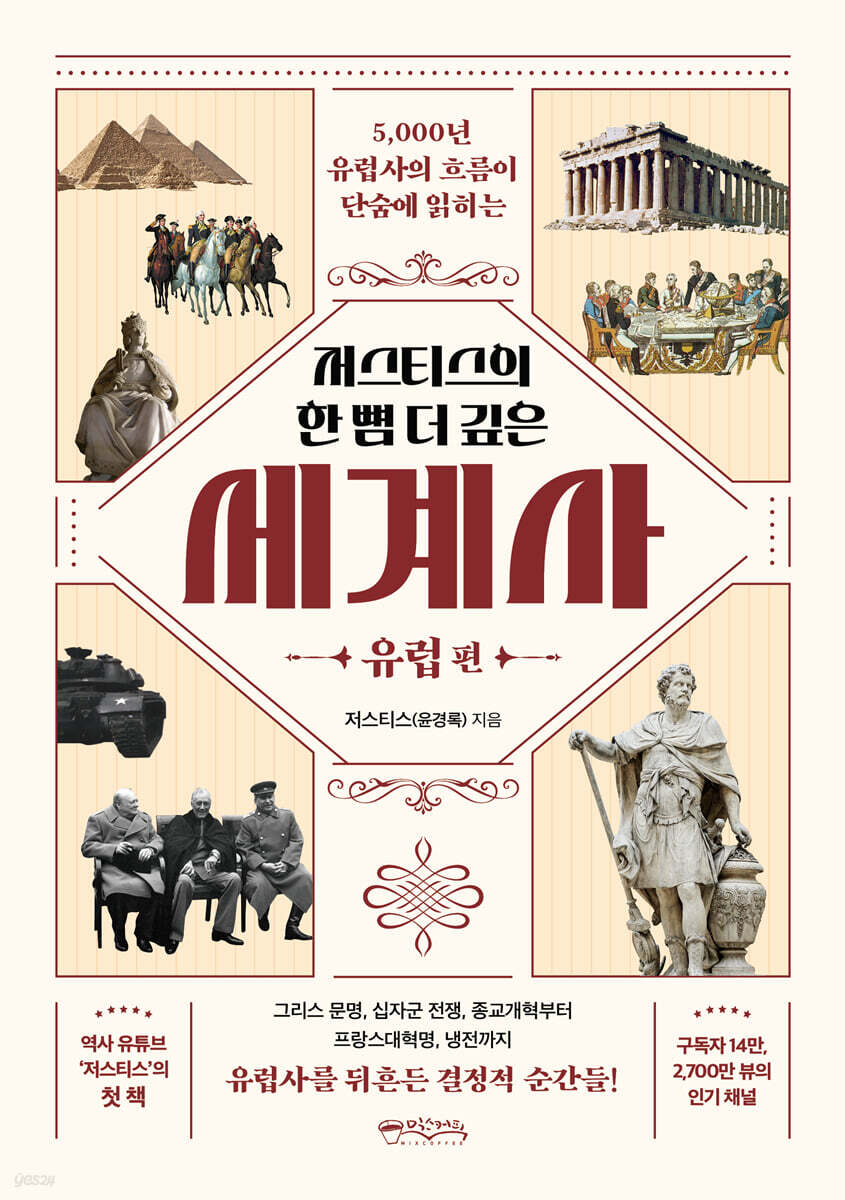
The European history story of 'Justice', a history YouTube channel with 140,000 subscribers and 27 million cumulative views, has been published as a book.
Ancient European history, from Sumerian civilization to Greek civilization and the Roman Empire; Christianity and Islam clashing in the midst of the chaos and disorder of the Middle Ages with the Crusades; early modern Europe, where decisive moments such as the Renaissance, Reformation, and Age of Exploration unfolded; the modern era, where revolution, capital, and empires took place; and the modern era, where the polar opposites of catastrophe and gold are confusing.
It tells the story of 5,000 years of European history in an easy-to-read format.
This book, "Justice's Deeper World History (Europe Edition)", condenses the crucial moments in European history that were enough to shake the world into chronological order, from ancient times to the Middle Ages, early modern times, modern times, and the present.
We filled in parts that were not covered in the video, corrected inaccurate expressions, and placed photos, drawings, and sensory maps in appropriate places to reach readers more intuitively and in more detail than the video.
I think it would be good to look forward to a different charm from the video.
How to Read 5,000 Years of European History in One Breath
★ The first book from the history YouTube channel 'Justice' ★
★ Popular channel with 140,000 subscribers and 27 million cumulative views ★
★ Trusted History Channel, Requests for Publication Are Flooding! ★
The European history story of 'Justice', a history YouTube channel with 140,000 subscribers and 27 million cumulative views, has been published as a book.
Ancient European history, from Sumerian civilization to Greek civilization and the Roman Empire; Christianity and Islam clashing in the midst of the chaos and disorder of the Middle Ages with the Crusades; early modern Europe, where decisive moments such as the Renaissance, Reformation, and Age of Exploration unfolded; the modern era, where revolution, capital, and empires took place; and the modern era, where the polar opposites of catastrophe and gold are confusing.
It tells the story of 5,000 years of European history in an easy-to-read format.
This book, "Justice's Deeper World History (Europe Edition)", condenses the crucial moments in European history that were enough to shake the world into chronological order, from ancient times to the Middle Ages, early modern times, modern times, and the present.
We filled in parts that were not covered in the video, corrected inaccurate expressions, and placed photos, drawings, and sensory maps in appropriate places to reach readers more intuitively and in more detail than the video.
I think it would be good to look forward to a different charm from the video.
- You can preview some of the book's contents.
Preview
index
Author's Note_
A deeper look into the world history intertwined like warp and weft
Entering_
Decisive moments that shook European history
Part 1: The Age of Splendid Glory: Ancient European History
Civilizations that influenced the formation of ancient Europe
Greek civilization, which laid the foundation for Western civilization
Political, military, and cultural development in ancient Europe
Transforming the political landscape of the Western Mediterranean
Until Europe becomes a unified cultural sphere
A Crucial Turning Point in European History: Jesus and Christianity
The end of ancient Europe brought about by the great migrations of the Germanic peoples
Part 2: The Dark Rise and Fall of Medieval Europe
The foundation of Europe's territorial boundaries and political structure
Western Europe's Choice in the Clash Between the Seljuks and the Eastern Romans
England's unique and dynamic history
As a clash of civilizations and the starting point of the modern era
From proposals for royal authority to strengthening the parliamentary system
The end of feudalism and the beginning of absolute monarchy
Part 3: A Powerful Rebirth in Early Modern Europe
Cultural rebirth, the age of the Renaissance
A major event that determined modern European history
Europe at the center of world-historical change
The clash between two rising and rising nations
The rise and fall of the Habsburg family that ruled Europe
From religious to territorial, the Thirty Years' War
The foundation of England, the world's strongest power
The emergence of a new power, Prussia
The rapid rise of another emerging power: Russia
Witness the birth of the United States, the world's most powerful nation.
The Birth and Framework of Today's Democracy
Part 4: Modern European History: Revolution, Capital, and Empire
In the midst of a decisive change in human civilization
The aftermath of the French Revolution in 1789
The Legacy of a War of Conquest by a Military Genius
Let's go back to the old system before the revolution.
Until Germany and Italy achieved unification
The war that marked the most important turning point in American history
The problems we face can only be solved with iron and blood.
The 20th century began with World War I.
Part 5: Chaotic Catastrophe and Golden Modern European History
Until the birth of the world's first communist state
The full story of the global economic crisis that originated in the United States
The impact of the largest war in human history
The Cold War that shaped our era is not over.
A deeper look into the world history intertwined like warp and weft
Entering_
Decisive moments that shook European history
Part 1: The Age of Splendid Glory: Ancient European History
Civilizations that influenced the formation of ancient Europe
Greek civilization, which laid the foundation for Western civilization
Political, military, and cultural development in ancient Europe
Transforming the political landscape of the Western Mediterranean
Until Europe becomes a unified cultural sphere
A Crucial Turning Point in European History: Jesus and Christianity
The end of ancient Europe brought about by the great migrations of the Germanic peoples
Part 2: The Dark Rise and Fall of Medieval Europe
The foundation of Europe's territorial boundaries and political structure
Western Europe's Choice in the Clash Between the Seljuks and the Eastern Romans
England's unique and dynamic history
As a clash of civilizations and the starting point of the modern era
From proposals for royal authority to strengthening the parliamentary system
The end of feudalism and the beginning of absolute monarchy
Part 3: A Powerful Rebirth in Early Modern Europe
Cultural rebirth, the age of the Renaissance
A major event that determined modern European history
Europe at the center of world-historical change
The clash between two rising and rising nations
The rise and fall of the Habsburg family that ruled Europe
From religious to territorial, the Thirty Years' War
The foundation of England, the world's strongest power
The emergence of a new power, Prussia
The rapid rise of another emerging power: Russia
Witness the birth of the United States, the world's most powerful nation.
The Birth and Framework of Today's Democracy
Part 4: Modern European History: Revolution, Capital, and Empire
In the midst of a decisive change in human civilization
The aftermath of the French Revolution in 1789
The Legacy of a War of Conquest by a Military Genius
Let's go back to the old system before the revolution.
Until Germany and Italy achieved unification
The war that marked the most important turning point in American history
The problems we face can only be solved with iron and blood.
The 20th century began with World War I.
Part 5: Chaotic Catastrophe and Golden Modern European History
Until the birth of the world's first communist state
The full story of the global economic crisis that originated in the United States
The impact of the largest war in human history
The Cold War that shaped our era is not over.
Detailed image

Into the book
The most important turning points in ancient Greek history were the Greco-Persian Wars and the Peloponnesian War in the 5th century BC, leading to a series of events that led to the Hellenistic period that began in the 4th century BC.
During this period, ancient Greece underwent significant political, military, and cultural changes.
A series of important historical events also took place that formed the foundation of European society.
--- p.30
The 'Great Migration' was a historical event that lasted from the 4th to the 7th centuries.
It refers to the period when Germanic peoples living outside the Roman Empire moved into the Roman Empire, overthrew Rome, and established their own country.
The main cause of the migration of the Germanic peoples was the pressure of the Huns.
The Huns were a nomadic people from Central Asia who suddenly appeared north of the Black Sea in the mid-4th century and moved westward, causing destruction and terror across Europe.
In addition to the pressure from the Huns, the climate change that swept across Northern and Eastern Europe after the 4th century, making agriculture difficult, also triggered the migration of the Germanic peoples.
Germanic peoples, seeking a better life in the cold north, sought to migrate south, targeting the Roman Empire's warm climate and abundant resources.
--- p.59
Western Europe experienced a period of chaos and disorder during the 9th and 10th centuries.
In many parts of Western Europe, centralized rule weakened, and Viking invasions and civil wars became more frequent.
In the midst of this chaos, Western Europe was transforming into a period in which the feudal system took hold and local lords expanded their power and competed with each other.
In contrast, relatively stable power continued in Eastern Europe.
The Eastern Roman Empire, which ruled this region, maintained a strong centralized system while maintaining Roman traditions and Christian culture even after the fall of the Western Roman Empire in the 5th century.
However, in the 11th century, the Eastern Roman Empire faced a serious crisis due to the rise of the Seljuk (Turkish) Empire, a new Turkic empire in Central Asia.
--- p.78~79
The Crusades were a series of wars fought between European Christian allies and Muslim forces from the late 11th to the late 13th centuries to take control of Jerusalem and its surrounding areas.
At the time the war was taking place, people did not call the Crusades a "war" but rather "the road to the Holy Land."
Participants were called 'pilgrims'.
They set out on a peculiar form of pilgrimage, carrying weapons.
Western Europe watched closely as the Eastern Roman Empire was threatened by Islamic forces after its defeat by the Seljuk Empire at the Battle of Manzikert in 1071.
It was an event that revealed that the Eastern Roman Empire was no longer a strong defensive line for Europe.
Recognizing the threat of Islam, Pope Gregory VII developed a strategy to personally lead an army to the East without a request from the Eastern Roman Empire.
--- p.92~93
The Renaissance movement began in Italy in the late 14th century and continued until the early 17th century.
The term 'Renaissance' means 'rebirth' in French, and in English it corresponds to 'Rebirth' or 'Renewal'.
But it has a deeper meaning than the simple concept of 'renewal'.
The Renaissance was an intellectual, artistic, and social movement that sought to rediscover the culture, knowledge, and philosophy of ancient Greece and Rome and to revive them against the Christian-centric worldview of the Middle Ages.
It marked the beginning of a new era that emphasized individual creativity, human dignity, and reason in all fields of academia and the arts.
--- p.132
As Mediterranean trade rights fell to the Ottoman Empire, Europe faced a major problem.
Because it became very difficult to import spices, which were essential for Europeans, from the East.
The Ottoman Empire controlled the Mediterranean and monopolized the spice trade, causing spice prices to rise sharply.
Western European countries found it no longer possible to import spices through the Ottoman Empire.
A new route to India had to be found.
Against this backdrop, maritime nations such as Portugal and Spain embarked on an adventure to open new routes south.
--- p.145
As a result of the Hundred Years' War, England lost all its lands in France.
But in the long run, it has had unexpected benefits.
Weavers from the war-torn Flanders region migrated to England in search of a more stable environment.
This was the opportunity for Britain to acquire textile technology.
In particular, the British royal family actively promoted textile technology and pursued policies to protect and develop the woolen textile industry.
--- p.206
The event that directly caused World War I was the Sarajevo incident.
This is the incident in which a Serbian youth, Gavrilo Princip, shot and killed the Austrian crown prince and his wife in protest against his country's annexation by Austria.
Princip, a Bosnian Serb, was a member of the Black Hand, a Serbian nationalist group that advocated pan-Slavism in opposition to the annexation of Bosnia by Austria-Hungary.
He resisted Austrian rule and hoped for the unification of all Slavic peoples, including Serbia.
The incident itself may seem small, but given the complex alliances and tense political climate in Europe at the time, it served as the trigger for World War I.
--- p.253~254
World War I left Europe in ashes.
However, the United States amassed enormous wealth by investing in the reconstruction of Europe after the war.
Amidst the economic turmoil and destruction in Europe, the United States emerged as a new global economic power.
Now the center of world history has shifted across the Atlantic to the United States.
The New York Stock Exchange symbolized the prosperity of the American economy, which stood at the center of world history.
The stock market continued to rise, and the stock exchanges were crowded with investors looking to buy stocks.
The 1920s were a golden age for the American economy, and its economic growth and prosperity seemed destined to last forever.
However, the boom cannot last forever, and from 1925 onwards, the construction industry began to decline, which had a serious impact on the overall economy.
The downturn in the construction industry led to a decline in industrial production, and consumer demand also began to decline.
Companies began to accumulate inventory, leading to slowdowns in production.
--- p.274~275
In 1947, the United States announced the Truman Doctrine, providing military and economic aid to Europe to prevent the spread of communism.
It stemmed from concerns about Soviet expansion after World War II.
The Truman Doctrine expressed the United States' intention to directly intervene to protect free democratic countries from communism, and the Marshall Plan emerged as a concrete implementation plan.
The Marshall Plan was a program in which the United States provided large-scale economic aid to support the reconstruction of post-war Europe.
America's goal was to revive the European economy, centered on Germany, to prevent the spread of communism and stabilize Western Europe.
Its goal was to create a federal system in Europe, prevent German rearmament, and defend Central Europe from the Soviet Union.
During this period, ancient Greece underwent significant political, military, and cultural changes.
A series of important historical events also took place that formed the foundation of European society.
--- p.30
The 'Great Migration' was a historical event that lasted from the 4th to the 7th centuries.
It refers to the period when Germanic peoples living outside the Roman Empire moved into the Roman Empire, overthrew Rome, and established their own country.
The main cause of the migration of the Germanic peoples was the pressure of the Huns.
The Huns were a nomadic people from Central Asia who suddenly appeared north of the Black Sea in the mid-4th century and moved westward, causing destruction and terror across Europe.
In addition to the pressure from the Huns, the climate change that swept across Northern and Eastern Europe after the 4th century, making agriculture difficult, also triggered the migration of the Germanic peoples.
Germanic peoples, seeking a better life in the cold north, sought to migrate south, targeting the Roman Empire's warm climate and abundant resources.
--- p.59
Western Europe experienced a period of chaos and disorder during the 9th and 10th centuries.
In many parts of Western Europe, centralized rule weakened, and Viking invasions and civil wars became more frequent.
In the midst of this chaos, Western Europe was transforming into a period in which the feudal system took hold and local lords expanded their power and competed with each other.
In contrast, relatively stable power continued in Eastern Europe.
The Eastern Roman Empire, which ruled this region, maintained a strong centralized system while maintaining Roman traditions and Christian culture even after the fall of the Western Roman Empire in the 5th century.
However, in the 11th century, the Eastern Roman Empire faced a serious crisis due to the rise of the Seljuk (Turkish) Empire, a new Turkic empire in Central Asia.
--- p.78~79
The Crusades were a series of wars fought between European Christian allies and Muslim forces from the late 11th to the late 13th centuries to take control of Jerusalem and its surrounding areas.
At the time the war was taking place, people did not call the Crusades a "war" but rather "the road to the Holy Land."
Participants were called 'pilgrims'.
They set out on a peculiar form of pilgrimage, carrying weapons.
Western Europe watched closely as the Eastern Roman Empire was threatened by Islamic forces after its defeat by the Seljuk Empire at the Battle of Manzikert in 1071.
It was an event that revealed that the Eastern Roman Empire was no longer a strong defensive line for Europe.
Recognizing the threat of Islam, Pope Gregory VII developed a strategy to personally lead an army to the East without a request from the Eastern Roman Empire.
--- p.92~93
The Renaissance movement began in Italy in the late 14th century and continued until the early 17th century.
The term 'Renaissance' means 'rebirth' in French, and in English it corresponds to 'Rebirth' or 'Renewal'.
But it has a deeper meaning than the simple concept of 'renewal'.
The Renaissance was an intellectual, artistic, and social movement that sought to rediscover the culture, knowledge, and philosophy of ancient Greece and Rome and to revive them against the Christian-centric worldview of the Middle Ages.
It marked the beginning of a new era that emphasized individual creativity, human dignity, and reason in all fields of academia and the arts.
--- p.132
As Mediterranean trade rights fell to the Ottoman Empire, Europe faced a major problem.
Because it became very difficult to import spices, which were essential for Europeans, from the East.
The Ottoman Empire controlled the Mediterranean and monopolized the spice trade, causing spice prices to rise sharply.
Western European countries found it no longer possible to import spices through the Ottoman Empire.
A new route to India had to be found.
Against this backdrop, maritime nations such as Portugal and Spain embarked on an adventure to open new routes south.
--- p.145
As a result of the Hundred Years' War, England lost all its lands in France.
But in the long run, it has had unexpected benefits.
Weavers from the war-torn Flanders region migrated to England in search of a more stable environment.
This was the opportunity for Britain to acquire textile technology.
In particular, the British royal family actively promoted textile technology and pursued policies to protect and develop the woolen textile industry.
--- p.206
The event that directly caused World War I was the Sarajevo incident.
This is the incident in which a Serbian youth, Gavrilo Princip, shot and killed the Austrian crown prince and his wife in protest against his country's annexation by Austria.
Princip, a Bosnian Serb, was a member of the Black Hand, a Serbian nationalist group that advocated pan-Slavism in opposition to the annexation of Bosnia by Austria-Hungary.
He resisted Austrian rule and hoped for the unification of all Slavic peoples, including Serbia.
The incident itself may seem small, but given the complex alliances and tense political climate in Europe at the time, it served as the trigger for World War I.
--- p.253~254
World War I left Europe in ashes.
However, the United States amassed enormous wealth by investing in the reconstruction of Europe after the war.
Amidst the economic turmoil and destruction in Europe, the United States emerged as a new global economic power.
Now the center of world history has shifted across the Atlantic to the United States.
The New York Stock Exchange symbolized the prosperity of the American economy, which stood at the center of world history.
The stock market continued to rise, and the stock exchanges were crowded with investors looking to buy stocks.
The 1920s were a golden age for the American economy, and its economic growth and prosperity seemed destined to last forever.
However, the boom cannot last forever, and from 1925 onwards, the construction industry began to decline, which had a serious impact on the overall economy.
The downturn in the construction industry led to a decline in industrial production, and consumer demand also began to decline.
Companies began to accumulate inventory, leading to slowdowns in production.
--- p.274~275
In 1947, the United States announced the Truman Doctrine, providing military and economic aid to Europe to prevent the spread of communism.
It stemmed from concerns about Soviet expansion after World War II.
The Truman Doctrine expressed the United States' intention to directly intervene to protect free democratic countries from communism, and the Marshall Plan emerged as a concrete implementation plan.
The Marshall Plan was a program in which the United States provided large-scale economic aid to support the reconstruction of post-war Europe.
America's goal was to revive the European economy, centered on Germany, to prevent the spread of communism and stabilize Western Europe.
Its goal was to create a federal system in Europe, prevent German rearmament, and defend Central Europe from the Soviet Union.
--- p.290~291
Publisher's Review
'The Light and Shadow of Rewriting European History!'
A deeper look into the world history intertwined like warp and weft
With 140,000 subscribers, the historical YouTube channel "Justice" launched in 2019 and has uploaded approximately 500 videos over the past six years, slowly and honestly conveying the decisive events, moments, and scenes of history.
It covers the history of Europe, the Middle East, China, Japan, the United States, nomads, and Southeast Asia in such detail that it is difficult to find a place that has not been covered.
The region covered in this first book is 'Europe', and its importance is so outstanding that it can be said that 'world history cannot be understood without knowing Europe'.
Europe is home to dozens of countries, more than half of which are members of the European Union, which works together to address issues such as politics, diplomacy, security, economy, society, and the environment. However, historically, the region has experienced countless cycles of integration and division.
In doing so, it experienced many decisive events and even resulted in outcomes that changed the course of humanity.
It has been through a cycle of calm, growth, stagnation, and rebound to reach where we are today.
Therefore, Europe and European history are a core part of human history that we must know.
If possible, I would recommend reading this book, "Justice's Deeper World History (Europe Edition)," to quickly grasp the context and understand the flow at a glance, allowing you to understand the complexities of European history.
This book is divided into five parts.
Part 1 covers the glorious history of ancient Europe.
From the ancient civilizations that laid the foundations of Western civilization to the Roman Empire and the advent of Jesus.
Part 2 shows the dark history of medieval Europe during its heyday.
In the midst of the chaos of constant territorial shifts, the Crusades, a conflict between Christianity and Islam, and the Black Death plunge all of Europe into darkness.
There was a lot going on in the early modern European history, a period of powerful rebirth covered in Part 3.
There followed a series of turning points for all mankind, such as the Renaissance, the Reformation, and the Age of Exploration.
There were many important turning points in the modern European history of revolution, capital, and empire that Part 4 shows.
Revolutions such as the Industrial Revolution and the French Revolution followed, imperial wars continued, and capitalism emerged and took hold.
Part 5 covers the chaotic catastrophe and golden modern European history.
This is the story of Europe, from the Great Depression that plunged the world into panic, to World War II, the worst war in human history, to the Cold War that shaped our era.
A deeper look into the world history intertwined like warp and weft
With 140,000 subscribers, the historical YouTube channel "Justice" launched in 2019 and has uploaded approximately 500 videos over the past six years, slowly and honestly conveying the decisive events, moments, and scenes of history.
It covers the history of Europe, the Middle East, China, Japan, the United States, nomads, and Southeast Asia in such detail that it is difficult to find a place that has not been covered.
The region covered in this first book is 'Europe', and its importance is so outstanding that it can be said that 'world history cannot be understood without knowing Europe'.
Europe is home to dozens of countries, more than half of which are members of the European Union, which works together to address issues such as politics, diplomacy, security, economy, society, and the environment. However, historically, the region has experienced countless cycles of integration and division.
In doing so, it experienced many decisive events and even resulted in outcomes that changed the course of humanity.
It has been through a cycle of calm, growth, stagnation, and rebound to reach where we are today.
Therefore, Europe and European history are a core part of human history that we must know.
If possible, I would recommend reading this book, "Justice's Deeper World History (Europe Edition)," to quickly grasp the context and understand the flow at a glance, allowing you to understand the complexities of European history.
This book is divided into five parts.
Part 1 covers the glorious history of ancient Europe.
From the ancient civilizations that laid the foundations of Western civilization to the Roman Empire and the advent of Jesus.
Part 2 shows the dark history of medieval Europe during its heyday.
In the midst of the chaos of constant territorial shifts, the Crusades, a conflict between Christianity and Islam, and the Black Death plunge all of Europe into darkness.
There was a lot going on in the early modern European history, a period of powerful rebirth covered in Part 3.
There followed a series of turning points for all mankind, such as the Renaissance, the Reformation, and the Age of Exploration.
There were many important turning points in the modern European history of revolution, capital, and empire that Part 4 shows.
Revolutions such as the Industrial Revolution and the French Revolution followed, imperial wars continued, and capitalism emerged and took hold.
Part 5 covers the chaotic catastrophe and golden modern European history.
This is the story of Europe, from the Great Depression that plunged the world into panic, to World War II, the worst war in human history, to the Cold War that shaped our era.
GOODS SPECIFICS
- Date of issue: April 30, 2025
- Page count, weight, size: 300 pages | 472g | 149*210*18mm
- ISBN13: 9791170436324
- ISBN10: 1170436323
You may also like
카테고리
korean


korean

![GQ KOREA Mark (Monthly): December [2025]](http://librairie.coreenne.fr/cdn/shop/files/8ef265dbbfbf186523ed75ba7319009d.jpg?v=1765340328&width=3840)


