

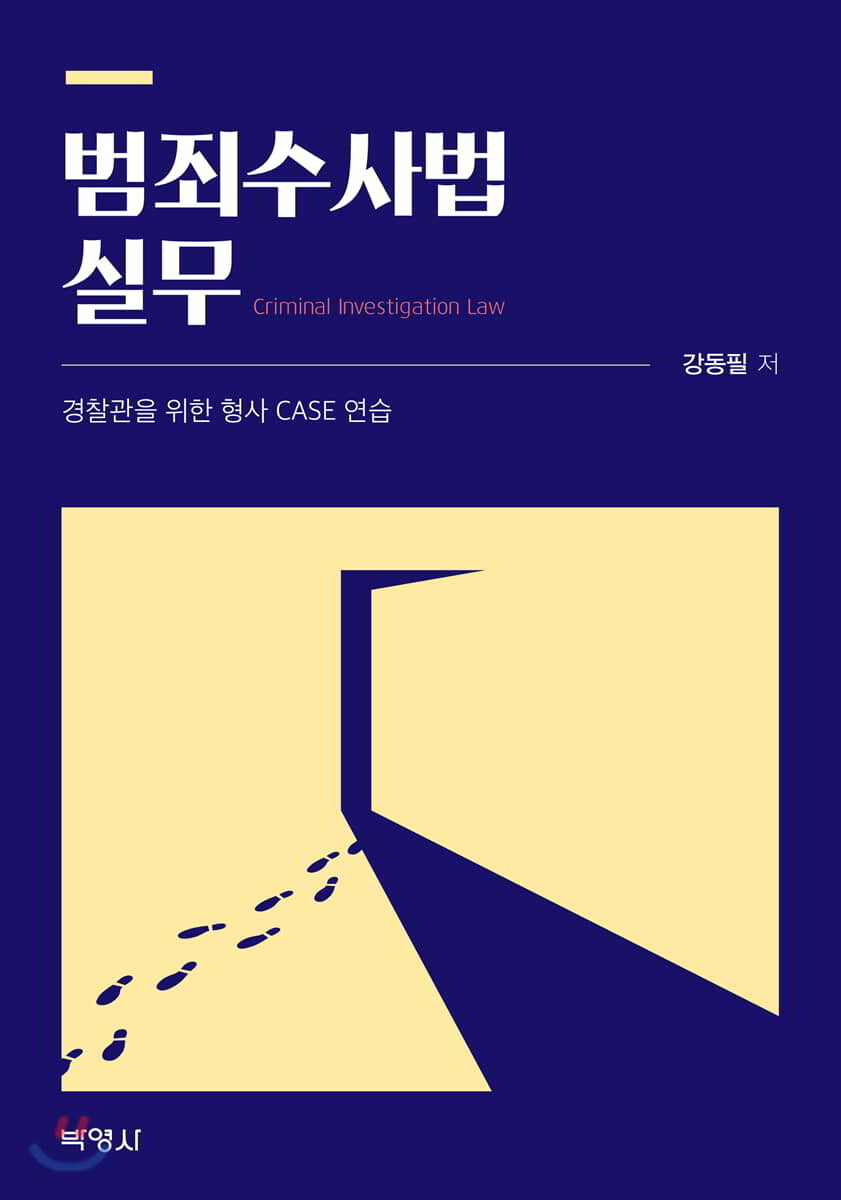
Criminal Investigation Practice
 |
Description
Book Introduction
This book is about the legal practice of criminal investigation. It contains leading cases that well contain the elements and legal principles of crime or have practical value in criminal investigation. It organizes various cases and commentaries and includes basic theories and important practical opinions.
index
PART 1 EXCLUSION OF ILLEGALLY COLLECTED EVIDENCE
CHAPTER 1: Illegal Confession Exclusion Rule 17
1.
Torture, assault, threats, etc. / 17
2.
Deception / 23
3.
Promise / 24
4.
Unlawful Detention: Violation of the Warrant Principle / 26
CHAPTER 2 Right to Assistance of Counsel and Right to Remain Silent
Violation 28
1.
Violation of the Right to Assistance of Counsel / 28
2.
Violation of the Right to Remain Uninformed / 34
Case 1 | Director of the National Intelligence Service / 36
CHAPTER 3: Evidence Exclusion from Unlawful Material Forced Dispositions 38
CHAPTER 4: The Evidentiary Ability of Derivative Evidence, etc. 39
1.
Criteria for Excluding Derivative Evidence from Illegally Obtained Evidence / 39
2.
Cases of illegally collected evidence against third parties / 46
3.
Evidence Illegally Gathered by a Sign: Comparative Sentencing / 46
CHAPTER 5: Entrapment Investigation 50
1.
Permissible limits of entrapment investigation / 50
2.
Detailed Review / 51
Case 2 | Ticket Cafe Crackdown / 55
Case 3 | Let's Talk About This / 60
Case 4 | Call a Helper / 64
Case Study | 5 | Reward Investment / 66
PART 2: The Occurrence of a Crime and the Arrest of a Suspect
CHAPTER 1: Arresting a Criminal in the Act 73
1.
Caught in the act and caught near the act / 74
2.
Arrest of a criminal caught red-handed / 77
3.
Arrest Procedure / 82
CHAPTER 2 Random Companions 85
1.
Requirements for the Legality of Voluntary Accompaniment in Investigative Procedures / 85
2.
Related Issues / 87
Case 6 | Sauna Bloodbath / 89
Case 7 | Spiral Master's Swordplay / 91
Case 8 | Lovebird Couple / 93
Case 9 | The Riot at Dangsan Station / 97
Case 10 | Park Go-ham's ID / 100
Case | 11 | Ring the Golden Bell / 103
Case 12 | Arrest and Prosecution / 108
Case 13 | The Limbs of the Ogre / 111
CHAPTER 3: Drunk Driving and Refusal to Take Tests 115
1.
The Relationship Between Drunk Driving and Refusal to Take Tests / 115
2.
Drunk Driving / 117
3.
The Problem of Illegal Evidence Collection / 126
Case 14 | Half voluntary, half involuntary / 130
Case 15 | Blood Collection / 132
Case 16 | When Your Face Turns Red / 135
Case 17 | Thai Wife and Alcohol Test / 139
Case 18 | Emperor's Pork Soup / 141
Case | 19 | 2m Drunk Driving / 144
Case 20 | Detectors and Measurement Refusals / 148
CHAPTER 4: Emergency Arrest 153
1.
Requirements for Emergency Arrest / 153
2.
Based on the circumstances at the time of arrest / 154
3.
The Use of Emergency Arrests in Practice / 155
Case 21 | Mulberry and Emergency Arrest / 157
Case 22 | The Hiding Under the Bed / 161
Case 23 | The Irrationality of Prosecutor Oh / 165
PART 3 Securing Physical Evidence
CHAPTER 1: Investigative Seizure, Search, and Verification 171
1.
The Significance of Seizure, Search, and Verification / 171
2.
Requirements for Search and Seizure / 173
3.
Crimes in Seizure Procedures / 176
Case 24 | Park Se-gang's War on Crime / 178
Case | 25 | Objective and Personal Relevance / 182
CHAPTER 2: Seizure, Search, and Verification by Warrant 189
1.
Preparation of warrant application documents / 189
2.
Enforcement Participants and Notifications / 191
3.
Presentation of the Warrant and Commencement of Execution / 192
4.
Execution of Search and Seizure / 194
5.
Preparation and issuance of related documents / 197
6.
End of Execution: Duty to Restore to Original Condition / 198
Case 26 | Forced Urine Collection / 199
Case | 27 | Special Case Investigation / 203
CHAPTER 3: Search, Seizure, and Verification Without a Warrant 205
1.
Seizure, Search, and Verification at the Arrest Scene / 206
2.
Seizure, Search, and Verification at Crime Scenes / 206
3.
Seizure, Search, and Verification Following Emergency Arrest / 207
4.
Arbitrary submission or custody of remains / 210
Case 28 | Niagara Hawaii / 215
Case 29 | Paper Box and 400,000 Won / 218
Case | 30 | Jilleo Karaoke Practice Room / 222
Case 31 | Molka Criminal's Smartphone / 226
CHAPTER 4: Video and Audio Recording 230
1.
Video recording / 230
2.
Photo taken from a mobile phone screen / 231
3.
Voice: Communications Secrets Protection Act / 232
CHAPTER 5 VERIFICATION AND FIELD INVESTIGATION 238
1.
Related Articles / 238
2.
Verification and Field Investigation / 239
Case | 32 | Who Recorded It / 243
Case 33 | Nightclub Porn Show / 245
Case 34 | Chosadong Gas Cylinder / 248
Case 35 | Evidence of Recordings / 251
PART 4 Investigating Personal Evidence (Indictments and Accusations)
CHAPTER 1 Accusations and Accusations 255
1.
Plaintiff / 255
2.
In the case of lawsuits related to capital, debt collection agencies, etc. / 258
3.
In case of withdrawal of complaint / 267
Case 36 | The Problem of Trauma Settlement / 271
Case 37 | Spouse's Complaint / 273
Case 38 | Capital Firm's Southern Lawsuit / 275
Case 39 | How Much Was Agreed? / 278
CHAPTER 2 Investigation of the Suspect 280
1.
Overview / 280
2.
Right to Remain Uninformed / 281
Case 40 | Am I a Suspect or a Witness? / 285
CHAPTER 3 The Evidence of Investigative Reports 288
1.
If the results of the verification are described / 288
2.
In the case of an investigation report containing the contents of a telephone conversation / 289
3.
In the case of an investigation report with attached data / 290
Case | 41 | Just Written as Seen / 292
PART 5: ACKNOWLEDGEMENT OF THE FACTS
CHAPTER 1: Free-Evidence 297
1.
Degree and Limits of Symptoms / 297
2.
Specific Judgment Criteria / 298
CHAPTER 2: Judging Credibility Based on Evidence Methods 300
1.
Suspect's Confession / 300
2.
Cases based on scientific evidence / 302
3.
Expert's Opinion / 306
4.
In the case of disposal documents / 307
5.
Medical Certificate / 308
6.
The Binding Power of Civil Judgments in Criminal Trials / 309
7.
Statement of a Reference Person or Witness / 309
8.
Criminal record / 319
Case | 42 | Can It Become More Clear? / 322
Case 43 | The Tragedy of Sotaegol Restaurant / 329
Case 44 | Overload and Burned Power Lines / 336
Case | 45 | The Power of a Medical Certificate / 351
Case | 46 | Hair Collection Techniques / 355
CHAPTER 3 Cases Based on Indirect Evidence 359
1.
Cases based on indirect evidence / 359
Case 47 | Fraud / 369
Case 48 | Document Forgery / 374
CHAPTER 4 Cases of Witnesses' Identification Statements 378
1.
Case Law: Criminal Identification Procedures / 378
2.
In the case of a single face-to-face meeting / 379
3.
Video presentation or street identification / 385
4.
Statement from a Child Sexually Abused Victim 385
5.
Considering Adult Sensitivity / 386
Case 49 | Criminal Identification Statement / 388
PART 6: The Investigation Concludes
CHAPTER 1 Writing a Statement of Opinion 399
1.
Suspect Identification / 399
2.
Whether criminal punishment and prosecution suspension are available / 399
3.
Criminal Facts / 400
4.
Applicable Law / 400
5.
Investigation Results / 400
CHAPTER 2: WRITING THE INJURY OPINION 404
1.
Overview / 404
2.
Preparation of criminal facts / 404
3.
Tips for Writing a Criminal Record Record / 409
4.
Description of applicable laws / 413
CHAPTER 3: Drafting a Motion Not to Prosecute 424
1.
Not indicted / 424
2.
No criminal conviction / 427
3.
Writing an Opinion of Insufficient Evidence / 436
4.
Not a sin Comment / 441
5.
No Prosecution Opinion / 443
6.
In the case of suspension of prosecution / 452
7.
In the case of a reference person's suspension / 452
CHAPTER 1: Illegal Confession Exclusion Rule 17
1.
Torture, assault, threats, etc. / 17
2.
Deception / 23
3.
Promise / 24
4.
Unlawful Detention: Violation of the Warrant Principle / 26
CHAPTER 2 Right to Assistance of Counsel and Right to Remain Silent
Violation 28
1.
Violation of the Right to Assistance of Counsel / 28
2.
Violation of the Right to Remain Uninformed / 34
Case 1 | Director of the National Intelligence Service / 36
CHAPTER 3: Evidence Exclusion from Unlawful Material Forced Dispositions 38
CHAPTER 4: The Evidentiary Ability of Derivative Evidence, etc. 39
1.
Criteria for Excluding Derivative Evidence from Illegally Obtained Evidence / 39
2.
Cases of illegally collected evidence against third parties / 46
3.
Evidence Illegally Gathered by a Sign: Comparative Sentencing / 46
CHAPTER 5: Entrapment Investigation 50
1.
Permissible limits of entrapment investigation / 50
2.
Detailed Review / 51
Case 2 | Ticket Cafe Crackdown / 55
Case 3 | Let's Talk About This / 60
Case 4 | Call a Helper / 64
Case Study | 5 | Reward Investment / 66
PART 2: The Occurrence of a Crime and the Arrest of a Suspect
CHAPTER 1: Arresting a Criminal in the Act 73
1.
Caught in the act and caught near the act / 74
2.
Arrest of a criminal caught red-handed / 77
3.
Arrest Procedure / 82
CHAPTER 2 Random Companions 85
1.
Requirements for the Legality of Voluntary Accompaniment in Investigative Procedures / 85
2.
Related Issues / 87
Case 6 | Sauna Bloodbath / 89
Case 7 | Spiral Master's Swordplay / 91
Case 8 | Lovebird Couple / 93
Case 9 | The Riot at Dangsan Station / 97
Case 10 | Park Go-ham's ID / 100
Case | 11 | Ring the Golden Bell / 103
Case 12 | Arrest and Prosecution / 108
Case 13 | The Limbs of the Ogre / 111
CHAPTER 3: Drunk Driving and Refusal to Take Tests 115
1.
The Relationship Between Drunk Driving and Refusal to Take Tests / 115
2.
Drunk Driving / 117
3.
The Problem of Illegal Evidence Collection / 126
Case 14 | Half voluntary, half involuntary / 130
Case 15 | Blood Collection / 132
Case 16 | When Your Face Turns Red / 135
Case 17 | Thai Wife and Alcohol Test / 139
Case 18 | Emperor's Pork Soup / 141
Case | 19 | 2m Drunk Driving / 144
Case 20 | Detectors and Measurement Refusals / 148
CHAPTER 4: Emergency Arrest 153
1.
Requirements for Emergency Arrest / 153
2.
Based on the circumstances at the time of arrest / 154
3.
The Use of Emergency Arrests in Practice / 155
Case 21 | Mulberry and Emergency Arrest / 157
Case 22 | The Hiding Under the Bed / 161
Case 23 | The Irrationality of Prosecutor Oh / 165
PART 3 Securing Physical Evidence
CHAPTER 1: Investigative Seizure, Search, and Verification 171
1.
The Significance of Seizure, Search, and Verification / 171
2.
Requirements for Search and Seizure / 173
3.
Crimes in Seizure Procedures / 176
Case 24 | Park Se-gang's War on Crime / 178
Case | 25 | Objective and Personal Relevance / 182
CHAPTER 2: Seizure, Search, and Verification by Warrant 189
1.
Preparation of warrant application documents / 189
2.
Enforcement Participants and Notifications / 191
3.
Presentation of the Warrant and Commencement of Execution / 192
4.
Execution of Search and Seizure / 194
5.
Preparation and issuance of related documents / 197
6.
End of Execution: Duty to Restore to Original Condition / 198
Case 26 | Forced Urine Collection / 199
Case | 27 | Special Case Investigation / 203
CHAPTER 3: Search, Seizure, and Verification Without a Warrant 205
1.
Seizure, Search, and Verification at the Arrest Scene / 206
2.
Seizure, Search, and Verification at Crime Scenes / 206
3.
Seizure, Search, and Verification Following Emergency Arrest / 207
4.
Arbitrary submission or custody of remains / 210
Case 28 | Niagara Hawaii / 215
Case 29 | Paper Box and 400,000 Won / 218
Case | 30 | Jilleo Karaoke Practice Room / 222
Case 31 | Molka Criminal's Smartphone / 226
CHAPTER 4: Video and Audio Recording 230
1.
Video recording / 230
2.
Photo taken from a mobile phone screen / 231
3.
Voice: Communications Secrets Protection Act / 232
CHAPTER 5 VERIFICATION AND FIELD INVESTIGATION 238
1.
Related Articles / 238
2.
Verification and Field Investigation / 239
Case | 32 | Who Recorded It / 243
Case 33 | Nightclub Porn Show / 245
Case 34 | Chosadong Gas Cylinder / 248
Case 35 | Evidence of Recordings / 251
PART 4 Investigating Personal Evidence (Indictments and Accusations)
CHAPTER 1 Accusations and Accusations 255
1.
Plaintiff / 255
2.
In the case of lawsuits related to capital, debt collection agencies, etc. / 258
3.
In case of withdrawal of complaint / 267
Case 36 | The Problem of Trauma Settlement / 271
Case 37 | Spouse's Complaint / 273
Case 38 | Capital Firm's Southern Lawsuit / 275
Case 39 | How Much Was Agreed? / 278
CHAPTER 2 Investigation of the Suspect 280
1.
Overview / 280
2.
Right to Remain Uninformed / 281
Case 40 | Am I a Suspect or a Witness? / 285
CHAPTER 3 The Evidence of Investigative Reports 288
1.
If the results of the verification are described / 288
2.
In the case of an investigation report containing the contents of a telephone conversation / 289
3.
In the case of an investigation report with attached data / 290
Case | 41 | Just Written as Seen / 292
PART 5: ACKNOWLEDGEMENT OF THE FACTS
CHAPTER 1: Free-Evidence 297
1.
Degree and Limits of Symptoms / 297
2.
Specific Judgment Criteria / 298
CHAPTER 2: Judging Credibility Based on Evidence Methods 300
1.
Suspect's Confession / 300
2.
Cases based on scientific evidence / 302
3.
Expert's Opinion / 306
4.
In the case of disposal documents / 307
5.
Medical Certificate / 308
6.
The Binding Power of Civil Judgments in Criminal Trials / 309
7.
Statement of a Reference Person or Witness / 309
8.
Criminal record / 319
Case | 42 | Can It Become More Clear? / 322
Case 43 | The Tragedy of Sotaegol Restaurant / 329
Case 44 | Overload and Burned Power Lines / 336
Case | 45 | The Power of a Medical Certificate / 351
Case | 46 | Hair Collection Techniques / 355
CHAPTER 3 Cases Based on Indirect Evidence 359
1.
Cases based on indirect evidence / 359
Case 47 | Fraud / 369
Case 48 | Document Forgery / 374
CHAPTER 4 Cases of Witnesses' Identification Statements 378
1.
Case Law: Criminal Identification Procedures / 378
2.
In the case of a single face-to-face meeting / 379
3.
Video presentation or street identification / 385
4.
Statement from a Child Sexually Abused Victim 385
5.
Considering Adult Sensitivity / 386
Case 49 | Criminal Identification Statement / 388
PART 6: The Investigation Concludes
CHAPTER 1 Writing a Statement of Opinion 399
1.
Suspect Identification / 399
2.
Whether criminal punishment and prosecution suspension are available / 399
3.
Criminal Facts / 400
4.
Applicable Law / 400
5.
Investigation Results / 400
CHAPTER 2: WRITING THE INJURY OPINION 404
1.
Overview / 404
2.
Preparation of criminal facts / 404
3.
Tips for Writing a Criminal Record Record / 409
4.
Description of applicable laws / 413
CHAPTER 3: Drafting a Motion Not to Prosecute 424
1.
Not indicted / 424
2.
No criminal conviction / 427
3.
Writing an Opinion of Insufficient Evidence / 436
4.
Not a sin Comment / 441
5.
No Prosecution Opinion / 443
6.
In the case of suspension of prosecution / 452
7.
In the case of a reference person's suspension / 452
Publisher's Review
I work at the National Police Investigation Training Institute, and I mainly lecture on legal practices related to property crime and other criminal investigations to economic crime investigators.
In relation to this, I personally run a private Naver band (economic crime investigation based on civil law) for training investigative police officers.
This is a format in which questions are posed by summarizing the facts of case law or practical cases, and responses to related issues and conclusions of guilt or innocence are written and participated in as comments.
I've noticed that many people struggle with questions that ask for the facts and then the issues and conclusions without giving them a choice.
And I became convinced that this type of CASE STUDY method would be helpful in developing the investigative skills of individual investigators.
The band currently has a collection of hundreds of cases submitted over the past year.
These are interesting adaptations of leading cases that are well-contained in the elements and legal principles of crime or have practical value in criminal investigation.
Meanwhile, there were many difficulties in conducting lectures and producing materials due to the lack of books related to criminal investigation legal practice.
This book is the cumulative result of the above band operation.
The cases and explanations posted on the band were organized and the basic theory and important practical opinions were described.
Although the title of the book is “Criminal Investigation Law Practice,” there is no such law in our country.
As is well known, criminal investigation is limited to Chapter 1, Part 2, Investigation of the Criminal Procedure Act, and there is little detailed legislation except for provisions related to arrest and detention.
Accordingly, the police and prosecution have internally established criminal investigation rules and prosecution case management rules to respond to investigative practices.
However, in practice, many administrative rules in investigative practice are procedures that impose significant disadvantages on the general public, and many of them directly affect the people's bodies and property, so I believe they should be stipulated as laws in accordance with Article 37, Paragraph 2 of the Constitution.
For example, various investigative techniques such as warrants, inquiries, and evidence collection have the potential to infringe upon the freedoms of the people, and even the methods and procedures for summons and investigations, such as the number of times and the duration of investigations, need to be clearly defined by law.
In order to prevent arbitrary investigations such as special investigations, it is necessary to establish the requirements for initiating investigations and establish standards related to investigation evasion.
The exclusionary rule for illegally collected evidence that requires individual comparative sentencing is not enough.
In addition, the grounds and procedures for requesting a warrant for compulsory investigation are separately stipulated and scattered across various laws, including the Telecommunications Business Act and the Financial Transactions Act, making it difficult for the general public to find or understand them.
In addition, the grounds for arrest, such as random searches, protective measures, arrests of criminals caught in the act or near-actually caught in the act, and arbitrary accompaniment, are also regulated separately by the Police Officers' Duties Act and the Criminal Procedure Act, making it difficult to clearly apply the requirements in momentary field work, which leads to the weakening of public power.
Therefore, it is necessary to establish specific, individual grounds for personal detention according to specific circumstances.
Ultimately, I believe that various arbitrary and compulsory investigation techniques should be regulated together as a single law in the ‘(A) Police Officers’ Criminal Investigation Act.
Meanwhile, considering that approximately 94% of all criminal cases are decided as either a preliminary or non-prosecution case based solely on police investigations at the police or prosecutorial level, it is no exaggeration to say that the police are still making direct decisions on actual criminal cases, regardless of the adjustment of investigative authority.
Therefore, at least for criminal cases that are concluded without indictment or in a summary manner, the court's criminal trial cannot be an effective and appropriate means of control.
Ultimately, establishing investigative procedures through legislation is virtually the only alternative for guaranteeing the people's basic rights.
Despite this, the people and the police still do not have a criminal investigation procedure law as a single law.
The current criminal procedure law only regards the field of criminal investigation as a procedure of the first trial, and relies on various administrative rules and special laws enacted from time to time.
This is counter-evidence that the Criminal Procedure Act relies on the prosecutor's discretionary investigative direction rather than establishing specific provisions for controlling investigative authority, and is regulated only around formal court trials. It also clearly shows that it does not properly reflect the reality and current status of the serious penalty procedures against citizens resulting from actual criminal investigations.
Furthermore, it goes without saying that the subject of enactment and operation of the above criminal investigation law should be the police, a specialized fact-finding department that is responsible for the majority of investigative work and the human and material elements of national security.
In short, the police, responsible for maintaining national security and order, have already exercised the right to investigate crimes as the most important means of public power, but have so far existed precariously on a weak legal basis.
Therefore, it is necessary to ensure that criminal justice is administered in accordance with due process by granting appropriate authority to responsible parties through the enactment of the Police Act and the Criminal Investigation Act or the Evidence Collection Act.
I believe this is the way to respond to the Constitution's emphasis on fundamental human rights and the public's demand for predictability in the exercise of public power.
In order to enact a single criminal investigation procedure law in the future, research and review of legislative precedents are necessary to reflect the reality of police investigations, and it is of course necessary to conduct research on case law and practical issues related to actual investigation practices.
This book is a manifestation of the above problem awareness.
For this purpose, I wrote as follows.
First, the criminal investigation practitioner is required to obtain the requirements and procedures for law enforcement according to the precedents of due process.
I wanted to explain through a volumetric example.
?We selected Supreme Court and lower court precedents that establish important standards for investigative practice.
?For the practice of extracting issues, the facts were organized faithfully and interestingly.
?The case explanation reflects appropriate practical opinions presented by the band.
?Included are generally accepted useful investigative tips related to investigation and journalistic techniques.
?Currently, the prosecution is solely responsible for concluding the investigation, but with the expectation that the primary investigation conclusion authority will be transferred in the future, the necessary examples and methods for non-indictment dispositions were introduced.
?In order to increase the reliability of the narrative, the text was structured by citing sentences and expressions from case law or lower court decisions, even if the narrative was limited to a limited discussion, and the case law number was also indicated.
Although I shudder at the lack of content, I console myself with the knowledge that much can be improved in the next revised edition.
If you point out any errors or shortcomings, I pledge to make up for them with sincere research. As an educator of investigative practice, I sincerely hope that the content will be supplemented with each edition, and that practical cases and opinions will be gathered on it.
In relation to this, I personally run a private Naver band (economic crime investigation based on civil law) for training investigative police officers.
This is a format in which questions are posed by summarizing the facts of case law or practical cases, and responses to related issues and conclusions of guilt or innocence are written and participated in as comments.
I've noticed that many people struggle with questions that ask for the facts and then the issues and conclusions without giving them a choice.
And I became convinced that this type of CASE STUDY method would be helpful in developing the investigative skills of individual investigators.
The band currently has a collection of hundreds of cases submitted over the past year.
These are interesting adaptations of leading cases that are well-contained in the elements and legal principles of crime or have practical value in criminal investigation.
Meanwhile, there were many difficulties in conducting lectures and producing materials due to the lack of books related to criminal investigation legal practice.
This book is the cumulative result of the above band operation.
The cases and explanations posted on the band were organized and the basic theory and important practical opinions were described.
Although the title of the book is “Criminal Investigation Law Practice,” there is no such law in our country.
As is well known, criminal investigation is limited to Chapter 1, Part 2, Investigation of the Criminal Procedure Act, and there is little detailed legislation except for provisions related to arrest and detention.
Accordingly, the police and prosecution have internally established criminal investigation rules and prosecution case management rules to respond to investigative practices.
However, in practice, many administrative rules in investigative practice are procedures that impose significant disadvantages on the general public, and many of them directly affect the people's bodies and property, so I believe they should be stipulated as laws in accordance with Article 37, Paragraph 2 of the Constitution.
For example, various investigative techniques such as warrants, inquiries, and evidence collection have the potential to infringe upon the freedoms of the people, and even the methods and procedures for summons and investigations, such as the number of times and the duration of investigations, need to be clearly defined by law.
In order to prevent arbitrary investigations such as special investigations, it is necessary to establish the requirements for initiating investigations and establish standards related to investigation evasion.
The exclusionary rule for illegally collected evidence that requires individual comparative sentencing is not enough.
In addition, the grounds and procedures for requesting a warrant for compulsory investigation are separately stipulated and scattered across various laws, including the Telecommunications Business Act and the Financial Transactions Act, making it difficult for the general public to find or understand them.
In addition, the grounds for arrest, such as random searches, protective measures, arrests of criminals caught in the act or near-actually caught in the act, and arbitrary accompaniment, are also regulated separately by the Police Officers' Duties Act and the Criminal Procedure Act, making it difficult to clearly apply the requirements in momentary field work, which leads to the weakening of public power.
Therefore, it is necessary to establish specific, individual grounds for personal detention according to specific circumstances.
Ultimately, I believe that various arbitrary and compulsory investigation techniques should be regulated together as a single law in the ‘(A) Police Officers’ Criminal Investigation Act.
Meanwhile, considering that approximately 94% of all criminal cases are decided as either a preliminary or non-prosecution case based solely on police investigations at the police or prosecutorial level, it is no exaggeration to say that the police are still making direct decisions on actual criminal cases, regardless of the adjustment of investigative authority.
Therefore, at least for criminal cases that are concluded without indictment or in a summary manner, the court's criminal trial cannot be an effective and appropriate means of control.
Ultimately, establishing investigative procedures through legislation is virtually the only alternative for guaranteeing the people's basic rights.
Despite this, the people and the police still do not have a criminal investigation procedure law as a single law.
The current criminal procedure law only regards the field of criminal investigation as a procedure of the first trial, and relies on various administrative rules and special laws enacted from time to time.
This is counter-evidence that the Criminal Procedure Act relies on the prosecutor's discretionary investigative direction rather than establishing specific provisions for controlling investigative authority, and is regulated only around formal court trials. It also clearly shows that it does not properly reflect the reality and current status of the serious penalty procedures against citizens resulting from actual criminal investigations.
Furthermore, it goes without saying that the subject of enactment and operation of the above criminal investigation law should be the police, a specialized fact-finding department that is responsible for the majority of investigative work and the human and material elements of national security.
In short, the police, responsible for maintaining national security and order, have already exercised the right to investigate crimes as the most important means of public power, but have so far existed precariously on a weak legal basis.
Therefore, it is necessary to ensure that criminal justice is administered in accordance with due process by granting appropriate authority to responsible parties through the enactment of the Police Act and the Criminal Investigation Act or the Evidence Collection Act.
I believe this is the way to respond to the Constitution's emphasis on fundamental human rights and the public's demand for predictability in the exercise of public power.
In order to enact a single criminal investigation procedure law in the future, research and review of legislative precedents are necessary to reflect the reality of police investigations, and it is of course necessary to conduct research on case law and practical issues related to actual investigation practices.
This book is a manifestation of the above problem awareness.
For this purpose, I wrote as follows.
First, the criminal investigation practitioner is required to obtain the requirements and procedures for law enforcement according to the precedents of due process.
I wanted to explain through a volumetric example.
?We selected Supreme Court and lower court precedents that establish important standards for investigative practice.
?For the practice of extracting issues, the facts were organized faithfully and interestingly.
?The case explanation reflects appropriate practical opinions presented by the band.
?Included are generally accepted useful investigative tips related to investigation and journalistic techniques.
?Currently, the prosecution is solely responsible for concluding the investigation, but with the expectation that the primary investigation conclusion authority will be transferred in the future, the necessary examples and methods for non-indictment dispositions were introduced.
?In order to increase the reliability of the narrative, the text was structured by citing sentences and expressions from case law or lower court decisions, even if the narrative was limited to a limited discussion, and the case law number was also indicated.
Although I shudder at the lack of content, I console myself with the knowledge that much can be improved in the next revised edition.
If you point out any errors or shortcomings, I pledge to make up for them with sincere research. As an educator of investigative practice, I sincerely hope that the content will be supplemented with each edition, and that practical cases and opinions will be gathered on it.
GOODS SPECIFICS
- Date of issue: June 17, 2019
- Page count, weight, size: 453 pages | 712g | 172*245*30mm
- ISBN13: 9791130334035
- ISBN10: 1130334031
You may also like
카테고리
korean


korean

![GQ KOREA Mark (Monthly): December [2025]](http://librairie.coreenne.fr/cdn/shop/files/8ef265dbbfbf186523ed75ba7319009d.jpg?v=1765340328&width=3840)


