

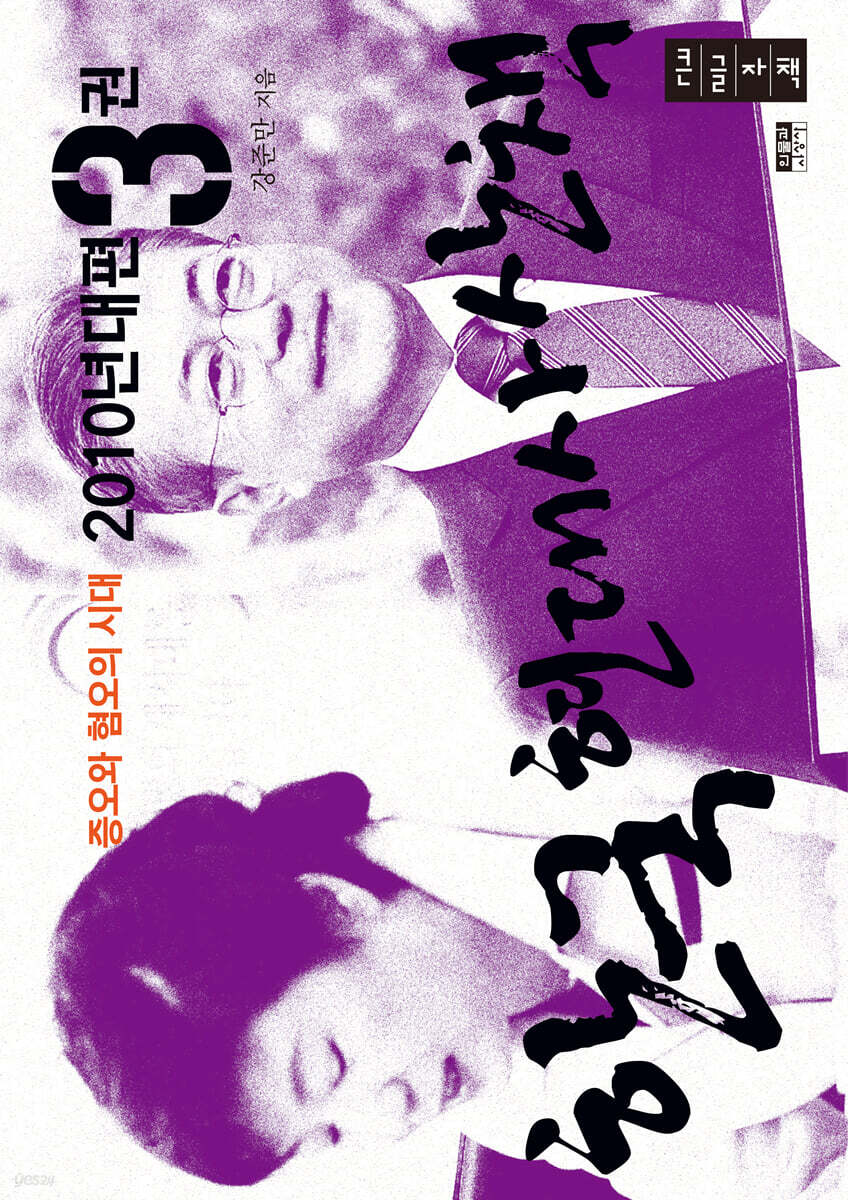
A Walk Through Modern Korean History: 2010s, Part 3 (Large Print Book)
 |
Description
Book Introduction
How have Korea's politics, economy, society, and culture evolved over the past 10 years?
The modern history of Korea, in which we have lived and in which we live now, is the starting point and the finishing point of history.
Because I have to live in a world where I have to make constant choices.
However, modern history has often been treated as a cold meal in the historical community.
Because these are sensitive topics.
Kang Jun-man presents various positions on controversial issues while also offering his own perspective, thereby providing readers with accurate information and a variety of opportunities for participation.
In that respect, the ‘A Walk Through Modern Korean History’ series is unparalleled.
It is like a Korean's 'treasure trove' that contains everything about the Republic of Korea that made up the 'me' of today.
The "A Walk Through Modern Korean History" series, which meticulously captures 75 years of history from noon on August 15, 1945, to Bong Joon-ho's [Parasite], covers a wide range of fields, from politics, economy, and society to popular culture and sports.
And it brought to life the life and historical stage that modern Koreans had to face.
To this end, the 'A Walk Through Modern Korean History' series attempted a three-dimensional approach through extensive annotations, photographs capturing scenes from the time, and a 'History Walk' corner.
The 'A Walk Through Modern Korean History' series is not limited to a simple listing of events.
'Explosion of Han (恨) and Desire' (1940s), 'Age of Extremes' (1950s), 'Birth of an Opportunist Republic' (1960s), 'Nationalization of Exports' (1970s), 'Gwangju Massacre and the Seoul Olympics' (1980s), 'Division is Our Destiny, Solidarity is My Destiny' (1990s), 'The Light and Shadow of the Roh Moo-hyun Era' (2000s), 'The Age of Hatred and Loathing' (2010s), etc. Numerous events and topics are persistently explored amidst a fierce sense of crisis about the emotions and structures that dominated each era.
And he emphasizes that just as the new generation can seize new values in the name of 'progress', it must also embrace the 'pain' of past generations who had to survive times of extremes and poverty.
Kang Jun-man recognizes that modern Korean history is a history that has excluded 'humanity', and is attempting to restore 'humanity' and, on that basis, to achieve a new reconciliation between ideologies and generations.
The modern history of Korea, in which we have lived and in which we live now, is the starting point and the finishing point of history.
Because I have to live in a world where I have to make constant choices.
However, modern history has often been treated as a cold meal in the historical community.
Because these are sensitive topics.
Kang Jun-man presents various positions on controversial issues while also offering his own perspective, thereby providing readers with accurate information and a variety of opportunities for participation.
In that respect, the ‘A Walk Through Modern Korean History’ series is unparalleled.
It is like a Korean's 'treasure trove' that contains everything about the Republic of Korea that made up the 'me' of today.
The "A Walk Through Modern Korean History" series, which meticulously captures 75 years of history from noon on August 15, 1945, to Bong Joon-ho's [Parasite], covers a wide range of fields, from politics, economy, and society to popular culture and sports.
And it brought to life the life and historical stage that modern Koreans had to face.
To this end, the 'A Walk Through Modern Korean History' series attempted a three-dimensional approach through extensive annotations, photographs capturing scenes from the time, and a 'History Walk' corner.
The 'A Walk Through Modern Korean History' series is not limited to a simple listing of events.
'Explosion of Han (恨) and Desire' (1940s), 'Age of Extremes' (1950s), 'Birth of an Opportunist Republic' (1960s), 'Nationalization of Exports' (1970s), 'Gwangju Massacre and the Seoul Olympics' (1980s), 'Division is Our Destiny, Solidarity is My Destiny' (1990s), 'The Light and Shadow of the Roh Moo-hyun Era' (2000s), 'The Age of Hatred and Loathing' (2010s), etc. Numerous events and topics are persistently explored amidst a fierce sense of crisis about the emotions and structures that dominated each era.
And he emphasizes that just as the new generation can seize new values in the name of 'progress', it must also embrace the 'pain' of past generations who had to survive times of extremes and poverty.
Kang Jun-man recognizes that modern Korean history is a history that has excluded 'humanity', and is attempting to restore 'humanity' and, on that basis, to achieve a new reconciliation between ideologies and generations.
index
Part 1 2014
Chapter 1: "If 62% is incompetent and arrogant, what about the other 11%?"
Park Geun-hye is "out of touch"? · 17 Why criticize public corporations while ruining them herself? · 19 "You said you wouldn't appoint parachutes, but you're mocking the people?" · 21 Does the Democratic Party have the right to criticize Park Geun-hye? · 23 Was this a competition of incompetence? · 25
A Walk Through History 1: Was Lee Jae-myung's Moratorium a "Political Show"? · 28
Chapter 2: Ah, 304! The April 16 Sewol Ferry Disaster
The government's 'wandering, back-and-forth, confusion, and turmoil' · 30 "I ask, is this a country?" · 33 "There is no system, only criticism" · 35 President Park Geun-hye's condolences and apology · 37 The Sewol ferry disaster has become a 'political incident' · 39 Conflict and internal strife surrounding 'political incitement' · 41 Was this really only the Park Geun-hye administration's problem? · 43
A Walk Through History 2: The Sewol Ferry Disaster and the Birth of "Giregi" · 46
Chapter 3: The June 4th Local Elections and the Moon Chang-geuk Personnel Dispute
The scandal surrounding Prime Minister nominee Ahn Dae-hee's preferential treatment of former officials · 48 The opposition's failed "Sewol Ferry Judgment" argument · 50 "Is the opposition a terrorist who only knows how to judge?" · 52 The Moon Chang-geuk scandal surrounding Prime Minister nominee · 54 "Moon Chang-geuk's 'April 3rd remarks' spread like wildfire... Public opinion boils over demanding his nomination be withdrawn" · 57 Kim Ki-choon's order to "weed out the human scum" · 59 "Park Geun-hye blamed the public for the 'personnel disaster' without apologizing" · 60
Chapter 4: The July 30th By-election and the "Ssagaji" Problem
Public sentiment that chose livelihood over Sewol · 63 The driving force behind "unscrupulous progressivism" is a sense of superiority · 65 "Judgment" is a magic spell that avoids oneself · 68 The anachronistic dichotomy of good and evil · 69 "Recruiting Lee Sang-don is terrorism against the New Politics Alliance for Democracy"? · 72
Chapter 5: The Sewol Ferry Special Act and the Political Mafia
The Sewol Ferry Special Act Controversy and Pope Francis · 74 Moon Jae-in's Gwanghwamun Square Hunger Strike · 77 'Sewol Fatigue' and the Divided Public Opinion · 79 Controversy over the Acquittal of Former National Intelligence Service Director Won Se-hoon · 81 'Tax Increases for the Common People' in Cigarette, Resident Tax, and Automobile Tax · 83 "Political Mafia Instead of 'Government Mafia' in Public Institutions" · 86 Even Large Corporations Fall for the 'Manmanhoe Impersonation' · 88 "The Endless Parachuting of Political Mafia" · 89 Is Politics 'Legal Theft'? · 92
Chapter 6: The "Jeong Yun-hoe State Affairs Intervention Report" Controversy
"Jeong Yoon-hoi's 'interference in state affairs' is true" · 94 "The president's closest secretaries manipulated state affairs" · 97 Park Geun-hye: "The leak of Blue House documents was an act of desecration of the national flag" · 98 Park Geun-hye: "The kind of stories you only see in flyers" · 100 Why did Superintendent Choi Kyung-rak have to commit suicide? · 103
Chapter 7: "Money Flocks to Seoul, and Only Debt Remains in the Provinces"
"If you want to succeed after graduating from a local university" · 105 "Killing local universities" is "Saving local universities" · 107 "Even if you come back from the dead, it won't work in the provinces"? · 110 "Money flows to Seoul, leaving only debt in the provinces" · 112 "In-Seoul" universities' dinosaur-like strategy · 115
Chapter 8: "Let's Crush Regular Employment and Regularize Non-Regular Workers"
"Is there really a way out of this ant hell?" · 119 "I wanted to sell my soul to get a job." · 120 Is a world without irregular workers possible? · 123 A "winner-takes-all culture" that favors the lucky ones. · 125 Should I just wait patiently, because everything will be solved when I get to heaven? · 127 "Korean social movements are doomed." · 130
Chapter 9 “Do you know who I am?”
“Do I have to bow down if I am a member of the National Assembly?” · 133 “Do you know who I am?
"I'll cut off your heads" · 135 "Who the hell are you?" · 137 Ideological slogans of the 'protocol society' · 139 The culture of military discipline among young students · 141 "How did I get here?" · 142
A Walk Through History 3: Incheon Asian Games and a Surprise Visit by North Korea's Three Powerful Men · 144
Historical Walk 4: "The guards don't even treat us like people, do they?" · 146
Historical Walk 5: The Marriage Ranking System and the Wedding Chicken Game · 148
Chapter 10: Korean Air's "Peanut Return" Incident
Butterfly at New York's JF Kennedy International Airport · 150 "Even if I lose everything, this is not it" · 152 "Surviving in a country of nobles and vulgarities" · 155 Is criticism of Cho Hyun-ah a 'witch hunt'? · 157 Why did 'Eul's husband become the Internet'? · 158 "Kneeling and apologizing because I'm ugly" · 160 "The illusion of social support" · 163 The imagination that 'Cho Hyun-ah is also a victim of the system' · 165
Chapter 11: "Democratization Drives the Success of the Korean Wave"
The "My Love from the Star" Craze in China · 167 Chinese Government's Internet Content Regulations · 170 Korean Wave in Entertainment, Co-Productions, and Drama Product Placement · 172 "Are We Just Going to Watch the Korean Wave Benefit China?" · 175 Competition Surrounding the "Latecomer's Benefit" · 178 Lee Young-ae, "Democratization Created the Success of the Korean Wave" · 180
A Walk Through History 6: The Dawn of the "One-Person Broadcasting" Era · 184
History Walk 7: The "Eating Show Syndrome" That Heals Loneliness · 187
Historical Walk 8: The Era of 10 Million Pet Owners · 190
Part 2 2015
Chapter 1: The Opportunity for National Reform That Were Self-Abandoned
"Choi Soon-sil is first in the power hierarchy, Chung Yoon-hoi second, and Park Geun-hye third." · 195 "Do you think face-to-face reporting is necessary?" · 199 "It feels like talking to a concrete wall." · 201 From "official mafia" to "political mafia and Park mafia" after the Sewol ferry disaster · 203 "Parachuting into the Park Geun-hye administration has increased by 30% since the MB era." · 206 The feud between Park Geun-hye and Yoo Seung-min · 208
Reverse Stroll 9: Why Did the Phrase "Hell Joseon" Become Popular? · 211
Historical Walk 10: The Tragedy of Innovation Cities Mass-Producing "Geese" · 214
Chapter 2: The "Sung Wan-jong Memo" and "National Assembly Act Amendment" Controversies
Sung Wan-jong's Suicide and the 'Sung Wan-jong Memo' Controversy · 217 The Saenuri Party's Landslide Victory in the April 29th By-elections · 221 The New Politics Alliance for Democracy Leadership: 'Bongsunga School' · 222 "The Sung Wan-jong Case: A Recurrence of the 'Prosecution's Distortion'" · 224 Conflict Surrounding the 'National Assembly Act Amendment' · 225 "The Politics of Betrayal Must Be Judged by the People" · 228 "The President's Politics of Intimidation Drives the Nation to Ruin" · 230 Is This a 'Discord Between the Queen and the Republic'? · 232
A Walk Through History 11: The Decision Declaring Adultery Unconstitutional · 236
Chapter 3: Audit of "Resource Diplomacy" and North Korea's DMZ Landmine Provocation
Audit and Controversy over Lee Myung-bak's Resource Diplomacy · 239 North Korea's DMZ Landmine Provocation · 242 Park Geun-hye's Resolute Avoidance of Face-to-Face Reports · 244 The Power of Loudspeaker Broadcasts to North Korea · 246
A Walk Through History 12: The Attack on U.S. Ambassador to South Korea Lippert · 249
Chapter 4: The Nationalization of Korean History Textbooks
The Ideological War Triggered by Korean History Textbooks · 251 Nationalization of History Textbooks: 47.6% in Support, 44.7% Against · 253 Secret Operations Involved by the Blue House in the Nationalization of Textbooks · 255 The October 28th By-election Results Swayed the Saenuri Party · 258
A Walk Through History 13: The MERS Outbreak That Killed 38 People · 261
Chapter 5: Park Geun-hye's "Jin-Park Song" and the Death of Baek Nam-gi
"Only honest people should be chosen" · 263 "The president's increasingly harsh words" · 265 The November 14 People's Uprising and Baek Nam-gi's death · 267 The worsening 'politics of division and confrontation' · 270 'politics of shouting', 'politics of pressure', 'politics of criticism', 'politics of self-righteousness' · 273 "Park Geun-hye's push for truth is extreme" · 275 Conflict surrounding the Korea-Japan comfort women agreement · 277
Historical Walk 14: Mocking the Victim of the Mokham Landmine Incident · 281
Chapter 6: Lee Jae-myung, who gained fame through "SNS fandom politics"
His 'harpoon' remark sent shivers down my spine. · 283 Why Lee Jae-myung is clinging to Yoo Seung-jun. · 285 Rising to the ranks of presidential candidates through 'social media politics.' · 287 "I apologize for only caring for the citizens of Seongnam." · 289 Lee Jae-myung becomes CEO of the 'Finger Revolutionary Army' fandom. · 291
A Walk Through History 15: The Arrest of Former Prime Minister Han Myeong-sook · 295
Chapter 7: Cafe Depression Born from Social Media
Why It's Difficult to Have the "Courage to Be Hated" · 298 The "Caffeine Depression" That Makes You Miserable · 300 Korean TV Makes Money by "Mocking Appearances" · 302 A "Rude Society" That Disregards Humanity · 304
Historical Walk 16: Park Geun-hye Attends China's Victory Day Ceremony · 307
Chapter 8: Why Has Real Estate Become a Black Hole?
"I feel like vomiting blood." · 309 Land speculation is a lifeline for political funds. · 311 Tens of trillions of won in rent plundered annually. · 313 "All politics is about real estate." · 315
Chapter 9: "Made to Kneel for Social Justice"
'Gapjil Republic' filled with the tears of 'eul' · 318 The tragedy of the 'dragon rising from the stream' model · 320 "Kneel down.
“Did you graduate from college?” · 323 “I was so scared I fell to my knees.” · 326 “For the first time, I thought about killing someone.” · 328
Chapter 10: The Megalia Incident
"Men should be hit once every time they breathe" · 331 Turning hate speech around and turning it around · 333 "10% of men are a surplus generation of single men" · 335 "The despair of men left behind in the marriage market" · 339 The "Jotrin-i incident", a dark history of Megalia · 341
Chapter 11: The Era of One Million Idol Aspirants
Is this an attack by 'China money'? · 343 'Hallyu marketing' and 'Hallyu star experience products' · 345 Are fans of the Korean Wave 'untouchables'? · 348 Human rights violations against independent producers of outsourced production companies · 351 'Superstar theory' and 'lonely hero theory' · 352 "1 million aspiring idols, only 324 debut" · 355 The secret of Korean classical music · 358 "Does it have to be survival shows and auditions?" · 361 "Kim Tae-ho is above Lee Soo-man and Yang Hyun-suk" · 365 The power dynamics between major entertainment agencies and terrestrial broadcasters · 367 The first image that comes to mind when thinking of Korea is K-pop · 369
A Walk Through History 17: "News Abuse" and "Portal News Regulation" · 371
Week 374
Chapter 1: "If 62% is incompetent and arrogant, what about the other 11%?"
Park Geun-hye is "out of touch"? · 17 Why criticize public corporations while ruining them herself? · 19 "You said you wouldn't appoint parachutes, but you're mocking the people?" · 21 Does the Democratic Party have the right to criticize Park Geun-hye? · 23 Was this a competition of incompetence? · 25
A Walk Through History 1: Was Lee Jae-myung's Moratorium a "Political Show"? · 28
Chapter 2: Ah, 304! The April 16 Sewol Ferry Disaster
The government's 'wandering, back-and-forth, confusion, and turmoil' · 30 "I ask, is this a country?" · 33 "There is no system, only criticism" · 35 President Park Geun-hye's condolences and apology · 37 The Sewol ferry disaster has become a 'political incident' · 39 Conflict and internal strife surrounding 'political incitement' · 41 Was this really only the Park Geun-hye administration's problem? · 43
A Walk Through History 2: The Sewol Ferry Disaster and the Birth of "Giregi" · 46
Chapter 3: The June 4th Local Elections and the Moon Chang-geuk Personnel Dispute
The scandal surrounding Prime Minister nominee Ahn Dae-hee's preferential treatment of former officials · 48 The opposition's failed "Sewol Ferry Judgment" argument · 50 "Is the opposition a terrorist who only knows how to judge?" · 52 The Moon Chang-geuk scandal surrounding Prime Minister nominee · 54 "Moon Chang-geuk's 'April 3rd remarks' spread like wildfire... Public opinion boils over demanding his nomination be withdrawn" · 57 Kim Ki-choon's order to "weed out the human scum" · 59 "Park Geun-hye blamed the public for the 'personnel disaster' without apologizing" · 60
Chapter 4: The July 30th By-election and the "Ssagaji" Problem
Public sentiment that chose livelihood over Sewol · 63 The driving force behind "unscrupulous progressivism" is a sense of superiority · 65 "Judgment" is a magic spell that avoids oneself · 68 The anachronistic dichotomy of good and evil · 69 "Recruiting Lee Sang-don is terrorism against the New Politics Alliance for Democracy"? · 72
Chapter 5: The Sewol Ferry Special Act and the Political Mafia
The Sewol Ferry Special Act Controversy and Pope Francis · 74 Moon Jae-in's Gwanghwamun Square Hunger Strike · 77 'Sewol Fatigue' and the Divided Public Opinion · 79 Controversy over the Acquittal of Former National Intelligence Service Director Won Se-hoon · 81 'Tax Increases for the Common People' in Cigarette, Resident Tax, and Automobile Tax · 83 "Political Mafia Instead of 'Government Mafia' in Public Institutions" · 86 Even Large Corporations Fall for the 'Manmanhoe Impersonation' · 88 "The Endless Parachuting of Political Mafia" · 89 Is Politics 'Legal Theft'? · 92
Chapter 6: The "Jeong Yun-hoe State Affairs Intervention Report" Controversy
"Jeong Yoon-hoi's 'interference in state affairs' is true" · 94 "The president's closest secretaries manipulated state affairs" · 97 Park Geun-hye: "The leak of Blue House documents was an act of desecration of the national flag" · 98 Park Geun-hye: "The kind of stories you only see in flyers" · 100 Why did Superintendent Choi Kyung-rak have to commit suicide? · 103
Chapter 7: "Money Flocks to Seoul, and Only Debt Remains in the Provinces"
"If you want to succeed after graduating from a local university" · 105 "Killing local universities" is "Saving local universities" · 107 "Even if you come back from the dead, it won't work in the provinces"? · 110 "Money flows to Seoul, leaving only debt in the provinces" · 112 "In-Seoul" universities' dinosaur-like strategy · 115
Chapter 8: "Let's Crush Regular Employment and Regularize Non-Regular Workers"
"Is there really a way out of this ant hell?" · 119 "I wanted to sell my soul to get a job." · 120 Is a world without irregular workers possible? · 123 A "winner-takes-all culture" that favors the lucky ones. · 125 Should I just wait patiently, because everything will be solved when I get to heaven? · 127 "Korean social movements are doomed." · 130
Chapter 9 “Do you know who I am?”
“Do I have to bow down if I am a member of the National Assembly?” · 133 “Do you know who I am?
"I'll cut off your heads" · 135 "Who the hell are you?" · 137 Ideological slogans of the 'protocol society' · 139 The culture of military discipline among young students · 141 "How did I get here?" · 142
A Walk Through History 3: Incheon Asian Games and a Surprise Visit by North Korea's Three Powerful Men · 144
Historical Walk 4: "The guards don't even treat us like people, do they?" · 146
Historical Walk 5: The Marriage Ranking System and the Wedding Chicken Game · 148
Chapter 10: Korean Air's "Peanut Return" Incident
Butterfly at New York's JF Kennedy International Airport · 150 "Even if I lose everything, this is not it" · 152 "Surviving in a country of nobles and vulgarities" · 155 Is criticism of Cho Hyun-ah a 'witch hunt'? · 157 Why did 'Eul's husband become the Internet'? · 158 "Kneeling and apologizing because I'm ugly" · 160 "The illusion of social support" · 163 The imagination that 'Cho Hyun-ah is also a victim of the system' · 165
Chapter 11: "Democratization Drives the Success of the Korean Wave"
The "My Love from the Star" Craze in China · 167 Chinese Government's Internet Content Regulations · 170 Korean Wave in Entertainment, Co-Productions, and Drama Product Placement · 172 "Are We Just Going to Watch the Korean Wave Benefit China?" · 175 Competition Surrounding the "Latecomer's Benefit" · 178 Lee Young-ae, "Democratization Created the Success of the Korean Wave" · 180
A Walk Through History 6: The Dawn of the "One-Person Broadcasting" Era · 184
History Walk 7: The "Eating Show Syndrome" That Heals Loneliness · 187
Historical Walk 8: The Era of 10 Million Pet Owners · 190
Part 2 2015
Chapter 1: The Opportunity for National Reform That Were Self-Abandoned
"Choi Soon-sil is first in the power hierarchy, Chung Yoon-hoi second, and Park Geun-hye third." · 195 "Do you think face-to-face reporting is necessary?" · 199 "It feels like talking to a concrete wall." · 201 From "official mafia" to "political mafia and Park mafia" after the Sewol ferry disaster · 203 "Parachuting into the Park Geun-hye administration has increased by 30% since the MB era." · 206 The feud between Park Geun-hye and Yoo Seung-min · 208
Reverse Stroll 9: Why Did the Phrase "Hell Joseon" Become Popular? · 211
Historical Walk 10: The Tragedy of Innovation Cities Mass-Producing "Geese" · 214
Chapter 2: The "Sung Wan-jong Memo" and "National Assembly Act Amendment" Controversies
Sung Wan-jong's Suicide and the 'Sung Wan-jong Memo' Controversy · 217 The Saenuri Party's Landslide Victory in the April 29th By-elections · 221 The New Politics Alliance for Democracy Leadership: 'Bongsunga School' · 222 "The Sung Wan-jong Case: A Recurrence of the 'Prosecution's Distortion'" · 224 Conflict Surrounding the 'National Assembly Act Amendment' · 225 "The Politics of Betrayal Must Be Judged by the People" · 228 "The President's Politics of Intimidation Drives the Nation to Ruin" · 230 Is This a 'Discord Between the Queen and the Republic'? · 232
A Walk Through History 11: The Decision Declaring Adultery Unconstitutional · 236
Chapter 3: Audit of "Resource Diplomacy" and North Korea's DMZ Landmine Provocation
Audit and Controversy over Lee Myung-bak's Resource Diplomacy · 239 North Korea's DMZ Landmine Provocation · 242 Park Geun-hye's Resolute Avoidance of Face-to-Face Reports · 244 The Power of Loudspeaker Broadcasts to North Korea · 246
A Walk Through History 12: The Attack on U.S. Ambassador to South Korea Lippert · 249
Chapter 4: The Nationalization of Korean History Textbooks
The Ideological War Triggered by Korean History Textbooks · 251 Nationalization of History Textbooks: 47.6% in Support, 44.7% Against · 253 Secret Operations Involved by the Blue House in the Nationalization of Textbooks · 255 The October 28th By-election Results Swayed the Saenuri Party · 258
A Walk Through History 13: The MERS Outbreak That Killed 38 People · 261
Chapter 5: Park Geun-hye's "Jin-Park Song" and the Death of Baek Nam-gi
"Only honest people should be chosen" · 263 "The president's increasingly harsh words" · 265 The November 14 People's Uprising and Baek Nam-gi's death · 267 The worsening 'politics of division and confrontation' · 270 'politics of shouting', 'politics of pressure', 'politics of criticism', 'politics of self-righteousness' · 273 "Park Geun-hye's push for truth is extreme" · 275 Conflict surrounding the Korea-Japan comfort women agreement · 277
Historical Walk 14: Mocking the Victim of the Mokham Landmine Incident · 281
Chapter 6: Lee Jae-myung, who gained fame through "SNS fandom politics"
His 'harpoon' remark sent shivers down my spine. · 283 Why Lee Jae-myung is clinging to Yoo Seung-jun. · 285 Rising to the ranks of presidential candidates through 'social media politics.' · 287 "I apologize for only caring for the citizens of Seongnam." · 289 Lee Jae-myung becomes CEO of the 'Finger Revolutionary Army' fandom. · 291
A Walk Through History 15: The Arrest of Former Prime Minister Han Myeong-sook · 295
Chapter 7: Cafe Depression Born from Social Media
Why It's Difficult to Have the "Courage to Be Hated" · 298 The "Caffeine Depression" That Makes You Miserable · 300 Korean TV Makes Money by "Mocking Appearances" · 302 A "Rude Society" That Disregards Humanity · 304
Historical Walk 16: Park Geun-hye Attends China's Victory Day Ceremony · 307
Chapter 8: Why Has Real Estate Become a Black Hole?
"I feel like vomiting blood." · 309 Land speculation is a lifeline for political funds. · 311 Tens of trillions of won in rent plundered annually. · 313 "All politics is about real estate." · 315
Chapter 9: "Made to Kneel for Social Justice"
'Gapjil Republic' filled with the tears of 'eul' · 318 The tragedy of the 'dragon rising from the stream' model · 320 "Kneel down.
“Did you graduate from college?” · 323 “I was so scared I fell to my knees.” · 326 “For the first time, I thought about killing someone.” · 328
Chapter 10: The Megalia Incident
"Men should be hit once every time they breathe" · 331 Turning hate speech around and turning it around · 333 "10% of men are a surplus generation of single men" · 335 "The despair of men left behind in the marriage market" · 339 The "Jotrin-i incident", a dark history of Megalia · 341
Chapter 11: The Era of One Million Idol Aspirants
Is this an attack by 'China money'? · 343 'Hallyu marketing' and 'Hallyu star experience products' · 345 Are fans of the Korean Wave 'untouchables'? · 348 Human rights violations against independent producers of outsourced production companies · 351 'Superstar theory' and 'lonely hero theory' · 352 "1 million aspiring idols, only 324 debut" · 355 The secret of Korean classical music · 358 "Does it have to be survival shows and auditions?" · 361 "Kim Tae-ho is above Lee Soo-man and Yang Hyun-suk" · 365 The power dynamics between major entertainment agencies and terrestrial broadcasters · 367 The first image that comes to mind when thinking of Korea is K-pop · 369
A Walk Through History 17: "News Abuse" and "Portal News Regulation" · 371
Week 374
Into the book
On June 11th, KBS reported on [News 9] in the afternoon about scenes of Moon Chang-geuk giving lectures at various churches in the Seoul area between 2011 and 2012, and his past remarks became an issue.
According to reports, in 2011, while giving a lecture on modern and contemporary history at a church in Yongsan-gu, Seoul, where he was an elder, Moon Chang-geuk said, “We can protest inwardly, ‘Why did God make this country a colony of Japan?’
(There) is God's will.
You are a people who wasted 500 years of Joseon Dynasty.
“You guys need trials,” he said.
It was explained that Japan's colonial rule was God's will to change the national character of our people.
Moon Chang-geuk said that the division of North and South Korea was also God's will.
He said, “(God) gave us the opportunity to create division between North and South Korea.
Looking back now, I think that was also God's will," he said. "Considering our constitution at the time, if Korea had been given complete independence, we would have had no choice but to become communist."
---From "Part 1, Chapter 3, June 4th Local Elections and the Moon Chang-geuk Personnel Controversy"
Everyone says that developing local universities is necessary for regional development.
Now, they emphasize the importance of industry-academia cooperation, saying that companies are following universities.
I don't know if there will be a counterargument to this claim, but no one is offering such a counterargument.
But what exactly is the reason for this de facto "death knell for local universities"? Let's think about it.
Who have been the main players in the "provincial killing" campaign over the past several decades? They are all locals living in Seoul.
If you come to Seoul from the countryside, you become a Seoul citizen.
Do you miss your hometown? I do visit it during Lunar New Year and Chuseok.
There are cases where people who become successful in Seoul and then return home want to become members of the National Assembly or heads of local governments.
Other than that, there is little that a person from the countryside who moves to Seoul can do for his hometown.
Public officials may be able to provide small assistance within their discretion, but what about the local government?
---From Chapter 7 of Part 1, “Money flows to Seoul, leaving only debt in the provinces.”
While those who have achieved considerable success consider themselves "dragons born from humble beginnings," haven't we diligently fostered a social atmosphere that allows them to be arrogant and boastful? Haven't we lived lives where our identities are defined solely within the hierarchy of others? Isn't that why, to confirm our own rank, we shout, "Do you know who I am?" at those we perceive as lower in the hierarchy? Isn't it our reality that even the powerless struggle to gain the position to shout, "Do you know who I am?" How can we sever the "collective unconscious that drives our lives?" Even I, the writer of this piece, can't guarantee that I'm free from the "Do you know who I am?" mentality when it comes to delving into the depths of the unconscious.
Isn't it true that progressives also shout out "progressive" as a means to get to a position where they can say, "Do you know who I am?"
---From Chapter 9 of Part 1, “Do You Know Who I Am?”
According to the Board of Audit and Inspection, the total amount of money invested by our country in overseas resource development since 1984 is 35.8 trillion won in 169 projects, of which 28 trillion won, or 77.6%, was invested during the Lee Myung-bak administration.
However, the results were extremely minimal compared to the scale of the investment.
The actual import of oil was only 0.4% (2.2 million barrels) of our share, and even this was mostly just three trial imports.
The Board of Audit and Inspection also pointed out that the construction companies participating in the project are at high risk of insolvency due to huge deficits.
The deficit that occurred in the early stages of the project (2008-2014) amounted to 12.8 trillion won, which was 9.7 trillion won more than the expected 3.1 trillion won, but the Board of Audit and Inspection pointed out that since each construction company was planning to invest an additional 46.6 trillion won in the future, the project would become insolvent and financial risks would increase.
It was pointed out that the additional investment needed by 2019 alone exceeds 22 trillion won.
---From "Part 2, Chapter 3: Audit of 'Resource Diplomacy' and North Korea's DMZ Landmine Provocation Incident"
Seoul subway stations have become giant 'plastic surgery advertisement tunnels', or rather 'tunnels of hope'.
In March 2014, out of a total of 12 advertisements attached to the interior walls of the first car of Subway Line 3, 7 were advertisements promoting plastic surgery clinics, and the number of advertisements attached to each exit was well over 40, with messages such as “I got plastic surgery and confessed to her” and “I have a new dream.”
There were approximately 110 plastic surgery advertisements installed at Apgujeong Station's six exits, hallways, and pillars.
Citizens using the subway were inevitably exposed to advertisements for plastic surgery clinics as they passed through the turnstiles, walked along the hallways, or even took the escalator to exit the subway station. It would not be an exaggeration to say that the subway station itself was a tunnel of plastic surgery advertisements.
“My boyfriend quietly, on his knees, recommended this place, ××× Plastic Surgery Clinic.” Now, there are even advertisements with this phrase on the subway.
A photo of the lower body of a man kneeling with his fists clenched takes up half of the billboard.
---From "Part 2, Chapter 7: Cafe Depression Born from SNS"
At the center of the online misogyny was the hate website 'Ilbe', and Megalia responded to the spread of various misogynistic terms centered around Ilbe by 'mirroring'.
Mirroring means 'to reflect and show something like a mirror'.
Just as a mirror shows the left and right sides reversed, 'mirroring' was a technique to practice 'misogynism', or 'hatred against misogyny', by reversing the gender arrangement.
Misogynists often used the term "samilhan," which is an abbreviation for "women should be beaten once every three days."
In response, Megalia created the word "breathless," which means "a man should be hit once every time he breathes."
To counter the term 'kimchi girl', which refers to a vain woman, terms such as 'kimchi man' and 'hannam-chung (insect-like Korean man)' were created.
According to reports, in 2011, while giving a lecture on modern and contemporary history at a church in Yongsan-gu, Seoul, where he was an elder, Moon Chang-geuk said, “We can protest inwardly, ‘Why did God make this country a colony of Japan?’
(There) is God's will.
You are a people who wasted 500 years of Joseon Dynasty.
“You guys need trials,” he said.
It was explained that Japan's colonial rule was God's will to change the national character of our people.
Moon Chang-geuk said that the division of North and South Korea was also God's will.
He said, “(God) gave us the opportunity to create division between North and South Korea.
Looking back now, I think that was also God's will," he said. "Considering our constitution at the time, if Korea had been given complete independence, we would have had no choice but to become communist."
---From "Part 1, Chapter 3, June 4th Local Elections and the Moon Chang-geuk Personnel Controversy"
Everyone says that developing local universities is necessary for regional development.
Now, they emphasize the importance of industry-academia cooperation, saying that companies are following universities.
I don't know if there will be a counterargument to this claim, but no one is offering such a counterargument.
But what exactly is the reason for this de facto "death knell for local universities"? Let's think about it.
Who have been the main players in the "provincial killing" campaign over the past several decades? They are all locals living in Seoul.
If you come to Seoul from the countryside, you become a Seoul citizen.
Do you miss your hometown? I do visit it during Lunar New Year and Chuseok.
There are cases where people who become successful in Seoul and then return home want to become members of the National Assembly or heads of local governments.
Other than that, there is little that a person from the countryside who moves to Seoul can do for his hometown.
Public officials may be able to provide small assistance within their discretion, but what about the local government?
---From Chapter 7 of Part 1, “Money flows to Seoul, leaving only debt in the provinces.”
While those who have achieved considerable success consider themselves "dragons born from humble beginnings," haven't we diligently fostered a social atmosphere that allows them to be arrogant and boastful? Haven't we lived lives where our identities are defined solely within the hierarchy of others? Isn't that why, to confirm our own rank, we shout, "Do you know who I am?" at those we perceive as lower in the hierarchy? Isn't it our reality that even the powerless struggle to gain the position to shout, "Do you know who I am?" How can we sever the "collective unconscious that drives our lives?" Even I, the writer of this piece, can't guarantee that I'm free from the "Do you know who I am?" mentality when it comes to delving into the depths of the unconscious.
Isn't it true that progressives also shout out "progressive" as a means to get to a position where they can say, "Do you know who I am?"
---From Chapter 9 of Part 1, “Do You Know Who I Am?”
According to the Board of Audit and Inspection, the total amount of money invested by our country in overseas resource development since 1984 is 35.8 trillion won in 169 projects, of which 28 trillion won, or 77.6%, was invested during the Lee Myung-bak administration.
However, the results were extremely minimal compared to the scale of the investment.
The actual import of oil was only 0.4% (2.2 million barrels) of our share, and even this was mostly just three trial imports.
The Board of Audit and Inspection also pointed out that the construction companies participating in the project are at high risk of insolvency due to huge deficits.
The deficit that occurred in the early stages of the project (2008-2014) amounted to 12.8 trillion won, which was 9.7 trillion won more than the expected 3.1 trillion won, but the Board of Audit and Inspection pointed out that since each construction company was planning to invest an additional 46.6 trillion won in the future, the project would become insolvent and financial risks would increase.
It was pointed out that the additional investment needed by 2019 alone exceeds 22 trillion won.
---From "Part 2, Chapter 3: Audit of 'Resource Diplomacy' and North Korea's DMZ Landmine Provocation Incident"
Seoul subway stations have become giant 'plastic surgery advertisement tunnels', or rather 'tunnels of hope'.
In March 2014, out of a total of 12 advertisements attached to the interior walls of the first car of Subway Line 3, 7 were advertisements promoting plastic surgery clinics, and the number of advertisements attached to each exit was well over 40, with messages such as “I got plastic surgery and confessed to her” and “I have a new dream.”
There were approximately 110 plastic surgery advertisements installed at Apgujeong Station's six exits, hallways, and pillars.
Citizens using the subway were inevitably exposed to advertisements for plastic surgery clinics as they passed through the turnstiles, walked along the hallways, or even took the escalator to exit the subway station. It would not be an exaggeration to say that the subway station itself was a tunnel of plastic surgery advertisements.
“My boyfriend quietly, on his knees, recommended this place, ××× Plastic Surgery Clinic.” Now, there are even advertisements with this phrase on the subway.
A photo of the lower body of a man kneeling with his fists clenched takes up half of the billboard.
---From "Part 2, Chapter 7: Cafe Depression Born from SNS"
At the center of the online misogyny was the hate website 'Ilbe', and Megalia responded to the spread of various misogynistic terms centered around Ilbe by 'mirroring'.
Mirroring means 'to reflect and show something like a mirror'.
Just as a mirror shows the left and right sides reversed, 'mirroring' was a technique to practice 'misogynism', or 'hatred against misogyny', by reversing the gender arrangement.
Misogynists often used the term "samilhan," which is an abbreviation for "women should be beaten once every three days."
In response, Megalia created the word "breathless," which means "a man should be hit once every time he breathes."
To counter the term 'kimchi girl', which refers to a vain woman, terms such as 'kimchi man' and 'hannam-chung (insect-like Korean man)' were created.
---From "Part 2, Chapter 10: The Megalia Incident"
Publisher's Review
The 2010s, an era of hatred and loathing
The 2010s were an era of hatred and loathing.
In other words, the 2010s were a time when passion was boiling and eyes were bloodshot.
They faced each other, radiating hostility, and shouted that only their side was right.
Political fandoms and those with a strong interest in politics and society, no matter how noble their intentions, ultimately feed on hatred and loathing toward those who stand in the way of realizing those intentions.
In other words, they justified their hatred and loathing by attempting to 'demonize' the other side to prove that they were the object of hatred.
Their competitiveness depended on who could better incite hatred and loathing, driving people to the point of madness.
Their hatred is only activated by the criteria of whether they are on our side or not.
So, as demand for more opportunities to vent their hatred and loathing, and for more racy content, has exploded, star political strategists have ascended to the ranks of spiritual leaders who not only make money but also command the love and respect of consumers.
The "era of hatred and loathing," a major theme of the 2010s, has continued into the 2020s and is now poised to become a structural characteristic of Korean politics.
A world completely free of hatred and loathing is not possible, but it is difficult to regard a world in which hatred and loathing are the fundamental driving force of politics and daily bread as a normal society.
The Lee Myung-bak, Park Geun-hye, and Moon Jae-in administrations that dominated the 2010s were all characterized by a lack of tolerance and restraint.
Even in the Moon Jae-in administration, which was established by the passionate candlelight vigils of the people to overcome a history of lack of tolerance and restraint, there was no tolerance or restraint.
At the time, there was some basis for the opposition parties calling the Moon Jae-in administration a “soft dictatorship.”
If Yoon Seok-yeol had continued to practice the principles of "fairness and common sense" after taking office in 2022, the heat of hatred and loathing would have begun to subside.
However, Yoon Seok-yeol acted as the embodiment of hypocrisy that surpassed the hypocrisy of the Moon Jae-in administration, thereby contributing to inflaming the heat of hatred and loathing.
『A Walk Through Modern Korean History 2010s』 consists of five volumes.
Volume 1 covers the years 2010 and 2011, Volume 2 covers 2012 and 2013, Volume 3 covers 2014 and 2015, Volume 4 covers 2016 and 2017, and Volume 5 covers 2018 and 2019.
Kang Jun-man says that although this book takes the form of a history book, it has a 'bias' that aims for harmony but difference and putting oneself in another's shoes.
This means that rather than being biased towards either the left or right or progressive or conservative, it is important to consider the other person's perspective and empathize with them.
The 2010s were a time, like no other, of 'maximization' and 'maximization' of politics, rather than 'minimization'.
Depending on the logic of the camps, the perspective on the incident could not help but be extreme depending on which side one was on.
British political scientist Jerry Stocker said, “Politics is not about seeking truth or deciding who is right.
“It is a constructive way to live together,” he said.
What we need now is 'coolness' without hatred and loathing.
It is also about creating a community where people on our side and those who are not on our side can live together.
This is a lesson and an ideology that we must know as we move through the 2010s.
April 16 Sewol Ferry Disaster
On April 16, a major disaster occurred when the 6,825-ton passenger ship Sewol sank off the coast of Jindo County, South Jeolla Province.
There were 476 people on board the Sewol, including 325 students from Danwon High School in Ansan, Gyeonggi Province, who were on a school trip to Jeju Island.
The government, which should be responsible for the accident response, was optimistic all morning, claiming that "most of the passengers were rescued," based on media reports, even though the rescue team on site was unable to enter the cabins or rescue even a third of the passengers.
But this was a false report.
And if Park Geun-hye received the first written report on the Sewol ferry sinking around 10 a.m., why did she wait seven hours before visiting the Central Disaster and Safety Countermeasures Headquarters? This remains the subject of heated debate, known as the "Park Geun-hye Seven-Hour Mystery."
As the Sewol ferry sinking shook the nation, the entire nation lowered its voices, hoping to reach the ears of the grieving families of the missing.
Spring cultural and sports events have been postponed or canceled, companies have decided to refrain from loud promotional activities, and scheduled rallies and protests have been postponed or held on a smaller scale.
Events and performances were also canceled one after another.
On April 29, Park Geun-hye visited the 'Government Joint Incense-Burning Altar for the Victims of the Sewol Ferry Disaster' at Hwarang Amusement Park in Ansan, Gyeonggi Province, and then, at a Cabinet meeting presided over by the Blue House, said, "I express my deepest condolences to those who lost their lives in this accident.
“I offer my sincere condolences to all those who are suffering the sorrow and pain of losing their family, relatives and friends,” he said.
This is the first apology in 13 days since the accident.
Korean Air's 'peanut rage' incident
On December 5, Korean Air Vice President Cho Hyun-ah was on board flight KE086, departing from New York JF Kennedy International Airport to Incheon, in first class.
Cho Hyun-ah reprimanded a flight attendant for her poor service in providing nuts (peanuts) and ordered Park Chang-jin, a middle-management manager, to leave the plane.
The plane carrying 247 passengers did not return to the runway for takeoff until 1:14 p.m.
The flight was delayed for 37 minutes due to the commotion, but there was not even a single apology on board.
What must Park Chang-jin, in his early 40s and a former Korean Air employee for 18 years, have been thinking, left alone in that desolate airport? He returned to Korea on a different flight and was reborn as a righteous whistleblower.
He said in a broadcast interview, “I need to find my self-esteem again.
“Even if I lose everything, this is not it,” he said.
Cho Hyun-ah was indicted on January 7, 2015, and on February 12, the court found her guilty of changing the flight route, which was the main issue in the case, and sentenced her to one year in prison.
At the sentencing hearing on February 2, Park Chang-jin said, “Vice President Cho Hyun-ah gnashed her teeth and yelled at me like a wild beast looking for prey,” and “I wonder if she thinks of me as a slave from the feudal era, forcing me to make a one-sided sacrifice, and even now, she only blames others rather than her own mistakes.”
The Korean Air 'peanut rage' incident showed that a culture of bullying is rampant in Korean society.
Former and current Korean Air flight attendants have exposed the owner's family's abuse of power.
Regarding the 'peanut return' incident, they said, "This incident is not uncommon.
“It’s surprising that something like this even made it to the news,” he said.
The ideological war sparked by Korean history textbooks
Deputy Prime Minister and Minister of Education Hwang Woo-yea announced plans to change middle and high school Korean history textbooks from the current screening system to a nationally published system starting in 2017.
The nationalization of Korean history textbooks was essentially a reflection of Park Geun-hye's intention to "develop balanced history textbooks and other institutional improvements."
The Ministry of Education named the national textbook the “Correct History Textbook.”
The Network to Stop the Nationalization of Korean History Textbooks, a group of 466 civic groups across the country, said, “Nationalization of Korean history textbooks is a challenge to democracy,” while seven conservative groups said, “We welcome and support the government’s efforts to properly correct left-leaning national history textbooks.”
The Democratic Party declared an all-out war, calling the policy of nationalizing history textbooks a "history coup" and resuming extra-parliamentary struggles.
The Park Geun-hye administration formed a task force team in advance to promote the nationalization of history textbooks and has been carrying out the nationalization work.
The organization consisted of 21 members, including one director, ten members of the planning team, five members of the situation management team, and five members of the public relations team. It was also confirmed that the task force reported its progress daily to the Blue House.
The abusive language of ruling party politicians in the political climate of nationalizing Korean history textbooks reached the extreme of McCarthyism.
90% of historians and the majority of middle and high school history teachers were branded as leftists, and excessive ideological arguments such as “opposition to nationalization is a preparation for communist unification” or “North Korean directives” were rampant.
The ruling party's verbal abuse was so severe that some people even said they were afraid of this kind of 'demonization'.
On November 3, the government announced the finalization of the ‘nationalization of Korean history textbooks’ despite public opposition.
Lee Jae-myung becomes CEO of the "Finger Revolutionary Army" fandom.
Lee Jae-myung began to receive national attention for his full-fledged 'SNS politics'.
He had so many supporters online that he was nicknamed the 'President of Social Media'.
He was even said to be the political leader optimized for the social media era.
However, Lee Jae-myung's 'SNS politics' had both light and dark sides.
He jumped into the debate even when he didn't need to, to the point of speaking out about Yoo Seung-jun's draft evasion and entry ban.
Lee Jae-myung warned, “I hope you stop mocking the people of the Republic of Korea for your own personal gain,” and “It’s scary when a good person gets angry.”
Lee Jae-myung's criticism of Yoo Seung-jun also contributed to raising his national profile.
Lee Jae-myung has become one of the few politicians who directly addresses various social issues with "straightforward" remarks and even has his remarks relayed to the entertainment media.
Have you ever seen a politician so blunt and direct? It was only natural that Lee Jae-myung's fandom, known as the "Finger Revolutionary Army," emerged.
Lee Jae-myung used the 'reputation capital' he accumulated in this way as 'political capital.'
Lee Jae-myung, who calls himself the CEO of a fandom called the "Finger Revolutionary Army," said he wanted to start a revolution that would change the Republic of Korea with his fingers.
Lee Jae-myung wrote on his Twitter, “First, your fingers must be healthy and sound.
Second, you will be excited by the right words and writings.
Third, you must have the will to change the world.
Fourth, he will absolutely not be a Saenuri Party or Ilbe agent.
Fifth, Son Ga-hyeok's recruitment guidelines were revealed, including, "Do not curse even if you are an enemy."
Thanks to Son Ga-hyeok's passionate support, Lee Jae-myung stands tall as a presidential candidate.
It was a surprising event that occurred just six years after he took office as head of a local government.
The 2010s were an era of hatred and loathing.
In other words, the 2010s were a time when passion was boiling and eyes were bloodshot.
They faced each other, radiating hostility, and shouted that only their side was right.
Political fandoms and those with a strong interest in politics and society, no matter how noble their intentions, ultimately feed on hatred and loathing toward those who stand in the way of realizing those intentions.
In other words, they justified their hatred and loathing by attempting to 'demonize' the other side to prove that they were the object of hatred.
Their competitiveness depended on who could better incite hatred and loathing, driving people to the point of madness.
Their hatred is only activated by the criteria of whether they are on our side or not.
So, as demand for more opportunities to vent their hatred and loathing, and for more racy content, has exploded, star political strategists have ascended to the ranks of spiritual leaders who not only make money but also command the love and respect of consumers.
The "era of hatred and loathing," a major theme of the 2010s, has continued into the 2020s and is now poised to become a structural characteristic of Korean politics.
A world completely free of hatred and loathing is not possible, but it is difficult to regard a world in which hatred and loathing are the fundamental driving force of politics and daily bread as a normal society.
The Lee Myung-bak, Park Geun-hye, and Moon Jae-in administrations that dominated the 2010s were all characterized by a lack of tolerance and restraint.
Even in the Moon Jae-in administration, which was established by the passionate candlelight vigils of the people to overcome a history of lack of tolerance and restraint, there was no tolerance or restraint.
At the time, there was some basis for the opposition parties calling the Moon Jae-in administration a “soft dictatorship.”
If Yoon Seok-yeol had continued to practice the principles of "fairness and common sense" after taking office in 2022, the heat of hatred and loathing would have begun to subside.
However, Yoon Seok-yeol acted as the embodiment of hypocrisy that surpassed the hypocrisy of the Moon Jae-in administration, thereby contributing to inflaming the heat of hatred and loathing.
『A Walk Through Modern Korean History 2010s』 consists of five volumes.
Volume 1 covers the years 2010 and 2011, Volume 2 covers 2012 and 2013, Volume 3 covers 2014 and 2015, Volume 4 covers 2016 and 2017, and Volume 5 covers 2018 and 2019.
Kang Jun-man says that although this book takes the form of a history book, it has a 'bias' that aims for harmony but difference and putting oneself in another's shoes.
This means that rather than being biased towards either the left or right or progressive or conservative, it is important to consider the other person's perspective and empathize with them.
The 2010s were a time, like no other, of 'maximization' and 'maximization' of politics, rather than 'minimization'.
Depending on the logic of the camps, the perspective on the incident could not help but be extreme depending on which side one was on.
British political scientist Jerry Stocker said, “Politics is not about seeking truth or deciding who is right.
“It is a constructive way to live together,” he said.
What we need now is 'coolness' without hatred and loathing.
It is also about creating a community where people on our side and those who are not on our side can live together.
This is a lesson and an ideology that we must know as we move through the 2010s.
April 16 Sewol Ferry Disaster
On April 16, a major disaster occurred when the 6,825-ton passenger ship Sewol sank off the coast of Jindo County, South Jeolla Province.
There were 476 people on board the Sewol, including 325 students from Danwon High School in Ansan, Gyeonggi Province, who were on a school trip to Jeju Island.
The government, which should be responsible for the accident response, was optimistic all morning, claiming that "most of the passengers were rescued," based on media reports, even though the rescue team on site was unable to enter the cabins or rescue even a third of the passengers.
But this was a false report.
And if Park Geun-hye received the first written report on the Sewol ferry sinking around 10 a.m., why did she wait seven hours before visiting the Central Disaster and Safety Countermeasures Headquarters? This remains the subject of heated debate, known as the "Park Geun-hye Seven-Hour Mystery."
As the Sewol ferry sinking shook the nation, the entire nation lowered its voices, hoping to reach the ears of the grieving families of the missing.
Spring cultural and sports events have been postponed or canceled, companies have decided to refrain from loud promotional activities, and scheduled rallies and protests have been postponed or held on a smaller scale.
Events and performances were also canceled one after another.
On April 29, Park Geun-hye visited the 'Government Joint Incense-Burning Altar for the Victims of the Sewol Ferry Disaster' at Hwarang Amusement Park in Ansan, Gyeonggi Province, and then, at a Cabinet meeting presided over by the Blue House, said, "I express my deepest condolences to those who lost their lives in this accident.
“I offer my sincere condolences to all those who are suffering the sorrow and pain of losing their family, relatives and friends,” he said.
This is the first apology in 13 days since the accident.
Korean Air's 'peanut rage' incident
On December 5, Korean Air Vice President Cho Hyun-ah was on board flight KE086, departing from New York JF Kennedy International Airport to Incheon, in first class.
Cho Hyun-ah reprimanded a flight attendant for her poor service in providing nuts (peanuts) and ordered Park Chang-jin, a middle-management manager, to leave the plane.
The plane carrying 247 passengers did not return to the runway for takeoff until 1:14 p.m.
The flight was delayed for 37 minutes due to the commotion, but there was not even a single apology on board.
What must Park Chang-jin, in his early 40s and a former Korean Air employee for 18 years, have been thinking, left alone in that desolate airport? He returned to Korea on a different flight and was reborn as a righteous whistleblower.
He said in a broadcast interview, “I need to find my self-esteem again.
“Even if I lose everything, this is not it,” he said.
Cho Hyun-ah was indicted on January 7, 2015, and on February 12, the court found her guilty of changing the flight route, which was the main issue in the case, and sentenced her to one year in prison.
At the sentencing hearing on February 2, Park Chang-jin said, “Vice President Cho Hyun-ah gnashed her teeth and yelled at me like a wild beast looking for prey,” and “I wonder if she thinks of me as a slave from the feudal era, forcing me to make a one-sided sacrifice, and even now, she only blames others rather than her own mistakes.”
The Korean Air 'peanut rage' incident showed that a culture of bullying is rampant in Korean society.
Former and current Korean Air flight attendants have exposed the owner's family's abuse of power.
Regarding the 'peanut return' incident, they said, "This incident is not uncommon.
“It’s surprising that something like this even made it to the news,” he said.
The ideological war sparked by Korean history textbooks
Deputy Prime Minister and Minister of Education Hwang Woo-yea announced plans to change middle and high school Korean history textbooks from the current screening system to a nationally published system starting in 2017.
The nationalization of Korean history textbooks was essentially a reflection of Park Geun-hye's intention to "develop balanced history textbooks and other institutional improvements."
The Ministry of Education named the national textbook the “Correct History Textbook.”
The Network to Stop the Nationalization of Korean History Textbooks, a group of 466 civic groups across the country, said, “Nationalization of Korean history textbooks is a challenge to democracy,” while seven conservative groups said, “We welcome and support the government’s efforts to properly correct left-leaning national history textbooks.”
The Democratic Party declared an all-out war, calling the policy of nationalizing history textbooks a "history coup" and resuming extra-parliamentary struggles.
The Park Geun-hye administration formed a task force team in advance to promote the nationalization of history textbooks and has been carrying out the nationalization work.
The organization consisted of 21 members, including one director, ten members of the planning team, five members of the situation management team, and five members of the public relations team. It was also confirmed that the task force reported its progress daily to the Blue House.
The abusive language of ruling party politicians in the political climate of nationalizing Korean history textbooks reached the extreme of McCarthyism.
90% of historians and the majority of middle and high school history teachers were branded as leftists, and excessive ideological arguments such as “opposition to nationalization is a preparation for communist unification” or “North Korean directives” were rampant.
The ruling party's verbal abuse was so severe that some people even said they were afraid of this kind of 'demonization'.
On November 3, the government announced the finalization of the ‘nationalization of Korean history textbooks’ despite public opposition.
Lee Jae-myung becomes CEO of the "Finger Revolutionary Army" fandom.
Lee Jae-myung began to receive national attention for his full-fledged 'SNS politics'.
He had so many supporters online that he was nicknamed the 'President of Social Media'.
He was even said to be the political leader optimized for the social media era.
However, Lee Jae-myung's 'SNS politics' had both light and dark sides.
He jumped into the debate even when he didn't need to, to the point of speaking out about Yoo Seung-jun's draft evasion and entry ban.
Lee Jae-myung warned, “I hope you stop mocking the people of the Republic of Korea for your own personal gain,” and “It’s scary when a good person gets angry.”
Lee Jae-myung's criticism of Yoo Seung-jun also contributed to raising his national profile.
Lee Jae-myung has become one of the few politicians who directly addresses various social issues with "straightforward" remarks and even has his remarks relayed to the entertainment media.
Have you ever seen a politician so blunt and direct? It was only natural that Lee Jae-myung's fandom, known as the "Finger Revolutionary Army," emerged.
Lee Jae-myung used the 'reputation capital' he accumulated in this way as 'political capital.'
Lee Jae-myung, who calls himself the CEO of a fandom called the "Finger Revolutionary Army," said he wanted to start a revolution that would change the Republic of Korea with his fingers.
Lee Jae-myung wrote on his Twitter, “First, your fingers must be healthy and sound.
Second, you will be excited by the right words and writings.
Third, you must have the will to change the world.
Fourth, he will absolutely not be a Saenuri Party or Ilbe agent.
Fifth, Son Ga-hyeok's recruitment guidelines were revealed, including, "Do not curse even if you are an enemy."
Thanks to Son Ga-hyeok's passionate support, Lee Jae-myung stands tall as a presidential candidate.
It was a surprising event that occurred just six years after he took office as head of a local government.
GOODS SPECIFICS
- Date of issue: March 25, 2025
- Page count, weight, size: 408 pages | 210*297*30mm
- ISBN13: 9788959067909
- ISBN10: 8959067903
You may also like
카테고리
korean


korean

![GQ KOREA Mark (Monthly): December [2025]](http://librairie.coreenne.fr/cdn/shop/files/8ef265dbbfbf186523ed75ba7319009d.jpg?v=1765340328&width=3840)


