

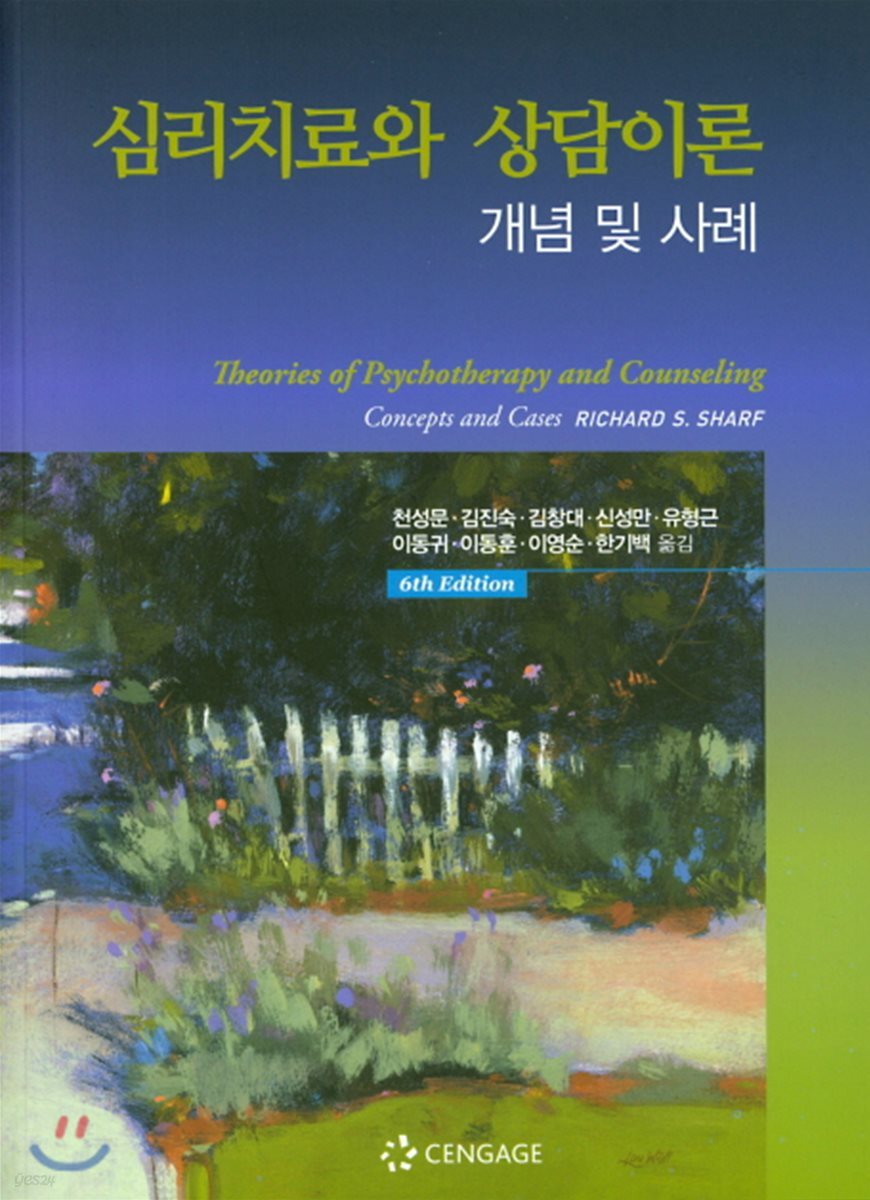
Psychotherapy and Counseling Theory: Concepts and Cases
 |
Description
Book Introduction
The major psychotherapy theories presented in this book and their background knowledge will help you understand the application of psychotherapy theories.
Understanding the personal life and philosophical influence of a theorist is important because it explains how the theorist views human behavior.
Knowing the theorist's perspective on personality provides insight into psychotherapy theory as it relates to understanding changes in behavior, thinking, or emotions.
This point is more evident than in previous editions, as it helps students think about their clients using personality theory.
In presenting the theory of psychotherapy, goals, assessment, psychotherapeutic relationship, and techniques are described.
Goals demonstrate aspects of human behavior that theorists consider most important, and assessments relate to the theorists' goals and include summative assessments and interview approaches.
Additionally, the psychotherapeutic relationship teaches techniques of change through examples of psychotherapy.
Meanwhile, information on topics related to the theory of psychotherapy was included, and research on the effectiveness of each theory was discussed in each chapter.
The results of the study are related to various methods of treating psychological disorders, but in the practice of psychotherapy, it is necessary to select and apply the psychotherapy period and approach appropriately.
We also discuss current issues facing psychotherapy theories, as well as ways in which each theory can leverage or integrate insights from other theories.
Cultural and gender differences are topics that are approached differently by different theories.
This is because understanding the client's background is very important in actual psychotherapy, although the importance of this varies from theorist to theorist.
Each chapter addresses this topic, and Chapter 13, Feminist Psychotherapy, focuses on the specifics of these topics in detail, enabling students to learn about the interplay of cultural and gender influences and psychotherapeutic methods of change.
Understanding the personal life and philosophical influence of a theorist is important because it explains how the theorist views human behavior.
Knowing the theorist's perspective on personality provides insight into psychotherapy theory as it relates to understanding changes in behavior, thinking, or emotions.
This point is more evident than in previous editions, as it helps students think about their clients using personality theory.
In presenting the theory of psychotherapy, goals, assessment, psychotherapeutic relationship, and techniques are described.
Goals demonstrate aspects of human behavior that theorists consider most important, and assessments relate to the theorists' goals and include summative assessments and interview approaches.
Additionally, the psychotherapeutic relationship teaches techniques of change through examples of psychotherapy.
Meanwhile, information on topics related to the theory of psychotherapy was included, and research on the effectiveness of each theory was discussed in each chapter.
The results of the study are related to various methods of treating psychological disorders, but in the practice of psychotherapy, it is necessary to select and apply the psychotherapy period and approach appropriately.
We also discuss current issues facing psychotherapy theories, as well as ways in which each theory can leverage or integrate insights from other theories.
Cultural and gender differences are topics that are approached differently by different theories.
This is because understanding the client's background is very important in actual psychotherapy, although the importance of this varies from theorist to theorist.
Each chapter addresses this topic, and Chapter 13, Feminist Psychotherapy, focuses on the specifics of these topics in detail, enabling students to learn about the interplay of cultural and gender influences and psychotherapeutic methods of change.
index
Translator's Preface v
Author's Preface vi
CHAPTER 1 Introduction … … … … … … … … … … … … … … … … … … … … … … … … … … … … … … … … … … … … … … … … … … … … 1
Theory 2
Accuracy and Clarity 3
Inclusivity 3
Verifiability 3
Usefulness 3
Psychotherapy and Counseling 4
Psychotherapy and Counseling Theory 5
Psychoanalysis 7
Jungian Analysis and Psychotherapy 7
Adlerian Psychotherapy 8
Existential Psychotherapy 8
Person-Centered Psychotherapy 8
Gestalt Psychotherapy 8
Behavioral Psychotherapy 9
Rational Emotive Behavioral Therapy 9
Cognitive Psychotherapy 9
Reality Psychotherapy 10
Constructivist Psychotherapy 10
Feminist Psychotherapy 10
Family Therapy 11
Other Psychotherapy 11
Integrative Psychotherapy 11
Structure of this book 12
History and Background 13
Conceptualization using personality theory 13
Psychotherapy Theory 14
Psychological Disorder 14
Short-term psychotherapy 20
Latest Trends 20
Using One Theory with Another 24
Study 24
Sexuality Topic 26
Multiculturalism Topic 26
Group Psychotherapy 27
Ethics 27
My Psychotherapy and Counseling Theory 28
Reader's Psychotherapy and Counseling Theory 29
Exercise 29
Recommended Resources 30
CHAPTER 2 Psychoanalysis … ...
History of Psychoanalysis 32
Freud's Drive Theory 36
Drive and Impulse 37
Level 37 of Consciousness
Personality Structure 38
Defense Mechanism 40
Psychosexual Development Stage 42
Ego Psychology 44
Anna Freud 45
Erik Erikson 45
Object Relations Psychology 47
Donald Winnicott 48
Otto Kernberg 49
Kohut's Self-Psychology 50
Relational Psychoanalysis 53
Psychoanalytic Approaches to Treatment 55
Psychotherapy Goal 55
Rating 56
Psychoanalysis, Psychotherapy, Psychoanalytic Counseling 57
Free Association 57
Therapeutic Neutrality and Empathy 58
Resistance 59
Interpretation 60
Dream Analysis 60
Interpretation and Analysis of Transition 62
Reversal 63
Relational Response 64
Psychological Disorder 64
Treatment of Hysteria: Katharina 65
Childhood Anxiety: Mary 67
Borderline Personality Disorder: Mr. R, 69
Narcissistic Personality Disorder: Mr. J, 71
Depression: Sam 73
Short-Term Psychoanalytic Psychotherapy 74
Latest Trends 78
Using Psychoanalysis with Other Psychotherapeutic Theories 80
Study 80
Sexuality Topic 84
Multiculturalism Topic 85
Group Counseling 87
Summary 89
Practice 90
Recommended Resources 90
CHAPTER 3 Jungian Analysis and Psychotherapy … … … … … … … … … … … … … … … … … … … … … … … … … … 92
A History of Jungian Analysis and Psychotherapy 93
Conceptualization using Jung's personality theory 97
Stage 98 of Consciousness
Circle 100
Personality Attitudes and Functions 103
Personality Development 107
Jungian Analysis and Psychotherapy 109
Psychotherapy Goal 109
Analysis, Psychotherapy, Counseling 110
Rating 110
Therapeutic Relationship 113
Stage 114 of Psychotherapy
Dream Analysis 114
Active Imagination 119
Other techniques 120
Transference and Countertransference 120
Psychological Disorder 122
Depression: Young Women 123
Anxiety Disorder: Girl 124
Borderline Disorder: Ed 126
Psychotic Disorder: Client 127
Short-Term Psychotherapy 127
Latest Trends 128
Using Jungian Analysis and Psychotherapy with Other Psychotherapeutic Theories 129
Study 130
Sexual Topics 131
Multiculturalism Topic 133
Group Psychotherapy 135
Summary 136
Exercise 137
Recommended Resources 137
CHAPTER 4 Adlerian Psychotherapy … … … … … … … … … … … … … … … … … … … … … … … … … … … … … … … 138
History of Adlerian Theory 139
140 People Who Influenced Adlerian Psychology and Psychotherapy
Conceptualization using Adlerian personality theory 142
Lifestyle 142
Social Interest 143
Inferiority and Superiority 144
Birth rank 146
Adlerian Psychotherapy and Counseling 147
Goals of Treatment and Counseling 147
Therapeutic Relationship 148
Evaluation and Analysis 149
Insights and Interpretations 154
Reorientation 156
Psychological Disorder 162
Depression: Sherry 162
Generalized Anxiety Disorder: Roberts 166
Eating Disorders: Judy 167
Borderline Disorder: Jane 168
Short-term psychotherapy 169
Latest Trends 170
Using Adlerian Psychotherapy with Other Psychotherapy Theories 171
Study 172
Sexuality-related topics 174
Multiculturalism Topic 175
Group Counseling and Psychotherapy 176
Summary 177
Practice 178
Recommended Resources 178
CHAPTER 5 Existential Psychotherapy … … … … … … … … … … … … … … … … … … … … … … … … … … … … … 179
A History of Existential Psychotherapy 180
Existentialist Philosopher 180
The founder of existential psychotherapy 183
Recent Contributors to Existential Psychotherapy 185
Conceptualization using existential personality theory 186
Existence in the World 187
Four Ways of Being 188
Time and Existence 189
Anxiety 191
Life and Death 192
Freedom, Responsibility, and Choice 193
Alienation and Love 194
Meaning and Meaninglessness 195
Self-Transcendence 196
Pursuit of Sincerity 197
The Development of Honesty and Values 198
Existential Psychotherapy 199
Goals of Existential Psychotherapy 199
Existential Psychotherapy and Counseling 200
Rating 200
Therapeutic Relationship 202
Life and Death 205
Freedom, Responsibility, and Choice 207
Alienation and Love 211
Meaning and Meaninglessness 211
Psychological Disorder 213
Anxiety: Natalie and Her Son 213
Depression: Catherine 216
Borderline Disorder: Anna 217
Obsessive-Compulsive Disorder: Female Client 218
Alcoholism: Harry 219
Short-term psychotherapy 220
Latest Trends 222
Using Existential Psychotherapy with Other Psychotherapeutic Theories 223
Study 224
Sexual Topics 225
Multiculturalism-related Topic 226
Group Counseling and Psychotherapy 228
Life and Death 228
Freedom, Responsibility, and Choice 229
Alienation and Love 229
Meaning and Meaninglessness 230
Summary 230
Exercise 231
Recommended Resources 231
CHAPTER 6 Person-Centered Psychotherapy … ...
A History of Person-Centered Psychotherapy 234
Conceptualization using human-centered personality theory 239
Psychological Development 239
Development and Conditioning 240
Self-Respect and Relationships 241
Fully Functioning Person 241
Person-Centered Psychotherapy Theory 242
Psychotherapy Goal 242
Rating 243
Nondirective attitude 243
Necessary and Sufficient Conditions for Client Change 244
Client Experiences in Therapy 249
The Process of Person-Centered Therapy 252
Psychological Disorder 253
Depression: Graduate Student 253
Application of Theory 255
Grief and Loss: Justin 255
Anxiety and Fear: Tony 257
Short-term psychotherapy 260
Latest Trends 260
Social Implications 260
Theoretical Purity vs. Eclecticism 261
Training Trends 262
Using Person-Centered Psychotherapy with Other Psychotherapy Theories 262
Study 263
Study on Key Conditions 264
The Effectiveness of Person-Centered Therapy 265
Sexuality-related topics 267
Multiculturalism-related topics 267
Group Counseling 269
Summary 270
Practice 271
Recommended Resources 272
CHAPTER 7 Gestalt Psychotherapy: Experiential Psychotherapy … … … … … … … … … … … … … … … … 273
The History of Gestalt Psychotherapy 274
Theorists and Theoretical Approaches That Influenced the Development of Gestalt Psychotherapy 277
Conceptualization using Gestalt personality theory 279
Gestalt Psychology and Gestalt Psychotherapy 280
Contact 281
Contact boundary 283
Contact boundary disorder 284
Awareness 285
Currently 287
Gestalt Psychotherapy Theory 287
Treatment Goal 288
Therapeutic Relationship 289
Assessment in Gestalt Therapy 290
Therapeutic Change 291
Increasing Awareness 292
Integration and Creativity 303
Risk 304
Psychological Disorder 305
Depression: Female 305
Anxiety: Male 307
Post-Traumatic Stress Disorder: 308 Holocaust Survivors
Drug Abuse: Mike 308
Short-Term Psychotherapy 309
Latest Trends 310
Using Gestalt Therapy with Other Psychotherapy Theories 311
Study 312
Sexuality-related topics 314
Multiculturalism-related Topic 316
Group Counseling 317
Summary 319
Practice 320
Recommended Resources 320
CHAPTER 8 BEHAVIORAL PSYCHOTHERAPY … ...
History of Behavioral Psychotherapy 322
Classical Conditioning 322
Operant Conditioning 323
Social Cognitive Theory 324
Current Trends in Behavioral Therapy 325
Conceptualization using behaviorist personality theory 326
Static reinforcement 327
Talisman Reinforcement 328
Elimination 328
Generalization 328
Discrimination 329
Sculpture 329
Observational Learning 329
Behavioral Therapy Theory 331
Goals of Behavioral Therapy 332
Behavioral Assessment 332
General Psychotherapy Methods 334
Systematic desensitization 335
Imagination Flood Method 338
Field-Based Psychotherapy 339
Virtual Reality Therapy 340
Modeling Techniques 342
Self-Instruction Training: A Cognitive-Behavioral Approach 344
Stress Prevention: A Cognitive-Behavioral Approach 344
Psychological Disorder 347
Generalized Anxiety Disorder: Claire 347
Depression: Jane 351
Obsessive-compulsive disorder: Jun 352
Phobic Disorder: 355 Six-Year-Old Girl
Short-term psychotherapy 356
Latest Trends 356
Behavioral Activation 357
Eye Movement Desensitization and Reprocessing Therapy 358
Dialectical Behavior Therapy 360
Ethical Topics 365
Using Behavioral Psychotherapy with Other Psychotherapy Theories 366
Study 367
Evidence Review 367
Obsessive-compulsive disorder 368
Generalized Anxiety Disorder 368
Phobia 369
Sexual Topics 371
Multiculturalism-related Topics 372
Group Psychotherapy 373
Social Skills Training 374
Claim Training 375
Summary 375
Exercise 376
Recommended Resources 377
CHAPTER 9 Rational Emotive Behavioral Psychotherapy … … … … … … … … … … … … … … … … … … … … … … … … … … 378
The History of Rational Emotive Behavior Therapy (REBT) 379
Rational Emotive Behavior Approach to Conceptualization 382
Philosophical Perspectives 382
Conceptualizing the Theory of Rational Emotive Action: Fundamental Factors 384
Conceptualization using the ABC of Rational Emotive Behavior personality theory 386
Rational Emotive Behavior Psychotherapy Theory 390
Goals of Psychotherapy 390
Rating 391
Therapeutic Relationship 394
ABCDE Psychotherapeutic Approach 394
Other cognitive techniques 400
Emotional Techniques 402
Behavioral Techniques 403
Insight 405
Psychological Disorder 405
Anxiety Disorders: TED 406
Depression: Penny 410
Obsessive-Compulsive Disorder: Women 411
Alcohol and Drug Addiction 411
Short-Term Psychotherapy 413
Latest Trends 414
Using Rational Emotive Behavior Psychotherapy with Other Psychotherapy Theories 415
Study 415
Sexuality-related topics 418
Multicultural Topic 421
Group Psychotherapy 422
Summary 423
Exercise 424
Recommended Resources 425
CHAPTER 10 Cognitive Psychotherapy … ...
A History of Cognitive Psychotherapy 427
Influence of Other Theories 428
Recent Impact 430
Conceptualization using cognitive psychotherapy personality theory 430
Psychological Disorders and Causality 431
Automatic Thoughts 431
A Cognitive Model of Schema Development 431
Cognitive Schema in Therapy 433
Cognitive Distortion 434
Cognitive Psychotherapy Theory 436
Goals of Psychotherapy 437
Assessment in Cognitive Psychotherapy 438
Therapeutic Relationship 442
Treatment Process 443
Therapeutic Techniques 445
Cognitive-Based Therapy Approaches to Psychological Disorders 449
Depression: Paul 449
Generalized Anxiety Disorder: Amy 452
Obsessive-Compulsive Disorder: Electrical Engineer 454
Drug Abuse: Bill 457
Brief Cognitive Therapy 460
Latest Trends 461
Mindfulness-Based Cognitive Therapy 461
Schema-Based Cognitive Therapy 462
Church Manual 464
Using Cognitive Psychotherapy with Other Psychotherapy Theories 465
Study 466
Depression Study 466
Generalized Anxiety Disorder Study 468
Obsessive-Compulsive Disorder Study 469
Sexuality-related topics 470
Multiculturalism Topic 471
Group Psychotherapy 472
Summary 474
Practice 475
Recommended Resources 475
CHAPTER 11 Reality Psychotherapy … ...
A History of Reality Therapy 478
Conceptualization using Selective Personality Theory 481
Reality Painting 481
Desire 482
Selection 483
Action 483
Choosing Action 484
Reality Therapy Theory 485
Goals of Reality Therapy 486
Rating: 486
The Process of Reality Therapy 488
Therapist Attitudes: Using WDEP 496
Reality Therapy Techniques 497
Psychological Disorder 502
Eating Disorders: Choosing to Empty Yourself by Starving or Vomiting: Gloria 503
Choices About Drug Addiction: Janet 509
Choosing to Feel Depressed: Teresa 511
Choosing to Be Anxious: Randy 513
Latest Trends 514
Using Reality Psychotherapy with Other Psychotherapy Theories 515
Study 516
Sexuality-related topics 518
Multiculturalism-related Topics 519
Group Counseling 520
Summary 521
Practice 522
Recommended Resources 522
CHAPTER 12 Constructivist Psychotherapy … … … … … … … … … … … … … … … … … … … … … … … … … … … … … … … 523
A History of Constructivist Psychotherapy 524
Initial Impact 525
George Kelly 525
Milton Erickson 526
Early Family Psychotherapy Approach 527
Recent Constructivist Psychotherapy 528
Solution-Focused Psychotherapy 529
Perspectives on Therapeutic Change 530
Rating: 530
Goal 531
Solution-Focused Psychotherapy Techniques 532
Rosie's Case 538
Narrative Psychotherapy 542
Individual Psychotherapy 542
Berry's Case 543
Epston and White's Narrative Psychotherapy 545
Rating: 546
Goal 546
Narrative Psychotherapy Techniques 547
Terry's Case 550
Latest Trends 553
Using Constructivist Psychotherapy with Other Psychotherapy Theories 554
Study 555
Solution-Focused Psychotherapy 555
Narrative Psychotherapy 557
Sexuality-related topics 558
Multiculturalism Topic 559
Group Psychotherapy 560
Summary 561
Practice 562
Recommended Resources 563
CHAPTER 13 Feminist Psychotherapy: A Multicultural Approach … … … … … … … … … … … … … … … … … 564
Gender as a Multicultural Issue 565
A History of Feminist Therapy 566
Conceptualization using feminist personality theory 570
Differences and Similarities Between the Genders in Lifelong Development 571
Schema Theory and Multiple Identities 574
Gilligan's Ethics of Care 576
Relationship Culture Model 577
Feminist Psychotherapy Theory 579
Goals of Feminist Therapy 580
Issues of Measurement and Assessment in Feminist Therapy 582
Therapeutic Relationship 582
Feminist Therapy Techniques 583
Using Feminist Psychotherapy with Other Psychotherapeutic Theories 592
Feminist Psychoanalytic Psychotherapy 593
Feminist Cognitive-Behavioral Psychotherapy 594
Feminist Gestalt Psychotherapy 595
Feminist Narrative Psychotherapy 595
Feminist Psychotherapy and Counseling 596
Short-term psychotherapy 597
Psychological Disorder 597
Borderline Personality Disorder: Barbara 598
Psychotherapy and Counseling Theory (6th Edition)_Chapter 00, Preface.indd 25 2019-01-27 10:29:47 PM
xxvi Psychotherapy and Counseling Theory: Concepts and Cases
Depression: Mr. B 600
Post-traumatic stress disorder: Andrea 602
Eating Disorders: Margaret 604
Latest Trends and Issues 606
Study 608
Sexuality-related topics 609
Feminist Therapy for Men 610
Feminist Therapy with Gay, Lesbian, Bisexual, and Transgender Clients 611
Multiculturalism-related Topics 613
Group Counseling 615
Summary 617
Practice 618
Recommended Resources 618
CHAPTER 14 FAMILY THERAPY … ...
Historical Background 620
Initial Approaches to Family Counseling 621
Impacts Associated with Psychoanalytic Family Therapy 621
A study on communication styles in family members with schizophrenia 622
General Systems Theory 624
Bowen's Multigenerational Approach 626
Family Systems Theory 626
Treatment Goal 629
Bowen's Family Therapy Techniques 629
Multigenerational Family Systems Therapy Case Study: Anne's Family 631
Structural Family Therapy 633
Concepts of Structural Family Therapy 633
Goals of Structural Family Therapy 635
Techniques of Structural Family Therapy 635
Structural Family Therapy Case Study: Family Exploration 638
Strategic Family Therapy 642
Concepts of Strategic Family Therapy 642
Goal 643
Strategic Family Therapy Techniques 643
A Case Study of Strategic Therapy: The Fire Boy 646
Experiential Family Therapy and Humanistic Family Therapy 648
Carl Whitaker's Experiential Therapy 648
Virginia Satir's Humanistic Approach 649
An Integrative Approach to Family Systems Therapy 651
Individual Therapy Theory Applied to Family Therapy 652
Psychoanalysis 652
Adlerian Psychotherapy 653
Existential Psychotherapy 653
Person-Centered Psychotherapy 653
Gestalt Psychotherapy 653
Behavioral Psychotherapy 654
Rational Emotive Behavioral Therapy 654
Cognitive Psychotherapy 654
Reality Psychotherapy 655
Feminist Psychotherapy 655
Brief Family Systems Therapy 656
The Mental Research Institute's Short-Term Family Therapy Model 656
Long-term and short-term treatment of the Milan School 657
Latest Trends 659
Psychoeducational Approach 659
Professional Training and Organization 660
Family Law 660
Medicine 660
Study 661
Sexuality-related topics 665
Multiculturalism-related topic 666
Using Family Systems Therapy with Individuals 668
Couples Counseling 669
Summary 669
Practice 670
Recommended Resources 670
CHAPTER 15 Other Psychotherapies … ...
Oriental Psychotherapy 672
Background 672
Eastern personality theories 674
Eastern Psychotherapy Theory 675
Summary 682
Acceptance and Commitment Therapy (ACT) 683
Background 683
Acceptance and Commitment Psychotherapy Theory 684
Acceptance and Commitment Psychotherapy Techniques and Methods 686
Case Example 693
A Study on Acceptance and Commitment Psychotherapy 694
Summary 694
Relationship-Focused Psychotherapy 695
Background 695
Personality Theory 698
Goal 699
Techniques of Relationship-Centered Psychotherapy 702
Case Study 705 of Relationship-Centered Psychotherapy
Application of Relationship-Centered Psychotherapy 707
Summary 708
Psychodrama 708
Background 708
Personality Theory 709
Psychotherapy Theory 711
Summary 716
Creative Arts Psychotherapy 716
Art Psychotherapy 717
Dance Psychotherapy 720
Drama Psychotherapy 721
Music Psychotherapy 723
Summary 724
Summary 725
Practice 725
CHAPTER 16 Integrative Psychotherapy … … … … … … … … … … … … … … … … … … … … … … … … … … … … … … … … … … … … 726
Wachtel's Circular Psychodynamic Theory 728
A Case Study of Wachtel's Circular Psychodynamic Theory: Judy 730
A Case Study of Wachtel's Circular Psychodynamic Theory: John 730
Using Wachtel's Circular Psychodynamic Theory as a Model for Integrative Theory 732
Prochaska and colleagues' transtheoretical approach 734
Stage 734 of Change
Level 735 of psychological problems
Change Process 735
Stages of change, levels of psychological problems, and integration of the change process 737
A Case Study of Prochaska and Co-workers' Transtheoretical Approach: Mrs. C 738
Using Prochaska and colleagues' transtheoretical approach as a model for integrative theory 739
Multimodality Therapy 740
Conceptualization using multimodal personality theory 741
Psychotherapy Goal 742
Rating: 743
Treatment Approach 745
Lazarus's Multimodal Therapy Case: Mrs. W 748
Use with Lazarus's multimodal theory as a model of integrated theory 748
Latest Trends 749
Study 750
Sexuality-related topics 752
Multiculturalism-related Topics 752
Summary 753
Practice 754
Recommended Resources 755
CHAPTER 17 Comparison and Criticism … ...
757 Basic Concepts of Personality Theory Used in Case Conceptualization
Counseling Goal 760
Evaluation in Counseling 761
Counseling Techniques 762
Differentiating Applications of Psychotherapy Approaches 765
Short-term psychotherapy 766
Latest Trends 768
Common Factor Approach 768
Evidence-Based Therapy (EBT) 770
Mindfulness 770
Use with other psychotherapeutic theories 771
Study 771
Performance Study 772
Future Direction 772
Sexuality-related topics 774
Multiculturalism-related Topics 775
Family Counseling 777
Group Counseling 777
Criticism 779
Psychoanalysis 780
Jungian Analysis 781
Adlerian Psychotherapy 781
Existential Psychotherapy 782
Person-Centered Psychotherapy 782
Gestalt Psychotherapy 783
Behavioral Psychotherapy 783
Rational Emotive Behavioral Psychotherapy 784
Cognitive Psychotherapy 784
Reality Psychotherapy 785
Constructivist Psychotherapy 785
Feminist Psychotherapy 786
Family Therapy 787
Summary 788
Practice 789
Glossary 790
Search 810
Author's Preface vi
CHAPTER 1 Introduction … … … … … … … … … … … … … … … … … … … … … … … … … … … … … … … … … … … … … … … … … … … … 1
Theory 2
Accuracy and Clarity 3
Inclusivity 3
Verifiability 3
Usefulness 3
Psychotherapy and Counseling 4
Psychotherapy and Counseling Theory 5
Psychoanalysis 7
Jungian Analysis and Psychotherapy 7
Adlerian Psychotherapy 8
Existential Psychotherapy 8
Person-Centered Psychotherapy 8
Gestalt Psychotherapy 8
Behavioral Psychotherapy 9
Rational Emotive Behavioral Therapy 9
Cognitive Psychotherapy 9
Reality Psychotherapy 10
Constructivist Psychotherapy 10
Feminist Psychotherapy 10
Family Therapy 11
Other Psychotherapy 11
Integrative Psychotherapy 11
Structure of this book 12
History and Background 13
Conceptualization using personality theory 13
Psychotherapy Theory 14
Psychological Disorder 14
Short-term psychotherapy 20
Latest Trends 20
Using One Theory with Another 24
Study 24
Sexuality Topic 26
Multiculturalism Topic 26
Group Psychotherapy 27
Ethics 27
My Psychotherapy and Counseling Theory 28
Reader's Psychotherapy and Counseling Theory 29
Exercise 29
Recommended Resources 30
CHAPTER 2 Psychoanalysis … ...
History of Psychoanalysis 32
Freud's Drive Theory 36
Drive and Impulse 37
Level 37 of Consciousness
Personality Structure 38
Defense Mechanism 40
Psychosexual Development Stage 42
Ego Psychology 44
Anna Freud 45
Erik Erikson 45
Object Relations Psychology 47
Donald Winnicott 48
Otto Kernberg 49
Kohut's Self-Psychology 50
Relational Psychoanalysis 53
Psychoanalytic Approaches to Treatment 55
Psychotherapy Goal 55
Rating 56
Psychoanalysis, Psychotherapy, Psychoanalytic Counseling 57
Free Association 57
Therapeutic Neutrality and Empathy 58
Resistance 59
Interpretation 60
Dream Analysis 60
Interpretation and Analysis of Transition 62
Reversal 63
Relational Response 64
Psychological Disorder 64
Treatment of Hysteria: Katharina 65
Childhood Anxiety: Mary 67
Borderline Personality Disorder: Mr. R, 69
Narcissistic Personality Disorder: Mr. J, 71
Depression: Sam 73
Short-Term Psychoanalytic Psychotherapy 74
Latest Trends 78
Using Psychoanalysis with Other Psychotherapeutic Theories 80
Study 80
Sexuality Topic 84
Multiculturalism Topic 85
Group Counseling 87
Summary 89
Practice 90
Recommended Resources 90
CHAPTER 3 Jungian Analysis and Psychotherapy … … … … … … … … … … … … … … … … … … … … … … … … … … 92
A History of Jungian Analysis and Psychotherapy 93
Conceptualization using Jung's personality theory 97
Stage 98 of Consciousness
Circle 100
Personality Attitudes and Functions 103
Personality Development 107
Jungian Analysis and Psychotherapy 109
Psychotherapy Goal 109
Analysis, Psychotherapy, Counseling 110
Rating 110
Therapeutic Relationship 113
Stage 114 of Psychotherapy
Dream Analysis 114
Active Imagination 119
Other techniques 120
Transference and Countertransference 120
Psychological Disorder 122
Depression: Young Women 123
Anxiety Disorder: Girl 124
Borderline Disorder: Ed 126
Psychotic Disorder: Client 127
Short-Term Psychotherapy 127
Latest Trends 128
Using Jungian Analysis and Psychotherapy with Other Psychotherapeutic Theories 129
Study 130
Sexual Topics 131
Multiculturalism Topic 133
Group Psychotherapy 135
Summary 136
Exercise 137
Recommended Resources 137
CHAPTER 4 Adlerian Psychotherapy … … … … … … … … … … … … … … … … … … … … … … … … … … … … … … … 138
History of Adlerian Theory 139
140 People Who Influenced Adlerian Psychology and Psychotherapy
Conceptualization using Adlerian personality theory 142
Lifestyle 142
Social Interest 143
Inferiority and Superiority 144
Birth rank 146
Adlerian Psychotherapy and Counseling 147
Goals of Treatment and Counseling 147
Therapeutic Relationship 148
Evaluation and Analysis 149
Insights and Interpretations 154
Reorientation 156
Psychological Disorder 162
Depression: Sherry 162
Generalized Anxiety Disorder: Roberts 166
Eating Disorders: Judy 167
Borderline Disorder: Jane 168
Short-term psychotherapy 169
Latest Trends 170
Using Adlerian Psychotherapy with Other Psychotherapy Theories 171
Study 172
Sexuality-related topics 174
Multiculturalism Topic 175
Group Counseling and Psychotherapy 176
Summary 177
Practice 178
Recommended Resources 178
CHAPTER 5 Existential Psychotherapy … … … … … … … … … … … … … … … … … … … … … … … … … … … … … 179
A History of Existential Psychotherapy 180
Existentialist Philosopher 180
The founder of existential psychotherapy 183
Recent Contributors to Existential Psychotherapy 185
Conceptualization using existential personality theory 186
Existence in the World 187
Four Ways of Being 188
Time and Existence 189
Anxiety 191
Life and Death 192
Freedom, Responsibility, and Choice 193
Alienation and Love 194
Meaning and Meaninglessness 195
Self-Transcendence 196
Pursuit of Sincerity 197
The Development of Honesty and Values 198
Existential Psychotherapy 199
Goals of Existential Psychotherapy 199
Existential Psychotherapy and Counseling 200
Rating 200
Therapeutic Relationship 202
Life and Death 205
Freedom, Responsibility, and Choice 207
Alienation and Love 211
Meaning and Meaninglessness 211
Psychological Disorder 213
Anxiety: Natalie and Her Son 213
Depression: Catherine 216
Borderline Disorder: Anna 217
Obsessive-Compulsive Disorder: Female Client 218
Alcoholism: Harry 219
Short-term psychotherapy 220
Latest Trends 222
Using Existential Psychotherapy with Other Psychotherapeutic Theories 223
Study 224
Sexual Topics 225
Multiculturalism-related Topic 226
Group Counseling and Psychotherapy 228
Life and Death 228
Freedom, Responsibility, and Choice 229
Alienation and Love 229
Meaning and Meaninglessness 230
Summary 230
Exercise 231
Recommended Resources 231
CHAPTER 6 Person-Centered Psychotherapy … ...
A History of Person-Centered Psychotherapy 234
Conceptualization using human-centered personality theory 239
Psychological Development 239
Development and Conditioning 240
Self-Respect and Relationships 241
Fully Functioning Person 241
Person-Centered Psychotherapy Theory 242
Psychotherapy Goal 242
Rating 243
Nondirective attitude 243
Necessary and Sufficient Conditions for Client Change 244
Client Experiences in Therapy 249
The Process of Person-Centered Therapy 252
Psychological Disorder 253
Depression: Graduate Student 253
Application of Theory 255
Grief and Loss: Justin 255
Anxiety and Fear: Tony 257
Short-term psychotherapy 260
Latest Trends 260
Social Implications 260
Theoretical Purity vs. Eclecticism 261
Training Trends 262
Using Person-Centered Psychotherapy with Other Psychotherapy Theories 262
Study 263
Study on Key Conditions 264
The Effectiveness of Person-Centered Therapy 265
Sexuality-related topics 267
Multiculturalism-related topics 267
Group Counseling 269
Summary 270
Practice 271
Recommended Resources 272
CHAPTER 7 Gestalt Psychotherapy: Experiential Psychotherapy … … … … … … … … … … … … … … … … 273
The History of Gestalt Psychotherapy 274
Theorists and Theoretical Approaches That Influenced the Development of Gestalt Psychotherapy 277
Conceptualization using Gestalt personality theory 279
Gestalt Psychology and Gestalt Psychotherapy 280
Contact 281
Contact boundary 283
Contact boundary disorder 284
Awareness 285
Currently 287
Gestalt Psychotherapy Theory 287
Treatment Goal 288
Therapeutic Relationship 289
Assessment in Gestalt Therapy 290
Therapeutic Change 291
Increasing Awareness 292
Integration and Creativity 303
Risk 304
Psychological Disorder 305
Depression: Female 305
Anxiety: Male 307
Post-Traumatic Stress Disorder: 308 Holocaust Survivors
Drug Abuse: Mike 308
Short-Term Psychotherapy 309
Latest Trends 310
Using Gestalt Therapy with Other Psychotherapy Theories 311
Study 312
Sexuality-related topics 314
Multiculturalism-related Topic 316
Group Counseling 317
Summary 319
Practice 320
Recommended Resources 320
CHAPTER 8 BEHAVIORAL PSYCHOTHERAPY … ...
History of Behavioral Psychotherapy 322
Classical Conditioning 322
Operant Conditioning 323
Social Cognitive Theory 324
Current Trends in Behavioral Therapy 325
Conceptualization using behaviorist personality theory 326
Static reinforcement 327
Talisman Reinforcement 328
Elimination 328
Generalization 328
Discrimination 329
Sculpture 329
Observational Learning 329
Behavioral Therapy Theory 331
Goals of Behavioral Therapy 332
Behavioral Assessment 332
General Psychotherapy Methods 334
Systematic desensitization 335
Imagination Flood Method 338
Field-Based Psychotherapy 339
Virtual Reality Therapy 340
Modeling Techniques 342
Self-Instruction Training: A Cognitive-Behavioral Approach 344
Stress Prevention: A Cognitive-Behavioral Approach 344
Psychological Disorder 347
Generalized Anxiety Disorder: Claire 347
Depression: Jane 351
Obsessive-compulsive disorder: Jun 352
Phobic Disorder: 355 Six-Year-Old Girl
Short-term psychotherapy 356
Latest Trends 356
Behavioral Activation 357
Eye Movement Desensitization and Reprocessing Therapy 358
Dialectical Behavior Therapy 360
Ethical Topics 365
Using Behavioral Psychotherapy with Other Psychotherapy Theories 366
Study 367
Evidence Review 367
Obsessive-compulsive disorder 368
Generalized Anxiety Disorder 368
Phobia 369
Sexual Topics 371
Multiculturalism-related Topics 372
Group Psychotherapy 373
Social Skills Training 374
Claim Training 375
Summary 375
Exercise 376
Recommended Resources 377
CHAPTER 9 Rational Emotive Behavioral Psychotherapy … … … … … … … … … … … … … … … … … … … … … … … … … … 378
The History of Rational Emotive Behavior Therapy (REBT) 379
Rational Emotive Behavior Approach to Conceptualization 382
Philosophical Perspectives 382
Conceptualizing the Theory of Rational Emotive Action: Fundamental Factors 384
Conceptualization using the ABC of Rational Emotive Behavior personality theory 386
Rational Emotive Behavior Psychotherapy Theory 390
Goals of Psychotherapy 390
Rating 391
Therapeutic Relationship 394
ABCDE Psychotherapeutic Approach 394
Other cognitive techniques 400
Emotional Techniques 402
Behavioral Techniques 403
Insight 405
Psychological Disorder 405
Anxiety Disorders: TED 406
Depression: Penny 410
Obsessive-Compulsive Disorder: Women 411
Alcohol and Drug Addiction 411
Short-Term Psychotherapy 413
Latest Trends 414
Using Rational Emotive Behavior Psychotherapy with Other Psychotherapy Theories 415
Study 415
Sexuality-related topics 418
Multicultural Topic 421
Group Psychotherapy 422
Summary 423
Exercise 424
Recommended Resources 425
CHAPTER 10 Cognitive Psychotherapy … ...
A History of Cognitive Psychotherapy 427
Influence of Other Theories 428
Recent Impact 430
Conceptualization using cognitive psychotherapy personality theory 430
Psychological Disorders and Causality 431
Automatic Thoughts 431
A Cognitive Model of Schema Development 431
Cognitive Schema in Therapy 433
Cognitive Distortion 434
Cognitive Psychotherapy Theory 436
Goals of Psychotherapy 437
Assessment in Cognitive Psychotherapy 438
Therapeutic Relationship 442
Treatment Process 443
Therapeutic Techniques 445
Cognitive-Based Therapy Approaches to Psychological Disorders 449
Depression: Paul 449
Generalized Anxiety Disorder: Amy 452
Obsessive-Compulsive Disorder: Electrical Engineer 454
Drug Abuse: Bill 457
Brief Cognitive Therapy 460
Latest Trends 461
Mindfulness-Based Cognitive Therapy 461
Schema-Based Cognitive Therapy 462
Church Manual 464
Using Cognitive Psychotherapy with Other Psychotherapy Theories 465
Study 466
Depression Study 466
Generalized Anxiety Disorder Study 468
Obsessive-Compulsive Disorder Study 469
Sexuality-related topics 470
Multiculturalism Topic 471
Group Psychotherapy 472
Summary 474
Practice 475
Recommended Resources 475
CHAPTER 11 Reality Psychotherapy … ...
A History of Reality Therapy 478
Conceptualization using Selective Personality Theory 481
Reality Painting 481
Desire 482
Selection 483
Action 483
Choosing Action 484
Reality Therapy Theory 485
Goals of Reality Therapy 486
Rating: 486
The Process of Reality Therapy 488
Therapist Attitudes: Using WDEP 496
Reality Therapy Techniques 497
Psychological Disorder 502
Eating Disorders: Choosing to Empty Yourself by Starving or Vomiting: Gloria 503
Choices About Drug Addiction: Janet 509
Choosing to Feel Depressed: Teresa 511
Choosing to Be Anxious: Randy 513
Latest Trends 514
Using Reality Psychotherapy with Other Psychotherapy Theories 515
Study 516
Sexuality-related topics 518
Multiculturalism-related Topics 519
Group Counseling 520
Summary 521
Practice 522
Recommended Resources 522
CHAPTER 12 Constructivist Psychotherapy … … … … … … … … … … … … … … … … … … … … … … … … … … … … … … … 523
A History of Constructivist Psychotherapy 524
Initial Impact 525
George Kelly 525
Milton Erickson 526
Early Family Psychotherapy Approach 527
Recent Constructivist Psychotherapy 528
Solution-Focused Psychotherapy 529
Perspectives on Therapeutic Change 530
Rating: 530
Goal 531
Solution-Focused Psychotherapy Techniques 532
Rosie's Case 538
Narrative Psychotherapy 542
Individual Psychotherapy 542
Berry's Case 543
Epston and White's Narrative Psychotherapy 545
Rating: 546
Goal 546
Narrative Psychotherapy Techniques 547
Terry's Case 550
Latest Trends 553
Using Constructivist Psychotherapy with Other Psychotherapy Theories 554
Study 555
Solution-Focused Psychotherapy 555
Narrative Psychotherapy 557
Sexuality-related topics 558
Multiculturalism Topic 559
Group Psychotherapy 560
Summary 561
Practice 562
Recommended Resources 563
CHAPTER 13 Feminist Psychotherapy: A Multicultural Approach … … … … … … … … … … … … … … … … … 564
Gender as a Multicultural Issue 565
A History of Feminist Therapy 566
Conceptualization using feminist personality theory 570
Differences and Similarities Between the Genders in Lifelong Development 571
Schema Theory and Multiple Identities 574
Gilligan's Ethics of Care 576
Relationship Culture Model 577
Feminist Psychotherapy Theory 579
Goals of Feminist Therapy 580
Issues of Measurement and Assessment in Feminist Therapy 582
Therapeutic Relationship 582
Feminist Therapy Techniques 583
Using Feminist Psychotherapy with Other Psychotherapeutic Theories 592
Feminist Psychoanalytic Psychotherapy 593
Feminist Cognitive-Behavioral Psychotherapy 594
Feminist Gestalt Psychotherapy 595
Feminist Narrative Psychotherapy 595
Feminist Psychotherapy and Counseling 596
Short-term psychotherapy 597
Psychological Disorder 597
Borderline Personality Disorder: Barbara 598
Psychotherapy and Counseling Theory (6th Edition)_Chapter 00, Preface.indd 25 2019-01-27 10:29:47 PM
xxvi Psychotherapy and Counseling Theory: Concepts and Cases
Depression: Mr. B 600
Post-traumatic stress disorder: Andrea 602
Eating Disorders: Margaret 604
Latest Trends and Issues 606
Study 608
Sexuality-related topics 609
Feminist Therapy for Men 610
Feminist Therapy with Gay, Lesbian, Bisexual, and Transgender Clients 611
Multiculturalism-related Topics 613
Group Counseling 615
Summary 617
Practice 618
Recommended Resources 618
CHAPTER 14 FAMILY THERAPY … ...
Historical Background 620
Initial Approaches to Family Counseling 621
Impacts Associated with Psychoanalytic Family Therapy 621
A study on communication styles in family members with schizophrenia 622
General Systems Theory 624
Bowen's Multigenerational Approach 626
Family Systems Theory 626
Treatment Goal 629
Bowen's Family Therapy Techniques 629
Multigenerational Family Systems Therapy Case Study: Anne's Family 631
Structural Family Therapy 633
Concepts of Structural Family Therapy 633
Goals of Structural Family Therapy 635
Techniques of Structural Family Therapy 635
Structural Family Therapy Case Study: Family Exploration 638
Strategic Family Therapy 642
Concepts of Strategic Family Therapy 642
Goal 643
Strategic Family Therapy Techniques 643
A Case Study of Strategic Therapy: The Fire Boy 646
Experiential Family Therapy and Humanistic Family Therapy 648
Carl Whitaker's Experiential Therapy 648
Virginia Satir's Humanistic Approach 649
An Integrative Approach to Family Systems Therapy 651
Individual Therapy Theory Applied to Family Therapy 652
Psychoanalysis 652
Adlerian Psychotherapy 653
Existential Psychotherapy 653
Person-Centered Psychotherapy 653
Gestalt Psychotherapy 653
Behavioral Psychotherapy 654
Rational Emotive Behavioral Therapy 654
Cognitive Psychotherapy 654
Reality Psychotherapy 655
Feminist Psychotherapy 655
Brief Family Systems Therapy 656
The Mental Research Institute's Short-Term Family Therapy Model 656
Long-term and short-term treatment of the Milan School 657
Latest Trends 659
Psychoeducational Approach 659
Professional Training and Organization 660
Family Law 660
Medicine 660
Study 661
Sexuality-related topics 665
Multiculturalism-related topic 666
Using Family Systems Therapy with Individuals 668
Couples Counseling 669
Summary 669
Practice 670
Recommended Resources 670
CHAPTER 15 Other Psychotherapies … ...
Oriental Psychotherapy 672
Background 672
Eastern personality theories 674
Eastern Psychotherapy Theory 675
Summary 682
Acceptance and Commitment Therapy (ACT) 683
Background 683
Acceptance and Commitment Psychotherapy Theory 684
Acceptance and Commitment Psychotherapy Techniques and Methods 686
Case Example 693
A Study on Acceptance and Commitment Psychotherapy 694
Summary 694
Relationship-Focused Psychotherapy 695
Background 695
Personality Theory 698
Goal 699
Techniques of Relationship-Centered Psychotherapy 702
Case Study 705 of Relationship-Centered Psychotherapy
Application of Relationship-Centered Psychotherapy 707
Summary 708
Psychodrama 708
Background 708
Personality Theory 709
Psychotherapy Theory 711
Summary 716
Creative Arts Psychotherapy 716
Art Psychotherapy 717
Dance Psychotherapy 720
Drama Psychotherapy 721
Music Psychotherapy 723
Summary 724
Summary 725
Practice 725
CHAPTER 16 Integrative Psychotherapy … … … … … … … … … … … … … … … … … … … … … … … … … … … … … … … … … … … … 726
Wachtel's Circular Psychodynamic Theory 728
A Case Study of Wachtel's Circular Psychodynamic Theory: Judy 730
A Case Study of Wachtel's Circular Psychodynamic Theory: John 730
Using Wachtel's Circular Psychodynamic Theory as a Model for Integrative Theory 732
Prochaska and colleagues' transtheoretical approach 734
Stage 734 of Change
Level 735 of psychological problems
Change Process 735
Stages of change, levels of psychological problems, and integration of the change process 737
A Case Study of Prochaska and Co-workers' Transtheoretical Approach: Mrs. C 738
Using Prochaska and colleagues' transtheoretical approach as a model for integrative theory 739
Multimodality Therapy 740
Conceptualization using multimodal personality theory 741
Psychotherapy Goal 742
Rating: 743
Treatment Approach 745
Lazarus's Multimodal Therapy Case: Mrs. W 748
Use with Lazarus's multimodal theory as a model of integrated theory 748
Latest Trends 749
Study 750
Sexuality-related topics 752
Multiculturalism-related Topics 752
Summary 753
Practice 754
Recommended Resources 755
CHAPTER 17 Comparison and Criticism … ...
757 Basic Concepts of Personality Theory Used in Case Conceptualization
Counseling Goal 760
Evaluation in Counseling 761
Counseling Techniques 762
Differentiating Applications of Psychotherapy Approaches 765
Short-term psychotherapy 766
Latest Trends 768
Common Factor Approach 768
Evidence-Based Therapy (EBT) 770
Mindfulness 770
Use with other psychotherapeutic theories 771
Study 771
Performance Study 772
Future Direction 772
Sexuality-related topics 774
Multiculturalism-related Topics 775
Family Counseling 777
Group Counseling 777
Criticism 779
Psychoanalysis 780
Jungian Analysis 781
Adlerian Psychotherapy 781
Existential Psychotherapy 782
Person-Centered Psychotherapy 782
Gestalt Psychotherapy 783
Behavioral Psychotherapy 783
Rational Emotive Behavioral Psychotherapy 784
Cognitive Psychotherapy 784
Reality Psychotherapy 785
Constructivist Psychotherapy 785
Feminist Psychotherapy 786
Family Therapy 787
Summary 788
Practice 789
Glossary 790
Search 810
Publisher's Review
Translator's Preface
There is a saying in the sutras: “If a righteous person speaks a false truth, even the false truth becomes right. If a wrong person speaks a true truth, even the true truth becomes wrong.”
This would mean that, in order for counselors to truly help their clients grow and develop psychologically, they need, above all, rigorous self-discipline, self-examination, and insight.
So, we can see that the path to becoming a competent counselor is by no means easy.
While it is important to meet an excellent mentor while studying counseling, to foster personal growth and improve counseling skills, it is also crucial to carefully select basic counseling materials that will serve as a stepping stone for counseling.
This book can be said to be one that can fulfill just such a need.
This is because it covers not only traditional counseling theories and recently popular counseling approaches and trends, but also many practical aspects of counseling, allowing you to build a theoretical foundation and develop your qualifications as a counselor.
In particular, the reason for translating the 6th edition into Korean, almost six years after the translation of the 5th edition, was to introduce recent issues and research by reflecting the developments and trends in the counseling field for each theory, and to provide a rich content that can be applied to various counseling problem areas.
This book will be of great help in developing your skills as a counselor, as it provides methods for analyzing and understanding the various life problems clients may encounter during counseling sessions and finding solutions.
Additionally, it will serve as a guideline for counselors to review their counseling process from the basics when they lose their way and find it difficult to provide counseling in the counseling field.
This translation also brought together the efforts of mid-career counseling scholars who play a pivotal role in the counseling field to publish the book.
Professor Kim Jin-sook translated chapters 6 and 7, Professor Kim Chang-dae translated chapters 2 and 17, Professor Shin Seong-man translated chapters 10 and 12, Professor Yoo Hyeong-geun translated chapters 4 and 8, Professor Lee Dong-gwi translated chapters 9 and 11, Professor Lee Dong-hoon translated chapters 3 and 5, Professor Lee Yeong-sun translated chapters 14 and 16, Professor Cheon Seong-mun translated chapter 15, the introduction and glossary, and Professor Han Ki-baek translated chapters 1 and 13.
We have tried to minimize differences in translation methods and terminology that arise from multiple translators. However, we ask for readers' understanding if there are any shortcomings.
Finally, I would like to express my gratitude to President Song Seong-heon of Cengage Learning Korea, who provided both material and spiritual support for the publication of this book despite the difficulties encountered during the publishing process, to Ms. Lee Jeong-ran, who helped with proofreading and editing, and to the editorial staff.
Translators in the spring of 2019
Author's Preface
I am delighted to publish the sixth edition of this book, which explains psychotherapy and counseling theory through various case studies.
Working as a counseling psychologist at a university counseling center and teaching graduate students for over 35 years has been a valuable experience both professionally and personally.
That's why I wanted to write a book that included at least one case study in each chapter, leveraging the extensive case study material I've accumulated over the years.
Because many psychotherapy and counseling theories use different psychotherapy approaches for different psychological disorders, I felt it was important to consider differentiated psychotherapy on a case-by-case basis.
First, in order to provide a comprehensive overview of psychotherapy and counseling theory, we attempted to provide not only an explanation of the concepts but also examples of their application using case summaries and counselor-client dialogues that explain techniques and psychotherapy.
The combination of theory and case studies will provide students interested in learning about psychotherapeutic approaches with a clearer and more realistic understanding of psychotherapy and counseling.
Additionally, most theories show how individual therapy or counseling can be applied to common psychological disorders such as depression or generalized anxiety disorder.
What is particularly noteworthy about this book is that it explains how each theory can be applied to group therapy.
Although only my name appears on the cover of this book, each chapter contains the expertise of over 70 authorities on a variety of theoretical approaches to psychotherapy and counseling.
As such, this book has been written by many experts on specific theories, and each authority makes suggestions on specific content or various stages of development.
The author is responsible for the composition and presentation of each theory.
A flexible approach to accommodate different education
One thing to keep in mind when preparing your writing is that many instructors will not cover every chapter.
Additionally, the theories are arranged in a general chronological order of development, but some chapters have been excluded.
In particular, Chapter 3, ‘Jungian Analysis and Psychotherapy,’ was placed after Chapter 2, ‘Psychoanalysis.’
Because there is a close relationship between the development of these two theories.
Additionally, Chapter 13, “Feminist Psychotherapy: A Multicultural Approach,” and Chapter 14, “Family Therapy,” are placed after the main theories because they require knowledge presented in the previous chapters.
Chapter 2 Psychoanalysis is the longest and most difficult chapter.
To present the practice of modern psychoanalysis, it is necessary to explain the contributions of psychoanalysis that emerged after Freud's death, including the key points of Winnicott's theory, Kohut's theory, and relational theory.
Instructors may wish to have students spend more time reading this chapter.
Especially if students are unfamiliar with personality theory, it may be helpful to have them read a few other chapters before reading this one.
Chapter 17, "Comparison and Criticism," allows students to study and understand each theory before critiquing it.
Furthermore, because knowledge of theory provides a basis for making judgments about other theories, we attempted to provide an overview of psychotherapy theories before explaining the strengths and limitations of each theory.
Knowledge of these various theories is crucial to understanding integrative theories such as Lazarus's multimodal approach, which will be discussed in Chapter 16, "Integrative Psychotherapy."
In the revised edition, Chapter 16 is presented before Chapter 17, which summarizes the theory, to allow students to summarize what is covered in the course and see how it relates to other chapters.
Contents of each chapter
The major psychotherapy theories presented in this book and their background knowledge will help you understand the application of psychotherapy theories.
Understanding the personal life and philosophical influence of a theorist is important because it explains how the theorist views human behavior.
Knowing the theorist's perspective on personality provides insight into psychotherapy theory as it relates to understanding changes in behavior, thinking, or emotions.
This point is more evident than in previous editions, as it helps students think about their clients using personality theory.
In presenting the theory of psychotherapy, goals, assessment, psychotherapeutic relationship, and techniques are described.
Goals demonstrate aspects of human behavior that theorists consider most important, and assessments relate to the theorists' goals and include summative assessments and interview approaches.
Additionally, the psychotherapeutic relationship teaches techniques of change through examples of psychotherapy.
Meanwhile, information on topics related to the theory of psychotherapy was included, and research on the effectiveness of each theory was discussed in each chapter.
The results of the study are related to various methods of treating psychological disorders, but in the practice of psychotherapy, it is necessary to select and apply the psychotherapy period and approach appropriately.
We also discuss current issues facing psychotherapy theories, as well as ways in which each theory can leverage or integrate insights from other theories.
Cultural and gender differences are topics that are approached differently by different theories.
This is because understanding the client's background is very important in actual psychotherapy, although the importance of this varies from theorist to theorist.
Each chapter addresses this topic, and Chapter 13, Feminist Psychotherapy, focuses on the specifics of these topics in detail, enabling students to learn about the interplay of cultural and gender influences and psychotherapeutic methods of change.
Each area of application is presented in a way that allows instructors to choose freely, emphasizing some and deemphasizing others.
For example, instructors may choose not to cover certain research areas to suit their teaching objectives.
We have developed an instructor manual that includes multiple-choice and essay questions, and the textbook includes suggested topics for discussion and a glossary of terms.
New changes in the 6th edition
There are several important changes in the 6th edition.
The most significant change is that the book has been designed to be user-friendly for both students and instructors.
Changes that occurred in several chapters
I changed the order of the last two chapters.
Chapter 17 is 'Comparison and Criticism' and Chapter 16 is 'Integrated Psychotherapy', which I applied after receiving feedback from instructors.
Having a summary chapter at the end of the textbook to provide a logical conclusion and having the last chapter before the final exam would be good for providing an overview of the overall content.
● As the topic of the personality theory section, we use ‘conceptualization using personality theory’ rather than ‘personality theory’.
Because some students do not understand that the conceptualization of a client's problem is based on the theorist's personality theory.
●The term evidence-based treatment, rather than research-proven treatment or empirically supported treatment, was used to describe psychotherapy and counseling that supports studies using randomized control or controlled groups.
Changes in each chapter
●Chapter 2 'Psychoanalysis', Chapter 3 'Jungian Analysis and Psychotherapy': These are the two most difficult chapters.
Clarified and revised some parts of the book.
●Chapter 6 ‘Human-Centered Psychotherapy’: Added a case of treating a child with anxiety disorder using human-centered play therapy.
●Chapter 7 'Gestalt: Experiential Psychotherapy': Clarifies the meaning of the two-chair and empty chair techniques.
●Chapter 8 ‘Behavioral Psychotherapy’: Activating client behavior was added as a treatment method for depression.
It has been described as a way to stabilize diaphragmatic breathing.
We also added Marsha Linehan's Dialectical Behavior Therapy (DBT) to treat borderline disorder.
●Chapter 10 ‘Cognitive Psychotherapy’: The terms ‘collaborative work’ and ‘relapse prevention’ have been expanded to provide clearer meaning.
●Chapter 12 ‘Constructivist Psychotherapy’: Added the concept of a letter writing campaign in the ‘narrative psychotherapy’ section.
●Chapter 14 'Family Therapy': Medical family therapy is a specialized skill for people working in hospitals to help families and medical professionals interact effectively.
●Chapter 15 ‘Other Psychotherapy’: Body psychotherapy was deleted and replaced with Acceptance and Commitment Therapy (ACT).
This is because ACT has grown in popularity, mindfulness has been emphasized, and there has been research support for ACT.
Many changes and additions have been made in every chapter.
Over 350 new references* have been added, many of which are new studies added to the 'Research' section.
Other new information can be found in the 'Latest Trends' section.
Acknowledgements
In writing this book, I received assistance from over 70 people in various aspects of reviewing and preparing the 6th edition.
First of all, I would like to thank Sandra Burkhardt of St. Savior's University.
Stephanie Hall of Monmouth University, Barbara Tucker of Sul Ross State University, and Tim Vandergast and Jacqueline Somerville of William Paterson University reviewed the fifth edition and made helpful suggestions.
I would also like to thank everyone who reviewed previous editions, as listed below.
Emery Cummins of San Diego State University, Christopher Faiver of John Carroll University, David Lane of Mercer University, Ruthellen Josselson of Towson State University, Ellyn Kaschak of San Jose State University, David Dillon of Trinity International University, and Beverly B.
Palmer, James R. of Boston University.
Mahalik, Stephen F.
Freddie Avant of Austin State University, Joel Muro of Texas Woman's University, Dorothy Espelage of the University of Illinois at Urbana-Champaign, Kelly Wester of the University of North Carolina at Greensboro, Linda Perosa of Acorn University, and Carolyn Kapner of the University of Pittsburgh.
I would also like to express my deepest gratitude to those who have provided suggestions, reviews, or both for chapter content in previous editions of the book.
●Chapter 1 'Introduction': E. of the University of Delaware
N. Simons, John C. of the University of Scranton.
Norcross and Peter E. of the University of Iowa.
Nathan.
Chapter 2, "Psychoanalysis": Cynthia Allen, a private counselor at the State University of New York at Stony Brook
* References can be found at http://www.cengage.co.kr/.
Psychotherapy and Counseling Theory (6th Edition)_Chapter 00, Preface.indd 9 2019-01-27 10:29:45 PM
x Psychotherapy and Counseling Theory: Concepts and Cases
Ann Byrnes at the school, Lawrence Hedges in private counseling, Jonathan Lewis at the University of Delaware, Steven Robbins at Virginia Commonwealth University, and Judith Mishne at New York University.
●Chapter 3 'Jungian Analysis and Psychotherapy': Amelio D'Onofrio, Fordham University; Anne Harris, California Institute of Professional Psychology; Stephen Martin, individual counselor; Polly Young-Eisendrath, individual counselor; Seth Rubin, individual counselor.
●Chapter 4 'Adlerian Psychotherapy': Michael Maniacci, who does individual counseling, Harold Mosak of the Adlerian School of Psychology, and Richard Watts of Sam Houston State University.
●Chapter 5 'Existential Psychotherapy': Stephen Golston of Arizona State University, William Gould of the University of Dubuque, and Emmy van Deurzen of Regent University.
●Chapter 6 'Person-Centered Psychotherapy': Douglas Bower, who practices individual counseling, Jerold Bozarth of the University of Georgia, David Cain, who practices individual counseling, and Richard Watts of Sam Houston State University.
●Chapter 7, 'Gestalt Psychotherapy: Experiential Psychotherapy': Stephen Golston of Arizona State University, Rich Hycner of the Association for Talk Psychotherapy, Joseph Wysong, editor of the Gestalt Journal, and Gary Yontef, a private practitioner.
●Chapter 8, 'Behavioral Psychotherapy': Douglas Fogel of Johns Hopkins University, Alan Kazdin of Yale University, and Michael Spiegler of Providence College.
●Chapter 9 'Rational Emotive Behavior Psychotherapy': Albert Ellis, Director of the Albert Ellis Institute for Rational Emotive Behavior Psychotherapy; Raymond DiGiuseppe of St. John's University; and Windy Dryden of Goldsmiths, University College London.
Chapter 10, 'Cognitive Psychotherapy': Aaron Beck and Judith Beck of the Beck Institute, Denise Davis of the Michael Center at Vanderbilt University, Bruce Liese of the University of Kansas Medical Center, and Cynthia Diefenbeck of the University of Delaware.
●Chapter 11, 'Reality Therapy': Laurence Litwack of Northeastern University and Robert Wubbolding of the Center for Reality Therapy.
●Chapter 12 'Constructivist Psychotherapy': Pamelia Brott of Virginia Polytechnic Institute and State University, Robert Neimeyer of the University of Memphis, and Richard Watts of Sam Houston State University.
●Chapter 13, 'Feminist Psychotherapy: A Multicultural Approach': Cyndy Boyd, University of Pennsylvania, Carolyn Enns, Cornell University, Ellyn Kaschak, San Jose State University, Pam Remer, University of Kentucky, and Judith Jordan, Wellesley College.
●Chapter 14 'Family Therapy': Dorothy Becvar, an individual counselor, and Herbert Goldenberg, California State University.
●Chapter 15 'Other Psychotherapies': Oriental Psychotherapy: David K., who does individual counseling.
Reynolds, Constructive Living, Acceptance and Commitment Psychotherapy: Steven Hayes, Emily Leeming, Brandon Sanford, Matthieu Villatte, and Tuna Townsend, University of Nevada, Reno; Psychodrama: Adam Blatner, who practices privately; Creative Arts Psychotherapy: Ron Hays, Hahnemann University.
Chapter 16, 'Integrated Psychotherapy': Arnold Lazarus of Rutgers University and John C.
Norcross.
We would like to thank those who provided information on psychological psychotherapy in the study of evidence-based psychotherapy.
Martin Antony of Ryerson University, David Barlw of Boston University, and Peter Nathan of the University of Iowa.
The University of Delaware library staff was helpful in finding resources for this book.
I would like to express my special thanks to Susan Brynteson, Director of the Library, and Jonathan Jeffrey and Megan Ganey of the Library Association for their assistance.
Additionally, I would like to thank Lisa Sweder for typing up a draft of the manuscript.
Cynthia Carroll, Elizabeth Parisan, and Alice Andrews also provided support and assistance as secretaries.
In the process of writing this book, I met with John B., a professor of human development and family studies at the University of Delaware.
I was fortunate to have Bishop's support.
In revising this edition, I would like to thank my daughter, Jennie Sharf, for her assistance in writing Chapter 9.
Finally, I would like to thank my wife, Jane, for her dedication to writing this book.
Richard S.
Sharf
There is a saying in the sutras: “If a righteous person speaks a false truth, even the false truth becomes right. If a wrong person speaks a true truth, even the true truth becomes wrong.”
This would mean that, in order for counselors to truly help their clients grow and develop psychologically, they need, above all, rigorous self-discipline, self-examination, and insight.
So, we can see that the path to becoming a competent counselor is by no means easy.
While it is important to meet an excellent mentor while studying counseling, to foster personal growth and improve counseling skills, it is also crucial to carefully select basic counseling materials that will serve as a stepping stone for counseling.
This book can be said to be one that can fulfill just such a need.
This is because it covers not only traditional counseling theories and recently popular counseling approaches and trends, but also many practical aspects of counseling, allowing you to build a theoretical foundation and develop your qualifications as a counselor.
In particular, the reason for translating the 6th edition into Korean, almost six years after the translation of the 5th edition, was to introduce recent issues and research by reflecting the developments and trends in the counseling field for each theory, and to provide a rich content that can be applied to various counseling problem areas.
This book will be of great help in developing your skills as a counselor, as it provides methods for analyzing and understanding the various life problems clients may encounter during counseling sessions and finding solutions.
Additionally, it will serve as a guideline for counselors to review their counseling process from the basics when they lose their way and find it difficult to provide counseling in the counseling field.
This translation also brought together the efforts of mid-career counseling scholars who play a pivotal role in the counseling field to publish the book.
Professor Kim Jin-sook translated chapters 6 and 7, Professor Kim Chang-dae translated chapters 2 and 17, Professor Shin Seong-man translated chapters 10 and 12, Professor Yoo Hyeong-geun translated chapters 4 and 8, Professor Lee Dong-gwi translated chapters 9 and 11, Professor Lee Dong-hoon translated chapters 3 and 5, Professor Lee Yeong-sun translated chapters 14 and 16, Professor Cheon Seong-mun translated chapter 15, the introduction and glossary, and Professor Han Ki-baek translated chapters 1 and 13.
We have tried to minimize differences in translation methods and terminology that arise from multiple translators. However, we ask for readers' understanding if there are any shortcomings.
Finally, I would like to express my gratitude to President Song Seong-heon of Cengage Learning Korea, who provided both material and spiritual support for the publication of this book despite the difficulties encountered during the publishing process, to Ms. Lee Jeong-ran, who helped with proofreading and editing, and to the editorial staff.
Translators in the spring of 2019
Author's Preface
I am delighted to publish the sixth edition of this book, which explains psychotherapy and counseling theory through various case studies.
Working as a counseling psychologist at a university counseling center and teaching graduate students for over 35 years has been a valuable experience both professionally and personally.
That's why I wanted to write a book that included at least one case study in each chapter, leveraging the extensive case study material I've accumulated over the years.
Because many psychotherapy and counseling theories use different psychotherapy approaches for different psychological disorders, I felt it was important to consider differentiated psychotherapy on a case-by-case basis.
First, in order to provide a comprehensive overview of psychotherapy and counseling theory, we attempted to provide not only an explanation of the concepts but also examples of their application using case summaries and counselor-client dialogues that explain techniques and psychotherapy.
The combination of theory and case studies will provide students interested in learning about psychotherapeutic approaches with a clearer and more realistic understanding of psychotherapy and counseling.
Additionally, most theories show how individual therapy or counseling can be applied to common psychological disorders such as depression or generalized anxiety disorder.
What is particularly noteworthy about this book is that it explains how each theory can be applied to group therapy.
Although only my name appears on the cover of this book, each chapter contains the expertise of over 70 authorities on a variety of theoretical approaches to psychotherapy and counseling.
As such, this book has been written by many experts on specific theories, and each authority makes suggestions on specific content or various stages of development.
The author is responsible for the composition and presentation of each theory.
A flexible approach to accommodate different education
One thing to keep in mind when preparing your writing is that many instructors will not cover every chapter.
Additionally, the theories are arranged in a general chronological order of development, but some chapters have been excluded.
In particular, Chapter 3, ‘Jungian Analysis and Psychotherapy,’ was placed after Chapter 2, ‘Psychoanalysis.’
Because there is a close relationship between the development of these two theories.
Additionally, Chapter 13, “Feminist Psychotherapy: A Multicultural Approach,” and Chapter 14, “Family Therapy,” are placed after the main theories because they require knowledge presented in the previous chapters.
Chapter 2 Psychoanalysis is the longest and most difficult chapter.
To present the practice of modern psychoanalysis, it is necessary to explain the contributions of psychoanalysis that emerged after Freud's death, including the key points of Winnicott's theory, Kohut's theory, and relational theory.
Instructors may wish to have students spend more time reading this chapter.
Especially if students are unfamiliar with personality theory, it may be helpful to have them read a few other chapters before reading this one.
Chapter 17, "Comparison and Criticism," allows students to study and understand each theory before critiquing it.
Furthermore, because knowledge of theory provides a basis for making judgments about other theories, we attempted to provide an overview of psychotherapy theories before explaining the strengths and limitations of each theory.
Knowledge of these various theories is crucial to understanding integrative theories such as Lazarus's multimodal approach, which will be discussed in Chapter 16, "Integrative Psychotherapy."
In the revised edition, Chapter 16 is presented before Chapter 17, which summarizes the theory, to allow students to summarize what is covered in the course and see how it relates to other chapters.
Contents of each chapter
The major psychotherapy theories presented in this book and their background knowledge will help you understand the application of psychotherapy theories.
Understanding the personal life and philosophical influence of a theorist is important because it explains how the theorist views human behavior.
Knowing the theorist's perspective on personality provides insight into psychotherapy theory as it relates to understanding changes in behavior, thinking, or emotions.
This point is more evident than in previous editions, as it helps students think about their clients using personality theory.
In presenting the theory of psychotherapy, goals, assessment, psychotherapeutic relationship, and techniques are described.
Goals demonstrate aspects of human behavior that theorists consider most important, and assessments relate to the theorists' goals and include summative assessments and interview approaches.
Additionally, the psychotherapeutic relationship teaches techniques of change through examples of psychotherapy.
Meanwhile, information on topics related to the theory of psychotherapy was included, and research on the effectiveness of each theory was discussed in each chapter.
The results of the study are related to various methods of treating psychological disorders, but in the practice of psychotherapy, it is necessary to select and apply the psychotherapy period and approach appropriately.
We also discuss current issues facing psychotherapy theories, as well as ways in which each theory can leverage or integrate insights from other theories.
Cultural and gender differences are topics that are approached differently by different theories.
This is because understanding the client's background is very important in actual psychotherapy, although the importance of this varies from theorist to theorist.
Each chapter addresses this topic, and Chapter 13, Feminist Psychotherapy, focuses on the specifics of these topics in detail, enabling students to learn about the interplay of cultural and gender influences and psychotherapeutic methods of change.
Each area of application is presented in a way that allows instructors to choose freely, emphasizing some and deemphasizing others.
For example, instructors may choose not to cover certain research areas to suit their teaching objectives.
We have developed an instructor manual that includes multiple-choice and essay questions, and the textbook includes suggested topics for discussion and a glossary of terms.
New changes in the 6th edition
There are several important changes in the 6th edition.
The most significant change is that the book has been designed to be user-friendly for both students and instructors.
Changes that occurred in several chapters
I changed the order of the last two chapters.
Chapter 17 is 'Comparison and Criticism' and Chapter 16 is 'Integrated Psychotherapy', which I applied after receiving feedback from instructors.
Having a summary chapter at the end of the textbook to provide a logical conclusion and having the last chapter before the final exam would be good for providing an overview of the overall content.
● As the topic of the personality theory section, we use ‘conceptualization using personality theory’ rather than ‘personality theory’.
Because some students do not understand that the conceptualization of a client's problem is based on the theorist's personality theory.
●The term evidence-based treatment, rather than research-proven treatment or empirically supported treatment, was used to describe psychotherapy and counseling that supports studies using randomized control or controlled groups.
Changes in each chapter
●Chapter 2 'Psychoanalysis', Chapter 3 'Jungian Analysis and Psychotherapy': These are the two most difficult chapters.
Clarified and revised some parts of the book.
●Chapter 6 ‘Human-Centered Psychotherapy’: Added a case of treating a child with anxiety disorder using human-centered play therapy.
●Chapter 7 'Gestalt: Experiential Psychotherapy': Clarifies the meaning of the two-chair and empty chair techniques.
●Chapter 8 ‘Behavioral Psychotherapy’: Activating client behavior was added as a treatment method for depression.
It has been described as a way to stabilize diaphragmatic breathing.
We also added Marsha Linehan's Dialectical Behavior Therapy (DBT) to treat borderline disorder.
●Chapter 10 ‘Cognitive Psychotherapy’: The terms ‘collaborative work’ and ‘relapse prevention’ have been expanded to provide clearer meaning.
●Chapter 12 ‘Constructivist Psychotherapy’: Added the concept of a letter writing campaign in the ‘narrative psychotherapy’ section.
●Chapter 14 'Family Therapy': Medical family therapy is a specialized skill for people working in hospitals to help families and medical professionals interact effectively.
●Chapter 15 ‘Other Psychotherapy’: Body psychotherapy was deleted and replaced with Acceptance and Commitment Therapy (ACT).
This is because ACT has grown in popularity, mindfulness has been emphasized, and there has been research support for ACT.
Many changes and additions have been made in every chapter.
Over 350 new references* have been added, many of which are new studies added to the 'Research' section.
Other new information can be found in the 'Latest Trends' section.
Acknowledgements
In writing this book, I received assistance from over 70 people in various aspects of reviewing and preparing the 6th edition.
First of all, I would like to thank Sandra Burkhardt of St. Savior's University.
Stephanie Hall of Monmouth University, Barbara Tucker of Sul Ross State University, and Tim Vandergast and Jacqueline Somerville of William Paterson University reviewed the fifth edition and made helpful suggestions.
I would also like to thank everyone who reviewed previous editions, as listed below.
Emery Cummins of San Diego State University, Christopher Faiver of John Carroll University, David Lane of Mercer University, Ruthellen Josselson of Towson State University, Ellyn Kaschak of San Jose State University, David Dillon of Trinity International University, and Beverly B.
Palmer, James R. of Boston University.
Mahalik, Stephen F.
Freddie Avant of Austin State University, Joel Muro of Texas Woman's University, Dorothy Espelage of the University of Illinois at Urbana-Champaign, Kelly Wester of the University of North Carolina at Greensboro, Linda Perosa of Acorn University, and Carolyn Kapner of the University of Pittsburgh.
I would also like to express my deepest gratitude to those who have provided suggestions, reviews, or both for chapter content in previous editions of the book.
●Chapter 1 'Introduction': E. of the University of Delaware
N. Simons, John C. of the University of Scranton.
Norcross and Peter E. of the University of Iowa.
Nathan.
Chapter 2, "Psychoanalysis": Cynthia Allen, a private counselor at the State University of New York at Stony Brook
* References can be found at http://www.cengage.co.kr/.
Psychotherapy and Counseling Theory (6th Edition)_Chapter 00, Preface.indd 9 2019-01-27 10:29:45 PM
x Psychotherapy and Counseling Theory: Concepts and Cases
Ann Byrnes at the school, Lawrence Hedges in private counseling, Jonathan Lewis at the University of Delaware, Steven Robbins at Virginia Commonwealth University, and Judith Mishne at New York University.
●Chapter 3 'Jungian Analysis and Psychotherapy': Amelio D'Onofrio, Fordham University; Anne Harris, California Institute of Professional Psychology; Stephen Martin, individual counselor; Polly Young-Eisendrath, individual counselor; Seth Rubin, individual counselor.
●Chapter 4 'Adlerian Psychotherapy': Michael Maniacci, who does individual counseling, Harold Mosak of the Adlerian School of Psychology, and Richard Watts of Sam Houston State University.
●Chapter 5 'Existential Psychotherapy': Stephen Golston of Arizona State University, William Gould of the University of Dubuque, and Emmy van Deurzen of Regent University.
●Chapter 6 'Person-Centered Psychotherapy': Douglas Bower, who practices individual counseling, Jerold Bozarth of the University of Georgia, David Cain, who practices individual counseling, and Richard Watts of Sam Houston State University.
●Chapter 7, 'Gestalt Psychotherapy: Experiential Psychotherapy': Stephen Golston of Arizona State University, Rich Hycner of the Association for Talk Psychotherapy, Joseph Wysong, editor of the Gestalt Journal, and Gary Yontef, a private practitioner.
●Chapter 8, 'Behavioral Psychotherapy': Douglas Fogel of Johns Hopkins University, Alan Kazdin of Yale University, and Michael Spiegler of Providence College.
●Chapter 9 'Rational Emotive Behavior Psychotherapy': Albert Ellis, Director of the Albert Ellis Institute for Rational Emotive Behavior Psychotherapy; Raymond DiGiuseppe of St. John's University; and Windy Dryden of Goldsmiths, University College London.
Chapter 10, 'Cognitive Psychotherapy': Aaron Beck and Judith Beck of the Beck Institute, Denise Davis of the Michael Center at Vanderbilt University, Bruce Liese of the University of Kansas Medical Center, and Cynthia Diefenbeck of the University of Delaware.
●Chapter 11, 'Reality Therapy': Laurence Litwack of Northeastern University and Robert Wubbolding of the Center for Reality Therapy.
●Chapter 12 'Constructivist Psychotherapy': Pamelia Brott of Virginia Polytechnic Institute and State University, Robert Neimeyer of the University of Memphis, and Richard Watts of Sam Houston State University.
●Chapter 13, 'Feminist Psychotherapy: A Multicultural Approach': Cyndy Boyd, University of Pennsylvania, Carolyn Enns, Cornell University, Ellyn Kaschak, San Jose State University, Pam Remer, University of Kentucky, and Judith Jordan, Wellesley College.
●Chapter 14 'Family Therapy': Dorothy Becvar, an individual counselor, and Herbert Goldenberg, California State University.
●Chapter 15 'Other Psychotherapies': Oriental Psychotherapy: David K., who does individual counseling.
Reynolds, Constructive Living, Acceptance and Commitment Psychotherapy: Steven Hayes, Emily Leeming, Brandon Sanford, Matthieu Villatte, and Tuna Townsend, University of Nevada, Reno; Psychodrama: Adam Blatner, who practices privately; Creative Arts Psychotherapy: Ron Hays, Hahnemann University.
Chapter 16, 'Integrated Psychotherapy': Arnold Lazarus of Rutgers University and John C.
Norcross.
We would like to thank those who provided information on psychological psychotherapy in the study of evidence-based psychotherapy.
Martin Antony of Ryerson University, David Barlw of Boston University, and Peter Nathan of the University of Iowa.
The University of Delaware library staff was helpful in finding resources for this book.
I would like to express my special thanks to Susan Brynteson, Director of the Library, and Jonathan Jeffrey and Megan Ganey of the Library Association for their assistance.
Additionally, I would like to thank Lisa Sweder for typing up a draft of the manuscript.
Cynthia Carroll, Elizabeth Parisan, and Alice Andrews also provided support and assistance as secretaries.
In the process of writing this book, I met with John B., a professor of human development and family studies at the University of Delaware.
I was fortunate to have Bishop's support.
In revising this edition, I would like to thank my daughter, Jennie Sharf, for her assistance in writing Chapter 9.
Finally, I would like to thank my wife, Jane, for her dedication to writing this book.
Richard S.
Sharf
GOODS SPECIFICS
- Date of publication: February 22, 2019
- Page count, weight, size: 818 pages | 1,554g | 191*261*40mm
- ISBN13: 9788962184549
- ISBN10: 8962184540
You may also like
카테고리
korean


korean

![GQ KOREA Mark (Monthly): December [2025]](http://librairie.coreenne.fr/cdn/shop/files/8ef265dbbfbf186523ed75ba7319009d.jpg?v=1765340328&width=3840)


