

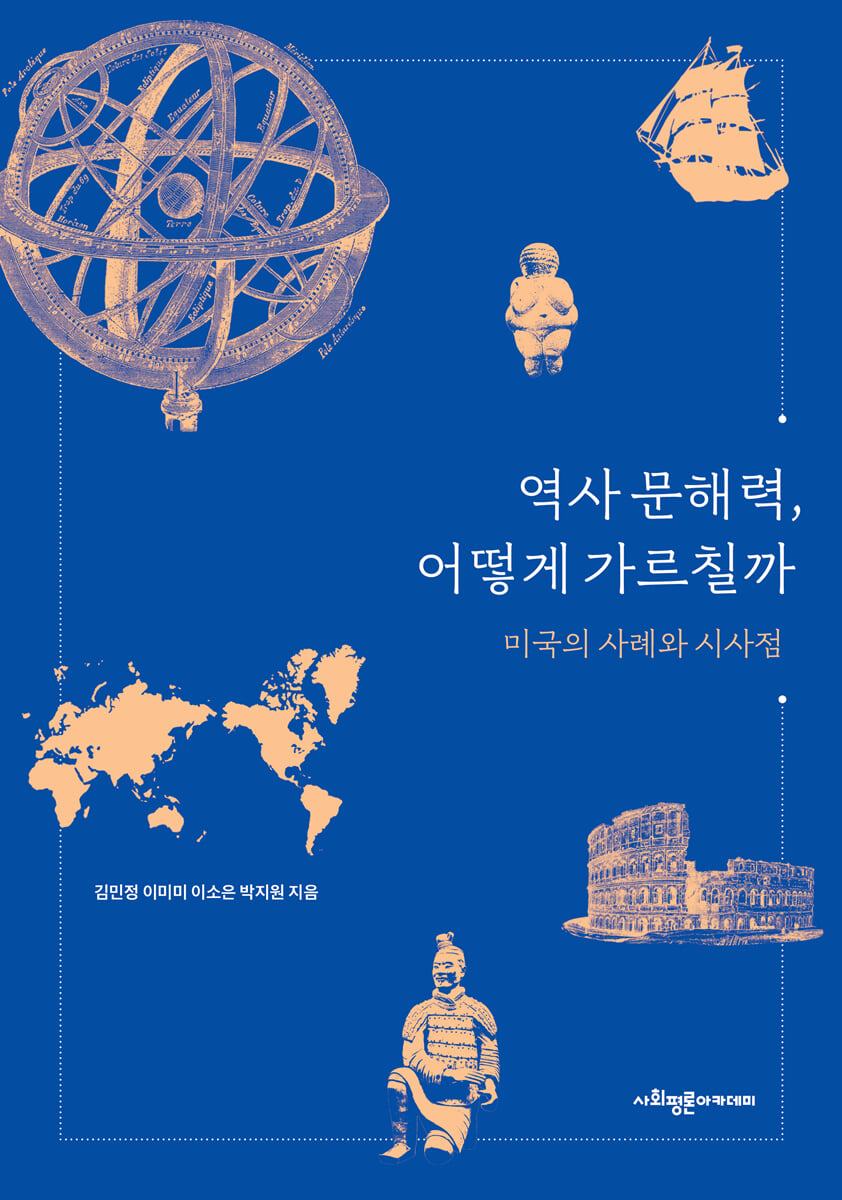
How to Teach Historical Literacy
 |
Description
Book Introduction
History education through reading, exploring, and writing
The Present and Future of Historical Literacy Education: A Look at the Case of the United States
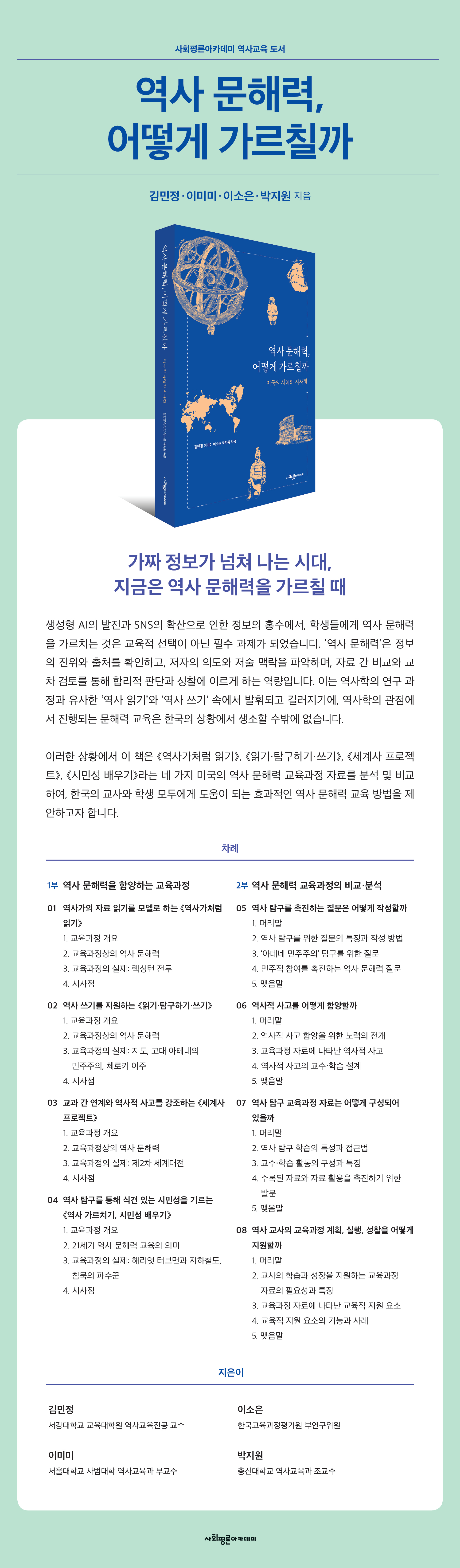
Historical literacy is the ability to select reliable sources by verifying the authenticity and source of information, to understand the intent and context in which information was created, and to reach rational judgment and reflection through comparison and cross-examination of sources.
With the rise of generative AI and the proliferation of social media, teaching students historical literacy has become a necessity rather than an educational option.
To address these needs, this book analyzes four American historical literacy curriculum materials: “Reading Like a Historian,” “Reading, Exploring, and Writing,” “The World History Project,” and “Learning Citizenship,” and proposes effective methods for history education.
The Present and Future of Historical Literacy Education: A Look at the Case of the United States
Historical literacy is the ability to select reliable sources by verifying the authenticity and source of information, to understand the intent and context in which information was created, and to reach rational judgment and reflection through comparison and cross-examination of sources.
With the rise of generative AI and the proliferation of social media, teaching students historical literacy has become a necessity rather than an educational option.
To address these needs, this book analyzes four American historical literacy curriculum materials: “Reading Like a Historian,” “Reading, Exploring, and Writing,” “The World History Project,” and “Learning Citizenship,” and proposes effective methods for history education.
- You can preview some of the book's contents.
Preview
index
Part 1: A Curriculum to Foster Historical Literacy
01 Reading Like a Historian: Modeling Historians' Reading of Materials
02 Reading, Exploring, and Writing: Supporting History Writing
03 The World History Project, emphasizing interdisciplinary connections and historical thinking
04 Teaching History, Learning Citizenship: Developing Insightful Citizenship through Historical Exploration
Part 2: Comparative Analysis of Historical Literacy Curriculum
05 How to Write Questions that Promote Historical Exploration
06 How to cultivate historical thinking
07 How are the historical exploration curriculum materials structured?
08 How to Support History Teachers' Curriculum Planning, Implementation, and Reflection
01 Reading Like a Historian: Modeling Historians' Reading of Materials
02 Reading, Exploring, and Writing: Supporting History Writing
03 The World History Project, emphasizing interdisciplinary connections and historical thinking
04 Teaching History, Learning Citizenship: Developing Insightful Citizenship through Historical Exploration
Part 2: Comparative Analysis of Historical Literacy Curriculum
05 How to Write Questions that Promote Historical Exploration
06 How to cultivate historical thinking
07 How are the historical exploration curriculum materials structured?
08 How to Support History Teachers' Curriculum Planning, Implementation, and Reflection
Detailed image
Into the book
The crucial turning point that creates a difference in the educational purpose of these two teachers in using long and difficult historical materials in their classes lies in their teaching method: how can teachers build a bridge so that students can deal with this difficult material?
--- p.59
The awareness that memorizing and retrieving fragmentary historical facts should no longer be the goal or unavoidable choice of history classes is a key commonality in both Korea and the United States.
In this context, examining how curricula are structured to foster students' ability to evaluate historical materials and develop evidence-based arguments, and how teaching and learning methods and support systems are established to achieve this, provides an interesting intellectual exploration and an opportunity to offer productive insights.
--- p.67
Students with a normative perspective recognize that various historical interpretations are possible, but they are also able to evaluate historical interpretations according to academic standards, and they recognize that there are better historical interpretations based on these standards.
--- p.192
The national curriculum emphasizes students' "life-related" and "deep learning" and can only be realized when the curriculum actively incorporates inquiry processes centered on historical questions.
When students engage in inquiry-based learning, solving diverse problems and answering questions, they develop a deeper understanding of the nature of historical knowledge, construct historical narratives, and enhance their historical literacy.
--- p.281
While studying the Code of Hammurabi, students learn to 'refute' the Code of Hammurabi, and the object of the rebuttal is an exhibition explanation of the Code of Hammurabi, which is included in the permanent exhibition at the Louvre Museum in Paris, France.
Students will write an email to the Louvre Museum curator refuting the Louvre exhibition description based on their interpretation of the Code of Hammurabi.
--- p.316
The trend of emphasizing educational support in curriculum materials starts from the proposition that teachers are the main actors in planning and implementing the curriculum at the class level.
Strengthening the educational support of curriculum materials will ultimately contribute to enhancing history teachers' teaching expertise and autonomy, thereby strengthening their capacity to create meaningful classes.
--- p.59
The awareness that memorizing and retrieving fragmentary historical facts should no longer be the goal or unavoidable choice of history classes is a key commonality in both Korea and the United States.
In this context, examining how curricula are structured to foster students' ability to evaluate historical materials and develop evidence-based arguments, and how teaching and learning methods and support systems are established to achieve this, provides an interesting intellectual exploration and an opportunity to offer productive insights.
--- p.67
Students with a normative perspective recognize that various historical interpretations are possible, but they are also able to evaluate historical interpretations according to academic standards, and they recognize that there are better historical interpretations based on these standards.
--- p.192
The national curriculum emphasizes students' "life-related" and "deep learning" and can only be realized when the curriculum actively incorporates inquiry processes centered on historical questions.
When students engage in inquiry-based learning, solving diverse problems and answering questions, they develop a deeper understanding of the nature of historical knowledge, construct historical narratives, and enhance their historical literacy.
--- p.281
While studying the Code of Hammurabi, students learn to 'refute' the Code of Hammurabi, and the object of the rebuttal is an exhibition explanation of the Code of Hammurabi, which is included in the permanent exhibition at the Louvre Museum in Paris, France.
Students will write an email to the Louvre Museum curator refuting the Louvre exhibition description based on their interpretation of the Code of Hammurabi.
--- p.316
The trend of emphasizing educational support in curriculum materials starts from the proposition that teachers are the main actors in planning and implementing the curriculum at the class level.
Strengthening the educational support of curriculum materials will ultimately contribute to enhancing history teachers' teaching expertise and autonomy, thereby strengthening their capacity to create meaningful classes.
--- p.430
Publisher's Review
Reading Like a Historian:
The answer to historical literacy education lies in teachers' "teaching strategies."
For the past 30 years, the use of materials in history classes has not been active in the United States and Korea due to factors such as student level and class progress.
In this reality, the application of the "Reading Like a Historian" curriculum in classes is a meaningful example of the teacher's efforts to bridge the gap between historical materials and students, and the potential for doing so.
The Stanford History Education Group presented two teachers with a variety of materials about historical events.
However, there was a significant difference in the way the two teachers used the materials in class.
While one teacher felt the material could be used only for high-achieving students, another actively designed multi-level learning activities tailored to the different abilities, experiences, and interests of all students.
Through well-designed teaching materials, students were able to learn the unique way of thinking of history by independently identifying what aspect of historical events each material represented.
The teacher's 'teaching method' led students to explore the organic context between historical events and historical materials.
These efforts by teachers are significant in that they can provide practical assistance in fostering students' historical literacy skills required in the digital age, and in turn, in developing modern problem-solving skills such as deciphering fake news.
Reading, Exploring, and Writing:
History classes aren't limited to classroom activities.
While the domestic history curriculum supports data-based inquiry and diverse modes of expression, it lacks detailed guidance on what "inquiry" actually means and how to implement it in class.
In contrast, the "Read, Explore, Write" curriculum clearly sets the goals of history classes and presents a step-by-step progress model to achieve them.
We also provide systematic support for both teachers and students by providing specific materials (bookmark tools, mentor texts, etc.) that can be applied directly to classes.
What is particularly noteworthy is that 'writing history' has expanded beyond a simple classroom activity to an active engagement with reality as responsible democratic citizens.
Students express historical significance in a variety of formats outside of school, including emails, letters, speeches, and museum guides, and they also participate in active historical activities with real-life figures such as education officials, National Park Service officials, and former presidents.
The World History Project and Learning Citizenship:
Expand historical thinking through interdisciplinary connections,
Developing citizenship through historical exploration
Advances in digital history and generative artificial intelligence have brought about significant changes not only in how we explore and read materials online, but also in how we learn and communicate about history.
These changes have a direct impact on history classes today.
The World History Project and Learning Citizenship are noteworthy in that they demonstrate a new direction for history education that reflects these trends.
The World History Project is a world history curriculum derived from the Big History Project, which was piloted in middle and high schools in the United States and Australia.
The Big History Project is not limited to a specific academic discipline, but rather explores the story of everything on Earth, from the beginning of the universe to the present, through a convergence of multiple academic fields.
The World History Project encourages in-depth learning by enriching the teaching and learning of world history through connections with other subjects.
"Learning Citizenship" is a curriculum designed to enable students to learn history through data-based inquiry and actively engage in civic participation.
It is distinguished from traditional materials-based learning curricula in that it aims to promote 'informed civic engagement activities.'
According to Knox, who developed this curriculum, informed civic engagement is only possible when people possess the knowledge, skills, and attitudes necessary to achieve appropriate and positive outcomes, and these knowledge, skills, and attitudes can be developed through historical inquiry.
This book was written to provide practical assistance to all who teach and learn history.
It provides teachers with specific ways to develop historical literacy with their students, and it provides students with a way to develop the ability to analyze historical data and think critically.
It will also provide all readers living in the digital age with the clues they need to properly understand and utilize information.
As the author hopes, I hope this book will serve as a valuable resource for establishing the direction of historical literacy education in Korea and exploring practical alternatives.
The answer to historical literacy education lies in teachers' "teaching strategies."
For the past 30 years, the use of materials in history classes has not been active in the United States and Korea due to factors such as student level and class progress.
In this reality, the application of the "Reading Like a Historian" curriculum in classes is a meaningful example of the teacher's efforts to bridge the gap between historical materials and students, and the potential for doing so.
The Stanford History Education Group presented two teachers with a variety of materials about historical events.
However, there was a significant difference in the way the two teachers used the materials in class.
While one teacher felt the material could be used only for high-achieving students, another actively designed multi-level learning activities tailored to the different abilities, experiences, and interests of all students.
Through well-designed teaching materials, students were able to learn the unique way of thinking of history by independently identifying what aspect of historical events each material represented.
The teacher's 'teaching method' led students to explore the organic context between historical events and historical materials.
These efforts by teachers are significant in that they can provide practical assistance in fostering students' historical literacy skills required in the digital age, and in turn, in developing modern problem-solving skills such as deciphering fake news.
Reading, Exploring, and Writing:
History classes aren't limited to classroom activities.
While the domestic history curriculum supports data-based inquiry and diverse modes of expression, it lacks detailed guidance on what "inquiry" actually means and how to implement it in class.
In contrast, the "Read, Explore, Write" curriculum clearly sets the goals of history classes and presents a step-by-step progress model to achieve them.
We also provide systematic support for both teachers and students by providing specific materials (bookmark tools, mentor texts, etc.) that can be applied directly to classes.
What is particularly noteworthy is that 'writing history' has expanded beyond a simple classroom activity to an active engagement with reality as responsible democratic citizens.
Students express historical significance in a variety of formats outside of school, including emails, letters, speeches, and museum guides, and they also participate in active historical activities with real-life figures such as education officials, National Park Service officials, and former presidents.
The World History Project and Learning Citizenship:
Expand historical thinking through interdisciplinary connections,
Developing citizenship through historical exploration
Advances in digital history and generative artificial intelligence have brought about significant changes not only in how we explore and read materials online, but also in how we learn and communicate about history.
These changes have a direct impact on history classes today.
The World History Project and Learning Citizenship are noteworthy in that they demonstrate a new direction for history education that reflects these trends.
The World History Project is a world history curriculum derived from the Big History Project, which was piloted in middle and high schools in the United States and Australia.
The Big History Project is not limited to a specific academic discipline, but rather explores the story of everything on Earth, from the beginning of the universe to the present, through a convergence of multiple academic fields.
The World History Project encourages in-depth learning by enriching the teaching and learning of world history through connections with other subjects.
"Learning Citizenship" is a curriculum designed to enable students to learn history through data-based inquiry and actively engage in civic participation.
It is distinguished from traditional materials-based learning curricula in that it aims to promote 'informed civic engagement activities.'
According to Knox, who developed this curriculum, informed civic engagement is only possible when people possess the knowledge, skills, and attitudes necessary to achieve appropriate and positive outcomes, and these knowledge, skills, and attitudes can be developed through historical inquiry.
This book was written to provide practical assistance to all who teach and learn history.
It provides teachers with specific ways to develop historical literacy with their students, and it provides students with a way to develop the ability to analyze historical data and think critically.
It will also provide all readers living in the digital age with the clues they need to properly understand and utilize information.
As the author hopes, I hope this book will serve as a valuable resource for establishing the direction of historical literacy education in Korea and exploring practical alternatives.
GOODS SPECIFICS
- Date of issue: April 14, 2025
- Page count, weight, size: 468 pages | 165*235*30mm
- ISBN13: 9791167071767
- ISBN10: 116707176X
You may also like
카테고리
korean


korean

![GQ KOREA Mark (Monthly): December [2025]](http://librairie.coreenne.fr/cdn/shop/files/8ef265dbbfbf186523ed75ba7319009d.jpg?v=1765340328&width=3840)


