

Intelligence Lab
 |
Description
Book Introduction
Johnny Thompson, author of the philosophy bestseller "Philosophy Lab," which created a sensation by concisely and clearly organizing numerous philosophical concepts, has now returned to readers with a book that explores a broader field of knowledge.
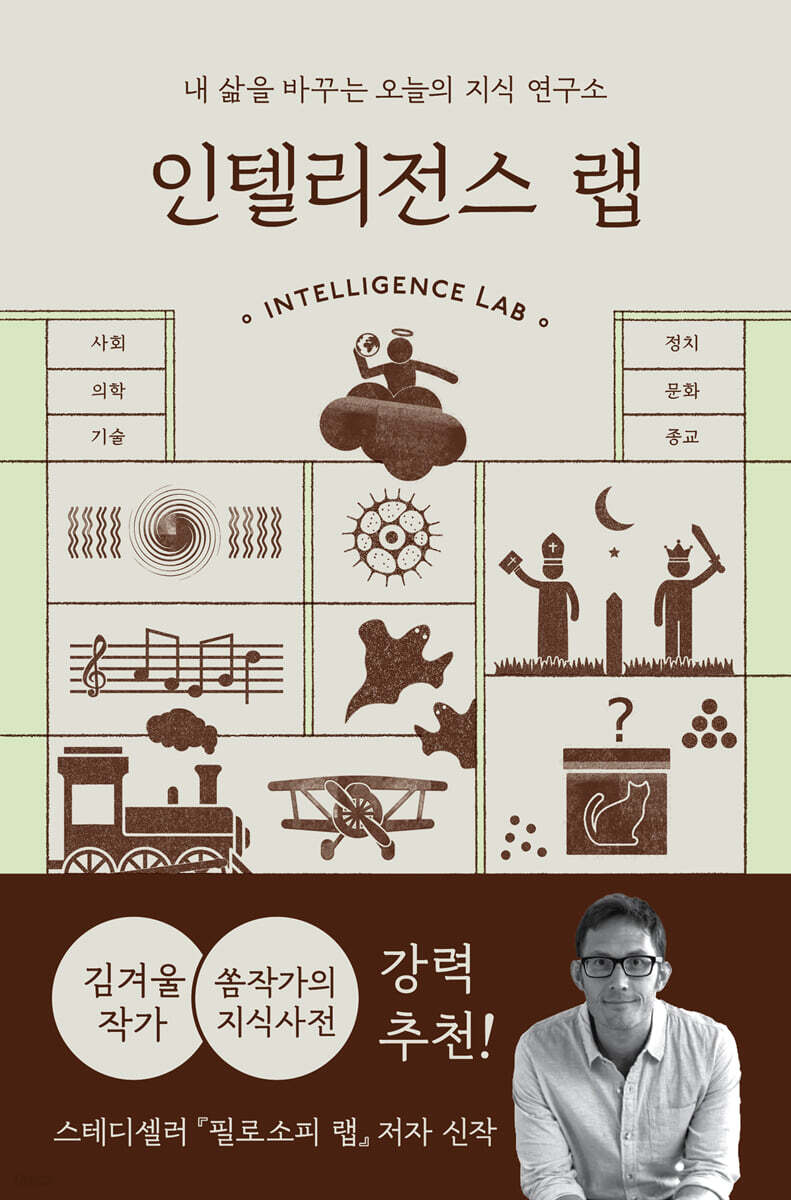
"Intelligence Lab" looks back at how the core concepts that make up the world we live in came into being.
From the invention of the wheel to the birth of democracy, this book selects 133 must-know concepts that swept contemporary thought in various fields such as science, society, politics, and religion, and unfolds the stories behind their backgrounds and development in an engaging way.
"How was surgery performed before the invention of modern anesthesia?" "Why do the Bible often mention hell and the apocalypse?" "When did humans begin to value freedom of expression?" Following these questions, we realize that the concepts we take for granted in our daily lives were formed through countless trials and errors and diverse contexts.
In the process, you will be able to clearly understand the moments of change that have shaped today's world, and also broaden your perspective on the world.
Interesting stories, deep thoughts, and humor sprinkled throughout.
If you want to fully experience the joy of accumulating knowledge, visit Johnny Thompson's fascinating knowledge lab.
"Intelligence Lab" looks back at how the core concepts that make up the world we live in came into being.
From the invention of the wheel to the birth of democracy, this book selects 133 must-know concepts that swept contemporary thought in various fields such as science, society, politics, and religion, and unfolds the stories behind their backgrounds and development in an engaging way.
"How was surgery performed before the invention of modern anesthesia?" "Why do the Bible often mention hell and the apocalypse?" "When did humans begin to value freedom of expression?" Following these questions, we realize that the concepts we take for granted in our daily lives were formed through countless trials and errors and diverse contexts.
In the process, you will be able to clearly understand the moments of change that have shaped today's world, and also broaden your perspective on the world.
Interesting stories, deep thoughts, and humor sprinkled throughout.
If you want to fully experience the joy of accumulating knowledge, visit Johnny Thompson's fascinating knowledge lab.
- You can preview some of the book's contents.
Preview
index
biology
The Origin of Life: The Moment the Evolutionary Dominoes Began
Circulatory System: The Heart Beats 2 Billion Times
Nervous System: Robots with Nerves
Cell Theory: The Smallest Living Things
Biological Taxonomy: Organizing in Boxes
Darwinism: Survival of the fittest
Pathology and Bacterial Infection: Strange Smells and Tiny Microbes
Genetics: Your body is rich in nucleic acids.
Mycelium Revolution: Beneficial Mushrooms
The Mystery of the Trees: The Forgotten Forest
CRISPR: The Future of DNA
chemistry
Alchemy: Get Rich Easily
Law of Conservation of Matter: We Never Disappear
Oxygen: Explosion or Breathing?
Purification: Clean Water and Health
The Periodic Table: The Universe in a Table
Explosives: A more effective way to blow something up
Internal Combustion Engine: The Aesthetics of Efficiency
Electronics: The basics of the basics
The Haber-Bosch Process: The Greatest Untold Idea
Polymers: A World Made of Plastic
Oral Contraceptives: The Pill of Choice
physics
Mathematics: A Metaverse Made of Numbers
Heliocentrism: A Copernican Perspective on the World
Newtonian Mechanics: Big Things Attract People
Wave-particle duality: neither here nor there
Electromagnetism: All visible light
Earth: The Structure of the Land We Live On
Thermodynamics and Entropy: Inexorable Decay Over Time
Special Relativity: My Today is Your Tomorrow
Quantum Mechanics: Zombie Cats and Superheroes
Union: You Who Make Me Whole Again
Nuclear Energy: Potential Beyond Imagination
Big Bang: It wasn't big and there was no explosion
String Theory: The One Rule That Ties It All Together
Dark Matter and Dark Energy: The Magic of the Universe
The Simulation Hypothesis: Is This World a Game?
medicine
Traditional Chinese Medicine: A Very Old and Very Obscure Art
Humoral Theory: Blood, Phlegm, Bile
Anesthesia: No pain and (usually) no death!
Vaccines: A Technology That Has Saved Countless Lives Since 1796
Disinfectant: Mr. Lister
Cesarean Section: Cutting Mortality Rates
X-ray: The magic of seeing skulls
Cancer Treatment: Cancer is Just a Disease
Modern Medicine: The Advantages of 'Big Pharma'
Psychiatry: Uncovering What's Hidden Beneath
Antibiotics: Don't eat moldy bread
Organ Transplant: Lend Me Your Ear, I'll Lend You My Hand
In Vitro Fertilization: Filling Hope with Science
Nanotechnology: Nano is the Future
society
The Great Migration: Long-Distance Travel and Genocide
Livestock: Man's Best Friend(s)
Marriage: Legalizing Sexual Relationships
City: Unpack and settle in
Nation and State: Immigration and War
Empire: When One Country Is Not Enough
Structural Engineering: The Technology That Keeps London Bridge From Collapsed
Money: The cause and solution of everything in the world
Bank: You can't carry it around
Business: Nothing to lose, much to gain.
Mass production: responsible for making only pin heads
Trickle-Down Effect: When wealth overflows, it trickles down.
Welfare State: No one is left behind
Ads: Top Google Search Exposure
Nudge Theory: A Whisper in Your Ear
Mutually Assured Destruction: If I Go, You Go
politics
Monarchy: The crown is heavy, but the chains are heavier.
Separation of Church and State: Don't Bring Religion to the Dinner Table
Sovereignty: You have no power here.
Aristocracy: good family and noble lineage
Democracy: Giving the people what they want
The Dynamics of the Modern State: Why Politics Must Be Boring
Communism: The Tree of Marxism
Fascism: How to Spot the Signs
Freedom: A Complex Concept
Freedom of Expression: Ensuring Diversity of Viewpoints
Human Rights: The Right to Better Treatment
The United Nations: A New World Order
Feminism: The Distribution of Power
Civil Rights: Demanding What's Right
Environmentalism: A Broken World
Utopia: The Power of Unrealistic Thinking
War: It Should Be a Last Resort
technology
Irrigation: artificial water channels
Food preservation: smoking, salting, spam
Navigation: Wow, land!
Maps: A Perspective on the World
The Wheel: The Origin of Great Ideas
Sword: A sharp, well-forged weapon
Lighthouse: Here!
Gunpowder: A pretty and deadly powder
Clock: Slave to Time
Steam engine: chugging!
Electricity: Modern Magic
Computers: A necessity of modern society
Phone: Hey!
Radio: DJ and White Noise
Flight: To the ends of the sky
Space Exploration: Look at my big rocket
GPS: Know where you are
The Internet: An Unbreakable Addiction
Social Media: Unstoppable Scrolling
Artificial Intelligence: The Future to Come
culture
Poetry: Rhyme, Recitation, Linguistics
Dance: The Movement of Our Soul
Letters: scribbles on paper
The Printing Press: The Opportunist Who Changed the World
Education: What We Need to Know
History: A long time ago
Western Classical Music: The Joy of Diverse Melodies
Novel: The Form of Women
Perspective: A picture disappearing into the distance
Theatre: Those who perform tragedy and comedy
Fashion: Still wearing bell-bottoms
Pro Sports: You can't be a good team.
Movie: Tear-Soaked Popcorn
Pop Music: Nostalgia for the Pop Stars of Yesterday
Postcolonial Criticism: National Trauma
Computer Games: Console Wars
The Video-On-Demand Revolution: The Fable of the Blockbuster
Religion and faith
Creation Myth: In the Beginning
Ancestor Worship: Honoring Those Who Have Gone Before
Pantheism: All is one
Ghosts: A Very Old Fear
Monotheism: One true God
Hell: Sadistic Peeking
Taoism: Going with the Flow
Prayer: Communication with God
Meditation: Finding Your Center
Incarnation: The Bridge to God
Atheism: God is not involved
The End: The End of the World Has Arrived
The Origin of Life: The Moment the Evolutionary Dominoes Began
Circulatory System: The Heart Beats 2 Billion Times
Nervous System: Robots with Nerves
Cell Theory: The Smallest Living Things
Biological Taxonomy: Organizing in Boxes
Darwinism: Survival of the fittest
Pathology and Bacterial Infection: Strange Smells and Tiny Microbes
Genetics: Your body is rich in nucleic acids.
Mycelium Revolution: Beneficial Mushrooms
The Mystery of the Trees: The Forgotten Forest
CRISPR: The Future of DNA
chemistry
Alchemy: Get Rich Easily
Law of Conservation of Matter: We Never Disappear
Oxygen: Explosion or Breathing?
Purification: Clean Water and Health
The Periodic Table: The Universe in a Table
Explosives: A more effective way to blow something up
Internal Combustion Engine: The Aesthetics of Efficiency
Electronics: The basics of the basics
The Haber-Bosch Process: The Greatest Untold Idea
Polymers: A World Made of Plastic
Oral Contraceptives: The Pill of Choice
physics
Mathematics: A Metaverse Made of Numbers
Heliocentrism: A Copernican Perspective on the World
Newtonian Mechanics: Big Things Attract People
Wave-particle duality: neither here nor there
Electromagnetism: All visible light
Earth: The Structure of the Land We Live On
Thermodynamics and Entropy: Inexorable Decay Over Time
Special Relativity: My Today is Your Tomorrow
Quantum Mechanics: Zombie Cats and Superheroes
Union: You Who Make Me Whole Again
Nuclear Energy: Potential Beyond Imagination
Big Bang: It wasn't big and there was no explosion
String Theory: The One Rule That Ties It All Together
Dark Matter and Dark Energy: The Magic of the Universe
The Simulation Hypothesis: Is This World a Game?
medicine
Traditional Chinese Medicine: A Very Old and Very Obscure Art
Humoral Theory: Blood, Phlegm, Bile
Anesthesia: No pain and (usually) no death!
Vaccines: A Technology That Has Saved Countless Lives Since 1796
Disinfectant: Mr. Lister
Cesarean Section: Cutting Mortality Rates
X-ray: The magic of seeing skulls
Cancer Treatment: Cancer is Just a Disease
Modern Medicine: The Advantages of 'Big Pharma'
Psychiatry: Uncovering What's Hidden Beneath
Antibiotics: Don't eat moldy bread
Organ Transplant: Lend Me Your Ear, I'll Lend You My Hand
In Vitro Fertilization: Filling Hope with Science
Nanotechnology: Nano is the Future
society
The Great Migration: Long-Distance Travel and Genocide
Livestock: Man's Best Friend(s)
Marriage: Legalizing Sexual Relationships
City: Unpack and settle in
Nation and State: Immigration and War
Empire: When One Country Is Not Enough
Structural Engineering: The Technology That Keeps London Bridge From Collapsed
Money: The cause and solution of everything in the world
Bank: You can't carry it around
Business: Nothing to lose, much to gain.
Mass production: responsible for making only pin heads
Trickle-Down Effect: When wealth overflows, it trickles down.
Welfare State: No one is left behind
Ads: Top Google Search Exposure
Nudge Theory: A Whisper in Your Ear
Mutually Assured Destruction: If I Go, You Go
politics
Monarchy: The crown is heavy, but the chains are heavier.
Separation of Church and State: Don't Bring Religion to the Dinner Table
Sovereignty: You have no power here.
Aristocracy: good family and noble lineage
Democracy: Giving the people what they want
The Dynamics of the Modern State: Why Politics Must Be Boring
Communism: The Tree of Marxism
Fascism: How to Spot the Signs
Freedom: A Complex Concept
Freedom of Expression: Ensuring Diversity of Viewpoints
Human Rights: The Right to Better Treatment
The United Nations: A New World Order
Feminism: The Distribution of Power
Civil Rights: Demanding What's Right
Environmentalism: A Broken World
Utopia: The Power of Unrealistic Thinking
War: It Should Be a Last Resort
technology
Irrigation: artificial water channels
Food preservation: smoking, salting, spam
Navigation: Wow, land!
Maps: A Perspective on the World
The Wheel: The Origin of Great Ideas
Sword: A sharp, well-forged weapon
Lighthouse: Here!
Gunpowder: A pretty and deadly powder
Clock: Slave to Time
Steam engine: chugging!
Electricity: Modern Magic
Computers: A necessity of modern society
Phone: Hey!
Radio: DJ and White Noise
Flight: To the ends of the sky
Space Exploration: Look at my big rocket
GPS: Know where you are
The Internet: An Unbreakable Addiction
Social Media: Unstoppable Scrolling
Artificial Intelligence: The Future to Come
culture
Poetry: Rhyme, Recitation, Linguistics
Dance: The Movement of Our Soul
Letters: scribbles on paper
The Printing Press: The Opportunist Who Changed the World
Education: What We Need to Know
History: A long time ago
Western Classical Music: The Joy of Diverse Melodies
Novel: The Form of Women
Perspective: A picture disappearing into the distance
Theatre: Those who perform tragedy and comedy
Fashion: Still wearing bell-bottoms
Pro Sports: You can't be a good team.
Movie: Tear-Soaked Popcorn
Pop Music: Nostalgia for the Pop Stars of Yesterday
Postcolonial Criticism: National Trauma
Computer Games: Console Wars
The Video-On-Demand Revolution: The Fable of the Blockbuster
Religion and faith
Creation Myth: In the Beginning
Ancestor Worship: Honoring Those Who Have Gone Before
Pantheism: All is one
Ghosts: A Very Old Fear
Monotheism: One true God
Hell: Sadistic Peeking
Taoism: Going with the Flow
Prayer: Communication with God
Meditation: Finding Your Center
Incarnation: The Bridge to God
Atheism: God is not involved
The End: The End of the World Has Arrived
Detailed image

Into the book
British novelist L.
P. Hartley wrote:
“The past is like a foreign country.
“People there live differently.”
--- From "First Sentence"
Given that the human nervous system is still not fully understood, this is perhaps not surprising, but speculation has been rife in the past.
Aristotle, influenced by Egyptian culture and never performing anatomy (the Greeks considered this taboo), believed that the heart controlled all movements and sensations.
But Galen, a Roman who was not afraid to use a knife, pointed out the brain as the organ that holds all the power.
--- From "The Nervous System"
For many readers of this book, the word 'quantum' will be synonymous with 'magic'.
Because the quantum world is a place where crazy things happen.
It is the world inside an atom where photons move with 'will' and waves decide to behave like particles.
And everyone pretends to understand this.
--- From "Quantum Mechanics"
Humans are dirty, disgusting, constantly touching creatures.
So when you cram people into a city with poor sanitation, all kinds of diseases are bound to spread.
Since the early days of civilization, when people began to gather together and form large cities, human society has almost always been plagued by periodic outbreaks of infectious diseases.
--- From "Vaccine"
What we don't know is why humans first came down from the trees.
My favorite hypothesis is the 'drunk monkey theory'.
There is fermented fruit on the ground, so the hypothesis is that our ancestors, the apes, spent more and more time on the ground.
I just liked getting a little tipsy.
--- From "The Great Migration"
According to Godwin's Law, proposed by American lawyer Mike Godwin, the longer an Internet discussion goes on, the more likely it is that one side will attack the other by comparing them to Nazis.
--- From "Fascism"
Technology often has a tendency to get out of control.
World chess champion Garry Kasparov scoffed at his poor performance after beating a computer in 1992.
Five years later, a computer beat Kasparov.
Perhaps artificial intelligence is at a similar point now.
--- From "Artificial Intelligence"
In 2011, Jay-Z said this about rap:
“If you take these songs, take out the music, and just show them the lyrics, people will say, ‘This is genius!’”
--- From "Poetry"
Over time, hell has evolved from a concrete space of endless torture to a psychological metaphor for immense suffering.
For example, the English poet William Blake offered a new interpretation of Milton's depiction of hell as a symbol of God's spiritual absence.
French philosopher Jean-Paul Sartre once said, “Hell is other people.”
P. Hartley wrote:
“The past is like a foreign country.
“People there live differently.”
--- From "First Sentence"
Given that the human nervous system is still not fully understood, this is perhaps not surprising, but speculation has been rife in the past.
Aristotle, influenced by Egyptian culture and never performing anatomy (the Greeks considered this taboo), believed that the heart controlled all movements and sensations.
But Galen, a Roman who was not afraid to use a knife, pointed out the brain as the organ that holds all the power.
--- From "The Nervous System"
For many readers of this book, the word 'quantum' will be synonymous with 'magic'.
Because the quantum world is a place where crazy things happen.
It is the world inside an atom where photons move with 'will' and waves decide to behave like particles.
And everyone pretends to understand this.
--- From "Quantum Mechanics"
Humans are dirty, disgusting, constantly touching creatures.
So when you cram people into a city with poor sanitation, all kinds of diseases are bound to spread.
Since the early days of civilization, when people began to gather together and form large cities, human society has almost always been plagued by periodic outbreaks of infectious diseases.
--- From "Vaccine"
What we don't know is why humans first came down from the trees.
My favorite hypothesis is the 'drunk monkey theory'.
There is fermented fruit on the ground, so the hypothesis is that our ancestors, the apes, spent more and more time on the ground.
I just liked getting a little tipsy.
--- From "The Great Migration"
According to Godwin's Law, proposed by American lawyer Mike Godwin, the longer an Internet discussion goes on, the more likely it is that one side will attack the other by comparing them to Nazis.
--- From "Fascism"
Technology often has a tendency to get out of control.
World chess champion Garry Kasparov scoffed at his poor performance after beating a computer in 1992.
Five years later, a computer beat Kasparov.
Perhaps artificial intelligence is at a similar point now.
--- From "Artificial Intelligence"
In 2011, Jay-Z said this about rap:
“If you take these songs, take out the music, and just show them the lyrics, people will say, ‘This is genius!’”
--- From "Poetry"
Over time, hell has evolved from a concrete space of endless torture to a psychological metaphor for immense suffering.
For example, the English poet William Blake offered a new interpretation of Milton's depiction of hell as a symbol of God's spiritual absence.
French philosopher Jean-Paul Sartre once said, “Hell is other people.”
--- From "Hell"
Publisher's Review
√ A new book from the author of the humanities bestseller, Philosophy Lab
√ Highly recommended by Kim Gyul-wool, Kwak Jae-sik, Shim Yong-hwan, and Im So-mi (The Encyclopedia of Knowledge by Som Writer)
√ From the Big Bang to Utopia, a minimum of general knowledge for busy modern people, summarized in 133 words.
√ Even difficult concepts are clearly explained with humorous text and pictograms drawn by the author himself!
Curious philosophy nerd,
Turning to the world beyond philosophy
Curious people have one thing in common.
It's about not taking everything around you for granted and constantly asking questions.
Johnny Thompson, who taught philosophy for over a decade and is now a full-time writer, is no exception.
In his previous work, "Philosophy Lab," he delved deeply into the appeal of philosophy in solving everyday concerns. He now runs a philosophy community with over 500,000 followers, continuing his broader intellectual exploration.
This time, he expanded his interests beyond philosophy to a much wider range of fields.
This is because I learned how many concepts we encounter in our daily lives, such as 'utopia', 'banking', 'marriage', 'evolution', and 'Big Bang', emerged through interesting contexts and trial and error, and how these stories lead us to an intellectual life.
Thompson noted that many of the concepts we take for granted today were not always accepted that way.
In this book, he explores the origins of the concepts that have shaped the world and how they have gradually or rapidly transformed people's lives.
As we follow the 133 core concepts in nine fields that have transformed our lives, familiar concepts begin to appear in a new light, and the organic connections between each concept naturally become apparent.
As new knowledge accumulates in this way, you will experience the joy of your perspective on the world expanding.
Taking conversation to the next level
Exciting knowledge curation
There is a strange persuasiveness in the conversations of intelligent people.
It gets to the point without being long-winded, and naturally unfolds the story behind it without going off the context.
When talking about a specific topic, he goes beyond simple opinions or impressions and provides insight into the background and flow of the matter.
For example, when the topic of economics comes up at a company dinner, some people will logically express their opinions on the roles of the government and banks, while others, upon leaving the theater, will sharply diagnose human psychology and social phenomena based on a single scene from a movie.
These conversations go beyond simply filling awkward silences; they can even elicit exclamations like, "You're so well-spoken," or "How can you think like that?"
This is possible because you have a wide range of knowledge and know how to use it appropriately.
Of course, we live in an age where we can search for anything we're curious about on our smartphones at any time.
However, with YouTube, blogs, and various news articles overflowing, we've all probably had the experience of hesitating to even search because the right keywords didn't come to mind.
Moreover, because search algorithms only select and show us information that we are already interested in, the scope of knowledge we are exposed to gradually narrows.
That's why we hesitate even when faced with familiar topics.
For example, if you've ever been at a loss for words trying to explain exactly what "democracy" is in a conversation, or tilted your head while trying to remember why Newton was such a great scientist, you'll probably relate.
Even if it feels overwhelming at first, if you know a variety of knowledge, even if it's just a little bit, you'll find yourself speaking more fluently at some point, and the density of your daily conversations will increase.
"Intelligence Lab" is a book that serves as a guide to accompany you through the process.
We've selected concepts that you need to know but can easily be overlooked and summarized them in a light and pleasant language.
It's a rarer experience than you might think to be able to learn this knowledge while giggling.
With humorous text and intuitive pictograms
Knowledge that just pops into your head
Even complex concepts are much easier to understand when explained in a fun way.
The Intelligence Lab is designed to provide an easy-to-understand introduction to essential concepts across a variety of fields.
Sharp questions and insights are naturally incorporated into the short text, so concepts that once felt unfamiliar quickly become familiar as you read.
"When did people start to consider religion taboo in public settings?" "How does GPS accurately determine our current location and report it in real time?" Finding answers to questions like these doesn't simply add another layer of information to our minds; it naturally leads us on an intellectual journey that allows us to see the world in a new way.
The reason this book doesn't feel boring is thanks to the author's excellent writing skills.
It's a fun read, with a friendly yet cheerful, sometimes sharp humor.
Easy but not shallow, short but gets to the point.
Thanks to this, learning each concept feels like an interesting conversation rather than a boring study.
The author's simple yet cute pictograms are added here, making even complex content easy to understand at a glance.
Pictures and text blend together naturally, leaving unfamiliar concepts as knowledge that sticks in your head.
The moment an amazing concept emerged,
Humanity could never return to the world before!
Innovative concepts that sweep the trends of an era sometimes come like a huge wave.
It may feel unfamiliar and sometimes uncomfortable at first, but the moment you truly understand its meaning, the world appears to you in a completely different way.
The same goes for the essential concepts covered in the Intelligence Lab.
At first, it may seem like just simple information, but as you chew on it, you will begin to see clues to how the world we live in and the mindset of the people living in it were formed.
In this way, we come to look at our daily lives, which we take for granted, with a slightly new perspective.
When the world we were so familiar with begins to look different, a change in thinking begins.
Even if you don't achieve some grand realization, you'll find yourself gradually shifting your thinking, familiar concepts gradually taking on a new meaning, and before you know it, you'll find yourself engaging in conversations.
If such moments accumulate, there may come a day when you can interpret the world in your own language.
"Intelligence Lab" is the book that will provide you with the most reliable first step on your journey.
√ Highly recommended by Kim Gyul-wool, Kwak Jae-sik, Shim Yong-hwan, and Im So-mi (The Encyclopedia of Knowledge by Som Writer)
√ From the Big Bang to Utopia, a minimum of general knowledge for busy modern people, summarized in 133 words.
√ Even difficult concepts are clearly explained with humorous text and pictograms drawn by the author himself!
Curious philosophy nerd,
Turning to the world beyond philosophy
Curious people have one thing in common.
It's about not taking everything around you for granted and constantly asking questions.
Johnny Thompson, who taught philosophy for over a decade and is now a full-time writer, is no exception.
In his previous work, "Philosophy Lab," he delved deeply into the appeal of philosophy in solving everyday concerns. He now runs a philosophy community with over 500,000 followers, continuing his broader intellectual exploration.
This time, he expanded his interests beyond philosophy to a much wider range of fields.
This is because I learned how many concepts we encounter in our daily lives, such as 'utopia', 'banking', 'marriage', 'evolution', and 'Big Bang', emerged through interesting contexts and trial and error, and how these stories lead us to an intellectual life.
Thompson noted that many of the concepts we take for granted today were not always accepted that way.
In this book, he explores the origins of the concepts that have shaped the world and how they have gradually or rapidly transformed people's lives.
As we follow the 133 core concepts in nine fields that have transformed our lives, familiar concepts begin to appear in a new light, and the organic connections between each concept naturally become apparent.
As new knowledge accumulates in this way, you will experience the joy of your perspective on the world expanding.
Taking conversation to the next level
Exciting knowledge curation
There is a strange persuasiveness in the conversations of intelligent people.
It gets to the point without being long-winded, and naturally unfolds the story behind it without going off the context.
When talking about a specific topic, he goes beyond simple opinions or impressions and provides insight into the background and flow of the matter.
For example, when the topic of economics comes up at a company dinner, some people will logically express their opinions on the roles of the government and banks, while others, upon leaving the theater, will sharply diagnose human psychology and social phenomena based on a single scene from a movie.
These conversations go beyond simply filling awkward silences; they can even elicit exclamations like, "You're so well-spoken," or "How can you think like that?"
This is possible because you have a wide range of knowledge and know how to use it appropriately.
Of course, we live in an age where we can search for anything we're curious about on our smartphones at any time.
However, with YouTube, blogs, and various news articles overflowing, we've all probably had the experience of hesitating to even search because the right keywords didn't come to mind.
Moreover, because search algorithms only select and show us information that we are already interested in, the scope of knowledge we are exposed to gradually narrows.
That's why we hesitate even when faced with familiar topics.
For example, if you've ever been at a loss for words trying to explain exactly what "democracy" is in a conversation, or tilted your head while trying to remember why Newton was such a great scientist, you'll probably relate.
Even if it feels overwhelming at first, if you know a variety of knowledge, even if it's just a little bit, you'll find yourself speaking more fluently at some point, and the density of your daily conversations will increase.
"Intelligence Lab" is a book that serves as a guide to accompany you through the process.
We've selected concepts that you need to know but can easily be overlooked and summarized them in a light and pleasant language.
It's a rarer experience than you might think to be able to learn this knowledge while giggling.
With humorous text and intuitive pictograms
Knowledge that just pops into your head
Even complex concepts are much easier to understand when explained in a fun way.
The Intelligence Lab is designed to provide an easy-to-understand introduction to essential concepts across a variety of fields.
Sharp questions and insights are naturally incorporated into the short text, so concepts that once felt unfamiliar quickly become familiar as you read.
"When did people start to consider religion taboo in public settings?" "How does GPS accurately determine our current location and report it in real time?" Finding answers to questions like these doesn't simply add another layer of information to our minds; it naturally leads us on an intellectual journey that allows us to see the world in a new way.
The reason this book doesn't feel boring is thanks to the author's excellent writing skills.
It's a fun read, with a friendly yet cheerful, sometimes sharp humor.
Easy but not shallow, short but gets to the point.
Thanks to this, learning each concept feels like an interesting conversation rather than a boring study.
The author's simple yet cute pictograms are added here, making even complex content easy to understand at a glance.
Pictures and text blend together naturally, leaving unfamiliar concepts as knowledge that sticks in your head.
The moment an amazing concept emerged,
Humanity could never return to the world before!
Innovative concepts that sweep the trends of an era sometimes come like a huge wave.
It may feel unfamiliar and sometimes uncomfortable at first, but the moment you truly understand its meaning, the world appears to you in a completely different way.
The same goes for the essential concepts covered in the Intelligence Lab.
At first, it may seem like just simple information, but as you chew on it, you will begin to see clues to how the world we live in and the mindset of the people living in it were formed.
In this way, we come to look at our daily lives, which we take for granted, with a slightly new perspective.
When the world we were so familiar with begins to look different, a change in thinking begins.
Even if you don't achieve some grand realization, you'll find yourself gradually shifting your thinking, familiar concepts gradually taking on a new meaning, and before you know it, you'll find yourself engaging in conversations.
If such moments accumulate, there may come a day when you can interpret the world in your own language.
"Intelligence Lab" is the book that will provide you with the most reliable first step on your journey.
GOODS SPECIFICS
- Date of issue: May 8, 2025
- Page count, weight, size: 304 pages | 434g | 145*220*20mm
- ISBN13: 9791155818138
- ISBN10: 115581813X
You may also like
카테고리
korean


korean

![GQ KOREA Mark (Monthly): December [2025]](http://librairie.coreenne.fr/cdn/shop/files/8ef265dbbfbf186523ed75ba7319009d.jpg?v=1765340328&width=3840)


