

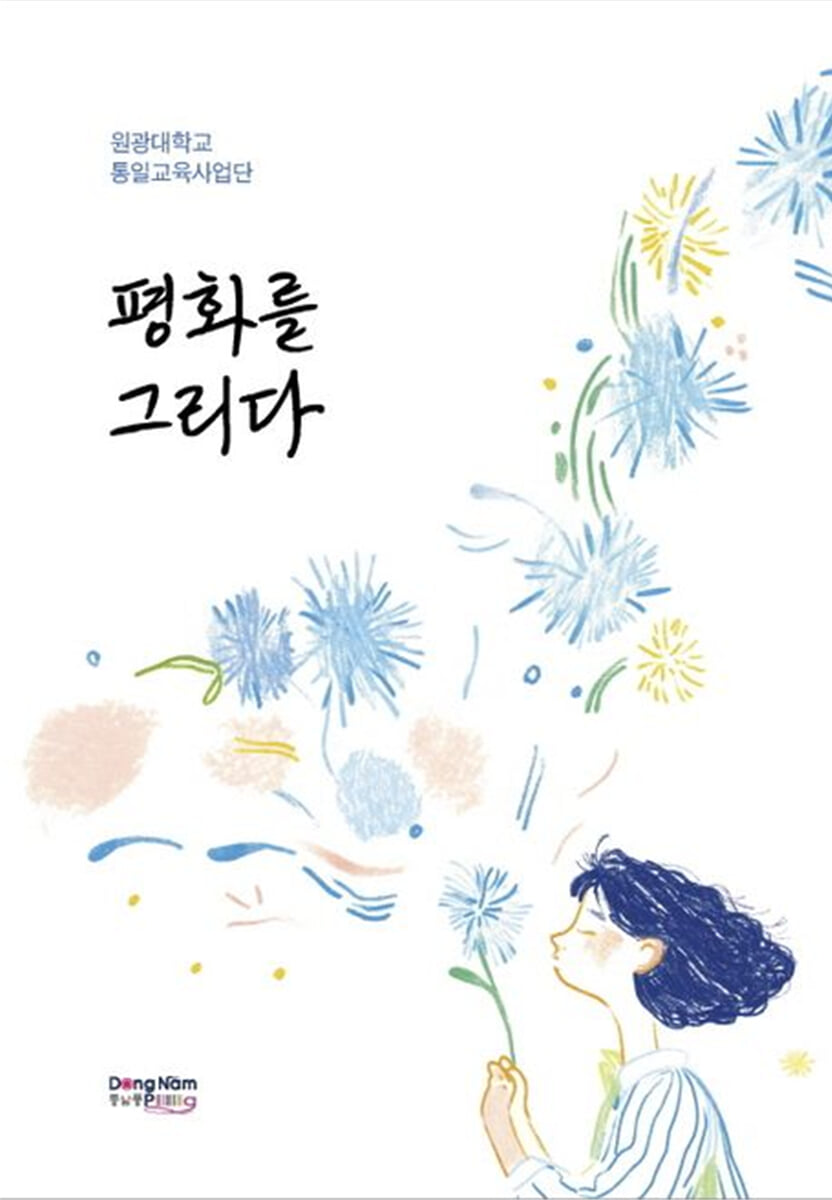
Drawing peace
 |
Description
Book Introduction
"Who am I? What is the era and society in which I live?"
This book was published as a project of the Wonkwang University Unification Education Project Group, which experienced a new time and space by standing alongside the Jeju 4.3 Incident and looking at the same place.
Time accumulates in space.
Past history (narrative) piles up in every space and leaves its traces.
But we only regard the weight of time accumulated like sedimentary layers as fossils and do not recognize the memories they contain.
Therefore, walking through a historical 'memory' is also a site of 'spatial' experience that goes beyond what we see.
This is the purpose and value of the 'Dark Tour'.
This 'Peace Journey' by the Wonkwang University Unification Education Project was not simply a visit to a place, but a journey toward memory and peace.
What 'Jeju 4.3' teaches us is that peace is not simply the absence of conflict, but is achieved through facing the pain of the past and making efforts to heal this historical trauma.
This book was published as a project of the Wonkwang University Unification Education Project Group, which experienced a new time and space by standing alongside the Jeju 4.3 Incident and looking at the same place.
Time accumulates in space.
Past history (narrative) piles up in every space and leaves its traces.
But we only regard the weight of time accumulated like sedimentary layers as fossils and do not recognize the memories they contain.
Therefore, walking through a historical 'memory' is also a site of 'spatial' experience that goes beyond what we see.
This is the purpose and value of the 'Dark Tour'.
This 'Peace Journey' by the Wonkwang University Unification Education Project was not simply a visit to a place, but a journey toward memory and peace.
What 'Jeju 4.3' teaches us is that peace is not simply the absence of conflict, but is achieved through facing the pain of the past and making efforts to heal this historical trauma.
index
005 Empathy Writing
010 Prologue After the Train _ Mourning, Memory, and Thought:
A conversation between those who have experienced it and those who have not
030 Story 01 Kang Se-chang _ From Non-Sadness to Sadness
038 Story 02 Kwak Geun-young _ Jeju 4.3, To Not Forget That Pain
047 Story 03 Kim Min-ji _ Jeju, a place of peace beyond pain
056 Story 04 Kim Se-yeon _ Jeju Island, a Continuum of Newness
064 Story 05 Kim Soo-min _ A Journey for Me
079 Story 06 Kim Chae-yeon _ A Quiet Promise
092 Story 07 Moon Geon-woo _ Because they were there
104 Story 08 Baek Shin-young _ Asking for Peace
112 Story 09 Shin Ye-ryun _ Beyond Time, Listening to Jeju
126 Story 10 Oh Ga-young _ Tragedy on a Beautiful Island
139 Story 11 Yun Yu-bi _ Waves
149 Story 12 Lee Jin-young _ Jeju 4.3 and Peace
163 Story 13 Jeon Ji-hye _ Drawing the Peace of Jeju 4.3
173 Story 14 Jeong Da-won _ Facing the Jeju 4.3 Incident
183 Story 15 Jo Soo-young _ I was just breathing
191 Story 16 Choi Jae-hyuk _ Jeju, an island without a care in the world
205 Story 17 Ha Seo-yoon _ The Meaning of Sutured Fingers
212 Epilogue Im Jong _ Unification is Understanding
010 Prologue After the Train _ Mourning, Memory, and Thought:
A conversation between those who have experienced it and those who have not
030 Story 01 Kang Se-chang _ From Non-Sadness to Sadness
038 Story 02 Kwak Geun-young _ Jeju 4.3, To Not Forget That Pain
047 Story 03 Kim Min-ji _ Jeju, a place of peace beyond pain
056 Story 04 Kim Se-yeon _ Jeju Island, a Continuum of Newness
064 Story 05 Kim Soo-min _ A Journey for Me
079 Story 06 Kim Chae-yeon _ A Quiet Promise
092 Story 07 Moon Geon-woo _ Because they were there
104 Story 08 Baek Shin-young _ Asking for Peace
112 Story 09 Shin Ye-ryun _ Beyond Time, Listening to Jeju
126 Story 10 Oh Ga-young _ Tragedy on a Beautiful Island
139 Story 11 Yun Yu-bi _ Waves
149 Story 12 Lee Jin-young _ Jeju 4.3 and Peace
163 Story 13 Jeon Ji-hye _ Drawing the Peace of Jeju 4.3
173 Story 14 Jeong Da-won _ Facing the Jeju 4.3 Incident
183 Story 15 Jo Soo-young _ I was just breathing
191 Story 16 Choi Jae-hyuk _ Jeju, an island without a care in the world
205 Story 17 Ha Seo-yoon _ The Meaning of Sutured Fingers
212 Epilogue Im Jong _ Unification is Understanding
Into the book
Traces of those who sacrificed themselves for peace remain in every place on Jeju Island that students from Wonkwang University's Unification Education Program visited.
I hope that their unfortunate lives will not remain as mere sorrow, but will become a path to peace.
I hope this book will become a record of finding peace in our hearts and putting it into practice with our bodies.
--- p.7
Instead of the fantastic rapeseed fields, the students toured the painful site of the Bukchon Massacre, the lost village of Gonul-dong, and the Gangjeong Naval Port, where the flag of the peace movement still soars high.
And here I confess my experience of 4.3, which was more poisonous than the cold wind.
The students' perspectives are sometimes cynical, but like future generations, they talk about a future of peace that transcends the pain we all share.
Let's set out on that path together.
--- p.9
At the root of the self is the other, and because the other lives, there is the life of 'me'.
Arendt says that reason is “the ability to think and judge from the standpoint of others.”
Through condolences and empathy, I looked at the world in which those who ‘did not experience’ the Jeju 4.3 Incident currently live from the perspective of those who ‘experienced’ it.
--- p.15
The motif of "Uncle Sooni" is the incident in Bukchon-ri, Jochon-eup, where hundreds of residents were massacred after being lured into evacuation.
We come to realize that the state is not a means for the good of mankind.
The state is an instrument for the good of mankind, and mankind can never become an instrument of the state.
What the state or any particular power should demand is to awaken and expand the humanistic conscience that judges and practices what is in the best interest of humanity at every moment.
Niebuhr says, “This type of diagnosis and prescription, which regards morality not on a political horizon but as a problem of individual thought and action or a problem of the spirit and culture of society as a whole, both shows that personal morality and social immorality coexist, and moralistic admonitions become powerless in the face of a strong understanding.”
This means that morality must be placed on a political horizon, and social immorality must be discussed as a matter of political responsibility and accountability.
--- p.21
Empathy achieved without understanding the heart is not empathy.
The illusion of empathy is ultimately nothing more than understanding the other person by assimilating them to our standards and experiences.
In the end, it just ends up being an attempt to impose my own standards on the other person without fully understanding them.
The sentences I wrote in Jeju Island as a non-human were nothing but heartless epitaphs.
I'm going to go back to my hometown once again to write a sentence of sorrow with my heart.
--- p.37
As I learned more about the Jeju April 3 Incident, I increasingly pondered how its wounds were passed down from generation to generation.
It was a pain I had never experienced before, but when I realized how deeply that pain remained in the people of Jeju and in the descendants who inherited that wound, I could not turn away from that pain.
At that time, I realized that the April 3 Incident was not simply a thing of the past, but that its pain continues to affect us and our descendants today.
--- p.43~45
As I passed the baby grave, I saw a place where I could see the beautiful Jeju sea at a glance.
There was a monument there to console the souls of the victims of the Jeju 4.3 Incident in Bukchon-ri.
Turning to the back of the monument, the names of those who were sacrificed in Bukchon-ri at the time were engraved.
As I slowly recited the names one by one, I noticed something strange.
There were many people with the same surname.
This was a fact that could be known without much thought.
Most of the victims were massacred as family units.
Among them, there were some whose names were unknown, so they were recorded as ‘So-and-so’s wife’, ‘son’, ‘mother’, etc.
--- p.51
The Jeju naval base had an impact on the Sewol ferry disaster.
It was revealed that some of the steel bars loaded on the Sewol were intended for use at the Jeju naval base.
It was revealed through the statements of the crew that the Sewol was habitually overloaded with rebar, that the crew raised the issue of not loading cargo such as rebar on the bow, and that when the Sewol listed, Chonghaejin Marine Company checked the condition of the cargo loading.
This was really shocking.
I was ashamed of myself for not knowing much about this.
--- p.59
There was 'Uncle Sooni' there.
The dead are not the only victims.
Those who witness death and yet are silenced are also victims.
Uncle Sooni is a survivor of the Bukchon-ri massacre.
Suffering from post-traumatic stress disorder, she eventually commits suicide in a field of sorghum.
The moment I saw Uncle Sooni's tombstone, my heart sank.
No matter how much I studied history and read books, seeing the traces of death with my own eyes was truly shocking.
--- p.70
Yanggaewat is the place where residents hiding in the forest were massacred during the April 3 Incident. Although it has now become a beautiful forest, the sorrow that permeates it can be felt.
The screams and cries that must have been heard that day seemed to be mixed with the wind.
There, I was deeply moved by how easily human life can be endangered, and the courage of those who tried to protect one another in the midst of it all.
I put my hands together and expressed my regret and gratitude to them.
--- p.84
The next place we visited with our group was Gonul-dong.
Gonul-dong was a place I recognized from the cover of a recently published children's book called "There is Gonul-dong."
Gonuldong was a village on the coast.
Even then, it was left in ruins due to the violence of the military and police during the Jeju 4.3 Incident.
Why is that so?
At that time, in accordance with the proclamation of the 9th Regiment Commander Song Yo-chan, an operation was carried out to scorch the remaining central and mountainous regions, leaving only an area 5km from the coast.
Gonuldong was a place right on the coast, with a direct view of Jeju Port.
But on January 5, 1949, the military and police stormed the village, killing the young people and burning the village down.
Why was it that a coastal village was left in ruins, unable to escape the fire?
--- p.98
The Jeju April 3 Incident was not just the pain of the people of Bukchon.
It was a tragic incident in which countless Jeju Island residents lost their lives without any guilt.
The people of Jeju Island were simply trying to regain their rights.
But what they got in return was a barrage of gunfire, indiscriminate killings, and a long silence.
--- p.108
The past should not be remembered simply because something cruel happened, because many people died, or because it was so sad.
It must be remembered that seemingly trivial discrimination, hatred, and oppression by state power have been repeated for over 80 years.
Still, the state is trying to oppress Jeju residents with the logic of the powerful when conflicts arise, such as the construction of the Gangjeong Village naval base and the second airport.
Not only in Jeju Island but also on the mainland, the word 'red' is often invoked when criticizing an opponent.
For example, people who demand the truth about the Sewol ferry disaster are called communists, and those who demand the truth about workers who died in industrial accidents at semiconductor factories are also branded communists.
In order to avoid repeating these mistakes, we must know and remember exactly what the problem was.
--- p.136
Jeju's sea has now become an island of peace, but the events that occurred here in the past vividly reveal the ironic history of Jeju, the island of peace.
The Jeju April 3 Incident was a horrific event that began on March 1, 1947, encompassing the riots that erupted on April 3, 1948, and continued for seven years with armed conflict and massacres until September 21, 1954.
At that time, the lives and livelihoods of many Jeju Island residents were cruelly taken away.
--- p.141
If you go to the Jeju 4.3 Memorial Hall, there is a place where a nameless stone monument called ‘Baekbi’ is placed.
This is because the nature of the incident, like the May 18 Gwangju Democratization Movement, was not clearly defined.
Looking at the Jeju 4.3 Incident, some call it an incident, some call it an uprising, some call it a situation, and some call it a massacre.
So what should we do first? Shouldn't we prioritize defining the nature of the April 3 Incident and inscribing their names on a monument to console the souls of those unjustly killed?
--- p.156
Through this Jeju Peace Journey, I deeply realized that the word "peace" is not a simple concept, but something created through continuous effort and practice to achieve it.
A peaceful life and society does not mean a state without conflict.
It is a process of fully facing the pain and wounds of the past, remembering that pain, and building a better future based on it.
The scars left by the Jeju April 3 Incident are still deeply engraved in the hearts of the people here, and their pain and sorrow are not simply a page in history, but still live and breathe in the lives and minds of those living today.
We must inherit that memory and ensure that such a tragedy never happens again.
--- p.169
I was just enjoying the trip and didn't think much about the implications of the dark tour that was starting tomorrow.
But while I was enjoying Jeju Island's nature, I felt uneasy for some reason.
How could such a tragedy have happened on such a beautiful island? How could people in a peaceful village have been so cruelly sacrificed? Such questions raced through my mind.
--- p.176
People at that time had no choice but to remain silent in the face of the fear imposed by the state.
No one asked what happened in Gon-eul-dong, and there was no one to speak on behalf of the victims.
The word 'red' killed them twice.
Those who survived had to hide their existence, and those who died could not even leave their names behind.
--- p.190
In front of the Neobunseong-i 4.3 Memorial Hall, there is the Neobunseong-i 4.3 Historical Site.
There are still some baby graves left there, which give us a glimpse into the dire situation at the time.
What did the babies know and what did they do to deserve death?
I don't know.
So, did the command that decided on the deaths and those who carried out that decision know why the babies had to die? I don't think they knew either.
Babies who have no reason to die are still left in the swamp, exposed to the bitter wind, unable to fully realize their dreams or play to their heart's content.
--- p.196
The Jeju Peace Tour made me ask the question, “What is peace?”
It doesn't just mean the absence of war.
Peace begins with empathy and responsibility, not turning a blind eye to the pain of others, through the effort to constantly look back on history and learn from its pain, even if it means enduring discomfort. It becomes meaningful only when it goes beyond mere emotional compassion and leads to action.
--- p.208
The Bukchon-ri tragedy occurred on January 17, 1949. 1 The tragedy began in retaliation when a military vehicle passing through the Neobunseong-i Pass was attacked by armed forces, killing two soldiers.
And it is said that over 400 residents were shot to death over two days on the 17th and 18th.
It is the village with the third highest number of victims, following Nohyeong-ri and Gasiri.
This disaster did not happen suddenly one day.
Even before that, the punitive force that arrived in Jeju Island to suppress the Jeju April 3 Incident had been paying attention to Bukchon-ri.
For example, two years before the Bukchon-ri tragedy (August 13, 1947), there was an incident in Bukchon-ri where people assaulted police officers while protesting the police's indiscriminate firing, and the following year (June 16, 1948), there was an incident where young men from the village who were investigating a ship that had taken refuge in the port killed two police officers from the Udo Police Station.
It is said that after this incident, the young people of Bukchon-ri village fled the village to avoid the eyes of the punitive force or went into hiding at the foot of Mt. Halla.
Of course, there may have been people who joined the armed forces.
In this situation, the first mass murder of residents occurred in Bukchon-ri on December 16, 1948.
Twenty-two villagers who organized a civilian group to protect the village and cooperated with the military suppression force were taken away and executed by the military suppression force.
I hope that their unfortunate lives will not remain as mere sorrow, but will become a path to peace.
I hope this book will become a record of finding peace in our hearts and putting it into practice with our bodies.
--- p.7
Instead of the fantastic rapeseed fields, the students toured the painful site of the Bukchon Massacre, the lost village of Gonul-dong, and the Gangjeong Naval Port, where the flag of the peace movement still soars high.
And here I confess my experience of 4.3, which was more poisonous than the cold wind.
The students' perspectives are sometimes cynical, but like future generations, they talk about a future of peace that transcends the pain we all share.
Let's set out on that path together.
--- p.9
At the root of the self is the other, and because the other lives, there is the life of 'me'.
Arendt says that reason is “the ability to think and judge from the standpoint of others.”
Through condolences and empathy, I looked at the world in which those who ‘did not experience’ the Jeju 4.3 Incident currently live from the perspective of those who ‘experienced’ it.
--- p.15
The motif of "Uncle Sooni" is the incident in Bukchon-ri, Jochon-eup, where hundreds of residents were massacred after being lured into evacuation.
We come to realize that the state is not a means for the good of mankind.
The state is an instrument for the good of mankind, and mankind can never become an instrument of the state.
What the state or any particular power should demand is to awaken and expand the humanistic conscience that judges and practices what is in the best interest of humanity at every moment.
Niebuhr says, “This type of diagnosis and prescription, which regards morality not on a political horizon but as a problem of individual thought and action or a problem of the spirit and culture of society as a whole, both shows that personal morality and social immorality coexist, and moralistic admonitions become powerless in the face of a strong understanding.”
This means that morality must be placed on a political horizon, and social immorality must be discussed as a matter of political responsibility and accountability.
--- p.21
Empathy achieved without understanding the heart is not empathy.
The illusion of empathy is ultimately nothing more than understanding the other person by assimilating them to our standards and experiences.
In the end, it just ends up being an attempt to impose my own standards on the other person without fully understanding them.
The sentences I wrote in Jeju Island as a non-human were nothing but heartless epitaphs.
I'm going to go back to my hometown once again to write a sentence of sorrow with my heart.
--- p.37
As I learned more about the Jeju April 3 Incident, I increasingly pondered how its wounds were passed down from generation to generation.
It was a pain I had never experienced before, but when I realized how deeply that pain remained in the people of Jeju and in the descendants who inherited that wound, I could not turn away from that pain.
At that time, I realized that the April 3 Incident was not simply a thing of the past, but that its pain continues to affect us and our descendants today.
--- p.43~45
As I passed the baby grave, I saw a place where I could see the beautiful Jeju sea at a glance.
There was a monument there to console the souls of the victims of the Jeju 4.3 Incident in Bukchon-ri.
Turning to the back of the monument, the names of those who were sacrificed in Bukchon-ri at the time were engraved.
As I slowly recited the names one by one, I noticed something strange.
There were many people with the same surname.
This was a fact that could be known without much thought.
Most of the victims were massacred as family units.
Among them, there were some whose names were unknown, so they were recorded as ‘So-and-so’s wife’, ‘son’, ‘mother’, etc.
--- p.51
The Jeju naval base had an impact on the Sewol ferry disaster.
It was revealed that some of the steel bars loaded on the Sewol were intended for use at the Jeju naval base.
It was revealed through the statements of the crew that the Sewol was habitually overloaded with rebar, that the crew raised the issue of not loading cargo such as rebar on the bow, and that when the Sewol listed, Chonghaejin Marine Company checked the condition of the cargo loading.
This was really shocking.
I was ashamed of myself for not knowing much about this.
--- p.59
There was 'Uncle Sooni' there.
The dead are not the only victims.
Those who witness death and yet are silenced are also victims.
Uncle Sooni is a survivor of the Bukchon-ri massacre.
Suffering from post-traumatic stress disorder, she eventually commits suicide in a field of sorghum.
The moment I saw Uncle Sooni's tombstone, my heart sank.
No matter how much I studied history and read books, seeing the traces of death with my own eyes was truly shocking.
--- p.70
Yanggaewat is the place where residents hiding in the forest were massacred during the April 3 Incident. Although it has now become a beautiful forest, the sorrow that permeates it can be felt.
The screams and cries that must have been heard that day seemed to be mixed with the wind.
There, I was deeply moved by how easily human life can be endangered, and the courage of those who tried to protect one another in the midst of it all.
I put my hands together and expressed my regret and gratitude to them.
--- p.84
The next place we visited with our group was Gonul-dong.
Gonul-dong was a place I recognized from the cover of a recently published children's book called "There is Gonul-dong."
Gonuldong was a village on the coast.
Even then, it was left in ruins due to the violence of the military and police during the Jeju 4.3 Incident.
Why is that so?
At that time, in accordance with the proclamation of the 9th Regiment Commander Song Yo-chan, an operation was carried out to scorch the remaining central and mountainous regions, leaving only an area 5km from the coast.
Gonuldong was a place right on the coast, with a direct view of Jeju Port.
But on January 5, 1949, the military and police stormed the village, killing the young people and burning the village down.
Why was it that a coastal village was left in ruins, unable to escape the fire?
--- p.98
The Jeju April 3 Incident was not just the pain of the people of Bukchon.
It was a tragic incident in which countless Jeju Island residents lost their lives without any guilt.
The people of Jeju Island were simply trying to regain their rights.
But what they got in return was a barrage of gunfire, indiscriminate killings, and a long silence.
--- p.108
The past should not be remembered simply because something cruel happened, because many people died, or because it was so sad.
It must be remembered that seemingly trivial discrimination, hatred, and oppression by state power have been repeated for over 80 years.
Still, the state is trying to oppress Jeju residents with the logic of the powerful when conflicts arise, such as the construction of the Gangjeong Village naval base and the second airport.
Not only in Jeju Island but also on the mainland, the word 'red' is often invoked when criticizing an opponent.
For example, people who demand the truth about the Sewol ferry disaster are called communists, and those who demand the truth about workers who died in industrial accidents at semiconductor factories are also branded communists.
In order to avoid repeating these mistakes, we must know and remember exactly what the problem was.
--- p.136
Jeju's sea has now become an island of peace, but the events that occurred here in the past vividly reveal the ironic history of Jeju, the island of peace.
The Jeju April 3 Incident was a horrific event that began on March 1, 1947, encompassing the riots that erupted on April 3, 1948, and continued for seven years with armed conflict and massacres until September 21, 1954.
At that time, the lives and livelihoods of many Jeju Island residents were cruelly taken away.
--- p.141
If you go to the Jeju 4.3 Memorial Hall, there is a place where a nameless stone monument called ‘Baekbi’ is placed.
This is because the nature of the incident, like the May 18 Gwangju Democratization Movement, was not clearly defined.
Looking at the Jeju 4.3 Incident, some call it an incident, some call it an uprising, some call it a situation, and some call it a massacre.
So what should we do first? Shouldn't we prioritize defining the nature of the April 3 Incident and inscribing their names on a monument to console the souls of those unjustly killed?
--- p.156
Through this Jeju Peace Journey, I deeply realized that the word "peace" is not a simple concept, but something created through continuous effort and practice to achieve it.
A peaceful life and society does not mean a state without conflict.
It is a process of fully facing the pain and wounds of the past, remembering that pain, and building a better future based on it.
The scars left by the Jeju April 3 Incident are still deeply engraved in the hearts of the people here, and their pain and sorrow are not simply a page in history, but still live and breathe in the lives and minds of those living today.
We must inherit that memory and ensure that such a tragedy never happens again.
--- p.169
I was just enjoying the trip and didn't think much about the implications of the dark tour that was starting tomorrow.
But while I was enjoying Jeju Island's nature, I felt uneasy for some reason.
How could such a tragedy have happened on such a beautiful island? How could people in a peaceful village have been so cruelly sacrificed? Such questions raced through my mind.
--- p.176
People at that time had no choice but to remain silent in the face of the fear imposed by the state.
No one asked what happened in Gon-eul-dong, and there was no one to speak on behalf of the victims.
The word 'red' killed them twice.
Those who survived had to hide their existence, and those who died could not even leave their names behind.
--- p.190
In front of the Neobunseong-i 4.3 Memorial Hall, there is the Neobunseong-i 4.3 Historical Site.
There are still some baby graves left there, which give us a glimpse into the dire situation at the time.
What did the babies know and what did they do to deserve death?
I don't know.
So, did the command that decided on the deaths and those who carried out that decision know why the babies had to die? I don't think they knew either.
Babies who have no reason to die are still left in the swamp, exposed to the bitter wind, unable to fully realize their dreams or play to their heart's content.
--- p.196
The Jeju Peace Tour made me ask the question, “What is peace?”
It doesn't just mean the absence of war.
Peace begins with empathy and responsibility, not turning a blind eye to the pain of others, through the effort to constantly look back on history and learn from its pain, even if it means enduring discomfort. It becomes meaningful only when it goes beyond mere emotional compassion and leads to action.
--- p.208
The Bukchon-ri tragedy occurred on January 17, 1949. 1 The tragedy began in retaliation when a military vehicle passing through the Neobunseong-i Pass was attacked by armed forces, killing two soldiers.
And it is said that over 400 residents were shot to death over two days on the 17th and 18th.
It is the village with the third highest number of victims, following Nohyeong-ri and Gasiri.
This disaster did not happen suddenly one day.
Even before that, the punitive force that arrived in Jeju Island to suppress the Jeju April 3 Incident had been paying attention to Bukchon-ri.
For example, two years before the Bukchon-ri tragedy (August 13, 1947), there was an incident in Bukchon-ri where people assaulted police officers while protesting the police's indiscriminate firing, and the following year (June 16, 1948), there was an incident where young men from the village who were investigating a ship that had taken refuge in the port killed two police officers from the Udo Police Station.
It is said that after this incident, the young people of Bukchon-ri village fled the village to avoid the eyes of the punitive force or went into hiding at the foot of Mt. Halla.
Of course, there may have been people who joined the armed forces.
In this situation, the first mass murder of residents occurred in Bukchon-ri on December 16, 1948.
Twenty-two villagers who organized a civilian group to protect the village and cooperated with the military suppression force were taken away and executed by the military suppression force.
--- p.222~223
Publisher's Review
Through condolences and sympathy, we can understand the Jeju 4.3 Incident.
From the perspective of “those who have experienced it”, “those who have not experienced it”
I looked at the world I live in.
We share a discourse on peace regarding people and life.
I hope that this poem, written while winter snow falls outside the window, will become a space of empathy.
"Together" is wisdom. This book is the story of wise people who, by connecting the dots of chance, became lines and became "together."
Wonkwang University's Unification Education Project publishes "Drawing Peace."
A space for empathy, a dialogue between those who have experienced it and those who have not.
Wonkwang University's Unification Education Center (Director Moon Kyung-sook) published its first book, Drawing Peace (Dongnampung, 2025).
Following the Jeju Peace Journey in December 2024, the book contains discourses on peace regarding people and life, and depicts the sense of critical thinking and humanistic reflection through field learning as a dream and hope for peace.
"Drawing Peace" is composed of several "important meanings," and each "important meaning" is connected through empathy and sharing with each other.
The 'important meanings' of the stories are peace, sorrow, faced memories, beyond pain, newness, for me, a quiet promise, violence of the past, questions, listening, a slow writer, waves, dignity, small actions, facing, just breathing, unchanging facts, sutured fingers, understanding of unification, etc.
Kim Su-min (Department of History Education), the president of the Unification Club who is exploring history to understand the world and himself, said, “The historical traces of Jeju 4.3 were not in books or text, but in the people right in front of me. We need to constantly reflect on whether the current society is truly for justice and peace,” and expressed the meaning in the theme of “A Journey for Me.”
Professor Jeon Cheol-hu (Life and Liberal Arts Education Center), Secretary General of the Unification Education Center, said, “We wanted to convey the value of peace hidden behind the present created by the past, and this book creates something new and leads to lively thinking by metaphorically comparing the memories of ‘those who have experienced’ to the memories of ‘those who have not experienced’ in a deep worldview of mourning and empathy.” He also conveyed the value of the book by saying, “I hope that the wisdom of the authors will create a thoughtful relationship with the readers.”
From the perspective of “those who have experienced it”, “those who have not experienced it”
I looked at the world I live in.
We share a discourse on peace regarding people and life.
I hope that this poem, written while winter snow falls outside the window, will become a space of empathy.
"Together" is wisdom. This book is the story of wise people who, by connecting the dots of chance, became lines and became "together."
Wonkwang University's Unification Education Project publishes "Drawing Peace."
A space for empathy, a dialogue between those who have experienced it and those who have not.
Wonkwang University's Unification Education Center (Director Moon Kyung-sook) published its first book, Drawing Peace (Dongnampung, 2025).
Following the Jeju Peace Journey in December 2024, the book contains discourses on peace regarding people and life, and depicts the sense of critical thinking and humanistic reflection through field learning as a dream and hope for peace.
"Drawing Peace" is composed of several "important meanings," and each "important meaning" is connected through empathy and sharing with each other.
The 'important meanings' of the stories are peace, sorrow, faced memories, beyond pain, newness, for me, a quiet promise, violence of the past, questions, listening, a slow writer, waves, dignity, small actions, facing, just breathing, unchanging facts, sutured fingers, understanding of unification, etc.
Kim Su-min (Department of History Education), the president of the Unification Club who is exploring history to understand the world and himself, said, “The historical traces of Jeju 4.3 were not in books or text, but in the people right in front of me. We need to constantly reflect on whether the current society is truly for justice and peace,” and expressed the meaning in the theme of “A Journey for Me.”
Professor Jeon Cheol-hu (Life and Liberal Arts Education Center), Secretary General of the Unification Education Center, said, “We wanted to convey the value of peace hidden behind the present created by the past, and this book creates something new and leads to lively thinking by metaphorically comparing the memories of ‘those who have experienced’ to the memories of ‘those who have not experienced’ in a deep worldview of mourning and empathy.” He also conveyed the value of the book by saying, “I hope that the wisdom of the authors will create a thoughtful relationship with the readers.”
GOODS SPECIFICS
- Date of issue: April 3, 2025
- Page count, weight, size: 244 pages | 135*195*20mm
- ISBN13: 9788962880588
- ISBN10: 896288058X
You may also like
카테고리
korean


korean

![GQ KOREA Mark (Monthly): December [2025]](http://librairie.coreenne.fr/cdn/shop/files/8ef265dbbfbf186523ed75ba7319009d.jpg?v=1765340328&width=3840)


